AI-Complementary Skills: What to Actually Hire and Develop for Now
Turn this article into takeaways for your work.


Each assistant summarizes the article only for you and suggests best practices for your work.
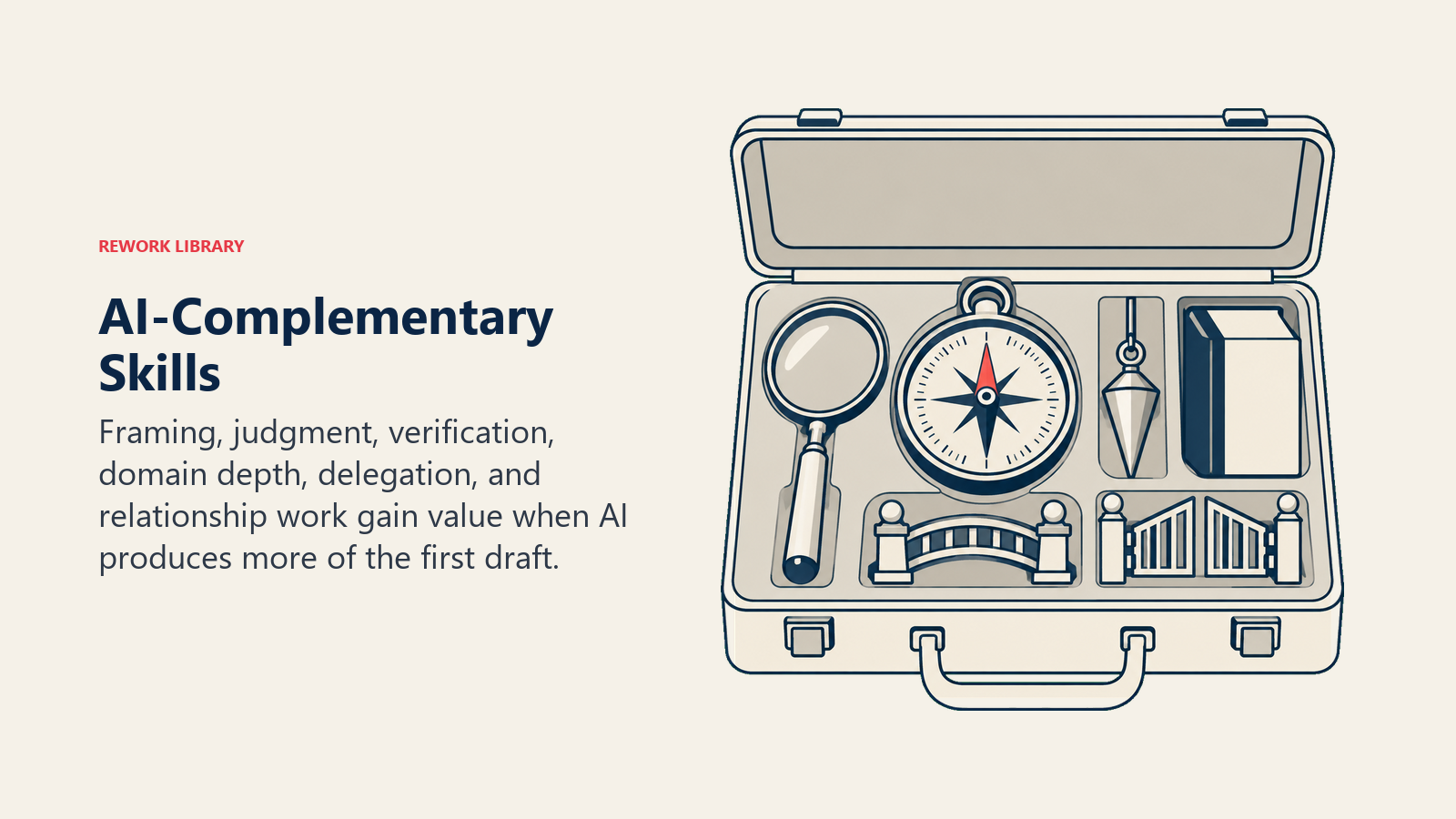
AI-complementary skills are the human capabilities that get more valuable, not less, as AI produces more of the first draft: framing the right problem before anyone starts generating answers, exercising judgment when the evidence is incomplete, verifying and catching a plausible-sounding wrong output, applying domain depth deep enough to know when something is off, setting context and delegating to AI agents the way you would to a new hire, and doing the relationship work that determines whether any of the above gets adopted.
"Soft skills matter more now" is true and also nearly useless as a hiring instruction. It doesn't tell a recruiter what to screen for, doesn't tell a manager what to develop in a team member, and doesn't distinguish a candidate who's genuinely good at judgment from one who's just confident. This article tries to be more specific: what these skills actually look like in practice, what evidence says is changing, what to ask for when you're hiring, and one honest example of a skill that got hyped as durable and isn't (prompt engineering).
Key Facts
- Analytical thinking is the single most in-demand core skill for employers in 2025, with roughly seven in ten companies naming it essential, while AI and big data top the list of fastest-growing skills employers expect to need through 2030. Source: World Economic Forum, Future of Jobs Report 2025
- Employers expect 39% of the core skills required in the job market to change by 2030, evidence that the skill set itself is shifting, not disappearing into a single "AI skills" bucket. Source: World Economic Forum, Future of Jobs Report 2025
- Asked which human skills matter most as AI takes on more of the work, workers ranked quality control of AI output first (50%) and critical thinking, reasoning through information and forming a judgment, second (46%). Source: Microsoft Work Trend Index 2026
- 86% of workers say they treat AI output as a starting point, not a finished answer, and that they remain responsible for the thinking behind it, the closest thing to a working verification norm the data shows today. Source: Microsoft Work Trend Index 2026
- LinkedIn's 2026 Skills on the Rise data shows technical AI skills and relationship-driven human skills (cross-functional collaboration, leadership, executive communication) accelerating in demand at close to the same pace, not one replacing the other. Source: LinkedIn, Skills on the Rise 2026
- A 2024/2025 Stanford RegLab study found that leading commercial legal AI research tools, marketed as hallucination-free, still fabricated or mischaracterized citations in 17% to 33% of tested queries, a concrete reminder that domain depth is what catches an error a generalist would miss. Source: Stanford RegLab, "Hallucination-Free? Assessing the Reliability of Leading AI Legal Research Tools"
- A 2026 randomized study of 1,339 Greek teachers found they were significantly more likely to accept an unfairly harsh grade when told it came from an algorithm than when told an identical harsh grade came from a human colleague, widening the resulting fairness gap by about 22%, evidence that even trained professionals show automation bias toward AI-labeled output. Source: PNAS Nexus, Goulas, Megalokonomou & Sotirakopoulos, 2026
The Skills That Actually Hold Up
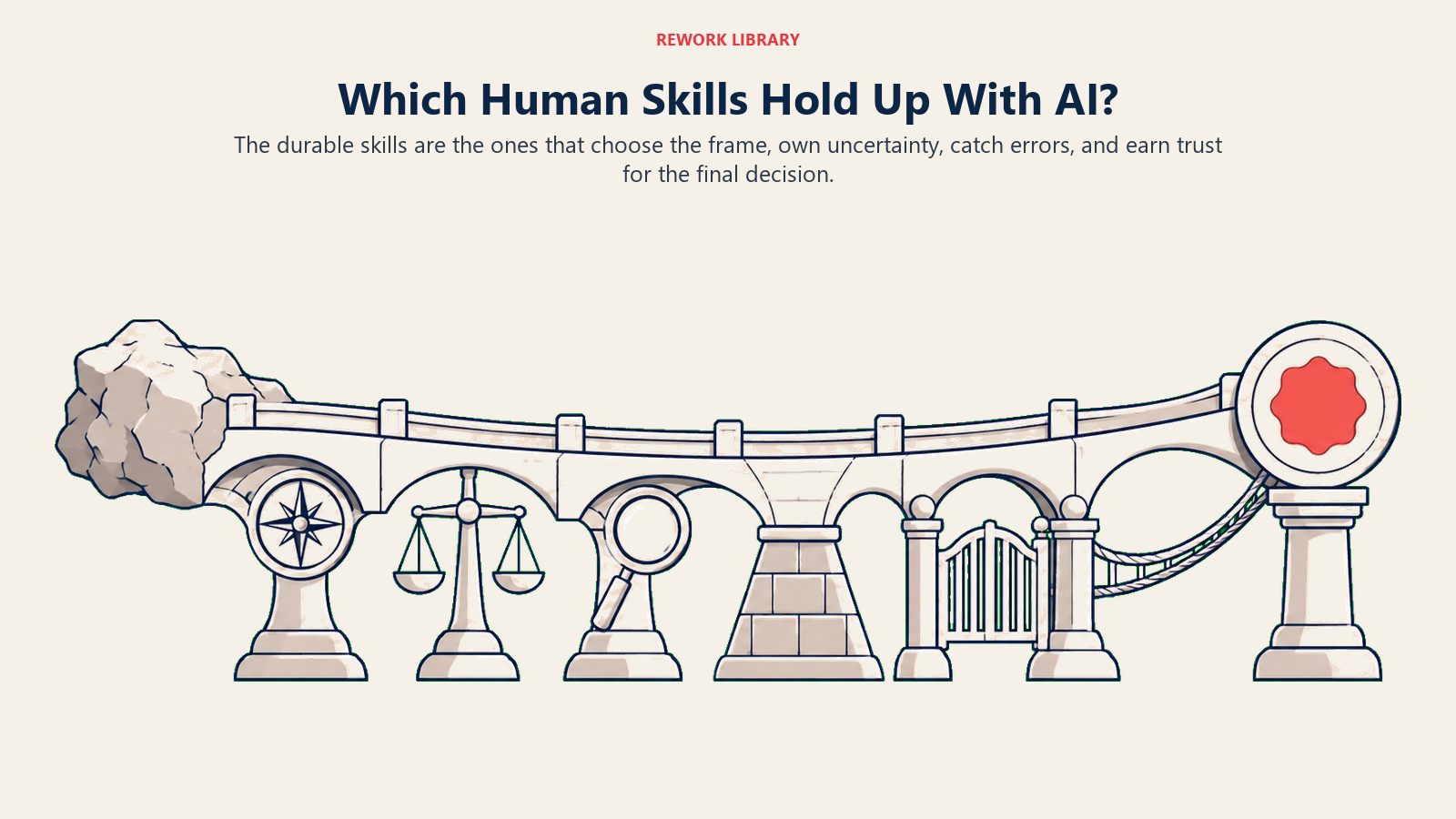
These six show up across the evidence above in different forms. None of them are new virtues invented for the AI era. What's new is how much more they're worth now that generating a plausible-looking first draft is cheap.
Problem Framing: Deciding What Question to Get Answered
AI is very good at producing an answer to the question you asked. It's much worse at telling you that you asked the wrong question. Someone asks an AI system to "reduce churn" and gets a list of retention tactics, when the real problem was a mispriced tier that should never have been sold to that segment in the first place. The model answered faithfully; the person who framed the request pointed it at the wrong target.
This is why systems thinking is rising in value rather than falling. Framing well means understanding how a problem connects to the systems around it: what's upstream, what's a symptom versus a cause, and what a "good answer" would even need to include to be useful. AI can execute inside a frame. It can't reliably tell you the frame is wrong, because it has no independent way of knowing what you actually meant to solve.
Judgment Under Uncertainty: Deciding When the Evidence Isn't Clean
AI models are confident by default. They will produce a fluent, well-structured answer whether the underlying evidence is strong, thin, or contradictory, and the fluency of the output carries no signal about which one it is. A forecast built on three months of noisy data reads exactly as polished as one built on three years of stable trend.
Decision-making under genuine uncertainty, where the honest answer is "we don't fully know, and here's how I'm weighing that," is a distinct skill from decision-making when the data is clean. It's also one of the two skills workers rank highest as AI takes on more execution, according to Microsoft's 2026 Work Trend Index cited above. The person who can say "this recommendation assumes X, and X is shaky" is doing work an AI system structurally can't do for itself, because it doesn't know what it doesn't know.
Verification and Error Detection: Catching the Plausible Wrong Answer
This is the skill most directly implied by "AI does more of the execution": someone has to check the execution. But checking is not the same as skimming. The Stanford RegLab study in the Key Facts box found legal AI tools marketed as hallucination-free still fabricated or garbled citations in 17% to 33% of tested queries. Those errors weren't obviously wrong. They were plausible enough to pass a quick read, which is exactly why they made it into filings before anyone caught them.
Human-in-the-loop review only works if the human in the loop is actually positioned to catch the specific kind of mistake the AI hallucination is likely to produce, not just glance at formatting and tone. That distinction, between review that catches errors and review that just adds a delay, is the whole difference between this skill being real and being theater.
Domain Depth: Why Expertise Is What Lets You Catch the Error
Verification only works if you know enough to recognize wrong. A generalist reading an AI-generated contract clause, financial model, or clinical summary can check that it's internally consistent and well-written. Only someone with real depth in that domain can catch the clause that's consistent, well-written, and still wrong, because the error lives in domain knowledge the model got subtly incorrect, not in the surface presentation.
This is the strongest argument against the idea that AI flattens the value of expertise. It does the opposite for the specific slice of expertise that's about pattern-matching against "does this look right in the real world," as opposed to the slice that was mostly about typing speed or recall of things you could look up anyway. Business acumen, built over years of seeing how a specific industry or function actually behaves, is what tells you the AI-generated projection is off by an order of magnitude before it reaches a client. For a lot of specialists, that depth was also part of how they thought of themselves at work, which is why meaning, identity, and craft in the AI era treats losing the chance to build it as more than a skills gap.
Context-Setting and Delegation: Managing Agents Like You'd Manage a New Hire
As AI systems move from answering single questions to acting on AI agents that plan and execute multi-step work, a new skill becomes load-bearing: setting the boundaries, goals, and escalation rules before the work starts, because you often aren't in the room while the agent is doing it. That's a delegation skill, not a prompting skill. It's closer to writing a job description and a set of guardrails for a new employee than to phrasing a search query well.
Companies already running human-agent teams are finding that the quality of the outcome depends heavily on how well someone set the initial scope, what the agent is allowed to decide on its own, and when it's required to check back in. Get that wrong and you either bottleneck the agent on trivial approvals or let it run unsupervised into a mistake nobody catches until it's expensive.
Relationship Work: What Determines Whether Any of This Gets Adopted
None of the first five skills matter if nobody trusts the person applying them, or the recommendation dies in a meeting because it wasn't delivered in a way stakeholders could act on. Relationship building, the ability to earn trust, read a room, and negotiate buy-in across functions, was never something AI threatened to replace, and the shift toward more AI-generated output has made it more visible, not less. Someone has to be the person a skeptical VP believes when they say "I checked this, and it's right." That trust is earned over time, in person, and it doesn't transfer to a model, which is exactly the logic behind the human premium: some touchpoints stay staffed by a person because the evidence says a human wins there, not out of habit.
There's also a quieter version of this at play: research on trust when your teammate is AI shows that people extend or withhold trust in AI-touched work partly based on who's vouching for it. The relationship skill and the verification skill reinforce each other. Verification without the credibility to be believed doesn't change a decision.
What Doesn't Hold Up: Prompt Engineering as a Case Study
Prompt engineering is worth naming honestly because it's the clearest example of a skill that got sold as a durable career bet and turned out to be a transitional one. In early 2023, learning to phrase instructions carefully for a language model looked like a genuinely scarce, well-compensated specialty. By 2026, that specific skill, crafting exact wording to compensate for a model's literal-mindedness, has largely folded into other roles rather than surviving as its own job title. The underlying reason is straightforward: as models got better at handling plain, imprecise instructions and asking clarifying questions themselves, the value of being a specialist "translator" between humans and models shrank. What remains useful, understanding what an AI system needs to do a task well, structuring context, giving it the right examples, isn't gone. It just stopped being a standalone job and became a baseline expectation folded into roles like AI product management, applied AI engineering, and domain specialist positions that use AI heavily.
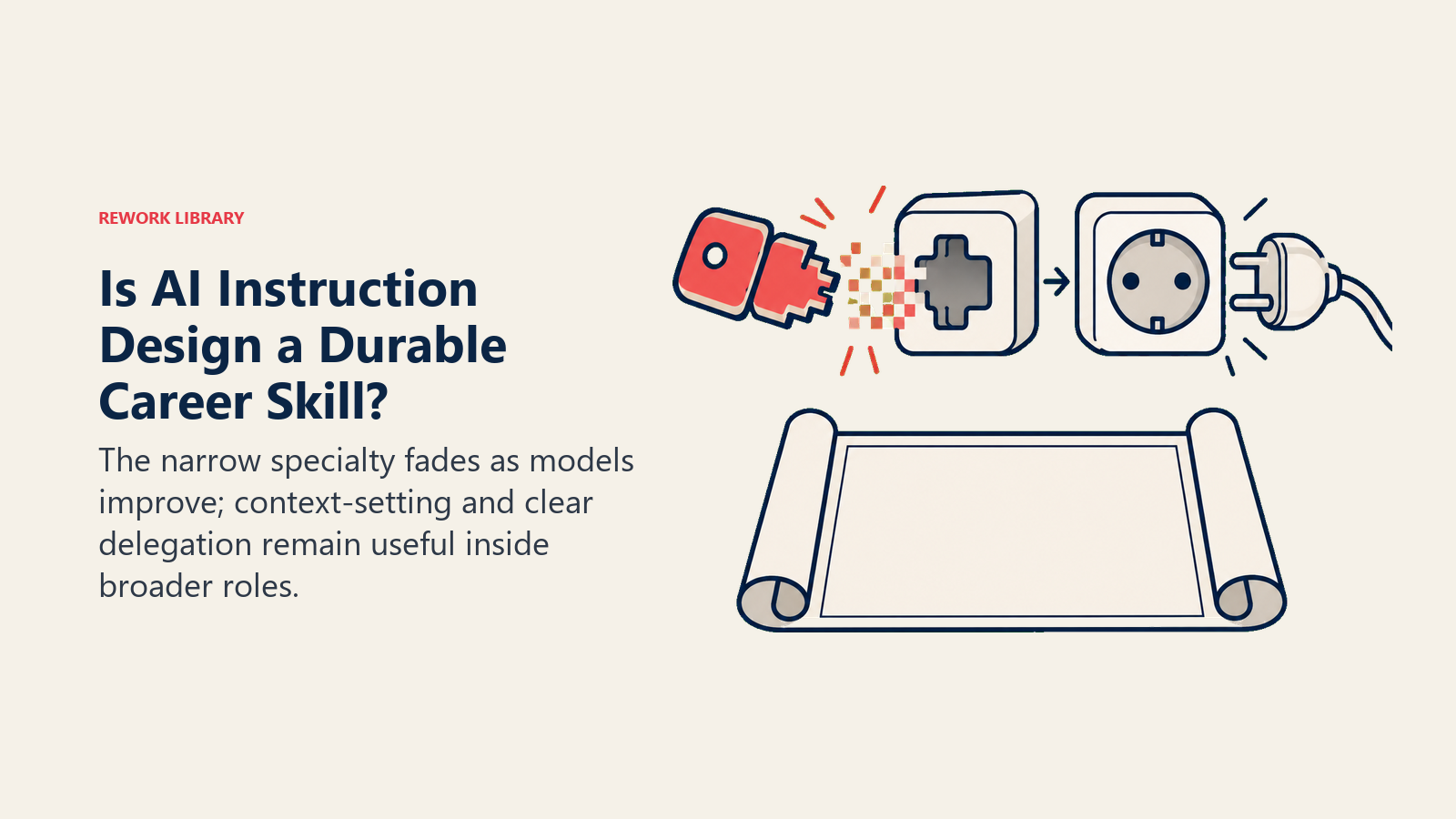
The lesson generalizes past prompt engineering itself: any skill whose entire value depends on compensating for a specific, current limitation of AI tooling is at risk the moment that limitation gets engineered away. That's a useful filter for evaluating the next "essential AI skill" claim that shows up in a job posting. Ask whether the skill would still matter if the underlying model got dramatically better at the thing the skill compensates for. Problem framing, judgment, verification, domain depth, delegation, and relationship work all pass that test. A narrow tooling workaround usually doesn't.
Skill, Value Driver, and Hiring Signal
| Skill | Why AI raises its value | How to assess it in hiring |
|---|---|---|
| Problem framing | AI executes inside whatever frame it's given but can't validate that the frame is right | Give a vague, underspecified business problem and see if the candidate asks what the real goal is before proposing a solution |
| Judgment under uncertainty | AI output looks equally confident whether the underlying evidence is strong or thin | Ask about a past decision made with incomplete data; listen for how they describe what they didn't know, not just what they decided |
| Verification and error detection | Errors from AI are often fluent and plausible, not obviously wrong | Show a work sample with a subtle, domain-specific error planted in it and see if they catch it, not just proofread it |
| Domain depth | Only real expertise catches an error that's internally consistent but factually wrong | Ask a scenario question that has a "textbook right" answer and a "actually right in practice" answer, and see which one they give |
| Context-setting and delegation | Agents act on the boundaries a person set before the work started, not in real time | Have them write scope and escalation rules for a hypothetical delegated task, human or AI, and check for specificity |
| Relationship work | Verified, well-framed work still needs to be trusted and adopted by stakeholders | Ask how they've changed a skeptical stakeholder's mind, and probe for the actual mechanism, not just the outcome |
What to Actually Ask for in Hiring
Job descriptions that list "strong communication skills" and "comfortable with AI tools" screen for almost nothing. A better approach is to ask for evidence tied to the specific skill, using real work rather than self-description.
Questions That Actually Test for This
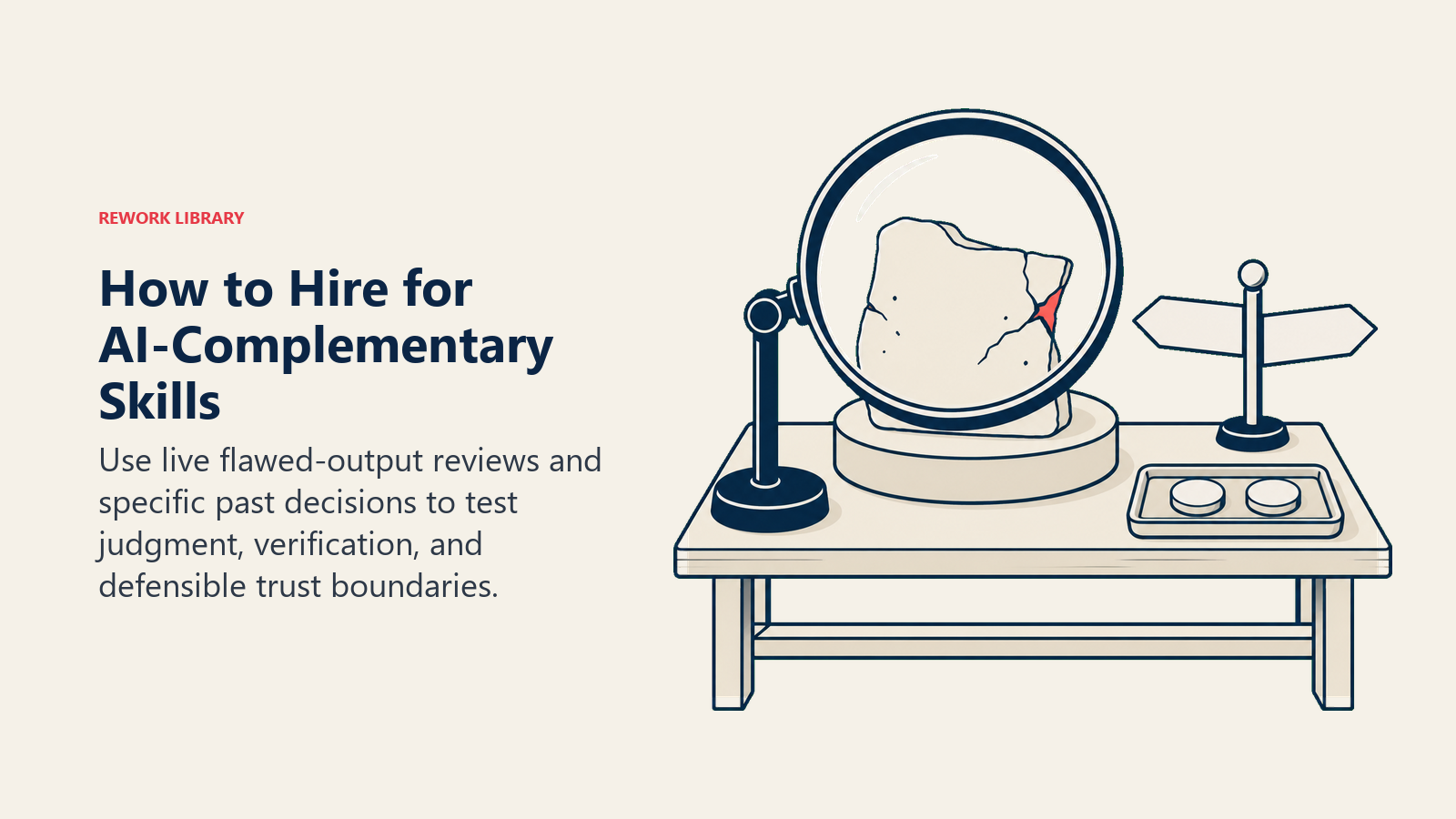
Instead of "are you good at critical thinking," ask a candidate to walk through a time they disagreed with a recommendation, AI-generated or not, and had to decide whether to override it. Instead of "how comfortable are you with AI," ask them to review a flawed AI-generated output live and talk through what they'd check first and why. Instead of "do you have leadership skills," ask about a specific instance where they had to get a skeptical audience to act on something they knew was correct.
The pattern across all of these: past behavior with specifics beats a self-rating, and a live exercise beats a past-behavior question whenever you can arrange one, because it's much harder to fake competent verification in the room than to describe it convincingly afterward.
What a Good Answer Sounds Like Versus a Rehearsed One
A rehearsed answer to "how do you use AI" sounds like a features list: which tools, which prompts, which shortcuts. A genuine answer sounds like a decision process: what they generate with AI, what they never trust without a second look, and specifically why that boundary sits where it does for their kind of work. The second answer reveals critical thinking in a way the first doesn't, because it shows the candidate has actually thought about where their own judgment adds value versus where it's redundant.
AI literacy as a hiring signal isn't "have they used ChatGPT." It's whether they can articulate, specifically, where they'd trust an AI system's output unreviewed and where they wouldn't, for the actual work they'd be doing. Vague enthusiasm and vague suspicion are both weaker signals than a specific, defensible boundary.
Building These Skills on a Team You Already Have
Most organizations aren't hiring fresh for every one of these skills; they're trying to develop them in people already on the team. The practical version of that work usually starts with making verification a named, visible part of a role rather than an assumed background task. If nobody's job explicitly includes "catch the AI's mistakes in this workflow," it tends not to happen reliably, because it competes with faster, more visible work.
It also means giving people the domain reps that build the pattern-matching described earlier. Someone can't develop the instinct for "this AI-generated number looks off" without enough exposure to what right looks like first, which argues against handing the most execution-heavy, least judgment-heavy work entirely to AI while junior staff never build the base of experience they'd need to supervise it later. That tradeoff, between speed today and expertise five years from now, is one leaders should make on purpose rather than by default.
On the operational side, this is also where workforce data earns its keep. Rework's People app exists partly for this: pairing skills and competency tracking with the workflow data that shows who's actually building judgment on the job, not just who completed a training module. It's a small piece of a much bigger question, but it's a useful place to start if you don't currently have a clear view of who on your team has the skills this article describes.
None of this argues that AI is making people less capable. It's redrawing which capabilities carry the weight. A team that spent the last decade optimizing for who could produce the most output the fastest now needs to optimize for who can frame the right problem, hold a defensible judgment call, and catch the mistake nobody else in the room would have spotted. That's a harder thing to screen for than typing speed ever was, which is exactly why the organizations that get good at it early will be operating with a real, compounding advantage over the ones still writing job descriptions for a workforce that doesn't exist anymore.

Co-Founder, Rework.com
On this page
- Key Facts
- The Skills That Actually Hold Up
- Problem Framing: Deciding What Question to Get Answered
- Judgment Under Uncertainty: Deciding When the Evidence Isn't Clean
- Verification and Error Detection: Catching the Plausible Wrong Answer
- Domain Depth: Why Expertise Is What Lets You Catch the Error
- Context-Setting and Delegation: Managing Agents Like You'd Manage a New Hire
- Relationship Work: What Determines Whether Any of This Gets Adopted
- What Doesn't Hold Up: Prompt Engineering as a Case Study
- Skill, Value Driver, and Hiring Signal
- What to Actually Ask for in Hiring
- Questions That Actually Test for This
- What a Good Answer Sounds Like Versus a Rehearsed One
- Building These Skills on a Team You Already Have