Keeping Human Judgment Sharp: The De-Skilling Paradox of AI at Work
Turn this article into takeaways for your work.


Each assistant summarizes the article only for you and suggests best practices for your work.
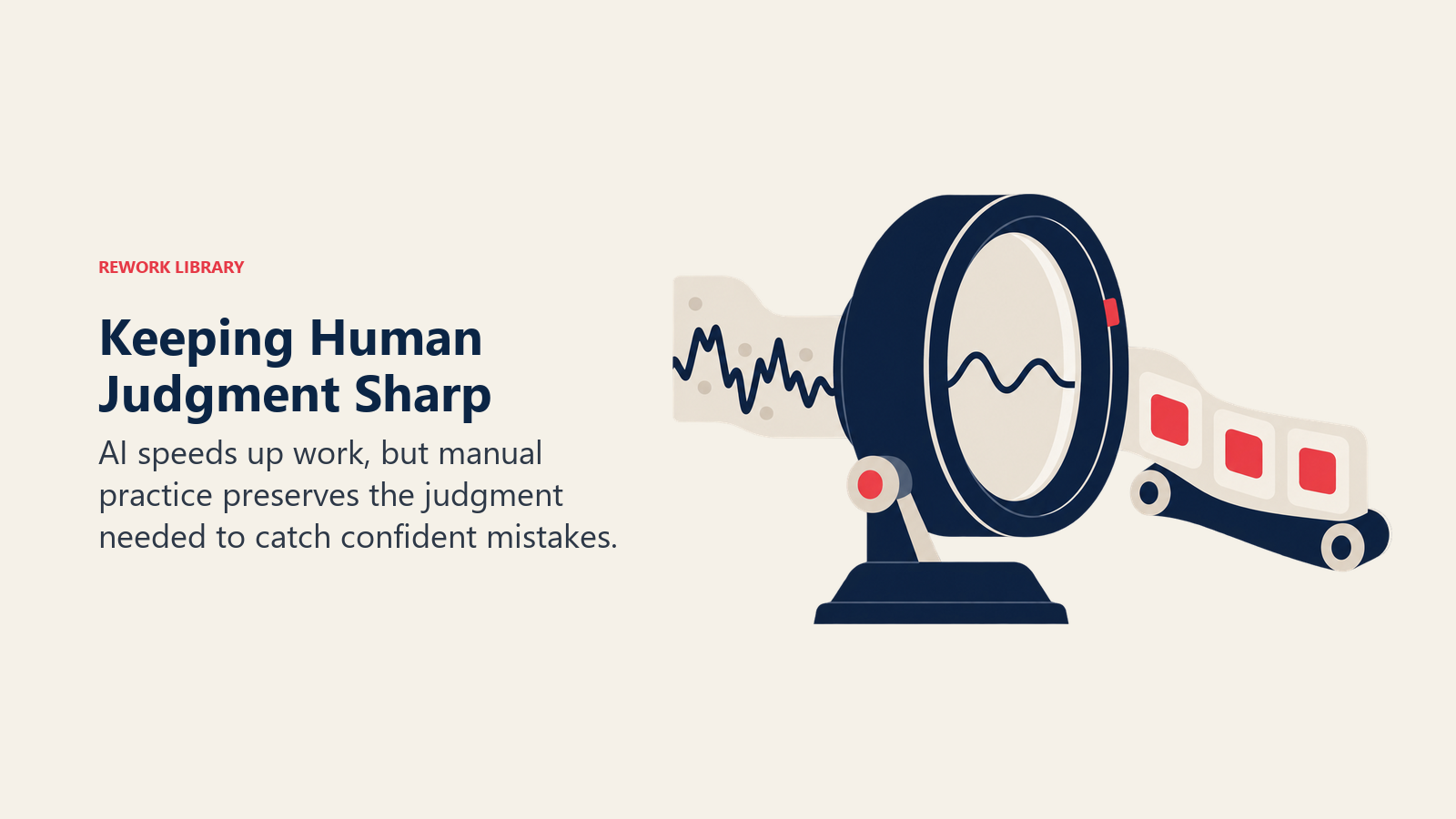
The de-skilling paradox is this: the more a team offloads thinking to AI, the weaker its judgment gets at exactly the skill it now needs most, catching AI when it is wrong. Verification, the ability to spot a plausible-sounding error, depends on the same mental muscle that generating the work from scratch used to build. Delegate the generation and skip the practice, and the muscle atrophies while the job that requires it (checking the machine) stays firmly on the human side of the desk.
This is not a prediction. It is a pattern with decades of evidence behind it in aviation, in navigation, and now in early research on knowledge work itself. None of that evidence says AI makes people permanently worse thinkers. It says a specific, well-documented mechanism kicks in whenever a task moves from "I do this" to "a system does this and I check it," and that mechanism is manageable once you know it exists.
Key Facts
- Automation bias has two failure modes, and training only fixes one of them. Skitka, Mosier, and Burdick's original studies found people commit omission errors (missing something the automation didn't flag) and commission errors (following automation advice even when other evidence contradicts it), and that awareness training reduced commission errors but not omission errors. Does Automation Bias Decision-Making? (Skitka, Mosier & Burdick)
- MIT Media Lab's "Your Brain on ChatGPT" found weaker brain connectivity in the LLM-assisted writing group, but it is a small, non-peer-reviewed preprint. 54 participants, EEG-measured cognitive engagement was lowest in the group using an LLM to write essays and highest in the brain-only group. The authors themselves flag the sample size and lack of peer review as real limits. MIT Media Lab, "Your Brain on ChatGPT"
- Higher confidence in AI predicts less reported critical thinking, in a Microsoft Research and Carnegie Mellon survey of 319 knowledge workers. The more people trusted AI to handle a task well, the less critical scrutiny they said they applied to its output, while confidence in their own ability moved the opposite direction. Microsoft Research, "The Impact of Generative AI on Critical Thinking"
- Heavier lifetime GPS use predicts worse spatial memory when navigating without it. A McGill University study of 50 regular drivers found this relationship, and a three-year follow-up on a subset showed that increased GPS use since the first test tracked with a steeper decline in hippocampus-dependent spatial memory, not the reverse. Dahmani & Bohbot, Scientific Reports (Nature)
- Aviation regulators have spent over a decade building policy around manual-flying skill loss. The FAA's Flight Deck Automation Working Group and international bodies (ICAO, EASA) identified degraded manual flying skills and automation-response awareness as contributing factors in loss-of-control incidents, driving mandatory manual-flight and automation-failure training. FAA Air Carrier Training ARC report
The De-Skilling Paradox, Defined
Every profession has a version of the same rule: you learn to catch a bad answer by having produced enough good and bad answers yourself. A radiologist reads films for years before a glance tells them something is off. An editor develops a sense for a weak argument by writing hundreds of weak first drafts of their own. That pattern-matching sense is judgment, and it is built through repetition, not instruction. It is also, for a lot of people, the part of the job that felt like craft rather than labor, which is why losing the repetition costs more than a skill; meaning, identity, and craft in the AI era covers that second, less-measured loss.
AI changes the economics of that repetition. Why write the first draft, run the numbers by hand, or read the full contract when a model will do it in ten seconds? For any single task, skipping the manual rep is the obviously efficient choice. But judgment is a compounding asset built from thousands of individually small reps, and skipping the rep is also skipping the deposit. Do that consistently across a team, a role, or a career stage, and the accumulated judgment that used to make experienced people valuable stops accumulating.
The paradox is the double bind this creates. AI is most useful precisely on the tasks that are tedious or slow to do manually, which are also the tasks that build the judgment needed to check AI's work. The team that leans hardest on AI improves its output speed today while quietly degrading its capacity to catch tomorrow's mistake. Neither effect is visible in the moment. Speed shows up immediately; the judgment gap shows up months later, usually the first time the AI is confidently wrong about something that matters.
Automation Bias and Complacency: Why We Stop Checking
What Automation Bias Actually Does to a Decision
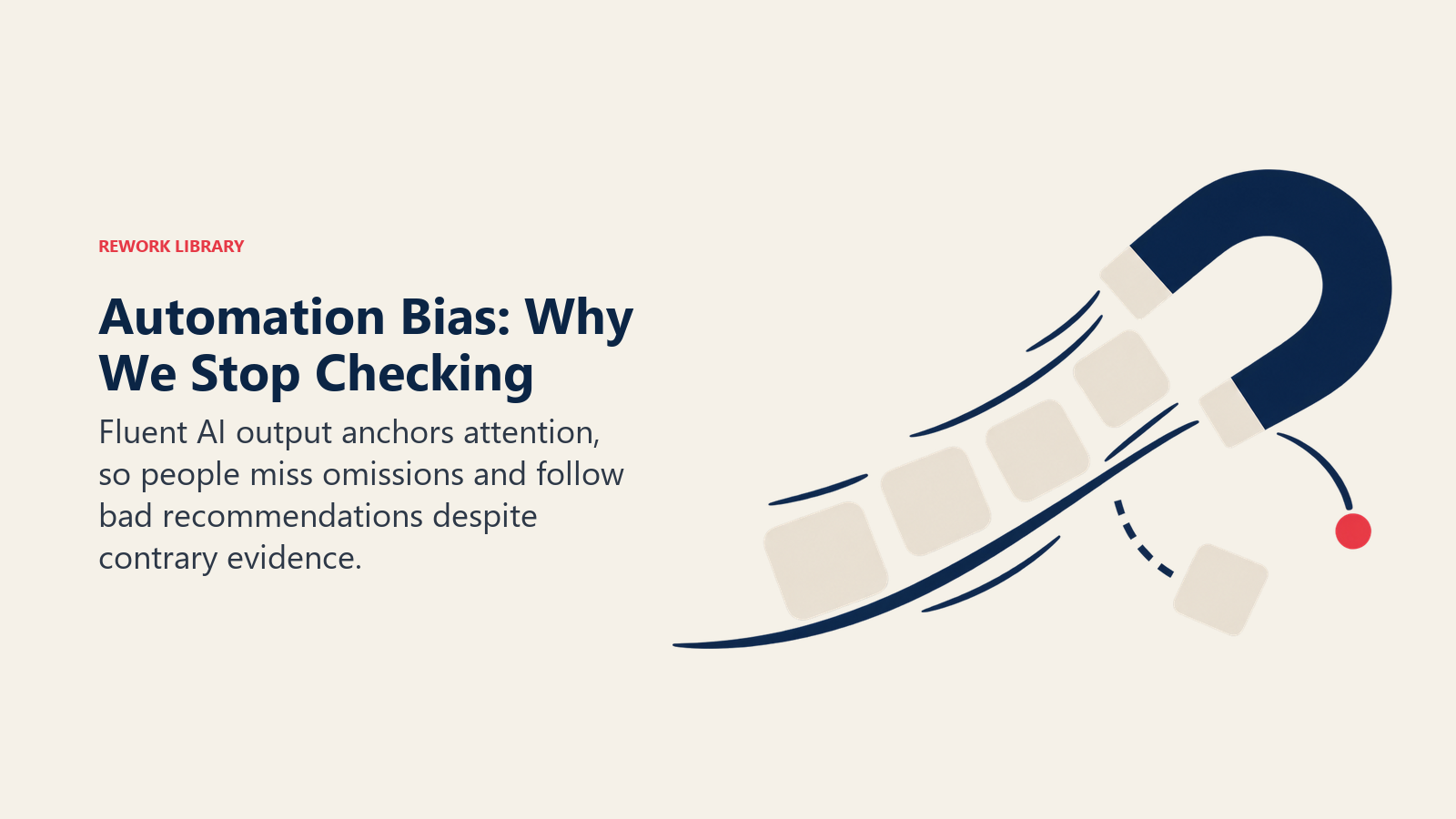
Automation bias is the well-documented tendency to treat an automated recommendation as a substitute for actively checking the evidence yourself, rather than as one more input to weigh. Linda Skitka, Kathleen Mosier, and Susan Burdick ran a series of studies putting participants in a simulated flight-monitoring task, some paired with a highly (but not perfectly) reliable automated aid and some without one. People without the aid caught more errors overall. People with the aid missed events it failed to flag (omission errors) and, more strikingly, sometimes followed its advice even when they had contradicting information sitting right in front of them (commission errors).
The unsettling part of their findings is that these errors persisted even after participants were explicitly told the aid was not perfectly reliable. Knowing intellectually that a system can be wrong does not reliably change behavior toward it. Only targeted training that specifically walked through automation-bias failure modes reduced commission errors, and even that training left omission errors largely untouched. Telling a team "remember, it can be wrong" is not, by itself, a fix.
Complacency Is the Default, Not the Exception
Complacency is the quieter cousin of automation bias: not actively trusting a wrong answer, just not looking closely enough to notice. It is the default state, not a lapse in an otherwise vigilant process, because vigilance is expensive and a fluent, confident-sounding AI answer gives the brain every signal it uses to decide something doesn't need a second look. This is the mechanism behind psychological safety in AI teams: that article covers whether people feel safe enough to voice doubt about an AI's output out loud. This one covers something upstream of that: whether they still have the sharpened judgment to notice there is something to doubt in the first place. A team can be maximally safe to speak up and still miss the error, if nobody on it has kept the pattern-matching skill that would have flagged it.
Cognitive Offloading and What It Costs
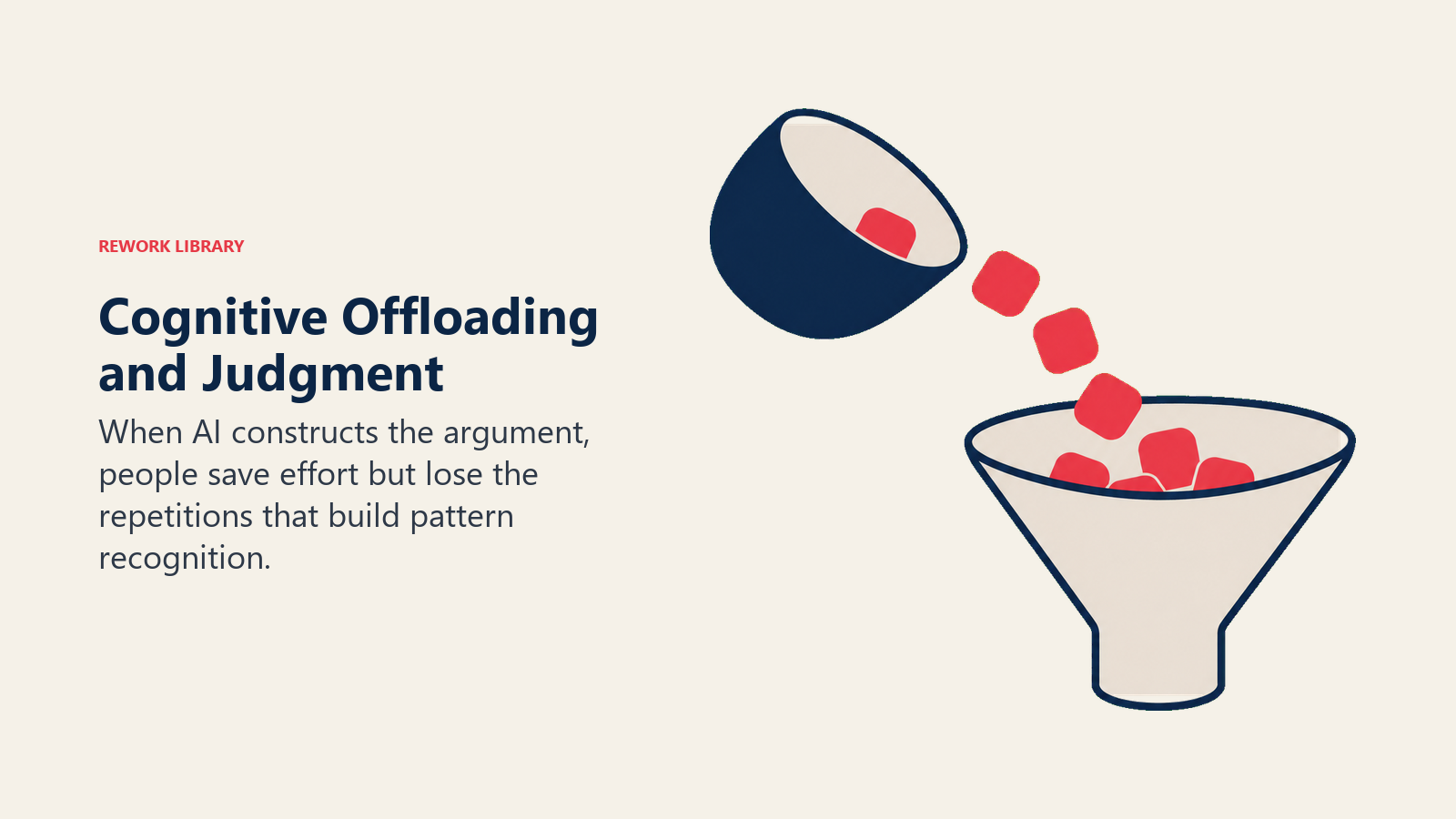
Cognitive offloading, handing a mental task to an external tool rather than doing it in your head, is not new and is not inherently bad. Writing things down, using a calculator, and looking up a fact are all offloading, and none of them destroyed literacy or arithmetic. What differs with generative AI is the scope: it offloads not just memory or computation but the actual construction of an argument, an analysis, or a decision, which is a much larger share of the thinking that builds judgment.
The MIT Media Lab Findings, and Their Real Limits
MIT Media Lab's widely shared "Your Brain on ChatGPT" study measured EEG brain connectivity in people writing essays with an LLM, with a search engine, or with no tool at all. The brain-only group showed the strongest, most distributed neural engagement; the LLM group showed the weakest. It is a genuinely interesting early signal, and it deserves to be reported honestly rather than oversold: 54 participants, a single essay-writing task, no peer review as of the version discussed here, and the authors themselves caution against treating the result as settled science. Read it as a hypothesis worth taking seriously, not as proof that AI use rewires the brain. The direction of the finding matters more than its statistical certainty at this stage: it lines up with a mechanism (less active construction, less active engagement) that shows up independently in the aviation and navigation research below.
The Microsoft and Carnegie Mellon Confidence Effect
More robust, because it surveyed real work rather than a lab task, is the Microsoft Research and Carnegie Mellon study of 319 knowledge workers describing 936 actual instances of using generative AI on the job. Its central finding: the more confidence someone had in the AI's ability to handle a task, the less critical thinking they reported applying to the result, while confidence in their own ability moved the opposite direction. The researchers also found that generative AI shifts what critical thinking looks like, from generating an answer to verifying, integrating, and stewarding one, and that people skip that new verification step most often when they lack the skill to actually inspect and improve what the AI produced. That last point is the paradox in a single sentence: the people least equipped to catch an AI error are often the ones who have offloaded the most work that would have built the skill to catch it.
Two Precedents We Already Have Evidence For
Knowledge work is new to this problem. Two other domains are not, and both have decades of measured data on what happens when a skill is handed to automation and stops being practiced.
Aviation: What Happens When Pilots Stop Hand-Flying
Modern airliners can fly nearly the entire route on autopilot, and pilots often do exactly that to reduce workload and fuel burn. The tradeoff regulators eventually had to confront: manual flying and failure-recognition skills degrade when they are not exercised, and several serious incidents traced back in part to a flight crew that had not recently practiced the exact scenario the automation handed back to them at the worst possible moment. The FAA's Flight Deck Automation Working Group documented this pattern clearly enough that it reshaped training standards industry-wide, adding mandatory manual-flight segments and automation-failure drills specifically to keep the underlying skill from eroding. The fix was never "use less automation." It was "practice the skill on purpose, on a schedule, whether or not the job currently demands it."
GPS and the Quiet Erosion of Spatial Memory
Navigation offers a cleaner, longer-running natural experiment because millions of people have been running it for two decades. A McGill University study measured spatial memory in regular drivers and found that people with more lifetime GPS experience performed worse on self-guided navigation tasks, the ones requiring an internal mental map rather than turn-by-turn instructions. A follow-up three years later on a smaller group found the direction of causation: people who increased their GPS use in the interim showed a steeper decline in hippocampus-dependent spatial memory, and this wasn't explained by them having a poor sense of direction to begin with that pushed them toward the tool. The mechanism is almost identical to what shows up in knowledge work: GPS turns navigation into following a stimulus-response instruction ("turn right in 200 meters") instead of building and updating an internal model of the route, so the skill that builds the internal model simply stops getting exercised.
Why This Hits Verification Hardest
Every countermeasure below exists because of one structural problem: verification is the exact skill this pattern erodes fastest, and it is also the one skill nobody can outsource to the AI itself. You cannot ask a model to reliably tell you when it is wrong; AI hallucination research is clear that a confident, fluent, wrong answer looks identical from the outside to a confident, fluent, correct one. The only thing standing between a plausible AI error and a costly decision is a human who still has the pattern-matching sharpness to notice something is off, and that sharpness is built by exactly the kind of manual repetition that AI adoption removes. Deciding to keep that sharpness in-house, on purpose, rather than assuming a model will eventually catch its own mistakes, is the same calculation the human premium covers for deciding which touchpoints stay human at all.
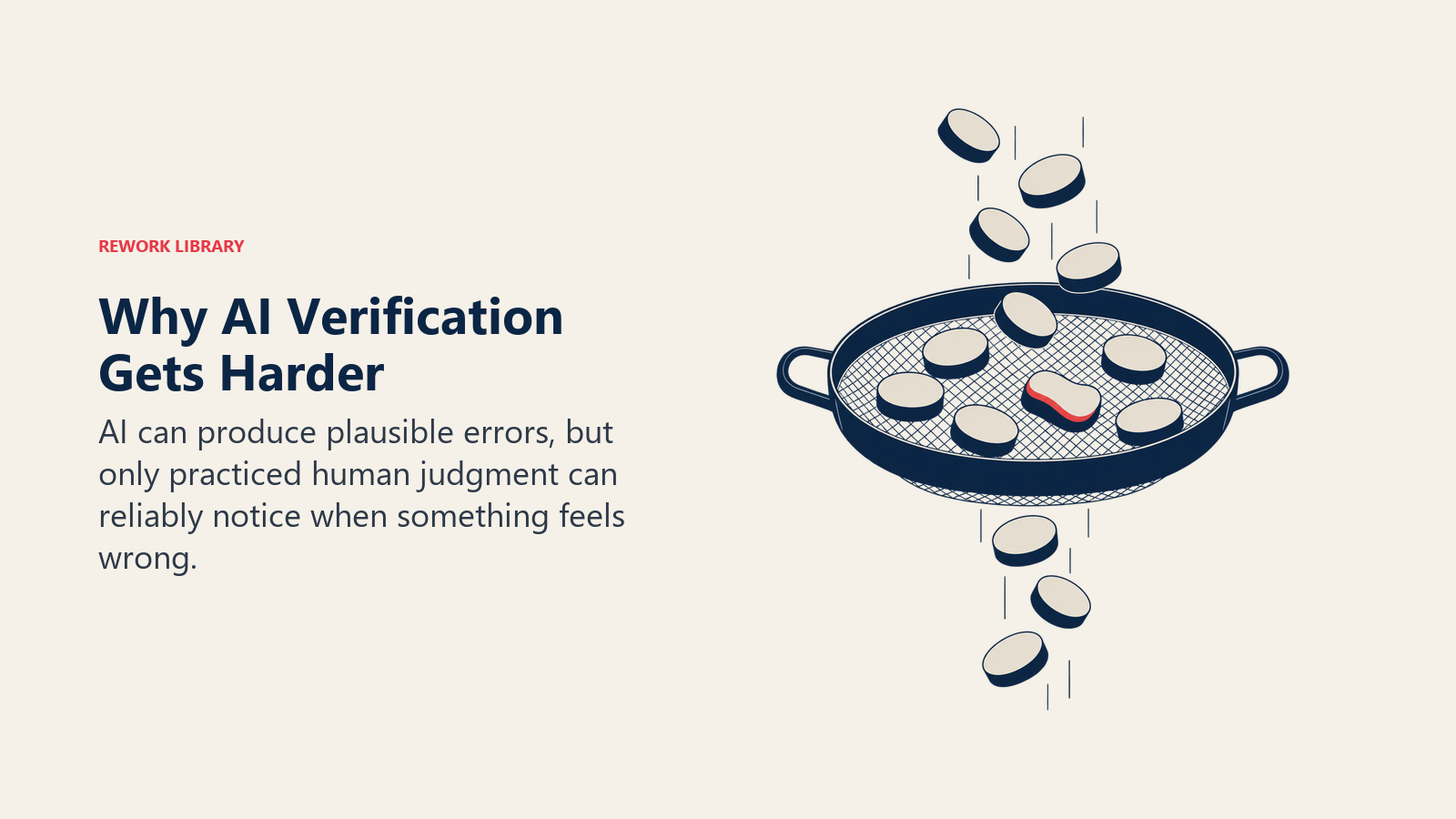
This is also where the paradox compounds across a team rather than staying an individual problem. When one person's judgment dulls, that is a personal risk. When a whole team's collective judgment dulls at the same time, on the same tasks, because everyone adopted the same AI workflow together, there is nobody left in the room with the sharpened instinct to catch what slipped through. That is a structural risk, and it is why human-agent teams need to think about skill maintenance as a team-level design question, not an individual habit.
| Capability at risk | How it erodes | Countermeasure |
|---|---|---|
| First-draft construction (writing, analysis, code) | Skipping the manual attempt removes the repetition that builds pattern recognition for what a wrong answer looks like | Deliberate manual practice on a fixed cadence, done even when AI could do the task faster |
| Error detection in someone else's (or the AI's) output | Automation bias and complacency make a fluent answer feel checked when it has only been skimmed | Blind-first review, where the human reaches an independent answer before seeing what the AI produced |
| Calibrated trust (knowing when to push back) | Confidence in the AI substitutes for confidence in your own judgment, per the Microsoft and CMU confidence-effect finding | Rotating the reviewer, so no one person's trust in a given AI workflow goes unquestioned for long |
| Domain intuition on the specific system or account | Complacency compounds when the same person always defers on the same recurring task | Red-teaming AI output on a schedule, treating adversarial checks as routine maintenance, not incident response |
| Judgment under ambiguity (cases the AI wasn't trained on) | Manual-flying-style skill loss: rarely-practiced judgment degrades fastest and fails exactly when the routine case turns into an edge case | Human-in-the-loop gates placed at genuine judgment points, not stamped on every output regardless of stakes |
Building Countermeasures That Actually Work
Deliberate Manual Practice
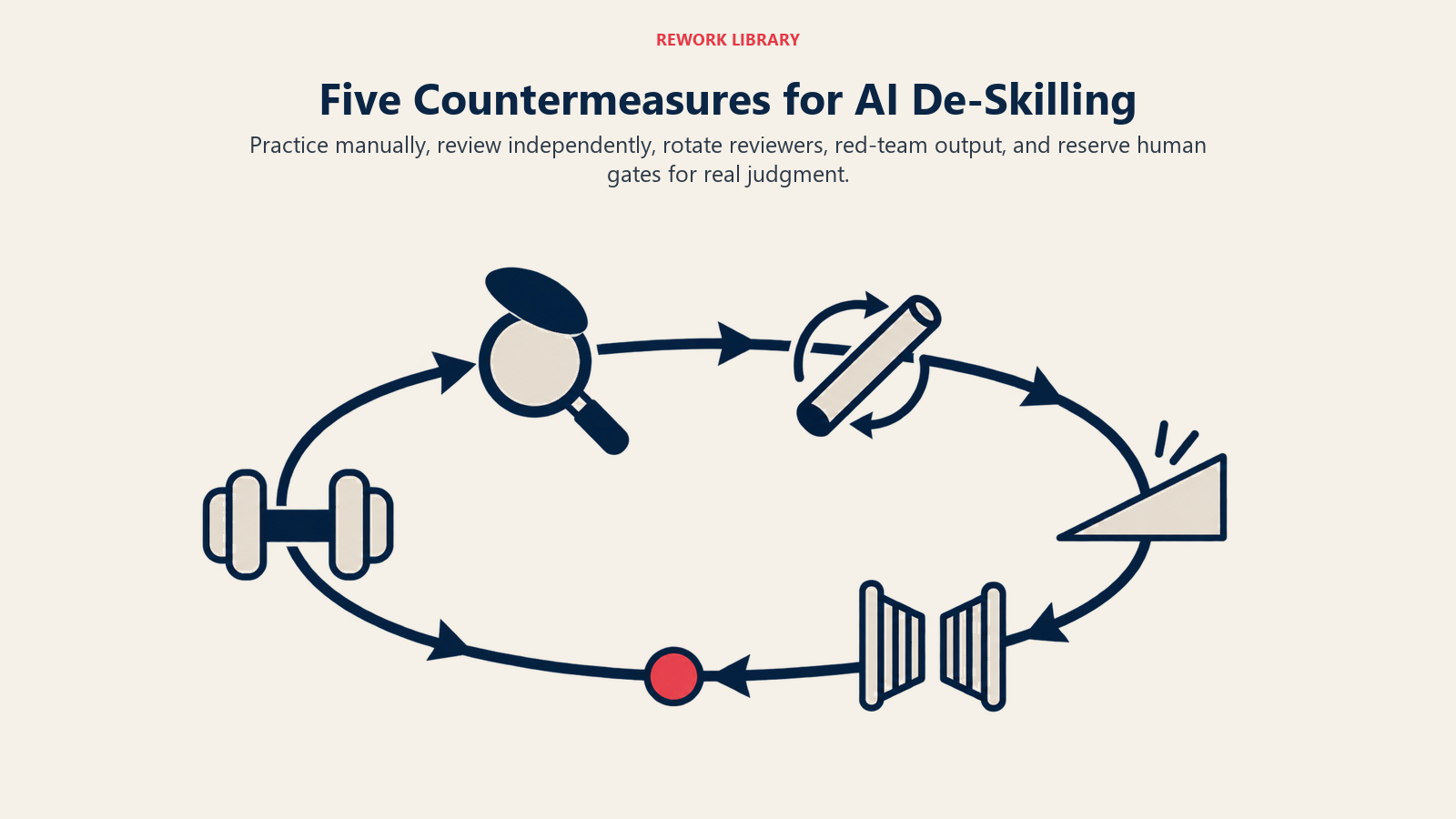
Aviation's fix generalizes cleanly: schedule manual reps on purpose, separate from whether the job needs them today. A finance team that lets AI build every model should still have analysts build a handful from scratch each quarter. A support team that lets AI draft every response should still have people write some unaided, specifically to keep the underlying skill from going quiet. The goal isn't nostalgia for doing things the slow way. It's keeping the pattern-recognition machinery warm enough to notice when the fast way produces something wrong.
Blind-First Review
The single highest-leverage habit against automation bias is sequencing: form your own view before you see the AI's. Read the contract clause, estimate the number, or sketch the argument first, then compare notes with what the model produced. Reversing that order, seeing the AI's answer and then trying to evaluate it, is exactly the setup Skitka and Mosier's research shows people are worst at, because a fluent answer anchors judgment before judgment gets a chance to form independently.
Rotating the Reviewer
Complacency deepens the longer the same person reviews the same AI workflow. Rotate who does the final check on a recurring AI-assisted process, even when the "expert" reviewer is technically more qualified. A fresh reviewer has not yet built the trust (or the blind spots) that come from months of the AI being right often enough to stop being questioned closely. This is a structural fix, not a training one, and it works precisely because it does not depend on any one person's willpower.
Red-Teaming AI Output as Routine, Not Incident Response
Treat adversarial testing of AI-generated work the same way security teams treat penetration testing: scheduled, not triggered only after something breaks. Pick a sample of AI output each cycle and deliberately try to break it, find the wrong assumption, the unsupported claim, the edge case it missed. Rework's red-teaming for AI agents covers the mechanics for agentic systems specifically, but the discipline applies just as well to a single AI-drafted memo or spreadsheet. The point is not to catch every error; it is to keep the muscle of skeptical scrutiny in active use so it is there when a real error shows up unscheduled.
Human-in-the-Loop for Judgment, Not Rubber-Stamping
Human-in-the-loop gates are only worth the friction they add if the human at the gate is actually exercising judgment rather than clicking approve. A gate placed on every single output, regardless of stakes, trains people to approve reflexively, the opposite of the intended effect. Reserve human approval points for decisions with real consequence, and pair each one with enough context that the reviewer has something to actually evaluate. Good AI agent guardrails and observability into what an agent actually did both help here, because a reviewer with visibility into the reasoning has more to check than one staring at a final answer with no trail behind it. Getting this gate wrong is also a culture problem: a team that punishes the person who flags an AI error will train everyone else to stop flagging, which quietly guts the entire point of having a human in the loop.
What Leaders Should Actually Do With This
None of this argues for using less AI. The teams with the sharpest judgment five years from now will be the ones that used AI heavily and treated skill maintenance as a deliberate, budgeted practice rather than an accident of whatever the tool happened to leave behind. Build manual practice into the calendar the way pilots build in recurrent training. Structure review so a human forms a view before seeing the machine's. Rotate the people doing that review. Schedule red-teaming instead of waiting for a failure to force it. And build trust in the AI itself that is calibrated to what it has actually earned, not to how confident and fluent it sounds. None of these are large investments individually. Skipped together, they add up to a team that can no longer tell when the machine is wrong, on the day that matters most.

Co-Founder, Rework.com
On this page
- Key Facts
- The De-Skilling Paradox, Defined
- Automation Bias and Complacency: Why We Stop Checking
- What Automation Bias Actually Does to a Decision
- Complacency Is the Default, Not the Exception
- Cognitive Offloading and What It Costs
- The MIT Media Lab Findings, and Their Real Limits
- The Microsoft and Carnegie Mellon Confidence Effect
- Two Precedents We Already Have Evidence For
- Aviation: What Happens When Pilots Stop Hand-Flying
- GPS and the Quiet Erosion of Spatial Memory
- Why This Hits Verification Hardest
- Building Countermeasures That Actually Work
- Deliberate Manual Practice
- Blind-First Review
- Rotating the Reviewer
- Red-Teaming AI Output as Routine, Not Incident Response
- Human-in-the-Loop for Judgment, Not Rubber-Stamping
- What Leaders Should Actually Do With This