What Is an AI Sales Operator? 4 Patterns Working Together

Turn this article into takeaways for your work.


Each assistant summarizes the article only for you and suggests best practices for your work.
Most sales teams using AI right now have the same problem: three to five tools that don't talk to each other.
Gong transcribes calls. HubSpot scores leads. ChatGPT drafts follow-up emails. Salesforce sends alerts when deals go quiet. Each tool does its job. None of them know what the others did. The rep sits in the middle, context-switching between systems, manually moving information from one place to the next, and losing three to four hours a day doing it.
That's not a tooling problem. That's an architecture problem.
The AI Sales Operator concept solves the architecture problem. It's not a product you buy. It's a role performed by AI: a specific configuration of four interconnected patterns that together handle the repetitive cognition of sales operations, so your reps can focus on judgment and relationships.
What the AI Sales Operator actually is
In the ACE Framework (Ingest, Analyze, Predict, Generate, Execute), AI agents sit at Level 3. A Level 3 agent is a job function performed by AI, built by stacking two to five Level 2 patterns on top of each other. The patterns are the building blocks. The agent is what you get when you wire them together.
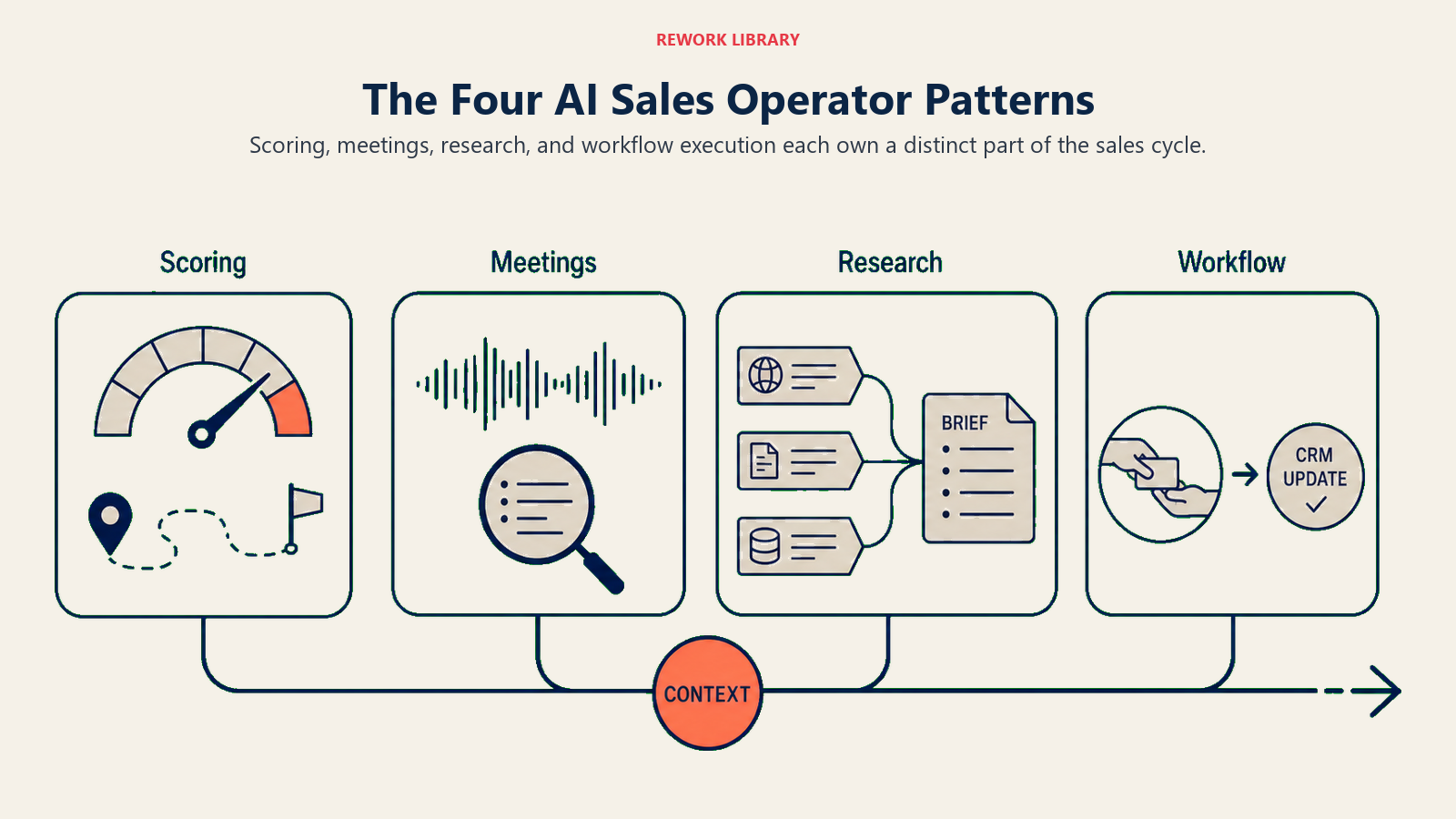
The AI Sales Operator is specifically defined as the Level 3 agent that serves sales operations. It stacks four patterns:
- Scoring+Routing: which leads and deals deserve attention right now
- Meeting Intelligence: what happened in calls and what should happen next
- Generative Research: what reps need to know before they touch an account
- Workflow Copilot: how tasks, reminders, and Customer Relationship Management (CRM) updates actually get done
Each pattern uses a specific subset of the five ACE capabilities. When you run all four in sequence, you get an operator that covers the full sales ops workflow, from lead arrival to closed-won.
This is different from having four separate tools. The patterns share context. The lead score from Scoring+Routing informs what the Generative Research pattern surfaces. The call transcript from Meeting Intelligence feeds into the Workflow Copilot's next-step drafts. The data flows in one direction through one architecture, not across four disconnected dashboards.
Key Facts: AI in Sales Operations
- Sales reps using AI save between 1 and 5 hours per week on research and administrative tasks, with 64% reporting productivity gains from automation (Cirrus Insight, 2025)
- McKinsey estimates gen AI could unlock $0.8 trillion to $1.2 trillion in productivity across sales and marketing alone
- Companies deploying AI sales agents report an average 317% annual ROI, with a typical payback period of 5.2 months (Utmost Agency, 2025)
The 4 patterns: what each one does
The AI Sales Operator is easier to understand as four reusable patterns that each own a different stage of sales execution.
Scoring+Routing
The Scoring and Routing Pattern uses Ingest, Analyze, and Predict to answer one question: which leads and deals deserve attention, and who should handle them?
It ingests CRM data, web behavior, firmographic signals, and historical conversion patterns. It analyzes which signals correlate with conversion in your specific market. It predicts a probability score for each lead, and routes high-priority leads to the right rep based on territory, segment, or capacity rules.
What makes this an AI pattern (not just a scoring rule) is the Predict layer. Rules-based scoring says "if title = VP and company size > 200, score = 80." That's static. AI scoring recalibrates as new deals close, detecting signal combinations that human-written rules never captured.
See the full deep-dive on AI lead scoring.
Meeting Intelligence
The Meeting Intelligence Pattern uses Ingest, Analyze, and Generate to handle everything that happens around sales calls.
It ingests audio and transcript data from calls. It analyzes for talk ratios, competitor mentions, objection patterns, next-step commitments, and deal risk signals. It generates summaries, action items, and CRM-ready call notes.
Gong is the most common implementation. Clari Copilot and Chorus (now ZoomInfo Sales) do similar work. Rework Sales AI has Meeting Intelligence built into the CRM, so summaries land directly in the deal record without a separate login.
The value isn't just saving reps from manual note-taking. It's the Analyze layer. A rep remembers the call roughly. Meeting Intelligence captures that a prospect said "we need to show ROI to the CFO by Q3" three minutes in, and flags it as a buying trigger to route to the Workflow Copilot. That's the difference between a transcript and intelligence.
Generative Research
The Generative Research Pattern uses Ingest, Analyze, and Generate to build the briefing a rep should read before contacting an account.
It ingests company news, LinkedIn activity, job postings, 10-K filings, product launches, and anything else publicly available about the target account. It analyzes what's relevant to the rep's specific product category. It generates a concise brief: what the company does, what changed recently, who the key stakeholders are, what the likely objections will be.
Salesforce Einstein and tools like Clay or Apollo's AI layer do this. Without it, reps either spend 20-30 minutes on manual research (which most don't do), or they walk into calls cold.
The 4-Pattern Sales Operator Stack
The 4-Pattern Sales Operator Stack is the canonical architecture for AI in sales operations: Scoring+Routing, Meeting Intelligence, Generative Research, and Workflow Copilot running in sequence and sharing context. Each pattern covers a distinct phase of the sales workflow, and the value compounds when all four are wired together because outputs from one pattern become inputs to the next. No single-pattern implementation achieves the same ROI as the full stack.
Workflow Copilot
The Workflow Copilot Pattern uses Generate and Execute to close the loop between insight and action.
It takes the outputs of the other three patterns, the lead score, the call summary, the account brief, and turns them into draft emails, task reminders, CRM field updates, deal stage changes, and Slack notifications. A rep reviews a draft, hits send, and moves on.
Execute is the capability that separates a Copilot from a dashboard. Dashboards show information. Copilot changes state. The CRM record updates. The sequence triggers. The calendar invite goes out. These are consequences, and that's precisely why a human stays in the review loop.
| Pattern | ACE Capabilities Used | Primary Output | Feeds Into |
|---|---|---|---|
| Scoring+Routing | Ingest, Analyze, Predict | Lead priority score + rep assignment | Generative Research, Workflow Copilot |
| Meeting Intelligence | Ingest, Analyze, Generate | Call summary + next steps | Workflow Copilot |
| Generative Research | Ingest, Analyze, Generate | Account brief | Rep preparation, Workflow Copilot |
| Workflow Copilot | Generate, Execute | Drafts, tasks, CRM updates | Rep review queue |
Sales teams that run all four patterns in a coordinated stack reduce administrative time per rep from roughly 40% of the workweek to 15-20%, according to Forrester benchmarks. That recaptured capacity is the primary driver behind the ROI numbers companies report in year one.
How all four patterns work together: a deal lifecycle
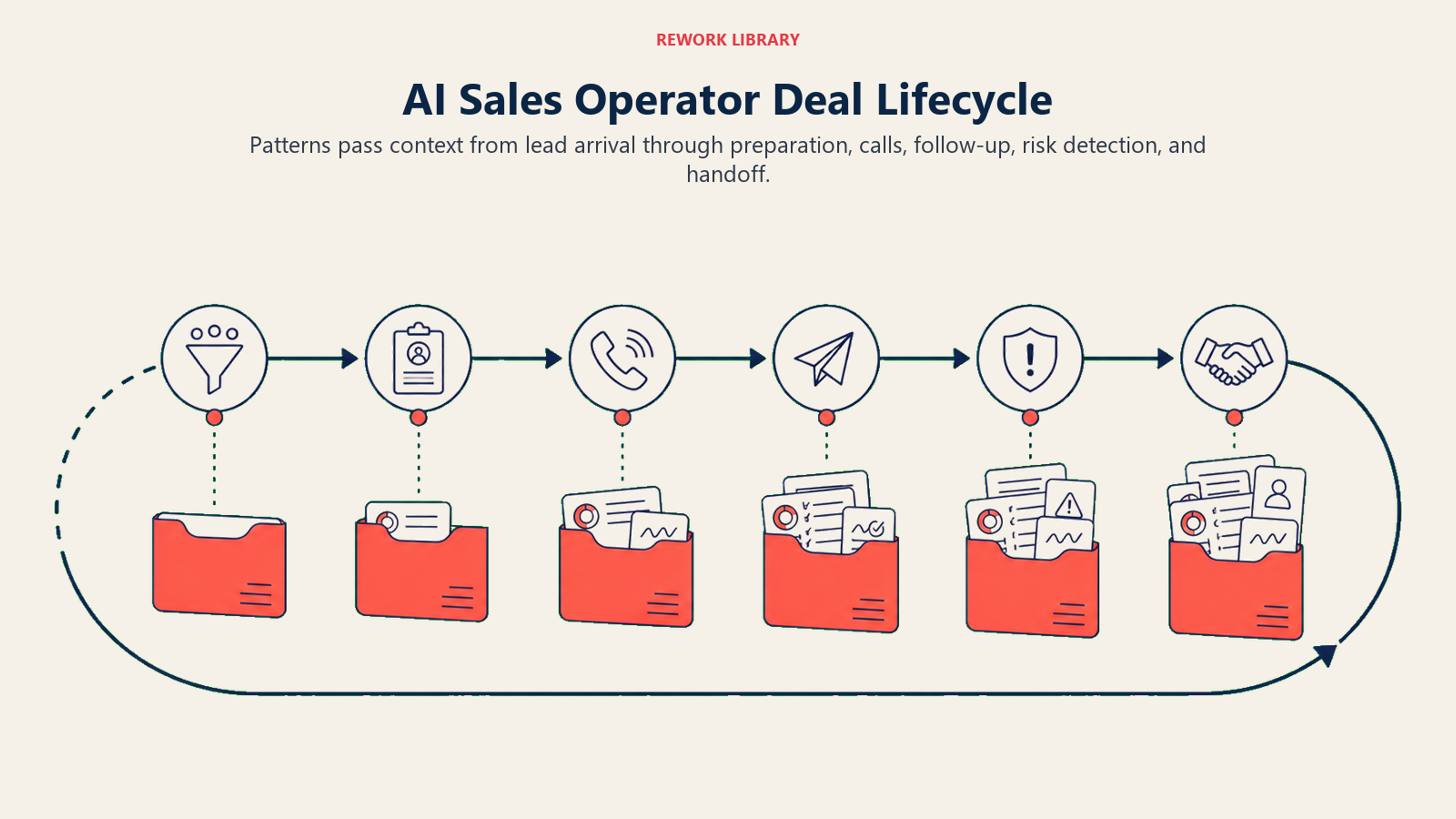
Here's what the AI Sales Operator looks like across a single deal, from first touch to closed-won.
Day 1: Lead arrives
A prospect fills out the demo request form at 9:14 AM on a Tuesday. Scoring+Routing immediately ingests the submission, cross-references it against CRM history, firmographic data (250-person B2B SaaS company, Series B, VP of Sales title), and behavioral signals (visited the pricing page twice last week). Predict assigns a 78% conversion probability. The lead routes to the enterprise team's senior rep, not the Sales Development Representative (SDR) queue. Notification lands in Slack within 90 seconds.
Day 1: Prep
Generative Research ingests the company's LinkedIn page, a recent TechCrunch article about their Series B, the rep's existing contact history, and the LinkedIn profiles of the VP of Sales and CRO. It generates a two-page brief: what the company does, their likely tech stack, recent hiring for a RevOps role (buying signal), and three probable objections based on similar accounts. The rep reads it in four minutes before the discovery call.
Day 3: Discovery call
The rep runs the discovery call. Meeting Intelligence ingests the audio, transcribes it in real time, and begins Analyze in the background. Twenty minutes after the call ends, the rep gets a summary: talk ratio (rep at 38%, good), three identified pain points (lead routing, CRM hygiene, forecasting accuracy), one competitor mention (HubSpot was brought up as an existing tool), and two next steps the prospect committed to ("send pricing by Thursday," "loop in CRO by end of month").
The summary auto-populates the CRM deal record. No manual note-taking.
Day 3: Follow-up
Workflow Copilot takes the call summary and drafts a follow-up email referencing the two specific pain points the prospect mentioned, attaches the pricing page, and creates a task: "Loop in CRO, due May 30." The rep reviews the draft, edits the second paragraph, and hits send. Total time: six minutes.
Week 3: Deal goes quiet
Scoring+Routing detects that the deal hasn't had activity in nine days and the close date is coming up. It downgrades the probability score from 78% to 52% and flags it as "at risk" in the pipeline dashboard. Workflow Copilot drafts a re-engagement message. Manager gets a Slack alert.
Week 5: Closed-won
The rep closes the deal. Meeting Intelligence captures the final call. Workflow Copilot generates the handoff brief for the customer success (CS) team: account background, what was promised, key stakeholders, implementation timeline. The CS team gets a complete picture from day one of onboarding.
From first touch to closed-won, the AI Sales Operator handled the research, the scoring, the note-taking, the follow-up drafts, the risk flagging, and the handoff. The rep handled the call, the relationship, and the judgment calls. The next question is who sets up this architecture.
Who operates the AI Sales Operator
The AI Sales Operator is not a tool that runs itself. It needs someone to configure it, calibrate it, and govern it.
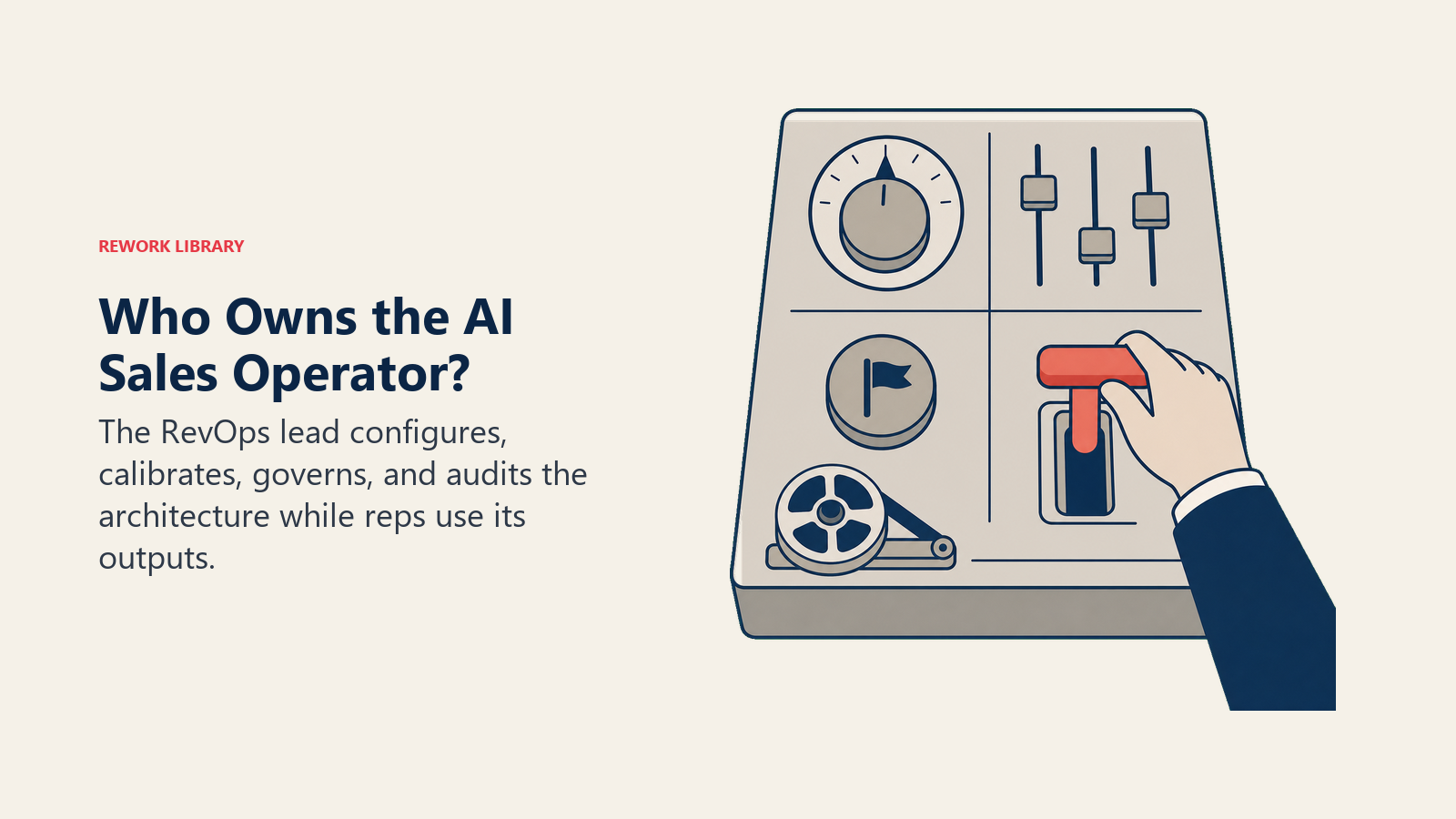
That person is typically the VP of Sales Operations or RevOps Lead.
Their job with the AI Sales Operator is to:
- Set the scoring model inputs and recalibrate it quarterly against actual conversion data
- Define routing rules (which rep gets which lead, under what conditions)
- Configure what Meeting Intelligence flags and how summaries get structured
- Decide which Workflow Copilot outputs go straight to reps vs. which need manager review
- Audit the Execute actions to catch errors before they damage relationships
Individual reps interact with the outputs. The RevOps lead owns the architecture. This distinction matters because AI agents amplify whatever rules and logic you put into them. A poorly configured Scoring+Routing model routes the wrong leads to the wrong reps at scale. A Workflow Copilot with bad templates sends hundreds of bad emails. The human operator sets the quality ceiling.
What it replaces, and what it doesn't
The AI Sales Operator handles repetitive cognition: tasks that are cognitive, follow a repeatable pattern, and don't require relationship-level judgment. Scoring a lead. Writing a meeting summary. Building an account brief. Sending a follow-up draft.
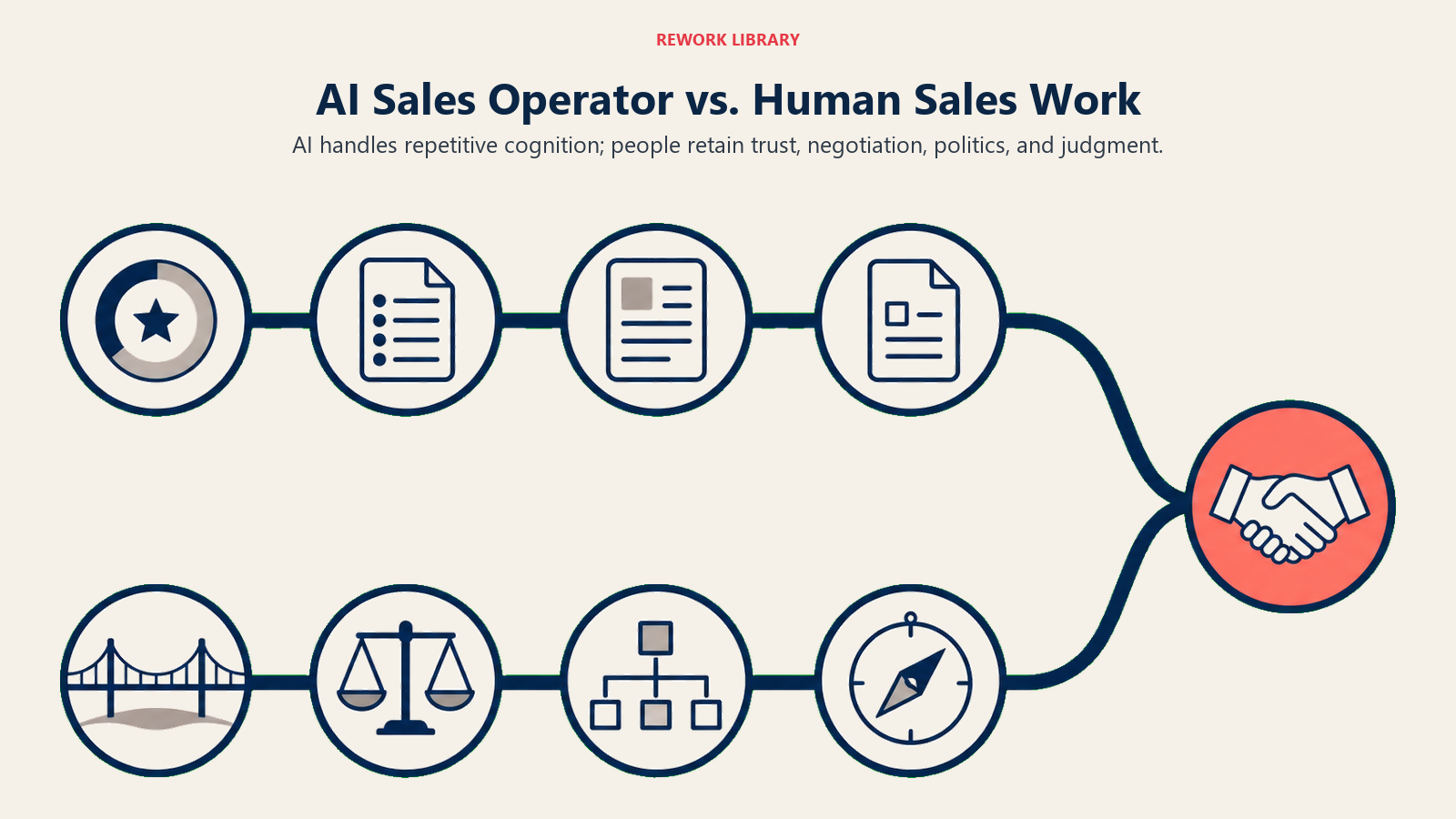
It doesn't replace what actually closes deals: building trust, navigating organizational politics, reading the room in a negotiation, knowing when to push and when to wait.
The practical effect is that a rep who used to spend 40% of their day on administrative tasks now spends closer to 15-20%. Forrester research puts the average at two full days per week burned on admin. The recaptured time goes toward more conversations, better preparation, and more thoughtful relationship-building.
Sales teams that implement all four patterns see productivity gains in the 25-47% range, with over 80% of AI-enabled teams reporting revenue increases compared to 66% of teams without AI, according to aggregate data from Cirrus Insight (2025). That gap between 80% and 66% is what the architecture difference produces.
Rework Analysis: In our work with B2B sales teams, the pattern we see most consistently is that the first pattern deployed (usually Scoring+Routing) delivers obvious value fast, which builds stakeholder confidence. But the second wave of ROI, the one that surprises teams, comes when Meeting Intelligence starts feeding context into Workflow Copilot. That's the moment where the architecture starts behaving like a single system rather than a collection of tools. Teams that wire all four patterns together within 90 days of their first deployment report 2-3x the productivity gains of teams that stay at one or two patterns.
Why this became practical in 2023-2025
Three things converged:
LLMs got usable for business tasks. GPT-4, Claude, and Gemini demonstrated that natural language generation at scale was reliable enough for commercial workflows. Generate capability became an API call, not a research project. McKinsey's State of AI research found that adoption of gen AI in marketing and sales more than doubled between 2023 and 2024, faster than any other business function.
Orchestration layers matured. Tools like LangChain, n8n, and native AI layers inside Salesforce and HubSpot made it possible to chain patterns together without building custom infrastructure. The plumbing got easier.
CRM data got cleaner. A decade of Salesforce and HubSpot adoption means most B2B sales teams now have structured historical data, won/lost labels, contact records, email threads. The Predict capability needs training data. Most mid-market sales teams finally have enough of it.
Before 2023, you could build two of the four patterns in reasonable time. After 2023, all four became configurable in a matter of weeks using existing tools. That's what changed. And that's why the ROI conversation shifted from "is this possible?" to "how fast can we deploy?"
The architecture, not the vendor
No single vendor delivers a perfect AI Sales Operator out of the box today. Most deployments combine two or three tools:
- Gong for Meeting Intelligence
- Clari for Scoring+Routing and pipeline intelligence
- Salesforce Einstein for Scoring+Routing and Workflow Copilot within the CRM
- Outreach for Workflow Copilot on the outbound side
- Rework Sales AI for teams that want all four patterns unified in one platform with the CRM
The right configuration depends on what's already in your stack, your team size, and where the biggest friction points are. This collection walks through each pattern in detail, so you can evaluate which vendors best serve each layer.
The collection starts with the AI Sales Operator concept, then goes pattern by pattern, with implementation guides for each one. Start with the pattern that maps to your biggest current pain, and build out from there.
Frequently Asked Questions
What is an AI Sales Operator?
An AI Sales Operator is a Level 3 ACE agent that performs the sales operations function using four stacked AI patterns: Scoring+Routing, Meeting Intelligence, Generative Research, and Workflow Copilot. It handles repetitive cognitive tasks across the sales workflow so reps focus on relationships and judgment. It's not a single product but an architectural configuration of interconnected patterns.
How is an AI Sales Operator different from individual AI tools like Gong or Clari?
Individual tools like Gong or Clari implement one or two AI patterns in isolation. An AI Sales Operator wires all four patterns together so outputs from one pattern automatically feed into the next. A Gong transcript becomes a Workflow Copilot input. A Clari lead score informs the Generative Research brief. The integration is what separates an operator architecture from a disconnected tool stack.
What ROI can sales teams expect from implementing an AI Sales Operator?
Companies deploying AI sales agents report an average 317% annual ROI with a payback period of around 5.2 months, according to 2025 benchmarks. Over 80% of AI-enabled sales teams report revenue increases, compared to 66% of teams without AI. The largest gains typically come in the first 90 days, when Scoring+Routing reduces time spent on low-probability leads.
Who is responsible for operating the AI Sales Operator?
The VP of Sales Operations or RevOps Lead typically owns configuration and governance. They set scoring model inputs, define routing rules, configure what Meeting Intelligence flags, and audit Workflow Copilot outputs. Individual reps interact with the outputs. The human operator sets the quality ceiling because AI patterns amplify whatever rules and logic you put into them.
What does the AI Sales Operator replace versus what stays human?
The AI Sales Operator handles repetitive cognition: lead scoring, meeting summaries, account research, follow-up drafts, task creation, and CRM updates. It doesn't replace trust-building, negotiation judgment, reading organizational politics, or knowing when to push and when to wait. Reps who implement all four patterns typically reduce administrative time from 40% of their workweek to 15-20%.
How long does it take to implement an AI Sales Operator?
Most teams configure two to three patterns within the first 30 days using existing tools (Gong, Clari, Salesforce Einstein, or an all-in-one platform). Adding the fourth pattern and tuning the integrations typically takes 60-90 days total. Teams that reach full four-pattern deployment within 90 days report 2-3x higher productivity gains than teams that stay at one or two patterns.
Why did AI Sales Operators become practical after 2023?
Three things converged: LLMs became reliable enough for commercial workflows, orchestration layers like LangChain and native AI features in Salesforce and HubSpot matured, and most B2B sales teams had accumulated enough structured CRM data to train predictive models. Before 2023, building two of the four patterns was feasible. After 2023, all four became configurable in weeks using existing tools.
Which vendors deliver AI Sales Operator capabilities?
No single vendor delivers all four patterns perfectly today. Common configurations combine Gong (Meeting Intelligence), Clari or Salesforce Einstein (Scoring+Routing), Outreach (Workflow Copilot), and Clay or Apollo (Generative Research). Rework Sales AI is built to deliver all four patterns inside a single CRM, reducing the integration overhead of the multi-tool approach.
Learn More
- AI Sales Ops vs. Traditional Sales Operations
- Why Sales Ops Is the Highest ROI AI Use Case
- AI Lead Scoring Beyond Rules-Based Models
- Sales Call Recording and Transcript Analysis
- Stacking Patterns to Build AI Agents
- The ACE Framework: A Periodic Table for Business AI
- Failure Modes: When AI Sales Ops Backfires
- How AI Patterns Combine Capabilities into Solutions
- When AI Changes External State and Why It's Risky
- What Business AI Actually Is

Co-Founder, Rework.com
On this page
- What the AI Sales Operator actually is
- The 4 patterns: what each one does
- Scoring+Routing
- Meeting Intelligence
- Generative Research
- The 4-Pattern Sales Operator Stack
- Workflow Copilot
- How all four patterns work together: a deal lifecycle
- Who operates the AI Sales Operator
- What it replaces, and what it doesn't
- Why this became practical in 2023-2025
- The architecture, not the vendor
- Learn More