Coaching Reps With Conversation Intelligence
Turn this article into takeaways for your work.


Each assistant summarizes the article only for you and suggests best practices for your work.
Most sales coaching is directional at best. "Work on your discovery questions." "You're moving to the demo too fast." "Try to be more consultative." These are true observations, but they're based on the manager's impressions from one observed call or a quarterly review conversation. They're hard to act on because they're not specific. HBR research on sales coaching found that most sales managers overestimate the time they actually spend coaching, and when they do coach, conversations typically focus on results and pending deals rather than the specific behaviors that drive outcomes.
Conversation intelligence makes coaching specific. Not "work on discovery" but: "In your last 5 discovery calls, you talked 68% of the time. Top performers on the team average 43%. Here are three calls where your talk-time crossed 70% and the deal stalled at qualification. Here are two from your teammate who averages 41% and has the highest stage-two conversion rate on the team."
That's a different conversation. The rep knows exactly what to change, has evidence for why it matters, and has a benchmark to measure against. The manager hasn't said anything subjective.
This article is for sales managers who have access to conversation intelligence data and want to use it to run coaching sessions that actually move metrics. The Meeting Intelligence Pattern explains how the underlying Ingest, Analyze, and Generate capabilities produce the metrics used here.
The metrics that predict rep performance
Before you can coach with data, you need to know which metrics matter. These five have the most consistent correlation with deal stage conversion:
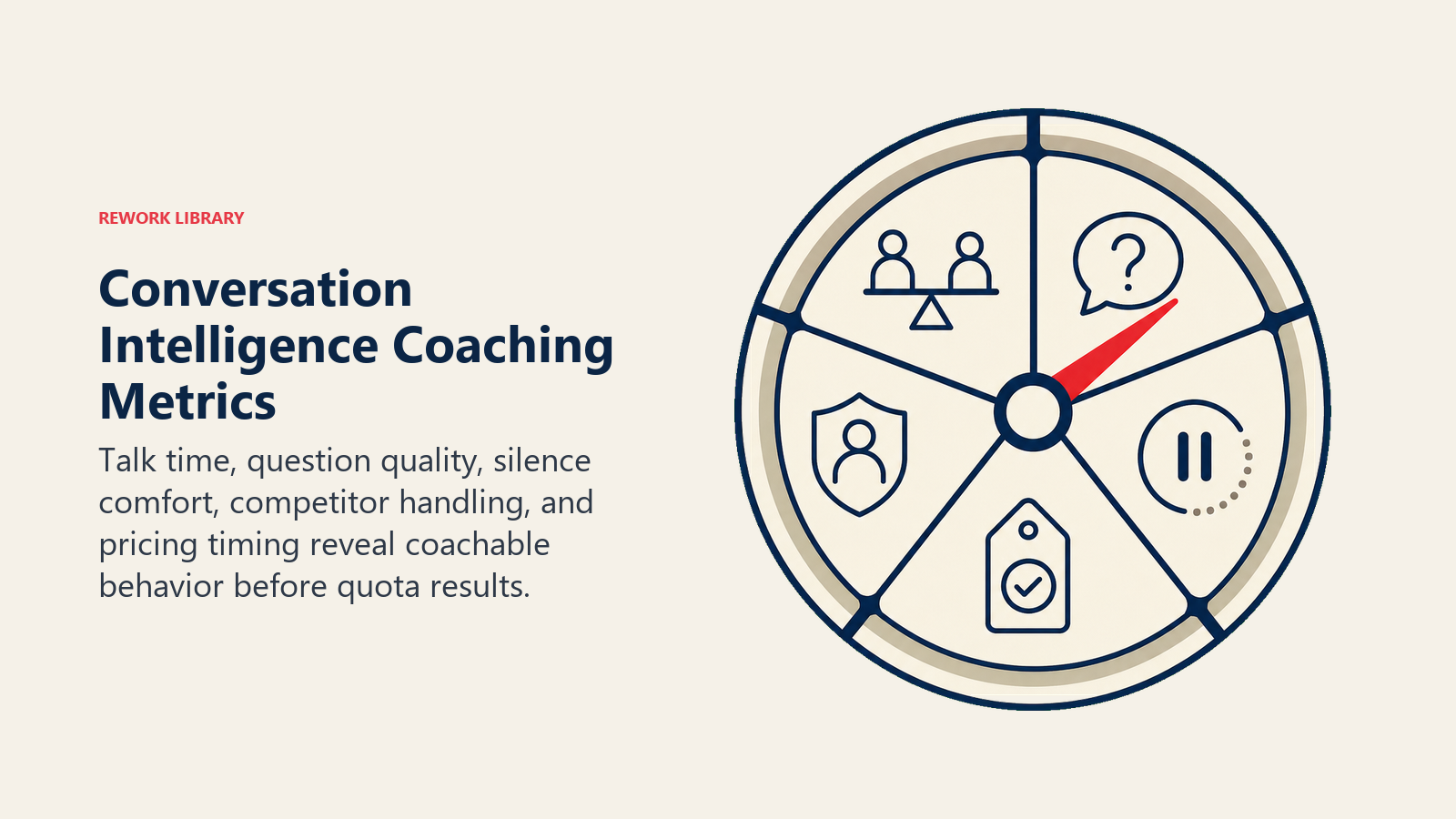
Talk-time ratio: The percentage of speaking time in a call that belongs to the rep vs. the buyer. In discovery, top performers typically hold their talk time between 35-45%. Higher isn't always worse (demos are rep-heavy), but in discovery and qualification calls, reps who dominate the conversation are getting less buyer insight per call.
Question frequency and type: How many questions does the rep ask per call? Are they open or closed? Top discovery performers ask more open questions and give buyers space to answer fully before following up. Conversation intelligence tools can classify question types, but even raw question count is a useful starting point.
Silence comfort (pause handling): Some reps fill every silence. They answer their own questions before the buyer can. A 3-5 second pause after a deep question is healthy; it signals that the buyer is thinking. Reps who consistently interrupt buyer pauses are cutting off the most substantive discovery answers.
Competitor-mention handling: When a buyer mentions a competitor by name, what does the rep do? Top performers acknowledge, ask a clarifying question, and continue discovery. Lower performers either over-react (launching into a competitive battle card recitation) or go silent. Conversation intelligence flags these moments so you can listen to how each rep handles them. The objection mining article covers how to turn aggregated competitor mentions into coaching material and product feedback.
Pricing discussion timing: When in the call does pricing come up? In deals that close, pricing typically surfaces in the second half of a qualified discovery call, after pain and value have been established. In deals that stall, pricing often comes up in the first 15 minutes, before the rep has established why the price is justified. This pattern is measurable and coachable.
The next section shows how to structure regular coaching sessions around these metrics.
Key Facts: Sales Coaching Effectiveness
- Sales training research consistently shows participants forget more than 80% of curriculum-based training within 90 days; call recording libraries solve the retention problem by providing contextual, just-in-time examples reps can return to on demand
- Conversation intelligence tools reduce ramp time for new Sales Development Representatives (SDRs) and Account Executives (AEs) by 20-30% when used to curate best-call libraries, because reps hear actual winning conversations in context rather than role-played examples from playbooks
- Teams running structured Weekly Coaching Loops based on conversation intelligence data see 15-25% improvement in discovery-to-demo conversion rates within two quarters of consistent application
The Weekly Coaching Loop
The Weekly Coaching Loop is the operational rhythm for data-grounded rep development using conversation intelligence. It runs in four stages: (1) Async metric review, where the manager reviews each rep's rolling 2-week metrics (talk ratio, question rate, flag distribution) before the live session; (2) Flagged call selection, where the manager picks one AI-flagged call that matches a metric trend for live review; (3) One-focus commitment, where the session ends with one specific measurable behavior the rep will track in the next 5 calls; and (4) Measurement close, where the following week's session opens by reviewing whether the metric moved. The loop converts coaching from impressionistic feedback ("be more consultative") to a closed-loop system where behavior, measurement, and correction are all connected.
Pattern coaching vs. call-by-call review
There are two modes of coaching with conversation intelligence, and both have a place.
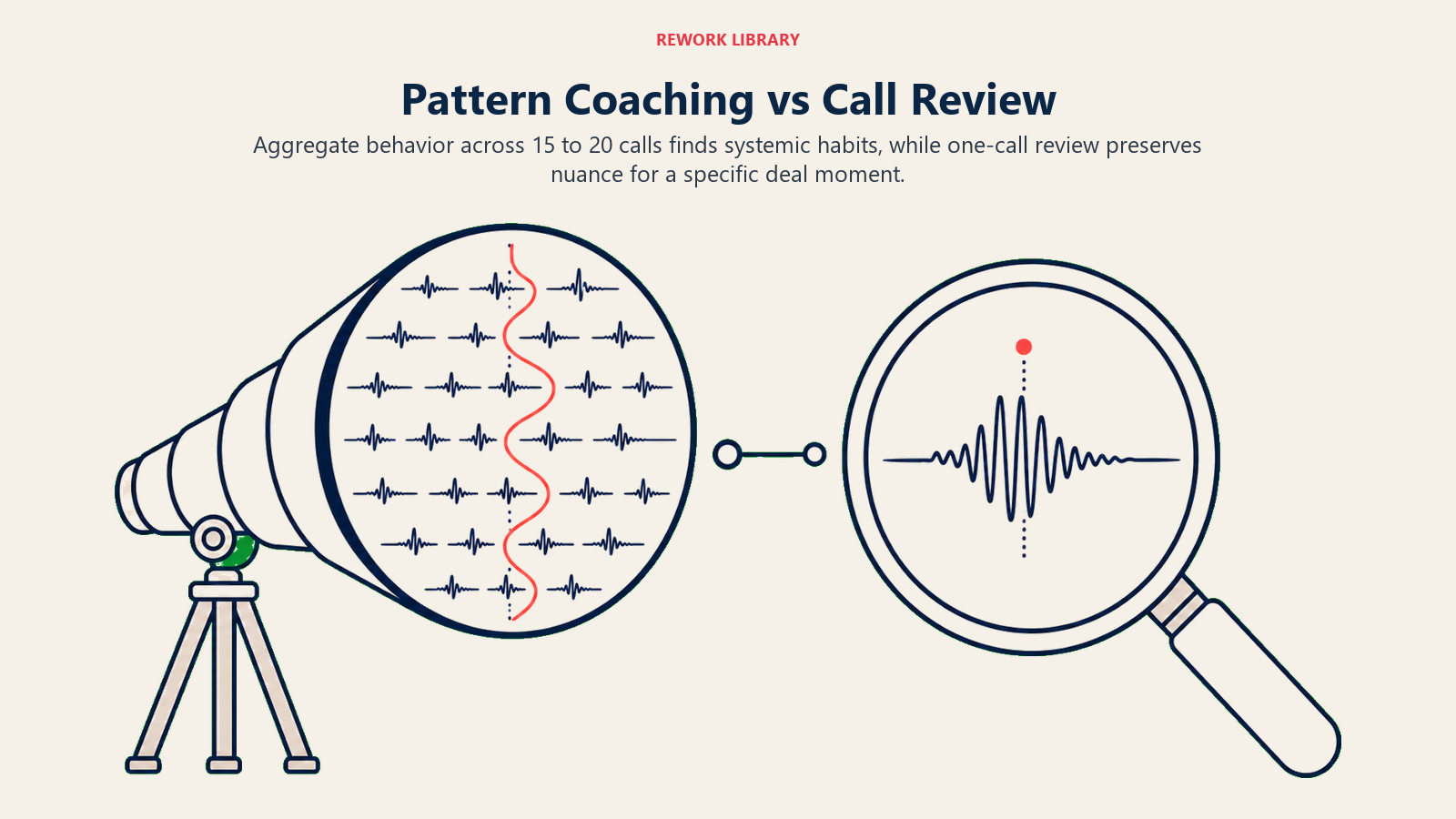
Call-by-call review is what most managers default to: listen to a specific call together, pause at moments that could have gone differently, discuss what the rep might try next time. This is valuable for complex coaching moments, relationship nuance, and calls that involve specific deal risks. But it's time-intensive (one call can take an hour to review properly) and relies on the manager choosing the right call to review.
Pattern coaching is often more impactful. Instead of one call, you look at aggregate metrics across 15-20 calls over the past month. What's this rep's average talk-time ratio over the past 4 weeks? Has their question rate changed since last quarter? Are they triggering competitor-mention flags more in late-stage calls (which suggests competitive pressure building in their pipeline)?
Pattern coaching surfaces systemic issues that individual call review misses. A rep might have a good call on the day you happen to observe. Pattern metrics show you the baseline behavior across many calls, including the ones you weren't in.
The most effective coaching cadence combines both: weekly pattern metric review per rep (10-15 minutes per rep, done asynchronously before the coaching session), and call-level deep-dive for the 1-2 calls AI flagged as needing attention.
How AI flags calls for review
A conversation intelligence platform scoring 50 calls per week across a 10-rep team generates more signal than any manager can process manually. AI call scoring prioritizes which calls need human attention.
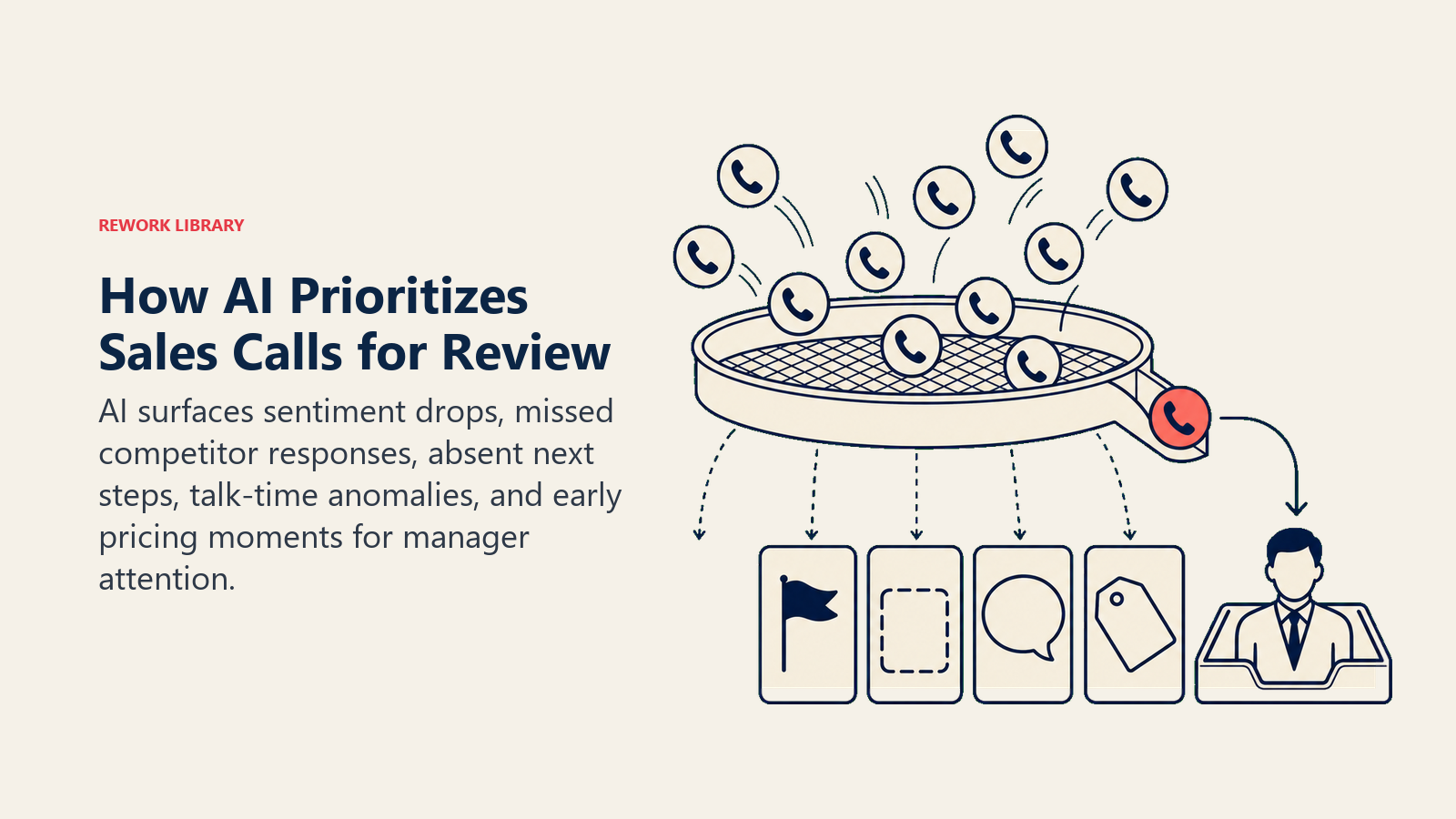
Flag categories typically include:
Buyer sentiment drop: Buyer language and tone shifted negative in the second half of the call without a corresponding rep acknowledgment. These calls are risk signals for deals that are starting to slip.
Competitor mention without rep response: A buyer named a competitor and the rep didn't address it. This might mean the rep didn't know how to handle the objection, or didn't register it as significant.
No clear next step committed: Call ended without a defined next action or date. Deals without committed next steps stall at higher rates than those with specific follow-up agreements.
Talk-time anomaly: Rep talked more than 75% of the call in what should have been a discovery session. Something went wrong in the call dynamic that's worth examining.
Pricing introduced early: Buyer asked about pricing in the first 20 minutes, rep engaged substantively with pricing before establishing value. This is often a coaching opportunity.
Managers don't need to watch 50 calls. They work through the 5-8 flagged calls that AI surfaced and spend the rest of the coaching session on pattern metrics. This is a manageable workload for a team of 10. The next section shows exactly how to structure that session.
The 30-minute coaching session structure
Here's a concrete agenda for a weekly coaching session that uses conversation intelligence data:
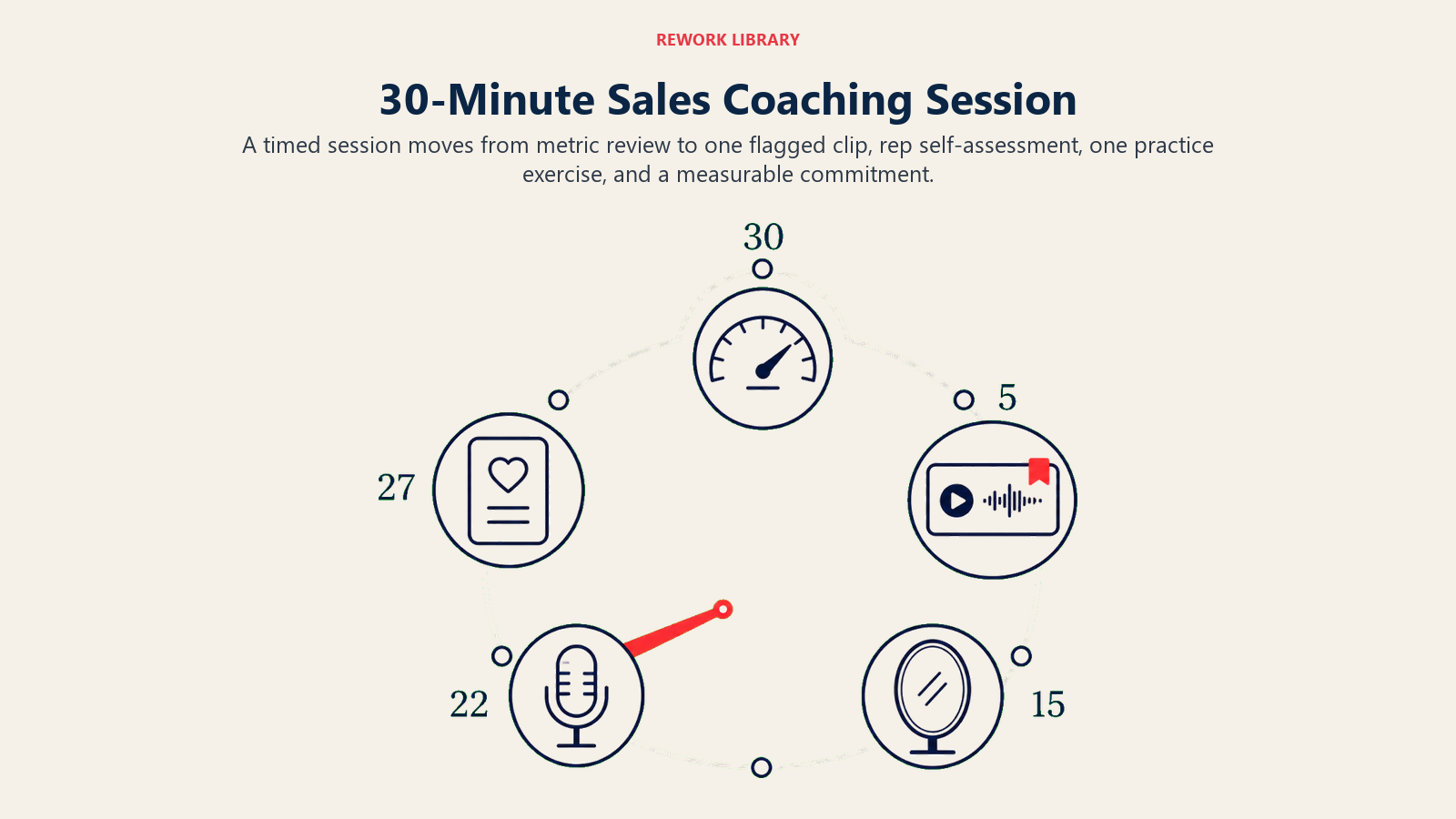
Minutes 0-5: Metric review Pull up the rep's dashboard for the past 2 weeks. Review talk-time trend, question rate, and call score distribution together. "Your average talk-time has been 61% this month, up from 54% in March. Let's look at what's driving that." Keep this factual and non-accusatory; you're reviewing a measurement, not making a judgment.
Minutes 5-15: Flagged call review Select one flagged call from the AI review queue, ideally one where the flag matches a metric trend you just discussed. Listen to a 2-3 minute clip, not the whole call. Focus on the specific moment: "Let's listen to the section starting at 18:30, where the buyer mentioned Competitor X." After the clip, ask the rep what they were thinking at that moment before offering your own observation.
Minutes 15-22: Rep self-assessment Ask the rep to identify one thing they'd do differently in that call and one thing they did well. Conversation intelligence data makes this a concrete discussion rather than a vague reflection exercise. "Based on the talk-time data, where in the call do you think you started losing the discovery thread?"
Minutes 22-28: One focus for next week Land on one specific, measurable thing the rep will work on in the next 5 calls. Not "be more consultative" but "in your next 5 discovery calls, target talking less than 50% of the time. I'll look at your metrics next week." One focus. Specific. Measurable.
Minutes 28-30: AI library recommendation (optional) If the rep is working on a specific skill (discovery questions, competitive handling), surface 2-3 calls from your team's top performers that demonstrate that skill well. Conversation intelligence platforms with call libraries let reps search by skill tag, talk-time ratio, or call outcome.
Total time: 30 minutes. Grounded in data. One actionable outcome per session.
New rep ramp acceleration
The same conversation intelligence that supports ongoing coaching is a new-rep training asset. Instead of directing a new hire to "shadow some calls and learn the product," you can give them a curated library:
- The 5 best discovery calls from the past quarter (selected by AI based on talk-time ratio, question rate, and deal outcome)
- The 3 best competitive handling moments from team calls
- The 2 best examples of a rep recovering from a buyer sentiment drop
New reps listening to these calls hear what "good" sounds like in audio form, not just in a playbook. They're listening to their actual colleagues, using the actual language your buyers respond to, in real deal contexts. Research on sales training consistently shows participants forget more than 80% of curriculum-based training within 90 days. Call recording libraries solve the retention problem by providing contextual, just-in-time examples that reps can return to on demand, and sales training research shows this can reduce ramp time for new SDRs and AEs by 20-30%. This is the AI Sales Operator's Meeting Intelligence pattern accelerating the team's collective learning curve, not just the manager's.
The requirement is that your top performers have to consent to using their calls as training material. Most are fine with this, especially if the framing is recognition ("your call was selected as a top example") rather than exposure.
The rep trust problem
Conversation intelligence can feel like surveillance if it's introduced wrong. "The company is now recording all your calls" lands differently than "we're building a coaching tool that surfaces your best calls and helps you improve faster."
The framing and rollout matter as much as the feature.
What works: Introduce the tool as a coaching asset, not a monitoring system. Let reps access their own data before managers see it. Show them their own metrics first. Make it clear that the goal is to find patterns that will help them hit quota, not to build a case for performance management.
What creates distrust: Deploying recording with no rep communication. Using call data in performance reviews without explaining that it will be used that way. Having managers reference specific call moments without giving reps the same access to their own data.
Opt-in moments: Some teams run call recording as opt-in for the first 90 days, transitioning to opt-out (always on) once reps have seen the coaching value. This costs you some data completeness early but dramatically reduces the cultural backlash that derails full deployments.
What to tell reps explicitly: The recording is used for coaching. Managers review flagged calls, not every call. The data won't be used to discipline reps for individual call moments without context. And the goal is to build the rep's own reference library of their best work.
Teams that handle the rollout well see higher tool adoption and reps who actively share their own call clips in team meetings. Teams that handle it badly create an environment where reps mute themselves or schedule calls outside the recorded system.
Rework Analysis: The metric that most sales managers skip is stage conversion rate tracked with a 60-90 day lag from coaching changes. Managers typically measure whether a rep's talk ratio improved (they do) but rarely close the loop on whether the improved talk ratio translated to higher stage-two conversion rates. When we review conversation intelligence deployments, the teams with the strongest business results are the ones who set a baseline conversion rate per coaching metric before starting structured coaching, then compare 90 days later. The metric movement is real.
Measuring coaching effectiveness
If you're investing in conversation intelligence and structured coaching, you should be measuring whether it's working. These are the metrics to track:
Talk-time ratio trend: Is it moving toward your team's target range? Track per-rep trend over 30/60/90 days after coaching.
Question rate change: Are reps asking more open questions per call than they were 90 days ago?
Stage conversion rate: The metric that matters most. Are reps converting discovery to demo, demo to proposal, proposal to close at higher rates after coaching interventions? Track this with a 60-90 day lag from when coaching changes were introduced.
Flag rate reduction: Are the flagged-call categories going down over time? If a rep's "no next step committed" flags drop from 40% of calls to 12%, that's measurable progress.
Ramp time for new reps: If you're using call libraries for new hire training, track first qualified opportunity timing and first close timing against a baseline from before you had the library.
Discovery question compliance with AI review covers more on how specific coaching metrics connect to sales methodology compliance.
The honest summary
Coaching improves faster when it's grounded in data from calls, not memories of calls.
The manager who says "work on your discovery" is giving feedback based on one call they half-remember and a general sense that this rep talks too much. The manager who says "your talk-time has averaged 65% this month and here's the call from Tuesday where it hit 78% right before the buyer went quiet" is giving feedback the rep can act on.
The conversation intelligence platform is not the coaching. The manager is still the coach. But the platform gives the manager data that makes coaching specific, measurable, and repeatable instead of impressionistic. Forrester's research on conversation intelligence identifies this specificity as the key to unlocking sales productivity: top platforms provide advanced scorecards and coaching triggers that reduce the evaluation effort while improving seller performance based on actual conversation patterns. And for the rep, getting feedback grounded in their actual call patterns rather than a manager's subjective impression changes the conversation from defensive to diagnostic.
That's a different kind of coaching relationship. And it produces different results.
Frequently Asked Questions
What is conversation intelligence in sales coaching?
Conversation intelligence uses AI to analyze recorded sales calls and extract structured metrics: talk-time ratios, question rates, buyer sentiment arcs, competitor mentions, and next-step commitment rates. These metrics give sales managers objective, call-level data for coaching sessions rather than relying on memory from observed calls or quarterly review impressions. The shift is from "you need to work on discovery" to "in your last 5 discovery calls, you talked 68% of the time and top performers average 43%."
Which call metrics most reliably predict rep performance?
Five metrics have the most consistent correlation with deal stage conversion: talk-time ratio in discovery (top performers average 35-45%); question frequency and type (more open questions, more buyer insight per call); silence comfort (reps who fill every pause cut off substantive answers); competitor-mention handling (acknowledge, clarify, continue vs. over-react or go silent); and pricing discussion timing (second half of a qualified call vs. first 15 minutes). These metrics are measurable, coachable, and observable through conversation intelligence data.
What is the difference between call-by-call review and pattern coaching?
Call-by-call review listens to a specific call with the rep to discuss individual moments. Pattern coaching reviews aggregate metrics across 15-20 calls over the past month to surface systemic behaviors that individual call review misses. A rep might have a good call on the day you observe. Pattern metrics show baseline behavior across many calls, including the ones you weren't in. The most effective coaching cadence combines weekly async pattern review with one flagged call deep-dive per session.
How long does a data-grounded coaching session take?
The Weekly Coaching Loop runs in 30 minutes: 5 minutes on rolling metric review, 10 minutes on one AI-flagged call clip (2-3 minutes of audio, not the full call), 7 minutes on rep self-assessment, 6 minutes on one specific measurable focus for the next 5 calls, and 2 minutes on call library recommendations if relevant. The 30-minute structure only works if the manager does 10-15 minutes of async metric review before the session.
How should conversation intelligence be introduced to sales reps to avoid creating a surveillance culture?
Frame it as a coaching asset, not a monitoring system. Let reps access their own metrics before managers review them. Explain explicitly that the data will be used for coaching, not performance management. Consider an opt-in period for the first 90 days to let reps see the value before it becomes standard. Teams that handle rollout well see reps actively sharing their own call clips in team meetings. Teams that don't often have reps muting themselves or scheduling calls outside the recorded system.
How does conversation intelligence help with new rep ramp acceleration?
New reps can access curated libraries of the team's best discovery calls, competitive handling moments, and recovery examples, selected by AI based on talk-time ratio, question rate, and deal outcome. Hearing actual winning conversations in real deal contexts is more effective than playbook training because it provides contextual, just-in-time examples reps can return to on demand. Research shows this approach reduces ramp time by 20-30% compared to traditional curriculum-based onboarding.
How do you measure whether conversation intelligence coaching is actually working?
Track five metrics with appropriate lag times: talk-time ratio trend per rep (improvement visible within 30 days), question rate change (30-60 days), discovery-to-demo stage conversion rate (60-90 day lag from coaching changes), flagged-call category reduction (30-60 days), and ramp time for new hires (compare first qualified opportunity timing against pre-library baseline). The critical principle is setting baselines before starting structured coaching, so you can measure delta rather than just current state.
Learn More
- Sales Call Recording and Transcript Analysis
- Discovery Question Compliance With AI Review
- Objection Mining: What Buyers Actually Push Back On
- From Call to CRM Update Automatically
- Choosing a Conversation Intelligence Tool
- Meeting Intelligence: From Audio to Action Items
- Analyze: How AI Makes Sense of What You've Collected
- Forrester: Conversation Intelligence and Sales Productivity
- HBR: The Dirty Secret of Effective Sales Coaching

Co-Founder, Rework.com