Why Sales Operations Is the Highest ROI AI Use Case

Turn this article into takeaways for your work.


Each assistant summarizes the article only for you and suggests best practices for your work.
When a CFO evaluates an AI budget request, they ask one question before anything else: where's the money?
Marketing AI can improve campaign performance, but attribution is messy. Support AI reduces ticket volume, but it's a cost-center reduction, not revenue growth. HR AI speeds up hiring, but the downstream revenue impact is diffuse and hard to date. These are real benefits. They're just hard to put a dollar sign on in a quarterly meeting.
Sales ops is different. Every improvement in sales ops maps directly to revenue with clear causality:
- Faster response to inbound leads = higher contact rates = more deals in pipe
- Better lead scoring = reps work the right deals = higher conversion
- More time selling instead of on admin = more conversations per rep = more pipeline
- More accurate forecasting = better resource allocation = fewer missed quarters
That tight causal chain is why sales ops returns the fastest and largest AI ROI for most B2B companies. And it's why the math on AI investment is worth doing seriously, rather than treating it as a soft "productivity" story.
Why sales ops is uniquely AI-ready
Three properties make sales operations the most tractable AI use case in the business:
The data already exists in structured form. A decade of Salesforce and HubSpot adoption means most B2B sales teams have Customer Relationship Management (CRM) records with contact fields, activity logs, deal stage history, and won/lost outcomes. The AI Predict capability needs labeled historical data to train on. Sales ops has it. But sales ops has the clearest outcome label: closed-won or closed-lost. That binary makes the modeling problem tractable.
The decisions being made have high economic value. A lead routing decision routes an enterprise lead to either a senior Account Executive (AE) or a junior Sales Development Representative (SDR). If the senior AE wins those accounts at 30% and the junior SDR wins them at 12%, that routing decision is worth real dollars at volume. A 1% improvement in lead qualification accuracy across 500 monthly inbound leads isn't a rounding error.
The outcomes are fast and measurable. Most B2B sales cycles are 30-90 days. That means you can run an A/B test on an AI scoring model and know within a quarter whether it improved conversion rates. You can't say the same for content marketing (attribution takes months) or HR (hiring impact takes years).
Key Facts: Sales Operations AI ROI
- Companies deploying AI sales agents report an average 317% annual ROI, with a payback period of 5.2 months (Utmost Agency, 2025)
- McKinsey identifies marketing and sales as one of four business functions that will account for 75% of total annual generative AI value across the entire economy
- The average company responds to inbound leads in 42 hours; an AI Sales Operator routes and notifies the right rep in under 90 seconds
The Sales Ops AI ROI Multiplier
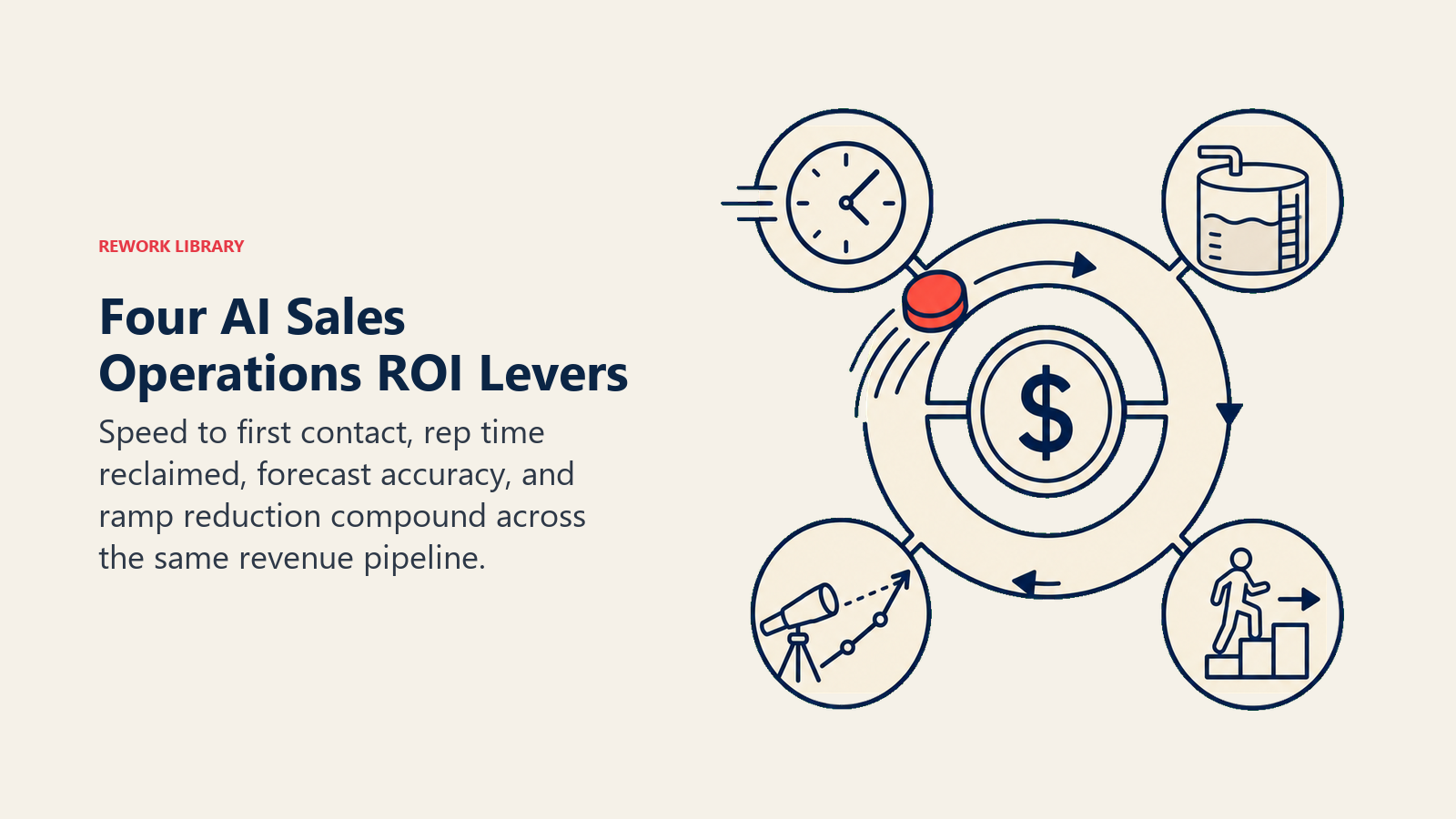
The Sales Ops AI ROI Multiplier is the compound effect that occurs when all four AI patterns (Scoring+Routing, Meeting Intelligence, Generative Research, Workflow Copilot) operate on the same pipeline simultaneously. Each pattern improves a distinct revenue lever: lead speed, rep capacity, forecast accuracy, and ramp time. Because these levers compound (faster leads create more pipeline; more rep time converts more of that pipeline; better forecasting deploys resources at the right moment), the total ROI exceeds the sum of individual gains. Teams that implement one pattern see 30-40% improvement on that lever. Teams that implement all four within 90 days routinely report 2-3x the ROI of single-pattern deployments.
The four ROI levers
Use this section map to orient the workflow before moving into the detailed steps.
Lever 1: Speed to first contact
The research on lead response time is consistent across studies going back over a decade. HBR's landmark analysis of online sales leads found that contacting a lead within 5 minutes of form submission dramatically increases contact rates versus responding within 30 minutes or an hour, and the companies that respond fastest win the conversation.
The average company responds to inbound leads in 42 hours.
An AI Sales Operator routes and notifies the right rep in under 90 seconds. The rep gets a Slack message with the lead details, an AI-generated brief, and a one-click dial option.
Even if you're skeptical of the extreme end of those multipliers, the direction is clear: faster contact rates, higher conversion rates, more revenue from the same inbound volume.
Illustrative example (labeled as such):
A company gets 400 inbound leads per month. Current average response time: 6 hours. Contact rate: 35%. Conversion rate on contacted leads: 15%. Average deal size: $28,000.
- Monthly closed deals from inbound: 400 × 35% × 15% = 21 deals
- Monthly revenue: 21 × $28,000 = $588,000
Improving response time to under 5 minutes increases contact rate to 60% (conservative, not the 21x multiplier in some studies):
- Monthly closed deals from inbound: 400 × 60% × 15% = 36 deals
- Monthly revenue: 36 × $28,000 = $1,008,000
That's $420,000/month in additional revenue from the same inbound volume, from one lever alone. Even if your conversion rate is more modest or your deal sizes differ, the directional math holds. The next lever is where the compounding starts.
Lever 2: Rep time reclaimed
A standard analysis of rep time allocation shows that reps spend roughly 33-40% of their workday on non-selling activities: CRM updates, note-taking, email drafting, internal reporting, and account research. This is consistent with McKinsey's research on AI in marketing and sales.
If a rep earns $120,000 in base salary, and 35% of their day is admin, that's $42,000/year in salary allocated to tasks that don't close deals.
The Workflow Copilot Pattern and Meeting Intelligence Pattern together reduce that admin burden to 15-20%, recovering 15-20 percentage points of rep time. For a 20-rep team at $120K base, that's roughly $420,000 in recovered capacity per year. Not a cash saving (you're not firing anyone), but a capacity increase. More selling time means more pipeline created means more revenue.
The more direct math: if a rep can do 8 outreach conversations per day instead of 5, the pipeline generation rate increases 60% without a single hire.
Lever 3: Forecast accuracy improvement
The cost of a bad forecast runs in two directions. Sandbagging leads to under-resourcing a closing quarter, missing the chance to add headcount or acceleration spend in time to capture demand. Overcommitting leads to overspend, missed margin targets, and credibility damage with the board.
Studies from Clari and Gartner between 2021 and 2024 suggest that companies using AI-assisted forecasting improve forecast accuracy by 10-20 percentage points versus manual CRM roll-up methods.
The financial value of that improvement depends on company scale. For a $50M Annual Recurring Revenue (ARR) company, a 15-point accuracy improvement on quarterly forecasting might represent $3-5M in resource decisions made correctly each quarter.
Lever 4: Rep ramp time reduction
The average ramp time for a new B2B SaaS AE is 4-6 months, per data from Gartner and Sales Hacker. During that period, the rep is in the pipeline but not at full productivity. A 60-rep team replacing 20% of its team annually (12 reps) has 12 people in various stages of ramp at any given time.
AI Sales Ops tools, particularly Generative Research and Meeting Intelligence, cut ramp time by providing new reps with:
- Account briefs that don't require prior experience to produce
- Call coaching data that shows them what winning conversations look like, at scale
- Scoring models that tell them which leads to work first, rather than relying on gut feel
Conservative estimates from Gong and Outreach's customer data suggest 30-45 day reductions in average ramp time. For a $100K On-Target Earnings (OTE) rep with a 6-month ramp, each month of reduced ramp is worth roughly $8-10K in recovered productivity.
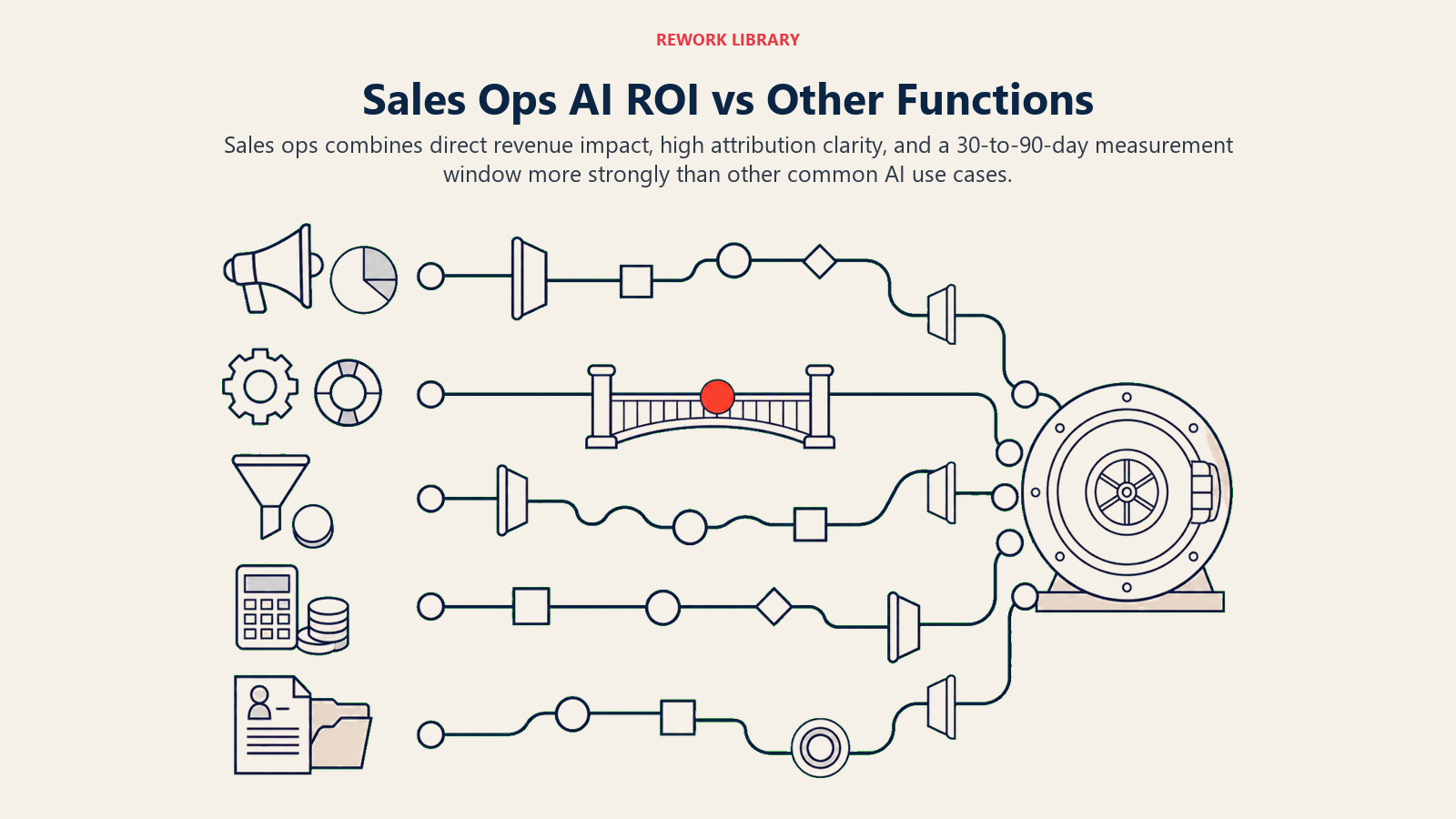
Comparison: AI use case ROI across business functions
Use this reference table to orient the section before applying the details below.
| Function | AI Benefit | Time to measurable ROI | Attribution clarity | Revenue impact |
|---|---|---|---|---|
| Sales Ops | Lead scoring, call intelligence, forecast accuracy | 30-90 days | High (direct to closed revenue) | Direct |
| Marketing | Content generation, campaign optimization | 3-6 months | Low (multi-touch attribution) | Indirect |
| Customer Support | Ticket deflection, L1 automation | 60-90 days | Medium (cost reduction, not growth) | Indirect (churn prevention) |
| Finance | Invoice processing, anomaly detection | 90-180 days | High (cost savings) | Indirect |
| HR | Screening, scheduling, JD writing | 6-12 months | Low (hiring quality impact is long-term) | Very indirect |
Sales ops wins on the combination of attribution clarity and direct revenue impact. Finance has similar attribution clarity, but the financial impact is cost-reduction, not growth. Support has faster ROI but it's a savings story, not a growth story. McKinsey's economic potential of generative AI report identifies marketing and sales as one of four functions that will account for 75% of the total annual value generative AI can deliver across the entire economy.
How to build your own ROI case
Rather than trusting vendor-provided statistics, build the case from your own numbers. Here's the framework:
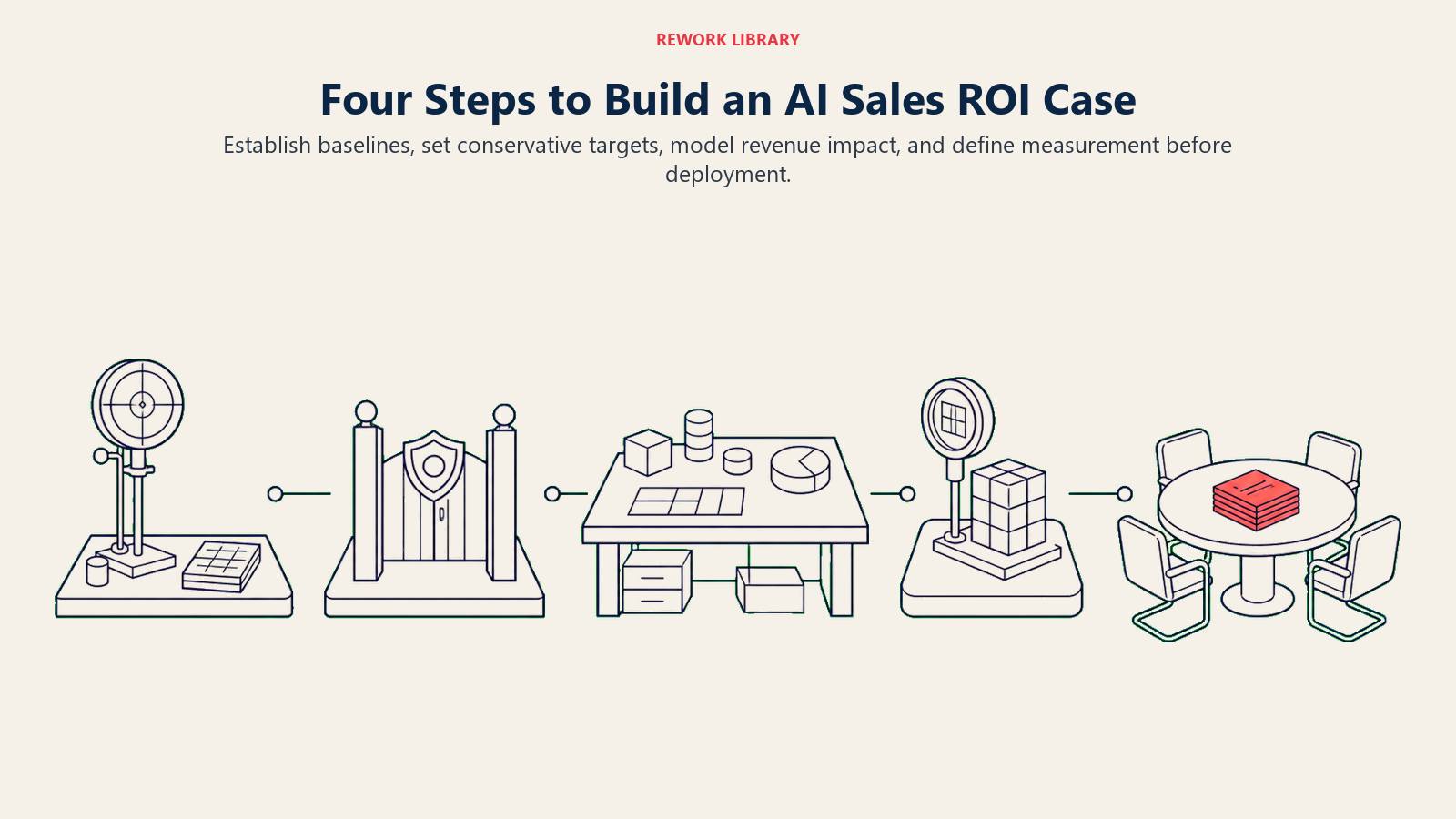
Step 1: Establish your current baselines
- Average lead response time
- Inbound lead contact rate
- Lead-to-opportunity conversion rate
- Average deal size
- Rep admin time % (survey 3-5 reps)
- Current forecast accuracy (actual vs. called, by quarter)
- Average AE ramp time
Step 2: Assign conservative improvement targets to each lever
Don't use vendor case studies as your benchmarks. Use conservative improvements: 20-30% better than your current state for each lever. If you exceed that, great.
Step 3: Model the revenue impact
For each lever, run the same before/after calculation as the worked example above. Add them up. Compare to the annual cost of the AI tooling.
Step 4: Set a measurement plan before deploying
This is the most important step. Decide how you'll measure each lever before the tool goes live. If you don't have a baseline, you can't prove the improvement. Set up weekly tracking for lead response time, contact rate, and rep time allocation. Run for 30 days before AI deployment. Then run for 60 days after.
Rework Analysis: When we walk through the ROI model with B2B sales leaders, the number that consistently surprises them is the ramp-time lever. Most CFOs think about AI ROI in terms of capacity (more reps doing more per day). They don't initially model the ramp reduction. But for a 60-rep team turning over 20% annually, a 30-day ramp reduction across 12 new hires is worth $96,000-$120,000 in recovered productivity per year. That's before counting the faster time-to-first-deal for new hires, which shows up in quarterly attainment. When you combine all four levers with conservative assumptions, the ROI case almost always exceeds the AI tooling cost by a factor of 3-5x by month 12.
What vendors don't tell you about ROI
AI vendors show you their best case studies. They don't show you the 40% of implementations that took 9-12 months to produce measurable impact. A few things worth understanding:
Data readiness is the hidden prerequisite. If your CRM has less than 12 months of clean won/lost data, the AI scoring model has limited signal to work from. "Clean" means consistent stage definitions, filled-in contact fields, and reliable outcome labels. Most companies overestimate how clean their data is.
Time-to-value for scoring models is 60-90 days minimum. The model needs to make predictions, see outcomes, and recalibrate. You can't evaluate it after two weeks.
Integration debt is real. Connecting a new AI tool to Salesforce, your email system, your call recording platform, and your routing logic takes longer than the demo suggests. Budget 3-4 weeks for a well-resourced implementation; 8-12 weeks if you have complex tech debt.
Rep adoption is the actual bottleneck. The technology often works fine. What fails is getting reps to actually change their behavior based on AI outputs. Trust takes time. A score of 73 means nothing to a rep who made a living on gut feel. Budget for change management, not just tooling.
The honest bottom line
The ROI on AI sales ops is real. The math checks out, and it checks out faster than almost any other AI investment a business can make. But "the math checks out" in theory and "this specific implementation delivered ROI" are two different things.
The difference comes down to: measuring the right inputs before deploying, not after; treating data readiness as a prerequisite, not an afterthought; and expecting 60-90 days before you have meaningful signal, not a week.
Sales ops leaders who do that work will find AI investment defensible to any CFO. Those who buy the technology first and try to prove ROI later will struggle to make the case. The AI Sales Operator architecture lays out exactly what to build, and in what order.
Frequently Asked Questions
Why is sales operations considered the highest ROI AI use case?
Sales operations has three properties that make AI ROI uniquely fast and measurable: structured historical data already exists in CRM systems, the decisions being automated have direct dollar value (every routing decision maps to a deal outcome), and results are measurable within 30-90 days. Most other AI use cases require months of indirect attribution. In sales ops, closed-won or closed-lost data makes the feedback loop fast.
What is a realistic ROI timeline for AI sales operations?
Most teams see initial measurable impact within 60-90 days of full deployment, with scoring models needing that time to make predictions, see outcomes, and recalibrate. Data from 2025 benchmarks shows an average 317% annual ROI with a 5.2-month payback period. However, teams that skip the data readiness step or lack a governance owner typically take 9-12 months to see meaningful impact.
What are the four main ROI levers in AI sales operations?
The four levers are: (1) Speed to first contact, which increases lead contact rates and conversion from faster inbound routing; (2) Rep time reclaimed, which turns 15-20% of the workday from admin back to selling; (3) Forecast accuracy improvement, which reduces over/under-resourcing decisions worth millions per quarter; and (4) Rep ramp time reduction, where AI coaching tools and account briefs cut the 4-6 month new-hire ramp by 30-45 days.
How much admin time does AI actually save sales reps?
Benchmarks consistently put rep administrative time at 33-40% of the workday under traditional ops. Implementing the Workflow Copilot and Meeting Intelligence patterns together typically reduces that to 15-20%, recovering 15-20 percentage points of rep time for selling activity. For a 20-rep team at $120K base, that's approximately $420,000 in recovered capacity per year, without adding headcount.
Does AI sales ops ROI require clean CRM data?
Yes. Clean CRM data, specifically at least 12 months of consistent won/lost labels, reliable deal stage definitions, and complete contact fields, is the primary prerequisite. AI scoring models learn from historical outcome patterns. If those patterns aren't in the data, the model produces noisy output. Most teams overestimate their data quality; a one-week audit before deployment prevents months of poor results.
How does AI sales ops ROI compare to AI in other business functions?
Sales ops delivers the fastest ROI with the highest attribution clarity. Marketing AI can improve performance, but attribution takes months and involves multiple touchpoints. Support AI reduces costs but doesn't drive growth. HR AI impacts hiring quality over 12+ months. Sales ops is the only function where AI improvements map directly to closed revenue within a single quarter, which is why it consistently delivers the strongest business case.
What's the biggest risk factor in AI sales ops ROI delivery?
Rep adoption is the most common failure point, not the technology. AI scoring models that reps ignore don't change behavior, and changed behavior is what creates the revenue impact. The fastest path to adoption is showing reps three specific deals where the AI flagged risk they missed, and two deals where a high AI score correlated with a close. That data-first trust-building process takes 30-60 days and is rarely budgeted into implementation plans.
Learn More

Co-Founder, Rework.com
On this page
- Why sales ops is uniquely AI-ready
- The Sales Ops AI ROI Multiplier
- The four ROI levers
- Lever 1: Speed to first contact
- Lever 2: Rep time reclaimed
- Lever 3: Forecast accuracy improvement
- Lever 4: Rep ramp time reduction
- Comparison: AI use case ROI across business functions
- How to build your own ROI case
- What vendors don't tell you about ROI
- The honest bottom line
- Learn More