The AI Sales Ops Vendor Landscape in 2026

Turn this article into takeaways for your work.


Each assistant summarizes the article only for you and suggests best practices for your work.
The AI sales ops market is confusing because every vendor claims to do everything. Gong says it's a revenue intelligence platform. Salesforce Einstein says it's the AI layer for your entire CRM. Outreach says it's an AI-first sales execution platform. Clay says it's how you build a research engine. They're all partially right, and the overlap makes comparison nearly impossible if you try to evaluate them feature-by-feature.
A cleaner approach: organize the market by which ACE pattern each vendor primarily serves. The four patterns in the AI Sales Operator stack are Scoring and Routing, Meeting Intelligence, Generative Research, and Workflow Copilot. Every AI sales ops tool does at least one of these well. The best platforms do three or four. For the broader pattern taxonomy, the AI Pattern Vendor Landscape Map shows how these categories fit within the full 10-pattern map.
This article maps 20-plus vendors by their primary pattern, shows pricing across team sizes, and covers the platform consolidation trend that will reshape buying decisions through 2027.
How to read this map
Key Facts: The AI Sales Ops Market in 2026
- The revenue intelligence platform market has grown to $3.8 billion in 2024, expanding at a 34.6% CAGR as sales teams shift from manual forecasting to AI-powered pipeline management. (Landbase, 2025)
- The global AI for sales and marketing market is projected to grow from $58 billion in 2025 to $240 billion by 2030, a 32.9% CAGR reflecting accelerating enterprise AI adoption. (Grand View Research, 2025)
- Only 21% of commercial leaders have fully enabled enterprise-wide AI adoption in B2B sales, meaning most organizations are still in early vendor selection and initial deployment. (McKinsey, 2025)
Each vendor entry includes:
- Primary pattern served
- Key ACE capability mix (Ingest, Analyze, Predict, Generate, Execute)
- CRM integration depth (shallow = API read-only, standard = read-write, deep = native bi-directional + triggers)
- Pricing range (where publicly available; enterprise tiers often require a quote)
Pricing is listed at three tiers: SMB (10 seats), mid-market (50 seats), enterprise (200+ seats). Where vendors publish list pricing, that's used. Where pricing requires contacting sales, estimates are based on published customer disclosures and analyst research.
The 2026 Sales Ops Vendor Map
The 2026 Sales Ops Vendor Map organizes the AI sales operations market by the four ACE patterns each vendor primarily serves: Scoring and Routing (Analyze + Predict + Execute), Meeting Intelligence (Ingest + Analyze + Generate + Execute), Generative Research (Ingest + Analyze + Generate), and Workflow Copilot (Ingest + Generate + Execute). Every AI sales ops vendor belongs primarily to one pattern category, even if they have features spanning others. Evaluating vendors by pattern category rather than feature count prevents the common mistake of comparing tools that are solving fundamentally different problems. The 2026 map documents 20+ vendors across all four patterns with pricing at three team sizes.
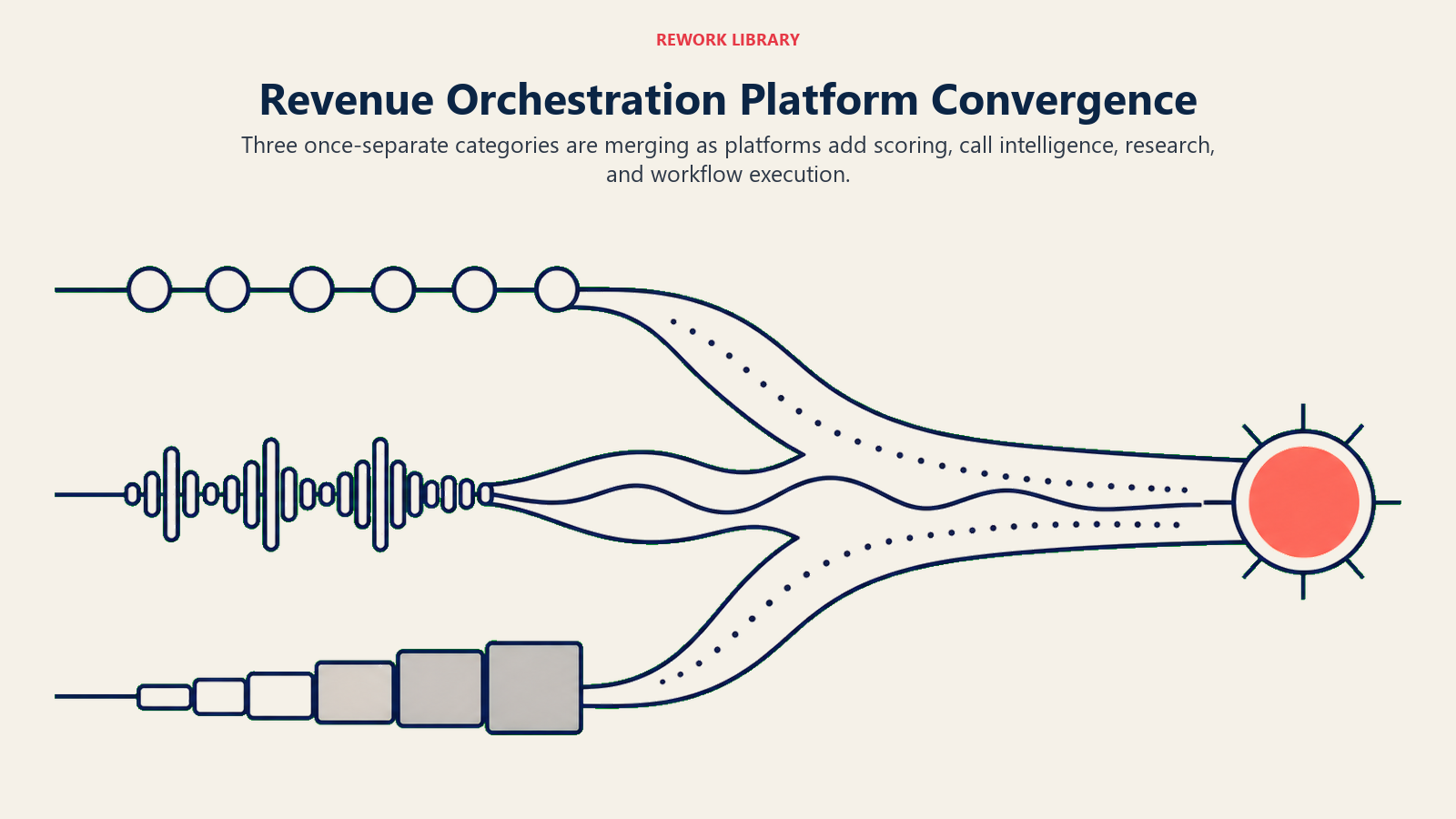
The AI sales ops market has consolidated significantly in 2025-2026: three previously separate categories (sales engagement, conversation intelligence, revenue operations) are merging into unified Revenue Orchestration Platforms, with the Forrester Wave Q3 2024 identifying this convergence as the defining market shift.
Pattern 1: Scoring and Routing
ACE capabilities: Analyze + Predict + Execute
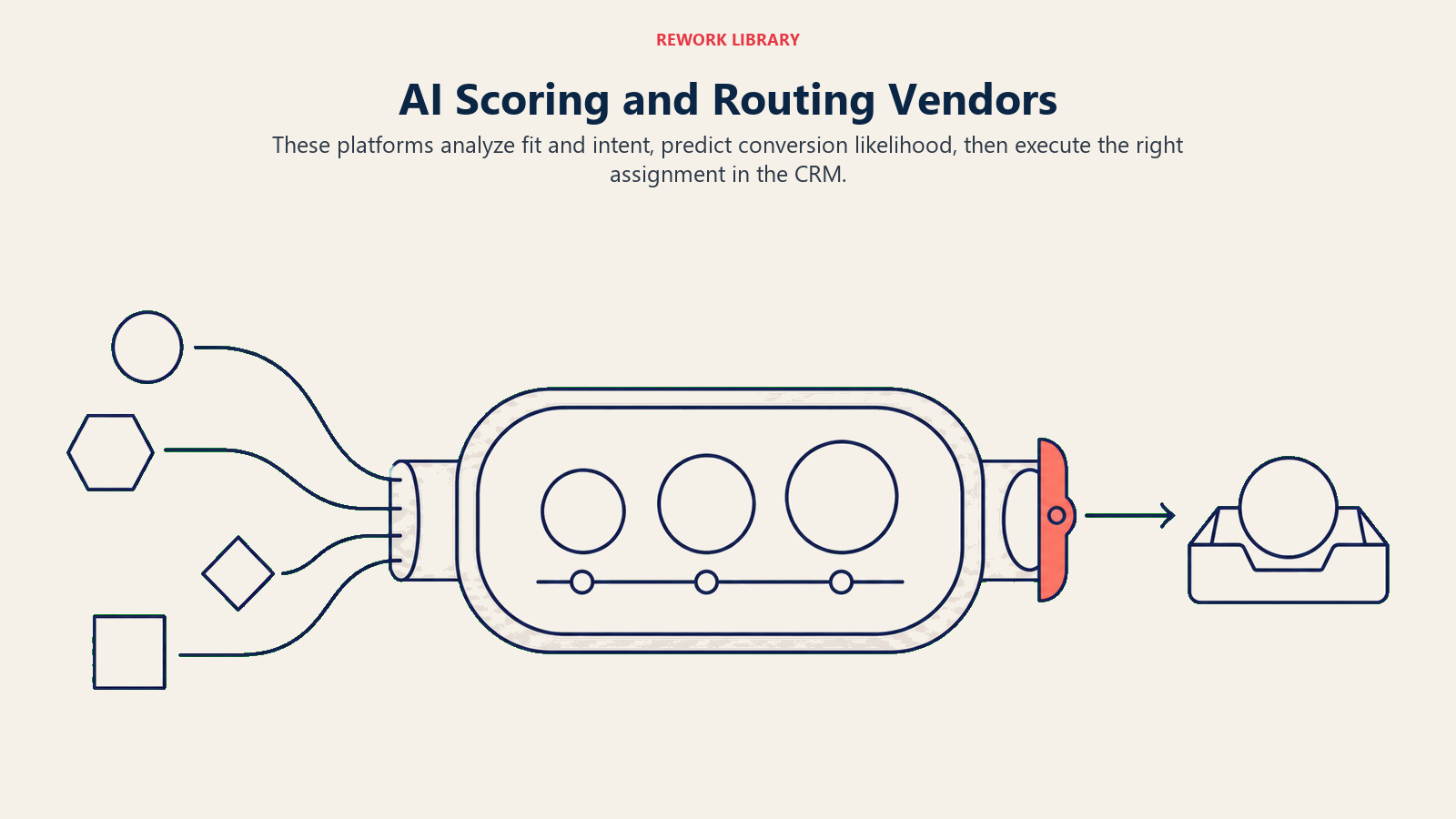
These vendors score inbound leads, contacts, and accounts based on fit and intent signals, then route or prioritize them automatically.
| Vendor | Primary strength | CRM integration | SMB pricing | Mid-market | Enterprise |
|---|---|---|---|---|---|
| Salesforce Einstein Lead Scoring | Native Salesforce scoring; no separate integration needed | Deep (native) | Included in Sales Cloud Einstein ($50/user/mo) | Same | Same; enterprise negotiated |
| HubSpot Predictive Lead Scoring | Accessible setup; native HubSpot | Deep (native) | Included in Marketing Hub Professional ($800/mo base) | Same | Enterprise: $3,600/mo base |
| MadKudu | B2B behavioral + firmographic scoring; multi-CRM | Standard | ~$1,000/mo | ~$2,500/mo | Custom |
| 6sense | Account-level intent + buying stage prediction | Standard | Custom only | Custom | Custom; widely cited at $50K-150K/yr |
| Demandbase | Account-based marketing (ABM) intent platform | Standard | Not SMB-focused | ~$40K/yr | Custom |
| Rework Sales AI | Lead scoring + routing native to CRM; included in the Sales Engine | Deep (native) | Sales Engine: from $69/mo billed yearly (5 seats) | Sales Engine, 50 seats: $258/mo billed yearly | Advanced or Enterprise edition; see rework.com/pricing |
Notes on this category:
Salesforce Einstein and HubSpot are default choices for teams already on those platforms. They're good enough for most use cases and require no additional vendor onboarding.
MadKudu is the best independent scorer for B2B SaaS companies with complex buying signals. It combines behavioral data (product usage, site activity) with firmographic data in ways that native CRM scoring typically doesn't. For a deeper look at how these models work, AI lead scoring beyond rules-based models covers the mechanics.
6sense and Demandbase are account-level platforms, not lead-level. They answer "which companies are in market" rather than "which leads within your CRM are most likely to close." Different use case, different buyer.
Rework's scoring is built into its Sales Engine. For teams that don't already have a CRM with scoring, it's the lowest-friction path to production lead scoring without a second vendor contract.
Pattern 2: Meeting Intelligence
ACE capabilities: Ingest + Analyze + Generate + Execute
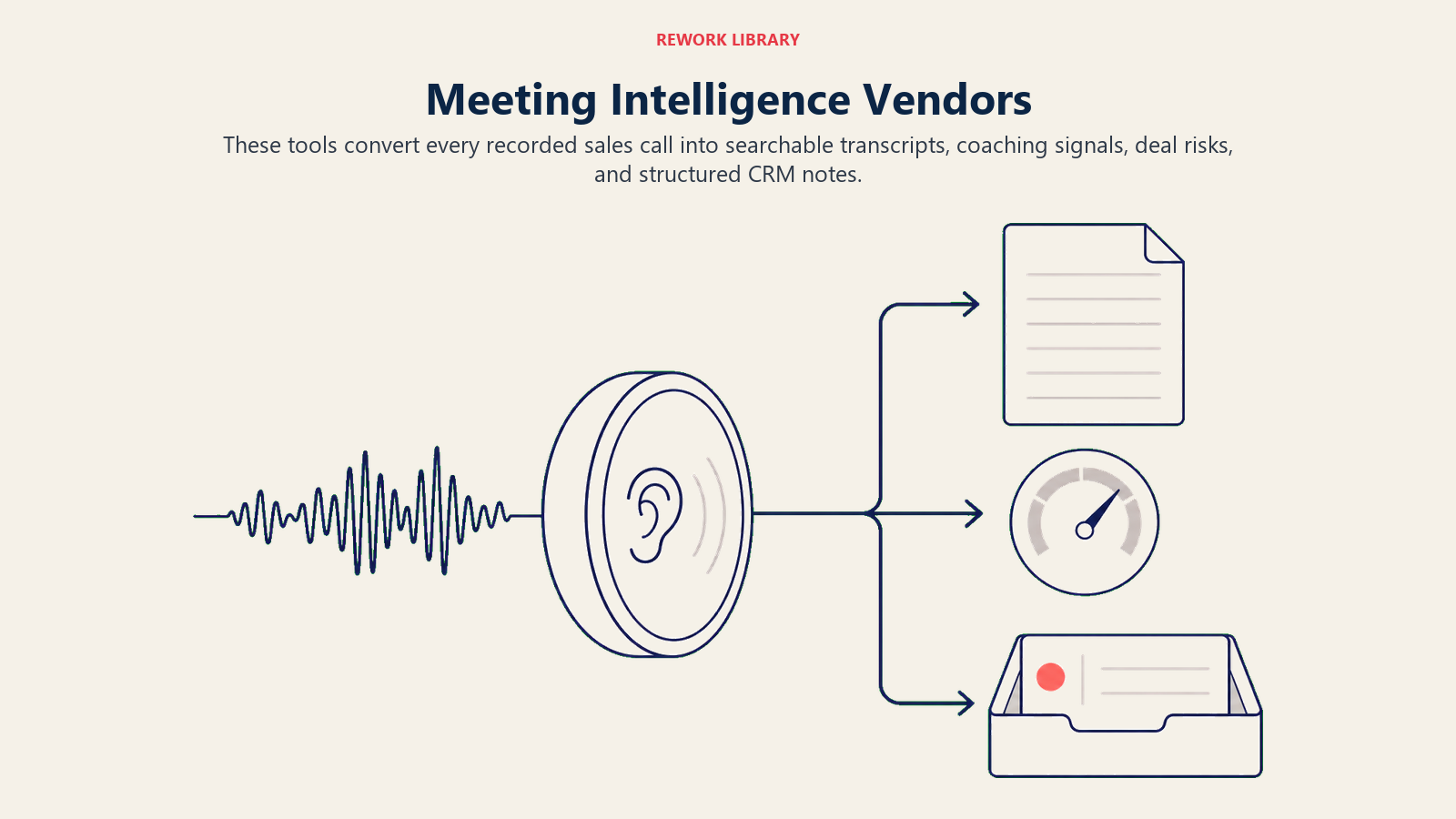
These vendors record calls, produce transcripts, extract deal signals, and write structured notes back to the CRM.
| Vendor | Primary strength | CRM integration | SMB pricing | Mid-market | Enterprise |
|---|---|---|---|---|---|
| Gong | Depth of call analytics; coaching features | Deep (Salesforce, HubSpot, others) | ~$100/user/mo; min seat requirements | $80-100/user/mo at volume | Negotiated; typically $60-80/user/mo at 200+ |
| Clari Copilot | Tight integration with Clari forecasting | Deep (Salesforce primary) | Bundled with Clari platform; ~$50-60/user/mo estimate | Same | Custom |
| Chorus (ZoomInfo) | Bundled with ZoomInfo data; large ecosystem | Standard-deep (Salesforce, HubSpot) | ~$70/user/mo standalone | Bundled discounts with ZoomInfo | Enterprise custom |
| Fireflies.ai | Price leader; broad platform coverage | Standard (Salesforce, HubSpot, 10+ others) | Business: $19/user/mo | Same list; volume discounts | Enterprise: custom |
| ExecVision | Coaching-focused; call library features | Standard | ~$30-50/user/mo | Similar | Custom |
| Salesloft Rhythm (Kaia AI) | Native to Salesloft sequence platform | Deep (Salesloft-native) | Included in Salesloft Advanced/Enterprise | Same | Custom |
Notes on this category:
Gong is the capability benchmark. If you want the deepest analytics, the best coaching dashboards, and the most complete competitor mention tracking, Gong leads the category. The price reflects it. See choosing a conversation intelligence tool for a full 10-dimension evaluation framework comparing these vendors.
Fireflies is the price leader by a wide margin. For teams that need reliable transcription and basic CRM write-back without the full analytics suite, Fireflies at $19/user/month is hard to beat. The coaching features are thin, but if you're not actively running a rep coaching program, that gap won't matter.
Chorus is worth considering if you're already a ZoomInfo customer and want one bundled contract. The integration between ZoomInfo prospecting data and Chorus call intelligence creates a connected record from first contact to closed won that standalone meeting intelligence tools can't match.
Clari Copilot makes most sense for teams already committed to Clari for forecasting. The data sharing between the call layer and the forecasting layer produces richer forecast signals than either system produces alone.
Pattern 3: Generative Research
ACE capabilities: Ingest + Analyze + Generate
These vendors synthesize data from multiple sources to produce account research briefs, contact intelligence, and personalized outreach inputs.
| Vendor | Primary strength | CRM integration | SMB pricing | Mid-market | Enterprise |
|---|---|---|---|---|---|
| Clay.com | Flexible data orchestration; no-code research pipelines | Standard (Salesforce, HubSpot, Airtable) | Explorer: free; Pro: $149/mo; Business: $800/mo | Business tier | Enterprise: custom |
| Apollo.io | Largest B2B contact database + outreach; Copilot for research | Standard | Free tier; Basic: $49/user/mo | Professional: $79/user/mo | Organization: custom |
| ZoomInfo Copilot | Intent data + AI-generated account summaries | Deep (Salesforce, HubSpot) | Not SMB-focused | ~$20-30K/yr base | Custom |
| Cognism | EMEA-focused contact data + research | Standard | ~$1,500/mo base | ~$3-5K/mo | Custom |
| Lavender | Email personalization AI; lightweight research for outreach | Standard (email integrations) | Free; Pro: $29/mo | Teams: $49/user/mo | Enterprise: custom |
| Perplexity for Teams | General research synthesis; web-current data | None (export only) | Pro: $20/user/mo | Teams: $20/user/mo | Enterprise: custom |
Notes on this category:
Clay has become the dominant tool for RevOps teams that want to build custom research workflows without writing infrastructure code. It's less a "vendor" and more a platform for building your own Generative Research pipeline. The learning curve is real; the capability ceiling is high.
Apollo is the best all-in-one for teams that want research and outreach in one platform. The database quality has improved significantly in 2025-2026. For mid-market B2B, Apollo often eliminates the need for both a separate data provider and a separate research tool.
Lavender is a specialist: it reads a draft email and suggests personalization based on the recipient's recent LinkedIn activity and company news. It doesn't replace account research, but it's the cheapest path to AI-assisted email personalization without a full research platform.
Perplexity for Teams is worth mentioning as an emerging pattern: sales teams using it for ad-hoc account research and industry context before calls. It's not a sales tool, but its web-current research capability fills gaps that ZoomInfo and Apollo miss on recent events.
Pattern 4: Workflow Copilot
ACE capabilities: Ingest + Generate + Execute
These vendors assist reps and managers in the CRM workflow: next best action suggestions, draft communications, pipeline review prep, and CRM hygiene prompts.
| Vendor | Primary strength | CRM integration | SMB pricing | Mid-market | Enterprise |
|---|---|---|---|---|---|
| Outreach | Sequence management + AI sequence optimization + Kaia call AI | Deep (Salesforce primary) | ~$100/user/mo | $80-100/user/mo | Custom |
| Salesloft | Cadence management + Rhythm AI copilot | Deep (Salesforce, HubSpot) | ~$75-100/user/mo | Similar | Custom |
| Salesforce Einstein Copilot | Native Salesforce; Sales Cloud integration | Deep (native) | Einstein: $50/user/mo add-on | Same | Enterprise negotiated |
| HubSpot AI Assistant | Native HubSpot; email drafts, contact summaries | Deep (native) | Included in paid tiers | Same | Same |
| Rework Sales AI | CRM-native NBA + draft assist + pipeline copilot | Deep (native) | Included in the Sales Engine (from $69/mo billed yearly, 5 seats) | Sales Engine, 50 seats: $258/mo billed yearly | Advanced or Enterprise edition; see rework.com/pricing |
| Microsoft Copilot for Sales | M365-native; Teams/Outlook integration | Deep (Dynamics primary; Salesforce connector) | $50/user/mo (requires M365) | Same | Custom |
Notes on this category:
Outreach and Salesloft are primarily sales engagement platforms (sequence execution) that have added AI copilot features. If you're running a high-volume outbound motion with structured sequences, they're the right starting point. If you're not running sequences, you're paying for capability you don't need.
Microsoft Copilot for Sales is the right answer for organizations already in the Microsoft 365 ecosystem with Dynamics CRM. The Teams and Outlook integration is genuinely deep. Outside the Microsoft stack, the integration story is weaker.
Salesforce Einstein Copilot is improving quickly. As of mid-2026, it's best suited for teams running complex Salesforce implementations where native integration depth matters more than AI feature sophistication.
Rework's copilot is the right fit for teams that don't already have a sales engagement platform and want scoring, meeting intelligence, and workflow copilot in one package without stitching multiple vendors together. The implementation roadmap for a single-platform approach runs significantly faster.
Multi-pattern platforms
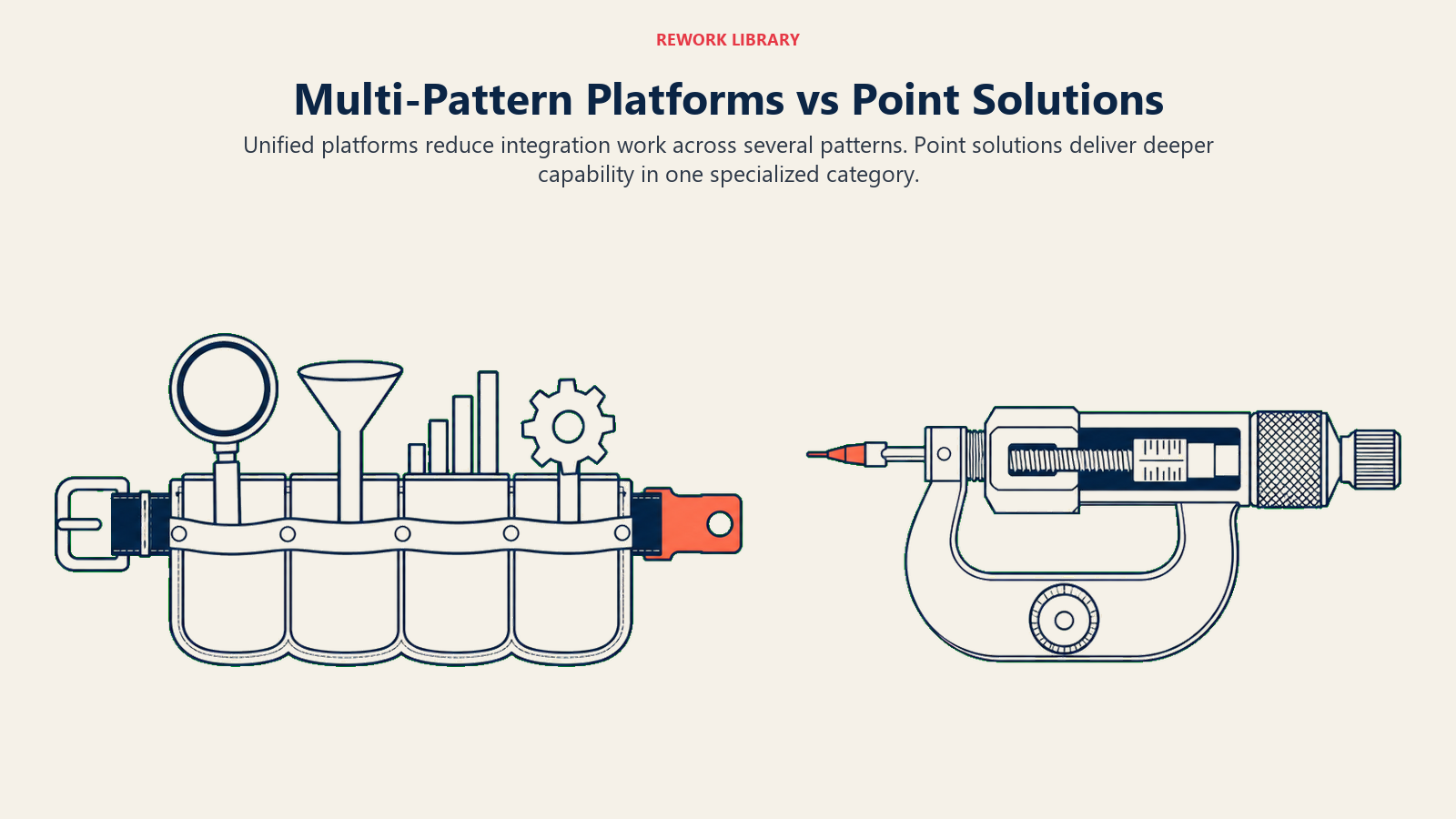
A separate category worth distinguishing: platforms that credibly serve three or four patterns and position as unified AI Sales Operator solutions.
| Platform | Patterns covered | Core strength | Primary market |
|---|---|---|---|
| Gong | Meeting Intelligence (primary) + Generative Research + Workflow Copilot | Call analytics and deal intelligence | Mid-market to enterprise; 50-2,000 seat range |
| Clari | Workflow Copilot (forecasting) + Meeting Intelligence + Scoring | Forecast accuracy and pipeline inspection | Mid-market to enterprise |
| Salesforce Einstein Suite | All 4 patterns | Native CRM integration; broadest ecosystem | Mid-market to enterprise; existing Salesforce customers |
| HubSpot AI | Scoring + Meeting Intelligence + Workflow Copilot | Accessible setup; SMB-friendly pricing | SMB to mid-market; HubSpot-native teams |
| Rework Sales AI | Scoring + Meeting Intelligence + Workflow Copilot | Single package, lower total cost, faster setup | 5-100 seat teams |
| Outreach + Kaia | Meeting Intelligence + Workflow Copilot + Generative Research (limited) | Outbound-heavy teams with sequence workflows | Mid-market |
Multi-pattern platforms trade depth per pattern for integration coherence. Gong's meeting intelligence is deeper than any platform that includes it as a secondary feature. But getting Gong's meeting data to talk cleanly to Salesforce Einstein's forecasting and MadKudu's scoring requires ongoing integration work. A unified platform avoids that integration burden at the cost of some per-pattern capability.
Evaluation criteria by pattern
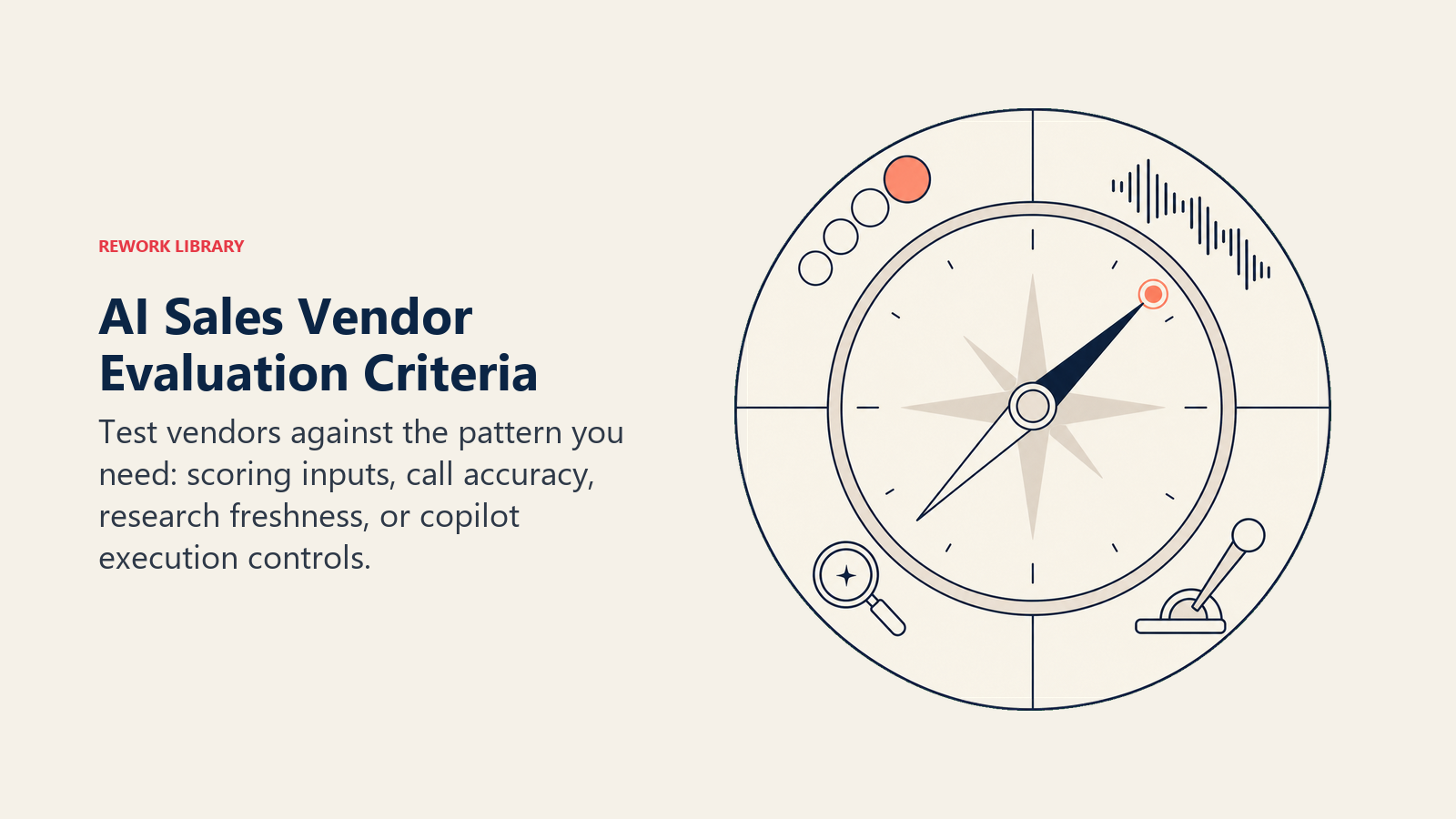
Each pattern needs its own test because transcript accuracy, scoring inputs, research freshness, and execution controls answer different buying questions.
For Scoring and Routing evaluations:
- What features does the model use? (Behavioral vs. firmographic vs. intent signals)
- How does the model get retrained as your data grows?
- Can routing rules be configured without engineering? (Territory complexity threshold)
- Is there an override mechanism for rep disputes?
For Meeting Intelligence evaluations:
- Transcript accuracy on your typical call quality (test with a sample of real calls, not vendor demos)
- CRM write-back configurability: which fields, what format, human review gate or auto-commit?
- Coaching workflow: how do managers access and action coaching data?
- Data processing agreement for call recording: EU data residency if needed?
For Generative Research evaluations:
- Data freshness: when was the underlying company database last updated?
- Source citation: does the brief cite where data comes from?
- Customization: can you define your research template, or is it fixed?
- Export format: does it write directly to CRM, or do you copy-paste?
For Workflow Copilot evaluations:
- What actions can the copilot Execute vs. only Generate for human approval?
- Where does the copilot surface (within CRM, sidebar extension, email client)?
- How are AI-generated suggestions distinguished from system-generated ones in the UI?
- What's the feedback loop for improving suggestions over time?
The platform convergence trend
The AI sales ops market in 2024-2025 was characterized by point solutions: best-in-class meeting intelligence from Gong, best-in-class research from Clay, best-in-class sequences from Outreach. Every category had a specialist leader.
That's changing in 2026 for two reasons.
The Forrester Wave for Revenue Orchestration Platforms, Q3 2024 identified this convergence as the defining market shift: three previously separate categories (sales engagement, conversation intelligence, revenue operations) merging into unified Revenue Orchestration Platforms. The Wave evaluated 12 vendors against 29 criteria and found that multi-pattern capability is now the primary differentiator.
First, the AI feature gap between specialist vendors and platform vendors is narrowing. Salesforce Einstein Copilot in 2024 was a rough beta. In 2026, it's a credible copilot that matches 70-80% of what a specialist copilot tool delivers. Not all the way there, but close enough that the integration tax of running a separate tool is hard to justify.
Second, consolidation is happening. ZoomInfo acquired Chorus. Salesloft added Kaia. Outreach added Kaia for Outreach. The standalone meeting intelligence vendors are being absorbed into sequences platforms. The standalone scoring vendors are building research features. Everyone is adding everything.
For buyers, the implication is clear: specialized point solutions are most at risk of platform overlap, capability commoditization, or acquisition disruption. If you sign a 3-year contract with a standalone meeting intelligence vendor in 2026, you're betting their capability stays differentiated and their independence holds for three years.
That's a reasonable bet for category leaders (Gong), riskier for tier-2 players.
What to look for in a platform that survives
If you're evaluating platforms with a 2-3 year horizon, the durability signals are:
Data network effect. Vendors trained on the largest deal corpus have a structural advantage in Scoring models. Gong's training data includes hundreds of millions of calls. MadKudu's models have processed millions of B2B deals. That data advantage is hard to replicate and grows over time.
CRM ecosystem depth. Platforms with the deepest Salesforce and HubSpot integrations are more defensible than those with shallow API read connections. Deep integrations mean customers can't easily swap vendors without re-engineering their CRM workflows.
Multi-pattern completeness. A platform covering 3-4 patterns is harder to displace than a point solution covering 1. Buying Gong means you're also getting research features and copilot features that might replace Clay and your copilot tool. That makes the Gong relationship stickier.
Pricing transparency. Vendors who publish pricing are easier to evaluate and tend to have more stable pricing over time. Enterprise-only pricing models make it hard to know what you're getting into until you're deep in a sales cycle.
The buy vs. build decision framework covers the economics of platform vs. point solution in more detail, including TCO comparisons at different team sizes.
The honest take on Rework in this landscape
Rework Sales AI is positioned as a single-package solution for teams in the 5-100 seat range who want scoring, meeting intelligence, and workflow copilot without managing multiple vendor contracts. Gartner's Critical Capabilities for Revenue Action Orchestration is the companion research to the Magic Quadrant, evaluating vendors on specific capability dimensions including AI-guided selling, pipeline analytics, and multi-channel execution, which maps directly to the four patterns in this article.
At the pricing level (Sales Engine from $69/month billed yearly with 5 seats included, and extra seats in blocks of 5 at $21/month), it's the most accessible full-stack AI sales ops option for SMB and lower mid-market teams. See rework.com/pricing for current details.
The trade-off is depth per pattern. Gong's call analytics are more sophisticated. 6sense's account intelligence is richer. MadKudu's scoring models are more nuanced for complex B2B. If any one pattern is mission-critical for your team and you need category-leading depth in that pattern, the specialist vendor wins.
If you need all four patterns to be "good enough" with minimal integration overhead and a tight budget, Rework is the strongest option in the sub-$5,000/year range for teams under 20 seats.
Conclusion
The AI sales ops market in 2026 is not a single category. It's four pattern categories with different vendor leaders, different buying criteria, and different consolidation dynamics. McKinsey's State of AI 2025 report notes that only 21% of commercial leaders have fully enabled enterprise-wide AI adoption in B2B sales, meaning most teams are still in early selection and deployment. The vendor choices made in 2026 will largely determine which organizations are in the leading cohort by 2028.
Use the pattern map as your evaluation lens. Start with which patterns your team needs most (most teams should start with Meeting Intelligence and Scoring; the implementation roadmap explains why). Identify the 2-3 vendors per pattern that fit your CRM and budget. Then evaluate based on pattern-specific criteria, not feature count.
The consolidation trend means the right answer in 2026 is almost always a multi-pattern platform over best-of-breed point solutions, unless you have dedicated RevOps engineering to manage the integration complexity. For most teams, that means picking Gong, Clari, Salesforce Einstein, HubSpot AI, or Rework as your primary platform and filling narrow gaps with point solutions only where the platform genuinely can't match specialist capability.
Rework Analysis: The most common vendor evaluation mistake in 2026 is comparing tools from different pattern categories on the same scorecard. Gong (Meeting Intelligence primary) and 6sense (Scoring + Account Intelligence primary) are solving different problems. Evaluating them side-by-side on a 20-feature matrix produces an inconclusive result because 12 of the features don't apply to both. Use the 2026 Sales Ops Vendor Map to identify which pattern category your bottleneck is in first, then evaluate vendors within that category using pattern-specific criteria. The team that defines the problem in pattern terms before selecting vendors consistently reaches deployment faster with better adoption outcomes.
The conversation intelligence segment alone is growing from $1.6 billion in 2023 to a projected $8.4 billion by 2030 at a 26% CAGR, faster than CRM and faster than sales engagement platforms. (Grand View Research) This growth rate reflects how quickly Meeting Intelligence is becoming a default capability rather than a differentiator.
See AI Sales Operator vs. Sales Engagement Platform for how AI-native sales ops tools compare to traditional sequence platforms that have added AI features.
Frequently Asked Questions
How is the AI sales ops vendor landscape organized?
The AI sales ops market is organized by four ACE pattern categories: Scoring and Routing (which vendors score leads and route them), Meeting Intelligence (which vendors record, transcribe, and analyze calls), Generative Research (which vendors synthesize account and prospect research), and Workflow Copilot (which vendors assist reps with deal actions, draft communications, and pipeline management). Every major vendor in the market serves one or more of these patterns. Evaluating vendors by pattern category rather than feature count produces clearer comparisons and better selection decisions.
What is the 2026 Sales Ops Vendor Map?
The 2026 Sales Ops Vendor Map is the pattern-organized visualization of 20+ AI sales ops vendors across the four ACE pattern categories, with pricing at SMB (10 seats), mid-market (50 seats), and enterprise (200+ seats) tiers. It replaces feature-matrix comparisons with pattern-category assignments, so buyers can identify which vendors compete in their specific bottleneck area rather than comparing fundamentally different tools on the same scorecard.
How big is the AI sales ops market in 2026?
The revenue intelligence platform market (the core category) has grown to $3.8 billion in 2024, expanding at a 34.6% CAGR. The broader AI for sales and marketing market is projected to grow from $58 billion in 2025 to $240 billion by 2030, a 32.9% CAGR. Conversation intelligence specifically is growing from $1.6 billion (2023) to a projected $8.4 billion by 2030 at a 26% CAGR, faster than CRM or sales engagement categories. Despite this growth, only 21% of commercial leaders have fully enabled enterprise-wide AI adoption in B2B sales.
What is the platform convergence trend in AI sales ops?
Three previously separate categories (sales engagement, conversation intelligence, revenue operations) are merging into unified Revenue Orchestration Platforms. The Forrester Wave for Revenue Orchestration Platforms, Q3 2024, identified this convergence as the defining market shift, evaluating 12 vendors across 29 criteria and finding multi-pattern capability as the primary differentiator. ZoomInfo acquired Chorus, Salesloft added Kaia, Outreach added Kaia for Outreach. For buyers, standalone meeting intelligence and standalone scoring vendors carry more vendor-continuity risk than multi-pattern platforms.
When should you choose a platform vs. best-of-breed tools?
Choose a platform when you need 3-4 AI patterns covered and have lean RevOps (under 2 people managing the tech stack): integration management overhead of 4-5 separate tools is material and reduces overall adoption. Choose best-of-breed when you need category-leading depth in a specific pattern (Gong's call analytics depth exceeds any platform that includes meeting intelligence as a secondary feature) and have dedicated RevOps engineering to manage integrations. At 50 seats, platform wins on TCO. At 500 seats, best-of-breed is often worth the integration investment.
What does Rework Sales AI do in the vendor landscape?
Rework Sales AI covers three of the four patterns (Scoring, Meeting Intelligence, and Workflow Copilot) in a single package optimized for 5-100 seat teams. It's the lowest-friction full-stack AI sales ops option for SMB and lower mid-market teams at its pricing tier (Sales Engine from $69/month billed yearly with 5 seats included; 10 seats run $90/month billed yearly). The trade-off is per-pattern depth: Gong's call analytics and 6sense's account intelligence are more sophisticated. Rework is the right fit when all four patterns need to be "good enough" and minimal integration overhead matters more than any single pattern being best-in-class.
What vendors lead each AI sales ops pattern category?
Scoring and Routing: Salesforce Einstein (best for existing Salesforce teams), MadKudu (best independent B2B SaaS scorer), 6sense (best account-level intent). Meeting Intelligence: Gong (capability benchmark, highest cost), Fireflies (price leader), Clari Copilot (best with Clari forecasting). Generative Research: Clay (most flexible, highest learning curve), Apollo (best all-in-one for research + outreach), ZoomInfo Copilot (best for US enterprise intent overlay). Workflow Copilot: Outreach and Salesloft (outbound-heavy teams), Salesforce Einstein Copilot (existing Salesforce shops), Rework Sales AI (full-stack for teams under 100 seats).
How should you evaluate AI sales ops vendors to avoid common mistakes?
Four evaluation steps prevent the most common mistakes: first, define which pattern category your current bottleneck is in (don't evaluate scoring tools when your problem is meeting follow-up); second, use pattern-specific evaluation criteria (not a generic feature matrix); third, test transcript accuracy with your actual call recordings, not vendor demo calls; fourth, verify CRM integration depth by asking which fields write back automatically vs. require manual rep entry. Teams that skip step one and compare tools from different pattern categories on the same scorecard consistently report evaluation processes that are inconclusive and vendor selections they regret within 18 months.
What to read next
- The AI Pattern Vendor Landscape Map: how these four pattern categories fit within the full 10-pattern vendor landscape
- Buy vs. Build for AI Sales Operations: the economics framework for choosing between platform and build approaches
- Choosing a Conversation Intelligence Tool: detailed evaluation of Pattern 2 vendors with a 10-dimension framework
- AI Sales Ops Implementation Roadmap: how to sequence vendor selection across the four patterns
- AI Sales Ops Governance and Audit Trails: vendor governance requirements that affect platform selection

Co-Founder, Rework.com
On this page
- How to read this map
- The 2026 Sales Ops Vendor Map
- Pattern 1: Scoring and Routing
- Pattern 2: Meeting Intelligence
- Pattern 3: Generative Research
- Pattern 4: Workflow Copilot
- Multi-pattern platforms
- Evaluation criteria by pattern
- The platform convergence trend
- What to look for in a platform that survives
- The honest take on Rework in this landscape
- Conclusion
- What to read next