Cuando los Patrones de AI Se Convierten en Deuda Técnica
Turn this article into takeaways for your work.


Each assistant summarizes the article only for you and suggests best practices for your work.
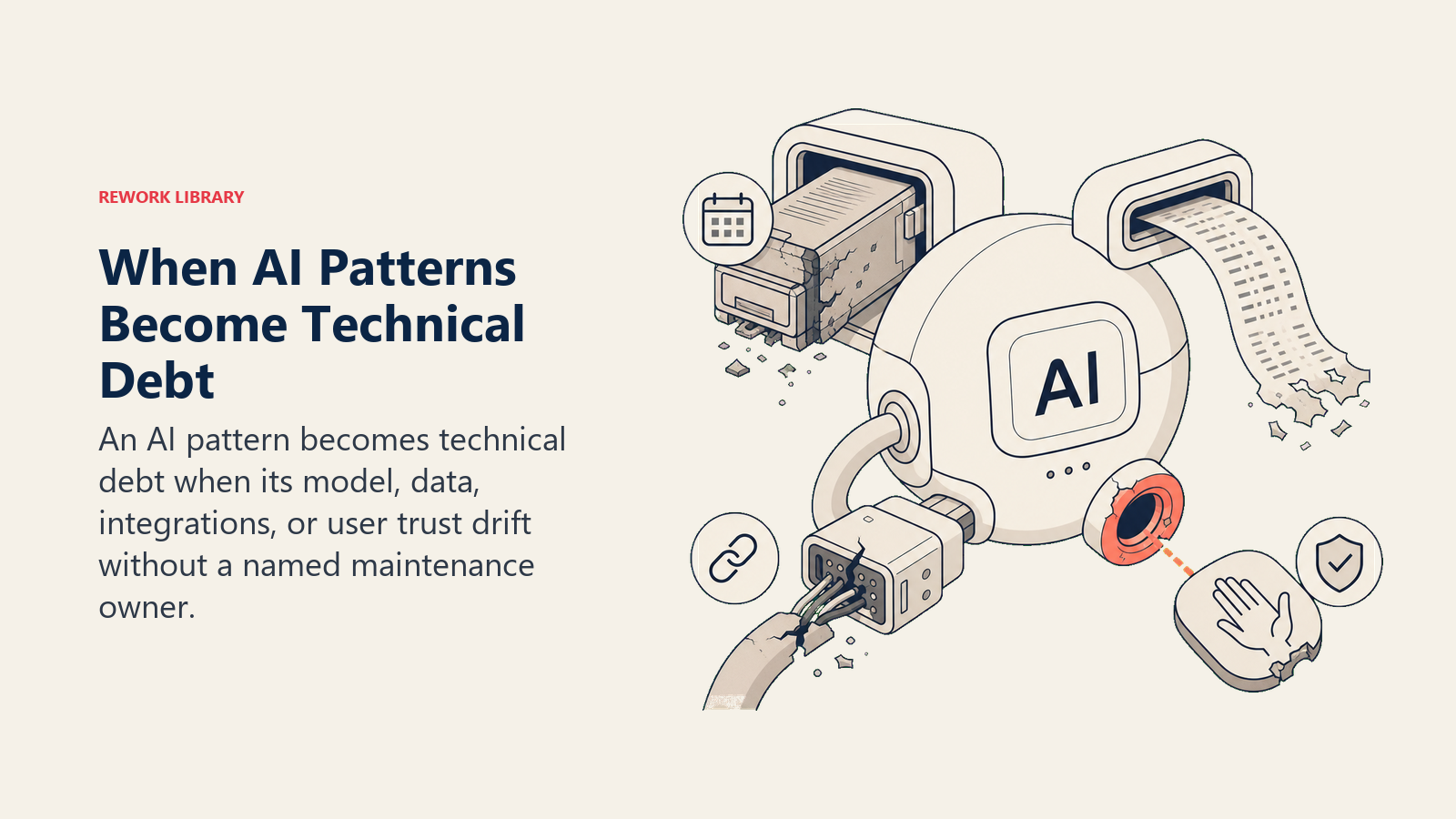
La deuda de software tradicional es visible cuando se convierte en un problema. Tiempos de carga lentos. Despliegues fallidos. Ingenieros quejándose del código en las revisiones. Se notan los síntomas antes de que el sistema falle. La definición canónica de deuda técnica de Martin Fowler la enmarca como deficiencias en la calidad interna que hacen que las modificaciones futuras sean más difíciles. Es la tasa de interés de la deuda que se paga lo sepa o no. La deuda de AI agrega una segunda dimensión a ese marco: no solo calidad del código, sino calidad del modelo, calidad de los datos y calidad de la confianza, todas degradándose de forma independiente.
La deuda de AI no funciona de esa manera. La precisión del modelo de Scoring and Routing se degrada del 84% al 71% durante ocho meses, pero nadie lo nota porque nadie está ejecutando verificaciones de precisión y el descenso de la tasa de conversión parece un cambio de mercado. El RAG Assistant comienza a responder desde documentos de política obsoletos, pero los representantes de soporte no lo detectan porque han dejado de leer las fuentes citadas. Las sugerencias del Workflow Copilot empeoran levemente cada trimestre, y los representantes dejan de aceptarlas en silencio en lugar de presentar un ticket.
Para cuando lo nota, los usuarios ya han tomado sus propias medidas. Construyeron su propia solución alternativa. Dejaron de usar la función de AI. Encontraron una herramienta diferente. El sistema técnicamente funciona. Su ROI se ha evaporado en silencio.
Este es el artículo que los operadores experimentados desearían haber leído antes del segundo año de su despliegue de AI.
Las cuatro formas de deuda técnica de AI
La deuda de AI se acumula en cuatro categorías distintas. Entenderlas por separado le ayuda a asignar la responsabilidad y construir ritmos de mantenimiento.
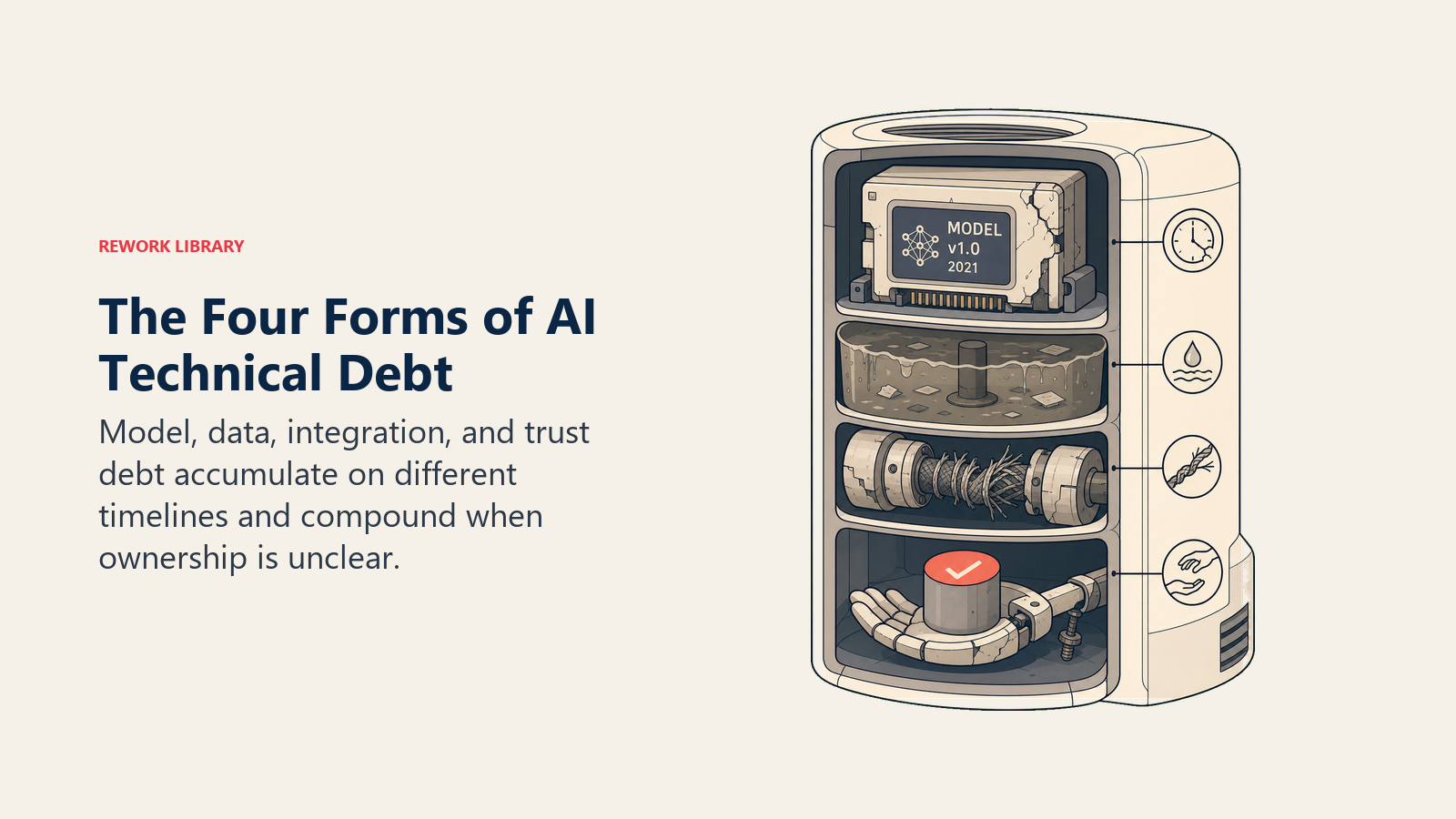
Deuda de modelo: El modelo de AI subyacente está desactualizado, fue dado de baja por el proveedor o simplemente ya no es la herramienta adecuada para el trabajo. GPT-3.5 Turbo era una elección razonable en 2023. En 2026, está varias generaciones de capacidades por detrás. Los sistemas construidos sobre APIs de modelos dados de baja eventualmente dejarán de funcionar. Los sistemas que siguen ejecutándose en modelos más antiguos pueden estar dejando mejoras de calidad significativas sobre la mesa.
La deuda de modelo también incluye modelos ajustados o personalizados que fueron entrenados con una instantánea de sus datos que ya no refleja los patrones actuales. Un clasificador ajustado entrenado con sus tickets de soporte de 2022 fue construido para una versión del producto que puede que ya no exista.
Deuda de datos: Los datos de entrenamiento, la base de conocimiento, la referencia de Scoring o el contenido del índice están obsoletos, sesgados o incompletos. Esta es la forma más común y más silenciosa de deuda de AI. El sistema no falla. Simplemente se vuelve gradualmente menos preciso a medida que el mundo cambia mientras los datos permanecen fijos.
La deuda de datos es particularmente insidiosa porque el sistema continúa devolviendo resultados que parecen correctos. El formato es correcto. La confianza es alta. El contenido es incorrecto de maneras que requieren conocimiento del dominio para detectar.
Deuda de integración: Los sistemas downstream han cambiado pero la integración de AI no se ha puesto al día. El CRM agregó nuevos campos que el Workflow Copilot no completa. La plantilla de factura cambió y el esquema de extracción de Vision Extract no coincide. La API del calendario cambió su método de autenticación y el envío al CRM del sistema de Meeting Intelligence falla silenciosamente tres días al mes.
La deuda de integración es la más probable de causar fallos agudos en lugar de degradación gradual. Cuando falla, suele fallar completamente y de manera visible. El riesgo es que nadie monitorea los fallos silenciosos entre los eventos de rotura.
Deuda de confianza: Los usuarios han perdido la confianza en el patrón debido a errores acumulados. El sistema puede funcionar técnicamente de manera correcta, pero la tasa de adopción ha colapsado porque los usuarios no creen que los resultados sean confiables. La deuda de confianza es la más difícil de recuperar, porque requiere cambiar el comportamiento humano, no solo resolver un problema técnico.
Key Facts: Escala de la Deuda Técnica de AI
- La deuda de AI global no gestionada alcanzará los $2 billones para 2026, según Gartner. Las organizaciones gravadas con esta deuda gastan hasta un 40% más en mantenimiento y entregan funciones un 50% más lentamente que sus competidores menos endeudados.
- El 55% de los modelos de ML en producción requieren reentrenamiento dentro de los 90 días, mientras que la mayoría de los presupuestos de despliegue solo contemplan el costo de entrenamiento inicial, creando deuda de mantenimiento sistemática desde el primer ciclo de despliegue. (DataRobot/Algorithmia Survey, 2025)
- La deuda técnica pesada puede consumir entre el 20-40% de los presupuestos de TI solo en mantenimiento, dejando mucho menos para la innovación genuina y las nuevas inversiones en patrones de AI. (McKinsey Technology Research, 2025)
Cómo acumula deuda cada patrón
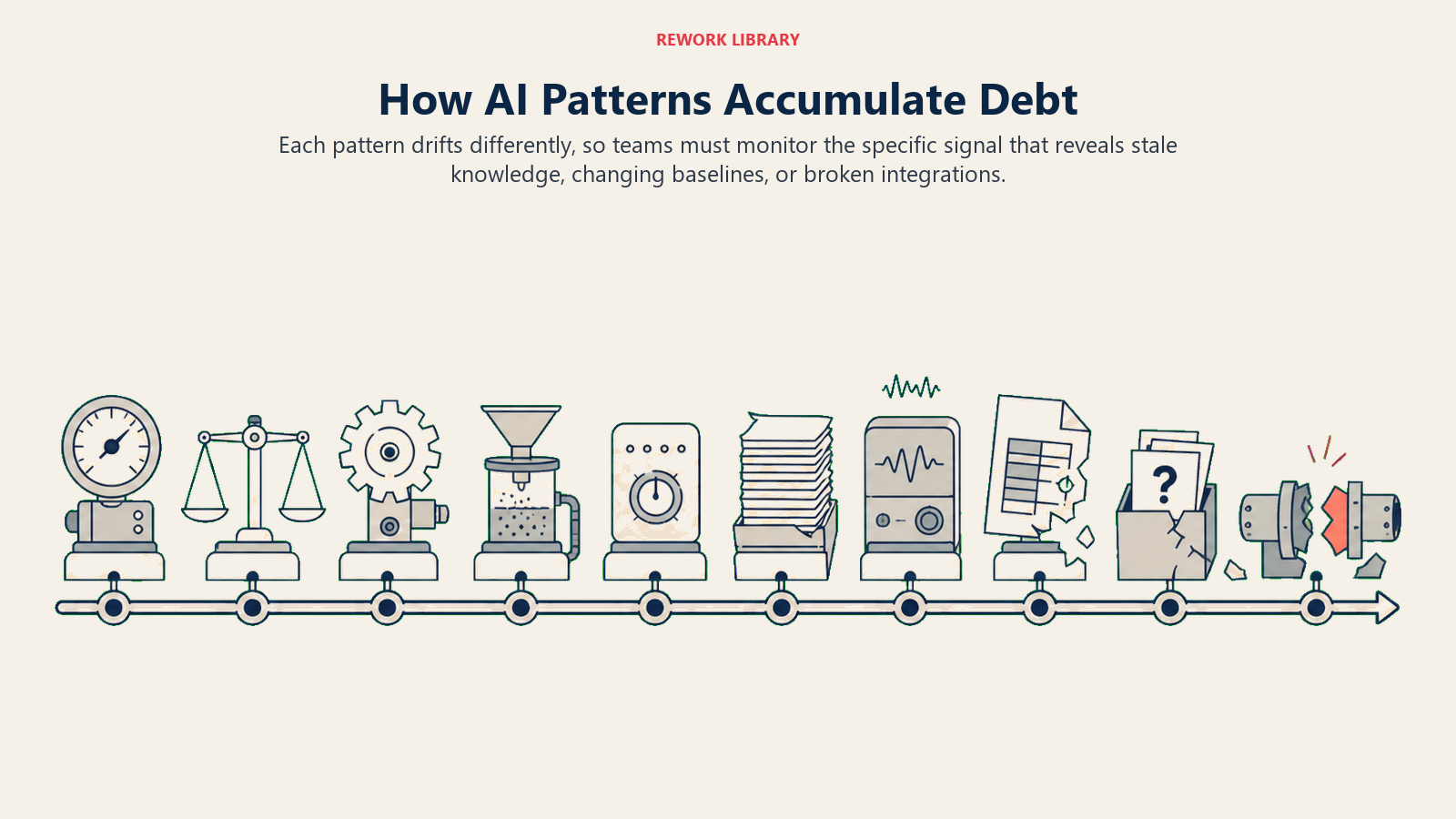
Cada patrón tiene una firma de deriva distinta, así que la señal de mantenimiento útil depende de los datos, el modelo y las integraciones que mantienen operativo ese patrón.
RAG Assistant: obsolescencia de la base de conocimiento
Cronograma: meses a años sin mantenimiento activo.
Un RAG Assistant desplegado sobre una base de conocimiento limpia y bien estructurada se convierte gradualmente en una responsabilidad a medida que los documentos se vuelven obsoletos. Los documentos de política hacen referencia a procedimientos antiguos. La documentación del producto describe funciones que han sido renombradas o eliminadas. Las guías para empleados hacen referencia a estructuras organizacionales que ya no existen. El sistema continúa devolviendo respuestas con confianza, citando documentos que ahora son incorrectos.
El efecto acumulado: los usuarios que detectan respuestas incorrectas dejan de usar el sistema. Los que no las detectan actúan basándose en información incorrecta. El primero crea deuda de confianza. El segundo crea riesgo para el negocio.
Indicador de deuda: rastree la tasa de retroalimentación "obtuve una respuesta incorrecta" y el porcentaje de documentos fuente con más de 12 meses de antigüedad. Cuando más del 30% de su base de conocimiento tiene más de un año, tiene deuda de datos independientemente de si ha notado síntomas aún.
Scoring + Routing: deriva del modelo por cambios en el ICP
Cronograma: 12-18 meses antes de una degradación significativa en la mayoría de los contextos B2B.
Un modelo de Scoring de leads se entrena con sus datos históricos de conversión. Aprende que las empresas de 50-200 empleados en servicios financieros que utilizan un stack tecnológico específico tienden a cerrar. Ese era su perfil de cliente ideal cuando entrenó el modelo. Si su ICP ha cambiado (subió de mercado, ingresó a un nuevo vertical, cambió sus precios), el modelo ahora está evaluando según un perfil desactualizado.
La deriva es gradual. El modelo no empieza a puntuar a todos de forma incorrecta de repente. Desarrolla sesgos sistemáticos: sobrepuntúa las empresas que coinciden con el ICP antiguo (ahora cierran menos frecuentemente), subpuntúa las empresas en nuevos verticales (cierran a tasas más altas pero el modelo aún no lo sabe).
Indicador de deuda: ejecute su modelo contra una cohorte reciente de deals cerrados ganados. ¿Qué porcentaje fue puntuado en el cuartil superior? Si está disminuyendo del 65% hacia el 45%, el modelo está derivando.
Vision Extract: nuevos formatos de documentos
Nuevos proveedores, nuevas plantillas, nuevos tipos de documentos no representados en los datos de entrenamiento originales. El sistema maneja perfectamente los documentos con los que fue entrenado. Maneja las nuevas variaciones de formato con tasas de error crecientes que nadie detecta porque los resultados parecen plausibles.
El modo de fallo silencioso: un equipo de cuentas por pagar que procesa facturas asume que la precisión de Vision Extract es estable al 98%. Un proveedor principal cambia a una nueva plantilla de factura. La precisión de extracción en las facturas de ese proveedor cae al 82%. La tasa de error del 18% pasa desapercibida hasta una auditoría de discrepancias de pagos seis meses después.
Indicador de deuda: verificación puntual mensual de precisión en documentos de sus 10 fuentes de mayor volumen. Si la precisión de alguna fuente cae por debajo del umbral, agregue ese formato al Pipeline de entrenamiento.
Meeting Intelligence: deriva de vocabulario y productos
Las llamadas de ventas de 2024 hacen referencia a una gama de productos, un conjunto de objeciones y un panorama competitivo que puede verse muy diferente en 2026. El sistema de Meeting Intelligence entrenado con llamadas de 2024 puede atribuir incorrectamente nuevos nombres de productos, confundir nuevas menciones de competidores y tener dificultades con la terminología introducida en actualizaciones recientes de productos.
Esta es una deuda de menor severidad que la deriva del Scoring. El sistema sigue produciendo resultados útiles, solo con un ruido creciente. Pero ese ruido degrada la calidad del coaching, la precisión de los datos del CRM y la confianza del manager en los datos.
Indicador de deuda: revisión puntual trimestral de 20 resúmenes de llamadas recientes contra las grabaciones de las llamadas reales. Verificando específicamente: ¿se transcriben correctamente los nuevos nombres de productos? ¿Se reconocen los nuevos nombres de competidores?
Anomaly Agent: deriva de la referencia por cambios en el negocio
Un Anomaly Agent aprende cómo se ve "normal" y señala las desviaciones. Si su negocio cambia fundamentalmente (nueva adquisición, giro importante del producto, cambio en los ciclos de pago, nuevo cliente empresarial con diferentes patrones de volumen), la referencia se vuelve incorrecta. Lo que solía ser anómalo ahora es normal. Lo que solía ser normal ahora es genuinamente anómalo.
La peor versión: un sistema de detección de fraude que señala el comportamiento de pago de un segmento de clientes recién adquirido como sospechoso porque no coincide con la distribución de entrenamiento original. Cada pago legítimo de ese segmento activa una alerta. El equipo de alertas se ahoga en falsos positivos, empieza a ignorarlos y pierde un evento de fraude real en el ruido.
Indicador de deuda: tasa de falsos positivos. Cuando su tasa de falsos positivos empieza a subir sin un aumento correspondiente en las anomalías reales, su referencia ha derivado.
Generative Research: obsolescencia del índice y fuentes obsoletas
Los sistemas de investigación que extraen de fuentes indexadas solo son tan actuales como su índice. Un sistema de inteligencia competitiva que fue indexado hace 6 meses ha perdido 6 meses de actividad de competidores. Un sistema de investigación de mercado con enlaces de fuentes rotos está sintetizando desde un corpus incompleto y llenando los vacíos con confabulación.
El modo de fallo sutil: el sistema continúa devolviendo informes de investigación confiados y bien formateados. Solo son cada vez más incompletos. El usuario que no sabe qué falta no sabe lo que no sabe.
Indicador de deuda: porcentaje de fuentes indexadas con marca de tiempo del último rastreo anterior a 30 días y tasa de enlaces de fuentes rotos.
Document Review: plantillas de comparación desactualizadas
Un sistema de Document Review entrenado para señalar desviaciones de sus plantillas de contrato estándar se vuelve menos útil a medida que sus plantillas evolucionan. Si su equipo legal actualizó su MSA estándar hace dos años y el sistema de revisión está comparando con la plantilla antigua, señala "desviaciones" que ahora son su posición estándar, creando ruido que erosiona la confianza del abogado en el sistema.
Indicador de deuda: tasa de señales falsas revisada trimestralmente. Cuando los abogados desestiman regularmente las señales de AI como "eso es lo estándar ahora," la plantilla de comparación está desactualizada.
Workflow Copilot: evolución del modelo del CRM
El copilot fue diseñado alrededor de una estructura de datos específica del CRM. A medida que el esquema del CRM evoluciona (nuevos campos, campos obsoletos, nombres de campos cambiados, nuevos tipos de registros), las sugerencias del copilot se vuelven menos precisas porque se generan desde una comprensión desactualizada de qué significan los campos y qué valores deben contener.
El síntoma visible: sugerencias del copilot que no tienen en cuenta los campos que importan ahora, o que rellenan campos de maneras que ya no coinciden con cómo el equipo usa realmente el CRM.
Indicador de deuda: tendencia de la tasa de aceptación de sugerencias. Si está bajando trimestre a trimestre sin un cambio en la configuración del copilot, la deuda de integración se está acumulando.
Personalization Engine: restricciones de datos de perfil
Esta es la categoría de deuda de AI con la mayor fuerza impulsora externa. Los datos de comportamiento del usuario que impulsaban su Personalization Engine en 2022 están cada vez más restringidos por el Artículo 7 del GDPR, la CCPA y los marcos de consentimiento de cookies. Las señales de comportamiento de terceros se están agotando. Los datos de primera parte en los que se basaba pueden ahora requerir consentimiento de participación que antes no necesitaba.
Un Personalization Engine construido sobre señales de comportamiento a nivel de sesión a las que ya no tiene acceso se está convirtiendo lentamente en un motor de mejor suposición posible que tiene una interfaz sofisticada. El modelo sigue funcionando. La calidad de la señal que se degrada por debajo es invisible hasta que los resultados de las pruebas A/B empiezan a declinar.
Indicador de deuda: tasa de cobertura de señales de datos. ¿Qué porcentaje de sus usuarios tiene señal de comportamiento suficiente para una personalización significativa? Si esto está bajando, el suministro de datos subyacente es el problema, no el modelo.
Autonomous Agent: cambios en las APIs de herramientas
Los Autonomous Agents dependen de un stack de APIs de herramientas externas. Cuando cualquiera de esas APIs cambia (nuevos requisitos de autenticación, endpoints obsoletos, formatos de respuesta cambiados, modificaciones de límites de velocidad), la capacidad Execute del agente se rompe. Parcial o completamente.
La versión insidiosa: la API cambia de una manera que sigue devolviendo respuestas, pero las respuestas tienen un formato diferente. El agente continúa funcionando, interpretando incorrectamente el nuevo formato, tomando acciones basadas en datos mal leídos. Este es un fallo de integración silencioso.
Indicador de deuda: monitoreo de tasa de errores de llamadas a herramientas. Cualquier aumento en los fallos de Execute debe activar una investigación inmediata. No asuma que es un error transitorio.
"La precisión de un modelo de Scoring que se degrada del 84% al 71% durante ocho meses parece un cambio de mercado desde afuera. Las tasas de conversión disminuyen. El equipo de ventas culpa a la presión competitiva. Nadie verifica si la calibración del ICP del modelo ha derivado. El verdadero problema es la deuda de modelo. El modelo está puntuando con confianza según un perfil de cliente que ya no refleja quién realmente compra." (Rework Model Drift Analysis, 2026)
La Doctrina del Rebuild del Año 2
La Doctrina del Rebuild del Año 2 es un principio de planificación que trata cada despliegue de patrón de AI como una versión 1 con una vida útil esperada de 18-24 meses antes de que se requiera un rebuild significativo. La doctrina existe porque los sistemas de AI acumulan cuatro formas independientes de deuda (de modelo, de datos, de integración y de confianza) en diferentes cronogramas, y el efecto compuesto típicamente obliga a elegir entre migración o degradación continua al final del segundo año. La implicación operativa de la doctrina es diseñar rutas de migración durante la construcción inicial, presupuestar para los costos de rebuild del año 2 en el caso de negocio inicial y asignar la responsabilidad operativa con ritmos de mantenimiento explícitos antes del despliegue, no después de que aparezcan los primeros signos de degradación.
Rework Analysis: Basándose en el hallazgo de Gartner de que la deuda de AI no gestionada alcanza los $2 billones para 2026 y el hallazgo de DataRobot de que el 55% de los modelos de ML necesitan reentrenamiento dentro de los 90 días, la Doctrina del Rebuild del Año 2 aborda la subinversión sistemática en el mantenimiento de AI que convierte patrones manejables en pasivos costosos. En los datos de implementación de Rework, los equipos que presupuestan explícitamente para los costos de rebuild del año 2 en su proceso de aprobación inicial experimentan costos de mantenimiento del año 2 en promedio un 60% más bajos que los equipos que tratan el despliegue como un evento único, porque han construido ritmos de mantenimiento y rutas de migración desde el principio en lugar de descubrir la necesidad de ellos cuando la deuda ya se ha acumulado.
La carga de mantenimiento que nadie planifica
Esto es lo que "mantener un patrón de AI" realmente requiere como compromiso operativo:
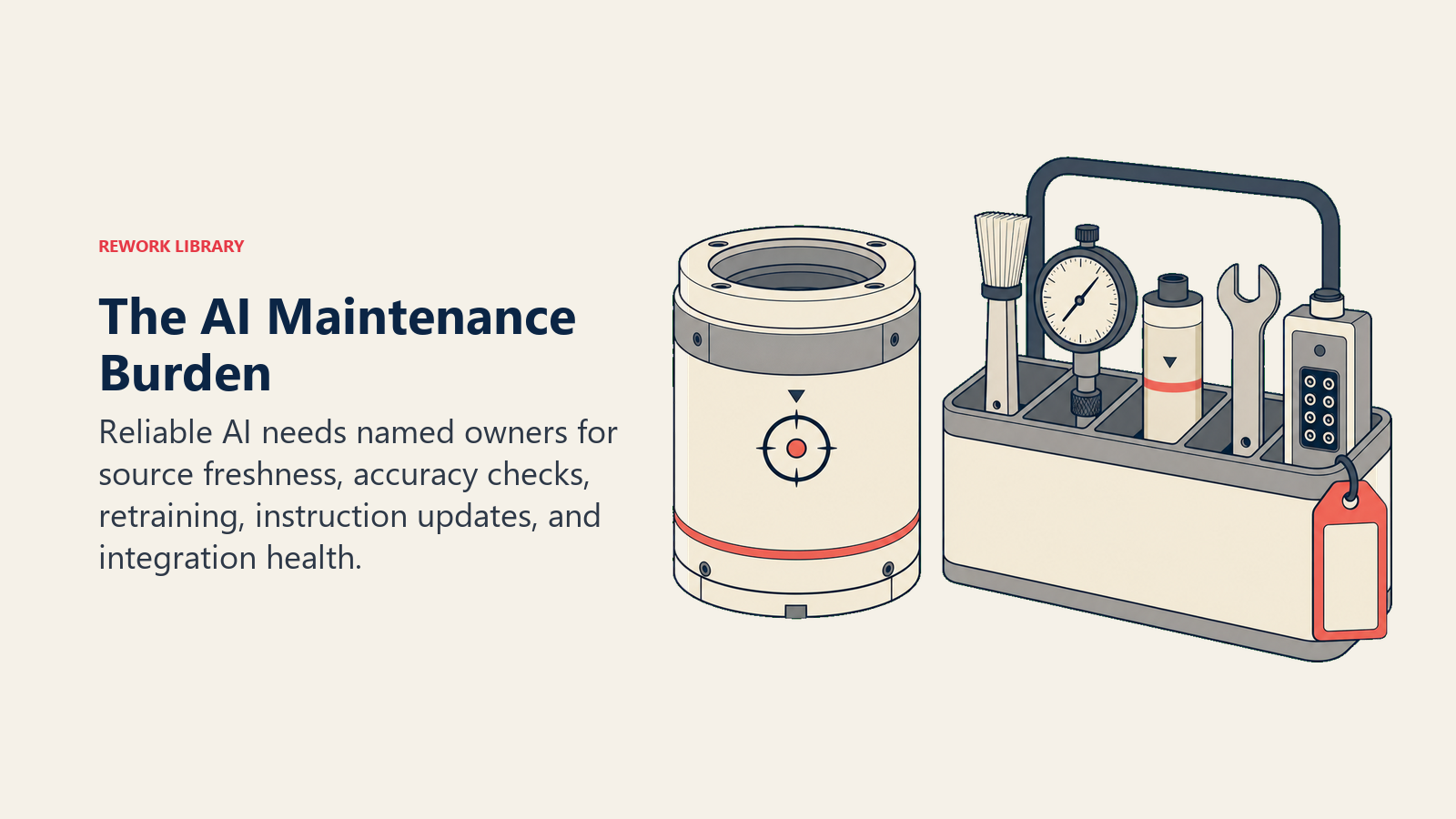
RAG Assistant: Alguien es propietario de la base de conocimiento. La revisan trimestralmente, eliminan documentos obsoletos, agregan nuevos, actualizan las políticas modificadas. Este no es un trabajo de ingeniería. Es propiedad de contenido. Si nadie está asignado, los documentos quedan obsoletos por defecto.
Scoring and Routing: Alguien ejecuta verificaciones de precisión del modelo en un conjunto de prueba trimestral. Alguien reentrena el modelo cuando la precisión cae por debajo del umbral. En la mayoría de las organizaciones, esto requiere tiempo de ciencia de datos, lo que significa que requiere programación y asignación de recursos, no solo un recordatorio en el calendario. La verificación de preparación de datos por patrón le da la plantilla de auditoría por patrón para estas verificaciones.
Workflow Copilot: Alguien revisa la tasa de aceptación de sugerencias y la precisión de las sugerencias mensualmente. Alguien actualiza la configuración del prompt cuando el modelo del CRM cambia. Esto es trabajo de product management, no de ingeniería. Pero necesita ser asignado explícitamente.
Autonomous Agent: Alguien revisa los registros de ejecución semanalmente durante los primeros 90 días y mensualmente después. Alguien valida la compatibilidad de las APIs de herramientas después de cada actualización de terceros. Este es el patrón de mayor mantenimiento en producción.
La verdad no expresada: si despliega un patrón sin asignar la responsabilidad operativa, el patrón tiene un propietario de mantenimiento por defecto. Ese propietario es nadie. Y nada acumula deuda más rápido que un sistema sin propietario. La investigación del MIT Sloan Management Review sobre la gestión de la deuda técnica en la era de AI estima el costo anual de la deuda técnica no gestionada en más de $2,41 billones solo en Estados Unidos, y advierte específicamente que las organizaciones con deuda heredada no resuelta tienen más dificultades para desplegar AI de manera efectiva. La deuda antigua se convierte en el suelo sobre el que se construyen los nuevos sistemas de AI.
Cuando el modelo subyacente cambia
Los proveedores actualizan sus modelos de base. GPT-3.5 Turbo se convirtió en GPT-3.5 Turbo Instruct, que se convirtió en GPT-4 Mini. Cada transición cambia el comportamiento del modelo de maneras que son sutiles pero reales. Las respuestas a los prompts que eran confiables se vuelven variables. Los formatos de salida que eran consistentes cambian ligeramente. Los sistemas downstream que analizan los resultados de AI fallan con los cambios de formato.
Si su patrón desplegado depende de un comportamiento específico del modelo (un formato de respuesta específico, un estilo de razonamiento específico, una convención específica de seguimiento de instrucciones), una actualización del modelo del proveedor puede romper silenciosamente ese comportamiento sin ningún cambio en la API. Su sistema sigue funcionando. Los resultados se degradan.
La mitigación: ancle la versión del modelo en los despliegues de producción. No consuma automáticamente la última versión del modelo en producción. Pruebe las actualizaciones del modelo en un entorno de staging con su biblioteca de prompts de producción antes de promoverlas. Consulte migración de patrones para el proceso de actualización completo.
Recuperación de la confianza después de errores acumulados
Esta sección es la más difícil de leer con honestidad. Cuando un patrón ha acumulado suficientes errores como para que los usuarios hayan dejado genuinamente de confiar en él, las mejoras técnicas por sí solas no restauran el uso.
Los usuarios construyen modelos mentales. Si han aprendido que el RAG Assistant a veces está equivocado de maneras peligrosas, van a seguir verificando todo lo que dice incluso después de que corrija la base de conocimiento. Ese hábito de verificación es racional (no saben que la corrección funcionó), y persiste mucho más allá de cuando el sistema realmente ha mejorado.
La recuperación de la confianza requiere:
- Un reconocimiento público de que el sistema tenía un problema y qué específicamente estaba mal
- Una lista documentada de los cambios realizados (no solo "lo mejoramos")
- Un proceso de validación en el que los usuarios puedan participar (acceso anticipado a la versión mejorada, mecanismo de retroalimentación)
- Una mejora de precisión demostrada que los usuarios puedan observar, no solo que se les diga
Cronograma típico de recuperación de confianza: 3-6 meses de rendimiento consistente después de la corrección antes de que las tasas de adopción vuelvan a los niveles anteriores al declive. A veces más tiempo si los errores causaron consecuencias downstream significativas.
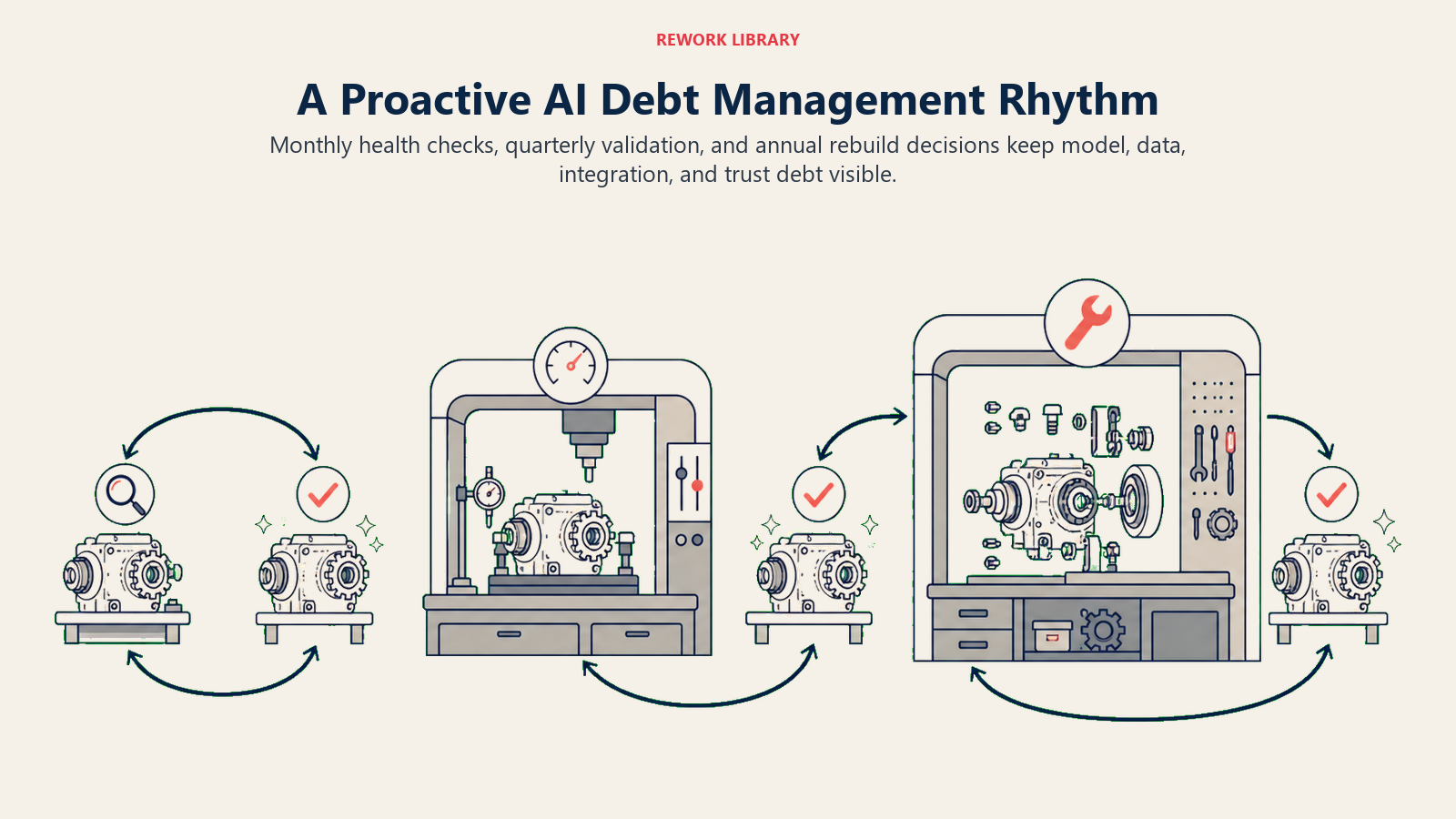
Ritmo proactivo de gestión de la deuda
Los patrones con la menor carga de deuda a largo plazo comparten una característica: tienen propietarios operativos nombrados y calendarios de revisión documentados.
| Patrón | Mensual | Trimestral | Anual |
|---|---|---|---|
| RAG Assistant | Verificación de tasa de retroalimentación | Auditoría de la base de conocimiento | Revisión completa del índice + precisión en conjunto de prueba |
| Scoring + Routing | Revisión de distribución de puntuaciones | Precisión del modelo en conjunto de prueba | Reentrenamiento del modelo si es necesario |
| Vision Extract | Verificación puntual de precisión | Cobertura de nuevos formatos | Revisión de datos de entrenamiento |
| Meeting Intelligence | Verificación puntual de precisión de resúmenes | Actualización de vocabulario | Revisión completa de precisión |
| Anomaly Agent | Tasa de falsos positivos | Verificación de validez de la referencia | Rebuild de la referencia si es necesario |
| Generative Research | Frescura de las fuentes | Completitud del índice | Auditoría completa de fuentes |
| Document Review | Tasa de señales falsas | Alineación de plantillas | Actualización de plantillas |
| Workflow Copilot | Tendencia de tasa de aceptación | Alineación del esquema del CRM | Revisión de la biblioteca de prompts |
| Personalization Engine | Tasa de cobertura de señales | Auditoría de cumplimiento de privacidad | Reentrenamiento del modelo |
| Autonomous Agent | Revisión de registros de ejecución | Auditoría de APIs de herramientas | Revisión completa del comportamiento |
Esta no es una carga operativa pesada. Las verificaciones mensuales toman 30-60 minutos por patrón. Las revisiones trimestrales toman medio día. La alternativa (sin revisión hasta que un usuario se queje o las métricas de rendimiento se desplomen) tarda semanas en diagnosticarse y meses en recuperarse.
La gobernanza es el marco operativo que previene la acumulación de deuda. Consulte requisitos de gobernanza por patrón para la infraestructura de rastro de auditoría que hace posible la detección de deuda, riesgo de alucinación por patrón para los modos de fallo específicos que debe vigilar, y migración de patrones para qué hacer cuando la deuda se ha acumulado hasta el punto en que el mantenimiento ya no es suficiente.
La deuda no significa que el patrón fue una elección incorrecta. Significa que el patrón es un sistema vivo, y los sistemas vivos requieren mantenimiento. Los operadores que entienden eso desde el principio construyen patrones que duran años. Los que tratan el despliegue como la conclusión construyen patrones que necesitan reconstruirse en el peor momento posible.
Preguntas Frecuentes
¿Qué es la Doctrina del Rebuild del Año 2?
La Doctrina del Rebuild del Año 2 trata cada despliegue de patrón de AI como una versión 1 con una vida útil esperada de 18-24 meses antes de que se requiera un rebuild significativo. Opera bajo la premisa de que los sistemas de AI acumulan deuda de modelo, de datos, de integración y de confianza en cronogramas independientes, y el efecto compuesto típicamente obliga a elegir entre migración o degradación al final del segundo año. La implicación operativa de la doctrina es diseñar rutas de migración durante la construcción inicial y presupuestar para el rebuild del año 2 en el caso de negocio inicial.
¿Cuáles son las cuatro formas de deuda técnica de AI?
Deuda de modelo (la AI subyacente está desactualizada o fue dada de baja), deuda de datos (los datos de entrenamiento, la base de conocimiento o la referencia están obsoletos y ya no reflejan los patrones actuales), deuda de integración (los sistemas downstream han cambiado pero la integración de AI no lo ha hecho), y deuda de confianza (los usuarios han perdido la confianza debido a errores acumulados y han dejado de confiar en el patrón). La deuda de confianza es la más difícil de recuperar porque requiere cambiar el comportamiento humano, no solo resolver un problema técnico.
¿Cuánto tiempo tarda un modelo de Scoring and Routing en empezar a derivar?
La degradación significativa aparece típicamente dentro de los 12-18 meses en la mayoría de los contextos B2B a medida que el ICP cambia, el proceso de ventas evoluciona o el panorama competitivo cambia. El modelo no falla de repente. Desarrolla sesgos sistemáticos: sobrepuntúa las empresas que coincidían con el ICP antiguo, subpuntúa las empresas en nuevos verticales. El indicador de deuda es ejecutar el modelo contra una cohorte reciente de deals cerrados ganados y rastrear qué porcentaje fue puntuado en el cuartil superior. Un descenso del 65% hacia el 45% señala deriva.
¿Por qué la deuda de confianza es más difícil de recuperar que la deuda de modelo o de datos?
La deuda de confianza requiere cambiar el comportamiento humano, no solo resolver un problema técnico. Cuando los usuarios han aprendido que un patrón de AI a veces está equivocado de maneras peligrosas, continúan verificando todo incluso después de que se implemente la corrección técnica. Ese hábito de verificación es racional (no saben que la corrección funcionó). La recuperación de la confianza requiere un reconocimiento público de qué estaba mal, los cambios documentados realizados, un proceso de validación del usuario y 3-6 meses de rendimiento consistente mejorado antes de que las tasas de adopción vuelvan a los niveles anteriores al declive.
¿Cuál es el compromiso operativo mínimo para mantener un patrón de AI?
Verificaciones mensuales (30-60 minutos por patrón para la tasa de retroalimentación, distribución de puntuaciones, tasa de aceptación o tasa de errores), revisiones trimestrales (medio día para la precisión en el conjunto de prueba, auditoría de la base de conocimiento, tasa de falsos positivos) y revisiones anuales (revisión completa de precisión, alineación de plantillas, auditoría completa de fuentes). Este ritmo previene la acumulación de deuda. La alternativa, sin revisión hasta que aparezcan síntomas, requiere semanas para diagnosticar y meses para recuperarse, consumiendo mucho más tiempo que el calendario de mantenimiento proactivo.
¿Cómo deben presupuestar las organizaciones para la deuda técnica de AI?
Presupuestando explícitamente para el mantenimiento del año 2 en el caso de negocio inicial. Esto incluye ciclos de reentrenamiento del modelo (el 55% de los modelos necesitan reentrenamiento dentro de los 90 días), mantenimiento de la base de conocimiento (auditorías trimestrales, actualizaciones inmediatas para cambios importantes), mantenimiento de la integración (cambios de API en los sistemas conectados) y tiempo de responsabilidad operativa. Las organizaciones que presupuestan explícitamente para el mantenimiento gastan en promedio un 60% menos en el mantenimiento del año 2 que las organizaciones que tratan el despliegue como un costo único, porque han construido los sistemas y los ritmos desde el principio en lugar de descubrir la necesidad de ellos de manera reactiva.
Más información

Co-Founder, Rework.com
On this page
- Las cuatro formas de deuda técnica de AI
- Cómo acumula deuda cada patrón
- RAG Assistant: obsolescencia de la base de conocimiento
- Scoring + Routing: deriva del modelo por cambios en el ICP
- Vision Extract: nuevos formatos de documentos
- Meeting Intelligence: deriva de vocabulario y productos
- Anomaly Agent: deriva de la referencia por cambios en el negocio
- Generative Research: obsolescencia del índice y fuentes obsoletas
- Document Review: plantillas de comparación desactualizadas
- Workflow Copilot: evolución del modelo del CRM
- Personalization Engine: restricciones de datos de perfil
- Autonomous Agent: cambios en las APIs de herramientas
- La Doctrina del Rebuild del Año 2
- La carga de mantenimiento que nadie planifica
- Cuando el modelo subyacente cambia
- Recuperación de la confianza después de errores acumulados
- Ritmo proactivo de gestión de la deuda
- Más información