More in
AI Workforce Transformation
Does AI Make Distributed Teams Easier or Harder to Lead?
Oct 11, 2026
Where AI Productivity Monitoring Turns Into Surveillance
Oct 11, 2026
Why Your Most Experienced People Resist AI Hardest (and Why You Need Them Most)
Oct 11, 2026
Is AI Making Teams Less Collaborative?
Oct 11, 2026
Should CEOs Use AI Themselves? Why Executive Fluency Sets the Adoption Ceiling
Oct 11, 2026
Does AI Favor Generalists or Specialists? What It Means for Who You Hire
Oct 10, 2026
Is Experience Still Worth Paying For When AI Narrows the Skill Gap?
Oct 10, 2026
When Every Candidate Uses AI, What Is a Resume Still Worth?
Oct 10, 2026
Should AI Screen Your Job Candidates? Where Automated Hiring Helps and Where It Backfires
Oct 10, 2026
Should Candidates Be Allowed to Use AI in Interviews?
Oct 10, 2026
AI Workforce Transformation in Professional Services: What's Different
Turn this article into takeaways for your work.


Each assistant summarizes the article only for you and suggests best practices for your work.
A Big 4 firm can't restructure its analyst tier the way a SaaS company can. A law firm can't quietly swap junior associates for AI tools and call it productivity. A management consulting practice can't just automate deliverables and expect clients to pay the same fees. HBR's analysis of how AI is upending consulting firm hiring is blunt about the root cause: AI is dismantling the traditional model that relied on large classes of junior associates to supply a handful of future partners, and firms that don't redesign around that reality are accumulating structural risk.
Professional services firms are in the middle of the same AI workforce shift that every other industry is navigating, but the terrain is quite different. Deloitte's 2026 State of AI in the Enterprise report surveyed 3,235 senior leaders globally and found that insufficient worker skills are the single biggest barrier to integrating AI into workflows, a finding that hits professional services particularly hard given how much tacit expertise sits in senior practitioners who haven't built AI fluency yet. The billable hour model, the relationship-driven revenue structure, and the regulatory environment all create constraints that make the standard "replace low-value work with AI and redeploy staff upward" formula much more complicated in practice.
This isn't a late-adopter story. It's a different transformation story. And firm leaders who treat it like a generic AI rollout will get the outcomes wrong.
Three Structural Differences That Change the Playbook
Professional services firms face three linked constraints that make AI transformation structurally different from a standard software rollout.
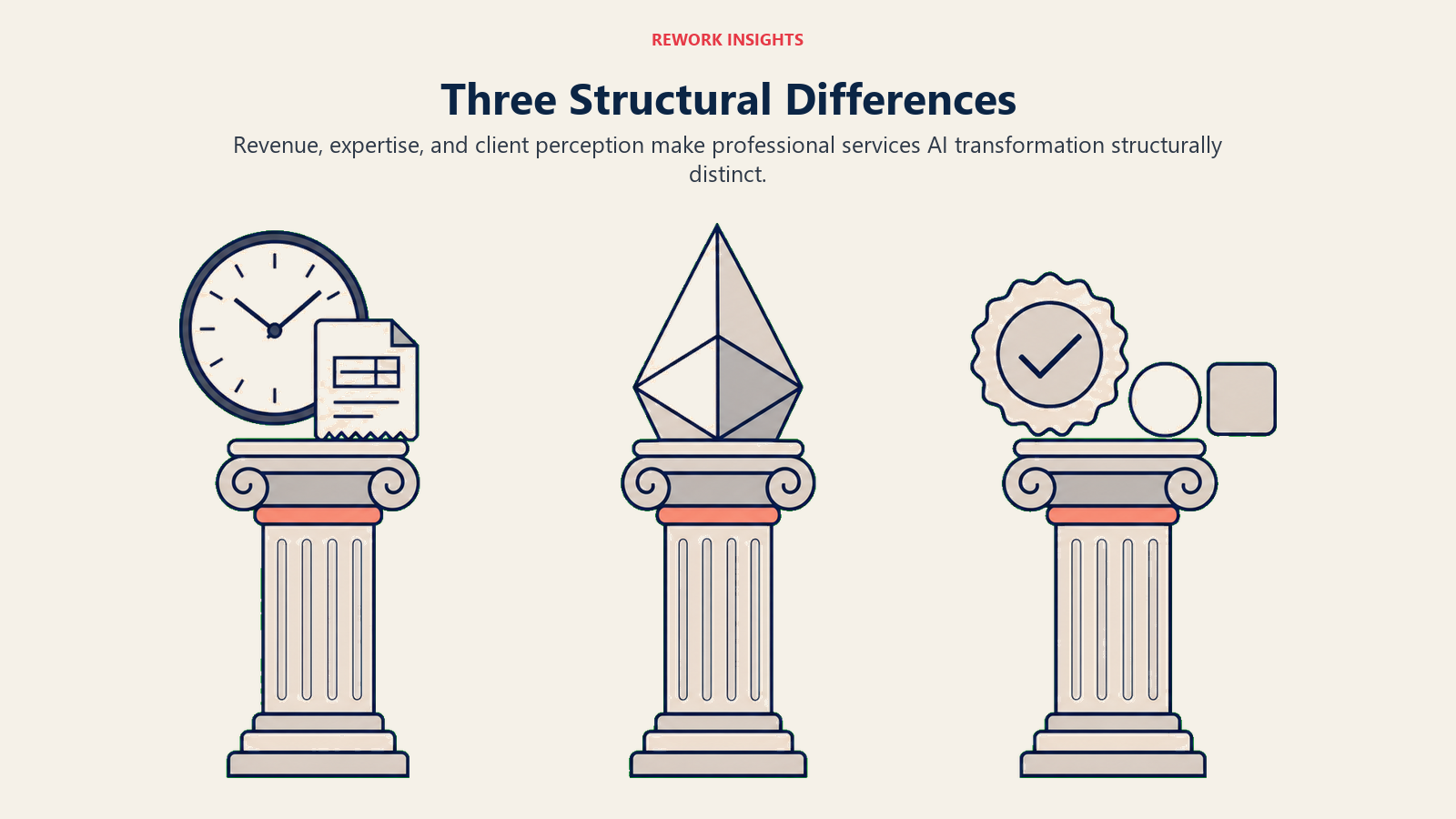
1. Revenue Is Tied to Human Effort
In a SaaS company, AI gains translate almost directly to margin. You automate a workflow, reduce headcount or avoid new hires, and the savings flow to the bottom line. The pricing model doesn't care whether a human or an algorithm did the work.
Professional services don't work that way. At most firms, revenue is still calculated as hours times rate. When AI compresses the time it takes to produce a first draft, analyze a dataset, or review a contract, that compression doesn't automatically become profit. It becomes a billing problem.
If a task that used to take 20 hours now takes 4, the firm either needs to reprice that task based on value rather than time, find more work to fill the 16 hours, or absorb the revenue drop. None of those options are straightforward. The billing model dependency is the single biggest structural barrier to AI-driven efficiency gains in professional services, and it's one that SaaS companies simply don't face in the same form.
2. Knowledge and Relationships Are the Product
In product companies, AI automates tasks that sit below the value line. The product itself remains human-designed, human-managed, and human-sold. The human contribution is upstream.
In professional services, the human contribution is the product. A client hires McKinsey for the judgment of its partners. A company retains outside counsel for the credibility and experience of its legal team. A CFO at a mid-market company uses their accounting firm not just for compliance outputs but for the senior advisor who picks up the phone.
What AI actually does in this context is commoditize the commodity work (the research, the drafting, the synthesis, the formatting) while it simultaneously elevates the importance of the premium work that AI can't replicate. Strategic judgment, client relationships, cross-situational expertise, the kind of contextual reading that comes from two decades in a specific industry. AI makes that work more valuable by making everything around it cheaper and faster.
But that shift puts enormous pressure on the talent development pipeline. The commodity work has historically been how junior professionals learn their craft. If you remove it, you need a different model for growing the next generation of senior advisors.
3. Client Perception Varies Sharply by Engagement Type
Not all clients react the same way to AI use. And the variation isn't random. It tracks closely with the nature of the engagement.
Transactional work has low client resistance to AI. Document review, standard contract generation, financial modeling templates, due diligence checklists: clients generally don't care whether a human or a system produced these, as long as the output is accurate and fast. Some clients actively prefer AI-assisted delivery here because it reduces cost.
Advisory work is different. When a client is navigating a sensitive M&A decision, a regulatory investigation, or a major strategic pivot, they're buying human judgment and human accountability. Telling that client "we use AI to assist our analysis" lands very differently than it does on a routine compliance audit. Some clients interpret it as a fee arbitrage play. Others see it as a signal that their matter isn't getting the senior attention it deserves.
Firm leaders need a clear communication framework that distinguishes between these engagement types, not a blanket policy applied uniformly across all client relationships.
Where AI Is Having the Fastest Impact Right Now
Across consulting, legal, and agency contexts, four functional areas are seeing the most rapid transformation.
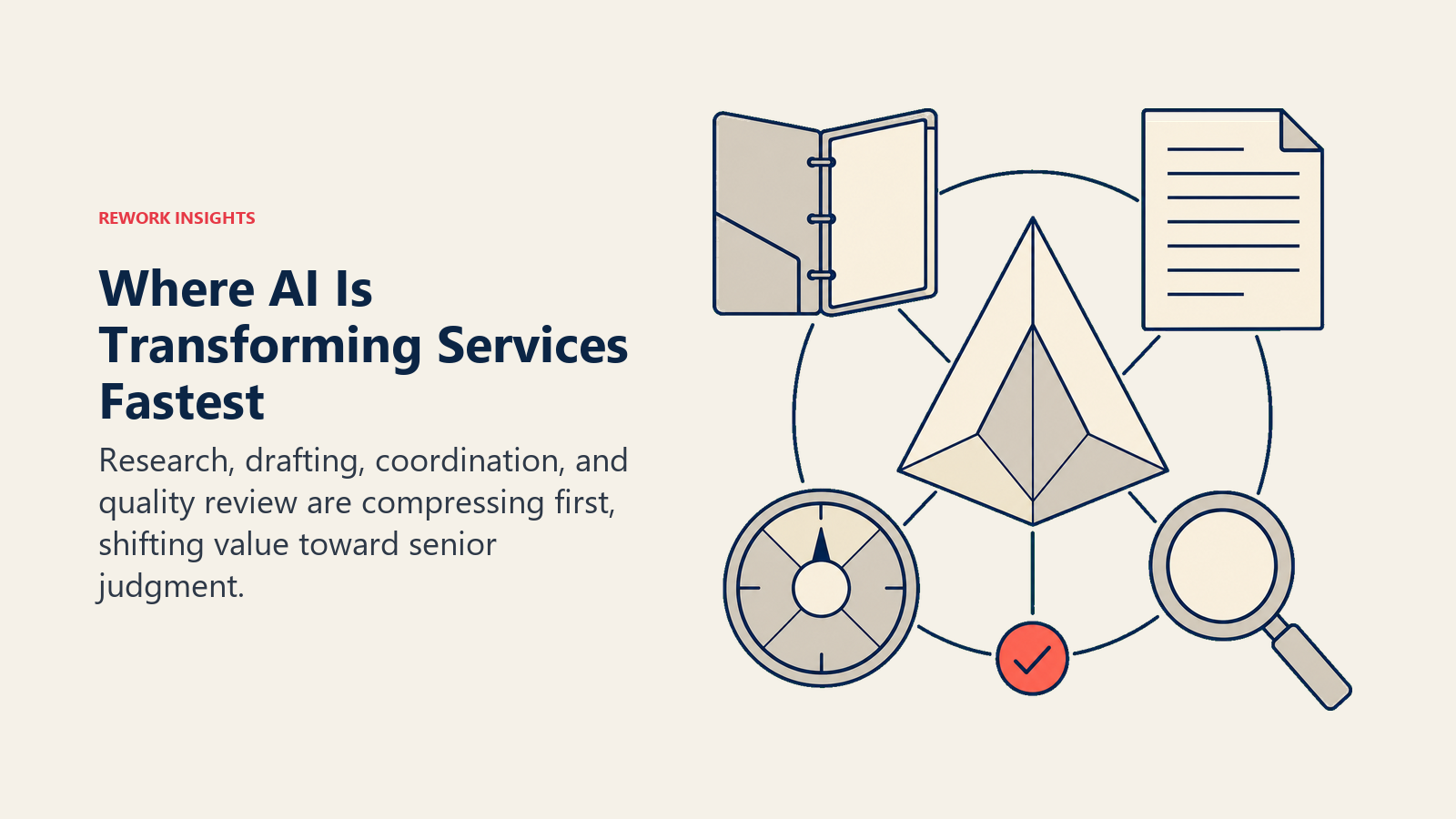
Research and synthesis. AI tools can now scan, summarize, and cross-reference industry reports, case law, regulatory filings, and competitive intelligence in a fraction of the time it used to take. What required a team of analysts working overnight now takes hours. This is where the billable hour problem hits hardest, and where pricing model reform is most urgent.
First-draft production. In legal, AI is drafting contracts, briefs, and memos. In consulting, it's generating slide frameworks and report outlines. In marketing agencies, it's producing first-pass copy, creative briefs, and campaign analyses. The quality of these drafts has improved to the point where senior review time (not junior production time) is now the real bottleneck.
Project and workflow management. AI is starting to absorb a meaningful slice of project coordination: status tracking, client update drafting, timeline modeling, risk flagging. In consulting especially, where project management has traditionally eaten a significant share of senior time, this creates real capacity gain, but only if the firm is structured to capture it.
Compliance and quality review. In legal and accounting, AI is being used to flag issues, check for consistency, and surface anomalies in documents and filings. This isn't replacing the professional judgment call at the end, but it's dramatically reducing the manual scanning work that precedes it.
The Talent Paradox: Junior Roles at Risk, Senior Roles Expanding
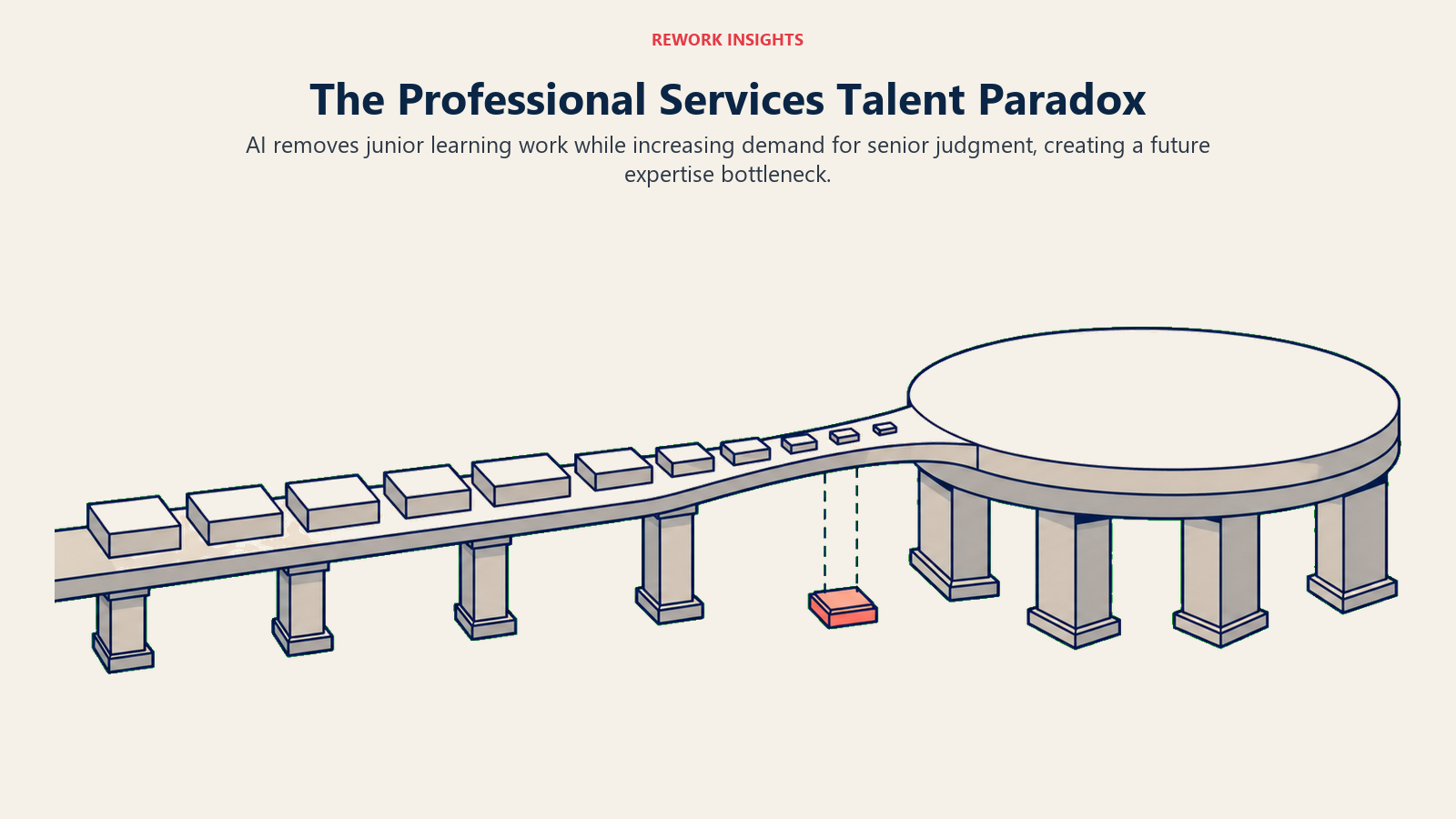
Here's the dynamic that firm leaders can't afford to misread. AI is compressing the volume of work that junior professionals do, but it isn't eliminating the need for those professionals. It's changing what's expected of them faster than the development model has adjusted.
A second-year associate at a law firm used to spend significant time on document review, legal research, and first-draft production. Those were learning tasks as much as they were billable tasks. They built the pattern recognition and substantive knowledge that senior partners draw on. If AI handles most of that work, the associate either needs to be doing more complex work earlier, or the firm needs to rethink how it develops expertise in the first place.
At the same time, demand for senior-level capability is increasing, not decreasing. Clients want more strategic engagement, more contextual advice, more senior face time. AI has raised client expectations about what "advisory" means because the commodity output is now assumed to be fast and cheap. The AI skills gap that executives are getting wrong is especially pronounced in professional services, where the gap isn't technical knowledge, it's the ability to direct AI in client-facing contexts.
This creates a pipeline problem. If junior roles produce fewer learning experiences, the supply of qualified senior advisors five years from now gets squeezed. Firms that ignore this are trading short-term efficiency for long-term talent depth.
The ones getting it right are redesigning junior roles rather than eliminating them, creating structured exposure to client interactions, judgment calls, and cross-functional problems earlier in the career path. Think of it as compressing the learning curve rather than removing the rung.
For more on how AI is shifting the hiring and retention calculus, see How AI Is Changing Your Retention Problem, Not Just Your Hiring Problem.
Firm-Level Decisions: Repricing, Redesigning Delivery, Communicating to Clients
Three strategic decisions are unavoidable for firm leadership right now.
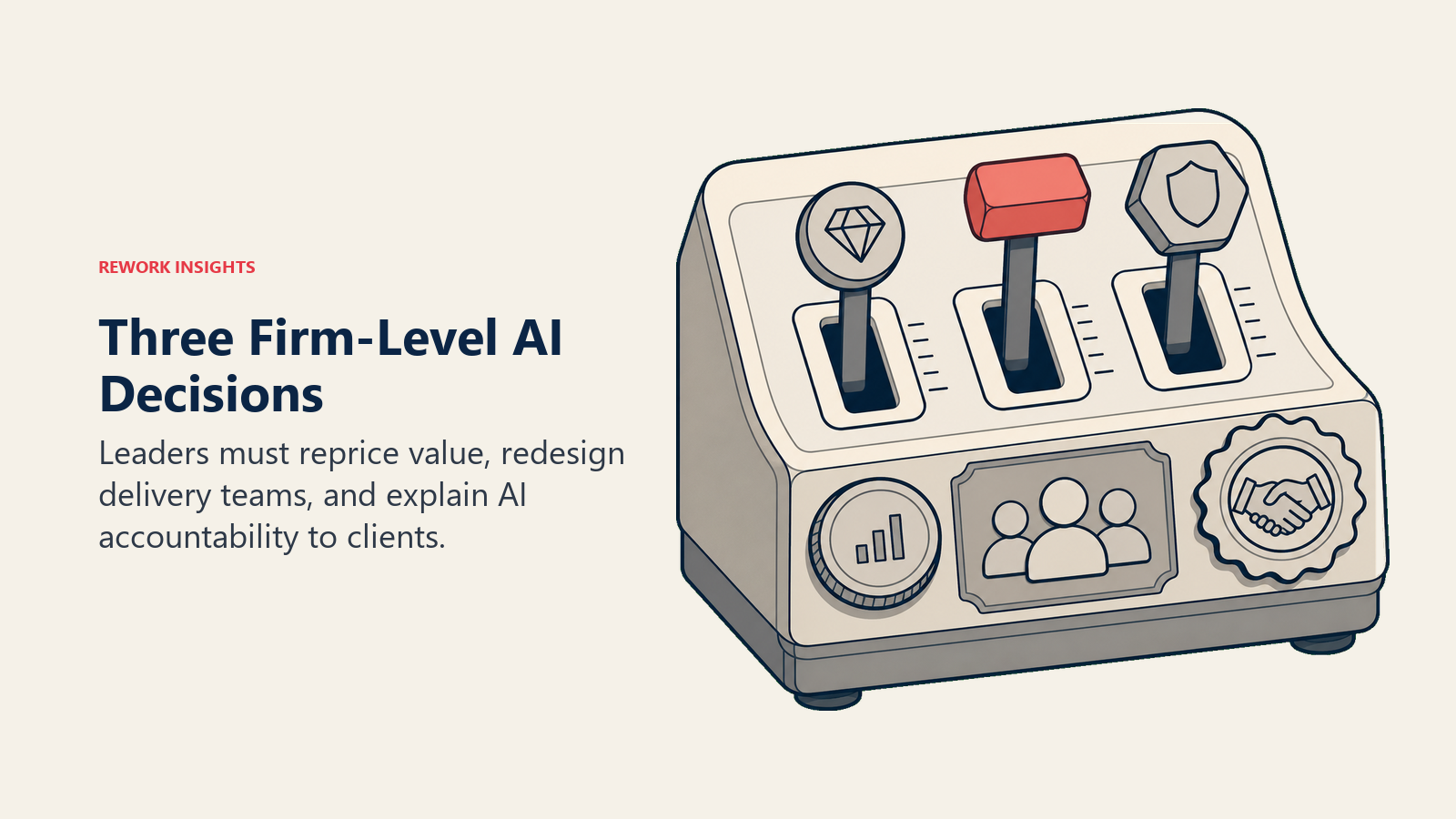
Repricing for value, not time. The transition from hourly billing to value-based or fixed-fee engagements has been discussed in professional services for decades. AI is forcing it. When the cost of producing a high-quality deliverable drops by 60-70% in time, hourly billing actively penalizes efficiency. Firms that have already moved toward project-based or retainer models are finding AI easier to absorb because the pricing model isn't in conflict with the efficiency gain. Firms still heavily dependent on hourly billing need a structured path toward repricing, or they'll find themselves in a permanent margin squeeze.
Redesigning delivery models. The traditional model (large junior teams producing output under senior oversight) is becoming economically inefficient in many contexts. Leading firms are experimenting with leaner team structures where AI handles the high-volume baseline work and a smaller number of senior professionals manage client relationships and quality. This changes span of control, changes utilization economics, and changes what a "fully staffed" engagement looks like.
Communicating AI use to clients. This deserves more strategic attention than most firms are giving it. The default posture of "we use AI to serve you better" is too vague to be credible and too generic to be reassuring. Clients in advisory relationships want specificity: what role does AI play in this engagement, who reviews its outputs, how is confidential information handled, and what's the accountability model if something goes wrong? Firms that can answer those questions clearly, and tailor those answers by engagement type, will be better positioned than those hiding behind marketing language. A formal AI governance policy at the department level gives client-facing partners a concrete document to point to rather than improvising their answers.
What Leading Consulting and Legal Firms Are Doing in 2025-2026
The early movers in professional services aren't reinventing themselves overnight. They're making a series of deliberate structural bets.
Large consulting firms are building internal AI practices that serve clients while simultaneously testing AI on their own operations. This dual-track approach lets them develop credibility and capability in parallel. They're also creating new role categories (AI delivery leads, prompt specialists, AI risk reviewers) that didn't exist three years ago. Deloitte's AI for in-house legal predictions captures how this is playing out at the legal end of professional services specifically: AI has the potential to drive sustainable change in how legal services are delivered, but only for firms willing to redesign delivery alongside deploying the tools. The AI certification market data from 2026 shows which of these new credentials are actually valued by clients and which are being dismissed as paper qualifications.
Law firms are investing heavily in AI review tools for due diligence, contract analysis, and compliance work, and repackaging those capabilities as faster, cheaper service tiers for transactional clients. Some are experimenting with subscription models for legal work that would previously have been billed hourly.
Mid-size accounting firms are using AI to expand capacity for advisory services without growing headcount proportionally, using the time freed from compliance and reporting work to deepen client relationships and offer more strategic CFO-adjacent services.
The pattern across all of these is the same: firms are using AI to move up the value chain, not just to cut costs. The ones that treat it primarily as a cost-reduction exercise are leaving the strategic upside on the table.
For context on how mid-market companies across industries are navigating similar role shifts, see Which Roles AI Is Actually Eliminating in Mid-Market Companies (and Which It's Creating).
Readiness Gap Self-Assessment for Firm Leadership
Before assuming your firm is further along than it is, work through these questions honestly.
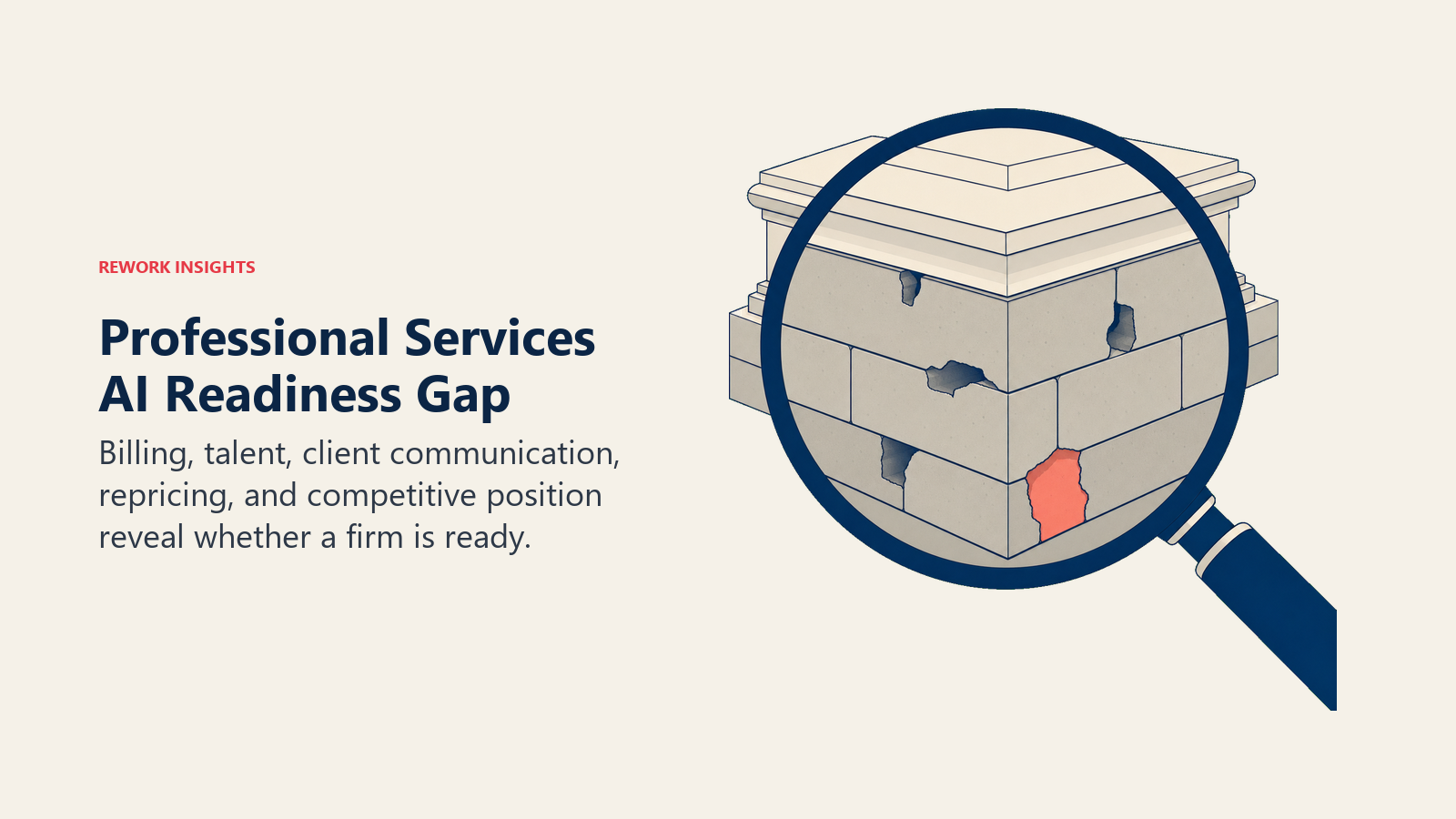
On the billing model: What percentage of your revenue is still tied to hourly billing? Have you modeled what a 40% reduction in delivery hours would do to annual revenue under your current pricing structure?
On talent development: If junior roles change significantly in the next 18 months, do you have a redesigned development model ready? Or are you assuming the current apprenticeship model will absorb the shift on its own?
On client communication: Do you have a clear, engagement-specific framework for how you discuss AI use with clients? Or is this handled inconsistently by individual partners?
On repricing: Have you had explicit conversations with your top ten clients about value-based pricing? Or is repricing still in the "we should think about this" category?
On competitive positioning: Are your competitors already using AI to deliver faster, cheaper versions of services you still price on time? If so, what's your response?
If more than two of those answers made you uncomfortable, the readiness gap is real, and it's narrowing the window for proactive strategy.
For a deeper look at the ROI considerations behind workforce investment decisions, see Upskill or Hire AI-Native? The ROI Case Every Executive Needs to Run.
Professional Services Leaders Who Wait Are Already Behind
The instinct in professional services is to wait for industry consensus before moving. Watch what the Big 4 do. See how the AmLaw 100 firms approach it. Let the market settle before making structural bets.
That instinct made sense when industry cycles moved slowly. It doesn't make sense when AI capability is advancing quarterly and client expectations are shifting faster than billing cycles.
The firms that are ahead right now aren't the ones with the most sophisticated AI strategy on paper. They're the ones that started making real decisions about pricing, delivery models, talent development, and client communication twelve months ago. Every quarter of delay is a quarter where competitors are building the competency and the client relationships that will define the next tier of the market.
Professional services isn't a late-adopter story. But it could become one if leadership keeps treating it like a wait-and-see problem.
The structural differences are real. But they make this transformation harder to execute, not optional.
Learn More
- Which Roles AI Is Actually Eliminating in Mid-Market Companies (and Which It's Creating)
- How AI Is Changing Your Retention Problem, Not Just Your Hiring Problem
- Upskill or Hire AI-Native? The ROI Case Every Executive Needs to Run
- Why Manufacturing's AI Workforce Shift Is Faster Than Anyone Expected
- AI Training for Non-Technical Teams: How leading professional services firms are upskilling their non-engineering staff

Co-Founder, Rework.com
On this page
- Three Structural Differences That Change the Playbook
- 1. Revenue Is Tied to Human Effort
- 2. Knowledge and Relationships Are the Product
- 3. Client Perception Varies Sharply by Engagement Type
- Where AI Is Having the Fastest Impact Right Now
- The Talent Paradox: Junior Roles at Risk, Senior Roles Expanding
- Firm-Level Decisions: Repricing, Redesigning Delivery, Communicating to Clients
- What Leading Consulting and Legal Firms Are Doing in 2025-2026
- Readiness Gap Self-Assessment for Firm Leadership
- Professional Services Leaders Who Wait Are Already Behind
- Learn More