More in
Productivity Tech News
Half of U.S. Workers Now Use AI on the Job: The Operating Model COOs Need for the Post-Pilot Era
Apr 17, 2026
Notion Now Searches Your Salesforce Data: What Cross-Tool AI Means for How Operations Teams Work
Mar 20, 2026
You Can Now Give Notion a 20-Minute Task and Walk Away: What That Means for How You Lead
Mar 17, 2026
Notion Custom Agents Are Free Until May 3: How COOs Should Run a 3-Week Evaluation
Mar 13, 2026
Atlassian Cut 900 R&D Roles: What Operations Leaders Need to Assess Before Renewal
Mar 10, 2026 · Currently reading
You Can Now Hire AI Agents for Your Monday.com Workspace: What That Means for How COOs Evaluate Work Management Platforms
Feb 6, 2026
ClickUp Wants to Replace Your PM Tool, Your Slack, and Your Zoom: Is the Everything App Bet Worth It?
Jan 30, 2026
Monday.com Lost 19% in One Day Over AI Agents: What That Signals About SaaS Pricing and Your Next Renewal
Jan 29, 2026
Monday.com vs. Asana in 2026: The AI Architecture Decision That Should Drive Your Platform Choice
Jan 16, 2026
AI Meeting Context vs. Your Notion Workspace: Do Teams Actually Need Both in 2026?
Jan 13, 2026
Atlassian Cut 900 R&D Roles: What Operations Leaders Need to Assess Before Renewal
Turn this article into takeaways for your work.


Each assistant summarizes the article only for you and suggests best practices for your work.
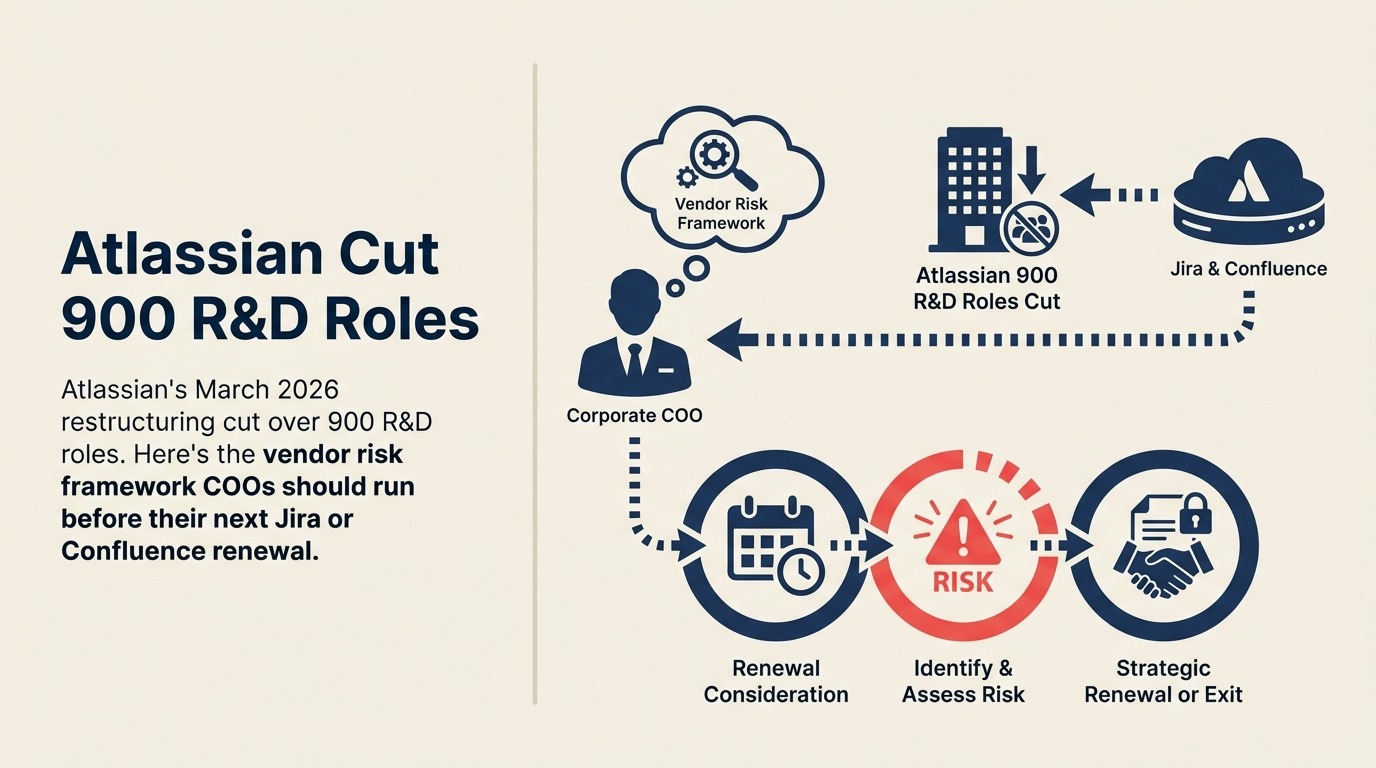
When a software vendor eliminates a tenth of its workforce and the majority of cuts land inside engineering, that's not an HR story. It's a product story. And if that vendor runs the project management and documentation infrastructure your operations team depends on, it belongs on your risk register.
Atlassian announced in March 2026 that it was eliminating approximately 1,600 positions globally, according to TechCrunch's reporting on the restructuring. That's roughly 10% of the company's total headcount. More than 900 of those roles came from software research and development, the people who build Jira, Confluence, Trello, and the broader suite of tools that distributed operations teams have built workflows around.
The company's stated rationale, confirmed in CNBC's coverage: redirecting spending toward AI and enterprise sales. The official Atlassian blog post frames it as a deliberate investment shift, not a cost-only move. That may be true. But the people who wrote the code for your ops team's daily workflows are gone, and understanding what that means before your next renewal conversation matters.
What Actually Changed Structurally
The operational detail COOs should flag is the CTO succession. Rajeev Rajan stepped down effective March 31, 2026. Rather than finding a single replacement, Atlassian split the CTO function into two separate roles: one executive (Taroon Mandhana, formerly Head of AI and Products) takes on the Teamwork AI track, and another (Vikram Rao) covers Enterprise and Trust.
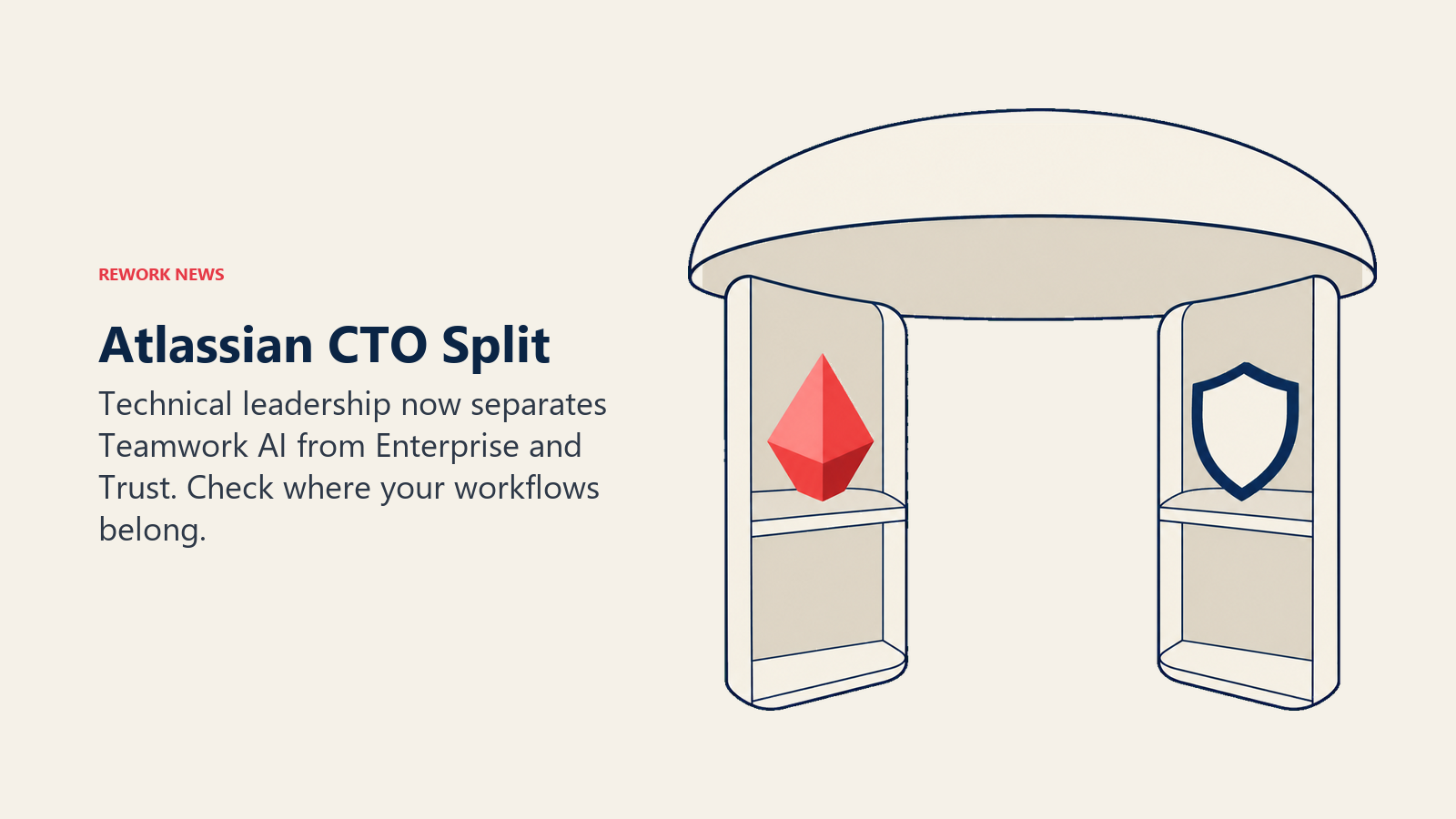
That org chart decision is a signal, not just a personnel change. When a company splits its top technical role along those lines, it's telling you where the divergent bets are. One track is moving fast on AI features. The other is focused on the compliance, security, and reliability needs of large enterprise accounts. For a COO whose team uses Jira for incident tracking or Confluence for compliance documentation, the question is which of those two tracks your use case lives on, and how much attention it will receive going forward.
Atlassian also disclosed restructuring charges of $225M to $236M, expected to clear by the end of June 2026. That's a large one-time cost to absorb, and it signals the company believes the restructured model will be more efficient. Whether "more efficient" translates to better product output for your specific Atlassian products depends on factors you won't find in a press release.
The CEO Reversal Worth Noting
In October 2025, Atlassian's CEO publicly stated the company would have more engineers in five years. Five months later came the opposite announcement. That's not necessarily duplicitous. Business conditions change, and the AI investment thesis may have genuinely shifted the calculus. But the reversal is short enough to note honestly when evaluating vendor predictability.
This isn't a reason to move off Atlassian. It is a reason to ask harder questions at your next account review.
The R&D Reduction: What It Might Mean for Product
More than 900 R&D roles eliminated doesn't automatically mean slower feature delivery. Atlassian's explicit bet is that AI accelerates engineering output enough to compensate. That premise is plausible. Some large companies have reduced headcount while shipping more through AI-assisted development cycles.
But there's a version of this that doesn't go as planned. If the AI investment thesis takes longer to prove out, or if the AI tooling offsets coding capacity but not testing, documentation, or infrastructure work, then feature backlogs and support response times may lengthen. The products most likely to feel that first are the ones that aren't Atlassian's primary AI growth bets.
For operations teams, the relevant question is whether your core Jira or Confluence use cases are in the AI-forward investment track or in a more mature, lower-priority maintenance track.
A Vendor Risk Framework for COOs
Before your next renewal conversation with Atlassian, run through these six questions:
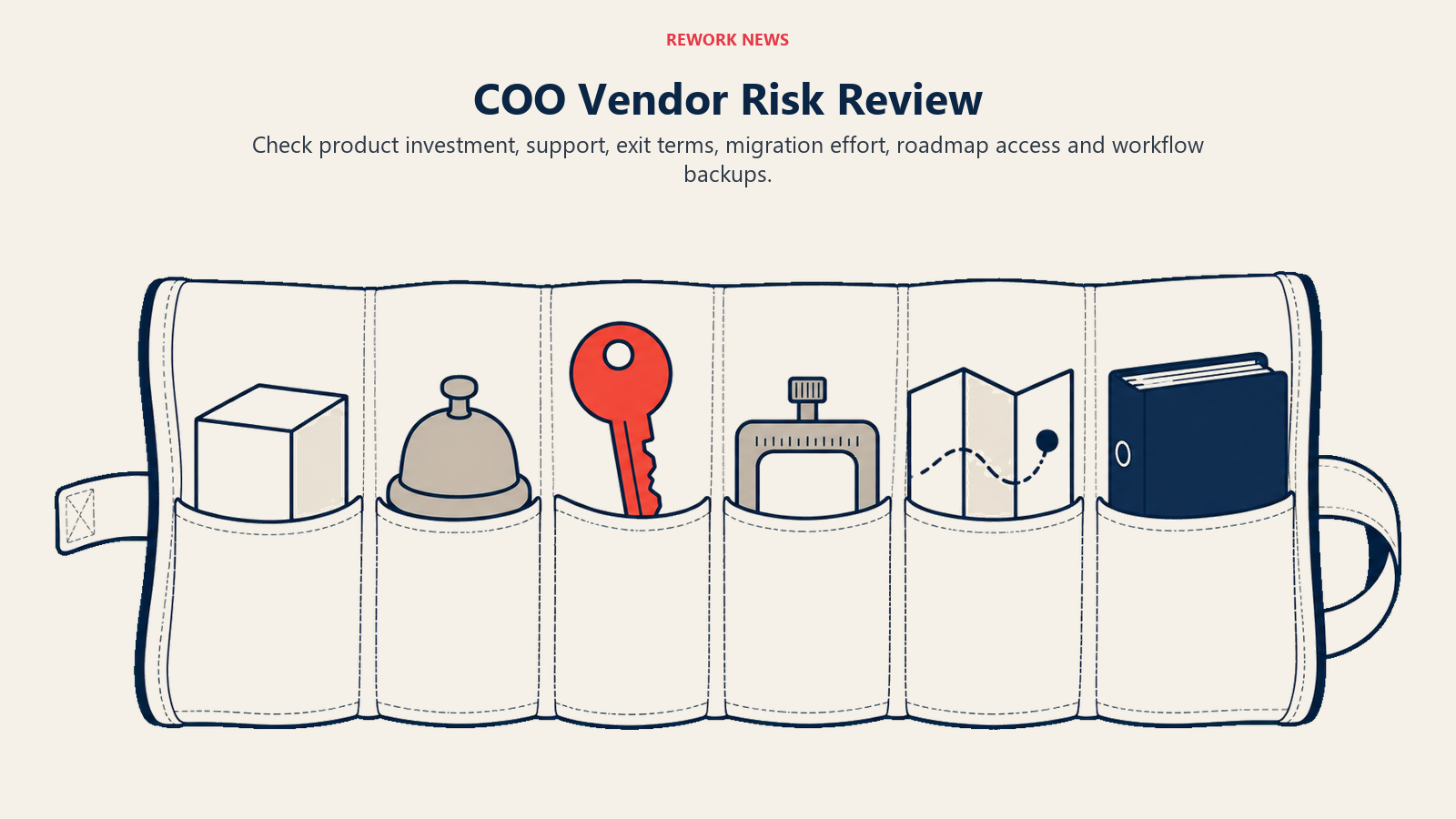
1. Which products does your team actually rely on, and are those products in the AI growth track? Jira AI and Confluence AI are Atlassian's showcased investments. If your team uses these features heavily, the restructuring may accelerate capabilities you'd pay for anyway. If your team uses Trello or relies on specific legacy Jira configurations, ask directly whether those products are receiving the same roadmap investment.
2. What do your current support SLAs guarantee, and have there been changes since March 2026? Support quality often degrades after significant R&D reductions. Not immediately, but over the following quarters as institutional knowledge leaves. Pull your last six months of support tickets and measure resolution time. It's the most honest leading indicator you have.
3. Does your contract include exit terms you've actually read? This isn't about leaving. It's about knowing your leverage. Multi-year Atlassian agreements can include auto-renewal clauses with short opt-out windows. Know when that window opens, because it's when you have the most negotiating power. The same logic applies whenever you're evaluating whether to keep or replace a productivity tool.
4. What would a 90-day migration off Atlassian look like for your top three workflows? You don't need a full migration plan. But knowing whether it's possible, and roughly what it would cost, changes how you negotiate. If the answer is "we're completely locked in," that's information worth acting on during the next contract cycle.
5. Have you requested a roadmap briefing for your specific products? Enterprise and mid-market accounts can typically request a product roadmap conversation from their account team. Ask for one. The response, both the content and the quality of the answer, tells you something about how Atlassian views your account.
6. Do you have backup workflow options documented for your most critical Jira or Confluence processes? Not contingency plans. Just documentation of what the process looks like without the tool. This forces your team to identify how much you've built on top of Atlassian abstractions that may or may not be portable.
What This Doesn't Mean
Running a vendor risk review is not the same as deciding to leave. Atlassian remains one of the most widely deployed work management platforms in enterprise, with deep integrations, a large marketplace, and years of operational context baked into customer instances. The cost of moving off Jira, in migration complexity, retraining, and institutional knowledge loss, is real and often underestimated. If you're weighing alternatives, the ClickUp everything-app consolidation case is one direction worth evaluating at the same time.
The goal of this assessment isn't to make a hasty decision. It's to make an informed one. COOs who treat a 10% workforce cut at a core infrastructure vendor as background noise are taking on vendor concentration risk they don't need to take.
What to Do This Week
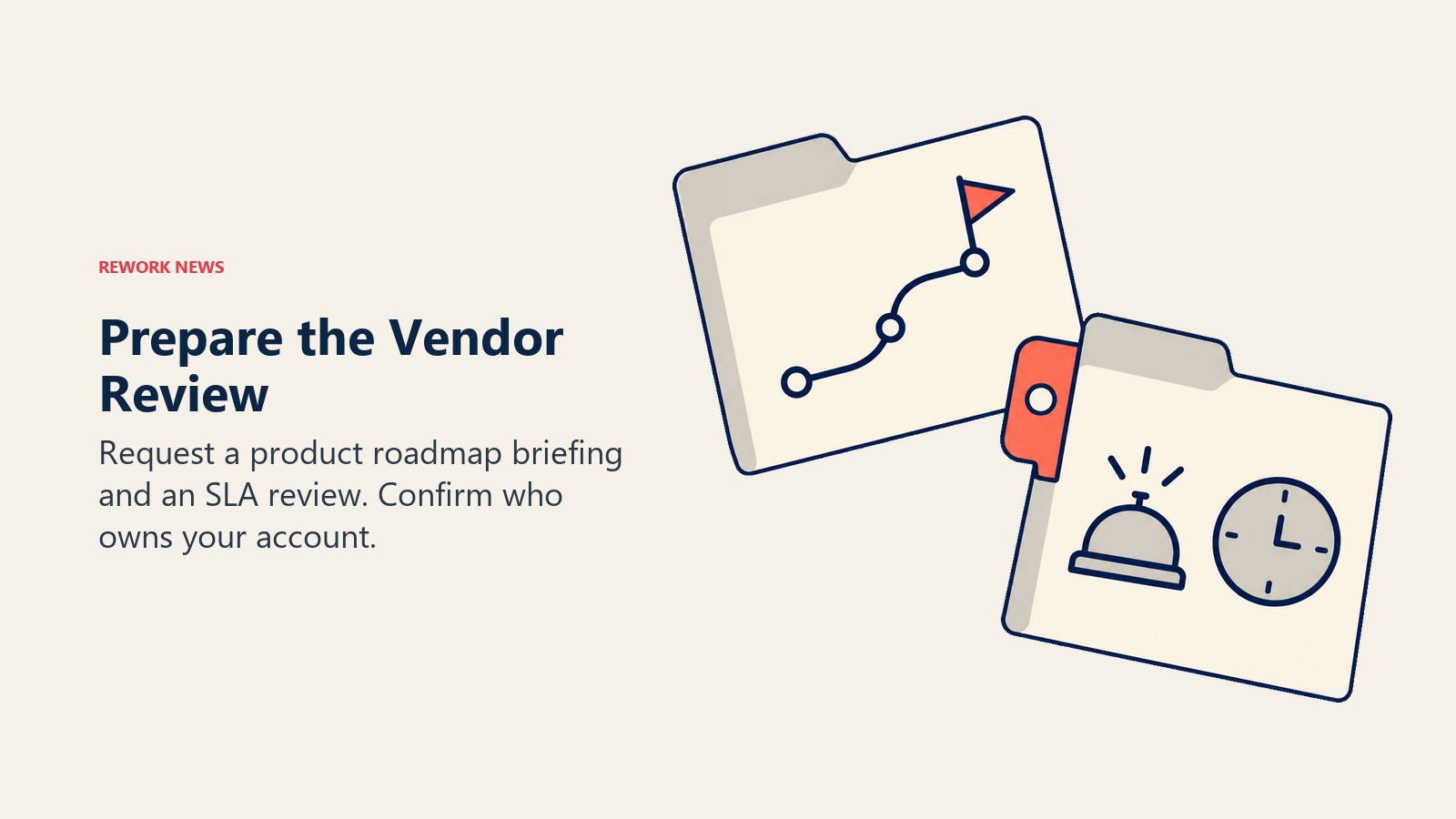
Schedule a meeting with your Atlassian account representative and request two things: (1) a product roadmap briefing specific to the Atlassian products your team uses most, and (2) a review of your current SLA terms and support escalation paths. While you're auditing the stack, it's also worth revisiting how your team's core processes are documented: vendor changes are often the catalyst for discovering how much institutional knowledge is locked inside a specific tool. These aren't confrontational asks. Any account team will handle them as routine. But the answers will tell you how to approach your next renewal, and whether the AI investment narrative holds up when applied directly to your use cases.
If you don't have a named account contact, this is also a good week to find out who owns your account. That relationship is the first thing that erodes when companies restructure, and the first thing worth securing before you need it.
Learn More
- When Your SaaS Vendor Cuts Its R&D Team: Enterprise Buyer Checklist: The CRO's evaluation framework for the same Atlassian restructuring
- The SaaS Growth Model That No Longer Requires More Engineers: CEO-level analysis of why AI investment is driving the restructuring wave
- AI Readiness Assessment Templates: Evaluating your vendor dependencies as part of a broader AI readiness review
- Monday.com vs. Asana AI Architecture Decision: What to evaluate while you're reconsidering your productivity tool stack
