More in
AI at Work News
OpenAI Opened ChatGPT Advertising to Small Businesses at Any Budget
Jun 6, 2026
AI Is Everywhere at Work. Only 1 in 10 Say It Transformed the Job
Jun 6, 2026
Vibe Coding's $10.5B Moment: AI Now Starts Most New Software Builds
Jun 6, 2026
AI Agents Now Have More System Access Than Your Employees. Few Are Secured
Jun 5, 2026
Should You Build Your AI or Buy It? Watch What the Giants Bought.
Jun 5, 2026
Uber Caps Employee AI Spending at $1,500 Per Seat After a Budget Blowout
Jun 5, 2026
Trump's AI Executive Order Is Deregulatory. Your Compliance Risk Didn't Move
Jun 4, 2026
AI Pushed 220 Unicorns Below $1B. Pre-ChatGPT Companies Face a Reckoning
Jun 4, 2026
Token Prices Fell 67% This Year. Your AI Bill Is Going Up Anyway
Jun 3, 2026
Small Businesses Using AI Report Higher Revenue and Shorter Workdays
Jun 3, 2026
Gartner Says the AI Coding-Agent Market Is Realigning: What CTOs Should Lock Down Before the Next Renewal
Turn this article into takeaways for your work.


Each assistant summarizes the article only for you and suggests best practices for your work.
The vendor you signed with last year may not be the same company next year. That's not a threat. It's just what's happening in the enterprise AI coding-agent market right now.
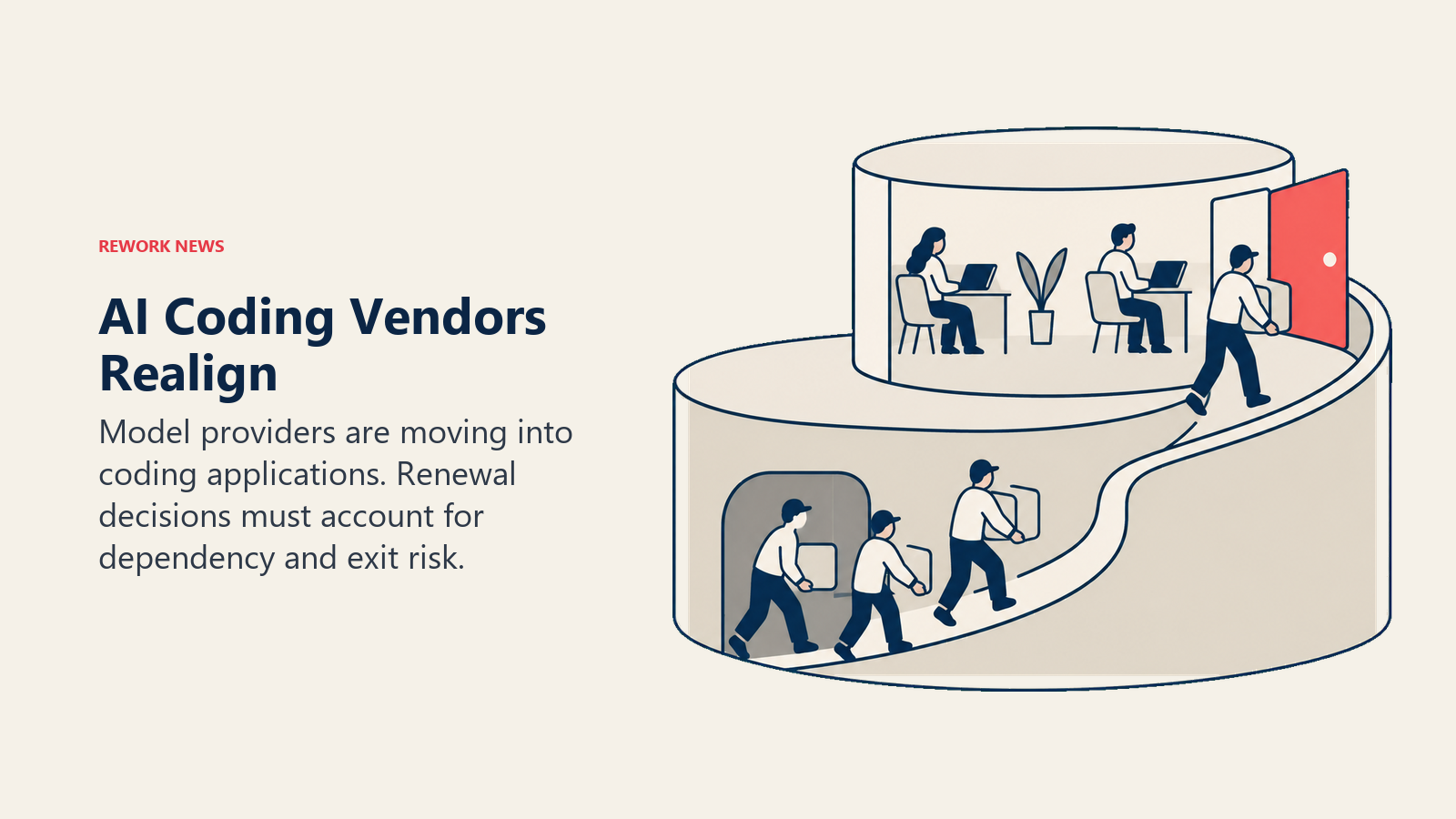
According to Gartner, the market is entering a new phase of expansion and competitive realignment. Frontier model providers, the companies building the foundational AI models underneath every coding tool, are moving into direct competition with the application-layer vendors your engineers are already using. The middle of the stack is getting squeezed from below.
For a chief technology officer (CTO), this isn't primarily a product evaluation question. It's a procurement and governance question. The decisions you lock in during the current renewal cycle will shape your organization's cost structure and vendor dependency for the next three years.
The Market Is Bigger Than You Think
The scale of this market often surprises people outside the developer tooling world. According to Gartner's May 20, 2026 analysis, the enterprise AI coding-agent market is running at around $10 billion annualized as of April 2026. That figure reflects real enterprise spend, not aspirational projections.
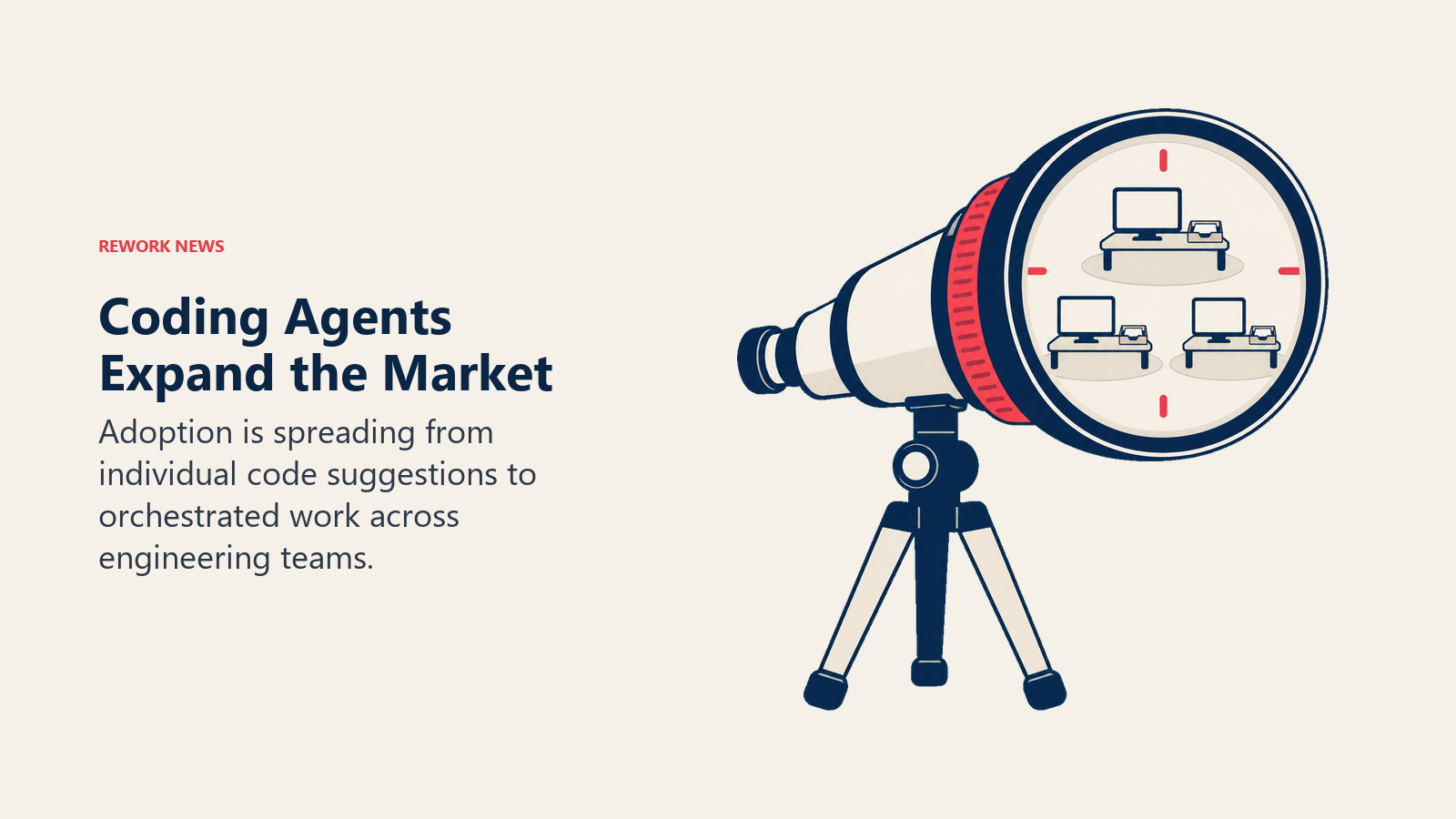
The growth trajectory makes it larger still. Gartner projects that roughly 90% of enterprise software engineers will use AI code assistants by 2028. In early 2024, that number was under 14%. The pace of adoption is why every major model provider, cloud vendor, and developer-tools company is now competing for this market simultaneously.
Key Facts
- The enterprise AI coding-agent market is running at around $10 billion annualized as of April 2026 (Gartner)
- Gartner projects roughly 90% of enterprise software engineers will use AI code assistants by 2028, up from under 14% in early 2024 (Gartner)
- By 2027, more than 65% of engineering teams using agentic coding will treat the integrated development environment (IDE) as optional (Gartner)
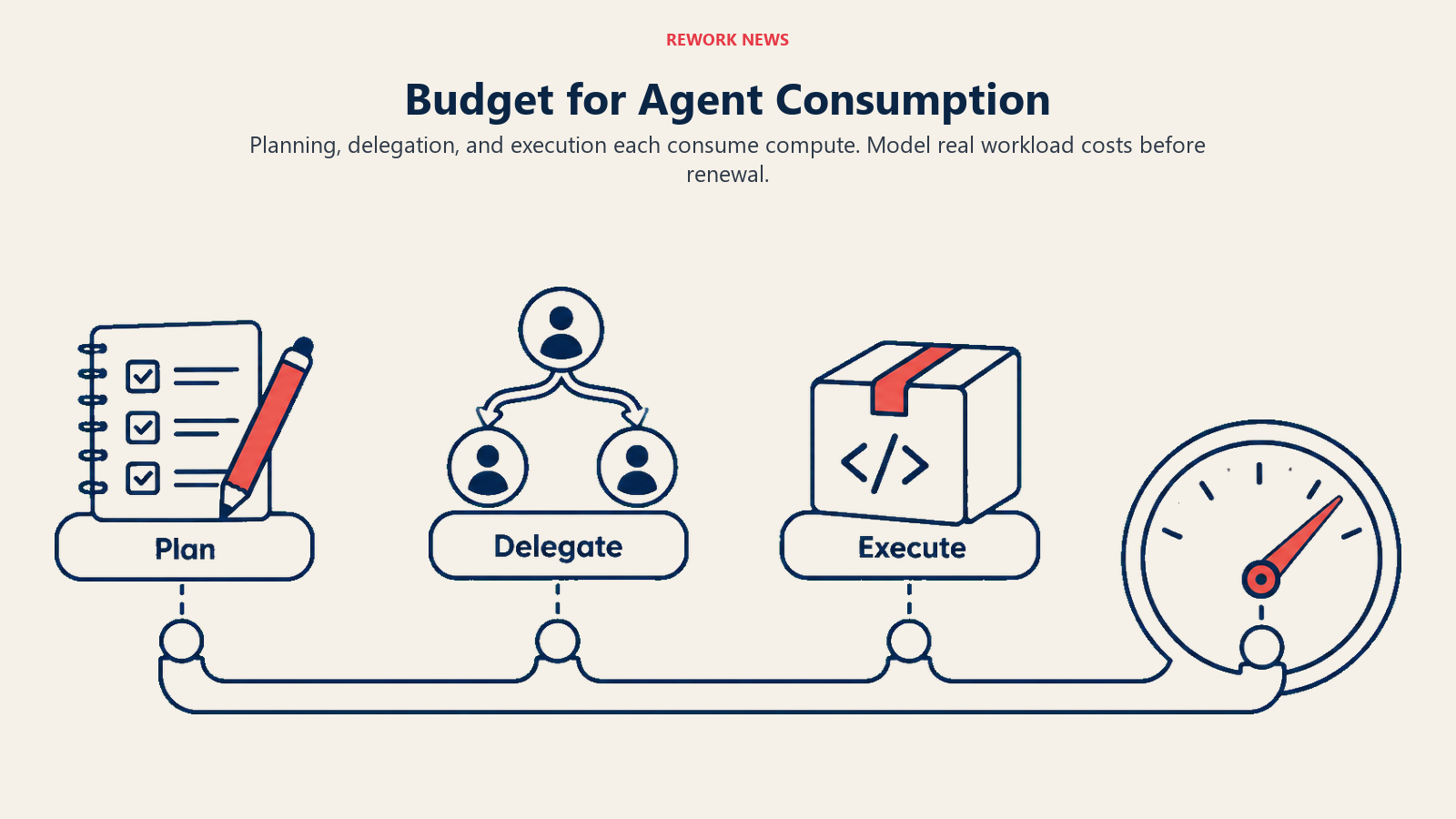
And Gartner also flagged a structural shift in how these tools operate: the market is moving from single-threaded code assistance (one developer, one suggestion at a time) to orchestrated, multi-agent workflows where agents plan tasks, delegate subtasks to other agents, and execute in parallel. That shift changes the cost model entirely.
OpenAI's recognition as a Leader in Gartner's 2026 evaluation confirms the dynamic: frontier model providers aren't just building the engines anymore. They're building the cars.
What "Realignment" Actually Means for Vendor Decisions
The word "realignment" in Gartner's framing is doing a lot of work. It's worth unpacking what's actually happening at each layer of the stack.
At the bottom layer, you have the foundation models: GPT-4.1, Claude 3.7, Gemini 2.5, and their successors. These models power the reasoning and code generation behind every coding agent. Until recently, the companies building these models largely provided them as infrastructure for others to build on.
That's changing. OpenAI's Codex and its direct enterprise offerings, Anthropic's Claude Code, and Google's Gemini Code Assist are all now competing directly with what Cursor, Tabnine, GitHub Copilot, and the rest of the application layer have been building for years.
The implication for vendor decisions: any application-layer vendor that isn't vertically integrated with a frontier model is now running a race against the companies whose APIs they depend on. Some will get acquired. Some will build proprietary models. Some will lose the race. A CTO signing a multi-year enterprise agreement with an application-layer-only vendor right now is taking a bet on that vendor's survival.
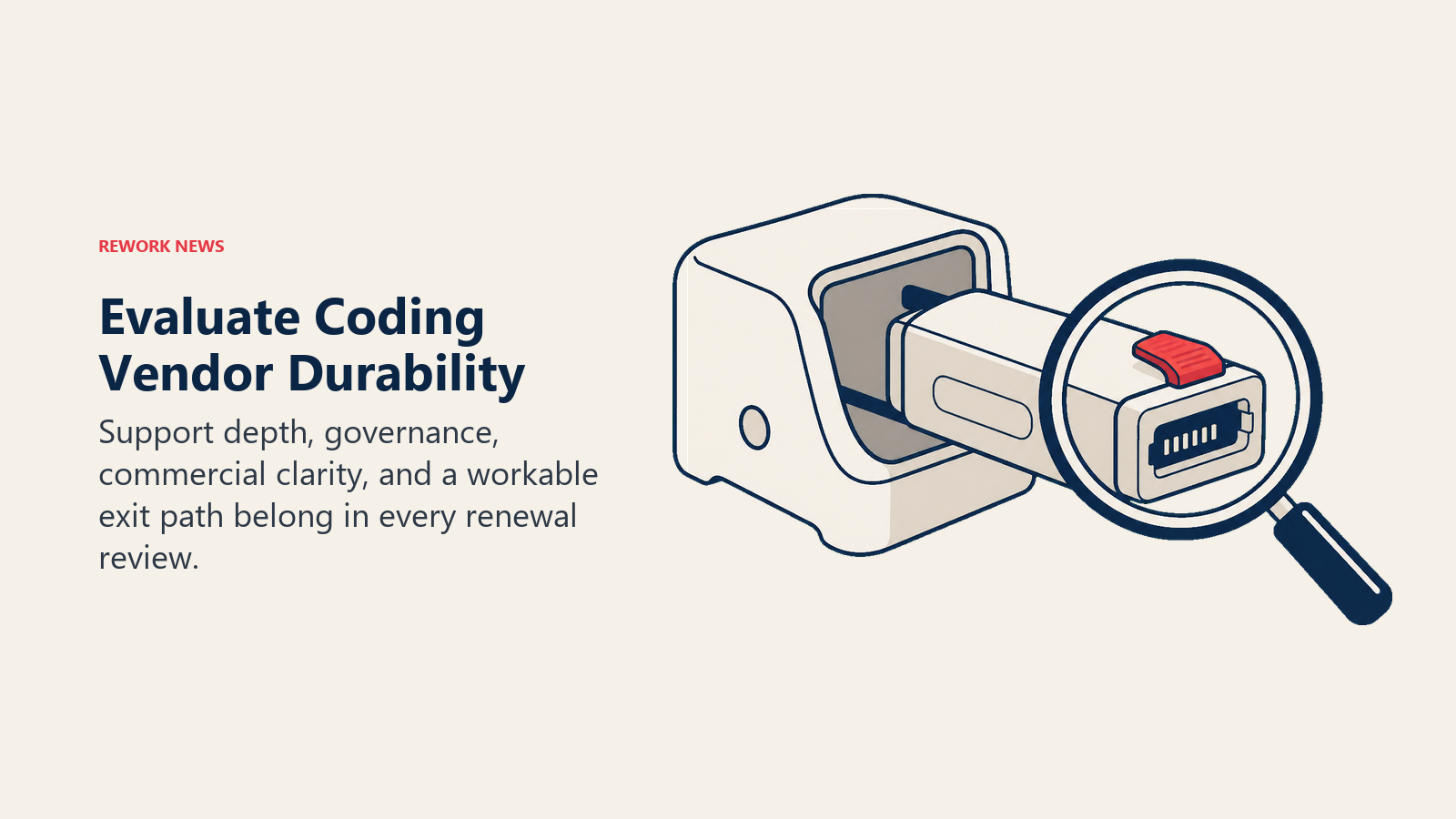
Gartner's advice is direct: tool selection shouldn't just weigh product quality and market momentum. It should explicitly evaluate enterprise sales maturity, support depth, governance capabilities, and commercial clarity. Those are durability signals, not just feature signals.
For context on what good AI governance looks like inside an organization, the gap between adoption speed and governance readiness is still wide in most enterprises.
The Pricing Shift That Changes Your Budget Model
Seat-based pricing is familiar. You know how many developers you have. You multiply by the per-seat cost. You budget it. Done.
That model is ending.
Gartner's analysis identifies a clear shift from seat-based subscriptions to usage-based pricing. The reason is structural: agentic workflows consume compute per action, not per user per month. When an agent is running a planning loop, delegating to subagents, and executing a hundred small tasks to close a single pull request, the cost isn't "one seat used." It's the sum of thousands of model API calls.
Usage-based pricing is a better reflection of actual value. It's also a much harder budgeting problem. A developer running a simple autocomplete tool costs roughly the same each month. A developer running an orchestrated multi-agent workflow for a major sprint could cost 10x more that month than the one before.
This matters most for the renewal conversation. If your current contracts are still seat-based, the next renewal negotiation is an opportunity to understand what your actual usage patterns would cost under a consumption model before you sign anything new. If you don't model that before the contract, you'll model it after, when it's too late to renegotiate.
Understanding how to measure the actual return from these investments is a related challenge. The framework for measuring AI return on investment covers how to structure that evaluation for a board or CFO audience.
The IDE Becoming Optional Is a Governance Problem
Gartner's projection that more than 65% of engineering teams using agentic coding will treat the integrated development environment (IDE) as optional by 2027 sounds like a developer workflow observation. But it's actually a governance statement.
When developers work inside an IDE like VS Code or JetBrains, there's a human in the loop at every step. The developer reads the suggestion, approves it, runs the tests, commits the change. The IDE is the checkpoint.
When agentic workflows take over, code is being generated, reviewed, tested, and committed without a developer touching each step. The IDE isn't the checkpoint anymore. The platform governance layer is. And most organizations don't have one.
This connects directly to the distinction between AI copilots and autonomous agents: a copilot assists a human who remains in control; an agent acts autonomously within a defined scope. When that scope includes your production codebase, the governance stakes are different.
A CTO who is already thinking about agent governance at the infrastructure level will find the executive decision framework for AI workforce transformation useful for structuring the organizational side of this shift. And for the build-vs-buy question on governance tooling itself, the build vs. buy vs. partner framework applies directly.
The Coding-Agent Procurement Test
Before signing or renewing any enterprise coding-agent contract, a CTO should be able to answer four questions clearly:
1. Where does your vendor sit in the stack? Is this an application-layer product, a vertically integrated product (model plus tooling), or a platform play from a frontier provider? The stack position tells you the acquisition and consolidation risk.
2. What does usage-based pricing actually cost at your usage patterns? Get the vendor to model your last 90 days of usage under their consumption pricing. If they can't or won't, that's the answer.
3. What governance controls come with the product? Can you audit what the agent did, who approved it, and what it changed? Governance capability should be a contract requirement, not a roadmap promise.
4. What's the exit path if you need to switch? What does data portability look like? What happens to custom prompt libraries, fine-tuned behavior, and integration configurations if you move to a different platform in 18 months?
This isn't skepticism about AI coding agents. They deliver real productivity gains. It's the same discipline you'd apply to any infrastructure vendor making significant claims during a period of market consolidation.
Frequently Asked Questions
What is the AI coding-agent market realignment Gartner identified?
According to Gartner's May 2026 analysis, the realignment refers to frontier model providers, the companies building foundation AI models, moving into direct competition with application-layer coding-agent vendors. Previously, model providers supplied the underlying AI; coding-tool vendors built products on top of it. Now, model providers are building those products themselves, creating direct competition with the vendors who were once their customers.
Why is usage-based pricing a concern for enterprise CTOs?
Usage-based pricing ties cost to compute consumption per agent action rather than to a fixed per-seat monthly fee. Agentic workflows that plan, delegate, and execute autonomously can consume significantly more compute than traditional code-suggestion tools. Without usage modeling before contract signing, organizations risk significant cost overruns as adoption scales and agentic workflows replace simpler assistance patterns.
How soon will agentic coding affect how my engineering teams work?
Gartner projects that by 2027, more than 65% of engineering teams using agentic coding will treat the IDE as optional. That's a 12-to-18-month window from the current date. For organizations already deploying agentic coding tools, the governance architecture for IDE-optional workflows needs to be in place before that shift completes, not after.
What to Do Now
Three concrete moves for a CTO before the next coding-agent contract renewal:
Model usage costs before the contract conversation starts. Ask your current and prospective vendors to run a usage simulation against your last 90 days of developer activity. Get a consumption-based cost estimate. Compare it to your current seat-based spend. That gap is your negotiating reality.
Add governance requirements to vendor evaluation criteria. Gartner explicitly advises that enterprise sales maturity, support depth, and governance capability belong in the vendor selection criteria alongside product quality. Write those requirements into your RFP before the vendor relationship sets expectations. Audit trails, scope controls, and human-in-the-loop override capabilities should be contract terms, not roadmap features.
Design your governance layer for IDE-optional workflows now. The 65% projection for IDE-optional engineering isn't a warning to slow down. It's a deadline for getting the governance architecture right. Map out which parts of your codebase need mandatory human review, what the approval flow looks like for autonomous code commits, and which agents have scope to touch production systems. Doing this now, while adoption is still early, is cheaper than retrofitting governance onto a sprawling agent deployment.
Learn More

On this page
- The Market Is Bigger Than You Think
- What "Realignment" Actually Means for Vendor Decisions
- The Pricing Shift That Changes Your Budget Model
- The IDE Becoming Optional Is a Governance Problem
- The Coding-Agent Procurement Test
- Frequently Asked Questions
- What is the AI coding-agent market realignment Gartner identified?
- Why is usage-based pricing a concern for enterprise CTOs?
- How soon will agentic coding affect how my engineering teams work?
- What to Do Now
- Learn More