More in
AI at Work News
OpenAI Opened ChatGPT Advertising to Small Businesses at Any Budget
Jun 6, 2026
AI Is Everywhere at Work. Only 1 in 10 Say It Transformed the Job
Jun 6, 2026
Vibe Coding's $10.5B Moment: AI Now Starts Most New Software Builds
Jun 6, 2026
AI Agents Now Have More System Access Than Your Employees. Few Are Secured
Jun 5, 2026 · Currently reading
Should You Build Your AI or Buy It? Watch What the Giants Bought.
Jun 5, 2026
Uber Caps Employee AI Spending at $1,500 Per Seat After a Budget Blowout
Jun 5, 2026
Trump's AI Executive Order Is Deregulatory. Your Compliance Risk Didn't Move
Jun 4, 2026
AI Pushed 220 Unicorns Below $1B. Pre-ChatGPT Companies Face a Reckoning
Jun 4, 2026
Token Prices Fell 67% This Year. Your AI Bill Is Going Up Anyway
Jun 3, 2026
Small Businesses Using AI Report Higher Revenue and Shorter Workdays
Jun 3, 2026
AI Agents Now Have More System Access Than Your Employees. Few Are Secured
Turn this article into takeaways for your work.


Each assistant summarizes the article only for you and suggests best practices for your work.
The most-cited annual breach report in enterprise security just named your AI agents as the next major attack target. If you funded the agent rollout but haven't funded the controls, you're carrying a board-level risk you probably can't quantify yet.
According to the 2026 Verizon Data Breach Investigations Report (DBIR), which covers incidents from November 2024 through October 2025, service accounts and machine identities are the assets most likely to be leveraged as attackers adopt more agentic approaches. This year's report, notably, was developed in partnership with Anthropic and analyzed hundreds of threat actors flagged for policy violations. That partnership signals something meaningful: the security industry isn't treating AI as a future concern anymore. It's present-tense.
The DBIR's framing is precise. It doesn't say "AI will be hacked someday." It says machine identities and service accounts are the credential surface most likely to be exploited in what it calls our potential agentic AI future. That's the surface your agents are running on right now.
Key Facts
- 76% of security professionals are worried about the security implications of integrating AI agents into their organization (Darktrace State of AI Cybersecurity 2026, survey of 1,500+ security leaders)
- 47% of security executives say they are very or extremely concerned about AI-agent security risks (Darktrace State of AI Cybersecurity 2026)
- The 2026 Verizon DBIR explicitly names machine identities and service accounts as the assets most likely to be exploited in an agentic-AI future (Verizon, 2026)
What the DBIR Actually Found
The Verizon DBIR has been the breach-data benchmark for over a decade. It covers real incidents, real exploits, real financial outcomes. When it flags a new attack surface, security teams listen. This year, for the first time, it calls out machine identities and service accounts as a category under direct pressure from agentic AI adoption.
The mechanism is straightforward. Attackers are not waiting for agents to become common. They're already shifting tactics, using more agentic approaches themselves, to probe for high-value credentials they can chain together. Machine identities, the tokens and service accounts that give AI agents their reach, are exactly the credential type that gets rotated least often and monitored least closely.
Your organization's existing security program was built to protect human credentials. That program has gaps where agent credentials live.
The Employee Onboarding Contrast
Think about how your company handles a new senior employee who needs broad system access. There's identity vetting before the offer letter is signed. Access is provisioned using the principle of least privilege, meaning only what the role specifically requires. Activity is logged, often reviewed. And when that person leaves, there's a formal offboarding: accounts disabled, credentials revoked, audit trail closed.
Now think about the last AI agent your team deployed.
Most agents enter production with broad API access negotiated by whoever built the integration, running on a shared service account that was created once and never touched again, with no behavioral monitoring layer and no defined offboarding process. The agent runs 24 hours a day, seven days a week. It touches CRM records, customer data, financial systems, and communication logs. And it does all of this as what security researchers are increasingly calling an unmanaged insider: something with the reach of an employee and none of the accountability.
The access asymmetry is real and growing. Enterprises are deploying agents into workflows where the agent, by design, needs broader system access than the human doing equivalent work. The agent needs to touch more systems, faster, to be useful. That's a feature. But without the controls that would wrap a human employee of equivalent reach, it's also a vulnerability.
This is the access-without-accountability gap. And the 2026 DBIR just told you that attackers have identified it too.
Why This Is a P&L Problem, Not an IT Problem
The Darktrace State of AI Cybersecurity 2026 report, based on a survey of more than 1,500 security leaders, frames agentic AI explicitly as a new class of insider risk. Nearly half of security executives say they're very or extremely concerned. Three in four security professionals overall say the implications worry them. Those are not abstract concerns about future scenarios. Those are practitioners who have already seen how the access picture changes when agents enter the stack.
Here is the CEO framing that matters: you approved the AI agent rollout. That decision was a good one. The productivity case, the cost case, the competitive case, all of it holds. But the budget for that rollout almost certainly included licenses, integration costs, and implementation time. It probably did not include a commensurate line item for credential management, behavioral monitoring, and agent-specific governance. You funded the offense. You may not have funded the defense.
A breach traced to an agent's service account is a board-level financial event. Regulatory exposure, customer notification requirements, reputational damage, and possible legal liability don't care whether the compromised credential belonged to a human or a machine. "The AI agent did it" is not a defense your general counsel wants to make. And the audit trail question ("Who approved this agent's access level and when?") is one the board will ask before the incident review is finished.
This connects directly to the AI governance gap already visible in enterprise operations. The governance problem and the security problem are the same problem viewed from two angles. You funded the capability without funding the control layer. That's the gap.
The Insider Risk Framing
The Darktrace framing, that AI agents represent a new class of insider risk, is worth sitting with. Traditional insider risk involves a person who either goes rogue or makes a mistake with access they legitimately hold. The controls built around insider risk: behavioral monitoring, anomaly detection, access reviews, and offboarding protocols, all assume you can track a person's intent over time.
An agent has no intent in the human sense. It executes instructions. But it can be manipulated. An attacker who gains control of a service account credential, or who finds a way to alter the instructions an agent receives, can use the agent's legitimate access to move laterally through systems. The agent itself becomes the inside threat, not because it made a choice but because it was running without the oversight that would have caught the compromise early.
The AI incident response playbook for this scenario is different from the one your team has for a phishing attack on a human account. Most organizations haven't written it yet.
What a CEO Should Ask the Security Team This Quarter
The goal is not to slow down agent deployment. It's to close the gap between the rollout you already approved and the controls that should have come with it. Four questions are worth putting on your next agenda with the CISO and CTO together, not separately.
First: can you give me a complete inventory of every deployed agent, what systems it touches, and what credentials it runs on? If the honest answer involves uncertainty about the full count, that's the finding. Agents procured by business units outside IT are common, and they carry the same credential risk.
Second: are any agents running on shared service accounts that other systems or humans also use? Shared credentials are a single point of compromise. Each agent should have a unique machine identity that can be rotated, monitored, and revoked independently.
Third: what behavioral monitoring is in place for agent activity? Agents should generate audit logs that are actively reviewed, not just stored. Unusual access patterns (volume spikes, off-hours activity, new system touchpoints) should trigger alerts, the same way they would for a human account.
Fourth: what is the offboarding process when an agent is retired or replaced? Service accounts for deprecated agents are a persistent access risk if they aren't formally disabled.
These are governance questions with a security frame. The AI risk register your team maintains should include agent credentials as a tracked asset category. If it doesn't, that's a gap to close before the next security review.
The Concrete Steps
A few moves make a real difference here and none of them require pausing your AI roadmap.
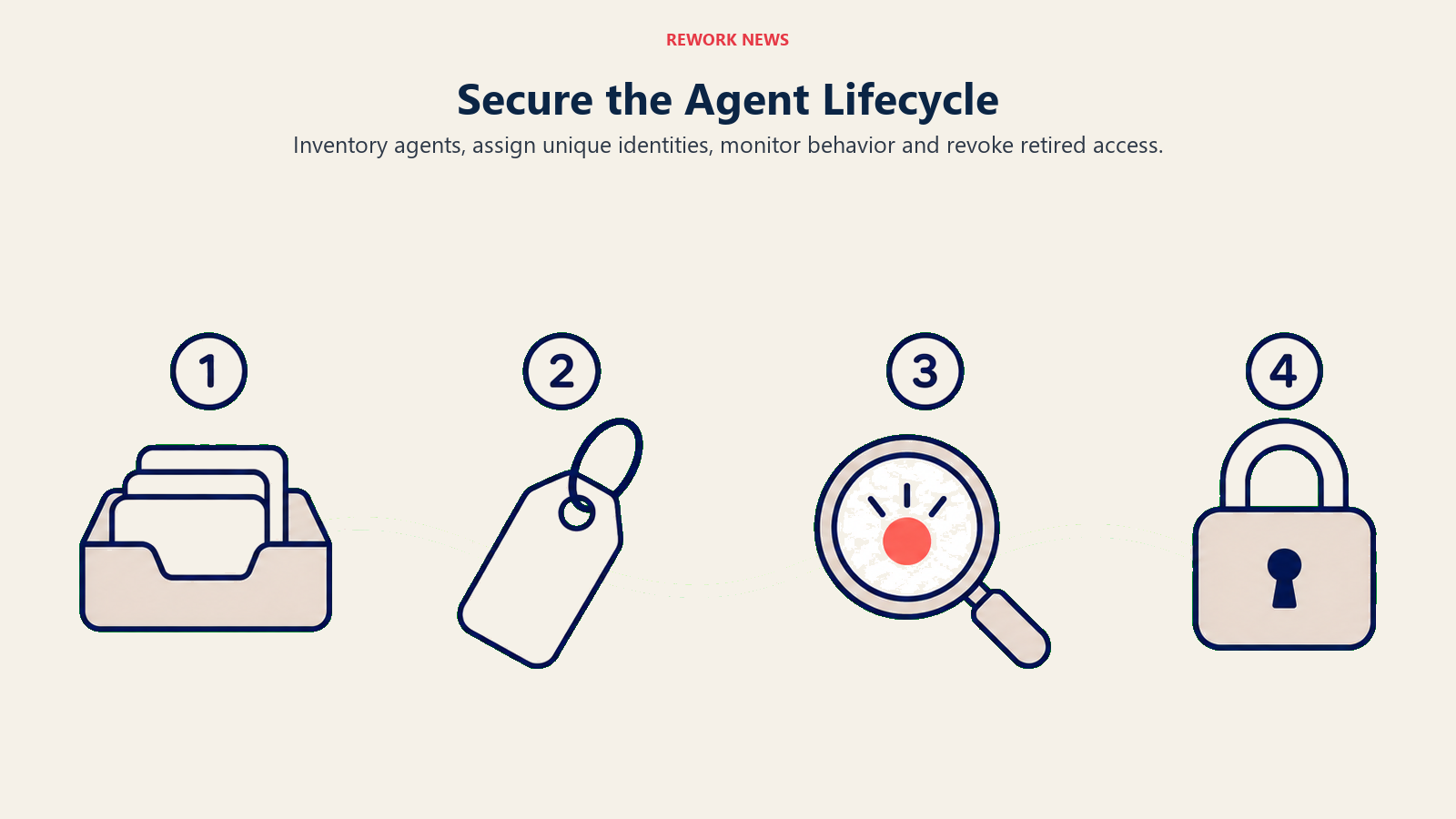
Inventory every deployed agent and its credentials. Include shadow deployments from business units. The number will likely surprise you. Use that count to scope the governance work.
Require unique machine identities. Every agent should run on its own credential, not a shared service account. This enables independent rotation and revocation, and it makes behavioral monitoring tractable.
Implement behavioral monitoring with alert thresholds. Agents should generate auditable logs. Security teams should have defined thresholds for anomaly alerts. This is the equivalent of the activity monitoring you already run on human accounts.
Build an offboarding protocol for agents. When an agent is retired, its credentials get revoked, its access gets audited, and the closure gets documented. This closes the persistent-access risk that deprecated service accounts create.
Fund agent security as a line item. The data classification work that tells you which systems carry the highest risk, and the audit trail infrastructure that makes agent actions reviewable, both require real investment. Budget them alongside the agent rollout, not as an afterthought.
Fold this into existing AI governance. If you have an AI governance policy at the department level, agent credential management should be an explicit requirement in it. Governance without a security annex for agent identities is incomplete.
The 2026 Verizon DBIR is not a warning about a future state. It's a description of what attackers are already doing and where they're looking next. Machine identities and service accounts are on that list. The question for a CEO is whether the controls around your agents are ready for the attention they're about to receive.
Frequently Asked Questions
What makes AI agents a security risk?
AI agents need broad system access to be useful. They touch multiple platforms, trigger business processes, and move data at a speed no human workflow matches. But most are deployed without the same controls applied to a human employee: no behavioral monitoring, no least-privilege access audit, no formal offboarding. That gap makes agent credentials a high-value target. An attacker who compromises the service account an agent runs on gets broad, persistent, 24/7 access to everything that agent touches.
What is a machine identity and why does the 2026 DBIR single it out?
A machine identity is the credential a software system uses to authenticate itself to other systems: API keys, tokens, service account credentials. Unlike human passwords, machine credentials tend to be long-lived, rarely rotated, and shared across multiple services. The 2026 Verizon DBIR flags them specifically because agentic AI creates many more machine identities very quickly, often without the governance processes that would normally govern human account creation. Each new agent is a new machine identity. If that identity isn't managed like a high-value credential, it becomes an exploitable surface.
What should a CEO ask the security team this quarter?
Four questions: How many agents are running and what credentials do they use? Are any running on shared service accounts? What behavioral monitoring covers agent activity? What is the offboarding process when an agent is retired? The answers will tell you whether the access-without-accountability gap is a current exposure or a managed risk. If the team can't answer all four with specificity, that's the finding to bring to the board.
Learn More
- The Agentic AI Governance Gap: the broader governance picture behind AI agent oversight and CEO accountability
- AI Incident Response Playbook: how to build the response process for AI-driven security events
- AI Risk Register: What to Track: the asset categories and risk dimensions your register should cover
- Audit Trails for AI-Executed Actions: building the logging infrastructure agent governance requires
- Data Classification for AI Access: knowing which systems carry the highest exposure before agents touch them
- Snowflake and Natoma: MCP Acquisition and Agent Governance: how enterprise platforms are building agent control layers
- Windows 365 for Agents: What CTOs Should Lock Down First: when a managed Windows desktop becomes an agent runtime and the system access that comes with it
Source: 2026 Verizon Data Breach Investigations Report (Verizon, 2026). Supporting data: Darktrace State of AI Cybersecurity 2026 (Darktrace, 2026).
