More in
AI at Work News
OpenAI Opened ChatGPT Advertising to Small Businesses at Any Budget
Jun 6, 2026
AI Is Everywhere at Work. Only 1 in 10 Say It Transformed the Job
Jun 6, 2026
Vibe Coding's $10.5B Moment: AI Now Starts Most New Software Builds
Jun 6, 2026
AI Agents Now Have More System Access Than Your Employees. Few Are Secured
Jun 5, 2026
Should You Build Your AI or Buy It? Watch What the Giants Bought.
Jun 5, 2026 · Currently reading
Uber Caps Employee AI Spending at $1,500 Per Seat After a Budget Blowout
Jun 5, 2026
Trump's AI Executive Order Is Deregulatory. Your Compliance Risk Didn't Move
Jun 4, 2026
AI Pushed 220 Unicorns Below $1B. Pre-ChatGPT Companies Face a Reckoning
Jun 4, 2026
Token Prices Fell 67% This Year. Your AI Bill Is Going Up Anyway
Jun 3, 2026
Small Businesses Using AI Report Higher Revenue and Shorter Workdays
Jun 3, 2026
Should You Build Your AI or Buy It? Watch What the Giants Bought.
Turn this article into takeaways for your work.


Each assistant summarizes the article only for you and suggests best practices for your work.
The biggest software companies in the world have nearly unlimited engineering talent. In the last two weeks, several of them decided not to use it.
Instead, they wrote checks. And the pattern in those checks is the clearest answer yet to a question every founder is wrestling with.
According to ERP Today, a cluster of enterprise software vendors just announced artificial intelligence (AI) acquisitions in a single short window, and they all point the same direction. Asana bought a no-code agent builder. Coupa bought a document-processing company. Vertice bought a procurement dataset. Salesforce signed a deal for a content platform. None of these companies lacks the engineers to build those features. They bought anyway. For any founder weighing whether to build AI in-house or buy it, that mergers-and-acquisitions (M&A) wave is worth reading closely, because it tells you where the real moat sits.
A Buying Spree With One Logic
The deals look unrelated on the surface. Work management, spend management, procurement, content. Different corners of the enterprise.
But TechCrunch reported that Asana paid $75 million for StackAI specifically to run agent workflows across enterprise systems, not to add a chatbot. Coupa's target brings document understanding into source-to-pay. Vertice's brings a procurement-pricing dataset and negotiation intelligence. ERP Today's read is blunt: these vendors are no longer just bolting an AI assistant onto an existing product. They are buying the data, the workflow, and the execution capability that an agent needs to actually do a job in a specific domain.
That is the tell. The model is not the scarce thing anymore. The thing an agent stands on is.
Key Facts
- Asana acquired StackAI, a no-code AI agent builder, for $75 million (announced May 28, 2026). (TechCrunch)
- Coupa (Rossum) and Vertice (Vendr) announced AI acquisitions in the same window, alongside Salesforce's agreement to buy Contentful. (ERP Today)
- Gartner projects 40% of enterprise applications will embed task-specific AI agents by the end of 2026, up from under 5% in 2025. (Gartner)
Why They Are Buying Instead of Building
The acquisition pattern shows where enterprise software vendors believe the hard part of agent deployment really sits.
Here is the part that should reframe your own roadmap.
An AI agent is only as good as what it sits on. A clever agent with no proprietary data, no workflow to act inside, and no domain context is a demo. It summarizes and suggests, and then a human does the real work. The agents that actually move a business are the ones wired into specific data, specific records, and a specific process they are allowed to change. That is exactly why vendors are shipping vertical, domain-bound agents instead of generic assistants, as Anthropic did with its 10 pre-built financial-services agents launched with JPMorgan.
Those assets are slow to build. A procurement-pricing dataset takes years of transactions to assemble. A document-processing engine that handles a thousand messy invoice formats takes a long, unglamorous grind. Workflow depth in a category takes a decade of customer feedback. The model on top can be swapped in an afternoon. The data and workflow underneath cannot.
So the giants are buying time. They have the cash to skip the grind and acquire the underlying asset, then point their existing models at it. The frontier model is becoming a commodity input, a reality you can see in the way enterprise AI bills keep climbing even as token prices fall and in the broader recalculation of what AI vendors are actually worth. The durable value moved underneath the model.
The Lesson Hiding in the Deals
For a founder, this M&A wave is not gossip. It is a free strategy memo.
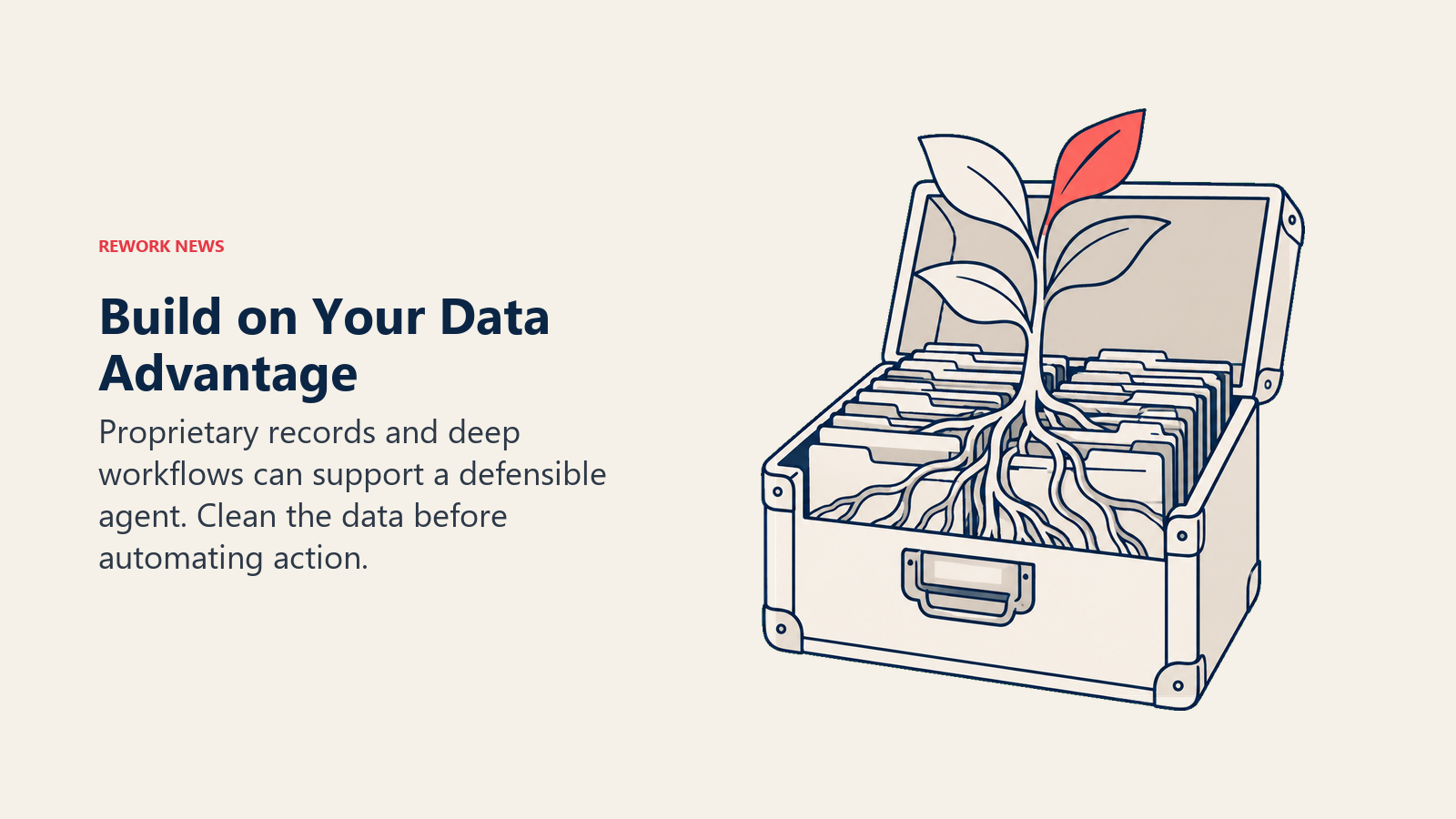
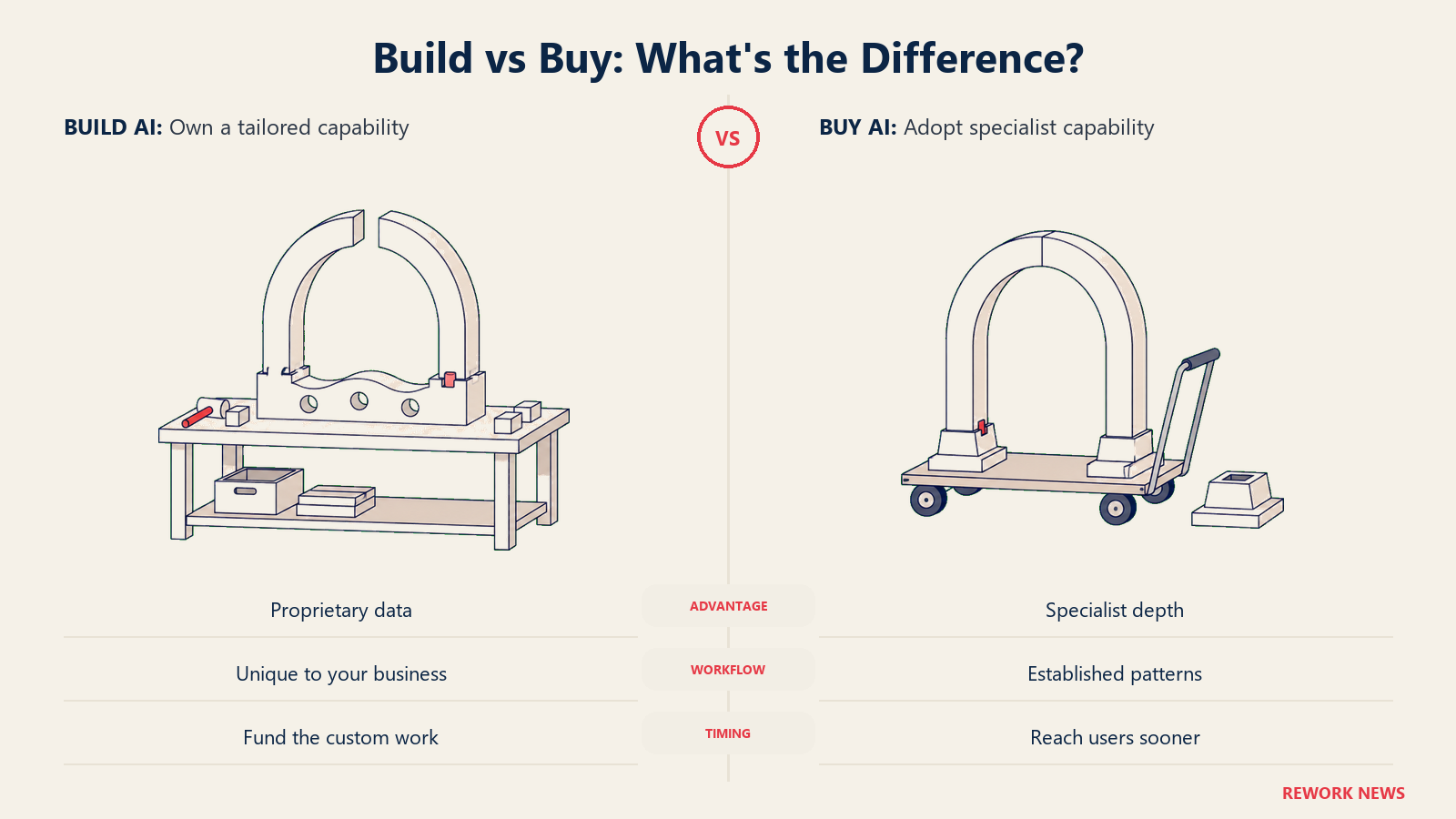
The build-versus-buy decision is not really about AI at all. It is about whether you own the data and workflow that would make an agent defensible. The companies getting repriced hardest are the ones whose core value an AI-native rival can now rebuild cheaply, which is why 220-plus pre-ChatGPT unicorns slipped below $1 billion. Sort your AI ambitions into two buckets.
Where you own proprietary data and a deep workflow, build. This is your moat. If you have years of customer transactions, a process nobody else can replicate, or domain context that is genuinely yours, an agent built on top of it is something a competitor cannot copy by buying a model. That is the one place in-house effort pays off. The same logic explains why Salesforce paid to give Agentforce a native content engine rather than waiting to build one.
Where you lack the data or the workflow, buy or partner. Trying to build a generic capability from scratch, document parsing, enrichment, a horizontal agent framework, means competing with companies that have a decade head start and a war chest. The giants just told you they would rather pay than fight that battle. You should listen.
There is a hard prerequisite under all of this. An agent built on messy, incomplete, or stale data does not just underperform. It acts wrong, at scale, faster than a human can catch it. Before you build an agent on your data, the data has to be worth building on, which is why the unglamorous discipline of clean enrichment and data hygiene is suddenly the difference between an agent that compounds and one that quietly creates liability.
Your Build-vs-Buy Test
You do not need a strategy offsite. You need to run four questions on every AI feature you are considering.
Do we own data here that a competitor cannot easily get? If yes, this is a build candidate. If no, it is a buy-or-partner candidate.
Would building this mean competing with a specialist who has years of head start? If yes, buying or integrating is almost always faster and cheaper than the engineering you would burn losing that race.
Is the data clean enough to trust an agent to act on it? If not, fix the data before you fund the agent. An agent on bad data is a faster way to make bad decisions.
Can we ship the bought version this quarter and the built version never? Speed is a real input. A capability live in eight weeks usually beats a better one shipped in eighteen months, especially while the category is still forming.
The giants have more engineers than you will ever hire, and they chose to buy. That is not an admission of weakness. It is a clear-eyed read on where value lives now: in the data and workflow underneath the agent, not in the agent itself. Build where you own that ground. Buy everywhere else. If a chunk of your AI roadmap is generic tooling you could license tomorrow, the smartest founders just showed you what to do with it. For a grounded starting point on the systems most worth owning versus buying, our guide to choosing a CRM for startups walks through where proprietary data actually accrues.
Frequently Asked Questions
What does the wave of enterprise AI acquisitions tell founders about build vs buy?
That the moat is data and workflow, not the model. Asana, Coupa, Vertice, and Salesforce all have the engineers to build AI features, yet they bought companies that owned proprietary data, document-processing capability, or workflow depth. The signal: build where you own unique data, and buy or partner for generic capability you would otherwise spend years recreating.
Why is an AI agent only as good as its data?
Because an agent's job is to act inside a specific context. Without proprietary data and a real workflow to operate in, it can only summarize and suggest, which leaves the actual work to a human. Worse, an agent acting on incomplete or stale data makes confident errors at machine speed. The underlying data and workflow, not the model, determine whether an agent creates value or risk.
When should a startup build its own AI instead of buying?
When the capability sits on top of data or a workflow you uniquely own. That is your defensible moat, and an agent built on it is something competitors cannot replicate by licensing a model. For generic, horizontal capability, buying or partnering is faster and cheaper than competing with established specialists.
Source: ERP Today, 2026 | TechCrunch, May 28, 2026 | Reworked, 2026
