More in
AI at Work News
OpenAI Opened ChatGPT Advertising to Small Businesses at Any Budget
Jun 6, 2026
AI Is Everywhere at Work. Only 1 in 10 Say It Transformed the Job
Jun 6, 2026
Vibe Coding's $10.5B Moment: AI Now Starts Most New Software Builds
Jun 6, 2026 · Currently reading
AI Agents Now Have More System Access Than Your Employees. Few Are Secured
Jun 5, 2026
Should You Build Your AI or Buy It? Watch What the Giants Bought.
Jun 5, 2026
Uber Caps Employee AI Spending at $1,500 Per Seat After a Budget Blowout
Jun 5, 2026
Trump's AI Executive Order Is Deregulatory. Your Compliance Risk Didn't Move
Jun 4, 2026
AI Pushed 220 Unicorns Below $1B. Pre-ChatGPT Companies Face a Reckoning
Jun 4, 2026
Token Prices Fell 67% This Year. Your AI Bill Is Going Up Anyway
Jun 3, 2026
Small Businesses Using AI Report Higher Revenue and Shorter Workdays
Jun 3, 2026
Vibe Coding's $10.5B Moment: AI Now Starts Most New Software Builds
Turn this article into takeaways for your work.


Each assistant summarizes the article only for you and suggests best practices for your work.
Something crossed a threshold last week, and the $500 million funding round almost obscures it.
Database startup Supabase raised half a billion dollars at a $10.5 billion valuation, according to CNBC, led by sovereign wealth fund GIC with Accel, Y Combinator, Craft Ventures, Felicis, Coatue, and Stripe joining in. That is roughly double the company's October 2025 valuation in under eight months. But the number that matters most for any founder planning a product roadmap is not the dollar figure. It is this one: more than 60% of new databases on Supabase's platform are now started by an AI coding tool rather than a human developer. Anthropic's Claude Code is the single largest source of those AI-initiated projects in 2026 so far.
This is not a quirky benchmark buried in the press release. It is a signal about what software creation looks like right now, and what building a company will look like for the next several years.
What Vibe Coding Actually Is
The term you will hear around this is "vibe coding." The idea is simple: instead of writing code line by line, a person (engineer or not) describes what they want to an AI coding tool, reviews the output, refines it through conversation, and ships. Tools like Claude Code and OpenAI's Codex handle the generation. The human handles the direction and judgment.
Supabase is a five-year-old company (founded 2020 by Paul Copplestone as CEO and Ant Wilson as CTO) that provides backend infrastructure: databases, authentication, storage, and APIs. It is the kind of platform that used to require a back-end engineer to set up properly. Now, according to reporting on its fundraise, the majority of people spinning up new databases on its platform are AI agents acting on behalf of a human prompter, often a non-engineer who would not have touched a database tool six months ago.
The round's investors are not betting on a niche developer trend. They are betting that this mode of software creation becomes the default, and that Supabase's 250,000-plus customers represent an early lead in a much larger market. The company is about 350 people. It has now raised at a valuation that most Series D companies never reach.
Key Facts
- Supabase raised $500 million at a $10.5 billion valuation in June 2026, roughly double its October 2025 valuation. (CNBC)
- More than 60% of new databases on Supabase's platform are now initiated by an AI coding tool rather than a human. (CNBC / Supabase)
- Anthropic's Claude Code is the single largest AI source of new Supabase databases in 2026. (CNBC / Supabase)
Three Structural Shifts for Founders
The Supabase data point matters because it exposes how AI-assisted building changes founder assumptions about speed, staffing, and infrastructure.
The 60% figure is Supabase-platform-specific. Don't stretch it into a claim that most software everywhere is AI-written. But it is a clean, credible data point from a platform where you can count exactly who started what. And if you run it through the implications for an early-stage company, three things change.
1. Build-vs-buy tilts toward build for more of your surface area.
The traditional argument for buying versus building is speed and cost. Hiring engineers to build a custom solution takes months and costs $200,000 to $400,000 per engineer per year in a competitive market. Now a founder or a small technical team can ship what used to require a four-person back-end squad, by describing the system to a coding agent, reviewing the output, and iterating. The floor on "how much does it cost to build this" has dropped. That changes the calculation on a lot of features you previously would have bought from a vendor. It doesn't mean build everything. It means revisit the assumptions about what's too expensive to build. For a grounded view of how AI is reshaping the SaaS operating model more broadly, the dynamics are similar: more surface area becomes buildable in-house than the old model assumed.
2. Moats made of "it's hard to build" are eroding.
If your competitive advantage is primarily that your product would be difficult for a competitor to replicate from scratch, that advantage has a shorter shelf life than it did two years ago. A competitor with a small team and access to Claude Code or Codex can now build a functional version of what once took 18 months in six. This doesn't mean all moats disappear. But the moats that survive are the ones that are hard to build even with AI agents: proprietary datasets, hard-won distribution, deep customer relationships, operational taste and judgment. The build-vs-buy signal from enterprise AI acquisitions points in the same direction: companies that bought AI capability were really buying the data and workflow underneath it, not the model on top. Your durable differentiator is the same thing: what you know and who you reach that a freshly-scaffolded AI project cannot replicate.
3. Your hiring math changes.
This one is counterintuitive. If AI agents are writing more of the code, you might assume you need fewer engineers. But the bottleneck doesn't disappear, it moves. Writing code is no longer the scarce resource. Reviewing, securing, and operating AI-generated code is. A production codebase built substantially by a coding agent needs humans who can audit it for security vulnerabilities, catch edge cases the agent missed, design the architecture at a level the agent doesn't hold, and own the system when something breaks at 2 a.m. Those skills are different from raw coding throughput. You may need fewer generalist engineers on the front end of a build, but you need more senior engineers and security-minded reviewers on the back end. For AI features and where to add them in a SaaS product, the same principle applies: the people who review and maintain are the constraint, not the people who generate.
The Part That Gets Glossed Over
The vibe-coding narrative is exciting and mostly accurate, but the version that gets passed around at conferences tends to strip out the friction.
AI-generated code still fails in predictable ways. It handles the straightforward path well and misses edge cases. It doesn't understand your security requirements unless you specify them explicitly, and even then it may implement them incorrectly. It generates code that works in a demo environment and breaks under load. The question of who owns and maintains a codebase built primarily by an AI agent is not settled. When the system behaves unexpectedly six months after launch, the person who prompted it into existence may not have the depth to diagnose it.
None of this means vibe coding isn't real or isn't valuable. But the Supabase 60% figure is a count of projects started, not a count of production systems running reliably at scale. The broader AI adoption question for companies in 2026 is the same: how much of the productivity gain survives the transition from demo to production?
This is why the third shift (hiring reviewers, not just builders) is not a hedge. It's the actual leverage point.
A Practical Vibe-Code vs. Engineer-Properly Decision Split
Use this as a starting filter, not a fixed rule.
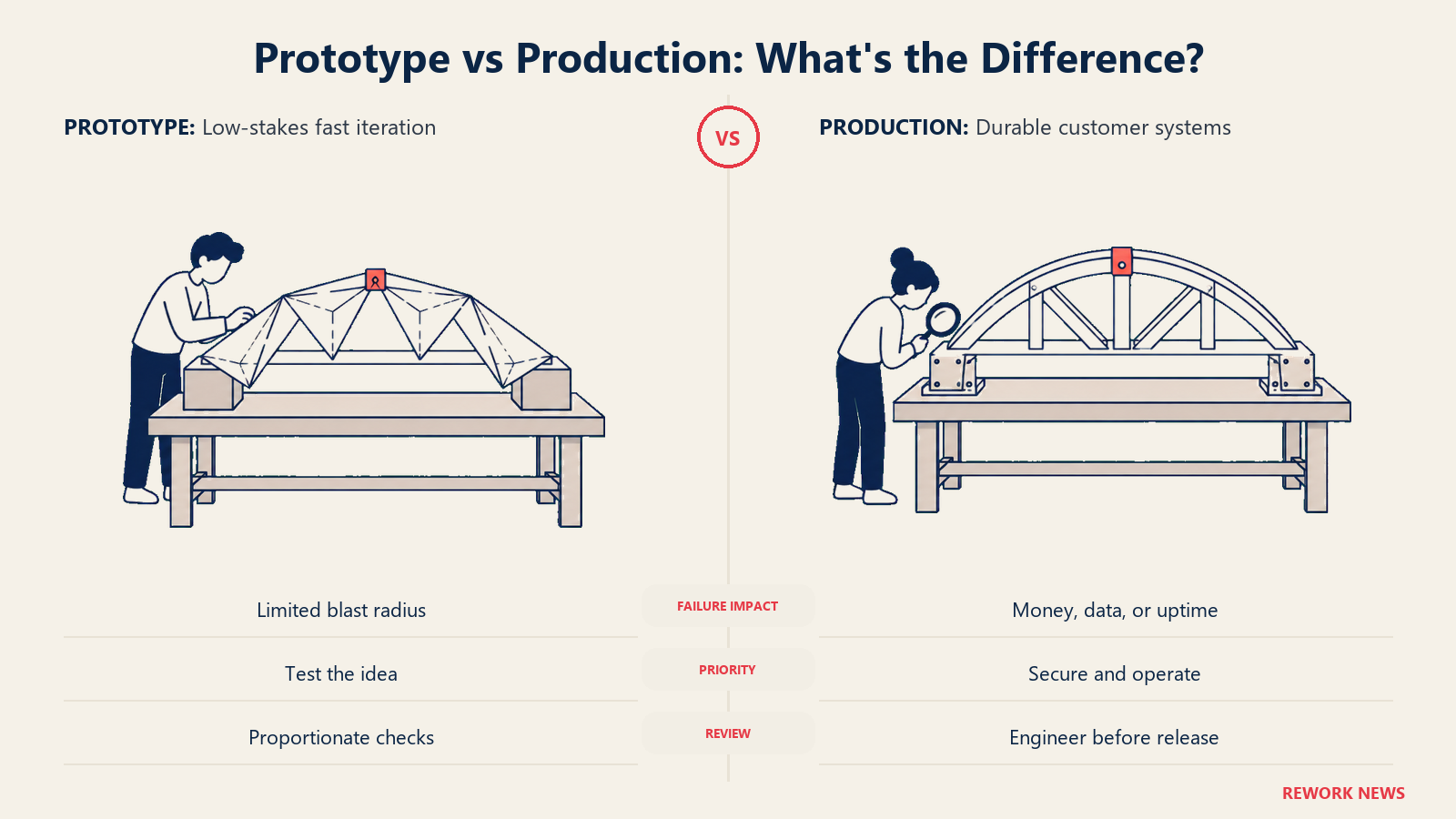
Vibe-code first (lower stakes, fast iteration):
- Internal tools and dashboards that only your team uses
- Early prototypes where you're testing whether users want the thing at all
- One-off scripts, automations, and integrations with low blast radius if they fail
- Features where a bug means a bad user experience, not a data breach or a financial error
Engineer properly (higher stakes, durable production):
- Anything that handles payment processing, personal data, or authentication
- Core infrastructure that other systems depend on (if it breaks, everything breaks)
- Anything regulated (healthcare, financial services, legal)
- Systems that need to scale beyond what a proof-of-concept load looks like
- Code that will be read and modified by future engineers who weren't in the original conversation with the AI
The practical gate between the two categories is this: if a bug in this system could cost a customer money, expose their data, or take your product offline, it needs a human engineer reviewing it before it ships. AI-generated code can still pass that gate. But it needs to go through it.
For founders thinking about how AI adoption plays out at the C-level and where it creates leverage versus risk, the vibe-coding wave is one of the clearest current examples of why SaaS is the highest-velocity AI adopter in any category.
Frequently Asked Questions
What is vibe coding and why does it matter for founders?
Vibe coding is the practice of building working software by prompting AI tools (like Claude Code or OpenAI's Codex) rather than writing code manually. It matters for founders because it lowers the labor cost and time of building software significantly, which changes the build-vs-buy calculation and compresses the time-to-prototype for small teams and non-engineers.
Is the Supabase 60% stat generalizable to all software?
No. The figure is specific to new databases started on the Supabase platform, which skews toward early-stage projects and developer tooling. It's a credible directional signal about how software creation is shifting, but it doesn't mean 60% of all production software is now AI-written. The meaningful implication is that AI-initiated projects are crossing from novelty to majority in at least some segments of the market.
What should a founder actually do differently because of this?
Three things. Revisit your build-vs-buy assumptions with the lower labor cost of vibe coding in mind. Audit your competitive moat to see how much of it depends on "this would be hard to build," and reinforce the parts that don't (distribution, data, relationships). Adjust your hiring plan to weight code review and security audit skills alongside raw coding throughput.
Learn More
- Why SaaS Is the Highest-Velocity AI Adopter
- AI Features as Product: Where to Add Them
- What AI Transformation Means at the C-Level
- Should You Build Your AI or Buy It?
- Anthropic IPO Filing: The $96.5B AI Vendor Calculus
- B2B SaaS Growth Model
Source: CNBC, June 4, 2026
