More in
AI at Work News
OpenAI Opened ChatGPT Advertising to Small Businesses at Any Budget
Jun 6, 2026
AI Is Everywhere at Work. Only 1 in 10 Say It Transformed the Job
Jun 6, 2026 · Currently reading
Vibe Coding's $10.5B Moment: AI Now Starts Most New Software Builds
Jun 6, 2026
AI Agents Now Have More System Access Than Your Employees. Few Are Secured
Jun 5, 2026
Should You Build Your AI or Buy It? Watch What the Giants Bought.
Jun 5, 2026
Uber Caps Employee AI Spending at $1,500 Per Seat After a Budget Blowout
Jun 5, 2026
Trump's AI Executive Order Is Deregulatory. Your Compliance Risk Didn't Move
Jun 4, 2026
AI Pushed 220 Unicorns Below $1B. Pre-ChatGPT Companies Face a Reckoning
Jun 4, 2026
Token Prices Fell 67% This Year. Your AI Bill Is Going Up Anyway
Jun 3, 2026
Small Businesses Using AI Report Higher Revenue and Shorter Workdays
Jun 3, 2026
AI Is Everywhere at Work. Only 1 in 10 Say It Transformed the Job
Turn this article into takeaways for your work.


Each assistant summarizes the article only for you and suggests best practices for your work.
Your team is using AI. Probably a lot of them. But if you're wondering why it isn't showing up yet in your numbers, you're not alone, and you're not misreading the data.
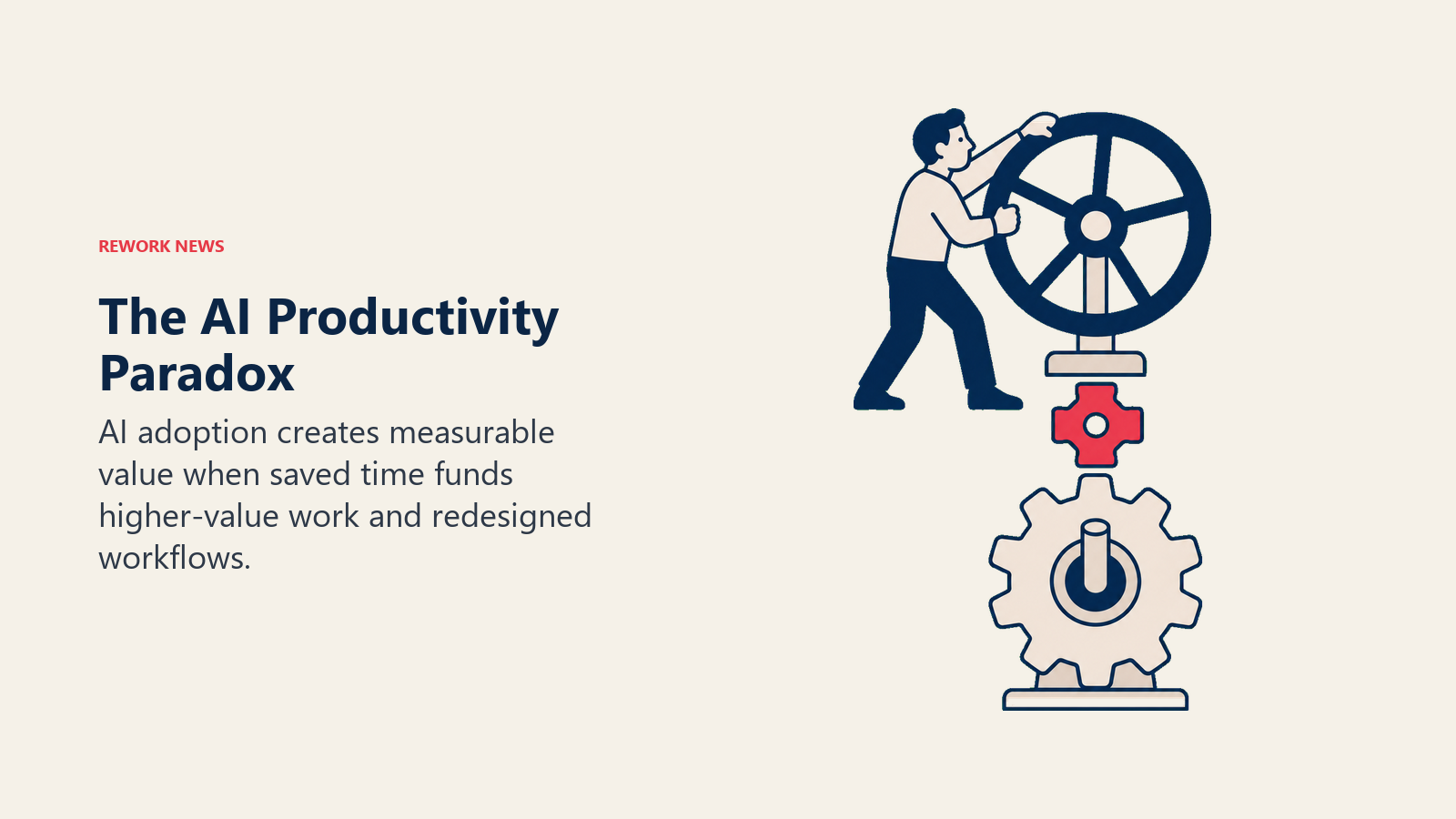
A National Bureau of Economic Research (NBER) working paper surveying nearly 750 corporate executives found something striking: perceived productivity gains from AI consistently exceed measured ones. The researchers call this the "productivity paradox" and trace it to a lag in revenue realization. Companies are adopting AI faster than they're redesigning the work around it, and that mismatch is exactly why the P&L stays flat even as license counts climb.
The paradox isn't a sign that AI doesn't work. It's a signal that adoption alone isn't the goal.
The Numbers Behind the Gap
The NBER paper (working paper w34984, co-published with the Federal Reserve Bank of Atlanta) is one of the most rigorous looks at this question to date. The executive-level survey captures what's actually happening inside organizations rather than what vendors promise in pitch decks.
Key Facts
- Nearly 750 corporate executives report perceived AI productivity gains exceeding measured gains, with the gap attributed to a delay in revenue realization (NBER/Atlanta Fed, w34984, 2026)
- Generative AI saves roughly 5.4% of work hours, about 2.2 hours per week for a standard 40-hour schedule (Federal Reserve, 2026)
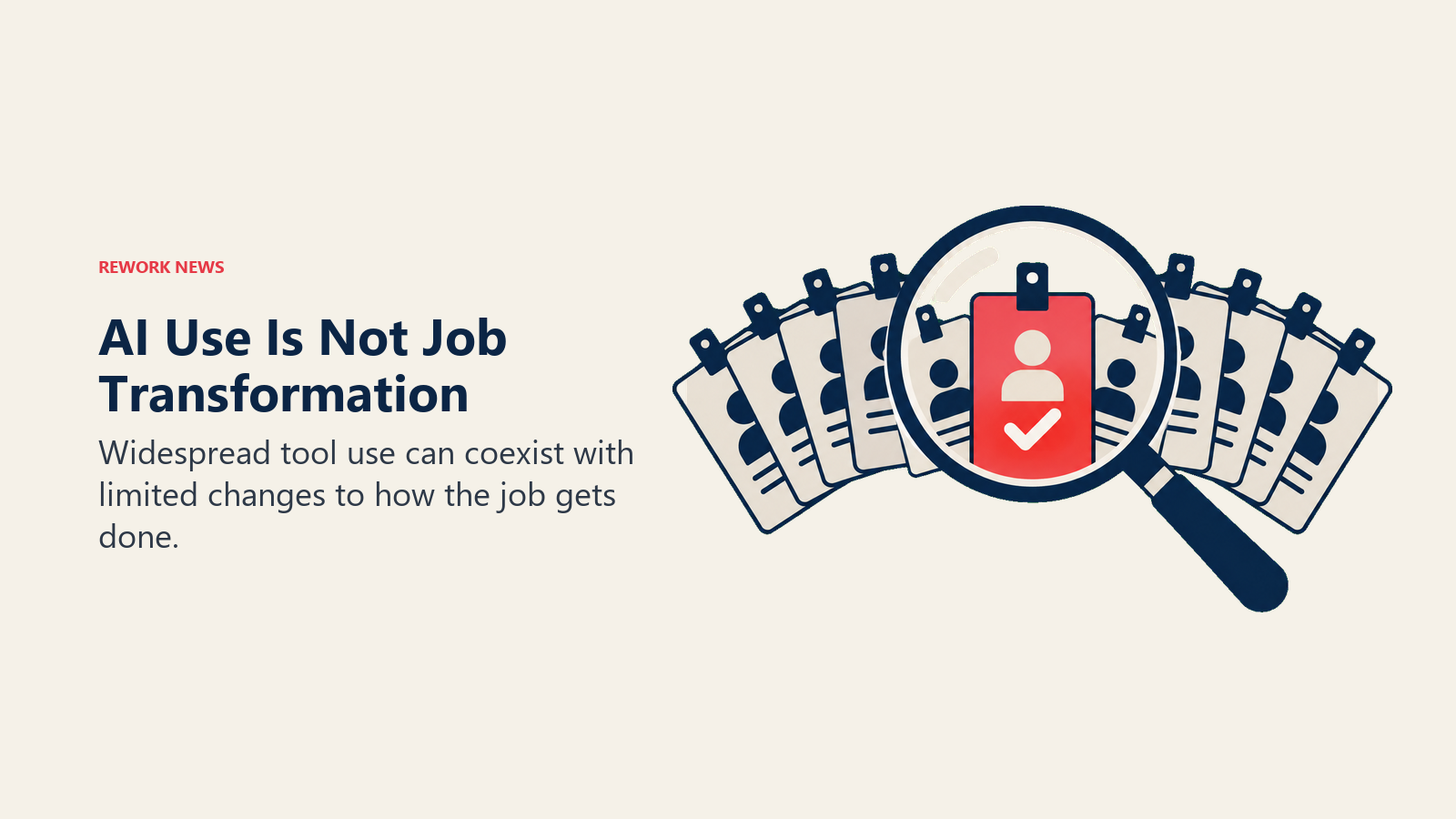
- Only about 1 in 10 employees in AI-adopting organizations strongly agree that AI has transformed how their work gets done (Gallup, 2026)
That Gallup figure deserves to sit with you for a moment. Around 80% of employees report using AI tools at work. But only roughly 10% say it actually changed how they do their jobs in a meaningful way. The rest are using AI the same way they once used Google, as a slightly faster version of what they already did.
Why Your Numbers Don't Match Your Usage Logs
The gap between perceived and measured impact isn't a mystery once you understand the mechanism. When employees adopt AI, they tend to automate the parts of their work that are easiest to automate, not necessarily the parts that drive the most value. A salesperson uses AI to draft follow-up emails faster. A manager uses it to summarize meeting notes. These are real time savings, but they don't directly move revenue.
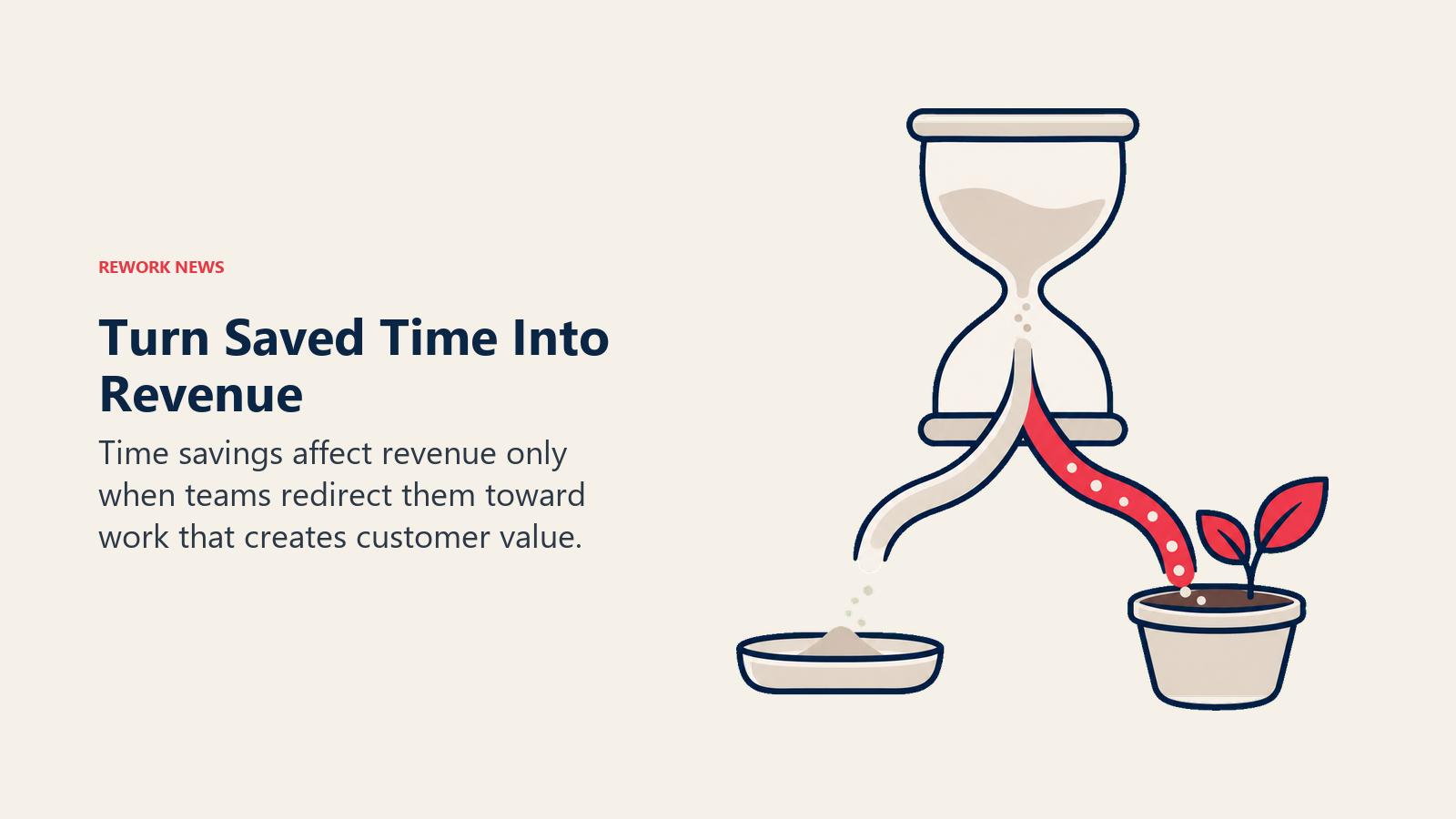
The Federal Reserve's analysis supports this. Generative AI saves about 2.2 hours per week across a 40-hour schedule. That's roughly a 5.4% efficiency gain on work-time. But work-time savings don't become P&L impact automatically. They only translate to revenue if the freed-up hours get redirected toward higher-value activities, or if the underlying workflow gets redesigned so the gain compounds.
Most organizations skip that redirection step. Employees save two hours, then fill them with lower-priority work or meetings. The time evaporates rather than converts. And because nothing in the revenue model changes, the productivity gain stays trapped inside the workflow.
The NBER paper adds another layer: the gains that do show up in measured productivity flow mostly through demand and innovation channels, not capital deepening. In plain language, AI creates value by enabling new things (better products, faster iteration, sharper customer targeting) not just by doing old things more cheaply. Organizations that treat AI as a cost-reduction tool tend to measure only the cheap part and miss the growth part.
Where the Gains Actually Show Up
Not all sectors or use cases are created equal. The NBER findings show the largest measured productivity gains in high-skill services and finance. These are areas where AI assists complex judgment work, deal analysis, contract review, financial modeling, client research, rather than simple repetitive tasks.
The pattern makes sense. When AI augments a $300,000 analyst or a senior relationship manager, the gain is large enough to register. When it helps someone send a slightly better email, it doesn't move the needle in aggregate.
The implication for CEOs: where you deploy AI matters as much as how broadly you deploy it. Spreading AI licenses across every function is adoption. Concentrating AI on the work that directly connects to revenue is transformation.
Small firms and large firms are also seeing different things. The NBER data shows larger firms anticipate AI-driven workforce reductions over time, while smaller firms actually expect modest headcount gains, driven by growth from productivity improvements. The common assumption that AI mostly cuts jobs at scale looks more complicated up close.
Four Things CEOs Can Do This Quarter
The gap between adoption and measured impact is closeable. But it requires treating AI as an operational design problem, not a procurement problem.
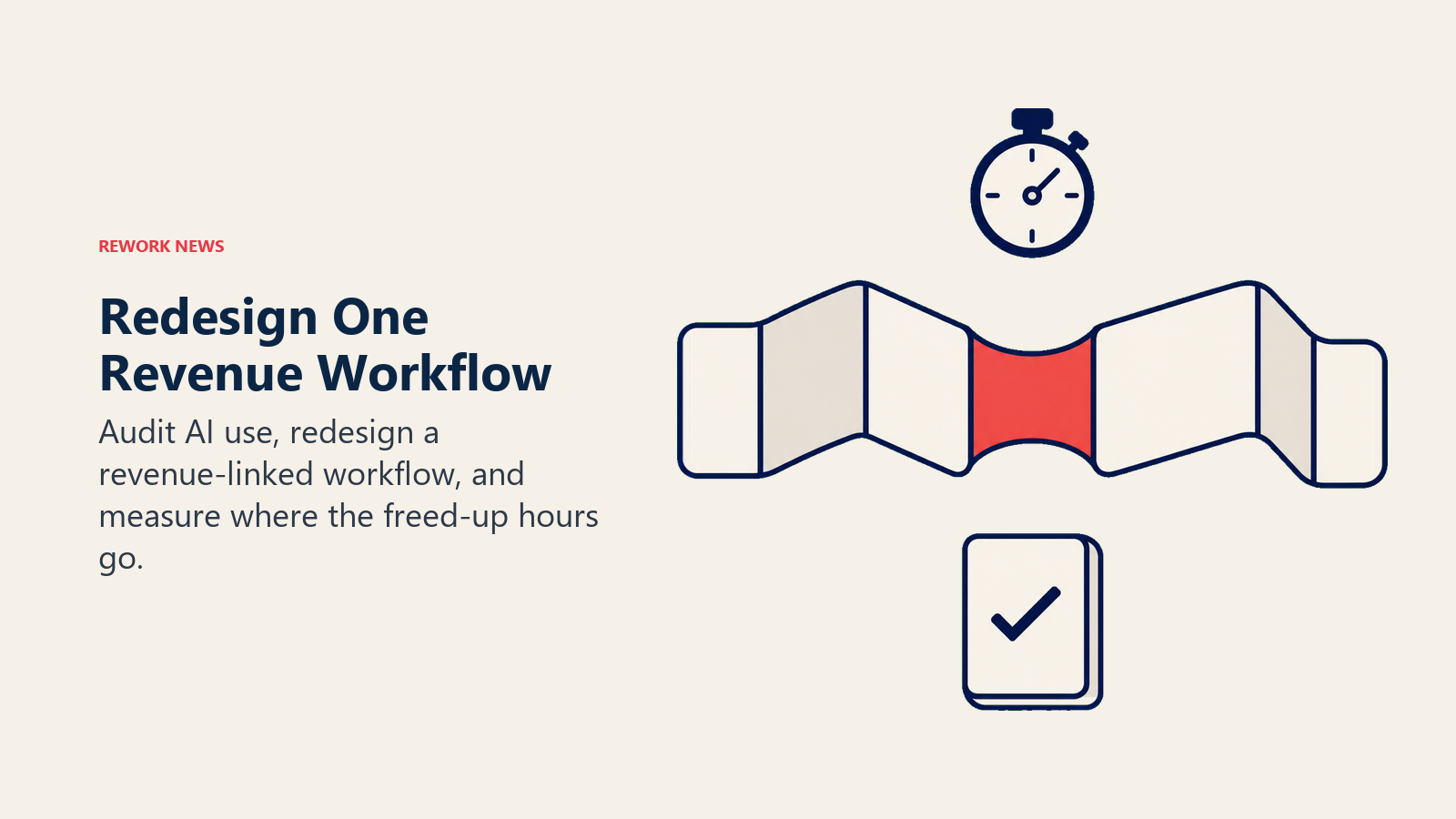
1. Audit where your AI hours are actually going. Pull usage data from your AI tools and map it to job function. Are your highest-leverage roles using AI on their highest-leverage tasks? In most companies, the answer is no. Heavy AI usage tends to cluster in communications and documentation, not in the work that closes deals or wins customers.
2. Redesign at least one revenue-linked workflow. Pick a workflow that directly touches revenue, a sales process, a customer success motion, a product development cycle, and redesign it around AI from the ground up. Don't bolt AI onto the existing steps. Ask: if we had to build this workflow today knowing what AI can do, what would it look like? The NBER paper's finding that gains flow through demand and innovation channels suggests this kind of redesign is where the real upside lives.
3. Measure outcomes, not usage. Most AI dashboards report seat counts and query volumes. These are adoption metrics, not impact metrics. Shift your reporting to outcome metrics: revenue per head in AI-assisted roles, cycle time on AI-redesigned workflows, customer acquisition cost in AI-supported funnels. If you can't link your AI investment to one of those numbers, you don't yet know if it's working.
4. Close the loop on freed-up time. The 2.2 hours per week that AI saves is only valuable if it goes somewhere deliberate. Build explicit time-to-value agreements with teams: when AI reduces the time you spend on task X, here's where that time goes next. Without that direction, the hours disappear and the productivity gain vanishes with them.
The Revenue-Realization Lag Is Real, But Finite
The NBER paper's framing of a "productivity paradox" doesn't mean the gains won't come. It means they come later and through different channels than most executives expect. The researchers find positive labor-productivity effects across the companies surveyed. The gap is a timing issue, not a fundamental failure.
But "it'll work eventually" isn't a strategy. CEOs who wait for the gains to materialize on their own are likely to keep watching the adoption curve rise and the P&L stay flat. The companies that close the lag earliest will be the ones that treat workflow redesign, outcome measurement, and revenue-focused deployment as the actual work of AI adoption, not the thing that happens after adoption.
AI is already everywhere at work. The question now is whether it's working.
Frequently Asked Questions
Why do employees perceive bigger productivity gains from AI than the data shows? People tend to notice when AI saves them time on a specific task and mentally extrapolate that to their whole job. But the measured gain reflects whether total output or revenue actually increased. When time savings don't get redirected to higher-value work, the perceived gain is real but the measured gain doesn't show up. This is the core of what the NBER research calls the revenue-realization lag.
Which industries see the most measurable AI productivity gains right now? The NBER survey of nearly 750 executives found the largest measured gains in high-skill services and finance. These sectors see the biggest lift because AI is augmenting complex, high-value judgment work where even incremental improvements move the needle in revenue terms.
Should CEOs push for more AI licenses if measured impact is low? Probably not yet. The evidence suggests the constraint isn't access to AI tools, it's how those tools are integrated into workflows and whether they're connected to revenue-linked tasks. More licenses without workflow redesign and outcome measurement tends to widen the adoption-to-impact gap rather than close it.
Learn More
- Why AI ROI Is Hard to Prove - the structural reasons measured AI returns lag adoption curves
- Time Saved vs. Revenue Impact: Measuring AI - a framework for converting AI efficiency gains into P&L-visible outcomes
- Enterprise AI Bills Are Rising Even as Token Prices Fall - the cost side of the AI investment equation
- PwC's AI Leadership Gap Report - how leading companies are pulling ahead of laggards in measured AI performance
Source: NBER Working Paper w34984, "Artificial Intelligence, Productivity, and the Workforce: Evidence from Corporate Executives" (2026) | Gallup, "Rising AI Adoption Spurs Workforce Changes" (2026) | Federal Reserve FEDS Note, "Monitoring AI Adoption in the U.S. Economy" (2026)
