Spektrum Penjajaran Jualan-CS: Cara Handoff Berubah dari SMB ke Enterprise
Turn this article into takeaways for your work.


Each assistant summarizes the article only for you and suggests best practices for your work.
Inilah corak yang berlaku di banyak syarikat SaaS yang sedang berkembang. VP Jualan menghadiri persidangan, mendengar ceramah hebat daripada seseorang di syarikat perisian enterprise 500 orang, dan kembali dengan mandat: kami merombak Handoff AE-ke-CSM. Dua bulan kemudian, pasukan tenggelam dalam templat perancangan akaun bersama dan pengenalan CS pra-penutupan untuk tawaran $12K yang ditutup dalam 14 hari. Wakil-wakil kecewa. CSM keletihan. Pelanggan keliru. Dan masalahnya bukan penjajaran yang lemah. Ia adalah model penjajaran yang salah diterapkan pada segmen yang salah.
Perkara sebaliknya juga berlaku. Pemimpin CS yang membina Playbook mereka dalam kumpulan SMB cuba menerapkannya pada tawaran enterprise $200K dengan lima pihak berkepentingan eksekutif dan pelaksanaan 90 hari. Mereka mengharapkan pelanggan melayani diri sendiri melalui sumber Onboarding. Champion yang mempertaruhkan reputasi mereka pada pembelian tidak mendengar dari CSM yang dinamakan selama dua minggu. Tawaran secara rasminya ditutup. Hubungan itu sudah berisiko. Penyelidikan McKinsey tentang kejayaan pelanggan menunjukkan bahawa syarikat SaaS berprestasi tinggi menentukur model liputan CS mereka mengikut kerumitan segmen, bukan satu standard tunggal. Dinamik ini kelihatan berbeza bergantung pada di mana tawaran anda sebenarnya berada. Perbandingan penjajaran SMB lawan enterprise merangkumi bagaimana model berubah merentasi lengkung pertumbuhan.
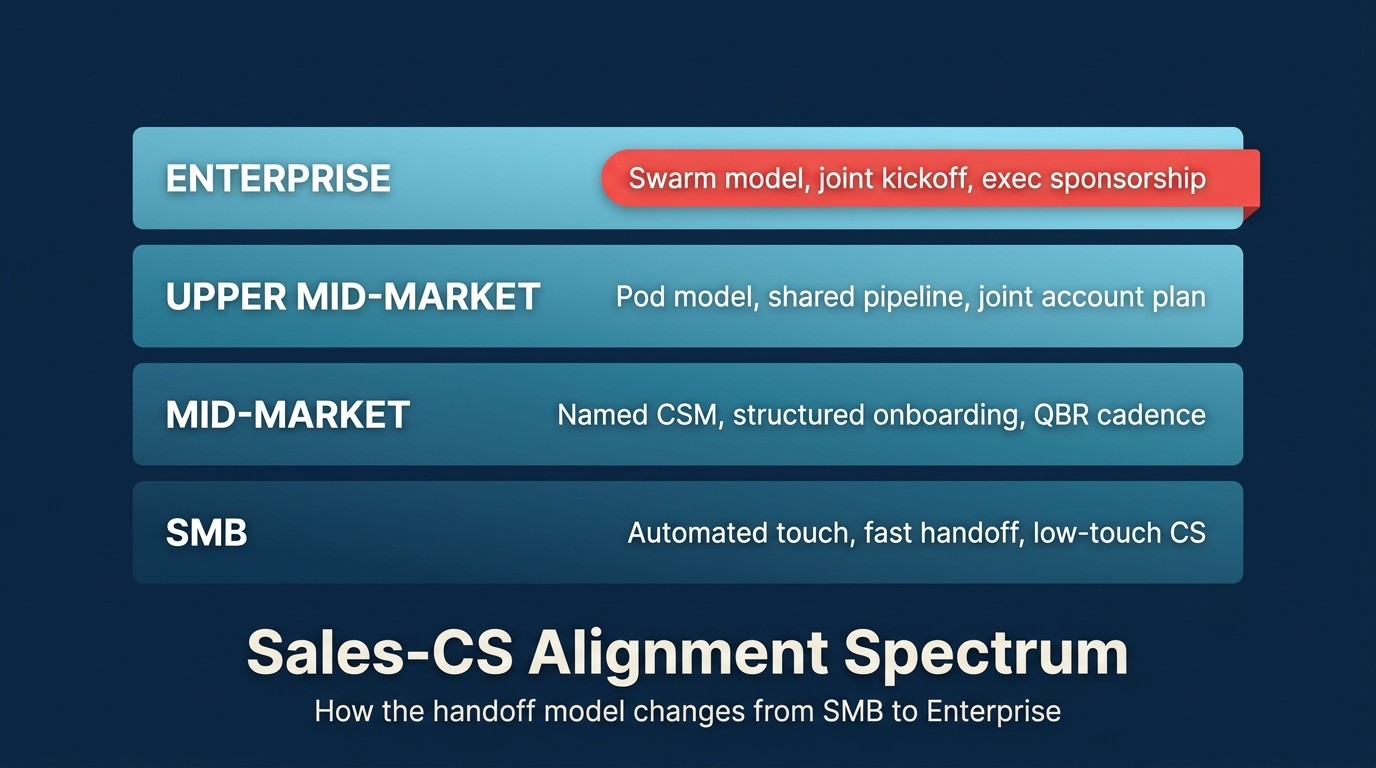
Penjajaran antara Jualan dan CS bukan model tunggal. Ia adalah spektrum. Dan mengetahui di mana perniagaan sebenar anda berada dalam spektrum itu lebih berharga daripada mana-mana Playbook amalan terbaik yang dipinjam dari syarikat yang beroperasi pada skala yang berbeza.
Spektrum Penjajaran (SMB ke Pasaran Pertengahan ke Enterprise) ialah rangka kerja yang digunakan artikel ini untuk mendiagnos kesesuaian segmen. Tiga segmen, tiga realiti, empat soalan penentukuran: tangga pelaburan penjajaran yang meningkat dengan kerumitan tawaran, bilangan pihak berkepentingan, dan risiko pelaksanaan. Tuntutan teras rangka kerja ini: model penjajaran yang betul bukan yang paling canggih. Ia adalah yang sesuai dengan tawaran anda.
Tiga Segmen, Tiga Realiti
Untuk tujuan artikel ini, spektrum dibahagikan kepada tiga segmen. Ini bukan rigid, dan kes tepi patut dibincangkan. Tetapi definisi ini memberi kita bahasa yang dikongsi.
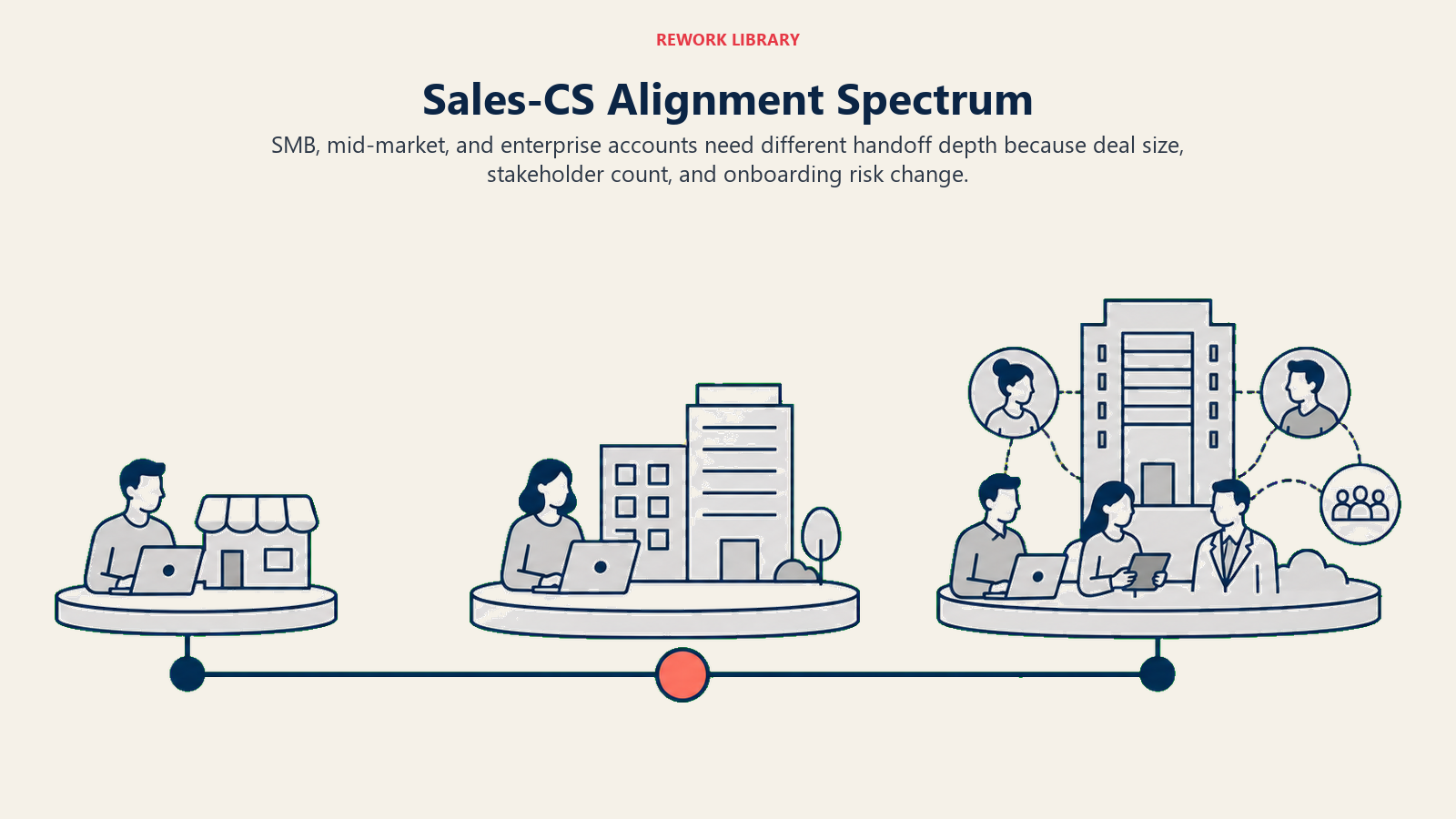
SMB: Di bawah 25 tempat duduk atau di bawah $15K ACV. Tawaran ditutup dengan cepat, sering dalam satu hingga tiga minggu. AE mungkin tidak pernah bercakap dengan lebih daripada satu atau dua kenalan. Onboarding dijangka diarahkan sendiri atau dibantu ringan. CS, jika wujud sama sekali, dikumpulkan bukan dinamakan.
Pasaran pertengahan: 25 hingga 250 tempat duduk atau $15K hingga $150K ACV. Tawaran mengambil masa minggu hingga bulan. Terdapat kenalan ICP yang ditentukan dan biasanya champion yang mendorong keputusan pembelian dalaman. CSM bernama ditugaskan selepas penutupan. Di sinilah kebanyakan infrastruktur Handoff yang diterangkan dalam koleksi ini tinggal, dan di mana kebanyakan kerosakan berlaku.
Enterprise: Lebih daripada 250 tempat duduk atau lebih daripada $150K ACV. Kitaran jualan adalah panjang. Pelbagai pihak berkepentingan wujud di kedua-dua belah tawaran. Kerumitan pelaksanaan bermakna CS ditarik masuk sebelum kontrak ditandatangani. Handoff bukan satu panggilan. Ia adalah proses berbilang minggu yang berkoordinasi. Penyelidikan Bain tentang pembaharuan perisian enterprise mengesahkan bahawa pertaruhan pada segmen ini luar biasa tinggi: pelanggan enterprise meneliti prestasi vendor jauh lebih rapi berbanding akaun SMB. Serah terima kitaran hayat AE-ke-CSM menghuraikan bagaimana urutan Handoff ini berbeza mengikut segmen.
Spektrum tidak linear seperti yang dijumlahkan oleh nombor-nombor tersebut. Tawaran $40K dalam gerakan jualan yang dipacu produk berkelajuan tinggi mungkin berkelakuan lebih seperti SMB. Tawaran land-and-expand $100K dengan pasukan pelaksanaan 10 orang kelihatan lebih seperti enterprise. Tetapi sauh-sauh ini memberi anda titik permulaan.
Fakta Utama: Kesesuaian Segmen dan Ekonomi Pengekalan
- Syarikat yang memadankan model liputan CS mereka dengan kerumitan tawaran melihat pengekalan hasil bersih 15-20% lebih tinggi berbanding mereka yang menerapkan pendekatan satu-saiz-untuk-semua, menurut tinjauan penandaarasan CS tahunan Gainsight.
- 68% pemimpin CS menyatakan risiko pengekalan utama mereka adalah "proses Handoff yang tidak sepadan" (bermakna Handoff direka untuk segmen yang berbeza daripada tawaran yang diterapkannya) (Totango, 2024).
- Tawaran enterprise (melebihi $100K ACV) di mana CS diperkenalkan pra-penutupan mempunyai kadar pengembangan 31% lebih tinggi dalam 12 bulan pertama berbanding tawaran di mana CS hanya masuk pada kickoff (KeyBank Capital Markets CS survey).
"Tawaran pasaran pertengahan mewakili titik pembelokan di mana 78% pemimpin pasukan hasil menyatakan kepekatan kegagalan Handoff tertinggi mereka. Bukan pada SMB di mana volum adalah raja, dan bukan pada enterprise di mana proses formal wujud, tetapi dalam jalur ACV $25K-$100K di mana proses belum menyaingi kerumitan." (Winning by Design, 2024)
"Pelanggan enterprise yang bertemu pasukan CS mereka sebelum tandatangan kontrak mempunyai kadar pengembangan 31% lebih tinggi dalam 12 bulan pertama berbanding pelanggan yang pertama kali bertemu CS pada kickoff. Jurang itu memampatkan keseluruhan kes untuk penglibatan CS pra-penutupan menjadi satu nombor." (KeyBank Capital Markets CS Survey, 2023)
Perbandingan Model Penjajaran
| SMB | Pasaran Pertengahan | Enterprise | |
|---|---|---|---|
| Struktur Handoff | AE → CS berkumpul atau Onboarding digital | AE → CSM bernama (dua hala) | AE + SE → CSM + Pelaksanaan (pelbagai hala) |
| Pemasaan penglibatan CS | Selepas penutupan sahaja | Pada atau sejurus sebelum penutupan | 30-90 hari sebelum penutupan |
| Alat penjajaran utama | Rekod CRM bersih, templat Onboarding standard | Panggilan Handoff, rekod konteks tawaran, kickoff bersama | Pelan akaun bersama, kriteria kejayaan dikongsi dalam kontrak, laluan eskalasi bertingkat |
Realiti Penjajaran SMB
Dalam SMB, AE sering berperanan sebagai CSM, sekurang-kurangnya untuk 60 hingga 90 hari pertama. Tawaran ditutup, dan pelanggan mengharapkan untuk memulakan. Mungkin tidak ada CSM bernama yang menunggu di sebelah lain. Handoff adalah dalaman: AE melengkapkan rekod CRM, mencetuskan urutan e-mel Onboarding, dan beralih ke peluang seterusnya.
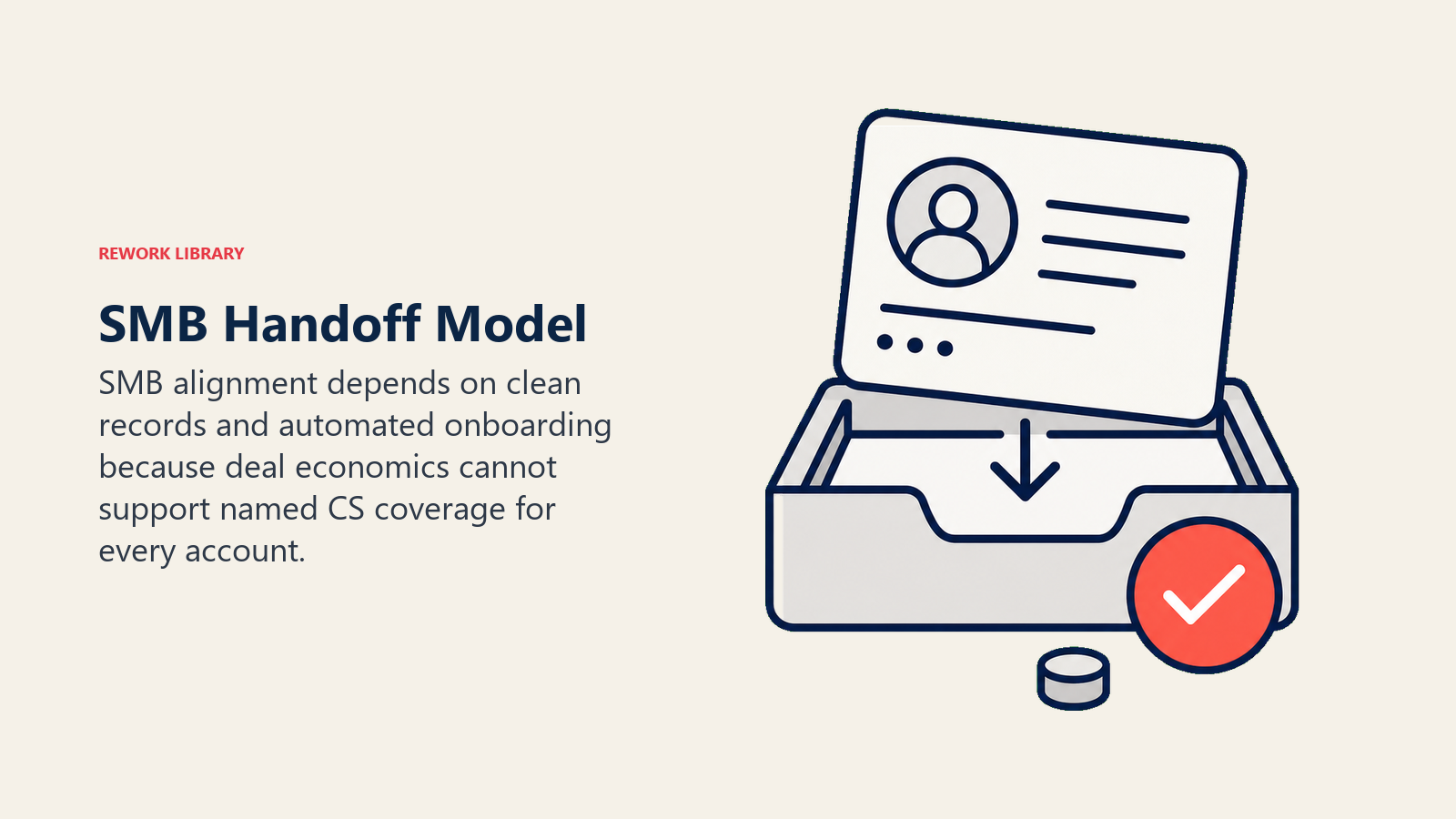
Ini bukan kegagalan penjajaran. Ia adalah ekonomi segmen. Anda tidak boleh meletakkan CSM yang berdedikasi pada kontrak tahunan $10K dan mengharapkan ekonomi unit yang positif. Tetapi risiko penjajaran adalah nyata.
Risiko utama dalam SMB adalah disiplin volum. Apabila AE menutup 30 tawaran sebulan, kebersihan CRM merosot. Templat Onboarding dicetuskan dengan data yang hilang. Pelanggan tidak mendengar dari sesiapa selama seminggu. Pasukan CS berkumpul mewarisi akaun yang hampir tidak mereka ketahui. Penyelesaiannya bukan CSM bernama setiap akaun. Ia adalah standard rekod Handoff yang bersih yang mengambil masa lima minit untuk dilengkapkan dan dikuatkuasakan pada penutupan.
Cara penjajaran kelihatan dalam SMB:
- Peluang CRM mempunyai semua medan yang diperlukan dilengkapkan sebelum peringkat berpindah ke Closed Won
- Urutan Onboarding standard dicetuskan secara automatik dalam beberapa minit dari penutupan
- Pasukan CS berkumpul mempunyai sejarah kenalan yang boleh mereka semak sebelum menghubungi
- Laluan Onboarding digital pertama membawa sebahagian besar 30 hari pertama
Kerja AE dalam SMB adalah menutup dengan bersih dan menyerahkan rekod yang lengkap. Berat hubungan tinggal dalam produk dan urutan Onboarding, bukan dalam perhatian manusia yang dinamakan. Tetapi apakah yang berlaku apabila kerumitan tawaran meningkat dan model ramping itu tidak lagi bertahan?
Realiti Penjajaran Pasaran Pertengahan
Di sinilah kebanyakan infrastruktur penjajaran dalam koleksi ini tinggal. Pasaran pertengahan adalah konteks lalai kerana di situlah sempadan antara Jualan dan CS paling kelihatan, paling penting, dan paling konsisten rosak.
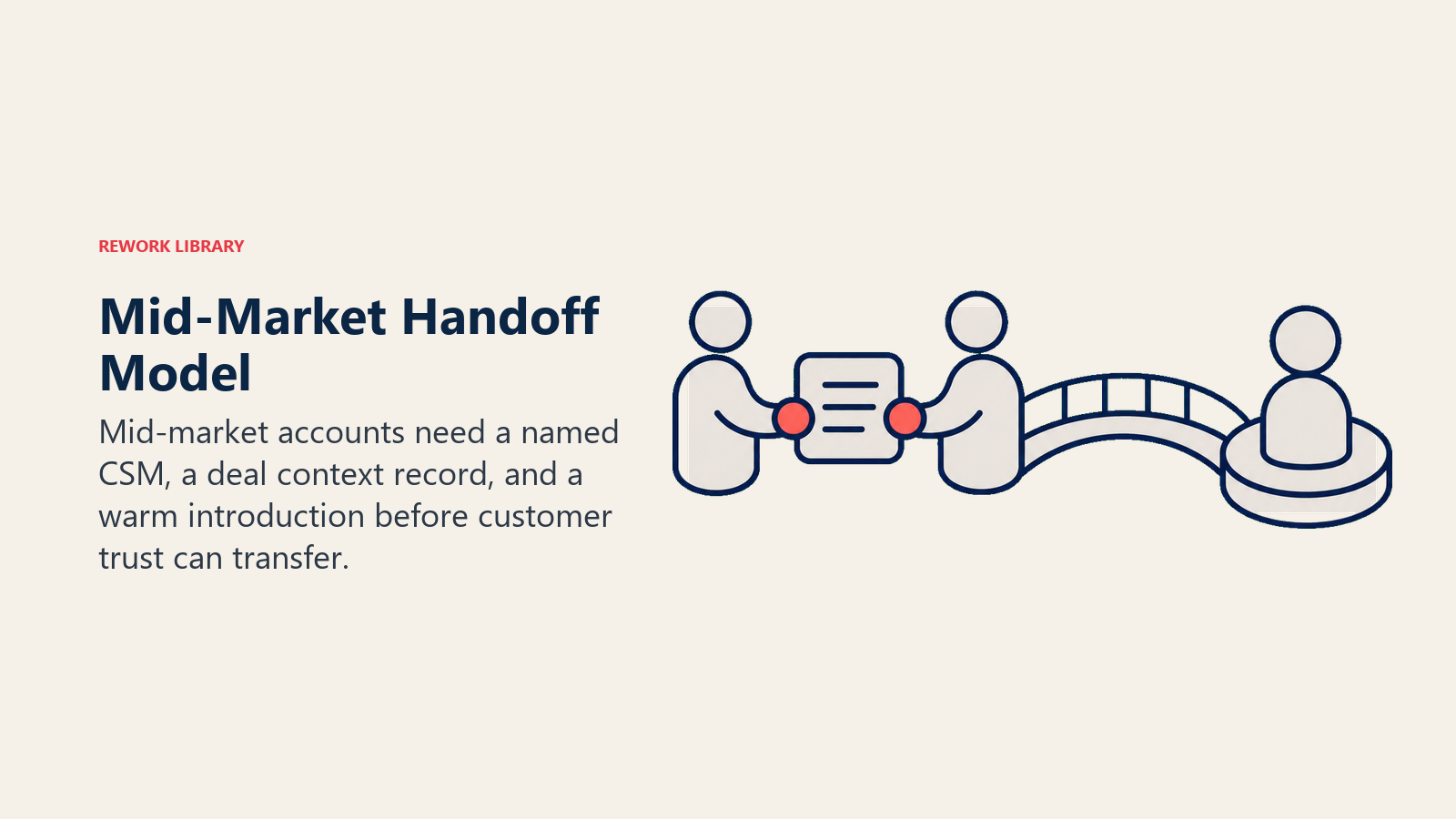
Dalam pasaran pertengahan, CSM bernama memasuki gambar. Tawaran mempunyai champion, seseorang yang mendorong keputusan dalaman dan kini mempertaruhkan beberapa kredibiliti profesional pada kejayaan pelaksanaan. Onboarding tidak sepenuhnya diarahkan sendiri. Terdapat keputusan konfigurasi, keperluan integrasi, dan sasaran penggunaan pengguna yang perlu dimiliki oleh seseorang.
Handoff adalah dua hala: satu AE, satu CSM, satu champion (mungkin dua). Ia boleh diurus. Tetapi ia bergantung sepenuhnya pada AE dan CSM mempunyai pemahaman bersama tentang akaun sebelum pelanggan pernah bertemu CSM. Pemahaman itu tidak berpindah secara automatik. Ia memerlukan proses yang disengajakan: rekod konteks tawaran, panggilan Handoff dalaman, pengenalan peribadi yang mesra.
Risiko utama dalam pasaran pertengahan adalah kehilangan konteks. AE mempunyai enam minggu sejarah hubungan, komitmen tidak formal, dan konteks politik tentang akaun dalam kepala mereka. CSM mempunyai rekod CRM dengan tarikh penutupan dan senarai produk. Jurang antara apa yang CSM tahu dan apa yang mereka perlu tahu untuk menjalankan kickoff yang berkesan adalah tempat di mana Onboarding terhenti dan champion menjadi senyap.
Cara penjajaran kelihatan dalam pasaran pertengahan:
- CSM bernama ditugaskan sebelum atau pada penutupan, bukan selepas pelanggan bertanya di mana pasukan CS mereka
- AE melengkapkan rekod Handoff konteks tawaran dalam masa 24 jam dari penutupan
- Panggilan Handoff dalaman antara AE dan CSM meliputi konteks yang tidak dapat dirakam dalam rekod
- AE menulis e-mel pengenalan dan menyertai panggilan kickoff pertama sebelum berundur
- CS memiliki pelan kejayaan 90 hari; AE kekal boleh dihubungi untuk soalan komersial sahaja
Artikel proses Handoff closed-won ke onboarded mendalami mekanik khusus dalam segmen ini. Artikel model pasukan akaun merangkumi cara pasukan pasaran pertengahan menstrukturkan pasangan AE-CSM. Penjajaran enterprise adalah kategori kerja yang sama sekali berbeza.
Realiti Penjajaran Enterprise
Penjajaran enterprise adalah kategori kerja yang berbeza. Tawaran itu mengambil masa enam bulan. AE mempunyai hubungan dengan VP Operasi, VP Kewangan, Arkitek Teknikal, dan Ketua Staf. CSM bukan mewarisi satu champion. Mereka mewarisi peta pihak berkepentingan.
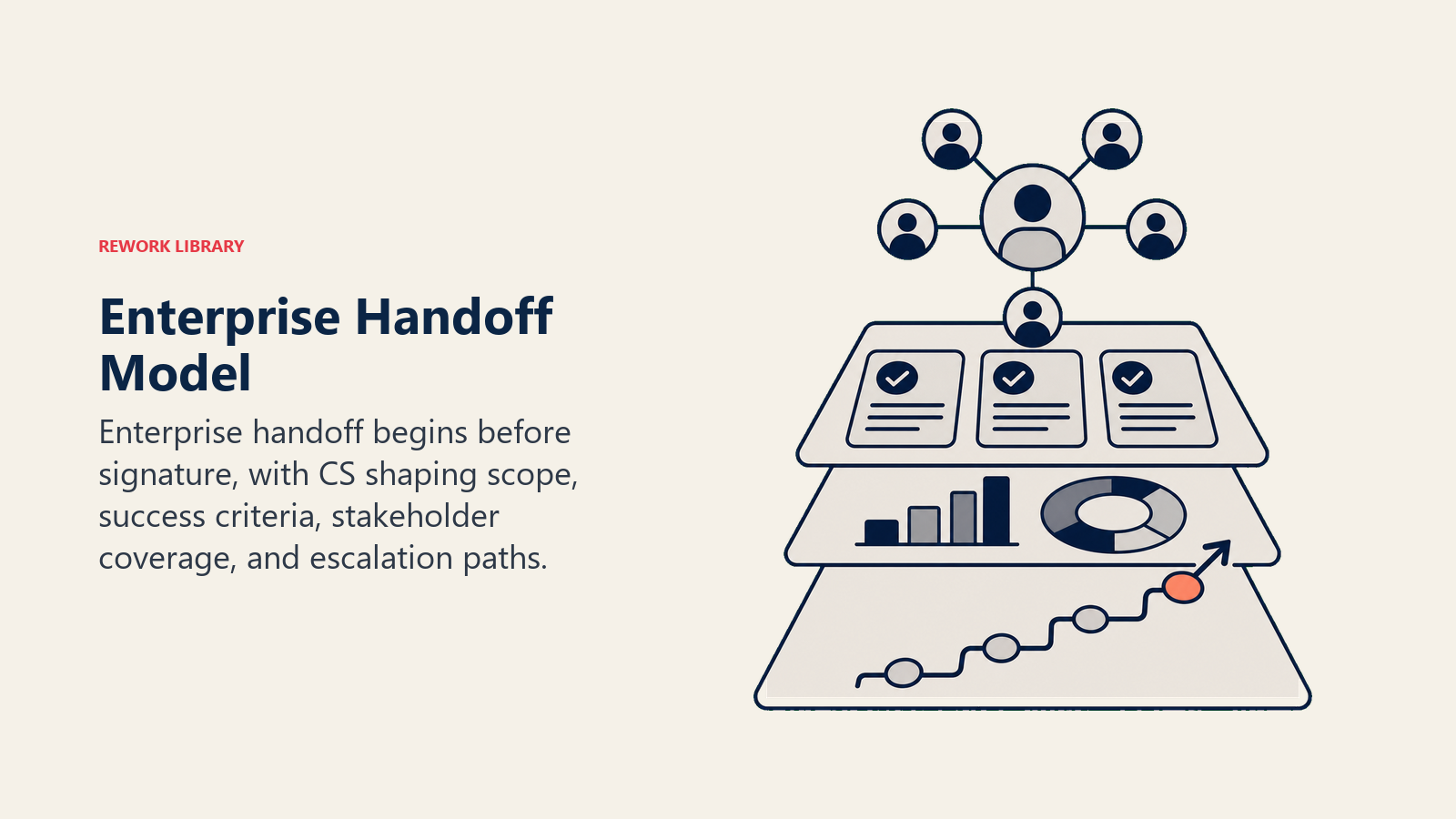
Dalam enterprise, CS ditarik ke dalam kitaran jualan 30 hingga 90 hari sebelum penutupan. Ini bukan tentang usaha wajar dari pihak vendor. Ini tentang menetapkan jangkaan pelaksanaan, membina hubungan CS dengan pihak berkepentingan sebelum kontrak ditandatangani, dan memastikan kriteria kejayaan dalam kontrak adalah yang CS sebenarnya boleh sampaikan.
Handoff dalam enterprise adalah satu proses, bukan satu acara. Ia berlangsung selama berminggu-minggu. Ia melibatkan berbilang orang dari kedua-dua belah. Dan ia didokumentasikan dalam pelan akaun bersama, bukan hanya rekod CRM.
Risiko utama dalam enterprise adalah jangkaan yang tidak sepadan yang dibakar ke dalam kontrak. Jualan menutup berdasarkan visi. CS menyampaikan berdasarkan realiti. Apabila jurang antara keduanya lebar (kerana CS tidak berada dalam bilik semasa visi sedang dijual), 90 hari pertama menjadi rundingan tentang apa yang dijanjikan bukannya laluan terfokus ke arah nilai.
Cara penjajaran kelihatan dalam enterprise:
- CS diperkenalkan kepada pihak berkepentingan utama semasa kitaran jualan, bukan pada kickoff
- Skop pelaksanaan dan kriteria kejayaan dirundingkan dengan input CS sebelum tandatangan kontrak
- Pelan akaun bersama dibina sebelum penutupan, meliputi pencapaian 90 hari dan laluan eskalasi
- Pelbagai sumber CS (CSM, pakar pelaksanaan, penaja eksekutif) dipetakan kepada rakan sejawat pelanggan
- Semakan akaun dalaman mingguan semasa 90 hari pertama dengan AE, CSM, dan pasukan pelaksanaan
Spektrum Tidak Linear
Nota tentang kes tepi, kerana ia lebih biasa daripada yang dicadangkan oleh kategori yang bersih.
Syarikat yang menjual alat SaaS berpacu produk $40K kepada jabatan individu mungkin menjalankan gerakan berkelajuan tinggi yang kelihatan lebih seperti SMB: kitaran jualan 15 hari, kerumitan Onboarding rendah, penglibatan pihak berkepentingan yang minimum. Menerapkan infrastruktur pasaran pertengahan (CSM bernama, kickoff bersama, rekod konteks tawaran) pada setiap tawaran akan mencipta overhead proses yang melambatkan jualan dan Onboarding.
Syarikat yang menjual tawaran platform $100K dengan pelaksanaan 6 bulan mungkin memerlukan infrastruktur penjajaran enterprise walaupun kontrak secara teknikalnya jatuh dalam julat ACV pasaran pertengahan. Kerumitan Onboarding adalah pendorong, bukan angka dolar.
Pemboleh ubah sebenar adalah:
- Kerumitan Onboarding (berapa hari untuk nilai bermakna pertama)
- Bilangan pihak berkepentingan (berapa ramai orang perlu diselaraskan agar pelaksanaan berjaya)
- Risiko pelaksanaan (apakah kos Onboarding yang gagal)
- Model kapasiti CS (berkumpul, bernama, atau bertingkat)
Gunakan pemboleh ubah itu untuk menentukur, bukan hanya ACV.
Memilih Model Anda: Empat Soalan
Jika anda tidak pasti di mana dalam spektrum tawaran anda berada, empat soalan ini meletakkan anda:
1. Apakah nilai kontrak purata anda? Di bawah $15K → model SMB. $15K-$150K → model pasaran pertengahan. Lebih daripada $150K → model enterprise. Biarkan kes tepi memaklumkan tiga soalan seterusnya.
2. Berapa hari yang diperlukan oleh pelanggan biasa untuk mencapai nilai pertama? Di bawah 14 hari → model SMB boleh digunakan. 14-60 hari → model pasaran pertengahan diperlukan. Lebih daripada 60 hari → model enterprise, CS mesti berada dalam tawaran pra-penutupan.
3. Berapa ramai pihak berkepentingan yang dimiliki pelanggan dalam pelaksanaan? 1-2 kenalan → Handoff dua hala SMB atau pasaran pertengahan. 3-5 kenalan → pasaran pertengahan dengan champion yang jelas. 5+ kenalan → enterprise, anda memerlukan peta pihak berkepentingan.
4. Adakah model liputan CS anda berkumpul atau bernama? Berkumpul → model SMB dibina untuk ini. Bernama → minimum pasaran pertengahan. Bernama bertingkat (CSM + pelaksanaan + penaja eksekutif) → model enterprise.
Kebanyakan syarikat menjawab empat soalan ini dan mendapati diri mereka jelas dalam satu zon, atau jelas antara pasaran pertengahan dan satu jiran. Matlamatnya bukan untuk mencari label "betul". Ia untuk menentukur proses mengikut realiti.
Ketidaksepadanan Biasa dan Gejalanya
Playbook enterprise pada gerakan SMB. Gejala: AE menghabiskan 30 minit setiap penutupan pada dokumentasi Handoff yang tidak dibaca oleh sesiapa pun, pasukan CS berkumpul menjalankan panggilan kickoff bersama untuk akaun $8K, skor NPS pelanggan pada 30 hari sebenarnya lebih rendah daripada sebelum perubahan proses. Penyelesaian: kupas proses kembali ke minimum yang diperlukan untuk saiz tawaran tersebut. Rekod CRM bersih dan urutan Onboarding yang dicetuskan secara automatik sering sudah mencukupi.
Model SMB pada tawaran pasaran pertengahan. Gejala: Champion tidak mendengar dari CS selama seminggu selepas penutupan, CSM masuk ke panggilan kickoff tanpa mengetahui siapa champion tawaran atau mengapa mereka membeli, churn awal yang tinggi dalam kohort $25K-$75K. Penyelesaian: kuatkuasakan tugasan CSM bernama pada atau sebelum penutupan, wajibkan rekod konteks tawaran, jadikan pengenalan AE wajib.
Model pasaran pertengahan pada tawaran enterprise. Gejala: CS mengetahui tentang keperluan integrasi yang kompleks untuk kali pertama pada kickoff, VP Operasi pelanggan tidak pernah bercakap dengan sesiapa dari pasukan CS sebelum pelaksanaan bermula, pelaksanaan berjalan 4 minggu lewat kerana skop tidak ditetapkan dengan input CS. Penyelesaian: tarik CS ke dalam kitaran jualan sebelum penutupan, bina kriteria kejayaan bersama sebelum tandatangan kontrak.
Detik Peralihan: Apabila Pertumbuhan Memaksa Perubahan Model
Kebanyakan syarikat lulus melalui spektrum apabila mereka berkembang. Dan detik peralihan cenderung menyakitkan jika model penjajaran tidak berkembang dengan perniagaan.
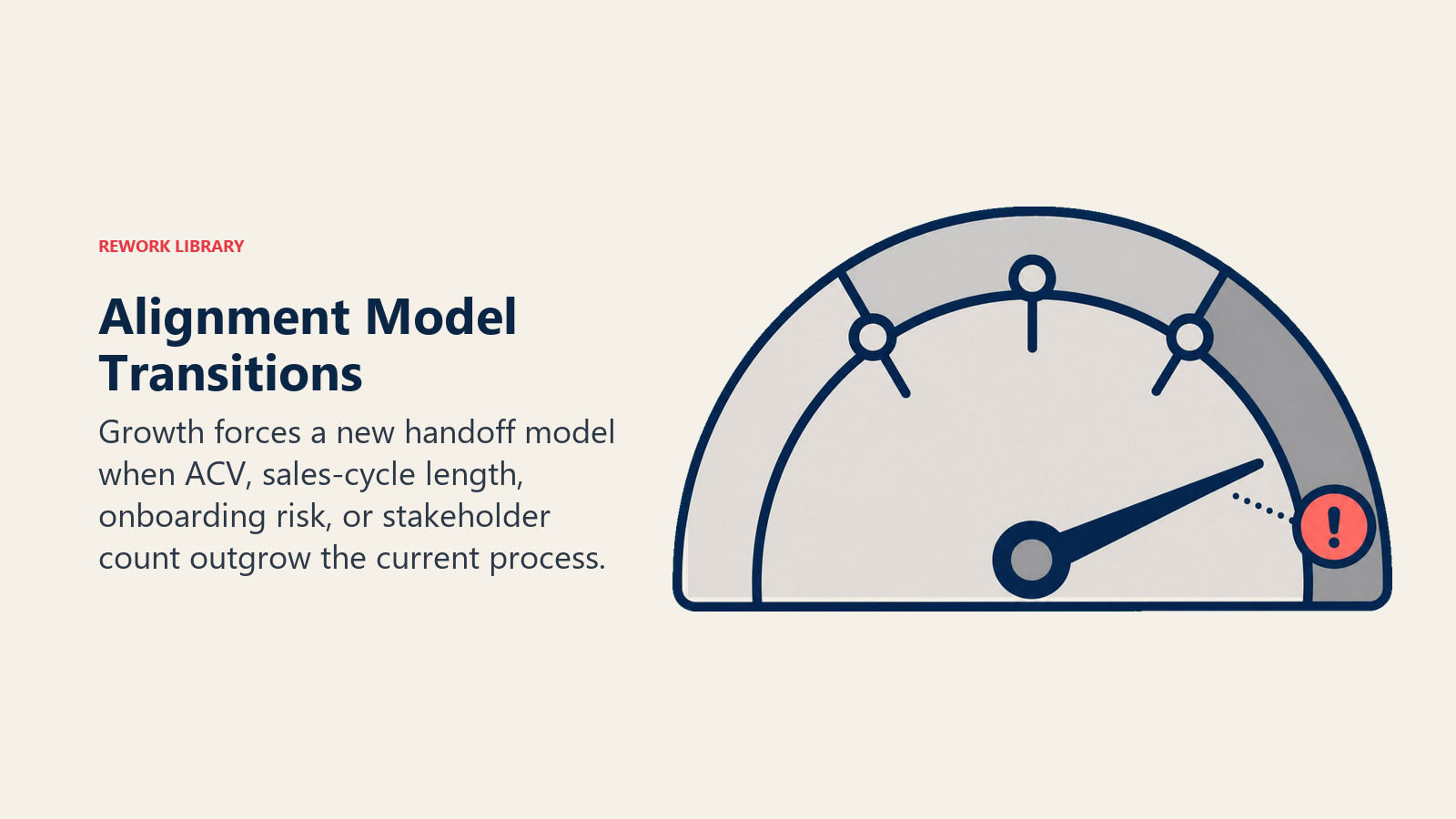
Peralihan SMB ke pasaran pertengahan: Biasanya dicetuskan oleh ACV purata melepasi $20K-$25K atau kitaran jualan purata memanjang melebihi 3 minggu. Isyarat: pasukan CS berkumpul mula terlepas SLA, churn awal dalam kohort $20K+ meningkat, AE menerima soalan Onboarding minggu selepas penutupan kerana CS tidak membina hubungan. Penyelesaiannya adalah tugasan CSM bernama, bukan lebih banyak dokumentasi dalam SMB.
"Akaun SMB yang menerima Handoff yang terlalu direkayasa (panggilan kickoff bersama, CSM bernama, pengenalan pra-penutupan) mencatat skor NPS 90 hari pertama 12% lebih rendah berbanding akaun yang menggunakan Onboarding digital yang lebih ringkas. Lebih banyak proses pada segmen yang salah mencipta geseran tanpa menambah nilai." (PX/Gainsight, 2023)
Peralihan pasaran pertengahan ke enterprise: Biasanya dicetuskan oleh mendarat kelompok tawaran melebihi $100K atau menambah gerakan perkhidmatan profesional. Isyarat: pelanggan meminta untuk bertemu pasukan pelaksanaan sebelum menandatangani, kitaran jualan memanjang hingga 4+ bulan, CS menghadapi ketidaksepadanan jangkaan pada kickoff. Penyelidikan kejayaan pelanggan 2.0 McKinsey mengenal pasti penglibatan CS pra-penutupan sebagai salah satu penanda paling jelas bagi operasi hasil yang bersedia untuk enterprise. Penyelesaiannya adalah menarik CS pra-penutupan, bukan menambah lebih banyak ke Handoff pasca-penutupan.
Model kematangan penjajaran jualan-CS merangkumi dimensi organisasi peralihan ini dengan lebih mendalam. Dan artikel 8 amaran tanda ketidaksepadanan jualan-CS berguna untuk mendiagnos mod kegagalan khusus yang berlaku apabila model tegang.
Model yang Betul adalah Fungsi Segmen Anda
Keinginan untuk meminjam Playbook penjajaran adalah nyata. Kajian kes enterprise ditulis dalam ceramah persidangan dan siaran blog kerana tawaran enterprise adalah besar dan dramatik. Tetapi model penjajaran yang betul bukan yang paling canggih. Ia yang sesuai dengan tawaran anda.
Kebanyakan syarikat SaaS antara 50 dan 300 pekerja menjalankan gerakan pasaran pertengahan. Tawaran mereka ditutup dalam minggu, bukan bulan. Pelanggan mereka mempunyai satu atau dua champion. CSM mereka dinamakan, bukan berkumpul. Model pasaran pertengahan dibina untuk ini. Dan mendapatkannya dengan betul (rekod Handoff bersih, pengenalan mesra, kickoff berstruktur, pelan kejayaan 90 hari) menghasilkan hasil pengekalan yang boleh diukur tanpa overhead peringkat enterprise.
Mulakan dengan segmen anda. Bina model penjajaran yang sesuai dengannya. Dan apabila tawaran anda mula kelihatan lebih kompleks daripada yang proses anda boleh kendalikan, gunakan isyarat peralihan untuk mengetahui sudah tiba masanya bergerak ke atas spektrum.
Artikel pemilikan pembaharuan merangkumi salah satu soalan paling bergantung-segmen dalam reka bentuk pasukan hasil: siapa yang memiliki perbualan pembaharuan, dan bagaimana ia berubah apabila saiz tawaran berkembang.
Analisis Rework: Berdasarkan corak pasukan hasil yang kami perhatikan merentasi SaaS pasaran pertengahan, ketidakselarasan yang paling biasa bukan pasukan SMB yang menyalin Playbook enterprise. Ia adalah pasukan pasaran pertengahan yang menerapkan Handoff tidak formal gaya SMB pada tawaran yang sudah melepasi ambang ACV $30K. Apabila ACV melebihi $30K dan Onboarding memanjang melebihi 30 hari, pelaburan minimum yang diperlukan ialah tugasan CSM bernama, rekod konteks tawaran yang lengkap, dan pengenalan AE secara peribadi. Itu bukan overhead enterprise. Itu ialah lantai untuk melindungi NRR pada pasaran pertengahan. Pasukan yang melaksanakan tiga langkah ini sebelum panggilan kickoff pertama lazimnya melihat peningkatan yang boleh diukur dalam NPS 30 hari dan masa-kepada-nilai-pertama yang dikurangkan, tanpa menambah perancangan akaun bersama dan penglibatan CS pra-penutupan yang diperlukan oleh tawaran enterprise.
Soalan Lazim tentang Spektrum Penjajaran Jualan-CS
Apakah Spektrum Penjajaran untuk handoff Jualan-CS?
Spektrum Penjajaran menerangkan bagaimana proses handoff antara Eksekutif Akaun (AE) dan Pengurus Kejayaan Pelanggan (CSM) patut berubah berdasarkan segmen tawaran: SMB, pasaran pertengahan, atau enterprise. Dalam SMB, penjajaran tertumpu pada rekod CRM yang bersih dan Onboarding automatik. Dalam pasaran pertengahan, ia memerlukan CSM bernama, rekod konteks tawaran, dan pengenalan yang mesra. Dalam enterprise, CS memasuki tawaran sebelum kontrak ditandatangani.
Bilakah handoff SMB tidak formal mula rosak?
Handoff tidak formal biasanya rosak apabila nilai kontrak purata melepasi $20K-$25K atau apabila tetingkap Onboarding biasa memanjang melebihi 14 hari. Di bawah ambang tersebut, rekod CRM yang bersih dan urutan Onboarding automatik membawa sebahagian besar berat hubungan. Di atasnya, pelanggan mengharapkan kenalan manusia bernama dan laluan berstruktur ke nilai pertama. Kesenyapan dalam 72 jam pertama mula mencipta risiko churn.
Apakah pelaburan penjajaran pertama yang patut dibuat oleh syarikat peringkat SMB apabila bergerak ke pasaran atas?
Tugasan CSM bernama ialah pelaburan pertama dengan pulangan tertinggi. Model CS berkumpul berfungsi dalam SMB kerana ekonomi volum tidak menyokong sumber berdedikasi. Tetapi sebaik sahaja kerumitan tawaran mewujudkan risiko Onboarding yang sebenar (bermakna kejayaan pelanggan bergantung pada kesinambungan hubungan, bukan sekadar kualiti produk), CSM bernama ialah asas yang menjadi tapak segala yang lain. Rekod konteks tawaran dan pengenalan yang mesra menyusul daripada itu.
Adakah penglibatan CS enterprise sebelum penutupan melambatkan kitaran jualan?
Ia boleh, jika tidak diskopkan dengan betul. Penglibatan CS pra-penutupan berfungsi paling baik sebagai pengenalan bersasar kepada pihak berkepentingan pelaksanaan utama, semakan bersama kriteria kejayaan sebelum kontrak dimuktamadkan, dan panggilan penskopan pelaksanaan. Bukan proses penilaian kedua. Apabila dibingkaikan kepada pelanggan sebagai "kami mahu memastikan pasukan kami bersedia menyampaikan dari hari pertama," ia lazimnya mempercepat keyakinan pembeli dan bukannya memanjangkan usaha wajar.
Bagaimana anda menentukur model penjajaran apabila anda menjual merentasi beberapa segmen serentak?
Ambang berasaskan segmen berfungsi lebih baik daripada mandat proses seluruh syarikat. Tentukan kriteria yang mencetuskan setiap model penjajaran: ACV, kerumitan Onboarding, bilangan pihak berkepentingan, model liputan CS. Terapkannya setiap tawaran dan bukannya setiap dasar syarikat. Tawaran $15K dan tawaran $120K boleh ditutup dalam minggu yang sama oleh AE yang sama dan memerlukan pendekatan handoff yang sama sekali berbeza. Empat soalan penentukuran dalam artikel ini memberi pasukan penilaian pantas peringkat tawaran tanpa mencipta geseran untuk penutupan yang mudah.
Apakah gejala paling boleh dipercayai bahawa pasukan pasaran pertengahan menggunakan model penjajaran peringkat SMB?
Champion yang tidak mendengar dari CS selama lebih daripada 48 jam selepas penutupan. Jurang tunggal itu ialah isyarat awal yang paling konsisten: tawaran ditutup, AE sudah beralih, dan tiada siapa menganggap kesinambungan hubungan sebagai hasil kerja yang perlu disampaikan. Kesan hiliran boleh diukur: churn awal yang lebih tinggi dalam kohort ACV $25K-$75K, CSM masuk ke kickoff tanpa mengetahui siapa champion, dan AE menerima soalan Onboarding minggu selepas penutupan kerana CS tidak pernah membina hubungan.
Bolehkah model penjajaran bergerak ke belakang, contohnya akaun enterprise yang dikecilkan kepada layanan pasaran pertengahan?
Ya, dan ia berlaku semasa pembaharuan dan penguncupan. Jika pelanggan enterprise mengurangkan bilangan pekerja atau skop dengan ketara semasa pembaharuan, liputan CS berterusan patut sepadan dengan saiz tawaran yang baharu, bukan yang asal. Terus menerapkan overhead enterprise penuh (pakar pelaksanaan berdedikasi, perancangan akaun bersama, penjajaran penaja eksekutif) pada apa yang kini pembaharuan $60K membazirkan kapasiti CS dan boleh dirasakan terlalu direkayasa oleh pelanggan. Segmenkan akaun pada pembaharuan, bukan sekadar pada penutupan.
Ketahui Lebih Lanjut

Principal Solution Architect
On this page
- Tiga Segmen, Tiga Realiti
- Perbandingan Model Penjajaran
- Realiti Penjajaran SMB
- Realiti Penjajaran Pasaran Pertengahan
- Realiti Penjajaran Enterprise
- Spektrum Tidak Linear
- Memilih Model Anda: Empat Soalan
- Ketidaksepadanan Biasa dan Gejalanya
- Detik Peralihan: Apabila Pertumbuhan Memaksa Perubahan Model
- Model yang Betul adalah Fungsi Segmen Anda
- Ketahui Lebih Lanjut