Model Pasukan Akaun: Pod, Swarm, dan Sequential: Struktur Mana yang Sesuai untuk Perniagaan Anda
Turn this article into takeaways for your work.


Each assistant summarizes the article only for you and suggests best practices for your work.
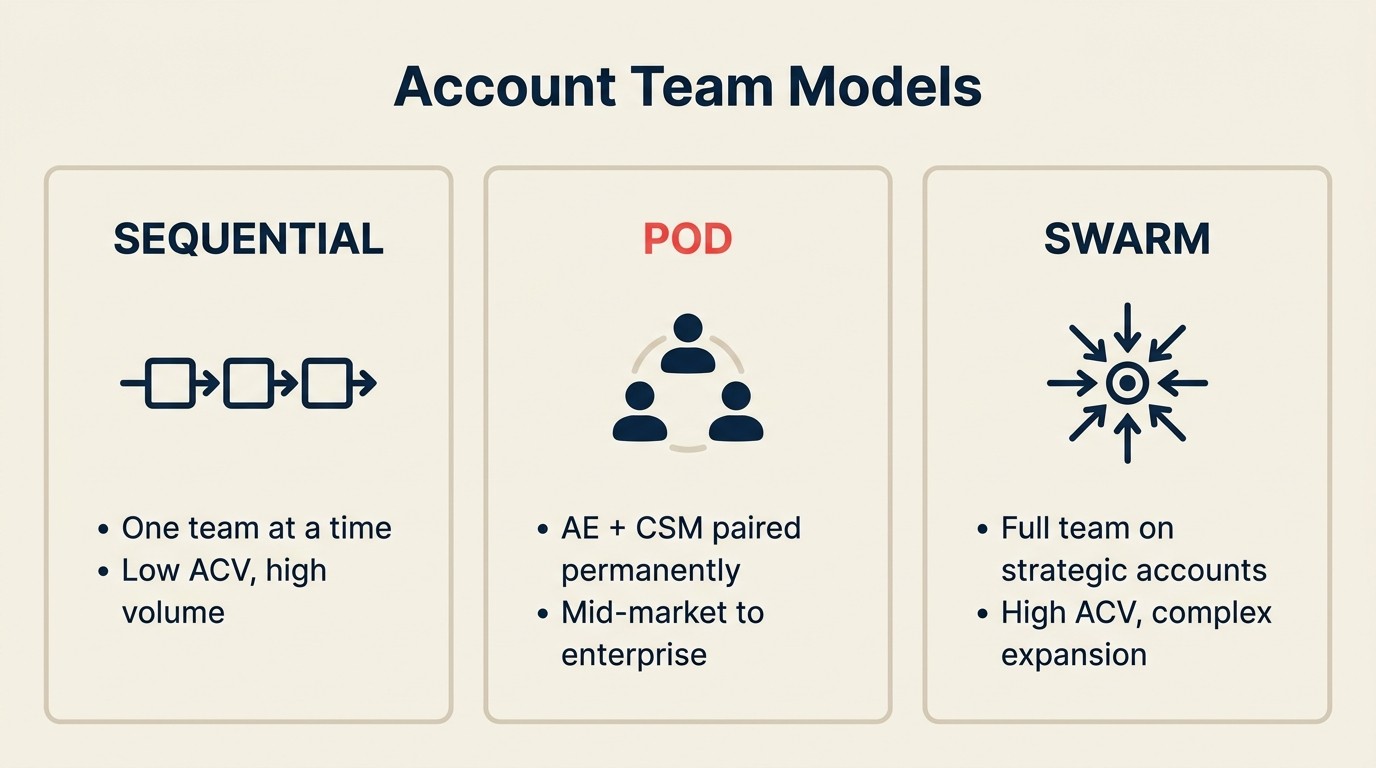
Tiga struktur pasukan akaun wujud dalam SaaS B2B (Sequential, Swarm, dan Pod), dan setiap satu adalah optimum untuk gabungan tertentu nilai kontrak tahunan (ACV), nisbah bilangan pekerja, dan kerumitan produk. Memilih model yang salah untuk peringkat anda bukan sahaja memperlahankan pertumbuhan; ia membakar kapasiti CS, menyelaraskan insentif dengan salah, dan menghasilkan jenis kegagalan handoff yang menelan kos 2-3 kali ganda ARR churn yang kelihatan. Matriks Keputusan Pod-Swarm-Sequential memberikan anda rangka kerja tiga soalan untuk memilih model yang betul tanpa mengimport jawapan daripada konteks syarikat lain.
Setiap kali syarikat SaaS melepasi $5 juta ARR, perbualan yang sama berlaku. VP Jualan atau VP CS baru datang, melihat cara akaun diliputi, dan berkata: "Kita perlu beralih kepada model pod." Atau: "Kita perlu menjadi lebih sequential; AE tidak boleh menjaga akaun selepas penutupan." Atau: "Mari cuba pendekatan swarm untuk akaun tahap teratas kita."
Setiap orang ini pernah menjalankan model ini sebelumnya. Setiap satu daripada mereka menerangkan model yang berjaya, di syarikat yang berbeza, pada peringkat ARR yang berbeza, dengan ACV yang berbeza, nisbah bilangan pekerja yang berbeza, dan profil kerumitan produk yang berbeza.
Itu bukan strategi. Ia adalah hutang pengambilan pekerja. Anda mengimport jawapan dari konteks yang mungkin tidak ada kaitan dengan konteks anda.
Tiga model pasukan akaun wujud dalam SaaS B2B. Tiga, tidak lebih, tidak kurang. Dan tiga model wujud kerana tiga kombinasi keadaan perniagaan yang berbeza (ACV, nisbah bilangan pekerja, kerumitan produk, peringkat pertumbuhan) memerlukan pendekatan yang berbeza. Model yang betul untuk perniagaan anda bukan yang dijalankan VP baru anda di kerja terakhir mereka. Ia adalah yang sepadan dengan kekangan semasa anda.
Mengapa Struktur Pasukan Akaun Penting untuk NRR?
Model pasukan akaun bukan keutamaan budaya. Ia menentukan tiga perkara dengan akibat hasil yang langsung.
Siapa yang memiliki apa. Jurang pemilikan adalah di mana akaun jatuh. Jika model tidak menentukan siapa yang memiliki susulan pembaharuan antara bulan sembilan dan bulan sebelas, tugas itu tidak dilakukan oleh sesiapa yang paling peduli. Ia dilakukan secara tidak konsisten, yang bermakna ia tidak dilakukan dengan boleh dipercayai. Model mewujudkan struktur akauntabiliti.
Cara konteks dipindahkan. Dalam model sequential, konteks perlu bergerak dari AE kepada CSM pada saat tertentu. Dalam model swarm, konteks tinggal dengan CSM secara berterusan, dan AE masuk semula dengan jurang konteks. Dalam model pod, konteks dikongsi dalam masa nyata. Model yang anda pilih menentukan betapa sukarnya pemindahan konteks, dan pemindahan konteks yang sukar menghasilkan handoff yang buruk. Serah terima kitaran hayat AE-ke-CSM merangkumi mekanik bagaimana saat itu harus distruktur tanpa mengira model yang anda jalankan.
Siapa yang dipersalahkan apabila akaun churn. Ini kedengaran sinis, tetapi penting secara praktikal. Apabila struktur pasukan tidak jelas tentang pemilikan dan akaun churn, post-mortem berubah menjadi tunjuk jari. Apabila struktur adalah eksplisit, post-mortem adalah tentang jurang proses, yang boleh dibaiki.
Fakta Utama: Struktur Pasukan Akaun dan Hasil Pendapatan
- Menurut penyelidikan kejayaan pelanggan TSIA, syarikat yang memadankan model pasukan akaun mereka kepada ACV dan nisbah bilangan pekerja mengurangkan pembaziran kapasiti CS sebanyak 20-30% berbanding syarikat yang menggunakan satu model merentasi semua tahap akaun.
- Penyelidikan Gainsight mendapati bahawa akaun yang diuruskan dalam struktur pod (AE bernama + CSM bernama) mempunyai kadar pengembangan 18% lebih tinggi berbanding akaun dalam model liputan sequential, tetapi hanya apabila ACV menjustifikasikan kos struktur yang dipasangkan.
- Menurut penyelidikan operasi hasil B2B Forrester, syarikat yang memformalkan protokol peningkatan antara model sequential dan swarm melihat masa respons 22% lebih pantas pada isyarat akaun berisiko berbanding peningkatan ad hoc.
Tiga Model: Gambaran Keseluruhan
Boleh Dipetik: "Akaun yang diuruskan dalam struktur pod mempunyai kadar pengembangan 18% lebih tinggi berbanding akaun dalam model liputan sequential, tetapi hanya apabila ACV menjustifikasikan kos struktur yang dipasangkan." (penyelidikan kejayaan pelanggan Gainsight)
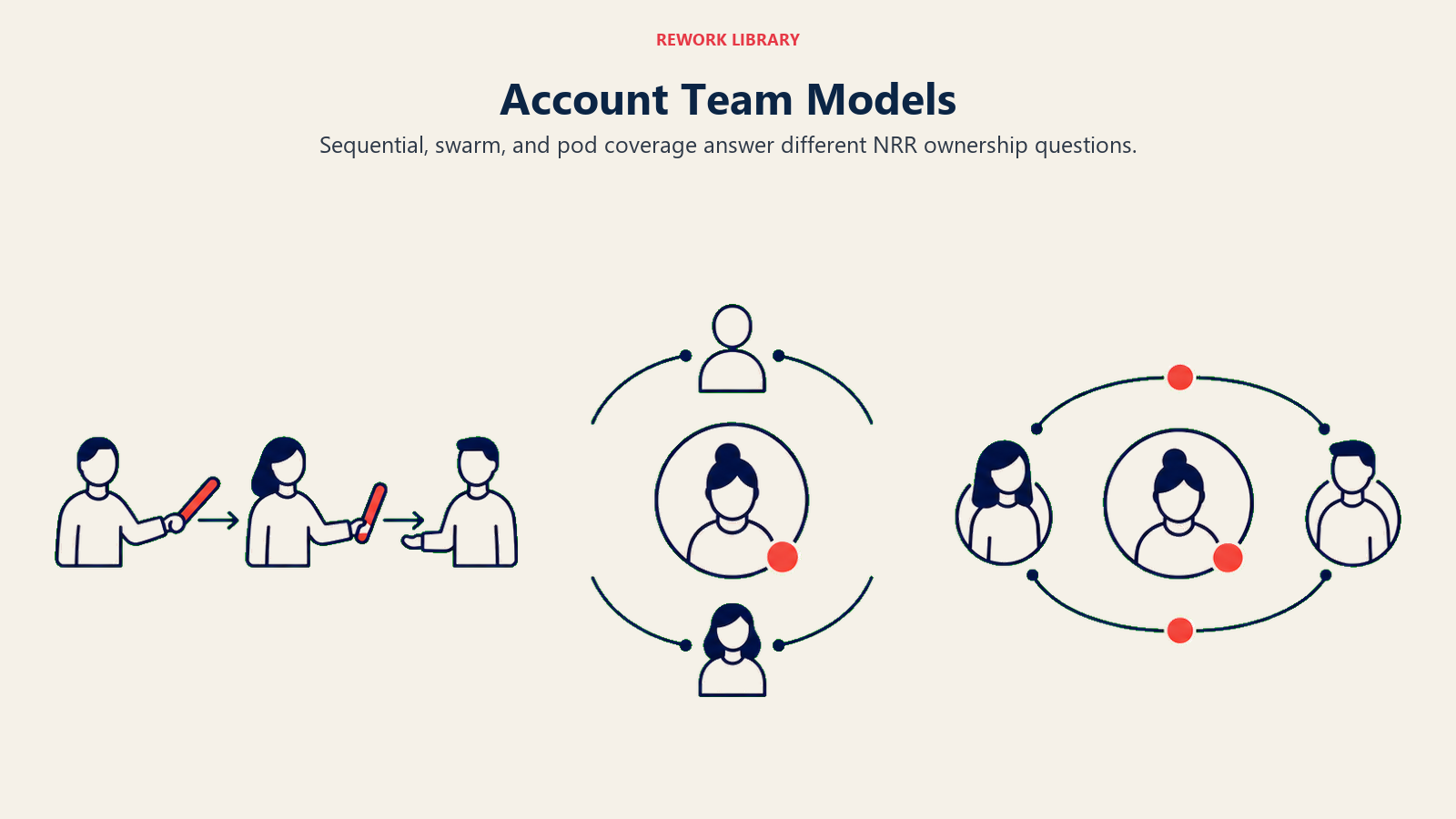
| Model | Cara Ia Berfungsi | Terbaik Untuk | Nisbah AE:CSM | Tradeoff Utama |
|---|---|---|---|---|
| Sequential | AE menutup; CS memiliki pasca-tandatangan; AE kembali hanya untuk pengembangan besar | SMB kelajuan tinggi, produk transaksional, nisbah AE:CSM tinggi | 4:1 atau lebih tinggi | Hubungan AE berakhir pada penutupan; pengembangan jatuh kepada CSM |
| Swarm | CS memiliki akaun; AE swarm masuk untuk perbualan pembaharuan dan pengembangan | Pasaran pertengahan dengan kapasiti AE yang terhad; liputan akaun bernama | 3:1 hingga 4:1 | Ketersediaan AE menjadi hambatan; CS berasa tidak disokong pada perbualan komersial |
| Pod | AE bernama + CSM bernama bersama memiliki buku akaun dari penutupan hingga pengembangan | Enterprise/pasaran pertengahan strategik; produk sentuhan tinggi; NRR adalah penuas pertumbuhan utama | 2:1 atau lebih rendah | Memerlukan nisbah yang lebih rendah dan ACV yang lebih tinggi untuk dijustifikasikan; penjajaran pampasan adalah kompleks |
Tiada satu daripada model ini yang "lebih baik." Setiap satu adalah optimum dalam keadaan tertentu. Jadual di atas adalah pokok keputusan. Apa yang berikut adalah butiran di sebalik setiap model.
Model 1: Sequential (Serah Baton)
Model sequential adalah lalai. Kebanyakan syarikat SaaS bermula di sini sama ada mereka mereka bentuknya atau tidak: AE menutup, CSM mengambil alih, AE beralih ke perjanjian seterusnya.
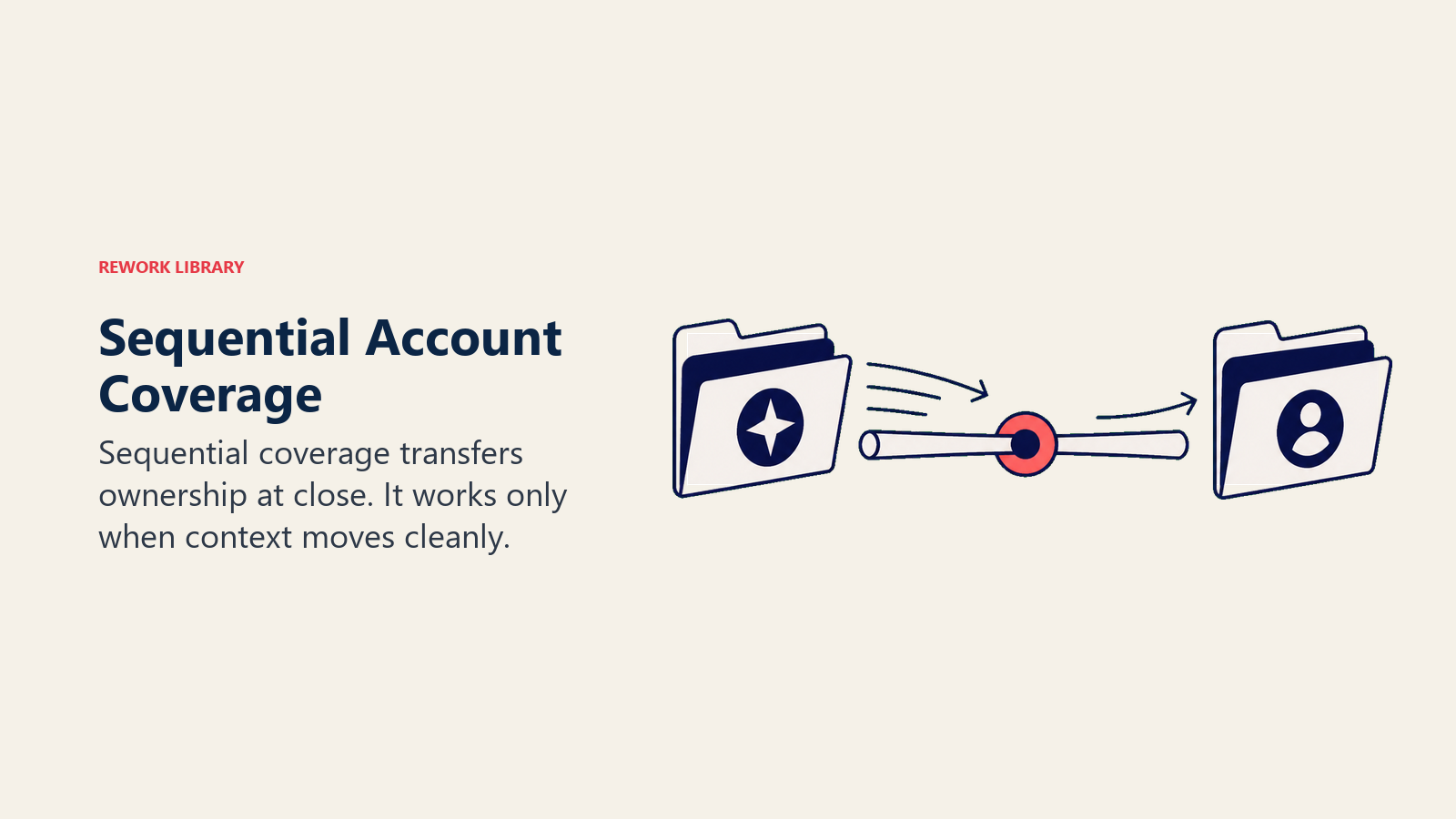
Cara ia berfungsi: AE memiliki hubungan melalui penutupan. Pada saat tutup-menang, pemilikan berpindah kepada CSM. CSM menguruskan onboarding, penerimapakaian, pembaharuan, dan hubungan harian. AE tersedia untuk peningkatan besar (penglibatan eksekutif, perbualan komersial pengembangan besar, ancaman kompetitif) tetapi bukan peserta aktif dalam pengurusan akaun biasa.
Bila ia berfungsi:
- Persekitaran SMB kelajuan tinggi di mana setiap AE menutup 8-15 perjanjian sebulan dan tidak boleh kekal terlibat selepas penutupan
- Produk dengan garis masa onboarding yang agak pendek (di bawah 30 hari kepada nilai awal)
- Akaun di mana ekuiti hubungan ada dalam produk, bukan dalam jurujual
- Nisbah AE:CSM di atas 4:1 di mana liputan berpasangan adalah mustahil secara ekonomi
Bila ia rosak:
- Produk kompleks di mana CSM memerlukan konteks perjanjian yang mendalam untuk onboarding secara berkesan, dan tidak mendapatkannya kerana AE sudah beralih
- Kitar jualan perundingan yang panjang di mana AE membina ekuiti hubungan juara yang ketara yang hilang pada handoff
- Akaun di mana proses jualan melibatkan komitmen teknikal atau pelaksanaan tertentu yang CSM temui semasa kickoff
- Mana-mana persekitaran di mana AE membuat janji yang tidak didokumentasikan, dan CSM adalah orang yang perlu menghantar
Keperluan dokumen handoff: Sequential hanya boleh dilaksanakan dengan protokol handoff yang ketat. Tanpanya, "sequential" hanyalah "CS bermula dingin." Dokumen handoff perlu menangkap hubungan juara, motivasi pembelian, sebarang komitmen teknikal, stakeholder yang skeptikal, dan jangkaan garis masa dari kontrak. Jadikannya wajib, bukan pilihan, atau model tidak berfungsi. Artikel pemindahan konteks perjanjian kepada CS merangkumi dengan tepat apa yang patut ada dalam dokumen itu.
Risiko pengembangan dalam sequential: Ini adalah had struktural yang paling ketara. Dalam model sequential, hubungan AE dengan akaun berakhir pada penutupan. Menjelang masa perbualan pengembangan sesuai (bulan enam hingga dua belas), AE mungkin mempunyai konteks minimum tentang kesihatan akaun, hubungan juara mungkin telah berubah, dan CSM adalah orang yang paling rapat dengan akaun. Sesetengah CSM boleh menutup perbualan komersial. Kebanyakan tidak diambil atau dilatih untuk itu. Pengembangan dalam model sequential cenderung lebih perlahan dan kadar tutup lebih rendah berbanding model swarm atau pod.
Model 2: Swarm (Perhatian Bertahap)
Model swarm mengekalkan pemilikan dengan CS sepanjang kitar hayat tetapi membawa AE masuk secara strategik untuk perbualan komersial: rundingan pembaharuan, pitch pengembangan, penglibatan eksekutif, dan pertahanan kompetitif.
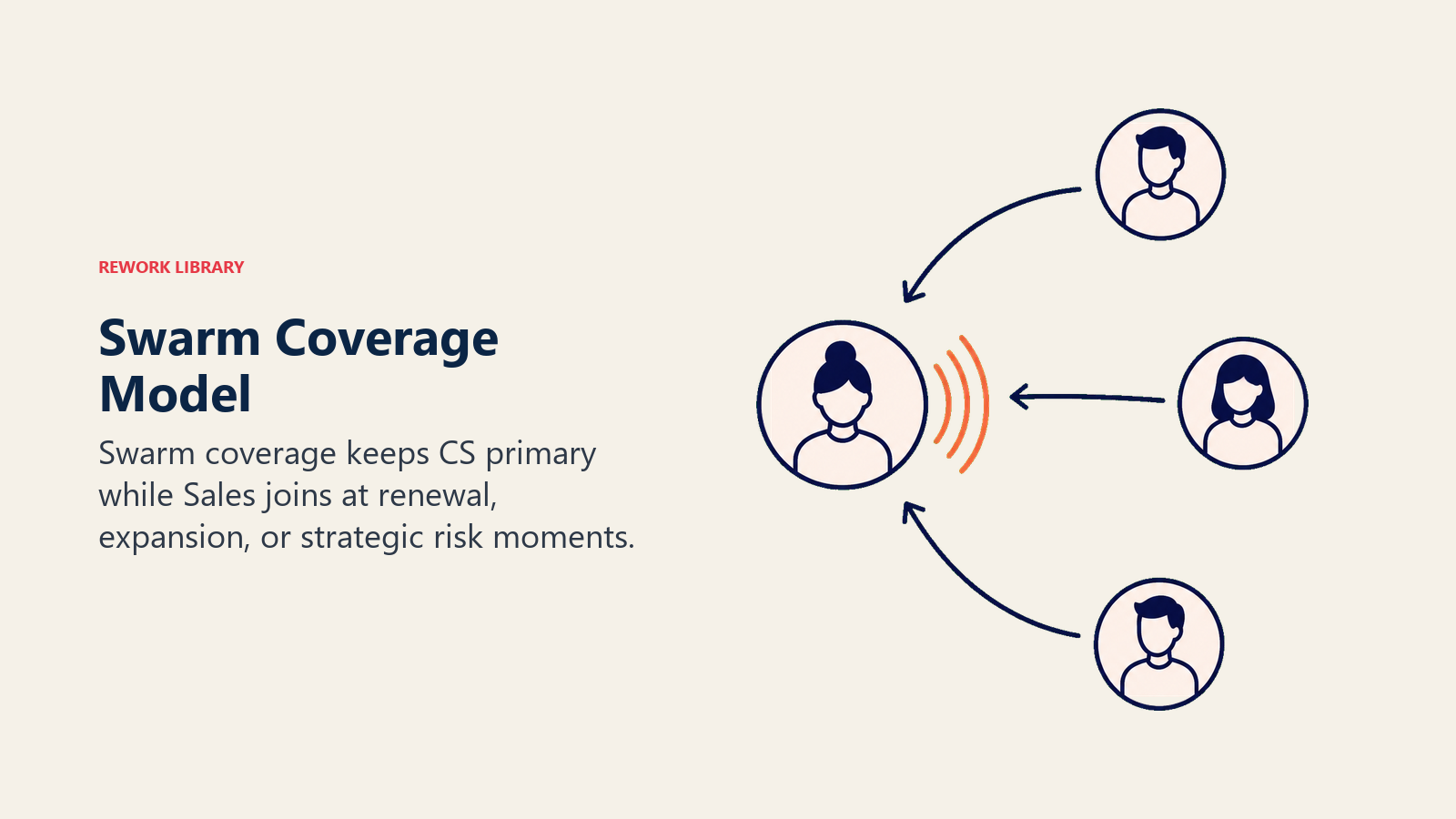
Cara ia berfungsi: CSM adalah pemilik hubungan utama dari penutupan sepanjang kitar hayat penuh. AE tidak mengurus akaun secara aktif antara peristiwa komersial. Apabila tetingkap pembaharuan dibuka, apabila CS mengenal pasti isyarat pengembangan, atau apabila akaun menjadi strategik, AE swarm masuk, membawa kepakaran komersial dan berat hubungan, kemudian berundur setelah perbualan komersial selesai.
Bila ia berfungsi:
- Model akaun bernama di mana setiap CSM memiliki 15-30 akaun dan AE menguruskan 50-80 akaun. AE tidak boleh dipasangkan ke setiap akaun, tetapi boleh diaktifkan untuk saat tertentu
- Produk pasaran pertengahan di mana CS mempunyai kualiti hubungan dan ketajaman komersial yang tinggi, tetapi memerlukan sokongan AE untuk harga dan rundingan kontrak
- Organisasi di mana tekanan kuota AE bermakna AE tidak boleh membawa kewajipan hubungan selepas penutupan secara munasabah merentasi buku yang besar
Bila ia rosak:
- Apabila ketersediaan AE menjadi hambatan. Jika AE sentiasa dalam tekanan kuota dan tidak bertindak balas kepada permintaan swarm CS dalam masa 48 jam, model gagal. CS berjanji kepada pelanggan akses kepada sumber komersial yang tidak tersedia dengan boleh dipercayai.
- Apabila kriteria pencetus peningkatan tidak ditakrifkan. "CS meminta AE apabila diperlukan" bukan protokol. Ini adalah cara untuk mendapatkan pasukan CS yang sama ada tidak pernah meningkatkan (terlalu banyak geseran) atau meningkatkan segala-galanya (AE terbeban).
- Apabila AE tidak mengekalkan cukup konteks tentang akaun untuk berguna apabila mereka swarm masuk. Jika tiga bulan berlalu antara titik sentuh AE dan AE tidak mempunyai ingatan institusi, mereka bermula dingin dalam perbualan pembaharuan, yang tepat adalah masalah yang model sepatutnya menghalang.
Protokol peningkatan: Model swarm hidup dan mati pada ini. Protokol perlu menentukan: apa yang mencetuskan swarm-in AE (isyarat pengembangan di atas ambang, pembaharuan dalam 90 hari, peningkatan berisiko, permintaan eksekutif), apakah SLA untuk respons AE (24 jam? 48 jam?), dan konteks apa yang CS serahkan kepada AE sebelum mereka terlibat. Tanpa spesifikasi ini, swarm adalah ad hoc, yang bermakna ia berlaku secara tidak konsisten, yang bermakna pasukan CS belajar untuk tidak bergantung padanya. Lihat bila hendak melibatkan jualan dalam akaun berisiko untuk kriteria pencetus peningkatan khusus yang berkesan dalam amalan.
Model 3: Pod (Pasukan Akaun Berpasangan)
Model pod memasangkan AE bernama dengan CSM bernama pada buku akaun bersama. Kedua-dua ahli pasukan aktif sepanjang kitar hayat penuh: AE mengekalkan hubungan juara selepas penutupan, CSM memiliki pengurusan dan penerimapakaian harian, dan kedua-duanya bersama memiliki hasil pembaharuan dan pengembangan.
Cara ia berfungsi: Pada penutupan, akaun tidak "diserahkan"; ia memasuki keadaan dimiliki bersama. AE tidak menghilang; mereka kekal hadir untuk titik sentuh strategik, penglibatan eksekutif, dan perbualan komersial. CSM tidak bermula dingin; mereka telah diperkenalkan semasa proses jualan akhir dan mempunyai konteks daripada AE sepanjang onboarding. Kedua-dua ahli pasukan menyemak akaun bersama pada kadens biasa, melihat data kesihatan yang sama, dan berkongsi akauntabiliti untuk hasil akaun.
Bila ia berfungsi:
- Akaun enterprise atau pasaran pertengahan atas dengan ACV di atas $50K, di mana ekonomi akaun menjustifikasikan overhead pemilikan bersama
- Produk dengan onboarding kompleks di mana kesinambungan hubungan juara penting untuk penerimapakaian
- Organisasi di mana NRR adalah penuas pertumbuhan utama: pod menghasilkan kadar pengembangan yang konsisten lebih tinggi berbanding model sequential atau swarm pada julat ACV yang setara
- Syarikat dengan nisbah AE:CSM 2:1 atau lebih rendah, di mana pemasangan adalah berdaya maju secara ekonomi
Bila ia rosak:
- Apabila matematik nisbah tidak berfungsi. Model pod memerlukan AE bernama dan CSM bernama pada setiap akaun. Jika nisbah AE:CSM anda adalah 4:1, anda tidak boleh menjalankan pod kecuali anda mensegmenkan. Anda akan menjalankan pod hanya pada tahap akaun teratas anda. Mencuba menjalankan pod merentasi buku penuh pada nisbah 4:1 sama ada membebankan CSM anda (terlalu banyak akaun setiap satu) atau AE anda (terlalu banyak kewajipan selepas penutupan setiap perjanjian).
- Apabila pampasan tidak diselaraskan. Pod rosak apabila AE dibayar sepenuhnya pada ARR baru dan tidak mempunyai kepentingan kewangan dalam pembaharuan atau pengembangan akaun. AE mengoptimumkan untuk perjanjian baru. CSM membawa akaun bersendirian dan membenci model. Apa yang kelihatan seperti pod sebenarnya hanyalah sequential dengan mesyuarat tambahan. Artikel pampasan yang disejajarkan pada NRR memperincikan struktur pampasan khusus yang menjadikan pod berdaya maju dari segi kewangan untuk kedua-dua peranan.
- Apabila kedua-dua ahli pasukan mempunyai gaya atau keutamaan yang bercanggah dan tiada proses pengantaraan peringkat pengurus. Model pod memerlukan dinamik pasukan yang berfungsi. Kepimpinan tidak boleh mengandaikan kimia. Mereka perlu membina perancah yang membuatnya berfungsi walaupun individu mempunyai gaya kerja yang berbeza.
Kerumitan pampasan dalam pod: Model pod layak mendapat tinjauan mendalam sendiri (lihat artikel tentang model pod: pasangan AE-CSM), tetapi soalan pampasan adalah faktor penentuan. Keperluan minimum: pampasan AE harus menyertakan komponen yang terikat kepada pengekalan akaun (clawback, bonus pembaharuan, atau bahagian pengembangan). Pampasan CSM harus menyertakan komponen pengembangan. Tiada satu ahli pasukan pun harus dapat mengoptimumkan pampasan mereka sepenuhnya sambil mengabaikan hasil utama orang lain. Apabila pampasan menghala ke arah yang sama, pod berfungsi. Apabila pampasan menghala ke arah yang berlawanan, pod mewujudkan konflik.
Memilih Model yang Betul untuk Peringkat Anda
Berikut adalah heuristik peringkat ARR yang terpakai untuk kebanyakan syarikat SaaS pasaran pertengahan. Ini bukan preskriptif. ACV dan kerumitan produk anda sama pentingnya dengan ARR. Tetapi ia adalah titik permulaan yang munasabah.
$0-$3 juta ARR: Sequential hampir selalu baik. Pasukan pengasas atau CSM pertama mengenali setiap akaun secara peribadi. Handoff adalah perbualan, bukan proses. Risiko kejuruteraan terlalu canggih model liputan pada peringkat ini melebihi risiko liputan tidak formal.
$3 juta-$10 juta ARR: Di sinilah kebanyakan kesakitan muncul. Pasukan cukup besar sehingga pengetahuan akaun individu tidak universal, tetapi cukup kecil sehingga model pod penuh adalah sukar secara ekonomi. Kebanyakan syarikat dalam julat ini menjalankan sequential untuk akaun SMB mereka dan memperkenalkan liputan swarm atau pod terpilih untuk 10-20% teratas akaun mereka mengikut ACV. Ini juga adalah peringkat di mana dokumen handoff menjadi benar-benar penting, bukan seremonial.
$10 juta-$30 juta ARR: Segmenkan buku. Sequential untuk akaun SMB ekor panjang (ACV di bawah $15K), swarm untuk akaun pasaran pertengahan ($15K-$50K ACV), dan pod untuk akaun strategik ($50K+ ACV atau akaun dengan potensi pengembangan yang ketara). Menjalankan satu model untuk semua tahap pada peringkat ini hampir selalu bermakna sama ada melayan akaun kecil secara berlebihan (pembaziran) atau melayan akaun besar secara kurang (risiko churn). Spektrum penjajaran daripada SMB kepada enterprise membincangkan dengan lebih mendalam bagaimana model liputan berkembang apabila ACV dan kerumitan meningkat.
$30 juta+ ARR: Model pod formal untuk akaun strategik. Swarm untuk tahap pasaran pertengahan. Sequential untuk ekor panjang dengan sokongan layan diri yang kukuh. Model segmentasi kini adalah fungsi RevOps: seseorang memiliki definisi tahap, model liputan mengikut tahap, dan kriteria peralihan apabila akaun bergerak antara tahap.
Pendekatan Segmentasi: Menjalankan Beberapa Model Serentak
Di sinilah pasukan paling kerap silap. Mereka membaca tentang model pod, memutuskan model pod adalah yang terbaik, dan menggunakannya kepada keseluruhan pangkalan akaun. Kemudian matematik nisbah meledak: CSM mempunyai 60 akaun dalam buku pod mereka dan tidak mungkin memberikan 60 akaun perhatian AE bernama.
Model mental yang betul adalah segmentasi: tahap yang berbeza dari pangkalan akaun mendapat model liputan yang berbeza. Berikut adalah struktur tahap praktikal untuk syarikat pada $10 juta-$20 juta ARR:
Tahap strategik (15% teratas mengikut ACV atau nilai strategik): Model pod. AE bernama + CSM bernama. Semakan akaun bersama setiap bulan. Pembaharuan dan pengembangan dimiliki bersama. Tahap ini mendapat liputan premium kerana ekonomi akaun menjustifikasikannya dan kerumitan hubungan menuntutnya.
Tahap teras (50% pertengahan mengikut ACV): Model swarm. CS memiliki harian; AE tersedia melalui protokol peningkatan yang ditakrifkan. Perbualan pembaharuan mencetuskan penglibatan AE pada 90 hari. Pengembangan di atas ambang mencetuskan penglibatan AE.
Tahap pertumbuhan (35% bawah mengikut ACV atau akaun yang lebih baru dan lebih kecil): Model sequential. CS memiliki sepenuhnya selepas handoff. AE tersedia hanya untuk peningkatan besar. Bergantung berat pada sumber layan diri dan pemantauan kesihatan automatik.
Protokol handoff berbeza mengikut tahap. Handoff tahap strategik memerlukan taklimat AE-kepada-CSM dua jam dan mesyuarat pengenalan pelanggan bersama. Handoff tahap pertumbuhan memerlukan dokumen handoff yang dilengkapkan dan semakan CSM async 30 minit. Usaha berskala kepada ekonomi akaun.
Cara mentakrifkan tahap: ACV adalah kriteria yang paling biasa, tetapi bukan satu-satunya. Nilai strategik (logo yang anda letakkan dalam kajian kes), kerumitan platform (akaun yang menggunakan pelbagai modul), dan potensi pengembangan (pelanggan yang syarikat induknya juga adalah sasaran) semuanya menjamin liputan premium melebihi apa yang ACV sahaja akan cadangkan. Bina penggantian manual: RevOps atau pengurus CS anda harus dapat menaik taraf akaun kepada tahap yang lebih tinggi berdasarkan kriteria strategik walaupun ACV sahaja tidak memenuhi syaratnya.
Kesilapan Biasa Apabila Menukar Model
Tiga kesilapan muncul secara konsisten apabila syarikat cuba mengubah struktur pasukan akaun mereka.
Beralih kepada pod terlalu awal. Kepimpinan melihat model pod berfungsi di syarikat enterprise dan ingin mengimportnya. Tetapi pada nisbah AE:CSM 3:1 atau 4:1 dengan ACV purata $20K, matematik tidak menyokong pemasangan bernama merentasi buku. CS terbeban. AE menolak kewajipan selepas penutupan. Model ditinggalkan dalam satu suku tahun dan semua orang menyimpulkan pod tidak berfungsi. Tetapi model gagal kerana ketidakpadanan nisbah, bukan kerana pod adalah salah.
Sequential tanpa dokumen handoff. Ini adalah Peringkat 1 yang menyamar sebagai model. "Kita menggunakan sequential" adalah penerangan handoff, bukan model, jika tidak ada protokol untuk apa yang handoff mengandungi. Sequential tanpa pemindahan konteks yang lengkap dan wajib hanyalah "CS bermula dingin dengan nama yang berbeza."
Swarm tanpa SLA AE. CS diminta untuk melibatkan AE dalam perbualan komersial tetapi tiada masa respons yang dikomitmenkan. AE berfokus kuota dan menganggap permintaan peningkatan CS sebagai pilihan. CS menunggu berhari-hari untuk sokongan komersial. Kadar permintaan peningkatan jatuh kerana CS belajar ia tidak berfungsi. Akaun penting terlepas tetingkap pembaharuan. Model wujud di atas kertas dan gagal dalam amalan kerana SLA tidak ditakrifkan.
Jadi apakah cara terpantas untuk mengetahui model mana yang benar-benar sesuai? Tiga soalan.
Matriks Keputusan Pod-Swarm-Sequential: Tiga Soalan
Jika anda tidak pasti model mana yang sesuai untuk perniagaan anda hari ini, Matriks Keputusan Pod-Swarm-Sequential meringkaskan pilihan itu kepada tiga soalan diagnostik.
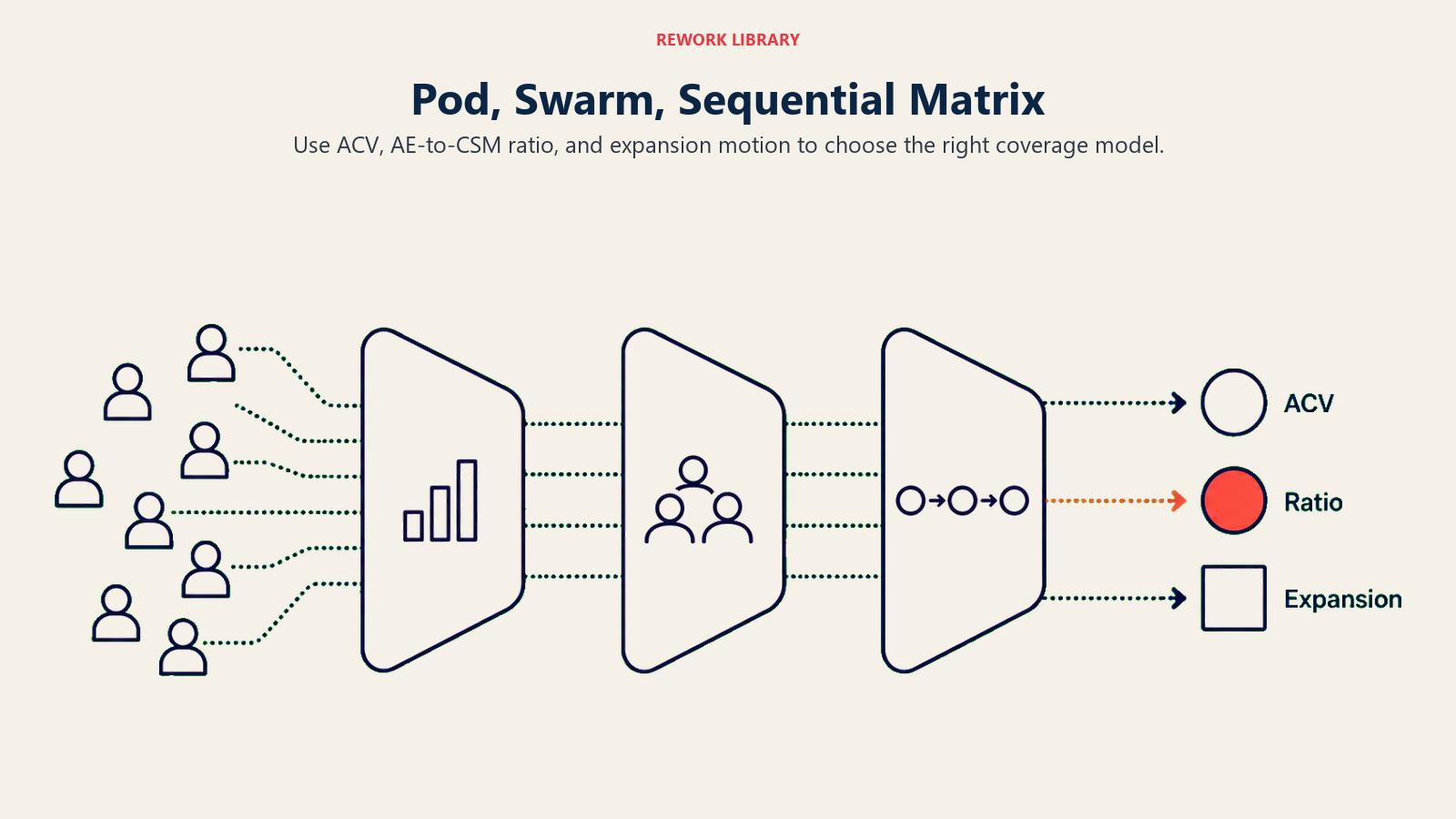
Soalan 1: Apakah pengagihan ACV anda?
- ACV purata di bawah $15K → Sequential untuk kebanyakan buku; swarm terpilih untuk akaun teratas
- ACV purata $15K-$50K → Swarm untuk pasaran pertengahan; pod untuk tahap strategik
- ACV purata di atas $50K → Pod untuk strategik; swarm untuk pasaran pertengahan; sequential untuk ekor panjang
Soalan 2: Apakah nisbah AE:CSM anda?
- Nisbah di atas 4:1 → Sequential adalah mungkin satu-satunya model berdaya maju pada skala; pod hanya untuk tahap teratas
- Nisbah 2:1 hingga 4:1 → Swarm boleh dilaksanakan merentasi buku; pod untuk segmen ACV tertinggi
- Nisbah 2:1 atau lebih rendah → Model pod boleh dilaksanakan; sequential menjadi overhead yang tidak perlu
Soalan 3: Seberapa kompleks onboarding dan produk anda?
- Masa-kepada-nilai pendek (di bawah 30 hari), produk transaksional → Sequential berfungsi
- Kerumitan sederhana (onboarding 30-90 hari, pelbagai stakeholder) → Swarm; AE kekal tersedia semasa onboarding
- Kerumitan tinggi (90+ hari, pelaksanaan enterprise, pelbagai integrasi) → Pod; kesinambungan hubungan dari jualan kepada pengeluaran adalah pemacu pengekalan
Kebanyakan syarikat akan mendapati jawapan mereka menghala ke arah model yang berbeza untuk tahap akaun yang berbeza, yang merupakan jawapan jujur. Respons yang betul bukan untuk memilih satu model untuk semua. Ia adalah untuk mensegmenkan dengan sengaja dan menjalankan setiap model dengan protokol yang diperlukannya.
Analisis Rework: Apabila menerapkan Matriks Keputusan Pod-Swarm-Sequential kepada syarikat ARR $12 juta dengan ACV purata $28K dan nisbah AE:CSM 3.5:1, data lazimnya menyokong struktur tiga tahap: Sequential untuk akaun di bawah ACV $12K (kira-kira 40% buku mengikut bilangan, 15% mengikut ARR), Swarm untuk akaun pada ACV $12K-$45K (50% akaun, 55% ARR), dan Pod untuk akaun strategik di atas ACV $45K (10% akaun, 30% ARR). Menjalankan satu model merentasi semua tahap pada profil ini menghasilkan sama ada CSM terbeban (jika pod merentasi semua akaun) atau pengabaian akaun strategik (jika sequential merentasi semua akaun). Pendekatan segmentasi menyelesaikan kedua-duanya.
Boleh Dipetik: "67% syarikat yang menjalankan satu model akaun untuk semua tahap melaporkan kekangan kapasiti CSM sebagai tiga halangan pertumbuhan teratas, berbanding 31% syarikat yang mensegmenkan model liputan mereka mengikut tahap akaun." (tinjauan pertumbuhan dipimpin produk OpenView Partners)
Matlamatnya bukan model yang paling canggih. Ia adalah model yang betul untuk akaun, pasukan, dan peringkat anda. Dapatkan itu dengan betul, dan halaju pengembangan serta pengekalan akan mengikut. Penyelidikan OpenView Partners tentang penskalaan pasukan CS mengesahkan bahawa ACV, kerumitan produk, dan volum semuanya mesti memaklumkan cara anda menentukan saiz dan mensegmenkan model liputan anda.
Soalan Lazim tentang Model Pasukan Akaun
Apakah model pod dalam pengurusan akaun SaaS?
Model pod memasangkan AE bernama dengan CSM bernama pada buku akaun bersama, kedua-duanya bersama memiliki hubungan pelanggan dari penutupan melalui pembaharuan dan pengembangan. Ia adalah model yang paling sentuhan tinggi dan paling mahal untuk dikendalikan, dijustifikasikan oleh ACV yang tinggi dan produk kompleks di mana kesinambungan hubungan secara langsung mendorong pengekalan dan pengembangan.
Bila model akaun sequential rosak?
Sequential biasanya rosak apabila kerumitan produk adalah tinggi, apabila AE membuat komitmen semasa jualan yang CS temui semasa kickoff, atau apabila ACV cukup tinggi sehingga kehilangan akaun kepada churn berkaitan handoff adalah ketara secara ekonomi. Untuk produk kompleks atau akaun di atas $30K ACV, beberapa bentuk penglibatan AE berterusan (swarm atau pod) biasanya menghasilkan NRR yang lebih baik.
Berapa banyak akaun yang boleh dibawa oleh CSM dalam setiap model?
Nisbah berbeza mengikut kerumitan produk, tetapi panduan umum: CSM sequential membawa 30-60 akaun (hujung bawah untuk produk kompleks), CSM swarm membawa 20-40 akaun, CSM pod membawa 8-20 akaun strategik. Nisbah dikekang oleh kerja proaktif yang diperlukan setiap model: pod memerlukan lebih banyak masa pelaburan setiap akaun, yang mengehadkan saiz buku.
Bolehkah anda menjalankan beberapa model pasukan akaun di syarikat yang sama?
Ya, dan ia adalah pendekatan yang betul untuk kebanyakan syarikat pada ARR $10 juta+. Segmentasi yang paling biasa adalah pod untuk akaun strategik, swarm untuk pasaran pertengahan, dan sequential untuk SMB. Setiap tahap mendapat protokol handoff yang berbeza, kriteria peningkatan yang berbeza, dan kadens mesyuarat yang berbeza. RevOps biasanya memiliki definisi tahap dan kriteria peralihan.
Bagaimana anda beralih daripada sequential kepada swarm atau pod tanpa mengganggu akaun sedia ada?
Beralih mengikut tahap, bukan sekali gus. Mulakan dengan mengenal pasti 15-20% teratas akaun mengikut ACV atau nilai strategik dan menjalankan perintis model baharu dengan segmen itu dahulu. Pasangkan AE dan CSM dengan sengaja dan bukannya secara rawak, dan tentukan protokol peningkatan sebelum semakan akaun bersama yang pertama. Jalankan perintis selama satu suku tahun penuh, ukur kualiti kickoff dan skor kesihatan akaun awal, dan gunakan data itu untuk memperhalusi model sebelum melancarkannya ke tahap seterusnya. Cuba menukar semua akaun serentak lazimnya menyebabkan kemerosotan produktiviti CSM selama dua suku tahun apabila semua orang menyesuaikan diri.
Ketahui Lebih Lanjut

Principal Solution Architect
On this page
- Mengapa Struktur Pasukan Akaun Penting untuk NRR?
- Tiga Model: Gambaran Keseluruhan
- Model 1: Sequential (Serah Baton)
- Model 2: Swarm (Perhatian Bertahap)
- Model 3: Pod (Pasukan Akaun Berpasangan)
- Memilih Model yang Betul untuk Peringkat Anda
- Pendekatan Segmentasi: Menjalankan Beberapa Model Serentak
- Kesilapan Biasa Apabila Menukar Model
- Matriks Keputusan Pod-Swarm-Sequential: Tiga Soalan
- Ketahui Lebih Lanjut