Gelung Penghalusan ICP: Bagaimana Maklum Balas CS tentang Tawaran Tidak Sesuai Membetulkan Penyasaran Huluan
Turn this article into takeaways for your work.


Each assistant summarizes the article only for you and suggests best practices for your work.
Masalah ICP (Ideal Customer Profile; lihat Glosari Penjajaran Jualan-CS untuk definisi penuh) di kebanyakan syarikat tidak dimiliki oleh mana-mana satu pasukan. Pemasaran mentakrifkannya berdasarkan siapa yang mereka fikir mereka sasarkan. Jualan menghampirinya di bawah tekanan kuota. CS mewarisi apa jua kombinasi yang dihasilkan. Jika pasukan pemasaran dan jualan anda tidak berkongsi satu dokumen ICP, mulakan dengan rangka kerja ICP bersama sebelum membina gelung maklum balas CS. Gelung itu tiada apa-apa untuk dikemas kini tanpa takrifan kanonik sebagai sauh.
Beginilah kegagalan berlaku di peringkat tawaran individu: seorang AE berada 12 hari menjelang akhir suku. Satu akaun masuk yang hampir memenuhi ICP: industri betul, saiz sedikit kecil, dan kes penggunaan utama bersebelahan dengan produk teras, bukan tepat di dalamnya. Di bawah tekanan kuota, "bersebelahan" menjadi "sudah cukup." Tawaran ditutup.
CSM ditugaskan ke akaun tersebut. Dalam masa 60 hari, mereka tahu: pelanggan ini membeli penyelesaian untuk masalah yang produk tidak selesaikan sepenuhnya. Penerimaan pakai akan tidak sekata. Champion bersemangat tetapi tidak berada dalam kedudukan untuk mendorong penggunaan merentas pasukan. Akaun ini kemungkinan akan mengalami Churn atau penurunan taraf semasa pembaharuan.
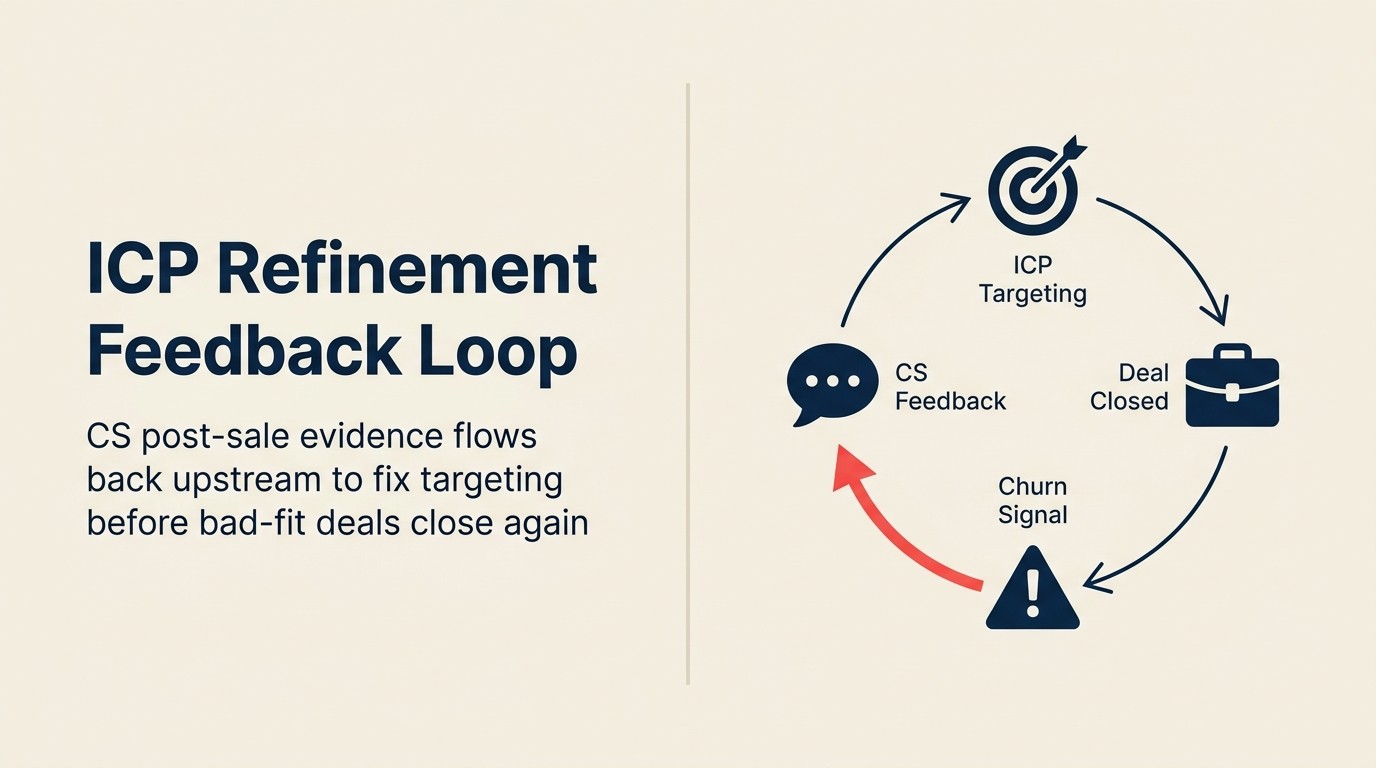
Isyarat itu, jelas, khusus, dan boleh diambil tindakan, hampir tidak pernah sampai kembali kepada Jualan atau Pemasaran dalam apa-apa cara yang sistematik. CSM menyebutnya dalam panggilan. Atau merekodkannya dalam platform CS di mana tiada seorang pun dari Jualan pernah melihat. Atau hanya menerimanya sebagai kos menjalankan perniagaan dalam syarikat dengan pipeline yang tidak selari.
Kemudian suku seterusnya, tawaran jenis yang sama ditutup. Dan suku selepas itu.
Mengapa Hanyutan ICP adalah Masalah Pendapatan, Bukan Masalah Pembahagian
Fakta Utama: Kos NRR Akibat Hanyutan ICP
- Akaun yang tidak sesuai mengalami Churn pada kadar 2-3x berbanding akaun yang sesuai dan berkembang pada separuh kadar, menurut penyelidikan Gainsight tentang kohort pelanggan B2B SaaS.
- Syarikat di mana CS memberikan maklum balas ICP berstruktur kepada Jualan setiap suku melihat peningkatan NRR sebanyak 8-12 mata peratusan dalam 18 bulan, berbanding syarikat tanpa gelung maklum balas formal, menurut penyelidikan TSIA tentang penjajaran CS-Jualan.
- Hanya 23% syarikat B2B SaaS mempunyai proses formal untuk pasukan CS menanda akaun tidak sesuai kepada Jualan, menurut tinjauan ChurnZero terhadap 600+ pemimpin CS.
- Walaupun hanya 10% daripada tawaran closed-won yang tidak sesuai boleh menekan NRR sebanyak 5-8 mata setiap tahun, apabila anda mengambil kira Churn, Expansion rendah, dan masa CS yang diserap, menurut analisis Bain & Company.
Matematik berganda di sini berbaloi untuk direnungkan sejenak. Penyelidikan pertumbuhan B2B McKinsey menunjukkan bahawa syarikat yang menggunakan analitik lanjutan untuk mengukur potensi perbelanjaan setiap pelanggan, sedia ada atau bakal, secara konsisten mengatasi pesaing dalam pertumbuhan bahagian pasaran. Kelebihan itu lesap apabila ICP anda hanyut dan penyasaran anda tersasar.
Katakan 12% daripada tawaran closed-won anda dalam suku tertentu tidak sesuai. Akaun-akaun tersebut mengalami Churn pada kadar yang meningkat. Bukan kerana CS gagal, tetapi kerana kesesuaian struktural adalah rendah dari hari pertama. Churn tersebut muncul 8-14 bulan kemudian sebagai penurunan NRR (Net Revenue Retention; lihat glosari).
NRR yang lebih rendah mewujudkan tekanan pada sasaran pemerolehan logo baharu untuk mengimbangi pangkalan yang hilang. Tekanan itu meningkatkan insentif bagi AE untuk menutup tawaran yang hampir ICP di bawah tekanan kuota. Yang menjana satu lagi kohort akaun tidak sesuai. Yang mengalami Churn dalam kitaran berikutnya.
Gelung itu berganda dalam arah yang salah. Tetapi ia kelihatan seperti masalah pipeline, atau masalah prestasi CS, sehingga anda menjejaknya kembali ke sumber.
Matematik tanggungjawab adalah tidak selesa: Jualan dan Pemasaran berkongsi punca huluan. CS memegang bukti hiliran. Tiada satu pasukan pun boleh membetulkannya secara bersendirian. Pemasaran tidak boleh menghaluskan ICP tanpa data Churn. Jualan tidak boleh memenuhi syarat dengan lebih ketat tanpa mengetahui atribut mana yang sebenarnya meramalkan kegagalan. CS boleh melihat corak dengan jelas tetapi tidak mempunyai mekanisme untuk mendapatkan corak itu ke huluan dalam bentuk yang mengubah tingkah laku.
Gelung maklum balas adalah mekanismenya. Tanpanya, data itu lesap menjadi anekdot suku tahunan. Proses maklum balas menang-kalah kepada pemasaran ialah gelung huluan yang bersebelahan. Data Churn CS dan analisis menang-kalah sering menunjuk ke ketidakpadanan segmen yang sama dari dua arah yang berbeza.
Jadi apakah yang CS sebenarnya tahu yang Jualan tidak tahu? Jawapannya lebih khusus daripada yang disedari kebanyakan pasukan.
Apa yang CS Sebenarnya Tahu yang Jualan Tidak Tahu
Ini bukan aduan tentang Jualan. Ini adalah realiti struktural: CSM melihat perkara selepas tutup yang tidak kelihatan atau masih teori semasa kitaran jualan.
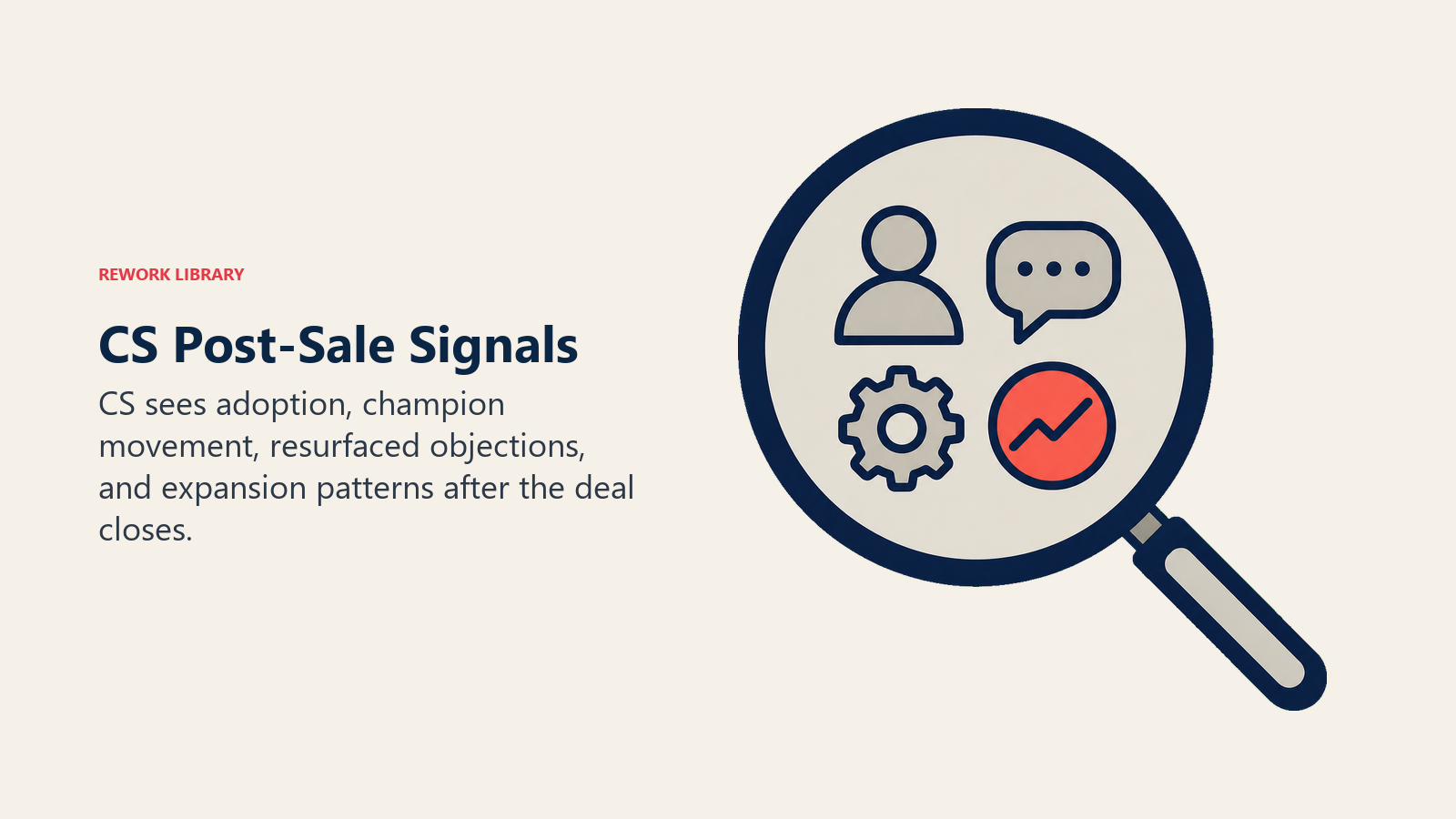
Corak penerimaan pakai mengikut segmen. Profil pelanggan mana yang benar-benar terlibat secara mendalam berbanding yang menerima Onboarding dengan sopan kemudian senyap. CSM yang menguruskan 40 akaun tahu dengan tepat vertikal mana yang mendorong Expansion dipacu produk dan mana yang berhenti pada 30% penggunaan tempat duduk.
Kes penggunaan yang dijanjikan mana yang tidak pernah terlaksana, dan seberapa cepat. CSM mengetahui dalam masa 90 hari sama ada kes penggunaan yang AE bina tawaran seputarnya benar-benar diusahakan. Divergens antara kes penggunaan yang dikomitmen dan kes penggunaan aktif adalah salah satu isyarat Churn paling awal yang tersedia.
Kestabilan champion pada 30, 90, dan 180 hari selepas tutup. CSM melihat pemergian champion, penyusunan semula, dan pengagihan semula belanjawan lebih awal daripada sesiapa pun dalam Jualan. Champion yang membeli dengan penuh semangat dan kemudian meninggalkan syarikat adalah risiko pembaharuan yang tiada metrik produk tangkap.
Bantahan mana yang diselesaikan dalam kitaran jualan muncul semula sebagai sebab Churn. CSM sering mendengar pelanggan berkata, "Kami diberitahu ini akan bersepadu dengan [X]." Itulah bantahan yang sama yang muncul dalam panggilan penemuan dan ditangani dengan "kita akan urus bersama-sama." Bantahan itu tidak hilang. Ia ditangguhkan.
Kadar Expansion mengikut profil pelanggan. Jenis akaun mana yang sebenarnya berkembang? Ini adalah isyarat yang paling bernilai secara komersial yang CS pegang dan yang paling konsisten tidak digunakan oleh Jualan. Penyelidikan customer success 2.0 McKinsey mendapati bahawa pelanggan sedia ada menyumbang antara satu pertiga hingga separuh daripada jumlah pertumbuhan pendapatan, malah di syarikat peringkat awal, yang menjadikan keterlihatan CSM terhadap corak Expansion sebagai input pendapatan langsung, bukan sekadar pemerhatian operasi. Akaun yang berkembang tidak diedarkan secara rawak merentas pangkalan pelanggan anda. Mereka berkelompok di sekitar profil, kes penggunaan, dan pencetus pembelian yang khusus. Artikel pemilikan expansion dan gerakan upsell memetakan bagaimana isyarat expansion itu dihalakan daripada CS kepada Jualan setelah rangka kerja ICP mengenal pasti profil mana yang berbaloi digandakan.
Persoalannya ialah bagaimana membawa pengetahuan ini ke huluan dalam bentuk yang benar-benar mengubah apa yang Jualan dan Pemasaran lakukan pada suku seterusnya.
Membina Gelung Maklum Balas: Model Empat Peringkat
Empat peringkat di bawah menunjukkan bagaimana bukti kesesuaian selepas jualan bergerak ke huluan daripada penandaan CS kepada perubahan penyasaran.
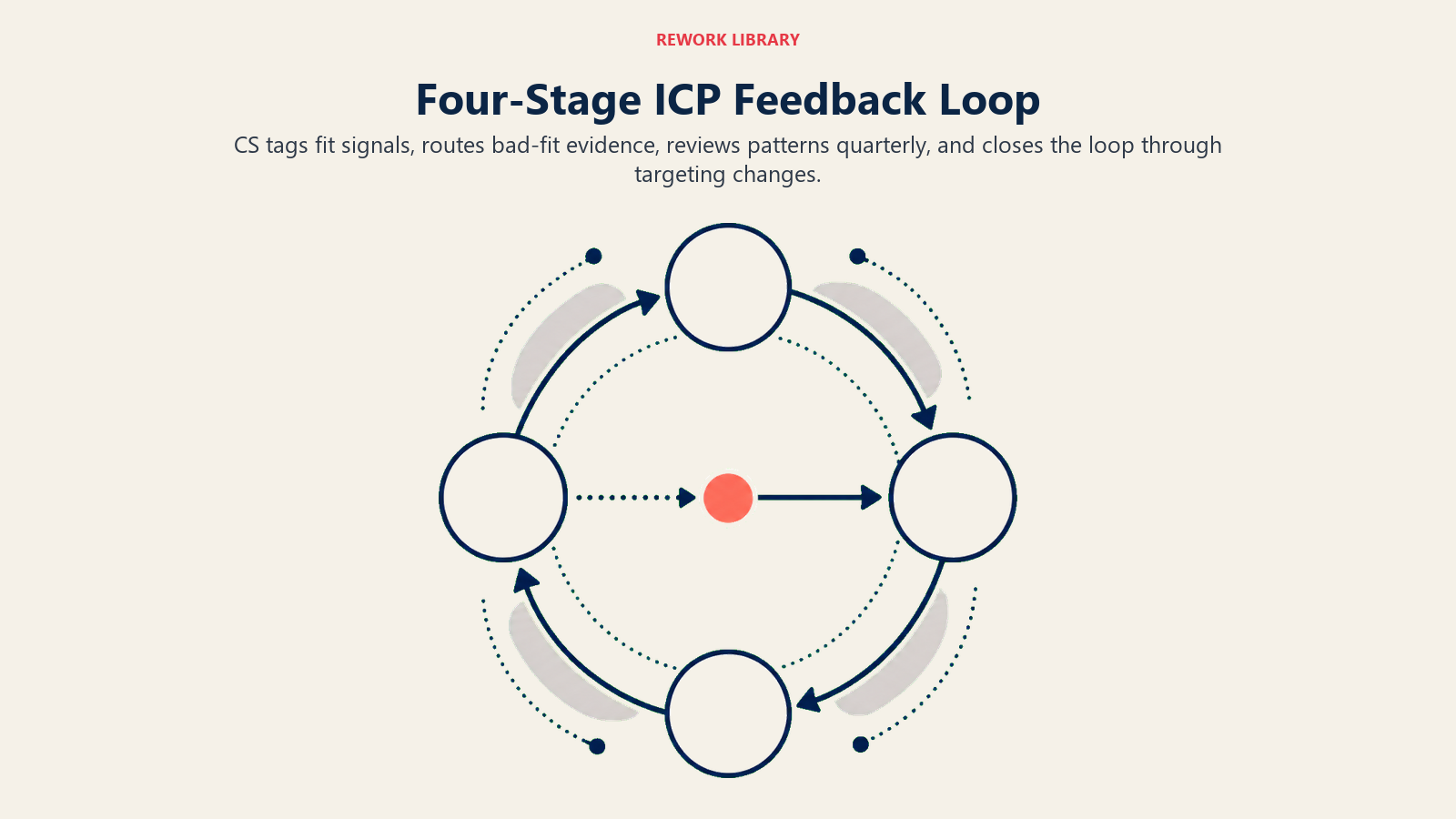
Peringkat 1: CS Menanda Akaun dengan Isyarat Kesesuaian pada Tanda 90 Hari
Pada 90 hari selepas tutup, setiap CSM menanda akaun mereka dengan isyarat kesesuaian. Tiga kategori sudah mencukupi: sesuai-kuat, hampir-sesuai, tidak-sesuai.
Kriteria untuk penetapan isyarat kesesuaian:
| Isyarat | Sesuai-kuat | Hampir-sesuai | Tidak-sesuai |
|---|---|---|---|
| Kes penggunaan teras aktif | Ya | Sebahagian | Tidak / belum lagi |
| Kestabilan champion | Orang yang sama, peranan yang sama | Perubahan peranan, hubungan dikekalkan | Champion telah pergi |
| Pematuhan segmen ICP | Disahkan | Anggaran | Tidak sepadan jelas |
| Trajektori penerimaan pakai pada hari ke-90 | Menepati atau melebihi rancangan | Lebih lambat daripada dijangka | Terhenti |
| Kes penggunaan yang dikomitmen AE aktif | 2+ aktif | 1 aktif | Tiada yang aktif |
Tanda tidak-sesuai dihala ke Peringkat 2. Tanda hampir-sesuai masuk ke senarai pantauan untuk semakan pada 180 hari.
Penandaan ini mengambil masa 10-15 minit setiap akaun. CSM sudah mengetahui jawapannya. Tanda hanya merakamnya dalam bentuk berstruktur yang boleh diambil tindakan oleh orang lain.
Peringkat 2: CSM Menghala Tanda Tidak-Sesuai ke Semakan Pendapatan Bersama
Tanda tidak-sesuai bukan aduan. Ia adalah serah terima berstruktur bagi isyarat khusus dengan bukti sokongan. CSM menghalakannya kepada tiga orang: AE yang menutup tawaran (untuk konteks dan akauntabiliti), peneraju Ops Jualan atau RevOps (untuk penjejakan corak), dan pengurus CS mereka sendiri (untuk bimbingan dan konteks beban kerja).
Format penghalaan penting. Mesej Slack yang berkata "akaun ini rasanya tidak sesuai" bukan tanda. Nota CRM dengan isyarat kesesuaian, jurang khusus (ketidakpadanan kes penggunaan / kerentanan champion / penyelewengan ICP), dan ringkasan bukti 2 ayat adalah tanda yang boleh diambil tindakan.
Fikirkan begini: jika maklumat tidak berada dalam CRM, ia tidak wujud untuk semakan suku tahunan. Ingatan CSM bukan sumber data.
Peringkat 3: Sesi Semakan ICP Suku Tahunan
Ini adalah jantung struktural gelung. Tanpa mesyuarat berulang yang dijadualkan dengan agenda dan pemilik yang dinamakan, data yang dikumpulkan dalam Peringkat 1 dan 2 tidak pernah menjadi penghalusan ICP. Ia hanya terkumpul.
Siapa yang hadir: VP CS, VP Jualan, peneraju RevOps, wakil Pemasaran. Ini bukan pembentangan CS kepada Jualan. Ini adalah semakan bersama bukti bersama.
Apa yang dibawa:
- Analisis kohort Churn CS: akaun yang ditutup dalam 12-18 bulan sebelumnya dan mengalami Churn dalam 12 bulan, disegmentasikan mengikut AE, segmen, industri, dan kes penggunaan yang dinyatakan
- Ringkasan isyarat kesesuaian CS: taburan tanda sesuai-kuat / hampir-sesuai / tidak-sesuai dari suku lepas mengikut segmen
- Kadar tutup Jualan mengikut segmen: di mana AE menutup dengan baik, di mana mereka bergelut, segmen mana yang memerlukan diskaun berlebihan untuk ditutup
- Sintesis RevOps: di mana data Churn dan data kadar tutup menunjuk ke ketidakpadanan segmen yang sama
Output setiap semakan suku tahunan:
- 3-5 kemas kini isyarat ICP khusus: "Akaun dengan kurang daripada 50 tempat duduk semasa tutup mempunyai Churn 3x lebih tinggi dalam 12 bulan pertama. Cadangan had bawah ICP: 75 tempat duduk"
- Perubahan kepada kriteria pemarkahan Lead berdasarkan data Churn CS (Pemasaran melaksanakan)
- Kriteria kelayakan yang dikemas kini untuk Jualan: satu atau dua penapis khusus yang AE harus terapkan dengan lebih teliti
- Senarai "jangan tutup" untuk suku seterusnya: segmen atau jenis akaun yang data mencadangkan harus didiskualifikasi lebih awal, bukan ditutup di bawah tekanan
Senarai "jangan tutup" adalah output yang paling sukar untuk dilaksanakan. AE di bawah tekanan kuota tidak mahu diberitahu tawaran mana yang perlu mereka lepaskan. Di situlah penjajaran kepimpinan penting. CRO perlu menyokong senarai tersebut agar ia bertahan.
Peringkat 4: Pemasaran Mengemas Kini Kedudukan dan Pemarkahan Lead
Semakan suku tahunan menghasilkan isyarat. Tetapi ia hanya mewujudkan perubahan huluan jika Pemasaran berada dalam bilik dan bertindak ke atasnya. Kerja Pemasaran dalam peringkat ini adalah untuk menterjemahkan sintesis CS/Jualan kepada:
- Kemas kini penapis ICP (kriteria firmografi mana yang perlu diberi lebih atau kurang berat dalam penyasaran)
- Perubahan pemarkahan Lead (isyarat tingkah laku mana yang sepadan dengan segmen tidak-sesuai yang CS kenal pasti)
- Pelarasan pemesejan (kes penggunaan mana yang perlu dikurangkan keutamaannya dalam kedudukan kerana ia menarik pembeli yang salah)
Dan yang paling kritikal: Pemasaran memberitahu CS apa yang mereka ubah. Gelung hanya ditutup jika maklumat mengalir dalam kedua-dua arah. CS mengubah tingkah laku Jualan dan Pemasaran; Pemasaran mengesahkan kembali kepada CS apa yang berubah dan mengapa.
Isyarat "Tawaran Ini Tidak Sepatutnya Ditutup"
Tidak semua akaun yang berprestasi rendah adalah akaun tidak sesuai. Sesetengah akaun tidak sesuai secara reka bentuk. Yang lain adalah akaun yang sesuai tetapi dengan penerimaan pakai yang lemah: produk betul, pelaksanaan yang salah.
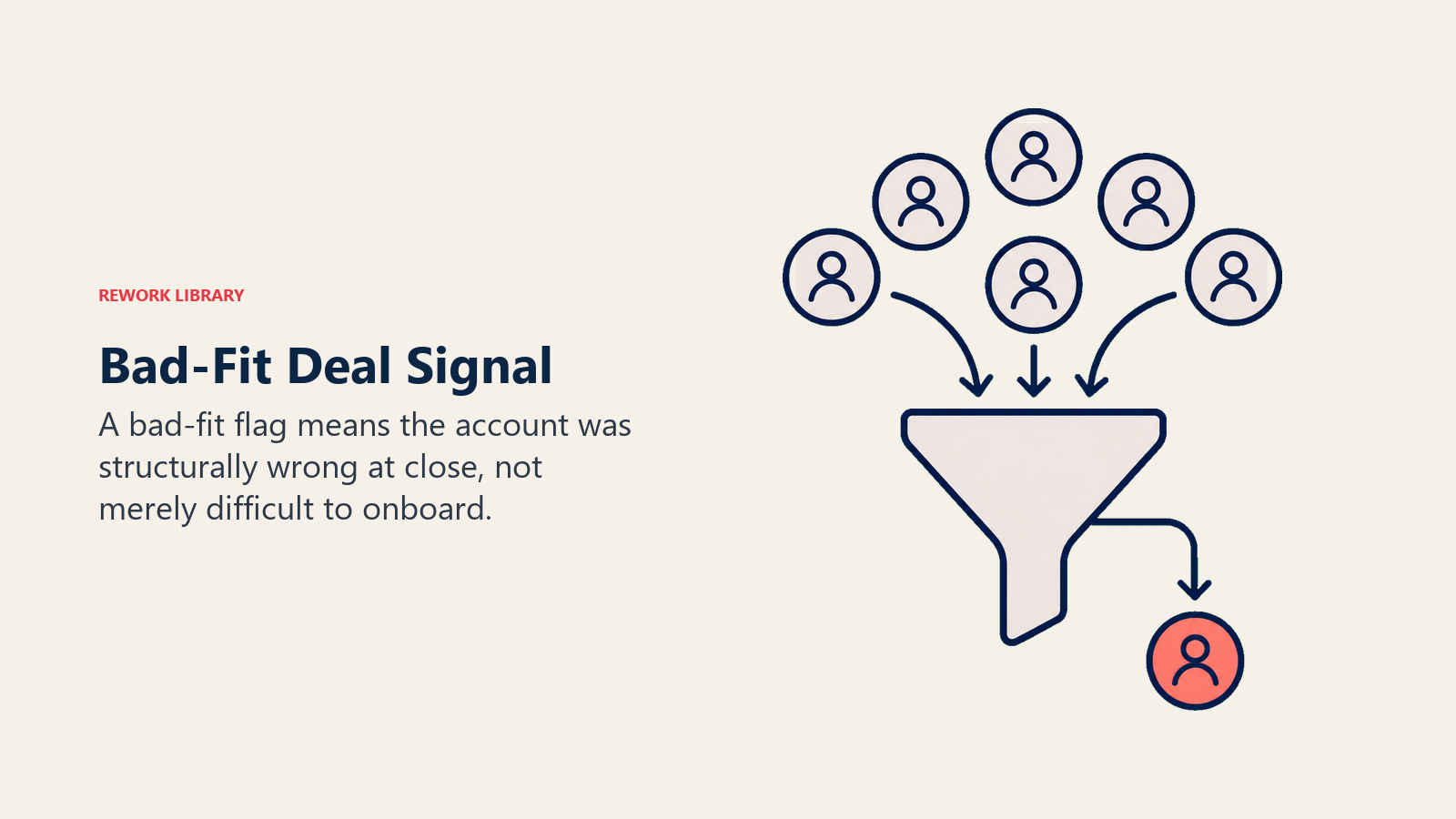
Perbezaan itu penting kerana respons huluan adalah berbeza:
| Jenis akaun | Punca akar | Respons |
|---|---|---|
| Tidak sesuai secara reka bentuk | Ketidakpadanan ICP, kes penggunaan yang salah dikomitkan | Tanda ICP kepada Jualan + Pemasaran |
| Sesuai, penerimaan pakai lemah | Kegagalan Onboarding, penglibatan CSM yang tidak mencukupi | Bimbingan CS, kemas kini Playbook |
| Sesuai, gangguan luaran | Pemergian champion, pembekuan belanjawan, M&A | Penglibatan semula AE, hubungan eksekutif |
CSM yang menanda semua perkara sebagai "tidak sesuai" cepat kehilangan kredibiliti dengan Jualan dan RevOps. Kriteria penandaan dalam Peringkat 1 perlu cukup ketat sehingga tanda tidak-sesuai bermakna sesuatu yang khusus: tawaran itu salah secara struktural semasa tutup, bukan hanya sukar untuk Onboarding.
Artikel Tawaran Ini Tidak Sepatutnya Ditutup: Gelung Kembali kepada Jualan merangkumi pencetus dan standard bukti khusus untuk tanda ICP formal.
Tempat Gelung Rosak: Empat Mod Kegagalan
Mod Kegagalan 1: Maklum Balas CS Bersifat Tidak Formal
"Saya menyebutnya dalam panggilan" bukan gelung maklum balas. Begitu juga ulasan dalam mesyuarat pasukan yang tidak direkodkan di mana-mana. Agar maklum balas CS mengubah ICP, ia mesti berada dalam format berstruktur, dalam sistem bersama, disemak oleh orang yang mempunyai autoriti untuk bertindak ke atasnya.
Mod Kegagalan 2: Jualan Mentafsir Maklum Balas Tidak-Sesuai sebagai Aduan CS
Ini memerlukan framing kepimpinan. Jika VP Jualan dan VP CS belum bersetuju secara eksplisit bahawa data isyarat kesesuaian CS adalah input komersial (bukan kritik prestasi terhadap AE individu), maka setiap tanda tidak-sesuai akan diterima sebagai tuduhan, bukan isyarat. Semakan ICP suku tahunan hanya berjaya jika kepimpinan Jualan hadir dengan benar-benar ingin tahu, bukan defensif.
Mod Kegagalan 3: RevOps Tidak Mempunyai Pemilik untuk ICP Antara Kitaran Perancangan Tahunan
Semakan ICP yang hanya berlaku sekali setahun semasa musim perancangan terlalu perlahan. Pasaran bergerak. Corak Churn muncul dalam kohort yang mengambil masa 6-9 bulan untuk menjelma. Kadens suku tahunan menangkap hanyutan sebelum ia berganda. Tetapi seseorang perlu memiliki dokumen ICP antara semakan: mengemas kininya, menjejaki perubahan yang dilaksanakan, mengekalkan sejarah versi. Itu adalah fungsi RevOps.
Mod Kegagalan 4: Pemasaran Mengubah Pemesejan Tanpa Memaklumkan CS
Gelung rosak dalam arah yang berbeza apabila Pemasaran bertindak ke atas isyarat tetapi tidak menutup gelung komunikasi kembali kepada CS. CS masih memberitahu prospek bahawa satu kes penggunaan sesuai untuk mereka, sementara Pemasaran sudah pun membuang kes penggunaan itu daripada ICP. Pelanggan mendapat isyarat bercampur. Dan CS tidak faham mengapa kohort akaun baharu kelihatan berbeza daripada yang dijangkakan.
Seperti Apa yang Baik: Semakan Isyarat ICP Suku Tahunan
Sesi suku tahunan adalah mekanismenya. Berikut adalah format praktikal yang sesuai untuk pasukan SMB dan pasaran pertengahan:
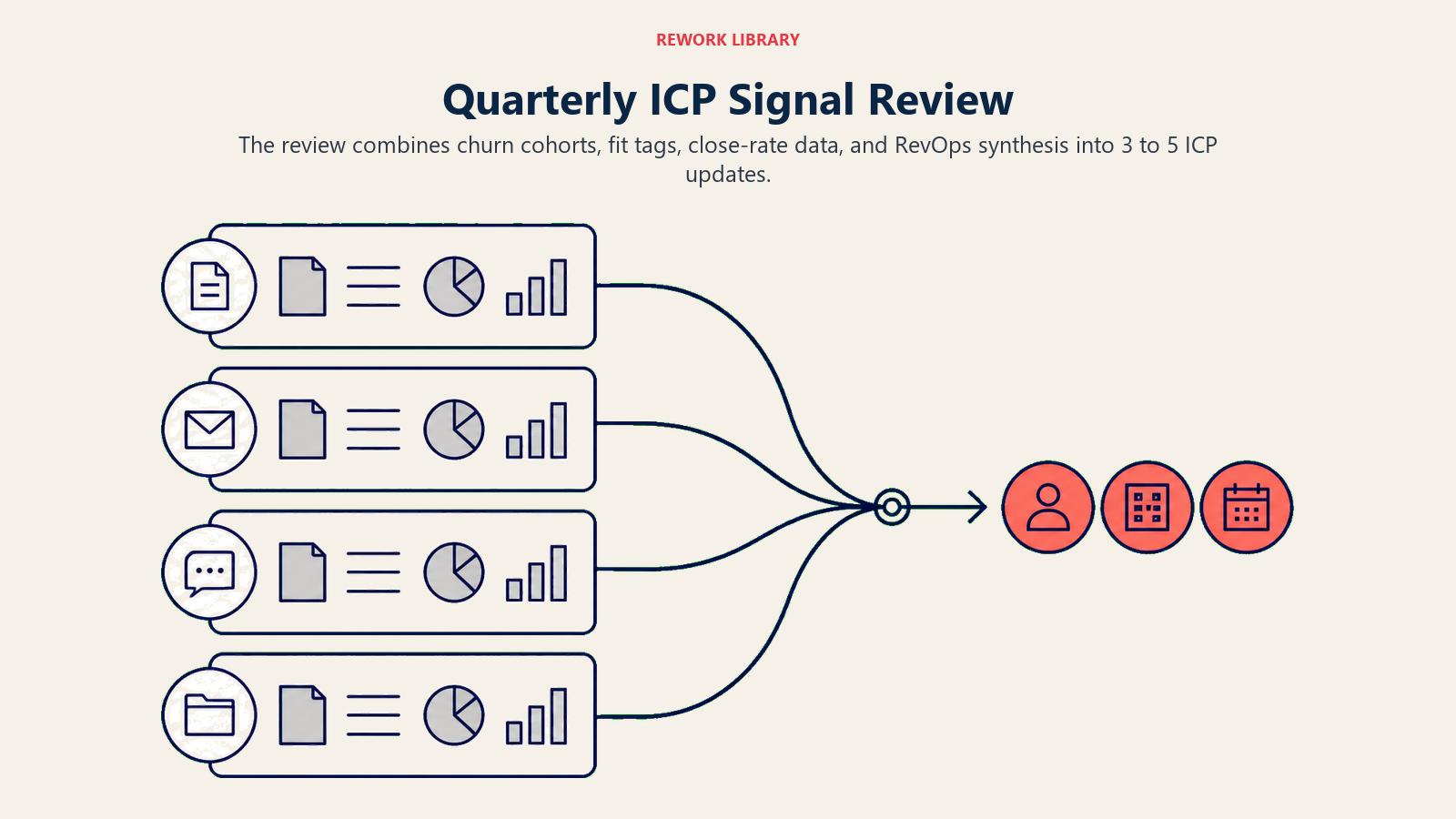
Peserta: VP CS, VP Jualan, peneraju RevOps, peneraju Pemasaran (tidak pilihan) Tempoh: 60-75 minit Kadens: Suku tahunan; semakan mikro bulanan jika NRR jatuh lebih daripada 2 mata dalam satu suku
Agenda:
| Masa | Topik | Pemilik |
|---|---|---|
| 0-15 min | Kohort Churn CS: akaun yang ditutup dalam Q-2 yang mengalami Churn dalam Q1 atau Q2, disegmentasikan mengikut profil | VP CS |
| 15-30 min | Ringkasan isyarat kesesuaian: taburan tanda kesesuaian dari suku lepas mengikut segmen | RevOps |
| 30-45 min | Kadar tutup Jualan dan trend diskaun mengikut segmen | VP Jualan |
| 45-60 min | Sintesis: di mana data Churn dan data kadar tutup menunjuk ke corak yang sama | RevOps |
| 60-75 min | Keputusan kemas kini ICP: 3-5 perubahan kriteria khusus, kemas kini pemarkahan Lead, senarai "jangan tutup" | Semua |
Peneraju RevOps memiliki dokumen ICP dan mengedarkan 3-5 kemas kini kepada semua pasukan dalam masa 5 hari perniagaan selepas semakan. Pemasaran mengesahkan jadual pelaksanaan dalam masa 2 minggu.
RevOps sebagai Pemilik Neutral
Gelung maklum balas memerlukan pemilik yang tidak memihak. CS akan menanda berlebihan: setiap akaun yang bergelut kelihatan seperti akaun tidak sesuai apabila anda cuba menyelamatkan pembaharuan. Jualan akan menanda kurang: setiap tawaran yang hampir ICP kelihatan boleh ditutup dari pandangan pipeline. Kedua-dua tafsiran adalah betul dari sudut pandang masing-masing pasukan.
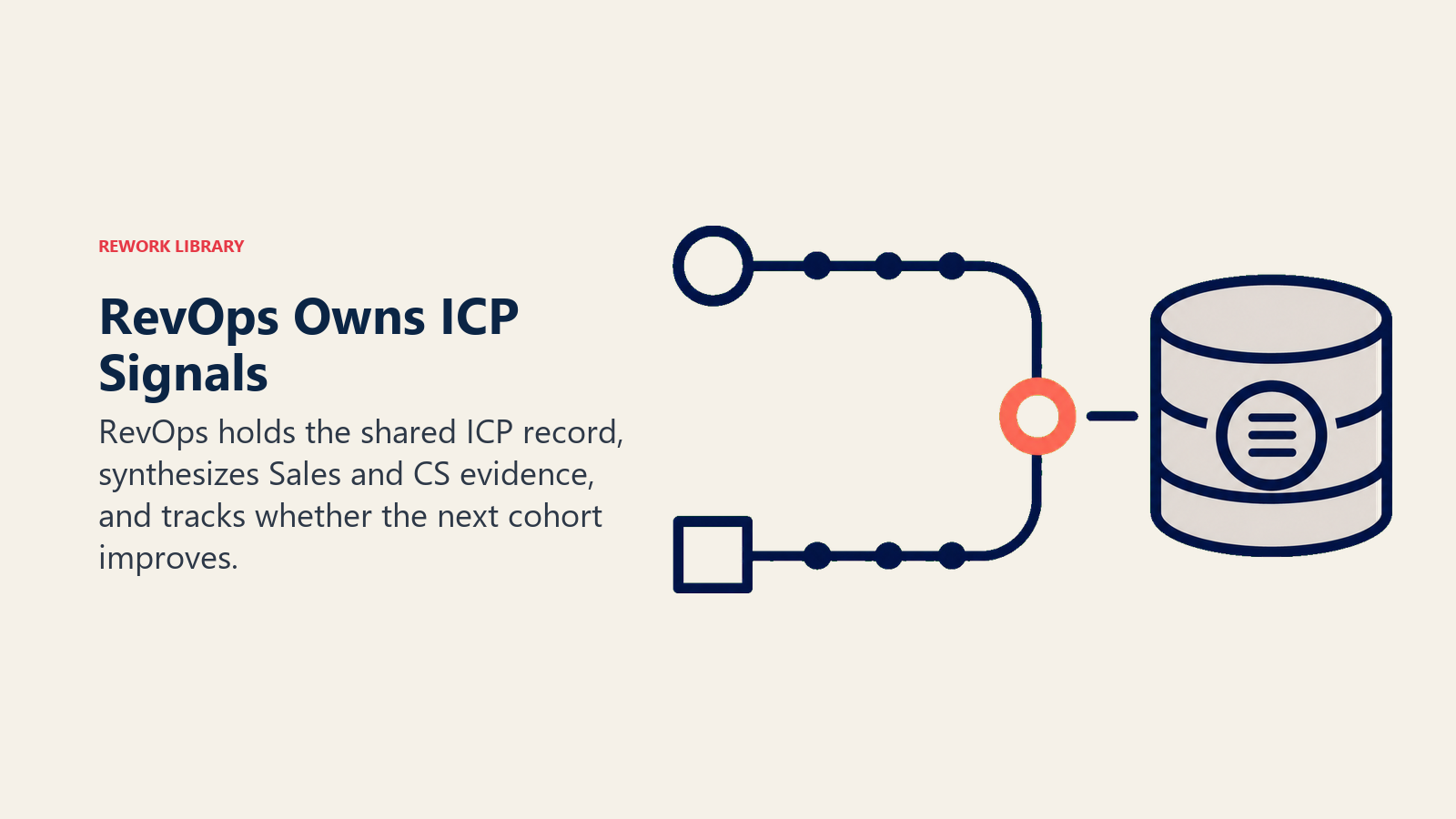
RevOps menyintesis isyarat tersebut. Mereka memegang dokumen ICP. Mereka menjejaki kemas kini yang dilaksanakan dan mengukur hasil kohort 6-12 bulan kemudian. Mereka bertanggungjawab kepada NRR sebagai metrik operasi, bukan kepada prestasi individu mana-mana pasukan. Untuk cara RevOps menstruktur ramalan NRR bersama merentas kedua-dua pasukan, artikel itu merangkumi mekanik menukar data kohort Churn dan ICP kepada ramalan pendapatan yang memandang ke hadapan.
Ini penting untuk ramalan ICP: kualiti ICP adalah petunjuk pendahuluan kestabilan NRR 12 bulan ke hadapan. Pasukan RevOps yang menjejaki taburan isyarat kesesuaian mengikut kohort tutup boleh meramalkan trajektori NRR dengan ketepatan yang munasabah 9-12 bulan lebih awal. Itu adalah tuas bermakna untuk perancangan pendapatan.
Pemilik RevOps juga ialah orang yang menutup gelung: mengesahkan kepada CS perubahan ICP mana yang dilaksanakan, menjejaki sama ada kadar tidak-sesuai kohort seterusnya bertambah baik, dan memberi amaran apabila ia tidak bertambah baik.
Titik Permulaan Praktikal untuk Pasukan SMB/Pasaran Pertengahan
Jika anda tidak mempunyai proses semakan ICP formal hari ini, mulakan dengan gelung maklum balas minimum yang boleh dilaksanakan:
Minggu 1: Cipta saluran Slack bersama (#icp-signals) di mana CSM menyiarkan tanda tidak-sesuai berstruktur menggunakan format mudah: "Tanda: [nama akaun] | isu kesesuaian: [ketidakpadanan kes penggunaan / ketidakpadanan ICP / kerentanan champion] | bukti: [1-2 ayat]." Peneraju Jualan dan RevOps berada dalam saluran. Tiada ulasan bebenang, hanya isyarat.
Bulan 1: RevOps mengeluarkan log saluran dan menghasilkan ringkasan: berapa banyak tanda, corak segmen mana yang muncul. Kongsi dengan VP CS dan VP Jualan.
Bulan 3: Jadualkan sesi semakan ICP suku tahunan pertama. Gunakan ringkasan tanda tidak-sesuai sebagai titik permulaan. Keluar dengan sekurang-kurangnya dua kemas kini kriteria ICP khusus.
Bulan 6: Automatikkan penandaan. Bina perintah isyarat kesesuaian 90 hari ke dalam aliran kerja platform CS anda supaya setiap akaun mendapat tanda berstruktur, bukan hanya yang CSM ingat untuk ditanda.
Tiga soalan yang setiap CSM harus jawab pada tanda 90 hari, dan hala kepada Jualan jika mana-mana jawapan membimbangkan:
- Adakah kes penggunaan utama yang pelanggan beli sedang digunakan secara aktif?
- Adakah champion masih dalam peranan yang sama?
- Adakah pelanggan menyebut pesaing atau menyatakan penyesalan tentang penukaran?
Itulah isyarat ICP minimum yang boleh dilaksanakan. Ia mengambil masa 5 minit setiap akaun. Dan isyarat itu lebih berharga daripada setahun analitik produk untuk meramalkan tawaran mana yang akan mengalami Churn.
Untuk pandangan terperinci tentang bagaimana pemarkahan kesihatan pelanggan berhubung dengan gelung ini, Pemarkahan Kesihatan Pelanggan dengan Konteks Jualan merangkumi lapisan konteks tawaran yang menjadikan skor kesihatan ramalan berbanding deskriptif.
Gelung ICP CS-ke-Pemasaran
Gelung ICP CS-ke-Pemasaran ialah model empat peringkat yang didokumenkan dalam artikel ini. Peringkat 1 ialah CS menanda akaun dengan isyarat kesesuaian pada tanda 90 hari. Peringkat 2 ialah menghala tanda tidak-sesuai ke semakan pendapatan bersama dengan bukti berstruktur. Peringkat 3 ialah sesi semakan ICP suku tahunan dengan VP CS, VP Jualan, RevOps, dan Pemasaran sebagai pemilik bersama yang dinamakan. Peringkat 4 ialah Pemasaran menterjemahkan sintesis kepada kemas kini penapis ICP, perubahan pemarkahan Lead, dan pelarasan pemesejan, kemudian menutup gelung kembali kepada CS tentang apa yang berubah.
Gelung hanya lengkap apabila maklumat Peringkat 4 mengalir kembali kepada CS. Tanpa penutupan itu, CS terus beroperasi atas ICP yang usang sementara Pemasaran sudah mengubah penyasaran. Hasilnya: jangkaan pelanggan yang tidak sepadan semasa Onboarding dan sumber Churn yang tidak kelihatan dalam kohort seterusnya.
Analisis Rework: Gelung ICP berganda dalam kedua-dua arah. Pasukan yang menjalankan sesi suku tahunan secara konsisten melihat NRR bertambah baik 8-12 mata dalam 18 bulan kerana setiap suku menangkap isyarat Churn 6-9 bulan sebelum ia muncul dalam data NRR. Pasukan yang melangkau gelung ini menyerap isyarat yang sama sebagai Churn yang tidak dapat dijelaskan, menambah lebih ramai CSM untuk menguruskan simptom dan bukannya AE huluan untuk membetulkan puncanya.
Petikan Berguna:
"Akaun yang tidak sesuai mengalami Churn pada kadar 2-3x berbanding akaun yang sesuai dan berkembang pada separuh kadar, menjadikan kualiti ICP pengganda langsung ke atas NRR, bukan sekadar keutamaan segmentasi." (Penyelidikan Gainsight tentang kohort pelanggan B2B SaaS)
"Hanya 23% syarikat B2B SaaS mempunyai proses formal untuk pasukan CS menanda akaun tidak sesuai kepada Jualan, bermakna 77% menyerap Churn yang boleh dicegah sebagai kos perniagaan dan bukannya masalah gelung maklum balas." (Tinjauan ChurnZero terhadap 600+ pemimpin CS)
"Walaupun hanya 10% daripada tawaran closed-won yang tidak sesuai boleh menekan NRR sebanyak 5-8 mata setiap tahun apabila anda mengambil kira Churn, Expansion rendah, dan masa CS yang diserap, jurang yang berganda setiap suku tanpa gelung maklum balas berstruktur." (Bain & Company)
Ketahui Lebih Lanjut
- Glosari Penjajaran Jualan-CS
- Rangka Kerja ICP Bersama
- Maklum Balas Menang-Kalah kepada Pemasaran
- Tawaran Ini Tidak Sepatutnya Ditutup: Gelung Kembali kepada Jualan
- Punca Akar Churn: Kembali kepada Jualan
- Suara Pelanggan kepada Pemesejan Jualan
- Pemarkahan Kesihatan Pelanggan dengan Konteks Jualan
- 8 Tanda Amaran Ketidakselarasan Jualan-CS

Principal Solution Architect
On this page
- Mengapa Hanyutan ICP adalah Masalah Pendapatan, Bukan Masalah Pembahagian
- Apa yang CS Sebenarnya Tahu yang Jualan Tidak Tahu
- Membina Gelung Maklum Balas: Model Empat Peringkat
- Peringkat 1: CS Menanda Akaun dengan Isyarat Kesesuaian pada Tanda 90 Hari
- Peringkat 2: CSM Menghala Tanda Tidak-Sesuai ke Semakan Pendapatan Bersama
- Peringkat 3: Sesi Semakan ICP Suku Tahunan
- Peringkat 4: Pemasaran Mengemas Kini Kedudukan dan Pemarkahan Lead
- Isyarat "Tawaran Ini Tidak Sepatutnya Ditutup"
- Tempat Gelung Rosak: Empat Mod Kegagalan
- Mod Kegagalan 1: Maklum Balas CS Bersifat Tidak Formal
- Mod Kegagalan 2: Jualan Mentafsir Maklum Balas Tidak-Sesuai sebagai Aduan CS
- Mod Kegagalan 3: RevOps Tidak Mempunyai Pemilik untuk ICP Antara Kitaran Perancangan Tahunan
- Mod Kegagalan 4: Pemasaran Mengubah Pemesejan Tanpa Memaklumkan CS
- Seperti Apa yang Baik: Semakan Isyarat ICP Suku Tahunan
- RevOps sebagai Pemilik Neutral
- Titik Permulaan Praktikal untuk Pasukan SMB/Pasaran Pertengahan
- Gelung ICP CS-ke-Pemasaran
- Ketahui Lebih Lanjut