Marketing-Sales Alignment for SMB vs Enterprise: One Framework, Two Operating Modes
Turn this article into takeaways for your work.


Each assistant summarizes the article only for you and suggests best practices for your work.
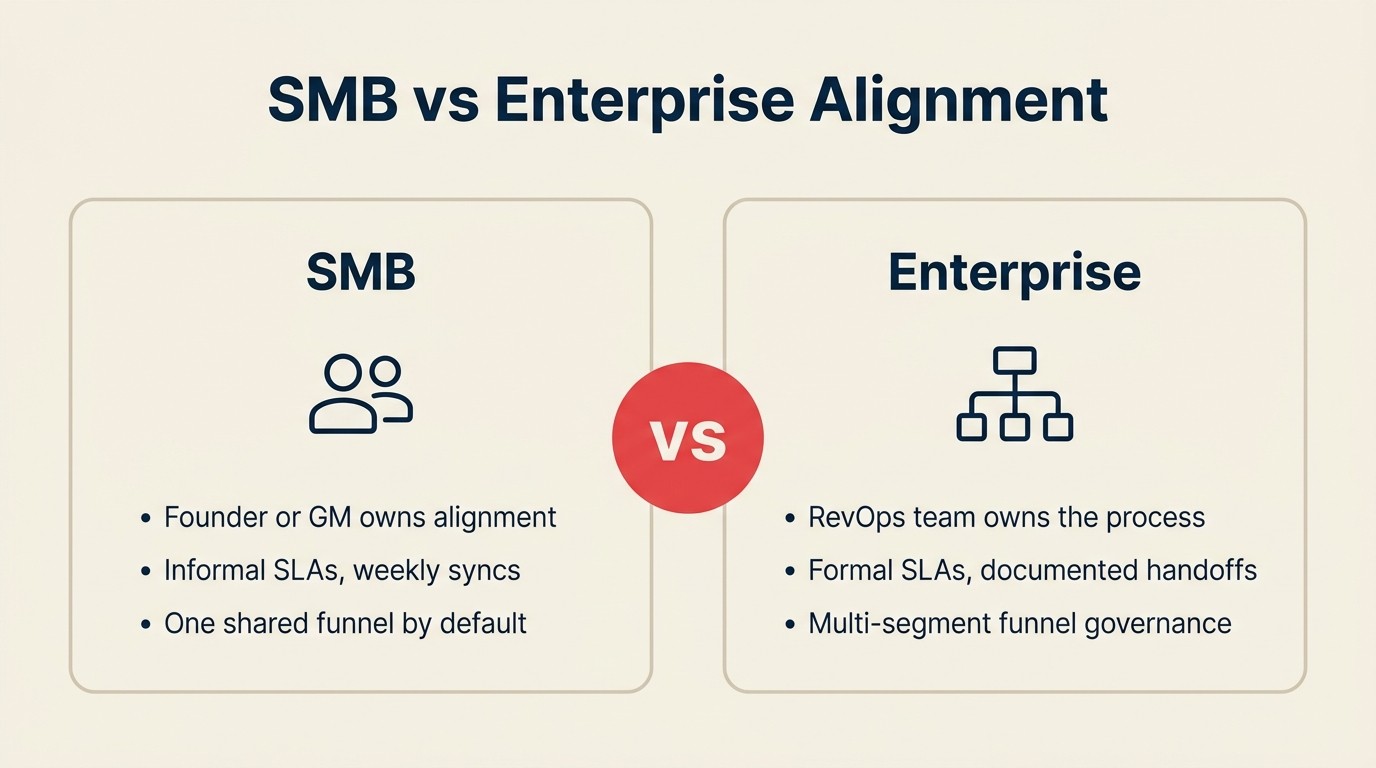
A 15-person B2B startup and a 500-person company with a full RevOps function both have the same problem: marketing and sales don't agree on what a good lead looks like. The pipeline number is off. Reps are complaining about lead quality. Marketing is defending their MQL count. The problems look identical. The fixes look nothing alike.
This article maps the same alignment principles across three operating modes (SMB, mid-market, and enterprise) so you know which levers to pull at your stage. Alignment is necessary everywhere; only the format and infrastructure change. For a common vocabulary across these concepts, see the marketing-sales alignment glossary.
The Shared Core: What Never Changes Regardless of Size
Before getting into the differences, here's what every company (from 8 employees to 8,000) needs to function:
A shared ICP definition. Marketing and sales must agree in writing on what type of company they're targeting. At a startup, this might be a two-sentence answer on a shared Google Doc. At enterprise, it's a scored profile integrated into your MAP. The format scales. The requirement doesn't. See the shared ICP framework for the joint-building process.
Agreed MQL and SQL criteria. What makes a lead ready for sales? The specific criteria will differ by market, but there must be a written definition that both teams negotiated together. Not marketing handing it down, not sales demanding impossible standards. A joint definition with documented reasoning.
Some form of closed-loop feedback. Sales must tell marketing what happened to the leads. Even at a startup, the two co-founders should know which leads turned into deals and which didn't. At scale, this becomes a formal reporting workflow. But the principle is always there: marketing needs to know what worked.
A single source of truth for pipeline data. One system (usually your CRM) holds the authoritative pipeline number. Not a spreadsheet. Not a Slack message. If marketing is reporting pipeline from their MAP and sales is reporting from the CRM, you'll fight every QBR about whose number is right.
Key Facts: Alignment Across Company Sizes
- Companies with tightly aligned sales and marketing teams see 36% higher customer retention and 38% higher sales win rates, according to MarketingProfs research.
- Only 8% of B2B companies report strong alignment between their marketing and sales departments, per Forrester.
- Companies that deploy RevOps see up to 19% faster revenue growth and 15% higher profitability compared to peers, per Boston Consulting Group.
SMB / Early-Stage Alignment (1-50 Employees)
At this stage, alignment is often a single-person problem. The Head of Revenue might own both marketing and sales. Or the founder runs both. Or there are two people, one each, who share a coffee every morning.
Who Owns Alignment
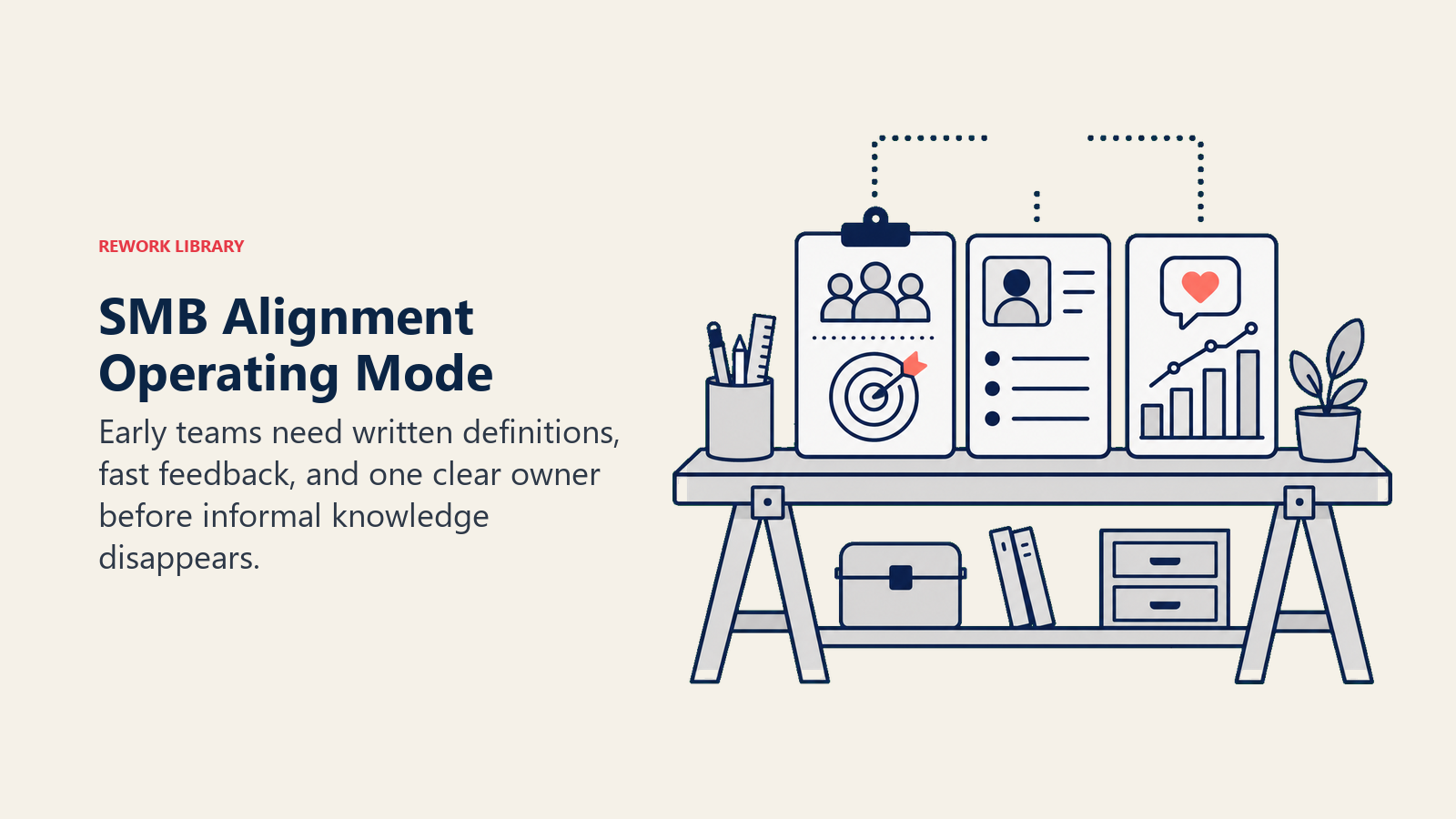
Usually: everyone, which means nobody formally. But someone needs to be the keeper of the ICP definition and the person who notices when leads stop converting. At early stage, this is typically the founder, the Head of Revenue, or whoever owns the CRM.
Assign it explicitly. Even if it's five minutes of weekly review, put it on someone's job.
Informal SLAs: Write Them Down
You don't need a contract. But "we follow up on every demo request within an hour" is an SLA (service-level agreement), even if it's just a Slack message between two people. The risk at early stage isn't that you won't agree. It's that you'll agree verbally and then the context disappears when someone gets busy.
Write the key commitments down. Even a short bullet list in your company wiki is better than shared assumptions.
Tools and Operating Rhythm
One CRM is sufficient. A shared Slack channel functions as the alignment "war room": drop in key leads, flag conversion wins, call out patterns you're seeing. The weekly all-hands is where both functions naturally share status.
This is genuinely lightweight. It works at this stage because the team is small enough that alignment issues surface in real time.
The Real Risk
Alignment at early stage depends almost entirely on one or two people knowing both sides of the equation. When that person leaves, or when you hire a second marketer or second sales rep, the informal system breaks. Nobody documented the ICP. Nobody wrote down the MQL criteria. The new hires guess, and the guesses diverge.
The fix is simple: before you hire your second person on either team, write down the current definitions. A paragraph on each term is enough. You'll need it sooner than you think.
Mid-Market Alignment (50-500 Employees)
This is the most dangerous stage for alignment. You've outgrown the informal system but haven't built a formal one yet.
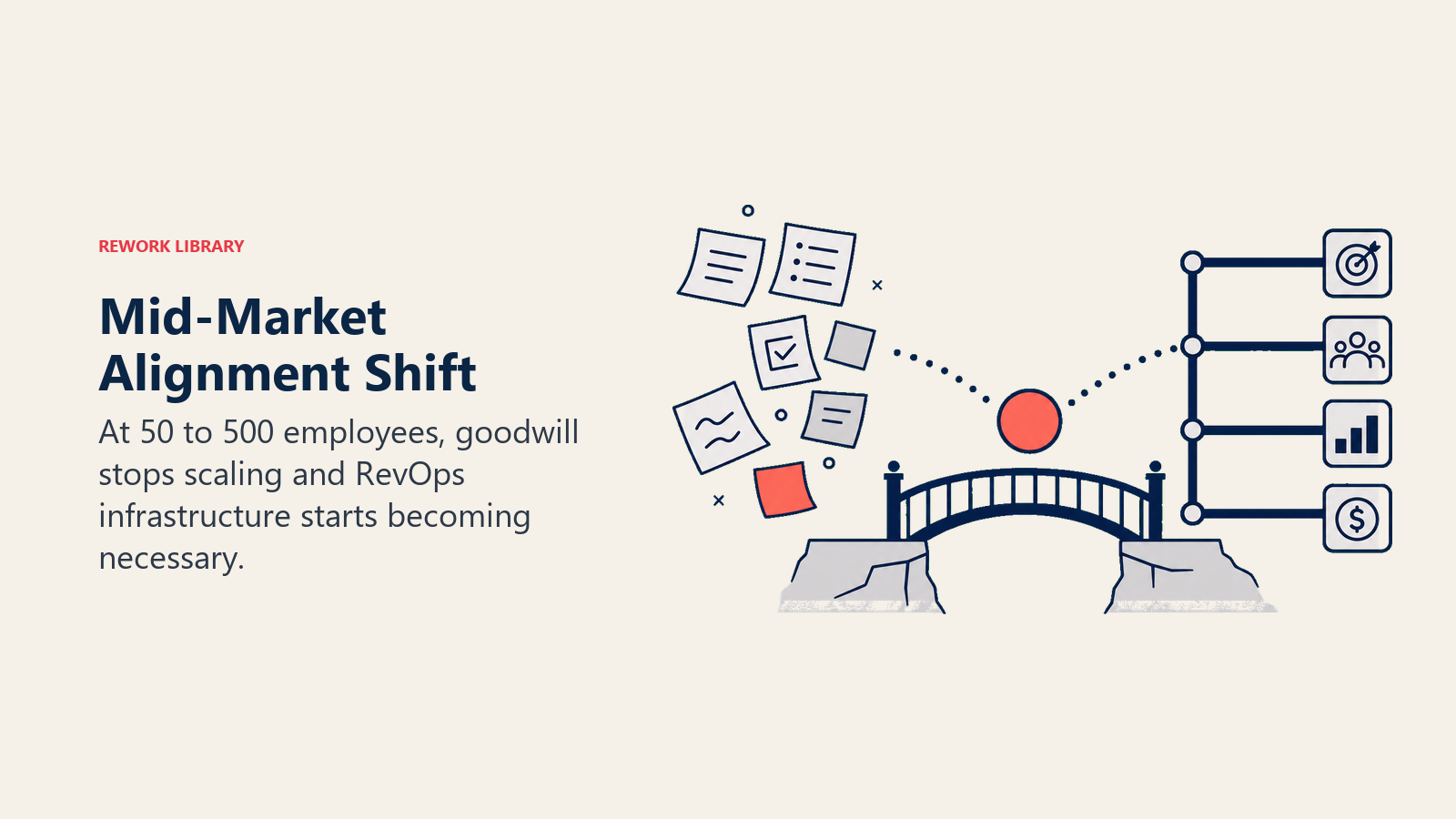
You've hired a dedicated marketer and a sales manager. They don't share a coffee every morning. They have different managers, different OKRs, and different systems. The informal alignment that worked at 20 people is now held together by goodwill.
The Pivot Point: First Marketing Ops or Sales Ops Hire
This hire is the signal that you're serious about building infrastructure. Whether it's a Marketing Ops analyst, a Sales Ops specialist, or your first RevOps role, this person will be the one who finally documents what "qualified" means, who configures the MQL trigger in the MAP, and who builds the dashboard both teams can trust.
Don't wait until this hire arrives to start building. But do recognize that their arrival means: time to formalize everything.
Formalizing the Informal
At mid-market, the priorities are:
- Write the ICP into your CRM and MAP as actual scoring criteria, not just a slide
- Create a written SLA (response time, follow-up attempts, data quality at handoff)
- Build the first version of a joint pipeline review cadence
- Establish lead rejection codes so you're tracking why leads get returned
None of this is glamorous. All of it prevents the misalignment that shows up as "we don't trust each other's data" six months later.
Attribution Conversations Begin Here
At some point between 50 and 200 employees, a board member or executive will ask: "What percentage of our pipeline is marketing-sourced?" If you don't have first-touch attribution set up, you'll wing the answer. And you'll get it wrong.
This is the stage to decide which attribution model you're using and implement it properly, before you need to defend a number in a board meeting.
Cadence
A bi-weekly joint pipeline review with marketing and sales leadership is the right operating rhythm at mid-market. Weekly is too frequent when the funnel is small; monthly misses too many inflection points. The agenda: MQL volume and quality, SAL rate, rejection patterns, current pipeline from marketing-sourced leads.
Enterprise Alignment (500+ Employees)
At enterprise scale, alignment isn't a conversation. It's a function. RevOps exists precisely to make alignment operational across marketing, sales, and customer success without requiring everyone to agree manually every time.
RevOps as Infrastructure
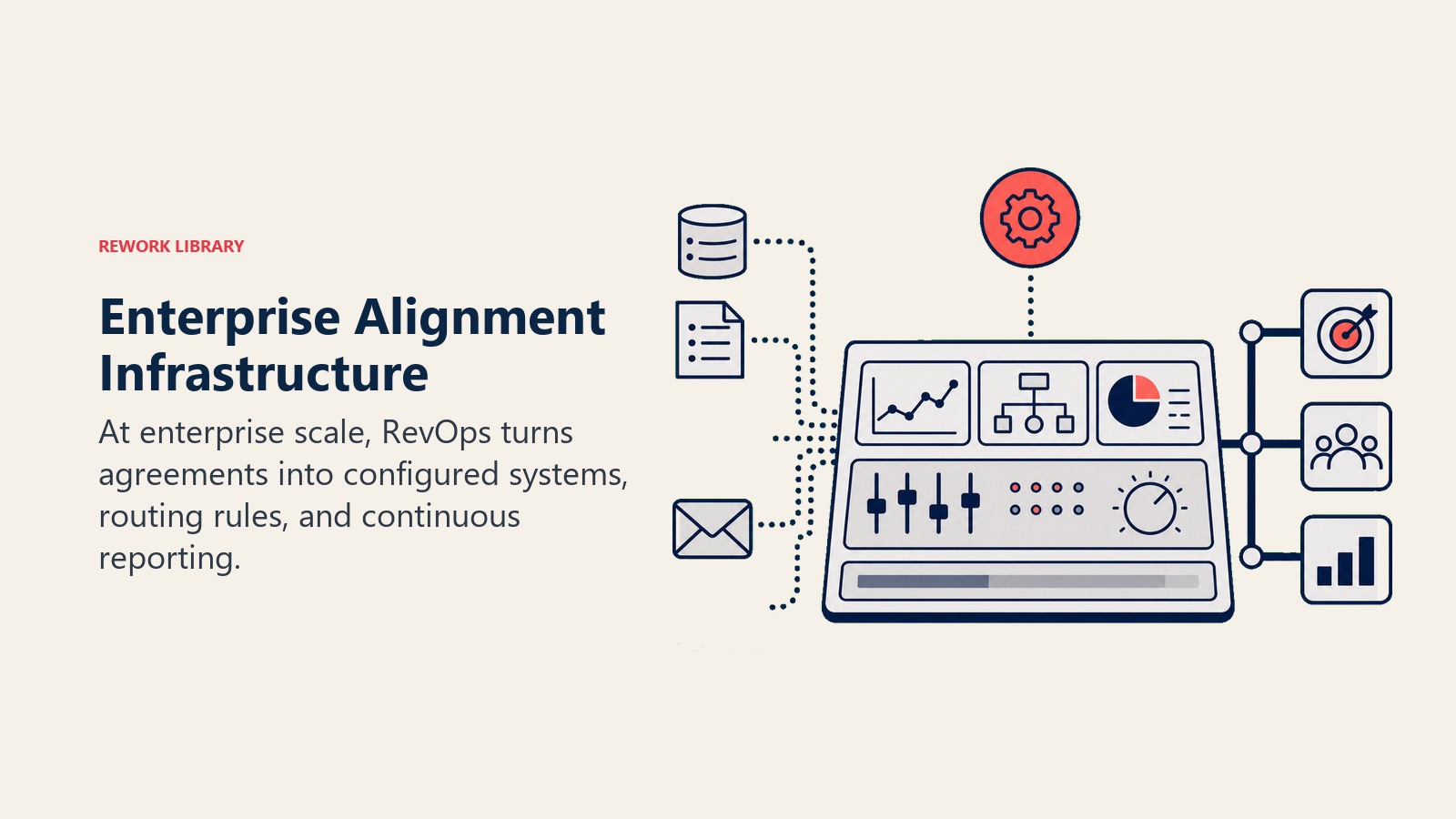
Revenue Operations, commonly called RevOps, is the function that unifies marketing, sales, and customer success under shared systems and processes. The RevOps team owns the systems that make alignment real: CRM configuration, attribution models, scoring logic, routing rules, SLA monitoring, and pipeline reporting. When marketing and sales agree on a new MQL threshold, RevOps implements it everywhere (MAP scoring model, CRM stage criteria, lead routing logic, reporting dashboards) so the agreement has operational weight.
Without RevOps, a CMO and CRO can agree in a meeting and then nothing changes in the systems. With RevOps, agreement → implementation → measurement is a known workflow.
Multiple ICPs, Multiple Handoff Flows
Enterprise companies typically have more than one product line, more than one market segment, or both. A single ICP no longer covers the territory. You need:
- An ICP per product line or segment
- Separate scoring models per ICP
- Different handoff flows for different buyer types (inbound SMB vs. enterprise ABM vs. partner-sourced)
Managing this complexity is why enterprise alignment requires dedicated operations infrastructure. Spreadsheet-based alignment doesn't survive at this scale.
ABM Requires Tighter Coordination
Account-based marketing programs, where marketing and sales target a defined list of named accounts together, require deeper coordination than inbound at every stage. The target account list must be jointly agreed. Marketing content is account-specific. Sales is aware of all marketing touches before they happen. The handoff is often a conversation, not a CRM notification. See the ABM and ABS joint playbook for how to run this coordination in practice.
If your enterprise team is running ABM, alignment isn't optional. It's the whole operating model.
The Three Inflection Points Where Informal Breaks
These are the moments when your current alignment approach will fail, regardless of how well it's been working.
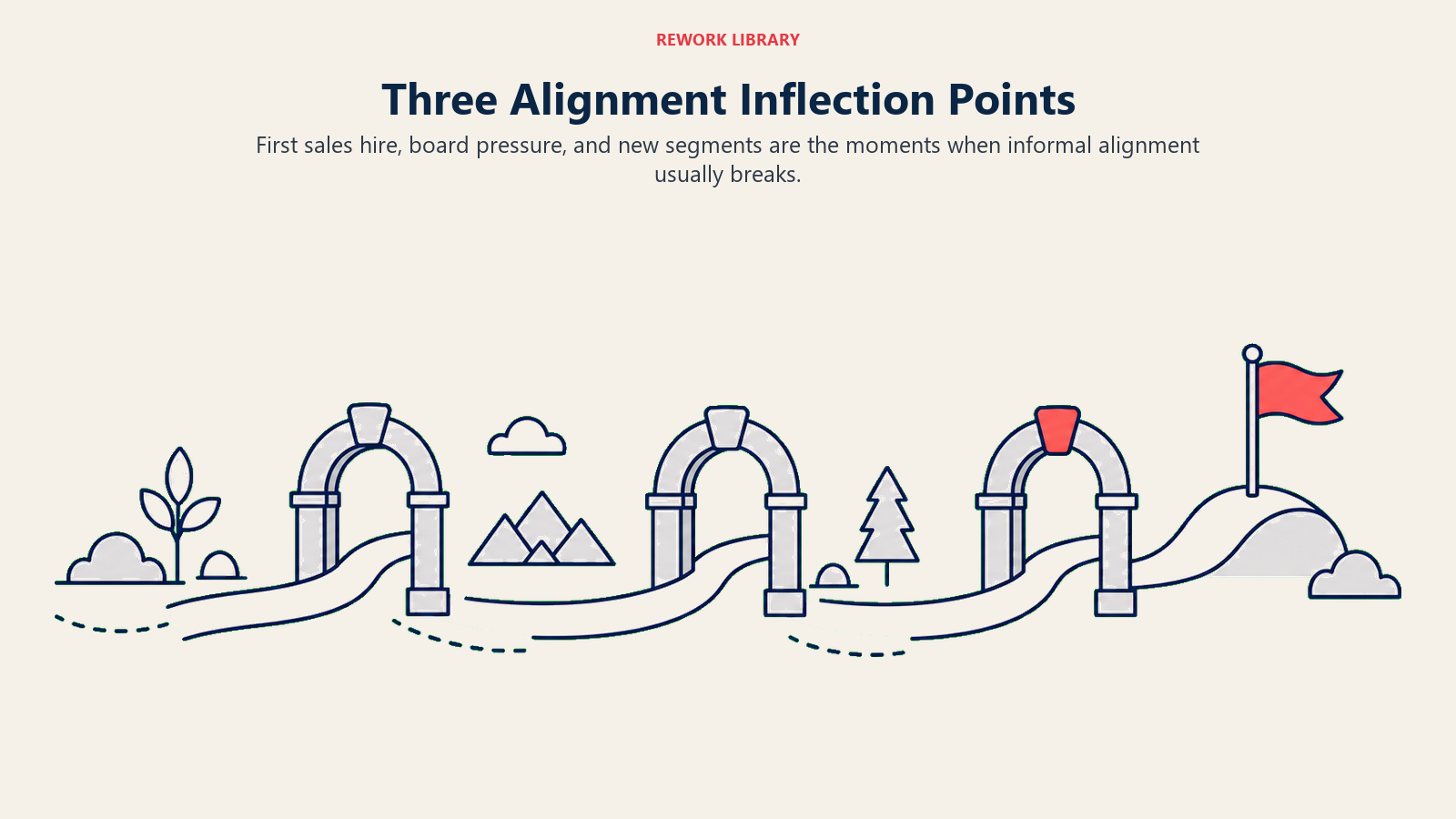
Inflection 1: First Sales Hire When the founder or Head of Revenue hands off sales to a dedicated rep, the informal knowledge transfer breaks. That first rep doesn't have the founder's context on the ICP, on what "good" looks like, or on the judgment calls embedded in the process. This is when you need the first written ICP and MQL definition, before the hire, not after.
Inflection 2: Series A/B Investors will ask about pipeline attribution, marketing-sourced revenue percentage, and MQL-to-close rates. If you can't answer those questions with CRM data, you'll scramble to build the infrastructure retroactively. The time to build closed-loop reporting and consistent stage definitions is three to six months before you expect to have that conversation, not during the fundraise.
Inflection 3: Multi-Product or Multi-Segment When you add a second product line, enter a new market, or decide to move up-market, your existing ICP definition no longer covers everyone you're targeting. Sales starts chasing deals marketing never considered. Marketing targets buyers sales can't close. The one ICP definition you've been using needs to fork, and that requires a joint session to define what changes and what stays the same.
What Scales and What Doesn't
| Alignment Element | Scales (same principle, different format) | Doesn't Scale (specific to stage) |
|---|---|---|
| Shared ICP definition | Yes: format changes, principle is constant | n/a |
| Agreed MQL criteria | Yes: definition stays, system changes | n/a |
| Closed-loop reporting | Yes: manual to automated as stage advances | Founder-level gut feel |
| SLAs | Yes: verbal to written to system-enforced | Informal "we'll call them fast" |
| Attribution model | Yes: first-touch to multi-touch over time | Single spreadsheet report |
| Alignment owner | Yes: individual to team to function | Shared ownership (leads to none) |
| Weekly sync cadence | Partial: frequency and formality scale up | Slack channel as primary channel |
| Tool complexity | No: MAP + CRM stack complexity grows | One-tool-fits-all |
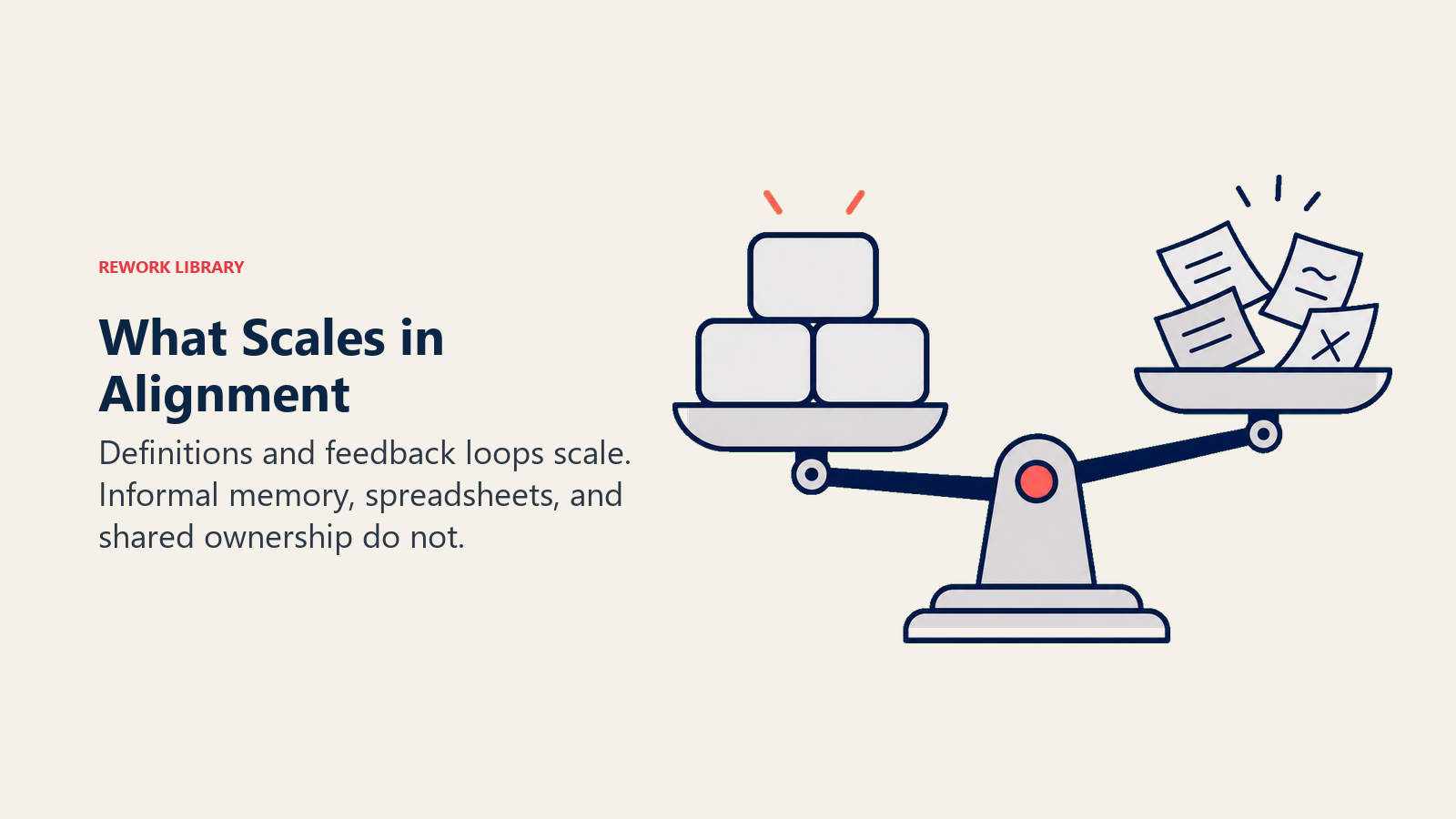
The core principles (shared definitions, agreed criteria, closed-loop feedback, single source of truth) apply everywhere. The format, rigor, and system support around those principles scale with headcount and complexity.
Where to Start at Each Stage
1-50 employees: Write down the ICP and the MQL definition today. Put them in a document both the marketer and the sales person have edited and agreed to. Review them when you make your next hire.
50-200 employees: Build the SLA first. Agree on response time, follow-up attempts, and what data must be passed at handoff. Then implement the attribution model. You'll need it by the time you're 200 people.
200-500 employees: Hire or formalize RevOps. Give them the mandate to own the alignment systems: not just the CRM, but the scoring model, the routing logic, and the pipeline reporting. A fractional RevOps person works if you're not ready for a full-time hire. Understand how leads move through your lifecycle before you automate the handoffs.
500+ employees: Run the alignment audit. Map your current ICP, scoring model, handoff SLAs, and reporting model against what your revenue team actually experiences. The gap between the documented process and the real process is where your alignment failures live.
Transition Planning: Evolving Without Breaking What Works
The most common mistake when formalizing alignment is over-engineering it at once. You've been running on informal agreements and they've mostly worked. Layering in a full RevOps infrastructure, a new MAP, a new attribution model, and a revised SLA all at once will break the parts that worked fine.
Transition in this order: definitions first, then process, then systems. Agree on what a good lead is before you build a scoring model. Document the handoff flow before you automate it. Establish the reporting requirements before you buy new software to produce them.
Alignment is a gradual investment, not a transformation project. The companies that get it right treat it as ongoing operations, not a one-time initiative.
The Alignment Investment Curve: A Stage-by-Stage Benchmark
B2B companies allocate alignment investment very differently depending on their stage. Here are three quotable benchmarks worth anchoring your planning against.
B2B companies with tightly aligned marketing and sales functions generate 208% more revenue from marketing efforts than misaligned peers, according to MarketingProfs research across B2B organizations. That gap does not shrink at smaller company sizes. It compounds.
RevOps-enabled organizations see up to 19% faster revenue growth and 15% higher profitability versus industry peers, per Boston Consulting Group analysis. But RevOps only becomes cost-effective around the 200-employee mark, which is why mid-market is the stage where the build-vs-delay decision on RevOps infrastructure matters most.
Only 8% of B2B companies report strong sales and marketing alignment, per Forrester. That 8% is not distributed evenly across stages: enterprise companies with dedicated RevOps functions account for a disproportionate share. SMBs and early mid-market teams are the ones most likely to be operating on informal agreements that are quietly eroding.
Rework Analysis: Alignment Investment by Company Stage
We mapped the point at which alignment investment stops being optional across company sizes. At 1-50 employees, the cost of misalignment is low (small team, fast feedback loops). At 50-200 employees, informal alignment starts producing measurable drag: MQL rejection rates rise, attribution gaps surface at board reviews, and pipeline inconsistencies become harder to explain. The inflection where a formal RevOps function produces positive ROI sits between 150 and 250 employees for most B2B SaaS companies, earlier if you're running ABM, later if you're fully inbound and self-serve. Before that point, a fractional RevOps resource and written definitions produce 80% of the alignment value at 20% of the cost.
The Alignment Maturity Staircase
The Alignment Maturity Staircase is a framework for diagnosing where your company currently operates and identifying the next step worth taking. It maps alignment infrastructure to company stage across four rungs.
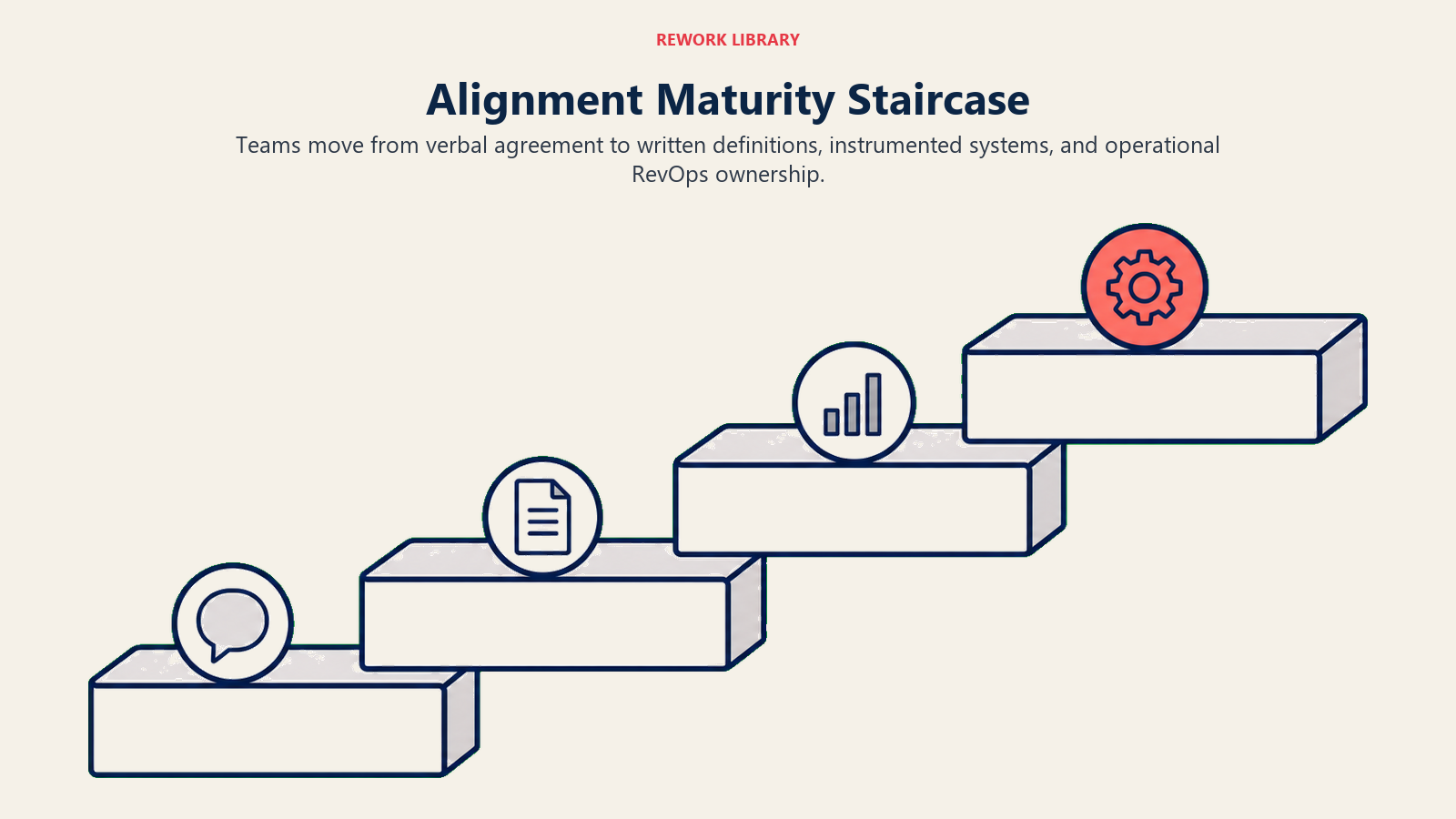
| Rung | Stage | Defining Feature | Next Step |
|---|---|---|---|
| 1: Verbal | 1-20 employees | Alignment lives in two people's shared understanding | Write the ICP and MQL definition before hire #3 on either team |
| 2: Written | 20-100 employees | Definitions exist in documents but aren't system-enforced | Wire criteria into MAP and CRM; build first SLA |
| 3: Instrumented | 100-300 employees | Systems enforce the definitions; reporting exists but is manual | Automate closed-loop feedback; implement attribution model |
| 4: Operational | 300+ employees | RevOps owns the full alignment stack; reporting is continuous | Run quarterly ICP reviews; build ABM coordination layer |
Most misalignment problems are Rung 1 or 2 problems wearing Rung 3 or 4 clothing. Before investing in a new tool or attribution platform, confirm which rung you're actually on and close the gap to the next one.
Frequently Asked Questions about Marketing-Sales Alignment for SMB vs Enterprise
When does informal alignment break down in a growing company?
Informal alignment typically breaks at three points: the first dedicated sales hire (context that lived in the founder's head doesn't transfer), the Series A or B board review (investors ask attribution questions you can't answer), and the addition of a second product line or market (one ICP definition no longer covers both). Any of these events without written definitions and formal process in place usually produces a pipeline misalignment crisis within 90 days.
When do I need a CRO and what does that signal for alignment?
A Chief Revenue Officer becomes necessary when marketing, sales, and customer success are operating from separate P&Ls or separate pipeline definitions and the CEO can no longer broker alignment between them directly. That typically happens between 150 and 400 employees in B2B SaaS. The CRO's first operational task is almost always a definition reset: ICP, MQL criteria, funnel stage definitions, and attribution model.
What alignment investment is appropriate for a 30-person startup?
At 30 people, the entire alignment infrastructure fits on one shared document: a two-paragraph ICP definition, a written MQL definition with three criteria, a bullet-point SLA (response time, follow-up attempts), and a single weekly pipeline review. Total investment: one 90-minute joint session to build it, 30 minutes per week to maintain it. The cost of not doing this is typically two to four rejections per month that silently erode trust between the marketer and the first sales rep.
How do mid-market companies typically handle attribution before RevOps?
At 50-200 employees, most mid-market companies default to first-touch attribution in their MAP because it's the default setting, not because it's the right model. First-touch systematically over-credits top-of-funnel content and makes it impossible to defend marketing's contribution to pipeline beyond lead volume. The practical fix: implement a simple two-touch model (first touch + opportunity-creation touch) in the MAP before you reach 150 employees. It's technically straightforward and produces attribution data you can defend in board meetings.
What does enterprise alignment look like when it's actually working?
In a functioning enterprise alignment model, the CMO and CRO can independently pull the same pipeline number from the same CRM and agree on what it means. MQL definitions, scoring thresholds, and routing rules are documented in RevOps-owned specifications that match what's actually configured in the MAP. Rejection reason codes are tracked and reviewed monthly. The ICP is versioned and reviewed quarterly. Joint pipeline reviews happen weekly at director level and monthly at executive level. The most reliable signal that it's working: the MQL-to-SAL rate is above 70% and has been stable for at least two quarters.
Does company size determine when to switch from round-robin lead routing to territory-based routing?
Territory-based routing becomes worth the overhead somewhere between 15 and 30 sales reps, when you have enough rep-to-segment density to route by territory without leaving any segment chronically under-resourced. Below that threshold, round-robin is usually faster and produces more consistent follow-up times. The routing decision also depends on whether you're running ABM: ABM requires account-owner routing regardless of team size, because a cold rep calling a warm account can undo weeks of marketing coordination.
How should a first-time RevOps hire prioritize their first 90 days?
The first RevOps hire's most valuable first-90-days output is a documentation sprint: ICP definition, MQL criteria, CRM stage definitions, lead routing rules, and the current attribution model all written down and aligned with how the systems are actually configured. Most companies discover a 30-50% gap between documented process and actual system behavior on this audit. Closing that gap before building anything new is where the highest alignment ROI sits.
Learn More

Principal Solution Architect
On this page
- The Shared Core: What Never Changes Regardless of Size
- SMB / Early-Stage Alignment (1-50 Employees)
- Who Owns Alignment
- Informal SLAs: Write Them Down
- Tools and Operating Rhythm
- The Real Risk
- Mid-Market Alignment (50-500 Employees)
- The Pivot Point: First Marketing Ops or Sales Ops Hire
- Formalizing the Informal
- Attribution Conversations Begin Here
- Cadence
- Enterprise Alignment (500+ Employees)
- RevOps as Infrastructure
- Multiple ICPs, Multiple Handoff Flows
- ABM Requires Tighter Coordination
- The Three Inflection Points Where Informal Breaks
- What Scales and What Doesn't
- Where to Start at Each Stage
- Transition Planning: Evolving Without Breaking What Works
- The Alignment Investment Curve: A Stage-by-Stage Benchmark
- The Alignment Maturity Staircase
- Learn More