Maksud "Berjaya Di-onboard" Sebenarnya: Mentakrifkan Kriteria yang Dipersetujui oleh Kedua-dua Pasukan

Turn this article into takeaways for your work.


Each assistant summarizes the article only for you and suggests best practices for your work.
Tanya sepuluh orang di sebuah syarikat SaaS apakah maksud "berjaya di-onboard" dan anda akan mendapat sembilan jawapan berbeza, dan seorang yang tidak pernah memikirkannya sebelum ini.
Pasukan jualan fikir pelanggan telah di-onboard apabila mereka sudah siap beroperasi. Pasukan pelaksanaan fikir mereka di-onboard apabila integrasi telah diuji. CSM fikir di-onboard bermakna pelanggan secara aktif menggunakan produk untuk matlamat yang dinyatakan. Pengarah kejayaan pelanggan fikir ia bermakna pelanggan mengesahkan kesediaan untuk beralih ke fasa kejayaan terurus. Setiap satunya masuk akal. Tiada satupun yang sama.
Jurang takrifan ini tidak kekal akademik. Ia memacu churn.
Apabila Jualan secara mental menutup buku pada akaun pada log masuk pertama, mereka berhenti memperhatikan kualiti onboarding. Apabila CS tidak mempunyai titik akhir yang ditakrifkan untuk onboarding, skor kesihatan pada Hari 30 mengukur keadaan yang tidak lengkap tanpa mengetahuinya. Apabila panggilan permulaan berakhir tanpa pencapaian kejayaan onboarding bertulis, kedua-dua CSM dan pelanggan menguruskan ke arah konsep "selesai" yang samar-samar yang tidak dapat diukur oleh mana-mana pihak. Kos jurang itu kepada perniagaan muncul lama sebelum sesiapa menamakannya.
Onboarding yang tidak diukur secara senyap menghasilkan churn. Syarikat tidak menyedarinya sehingga masa pembaharuan, apabila pelanggan yang "sudah siap" selama 11 bulan masih belum mencapai hasil yang mereka beli. Dan CSM sedang menjelaskan perkara itu kepada panggilan pembaharuan. Matematik NRR di sini adalah langsung: akaun yang terlepas pencapaian onboarding muncul dalam angka churn dan penguncupan yang menarik NRR di bawah 100%. Bukan kerana produk gagal, tetapi kerana takrifan "selesai" tidak pernah ditulis. Kajian McKinsey tentang NRR dalam teknologi B2B menunjukkan bahawa syarikat dalam kuartil NRR teratas berkongsi satu ciri: mereka mentakrifkan dan menjejak kejayaan onboarding sebagai pencapaian yang tegas, bukan keadaan yang diandaikan.
Mengapa "Sudah Siap Beroperasi" Bukan Ukuran yang Betul
Siap beroperasi bermakna persediaan teknikal selesai: kelayakan dicipta, integrasi disambungkan, konfigurasi asas dilakukan, pengguna diberi peruntukan. Produk boleh diakses. Itulah siap beroperasi.
Berjaya di-onboard bermakna pelanggan telah mencapai hasil pertama mereka dengan produk. Perkara yang mereka beli untuknya (kes penggunaan yang mereka huraikan semasa penemuan, masalah yang mereka bayar untuk diselesaikan) sedang berjalan. Mereka bukan sahaja ada dalam platform; mereka mendapat nilai daripadanya.
Jurang antara dua keadaan ini adalah di mana kebanyakan churn bermula. Pelanggan yang "sudah siap" tetapi belum mencapai hasil pertama mereka adalah pelanggan yang:
- Mempunyai sebab untuk mengekalkan kontrak (kos yang sudah dikeluarkan, pelaburan IT, komitmen politik), tetapi bukan sebab untuk memperbaharuinya
- Menjawab tinjauan NPS dengan 6 atau 7 (tidak aktif tidak berpuas hati, tetapi bukan penyokong)
- Tidak akan menjadi champion produk secara dalaman atau berkembang, kerana mereka belum dapat menjelaskan apa yang ia lakukan untuk mereka
- Terdedah kepada perbualan pesaing pada 8 bulan dengan mesej "kami boleh bawa anda mencapai X sekarang"
"Sudah siap beroperasi" adalah pencapaian. "Berjaya di-onboard" adalah takrifan kesediaan. Pelanggan boleh beroperasi selama 60 hari dan masih belum berjaya di-onboard. Itu bukan kegagalan produk. Ia adalah kegagalan proses, dan ia bermula dengan ketiadaan takrifan bertulis.
Fakta Utama: Takrifan Onboarding dan Churn
- Pelanggan yang belum mencapai pencapaian kejayaan pertama mereka dalam 90 hari adalah 3-4 kali lebih mungkin untuk churn semasa pembaharuan berbanding mereka yang telah mencapainya, mengikut data penanda aras Keadaan Kejayaan Pelanggan Gainsight.
- Churn tahun pertama turun 22% di syarikat yang melaksanakan pencapaian kejayaan onboarding yang ditakrifkan bersama dan menjejak ia sebagai medan dalam rekod pelanggan, mengikut penanda aras kualiti pelaksanaan Gainsight.
- Hanya 34% syarikat SaaS B2B menyertakan "pengesahan penaja" sebagai kriteria dalam takrifan onboarding mereka, namun data Totango menunjukkan pengekalan dua tahun 31% lebih tinggi untuk onboarding yang disahkan penaja.
Empat Kriteria yang Mentakrifkan "Berjaya Di-onboard"
Takrifan onboarding yang lengkap mempunyai empat komponen. Semua empat mesti benar untuk akaun ditanda "Berjaya Di-onboard: Ya" dalam rekod pelanggan.
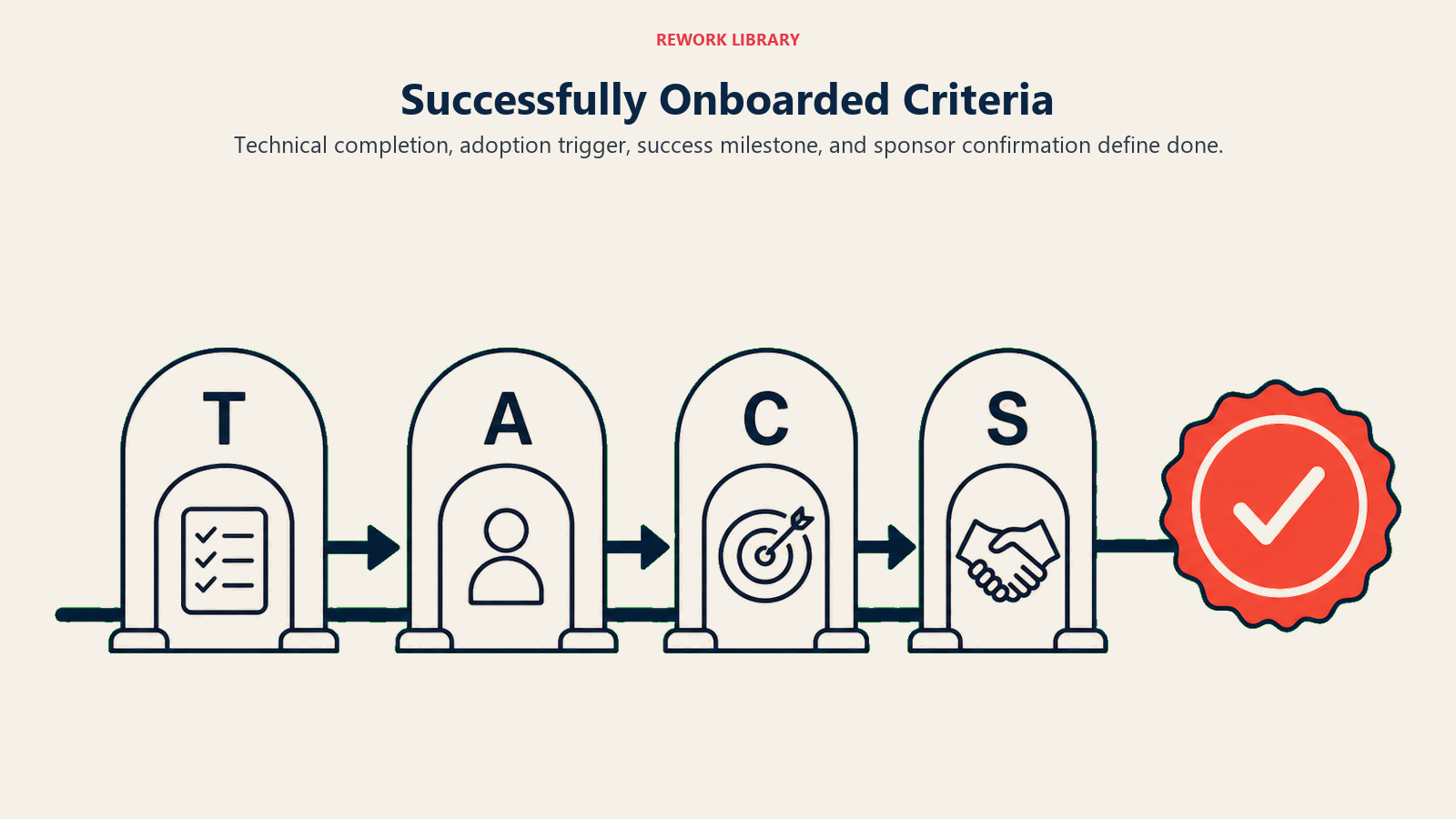
Rangka Kerja TACS untuk Penyempurnaan Onboarding
Empat kriteria membentuk urutan bernama yang boleh dioperasikan oleh kebanyakan pasukan paska jualan: Penyempurnaan Teknikal → Pencetus Pengambilan → Pencapaian Kejayaan → Pengesahan Penaja (TACS). Setiap kriteria menjadi pintu kepada yang seterusnya. Anda tidak mengukur pengambilan sebelum penyempurnaan teknikal disahkan, dan anda tidak meminta pengesahan penaja sebelum pencapaian kejayaan dicapai. Pasukan yang melangkau urutan menghasilkan skor kesihatan yang kelihatan berbeza bergantung pada kriteria mana yang telah dilepasi setiap akaun, menjadikan perbandingan merentas akaun tidak bermakna.
Rangka Kerja TACS menjawab pertikaian takrifan yang paling biasa dalam pasukan paska jualan: "Adakah 'siap beroperasi' sama dengan 'di-onboard'?" Tidak. Siap beroperasi sepadan dengan Penyempurnaan Teknikal (T). Di-onboard memerlukan keempat-empatnya.
Analisis Rework: Intervensi berimpak tertinggi dalam Rangka Kerja TACS ialah Kriteria 4 (Pengesahan Penaja). Hanya 34% syarikat SaaS B2B menyertakan pengesahan penaja sebagai sebahagian daripada takrifan onboarding mereka, namun data penanda aras Totango menunjukkan pengekalan dua tahun 31% lebih tinggi untuk akaun dengan onboarding yang disahkan penaja berbanding akaun di mana CSM mengesahkan penyempurnaan sendiri. Pengesahan itu mengambil masa 5 minit untuk diminta. Kesan pengekalan itu berganda selama 24 bulan.
Penanda aras boleh dipetik: Pelanggan yang belum mencapai pencapaian kejayaan pertama mereka yang ditakrifkan dalam 90 hari adalah 3-4 kali lebih mungkin untuk churn semasa pembaharuan berbanding mereka yang telah mencapainya, mengikut data penanda aras Keadaan Kejayaan Pelanggan Gainsight. Pencapaian kejayaan pertama ialah penunjuk utama pembaharuan yang paling meramal, lebih meramal daripada NPS, skor kesihatan, atau kekerapan log masuk dalam tempoh yang sama.
Penanda aras boleh dipetik: 58% syarikat SaaS sama ada tidak mempunyai takrifan "berjaya di-onboard" yang terdokumen atau mempunyai takrifan berasingan yang digunakan oleh Jualan dan CS, mengikut TOPO (kini Gartner). Di syarikat dengan jurang takrifan ini, pencapaian "berjaya di-onboard" ialah satu perasaan yang dipegang oleh CSM individu: bukan medan dalam rekod pelanggan, bukan pencetus dalam model kesihatan, dan bukan sesuatu yang dipersetujui oleh Jualan dan CS.
Penanda aras boleh dipetik: Churn tahun pertama turun 22% di syarikat yang melaksanakan pencapaian kejayaan onboarding yang ditakrifkan bersama dan menjejaknya sebagai medan binari dalam rekod pelanggan, mengikut penanda aras kualiti pelaksanaan Gainsight. Mekanismenya mudah: pencapaian yang ditakrifkan mewujudkan titik akauntabiliti bersama yang boleh dilihat, diukur, dan ditindak oleh kedua-dua pasukan sebelum pelanggan sampai ke tetingkap pembaharuan dalam keadaan merosot.
Kriteria 1: Penyempurnaan Teknikal
Integrasi atau konfigurasi teras sudah siap beroperasi dan diuji. Bukan "dalam proses" atau "diskop." Siap beroperasi, disahkan, dan berfungsi dalam keadaan pengeluaran. Untuk beberapa produk, ini adalah keseluruhan pelaksanaan. Untuk yang lain (integrasi API kompleks, aliran kerja pelbagai sistem, migrasi data), ini adalah fasa terpanjang. Penyempurnaan teknikal adalah perlu tetapi tidak mencukupi.
Rupanya dalam rekod: "Integrasi: Salesforce CRM disambungkan melalui REST API. Disahkan: 15/3/2026. Kadar ralat: 0 dalam 72 jam pertama. Pengesahan CSE: Sam Park."
Kriteria 2: Pencetus Pengambilan
Sekurang-kurangnya N pengguna telah log masuk dan menyelesaikan tindakan utama yang ditakrifkan dalam X hari dari siap beroperasi. Nombor dan tindakan spesifik bergantung pada jenis produk dan saiz perjanjian, tetapi kedua-duanya mesti ditakrifkan sebelum permulaan, bukan dinilai selepas fakta.
Pencetus pengambilan adalah bukti tingkah laku bahawa produk telah diterima oleh pengguna akhir, bukan hanya dikonfigurasi oleh pentadbir. Ia adalah isyarat bahawa pelaksanaan berjaya pada peringkat manusia, bukan hanya peringkat teknikal. Tanpanya, "berjaya di-onboard" boleh dipenuhi dengan produk yang hanya satu orang pernah sentuh.
Rupanya dalam rekod: "Pencetus pengambilan: 8 daripada 10 pengguna berlesen telah menyelesaikan entri pipeline pertama mereka dalam 30 hari dari siap beroperasi. Status: Dipenuhi pada Hari 28."
Kriteria 3: Pencapaian Kejayaan
Pelanggan telah menyelesaikan atau secara aktif menjejaki ke arah hasil pertama yang mereka beli. Ini adalah kriteria "mengapa mereka menandatangani". Ia dipetakan langsung kepada kriteria kejayaan yang didokumenkan semasa penemuan. Jika pelanggan membeli untuk mengautomasikan pelaporan pipeline mereka, pencapaian kejayaan bermakna laporan pipeline berjalan secara automatik. Jika mereka membeli untuk menggantikan proses hamparan manual, pencapaian kejayaan bermakna hamparan telah ditamatkan penggunaannya.
Kriteria ini memerlukan penilaian yang paling banyak dan komunikasi paling jujur dengan pelanggan. Ia juga mempunyai hubungan paling langsung dengan pembaharuan: pelanggan yang telah mencapai pencapaian kejayaan pada 90 hari memperbaharui pada kadar yang jauh lebih tinggi berbanding yang tidak. Artikel Wikipedia tentang user onboarding menyediakan bingkai yang berguna: perbezaan antara "disediakan secara teknikal" dengan "digunakan secara berkesan" dipetakan terus kepada sebab tarikh siap beroperasi sahaja tidak dapat mentakrifkan penyempurnaan. Kriteria penyempurnaan onboarding yang digunakan oleh pasukan paska jualan menyediakan penanda aras luaran yang berguna. Bandingkan pencapaian kejayaan pasukan anda dengan apa yang dianggap sebagai garisan penamat oleh pengamal paska jualan yang berdedikasi.
Rupanya dalam rekod: "Pencapaian kejayaan: Laporan pipeline automatik pertama dihantar kepada VP Jualan pada 1/4/2026. Pengesahan pelanggan: e-mel daripada Jordan Chen, VP Jualan, 2/4/2026."
Kriteria 4: Pengesahan Penaja
Penaja eksekutif atau champion telah mengakui kesediaan untuk beralih ke fasa seterusnya, secara bertulis (e-mel atau Slack) atau dalam panggilan yang direkodkan. Bukan diandaikan. Bukan diimplikasikan oleh ketiadaan aduan. Disahkan.
Pengesahan penaja adalah kriteria yang paling kerap dilangkau. Hanya 34% syarikat menyertakannya dalam takrifan onboarding mereka. Tetapi ia menutup gelung yang ketara: ia adalah saat akaun secara rasmi beralih dari "mod pelaksanaan" ke "mod kejayaan terurus," dan ia mewujudkan rekod bertulis yang melindungi CS jika akaun kemudiannya mendakwa mereka tidak pernah di-onboard dengan betul.
Rupanya dalam rekod: "Pengesahan penaja: Jordan Chen, VP Jualan, mengesahkan kesediaan melalui e-mel pada 3/4/2026. Petikan: 'Pasukan sudah berjalan. Bersedia untuk beralih ke fasa seterusnya.'"
Cara Menulis Takrifan Pasukan Anda
Empat kriteria di atas adalah kerangka. Takrifan pasukan anda mengisi pembolehubah. Dua versi, bersebelahan:

Contoh SMB (transaksional, 10 tempat, produk standard):
| Kriteria | Takrifan |
|---|---|
| Penyempurnaan Teknikal | Integrasi CRM teras disambungkan. Modul kenalan, perjanjian, dan pipeline asas dikonfigurasi. Disahkan oleh CSM dalam 14 hari dari penutupan. |
| Pencetus Pengambilan | 7 daripada 10 pengguna berlesen log masuk dalam 21 hari. 5 telah mencipta sekurang-kurangnya satu rekod perjanjian. |
| Pencapaian Kejayaan | Laporan pipeline pertama pelanggan dihantar melalui digest mingguan automatik. Laporan diakses oleh pemilik sekurang-kurangnya sekali. |
| Pengesahan Penaja | Pemilik atau pengasas telah membalas mesej CSM "bersedia untuk beroperasi?" dengan pengesahan. |
| Sasaran Jadual | Semua empat kriteria dipenuhi dalam 30 hari dari penutupan. |
Contoh Mid-Market (pelbagai pasukan, 50 tempat, integrasi tersuai):
| Kriteria | Takrifan |
|---|---|
| Penyempurnaan Teknikal | Integrasi ERP utama beroperasi dan diuji. Semua medan tersuai dipetakan mengikut dokumen keperluan. Persetujuan CSE diperoleh. |
| Pencetus Pengambilan | 35 daripada 50 pengguna berlesen log masuk dalam 45 hari. Sekurang-kurangnya 15 telah menyelesaikan aliran kerja yang ditetapkan (berbeza mengikut pasukan: pasukan CRM = entri perjanjian, pasukan ops = pelaporan, sokongan = penciptaan tiket). |
| Pencapaian Kejayaan | Ulasan pipeline silang pasukan pertama diadakan menggunakan platform. Champion (VP RevOps) mengesahkan data dipercayai dan menggantikan pelaporan sebelumnya. |
| Pengesahan Penaja | Penaja eksekutif (COO atau VP) telah menerima dan mengakui dokumen ringkasan penyempurnaan onboarding. Pengesahan direkodkan dalam rekod pelanggan. |
| Sasaran Jadual | Semua empat kriteria dipenuhi dalam 60 hari dari penutupan. Lanjutan 90 hari tersedia jika kerumitan integrasi melambatkan penyempurnaan teknikal. |
Jalankan latihan ini dengan ketua CS anda dan AE yang mewakili. Perbualan itu sendiri adalah nilainya. Di mana mereka tidak bersetuju dengan takrifan adalah tepat di mana jurang onboarding sedang terbentuk pada masa ini. Kad pemarkahan serah terima ialah pendamping semula jadi di sini. Ia mengukur sama ada maklumat perjanjian yang diperlukan untuk menetapkan kriteria ini sampai dengan lengkap pada Closed-Won.
Di Mana "Berjaya Di-onboard" Berada dalam Rekod Pelanggan
Pencapaian ini adalah medan, bukan perasaan. Ia milik dalam rekod pelanggan sumber kebenaran tunggal sebagai boolean dengan tarikh: Berjaya Di-onboard: Ya / Tidak | Tarikh: 3/4/2026.
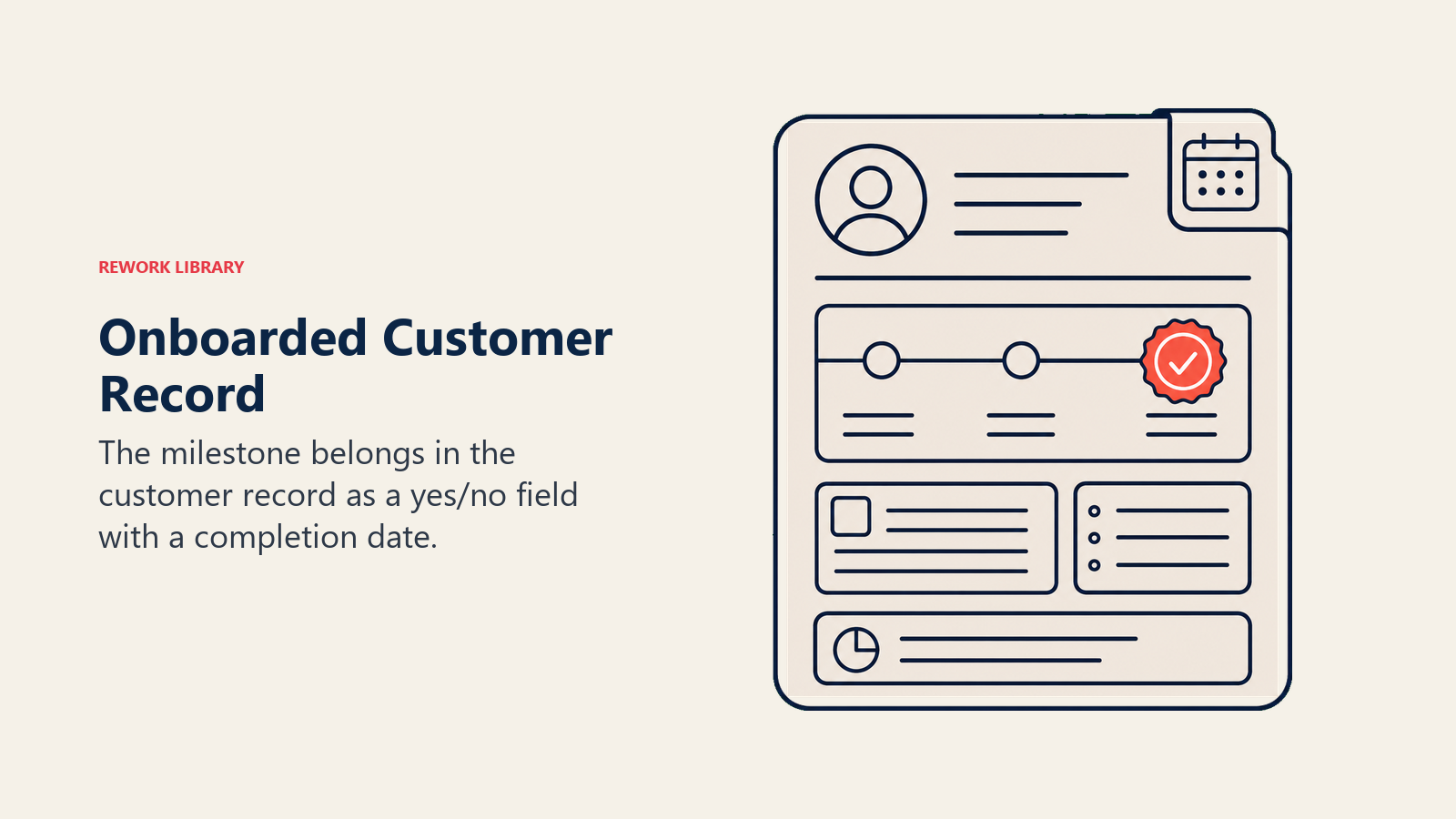
Siapa yang mengemas kininya. CSM. Bukan AE. Bukan pasukan pelaksanaan. CSM yang mempunyai keterlihatan ke semua empat kriteria dan yang menerima pengesahan penaja.
Apa yang mencetuskannya. Semua empat kriteria dipenuhi. Bukan tiga. Bukan "hampir selesai." Jika penyempurnaan teknikal ditanda tetapi pengambilan pada 40%, medan kekal palsu.
Apa yang berlaku apabila ia bertukar ke benar. Tiga perkara sepatutnya tercetus secara automatik: (1) akaun beralih dari barisan onboarding ke barisan kejayaan terurus; (2) model skor kesihatan beralih dari model kesihatan onboarding (yang memberi berat kepada penyempurnaan teknikal) ke model kesihatan berterusan (yang memberi berat kepada penggunaan, penglibatan, dan sentimen); (3) AE dan pengurus CS dimaklumkan bahawa akaun sedia untuk perbualan pengembangan.
Apa yang berlaku apabila ia tidak bertukar dalam sasaran jadual. Akaun memasuki laluan eskalasi. CSM tanda kepada pengurus CS pada Hari 30 melepasi sasaran. Pengurus CS menyertai panggilan pelanggan seterusnya. Eskalasi berterusan sehingga sama ada pencapaian dipenuhi atau akaun diklasifikasikan semula secara formal sebagai berisiko.
Cara Ia Berhubung dengan Pemarkahan Kesihatan
"Berjaya Di-onboard: Ya/Tidak" adalah input binari paling ramalan tunggal dalam skor kesihatan awal. Inilah sebabnya.
Skor kesihatan pada Hari 30 tanpa pencapaian yang di-onboard ditakrifkan sedang mengukur akaun yang mungkin berada dalam keadaan yang sangat berbeza: sesetengahnya sudah beroperasi sepenuhnya dan mengambil dengan baik, sesetengahnya masih dalam persediaan teknikal, sesetengahnya menunggu IT pelanggan untuk menyelesaikan semakan. Purata ini bersama menghasilkan skor kesihatan yang hampir tidak memberitahu anda apa-apa tentang risiko churn sebenar.
Setelah pencapaian yang di-onboard ditakrifkan dan dijejak, logik pemarkahan kesihatan boleh bercabang:
- Akaun pra-pencapaian: Model kesihatan menekankan kemajuan ke arah empat kriteria: adakah penyempurnaan teknikal mengikut jadual, adakah pengambilan meningkat, adakah penaja terlibat.
- Akaun paska pencapaian: Model kesihatan beralih ke isyarat penglibatan berterusan: kekerapan penggunaan, kedalaman ciri, trend NPS, jumlah sokongan.
Tanpa pencapaian, anda mempunyai satu model kesihatan yang cuba melayani dua keadaan akaun yang sangat berbeza. Hasilnya adalah skor yang mengelirukan: akaun pra-pencapaian yang kelihatan sihat kerana mereka terlibat dengan pasukan pelaksanaan, dan akaun paska pencapaian yang kelihatan berisiko kerana penglibatan pasukan pelaksanaan berkurangan (seperti yang sepatutnya, kerana onboarding selesai).
Lihat pemarkahan kesihatan pelanggan dengan input konteks jualan untuk cara menyambungkan pencapaian yang di-onboard ke dalam model kesihatan yang membezakan keadaan pra dan paska.
Implikasi Serah Terima Jualan-CS
AE sepatutnya mengetahui kriteria kejayaan onboarding sebelum mereka menutup perjanjian, bukan kerana mereka memiliki onboarding, tetapi kerana kriteria kejayaan dari penemuan adalah kriteria yang sama yang digunakan pasukan CS untuk mentakrifkan pencapaian kejayaan.
Apabila AE melalui penemuan dan mengetahui bahawa matlamat utama pelanggan adalah menggantikan pelaporan pipeline manual mereka, kes penggunaan tersebut menjadi pencapaian kejayaan. AE yang menulis "pelanggan mahu pelaporan yang lebih baik" dalam nota penemuan memberikan input yang samar-samar. AE yang menulis "kriteria kejayaan utama pelanggan: laporan pipeline automatik menggantikan hamparan manual Jumaat pagi, dipercayai oleh VP Jualan untuk persediaan lembaga" memberikan pencapaian kejayaan yang boleh dioperasikan oleh CS dari hari pertama.
Nota penemuan adalah input onboarding. Apabila AE memahami ini, mereka bertanya soalan penemuan yang lebih baik dan mendokumenkan jawapan dengan lebih spesifik. Apabila mereka tidak faham, CS menghabiskan dua minggu pertama onboarding melakukan semula penemuan yang AE telah lakukan.
Ini adalah salah satu hujah pengaruh tertinggi untuk melibatkan CS dalam semakan konteks perjanjian, bukan untuk melambatkan perjanjian, tetapi untuk memastikan output penemuan cukup lengkap untuk memacu onboarding. Ia juga di mana serah terima kitaran hayat AE-ke-CSM mempunyai kesan langsung. Serah terima yang merakam nota penemuan dalam kespesifikan asalnya menjimatkan CSM dua minggu pertama kerja semula. Rangka kerja kitaran hayat paska jualan Forrester menganggap fasa permulaan (segala-galanya dari Closed-Won hingga nilai pertama) sebagai tetingkap berimpak tertinggi untuk menetapkan jangkaan pelanggan dengan betul, kerana pembetulan menjadi jauh lebih mahal selepas Hari 30.
Mengoperasikan Pencapaian
Tiga perkara yang perlu dilakukan sebelum melancarkan ini:
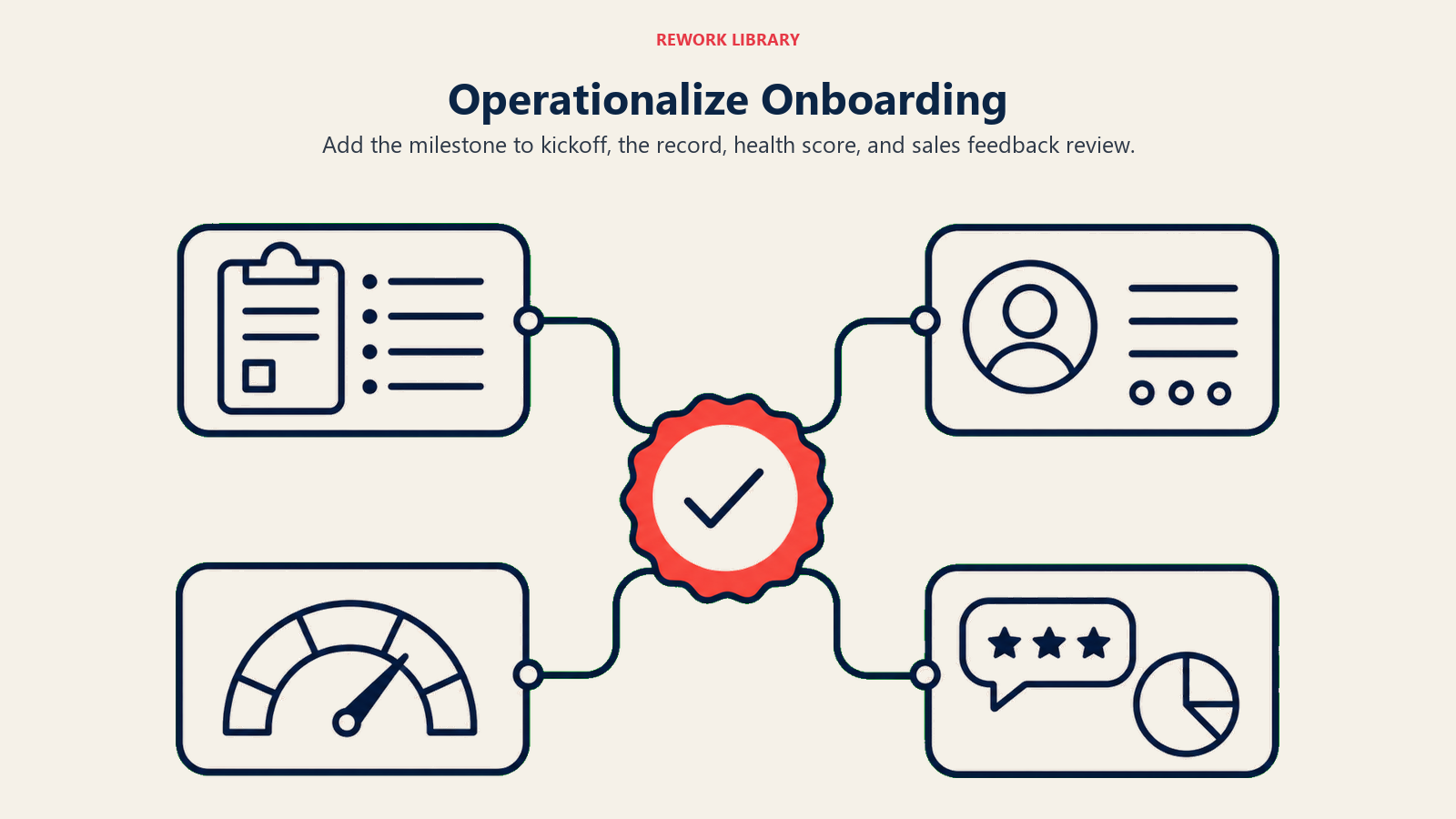
Tambahkan ia ke agenda permulaan. Panggilan permulaan adalah di mana empat kriteria disahkan dengan pelanggan, bukan dibentangkan sebagai takrifan dalaman CS, tetapi dibincangkan sebagai "inilah cara kami akan tahu anda disediakan untuk kejayaan." Ini melakukan tiga perkara: ia memberi pelanggan gambaran jelas tentang rupa "selesai," ia mewujudkan akauntabiliti bersama untuk pencapaian, dan ia mendedahkan sebarang ketidakpadanan antara apa yang CS rancang dan apa yang pelanggan jangkakan (yang, jika ditangkap semasa permulaan, boleh dipulihkan; jika ditangkap pada Hari 60, sering tidak dapat). Lihat agenda panggilan permulaan bersama untuk cara menyusun perbualan ini supaya kriteria diterima sebagai perjanjian bersama dan bukannya formaliti CS.
Tetapkan jangkaan pada jadual. Bersikap jelas tentang sasaran: "Matlamat kami adalah untuk memenuhi semua empat kriteria menjelang Hari 30 (atau Hari 60 untuk mid-market). Inilah yang kami perlukan dari pasukan anda untuk mencapai sasaran itu." Jangkaan jadual mewujudkan urgensi pada kedua-dua pihak dan memberi CSM kedudukan yang boleh dipertahankan jika kelewatan pelanggan menolak pencapaian keluar.
Takrifkan laluan eskalasi untuk apabila pencapaian tidak dicapai. Siapa yang mengeskalikekan, kepada siapa, dan dalam tetingkap apa sepatutnya ditulis sebelum ia diperlukan. Lalai yang munasabah: jika kriteria penyempurnaan teknikal tidak dipenuhi menjelang Hari 14 (SMB) atau Hari 30 (mid-market), CSM tanda kepada pengurus CS. Jika pencapaian kejayaan tidak dipenuhi menjelang Hari 45 (SMB) atau Hari 75 (mid-market), Pengurus CS menyertai panggilan pelanggan seterusnya dan pelan yang disemak dicipta bersama pelanggan. Jika tiada kriteria dipenuhi menjelang Hari 60 (SMB) atau Hari 90 (mid-market), akaun diklasifikasikan secara formal sebagai berisiko dan gerakan penyelamatan dicetuskan.
[faq title="Soalan Lazim tentang Maksud "Berjaya Di-onboard" Sebenarnya"] Q: Haruskah takrifan kejayaan onboarding berubah mengikut saiz perjanjian? A: Ya. Pembolehubah dalam empat kriteria (N pengguna untuk pencetus pengambilan, pencapaian kejayaan spesifik, sasaran jadual) sepatutnya berskala dengan kerumitan perjanjian. Akaun SMB 10 tempat dengan konfigurasi standard sepatutnya mempunyai sasaran 30 hari. Akaun mid-market 50 tempat dengan integrasi tersuai sepatutnya mempunyai sasaran 60 hari. Menggunakan takrifan yang sama untuk semua saiz perjanjian sama ada menetapkan jadual yang tidak boleh dicapai untuk akaun kompleks atau menetapkan bar yang terlalu rendah untuk akaun mudah.
Q: Bagaimana jika pelanggan menganggap diri mereka telah di-onboard sebelum CS berbuat demikian? A: Ini lebih biasa daripada yang didengari. Pelanggan fikir "kami sudah siap beroperasi, kami selesai" kerana integrasi berfungsi. CS tahu pencetus pengambilan belum dicetuskan dan pencapaian kejayaan belum dipenuhi. Jangan beritahu pelanggan mereka belum di-onboard. Itu adalah masalah nada. Sebaliknya, bingkaikan semula: "Anda sudah beroperasi dan persediaan berfungsi. Fasa seterusnya adalah memastikan [hasil tertentu] berjalan seperti yang anda huraikan dalam matlamat anda. Kami ingin memastikan anda mencapai itu sebelum kami beralih ke mod kejayaan terurus." Pencapaian kejayaan memberi CS cara untuk mengalihkan tumpuan tanpa menghapuskan apa yang telah dicapai pelanggan.
Q: Bagaimana takrifan onboarding berhubung dengan harga dan peringkat? A: Skop pelaksanaan, kerumitan, dan sumber CSM yang diperuntukkan sepatutnya sepadan dengan kriteria onboarding untuk peringkat pelanggan. Takrifan onboarding perusahaan dengan akses CSE berdedikasi dan pencapaian kejayaan dashboard tersuai secara tersirat dimasukkan dalam kontrak perusahaan. Akaun SMB transaksional yang mendapat kriteria onboarding peringkat perusahaan tidak boleh diskala. Bina templat takrifan onboarding yang berbeza untuk setiap peringkat utama dan sahkan mana yang terpakai pada tandatangan kontrak.
Q: Bolehkah takrifan kejayaan onboarding dirunding semula selepas permulaan? A: Ya, tetapi hanya secara bertulis dan dengan kesedaran pengurus CS. Jika keutamaan pelanggan berubah pertengahan pelaksanaan (VP Jualan pergi, skop integrasi berubah, kes penggunaan utama berkembang), pencapaian kejayaan boleh dipinda. Rekodkan pindaan dalam rekod pelanggan dengan tarikh dan sebab. Tetapi jangan biarkan pencapaian merayap tanpa henti tanpa dokumentasi. Pindaan yang tidak terdokumen tidak dapat dibezakan dari "kami tidak pernah mentakrifkannya sejak awal."
Q: Apakah sebenarnya yang dikira sebagai "berjaya di-onboard" berbanding "sudah siap beroperasi"? A: Siap beroperasi bermakna Penyempurnaan Teknikal (Kriteria 1 Rangka Kerja TACS): integrasi disambungkan, pengguna diberi peruntukan, konfigurasi selesai. Berjaya di-onboard memerlukan keempat-empat kriteria: Penyempurnaan Teknikal, Pencetus Pengambilan, Pencapaian Kejayaan, dan Pengesahan Penaja. Purata masa dari siap beroperasi ke berjaya di-onboard ialah 47 hari untuk akaun SMB dan 73 hari untuk mid-market, mengikut penanda aras amalan CSM. "Siap beroperasi pada Hari 14" jarang bermakna "di-onboard pada Hari 14."
Q: Apakah perbezaan antara "pencapaian siap beroperasi" dengan "pencapaian kejayaan"? A: Siap beroperasi ialah keadaan teknikal: produk boleh diakses dan berfungsi. Pencapaian kejayaan ialah keadaan hasil: pelanggan telah mencapai keputusan pertama yang mereka bayar. Pelanggan boleh siap beroperasi dan tidak pernah mencapai pencapaian kejayaan jika pengambilan tidak berlaku. Pencapaian kejayaan dipetakan terus kepada "mengapa mereka membeli" yang didokumenkan semasa penemuan. Jika pelanggan membeli untuk mengautomasikan pelaporan pipeline, pencapaian kejayaan ialah laporan automatik pertama, bukan sekadar halaman log masuk yang berfungsi.
Q: Bagaimana jika pelanggan tidak pernah mencapai pencapaian berjaya di-onboard? A: Jika keempat-empat kriteria tidak dipenuhi dalam jadual sasaran (30 hari untuk SMB, 60 hari untuk mid-market), akaun memasuki laluan eskalasi. CSM tanda kepada pengurus CS pada Hari 30 melepasi sasaran. Pengurus CS menyertai panggilan pelanggan seterusnya. Jika tiada kriteria dipenuhi menjelang Hari 60 (SMB) atau Hari 90 (mid-market), akaun diklasifikasikan secara formal sebagai berisiko dan gerakan penyelamatan dicetuskan. Membiarkan tetingkap pencapaian berlalu tanpa eskalasi ialah bentuk risiko churn awal yang paling biasa yang terlepas pandang sehingga perbualan pembaharuan.
Q: Siapa yang patut mengesahkan pencapaian kejayaan: CSM atau pelanggan? A: Pelanggan yang patut mengesahkan. Khususnya, penaja atau champion patut mengakui (secara bertulis, melalui e-mel atau Slack) bahawa kes penggunaan utama sedang berjalan dan mereka bersedia untuk beralih ke mod kejayaan terurus. Pengesahan sendiri oleh CSM (di mana CS menanda pencapaian selesai berdasarkan penilaian mereka sendiri tanpa pengesahan pelanggan) meninggalkan akaun dalam keadaan samar-samar. Jika pelanggan kemudiannya mempertikaikan bahawa onboarding berjaya, CSM tidak mempunyai pengesahan terdokumen untuk dirujuk.
[/faq]
Ketahui Lebih Lanjut
- Glosari Penjajaran Jualan & Kejayaan Pelanggan
- Panggilan Permulaan Bersama: Agenda, Peserta, Hasil
- Pemarkahan Kesihatan Pelanggan dengan Input Konteks Jualan
- Sumber Kebenaran Tunggal: Rekod Pelanggan
- Pemindahan Konteks Perjanjian: Apa yang CS Sebenarnya Perlukan dari Jualan
- Kriteria Penyempurnaan Onboarding
- Pengoptimuman Masa-ke-Nilai

Principal Solution Architect
On this page
- Mengapa "Sudah Siap Beroperasi" Bukan Ukuran yang Betul
- Empat Kriteria yang Mentakrifkan "Berjaya Di-onboard"
- Kriteria 1: Penyempurnaan Teknikal
- Kriteria 2: Pencetus Pengambilan
- Kriteria 3: Pencapaian Kejayaan
- Kriteria 4: Pengesahan Penaja
- Cara Menulis Takrifan Pasukan Anda
- Di Mana "Berjaya Di-onboard" Berada dalam Rekod Pelanggan
- Cara Ia Berhubung dengan Pemarkahan Kesihatan
- Implikasi Serah Terima Jualan-CS
- Mengoperasikan Pencapaian
- Ketahui Lebih Lanjut