Penilaian Kesihatan Pelanggan dengan Konteks Jualan: Apa yang AE Tahu yang Skor Anda Tidak Tahu
Turn this article into takeaways for your work.


Each assistant summarizes the article only for you and suggests best practices for your work.
Bulan 4: akaun adalah hijau. Penggunaan meningkat, tiada tiket sokongan, NPS kembali positif. Pasukan CS berasa baik tentangnya.
Bulan 11: pelanggan Churn. CSM terkejut. VP CS ingin memahami apa yang salah. Papan pemuka tidak menunjukkan sebarang amaran.
AE, yang menutup perjanjian itu sembilan bulan lalu, tidak terkejut. Mereka mengingati diskaun yang diberikan untuk mencapai suku tahun. Mereka mengingati kes penggunaan yang juara gambarkan (yang bersebelahan dengan apa yang produk sebenarnya lakukan, bukan tepat dalam skop keupayaannya). Mereka mengingati CFO yang meluluskan perjanjian tetapi jelas tidak diberi taklimat mengenai keperluan integrasi.
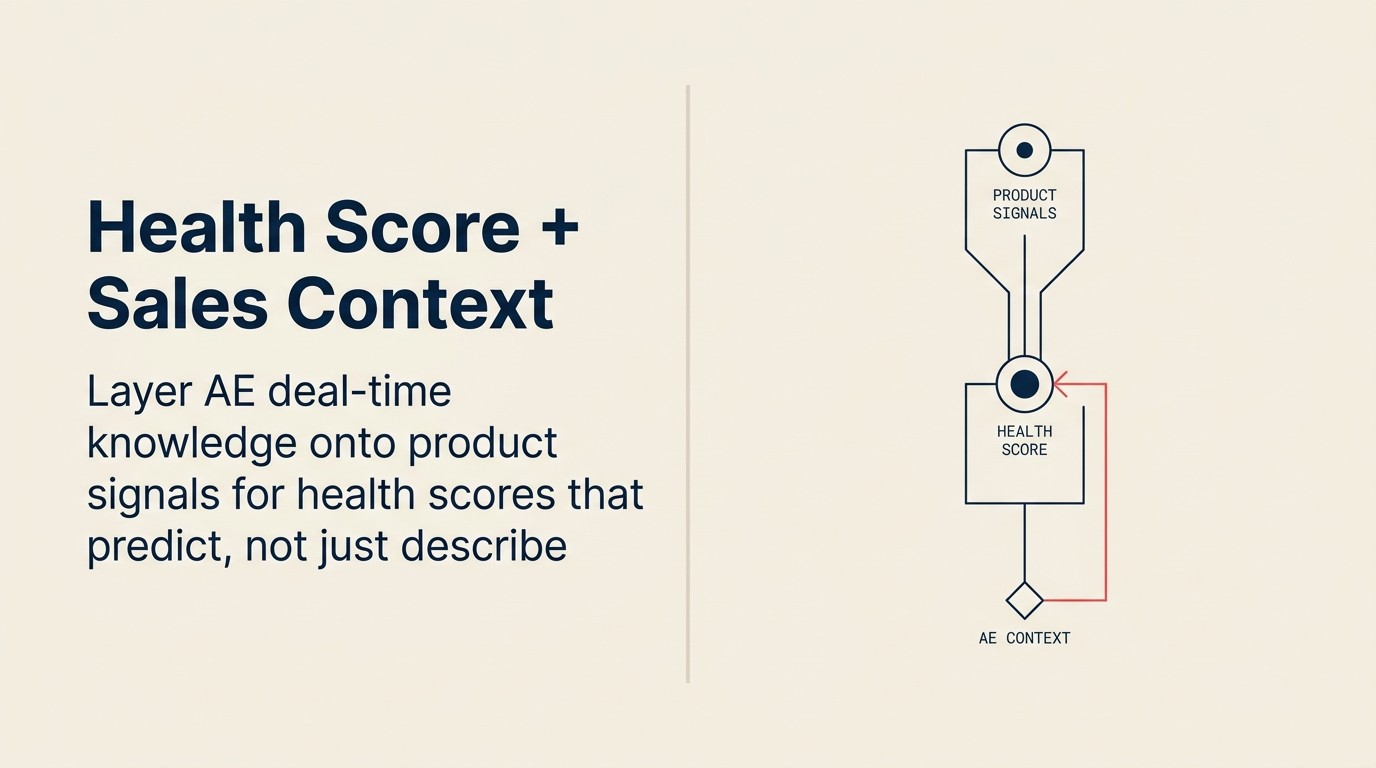
Tiada satu pun maklumat itu wujud di mana-mana dalam skor kesihatan. Kerana skor kesihatan dibina dari isyarat produk selepas jualan. Dan isyarat produk tidak mengetahui apa yang berlaku dalam bilik sebelum kontrak ditandatangani.
Fakta Utama: Titik Buta Skor Kesihatan
- 42% pasukan CS melaporkan bahawa mereka "terkejut" oleh peristiwa Churn yang kemudiannya mereka kesan kepada isu kualiti perjanjian yang berasal dari kitaran jualan, menurut kajian Gainsight tentang operasi CS.
- Skor kesihatan pelanggan yang menggabungkan isyarat kualiti perjanjian (kedalaman diskaun, kesesuaian ICP, kestabilan juara) mengenal pasti akaun berisiko 60-90 hari lebih awal berbanding model produk-sahaja, menurut penyelidikan Totango tentang rangka kerja kesihatan ramalan.
- 68% Churn dalam B2B SaaS boleh dikesan kepada isu yang wujud pada masa penutupan (perjanjian tidak sesuai, kes penggunaan yang terlebih janji, juara yang salah), bukan kepada kegagalan selepas jualan, menurut analisis Bain & Company tentang pemacu Churn B2B SaaS.
- Syarikat dengan model kesihatan hibrid (isyarat produk + lapisan konteks perjanjian) mempunyai kadar Churn 15-20% lebih rendah berbanding syarikat yang menggunakan isyarat produk sahaja, berdasarkan analisis oleh Gainsight.
Apa yang Skor Kesihatan Standard Ukur (dan Apa yang Ia Terlepas)
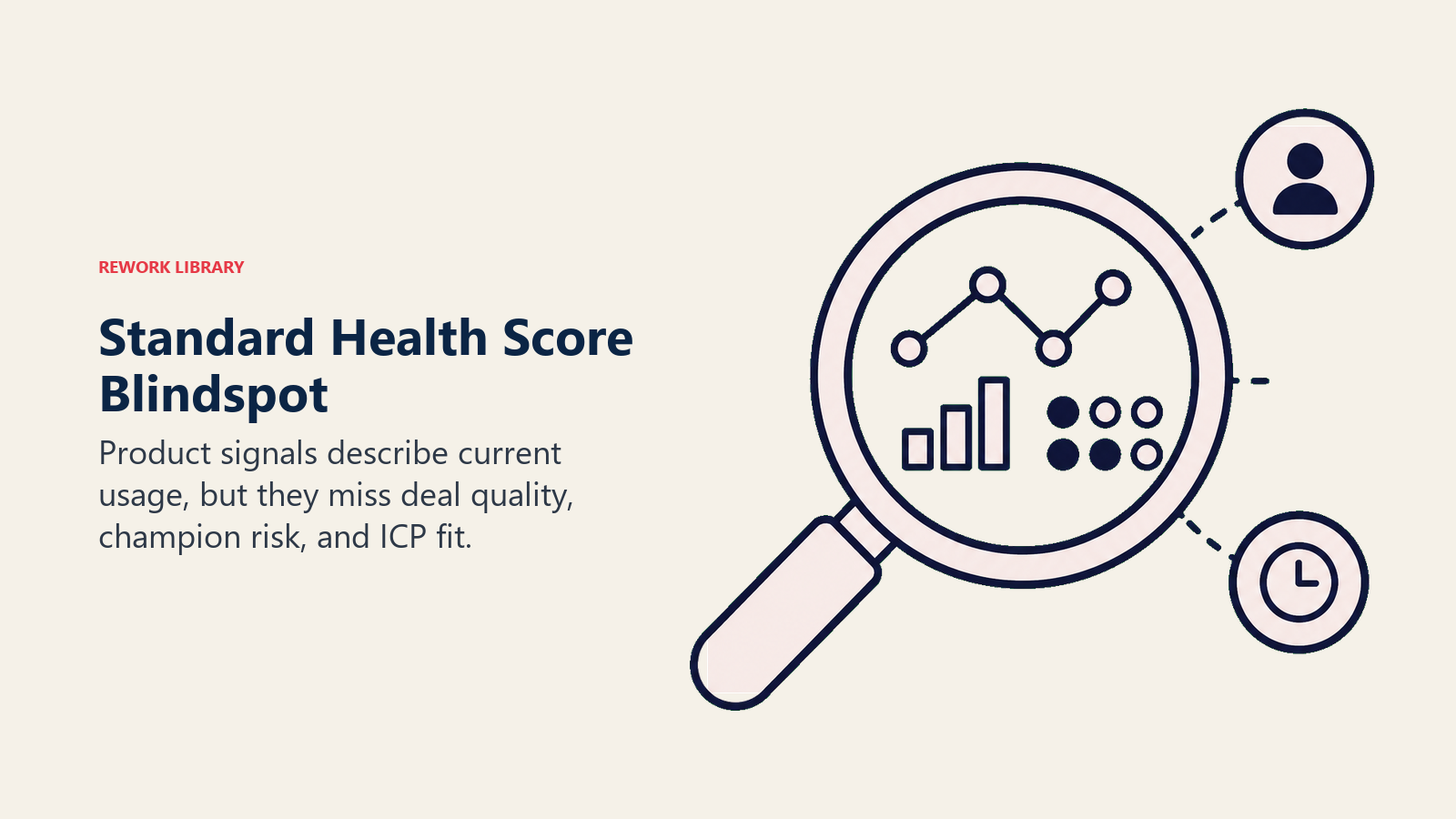
Kebanyakan skor kesihatan dibina dari data yang paling mudah dikumpulkan: penggunaan produk, tiket sokongan, skor NPS atau CSAT, kadar penggunaan tempat duduk, dan status pengebilan. Ini semua adalah isyarat nyata. Mereka memberitahu anda bagaimana pelanggan berinteraksi dengan produk sekarang. Gartner mentakrifkan skor kesihatan pelanggan sebagai ukuran yang meramalkan bagaimana hubungan pelanggan mungkin berubah dengan mempertimbangkan faktor seperti penglibatan kandungan, penyertaan komuniti, dan maklum balas.
Tetapi mereka hanya mengukur apa yang kelihatan selepas kontrak ditandatangani. Mereka mengukur output hubungan pelanggan, bukan kualiti strukturalnya.
Input skor kesihatan standard:
| Isyarat | Apa yang diukur | Ketersediaan |
|---|---|---|
| Penggunaan produk (DAU/MAU) | Kedalaman penggunaan | Platform CS |
| Penggunaan tempat duduk | Kecekapan lesen | CRM / Platform CS |
| Jumlah dan resolusi tiket sokongan | Geseran dalam produk | Alat sokongan |
| Skor NPS / CSAT | Nilai yang dirasai | Alat tinjauan |
| Status pengebilan | Kesihatan pembayaran | Sistem pengebilan |
| Kekerapan log masuk | Keluasan penglibatan | Analitik produk |
Isyarat-isyarat ini adalah perlu. Ia tidak mencukupi.
Apa yang tiada:
Kedalaman diskaun perjanjian. Perjanjian yang ditutup pada 40% di bawah harga senarai adalah akaun yang berbeza secara asasi berbanding perjanjian yang ditutup pada terma standard. Kedalaman diskaun adalah proksi untuk kemendesakan-melebihi-kesesuaian: pelanggan perlu mencapai tarikh akhir, atau AE perlu mencapai angka, dan diskaun adalah pelancarannya. Akaun tersebut mempunyai garis dasar Churn yang lebih tinggi daripada yang metrik produk akan pernah dedahkan.
Tajuk dan tempoh juara semasa penutupan, berbanding hari ini. Jika juara yang menandatangani kontrak adalah VP Operasi yang sejak itu telah pergi, penggunaan produk mungkin stabil sementara hubungan merosot. Skor kesihatan berdasarkan log masuk tidak tahu bahawa juara telah pergi.
Kesesuaian ICP. Glosari Penjajaran Sales-CS mendefinisikan ICP (Ideal Customer Profile) sebagai set atribut firmografi dan tingkah laku yang meramalkan kejayaan dengan produk anda. Jika akaun yang ditutup tidak sepadan dengan kriteria tersebut, metrik produk mungkin kelihatan baik sementara kesesuaian struktural tidak pernah ada. Churn hanya menunggu pemangkin yang betul. Memahami rupa asas kesihatan pelanggan dalam organisasi selepas jualan yang berstruktur baik memberi anda garis dasar tentang apa yang ditambah oleh lapisan konteks perjanjian.
Konteks penggantian bersaing. Akaun yang menggantikan pesaing yang tertanam kuat membawa garis dasar risiko Churn yang lebih tinggi untuk 18 bulan pertama. Kos penukaran yang dicipta oleh vendor sebelumnya akan muncul semula sebagai bantahan pada pembaharuan. Skor kesihatan produk-sahaja tidak tahu bahawa anda telah menggantikan sesiapa.
Kes penggunaan yang dikomitmenkan dalam kitaran jualan berbanding kes penggunaan aktif dalam produk. Artikel Pemindahan Konteks Perjanjian kepada CS merangkumi bagaimana maklumat ini hilang pada handoff. Jika AE menjanjikan integrasi aliran kerja yang CS kemudiannya mengesahkan tidak disokong, jurang itu akan muncul sebagai masalah kesihatan, tetapi skor tidak akan memberitahu anda mengapa.
Isyarat Jualan yang Patut Ada dalam Setiap Skor Kesihatan
Enam medan ini mengubah skor kesihatan deskriptif menjadi skor kesihatan ramalan. Setiap satunya boleh ditangkap semasa penutupan dan disimpan dalam rekod akaun.
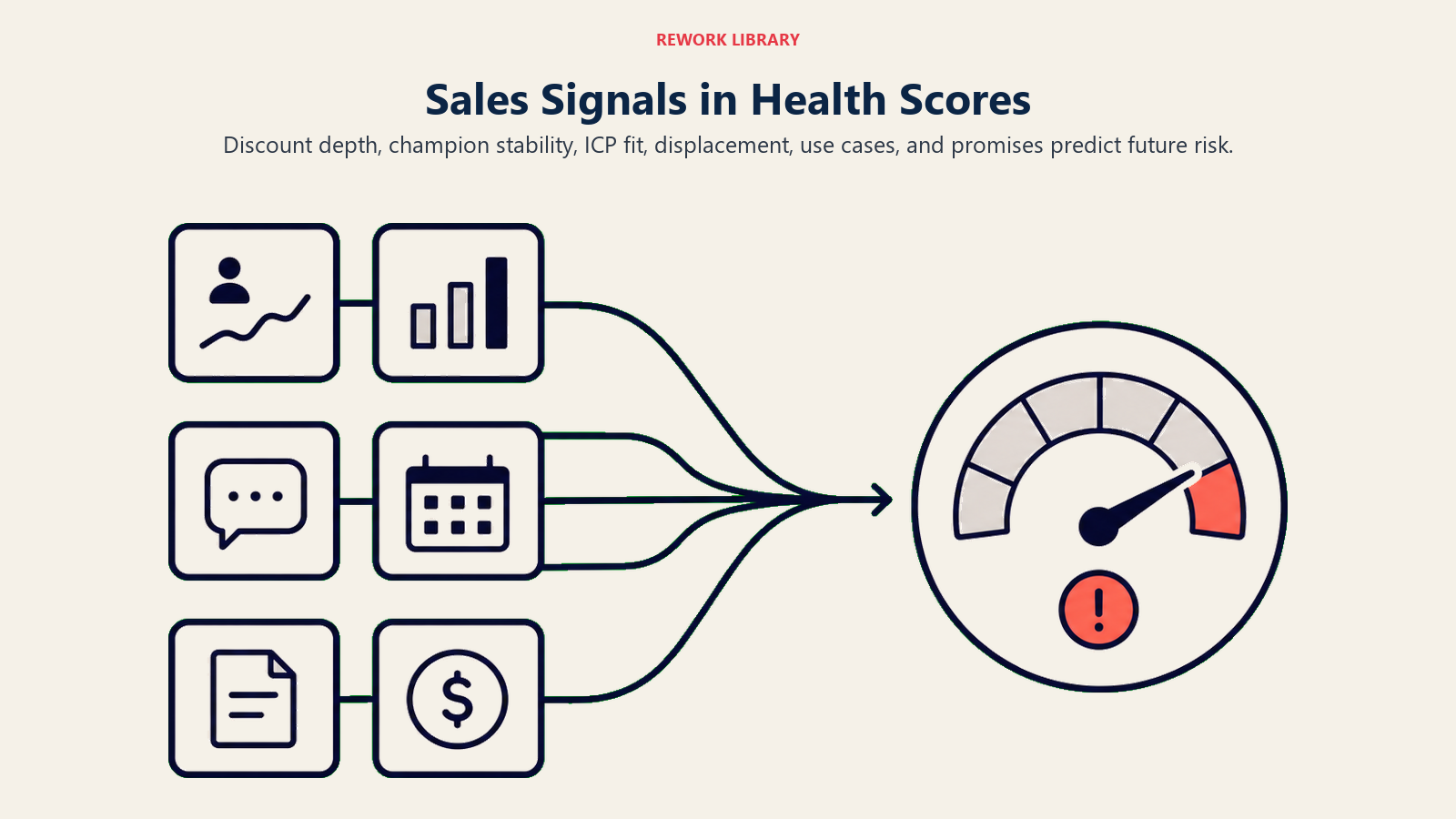
1. Kedalaman diskaun perjanjian Nyatakan sebagai peratusan di bawah senarai: 0-10% (standard), 11-25% (sederhana), 26%+ (ketara). Diskaun yang ketara sepatutnya menurunkan skor kesihatan garis dasar dengan jumlah yang bermakna dan menandakan akaun untuk pemantauan lebih dekat dalam 90 hari pertama.
Contoh: Diskaun 35% ke atas perjanjian ACV $48,000 yang ditutup pada minggu terakhir S3. CSM sepatutnya mengetahui ini sejak awal, bukan mendapatinya semasa pembaharuan.
2. Tajuk dan tempoh juara semasa penutupan Log nama, tajuk, dan kanan juara utama pada penandatanganan kontrak. Semak pada 90 hari: orang yang sama, tajuk yang sama, pasukan yang sama? Jika juara telah berubah, skor kesihatan sepatutnya mencerminkan risiko hubungan walaupun penggunaan produk stabil.
3. Skor kesesuaian ICP semasa penutupan Bukan ya/tidak. Penilaian 1-5 yang AE atau RevOps berikan semasa penutupan, berdasarkan padanan firmografi, keselarasan kes penggunaan, dan pencetus pembelian. Skor 2 daripada 5 sepatutnya membawa penalti kesihatan dari hari pertama, kerana kesesuaian struktural adalah rendah ketika anda bermula.
4. Bendera penggantian bersaing Adakah ini perjanjian penggantian? Ya atau tidak. Jika ya, vendor mana? Perjanjian penggantian memerlukan intensiti onboarding yang berbeza dan garis dasar risiko Churn yang lebih tinggi dalam model kesihatan untuk bulan 1-12.
5. Kes penggunaan yang dikomitmenkan berbanding kes penggunaan aktif Semasa penutupan, AE merekodkan 2-3 kes penggunaan utama yang pelanggan komitmenkan semasa kitaran jualan. Pada 60 dan 120 hari, CSM mengemaskini kes penggunaan mana yang aktif dalam produk. Perbezaan antara yang dikomitmenkan dan yang aktif adalah penunjuk Churn pendahulu, bukan penunjuk susulan.
6. Janji yang direkodkan dalam nota perjanjian Sebarang komitmen yang dibuat di luar kontrak standard: item roadmap yang disebut, perkhidmatan profesional yang dimasukkan secara lisan, integrasi yang dijanjikan sebagai "akan datang." Ini tidak muncul dalam metrik produk. Tetapi mereka muncul pada pembaharuan sebagai jangkaan yang tidak dipenuhi.
Cara Mengoperasikannya: Model Kesihatan Hibrid
Model hibrid mempunyai dua lapisan: lapisan isyarat produk, yang sudah dijejak oleh platform CS anda, dan lapisan konteks perjanjian, yang diisi dari data CRM semasa penutupan dan dikemaskini oleh CSM dari masa ke masa. Forrester menggariskan bahawa menerapkan data sejarah daripada akaun yang dikekalkan dan akaun yang Churn pada kad skor anda ialah langkah yang dilangkau oleh kebanyakan pelaksanaan penilaian kesihatan, dan langkah yang menjadikan skor itu ramalan dan bukannya deskriptif.
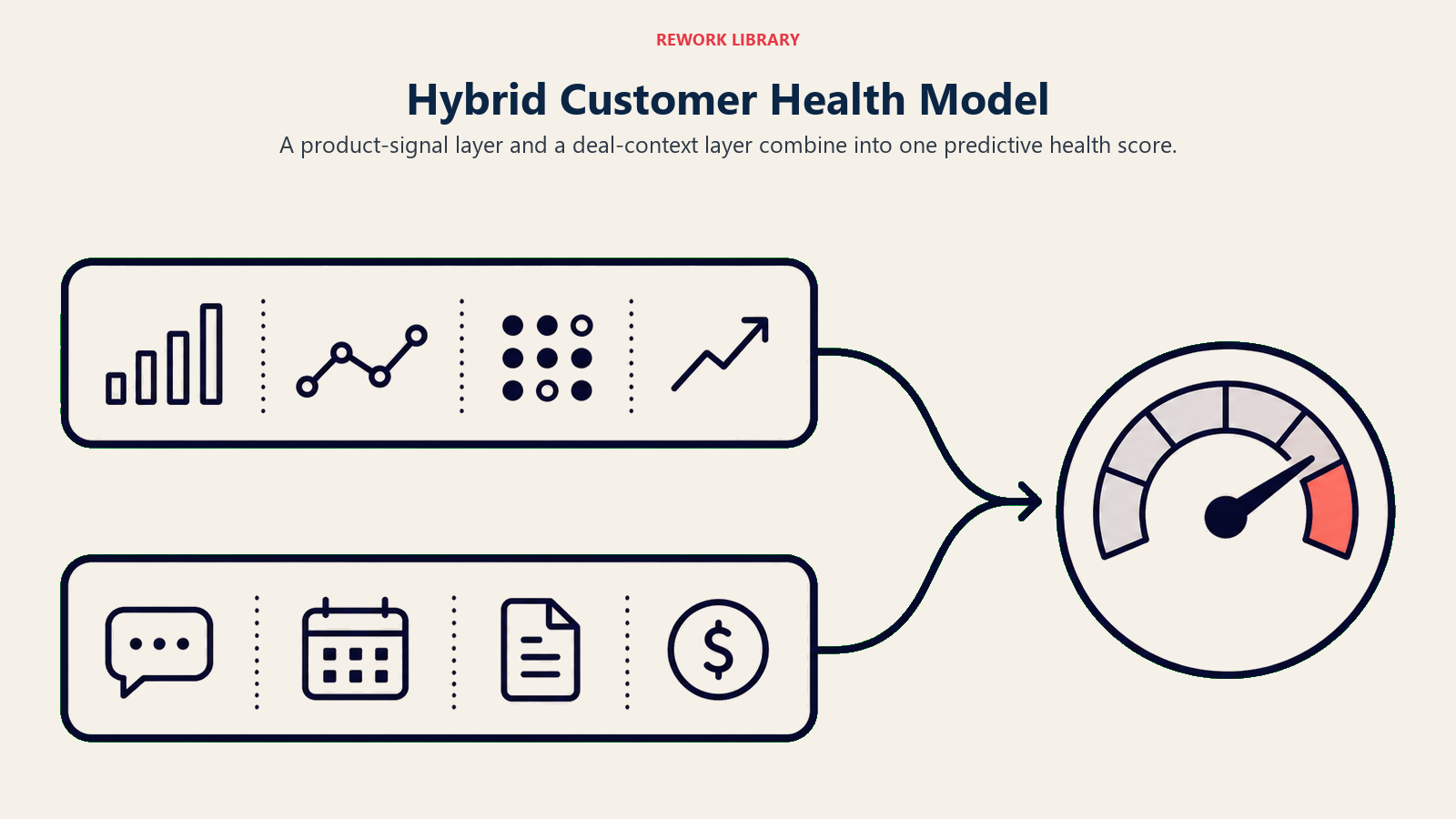
Lapisan 1: Isyarat produk (standard) Platform CS atau tumpukan analitik produk anda mengendalikan ini. Penggunaan, penggunaan, sokongan, NPS, pengebilan. Diberi berat mengikut cara model semasa anda memberatkannya. Tiada perubahan diperlukan di sini. Lapisan ini sudah berfungsi.
Lapisan 2: Isyarat konteks perjanjian (baharu)
| Medan | Sumber | Siapa yang mengemaskini | Kemerosotan |
|---|---|---|---|
| Kedalaman diskaun | Rekod peluang CRM | AE semasa penutupan | Kekal |
| Status juara | Rekod kenalan CRM | CSM pada tanda 90 hari | Suku tahunan |
| Skor kesesuaian ICP | Rekod peluang CRM | AE semasa penutupan; audit RevOps | Tahunan |
| Penggantian bersaing | Rekod peluang CRM | AE semasa penutupan | Kekal |
| Kes penggunaan dikomitmenkan vs aktif | Dokumen handoff + data produk | CSM pada 60 dan 120 hari | Semi-tahunan |
| Janji terbuka | Nota perjanjian dalam CRM | AE semasa penutupan | CSM padam apabila diselesaikan |
Pemberian berat yang dicadangkan untuk akaun SMB:
- Isyarat produk: 65% skor kesihatan
- Lapisan konteks perjanjian: 35% skor kesihatan
Pemberian berat yang dicadangkan untuk akaun mid-market:
- Isyarat produk: 55% skor kesihatan
- Lapisan konteks perjanjian: 45% skor kesihatan
Akaun mid-market lebih kompleks, membawa ACV yang lebih tinggi, dan biasanya mempunyai lebih banyak risiko konteks perjanjian yang tertanam. Lapisan konteks perjanjian sepatutnya membawa lebih banyak berat.
Siapa yang mengemaskini lapisan konteks perjanjian dari masa ke masa? AE mengisinya semasa penutupan. CSM memiliki kemaskini pada 90, 180, dan 365 hari: status juara, kes penggunaan dikomitmenkan vs aktif, dan sebarang janji terbuka yang telah diselesaikan. Ini tidak pilihan. Jika CSM tidak mengemaskinakannya, skor kesihatan berjalan pada data perjanjian yang lapuk.
Gelung Maklum Balas CSM-AE yang Ini Cipta
Model hibrid bukan sahaja menghasilkan skor yang lebih baik. Ia mewujudkan gelung maklum balas yang sebelumnya tidak wujud.
Apabila lapisan konteks perjanjian menandakan risiko (juara pergi, kesesuaian ICP adalah rendah, kes penggunaan yang dijanjikan tidak aktif), CSM mempunyai sebab untuk menarik AE kembali ke dalam akaun. Bukan sebagai perbualan menyalahkan. Sebagai perbualan operasi.
Perbezaan antara "AE dalam cc amaran pembaharuan" dan "AE diberikan tugas dalam rekod akaun" adalah sangat besar. Yang pertama adalah maklumat sahaja. Yang kedua adalah tugasan dengan pemilik.
Apa penglibatan semula AE kelihatan seperti apabila dicetuskan oleh penilaian kesihatan:
- AE menyemak medan janji terbuka dalam rekod akaun. Jika ada komitmen roadmap yang masih belum selesai, AE menyelaraskan dengan produk untuk mendapatkan kemaskini yang jujur dan menyampaikannya kepada pelanggan secara langsung, bukan melalui CSM.
- AE menyemak status juara. Jika juara telah berubah, AE menggunakan hubungan mereka dengan juara sebelumnya untuk memudahkan pengenalan yang mesra kepada yang baharu.
- AE menyemak skor kesesuaian ICP. Jika akaun mendapat skor rendah semasa penutupan, AE dan CSM bersama-sama membina pelan kejayaan yang mengambil kira jurang struktural: bukan pelan onboarding standard, tetapi pelan yang berorientasikan pemulihan.
Implikasi NRR: NRR (Net Revenue Retention) adalah metrik yang keseluruhan pasukan CS bertanggungjawab terhadapnya. Penyelidikan McKinsey menunjukkan bahawa syarikat dengan NRR melebihi 120% memperoleh median gandaan EV/hasil sebanyak 21x berbanding 9x bagi syarikat di bawah ambang tersebut. Itu menjadikan ketepatan skor kesihatan sebagai persoalan penilaian, bukan sekadar persoalan operasi. Skor kesihatan yang mendedahkan risiko konteks perjanjian 60-90 hari lebih awal berbanding isyarat produk sahaja memberi CSM tetingkap campur tangan yang lebih panjang. Perbezaan antara amaran 60 hari dan amaran 10 hari sering kali adalah perbezaan antara campur tangan yang berjaya dan usaha pengekalan yang terlambat. Untuk pengiraan tentang kos handoff yang rosak terhadap NRR secara langsung, lihat kos handoff yang rosak.
Untuk pandangan lebih mendalam tentang cara celah Pemilikan Pembaharuan: AE vs AM vs CSM berfungsi apabila risiko kesihatan ditandakan, artikel tersebut merangkumi siapa yang menjalankan respons.
Apa yang Perlu Diseragamkan Merentasi Pasukan
Model hibrid hanya berjaya jika semua orang bersetuju tentang definisi dan peraturan akses.
Ambang merah/kuning/hijau:
| Band skor | Status kesihatan | Tindakan lalai |
|---|---|---|
| 75-100 | Hijau | Jadwal CSM standard |
| 50-74 | Kuning | Semakan bulanan CSM; tandakan untuk QBR |
| 25-49 | Merah | Jadwal CSM dipertingkatkan; AE diberitahu dalam 7 hari |
| 0-24 | Kritikal | Pelan akaun bersama AE-CSM diperlukan |
Ambang ini perlu dipersetujui oleh VP CS dan VP Jualan dan didokumentasikan, bukan disimpan dalam kepala satu pasukan. Ia sepatutnya disemak setiap suku tahun berbanding hasil Churn sebenar.
Akses tulis berbanding baca-sahaja:
- Medan lapisan konteks perjanjian: AE mempunyai akses tulis semasa penutupan dan semasa penglibatan semula aktif. CSM mempunyai akses tulis untuk status juara, kes penggunaan aktif, dan resolusi janji. RevOps mempunyai akses tulis untuk audit kesesuaian ICP.
- Lapisan isyarat produk: pentadbir platform CS dan CSM sahaja. Jualan tidak menulis kepada metrik produk.
- Skor itu sendiri: baca-sahaja untuk AE dan CSM. Skor dikira oleh sistem, bukan disesuaikan secara manual.
Sumber kebenaran tunggal: Skor kesihatan wujud di satu tempat. Jika anda mempunyai platform CS (Gainsight, Totango, ChurnZero) dan CRM, putuskan sistem mana yang merupakan sistem rekod untuk skor. Kebanyakan pasukan mid-market lebih baik menyimpan skor dalam platform CS dan menyegerakkan medan konteks perjanjian dari CRM. Skor tidak sepatutnya wujud di dua tempat dengan dua nilai berbeza.
Anti-Corak yang Perlu Dielakkan
Sebelum mendalami mod kegagalan: model hibrid bergantung pada proses semakan perjanjian yang dimenangi yang menangkap medan konteks perjanjian semasa penutupan. Jika sesi debrief tidak berlaku, lapisan konteks perjanjian kekal kosong, dan model lalai kepada isyarat produk sahaja.
AE yang mengelembungkan konteks kesihatan untuk mengelakkan penglibatan semula. Jika medan kesesuaian ICP atau lapisan konteks perjanjian adalah pilihan, sesetengah AE akan membiarkannya kosong untuk mengelakkan akauntabiliti. Yang lain akan mengisinya dengan data yang optimistik untuk mengelakkan terlibat dalam kerja selepas jualan. Selesaikan ini secara struktural: jadikan konteks kesihatan wajib semasa penutupan, sertakan dalam semakan handoff akaun, dan audit setiap suku tahun dalam RevOps.
Skor kesihatan yang tidak ditinjau sesiapa sehingga pembaharuan 30 hari lagi. Skor kesihatan yang hanya disemak apabila pembaharuan sudah hampir bukan skor kesihatan. Ia adalah penggera kebakaran. Model hanya mewujudkan nilai jika CSM menyemaknya pada jadual tetap dan bertindak berdasarkan isyarat kuning sebelum bertukar merah.
Dua rekod kesihatan berasingan. Satu dalam platform CS menunjukkan hijau. Satu dalam CRM menunjukkan kuning. Tiada satu pasukan mempercayai angka pasukan lain. Inilah cara vakum pemilikan terbentuk: tiada siapa yang bertindak kerana setiap pasukan fikir angka pasukan lain adalah salah. Sumber kebenaran tunggal dengan hak akses tulis yang dipersetujui menyelesaikan ini di peringkat seni bina.
Pemula Pelaksanaan: Hamparan Konteks Perjanjian 5 Medan
Mana-mana pasukan RevOps SMB boleh menambahkan ini kepada skor kesihatan sedia ada mereka dalam masa kurang dari seminggu. Ini adalah medan konteks perjanjian minimum yang diperlukan:
| Medan | Jenis | Diisi oleh | Bila |
|---|---|---|---|
| Kedalaman diskaun (% di bawah senarai) | Nombor | AE | Semasa penutupan |
| Penilaian kesesuaian ICP (1-5) | Nombor | AE | Semasa penutupan |
| Nama + tajuk juara semasa penutupan | Teks | AE | Semasa penutupan |
| Penggantian bersaing (Y/T + vendor) | Boolean + teks | AE | Semasa penutupan |
| Kes penggunaan utama yang dikomitmenkan (1-2 baris) | Teks | AE | Semasa penutupan |
Sambungkan lima medan ini ke dalam skor kesihatan platform CS anda dengan berat agregat 35%, menggunakan berat pemarkahan dalam jadual di atas. Tetapkan jadual kemaskini CSM pada 90 hari untuk status juara dan kes penggunaan yang dikomitmenkan. Itulah model hibrid minimum yang diperlukan.
Gelung Pemurnian ICP: Maklum Balas CS kepada Jualan adalah pelengkap hulu kepada model ini. Apabila skor hibrid menandakan akaun yang tidak sesuai, maklum balas tersebut perlu bergerak kembali kepada Jualan dan Pemasaran untuk mencegah kohort seterusnya masalah yang sama.
Model Kesihatan Pelanggan Dua Lapisan
Model Kesihatan Pelanggan Dua Lapisan ialah rangka kerja yang dioperasikan oleh artikel ini. Lapisan 1 ialah lapisan isyarat produk standard yang sudah dijejak oleh platform CS. Lapisan 2 ialah hamparan konteks perjanjian yang diisi daripada data CRM semasa penutupan, meliputi kedalaman diskaun, kestabilan juara, skor kesesuaian ICP, bendera penggantian bersaing, kes penggunaan yang dikomitmenkan vs aktif, dan janji terbuka daripada kitaran jualan.
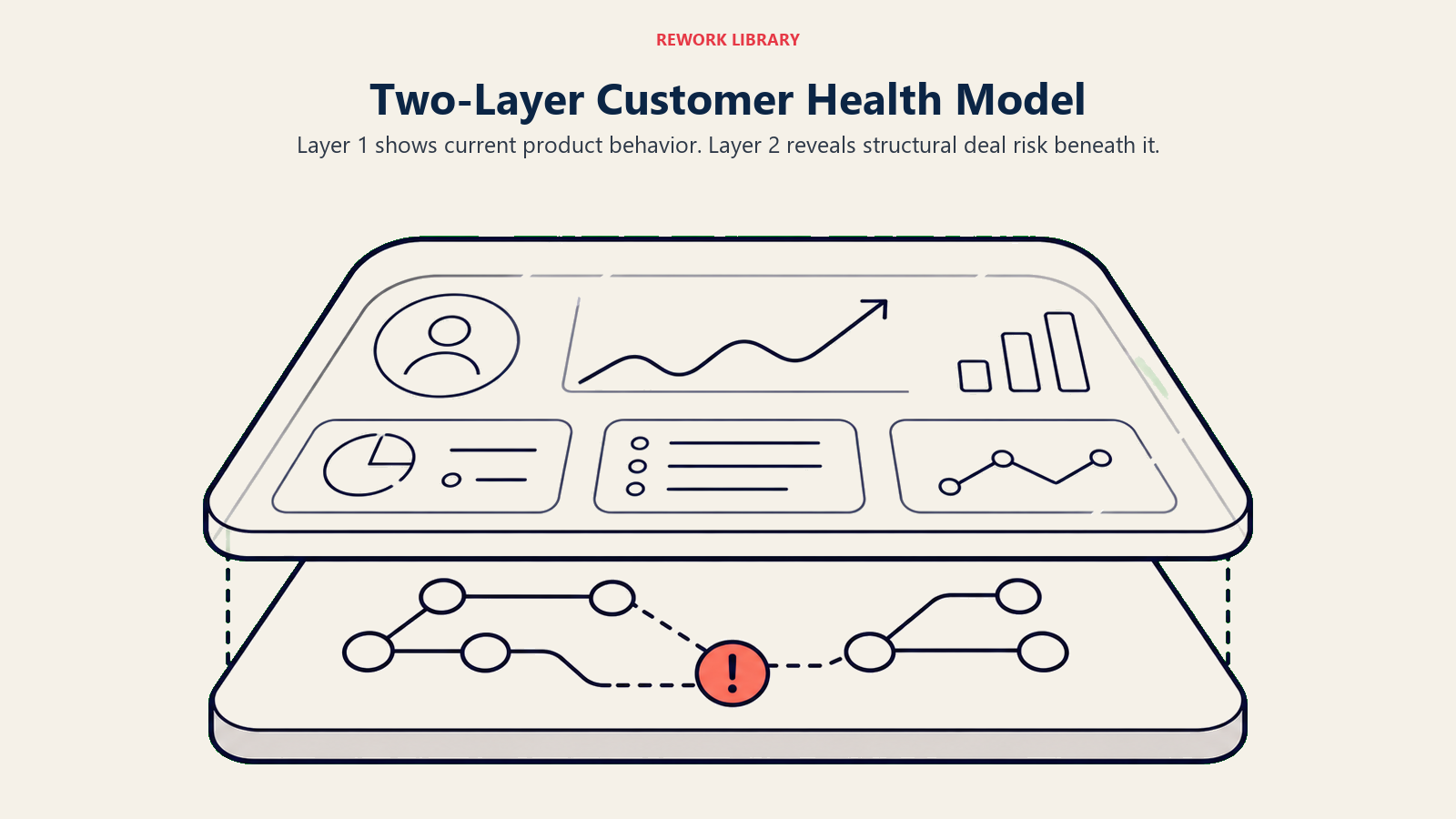
Kedua-dua lapisan saling berinteraksi: Lapisan 1 memberitahu anda bagaimana prestasi akaun sekarang. Lapisan 2 memberitahu anda keadaan struktural di mana prestasi itu berlaku. Skor Lapisan 1 yang hijau pada akaun Lapisan 2 yang ditandakan untuk kedalaman diskaun yang ketara, kesesuaian ICP yang rendah, dan pemergian juara bukanlah akaun hijau. Ia adalah akaun dengan risiko yang tersembunyi.
Analisis Rework: Berdasarkan data kohort pelanggan daripada syarikat SaaS mid-market, akaun yang membawa dua atau lebih isyarat risiko Lapisan 2 semasa penutupan (diskaun ketara, kesesuaian ICP rendah, pesaing yang digantikan) mengalami Churn pada kadar 3-4x berbanding akaun dengan profil Lapisan 2 yang bersih, walaupun skor produk Lapisan 1 mereka kelihatan sama pada bulan ke-6. Model hibrid mendedahkan risiko ini 60-90 hari lebih awal berbanding isyarat produk sahaja. Itulah perbezaan antara tetingkap campur tangan yang berdaya maju dan penggera kebakaran.
Petikan Utama:
"Skor kesihatan pelanggan yang menggabungkan isyarat kualiti perjanjian (kedalaman diskaun, skor kesesuaian ICP, kestabilan juara semasa penutupan) mengenal pasti akaun berisiko 60-90 hari lebih awal berbanding model produk-sahaja, mewujudkan tetingkap campur tangan yang menjadikan usaha pengekalan berkesan." (Penyelidikan Totango tentang rangka kerja kesihatan ramalan)
"68% Churn B2B SaaS dapat dikesan kepada keadaan yang wujud pada masa penandatanganan kontrak, bukan kepada kegagalan selepas jualan. Itu bermakna jurang skor kesihatan ialah masalah seni bina data, bukan masalah pelaksanaan CS." (Bain & Company)
"Syarikat dengan model kesihatan hibrid mempunyai kadar Churn 15-20% lebih rendah berbanding syarikat yang menggunakan isyarat produk sahaja. Lapisan konteks perjanjian bukan penambahbaikan yang sekadar bagus untuk ada. Ia ialah pemboleh ubah yang menjadikan model itu ramalan." (Penyelidikan Gainsight)
Soalan Lazim tentang Penilaian Kesihatan Pelanggan dengan Konteks Jualan
Apakah skor kesihatan pelanggan hibrid?
Skor kesihatan pelanggan hibrid menggabungkan dua lapisan isyarat: lapisan isyarat produk standard (penggunaan, penerimaan, sokongan, NPS, pengebilan) dan lapisan konteks perjanjian yang diisi daripada data CRM semasa penutupan. Lapisan konteks perjanjian merangkumi kedalaman diskaun, skor kesesuaian ICP, status juara, sejarah penggantian bersaing, dan kes penggunaan yang dikomitmenkan berbanding aktif. Model hibrid mengenal pasti risiko Churn 60-90 hari lebih awal berbanding skor kesihatan produk-sahaja.
Apakah isyarat yang patut anda jejak dalam skor kesihatan pelanggan?
Set isyarat minimum yang berdaya maju menggabungkan lima isyarat produk (penggunaan DAU/MAU, penggunaan tempat duduk, jumlah tiket sokongan, skor NPS/CSAT, status pengebilan) dengan lima isyarat konteks perjanjian (kedalaman diskaun sebagai peratusan di bawah senarai, penilaian kesesuaian ICP pada skala 1-5, nama dan tajuk juara semasa penutupan, bendera penggantian bersaing, dan kes penggunaan utama yang dikomitmenkan). Isyarat konteks perjanjian diisi oleh AE semasa penutupan dan dikemaskini oleh CSM pada 90, 180, dan 365 hari.
Berapa kerap anda patut menyegarkan skor kesihatan pelanggan?
Isyarat produk patut disegarkan secara masa nyata atau setiap hari melalui automasi platform CS. Lapisan konteks perjanjian memerlukan kemaskini manusia: status juara dan kes penggunaan dikomitmenkan vs aktif pada 90 hari, semua medan disemak pada 180 dan 365 hari. Skor kesesuaian ICP memerlukan audit RevOps setiap tahun. Bagi akaun yang ditandakan kuning atau merah, jadual penyegaran yang dipercepat (semakan bulanan semua medan konteks perjanjian) adalah sesuai.
Mengapa skor kesihatan standard tidak menangkap konteks perjanjian?
Kerana platform CS dibina pada sumber data selepas jualan: analitik produk, sistem sokongan, alat tinjauan, pengebilan. Mereka tidak mempunyai akses natif kepada rekod perjanjian CRM, nota panggilan AE, atau sejarah diskaun. Dan walaupun integrasi CRM wujud, medan konteks perjanjian jarang distrukturkan atau diisi secara konsisten. Data ada di sana; seni bina untuk menghubungkannya kepada model kesihatan biasanya tidak ada.
Bagaimana anda mencegah AE daripada memanipulasi medan konteks perjanjian?
Jadikan medan tersebut wajib semasa penutupan dengan format yang ditentukan (bukan teks bebas apabila boleh), sertakan dalam semakan handoff akaun, dan audit setiap suku tahun dalam RevOps berbanding hasil akaun sebenar. Skor kesesuaian ICP 5 pada akaun yang Churn pada bulan 8 disemak dan diperbetulkan. Dari masa ke masa, insentif untuk mengelembungkan berkurangan kerana integriti data dikekalkan.
Apakah keseimbangan yang betul antara isyarat produk dan isyarat konteks perjanjian?
Untuk SMB, 65% produk / 35% konteks perjanjian. Untuk mid-market, 55% / 45%. Akaun enterprise dengan struktur perjanjian yang kompleks mungkin membenarkan sehingga 50% berat konteks perjanjian. Prinsipnya: semakin tinggi ACV dan semakin kompleks jualan, semakin penting isyarat konteks perjanjian berbanding corak penggunaan produk awal.
Bagaimana jika AE yang menutup perjanjian sudah tidak ada di syarikat?
Medan konteks perjanjian sepatutnya diisi dalam CRM semasa penutupan, bukan disimpan dalam memori AE. Apabila AE Churn, data kekal. Jika medan tidak diisi sebelum AE pergi, CSM dan RevOps boleh membina semula yang paling kritikal (kesesuaian ICP, kedalaman diskaun) dari rekod peluang dan kontrak. Status juara sentiasa memerlukan semakan akaun semasa pun.
Ketahui Lebih Lanjut

Principal Solution Architect
On this page
- Apa yang Skor Kesihatan Standard Ukur (dan Apa yang Ia Terlepas)
- Isyarat Jualan yang Patut Ada dalam Setiap Skor Kesihatan
- Cara Mengoperasikannya: Model Kesihatan Hibrid
- Gelung Maklum Balas CSM-AE yang Ini Cipta
- Apa yang Perlu Diseragamkan Merentasi Pasukan
- Anti-Corak yang Perlu Dielakkan
- Pemula Pelaksanaan: Hamparan Konteks Perjanjian 5 Medan
- Model Kesihatan Pelanggan Dua Lapisan
- Ketahui Lebih Lanjut