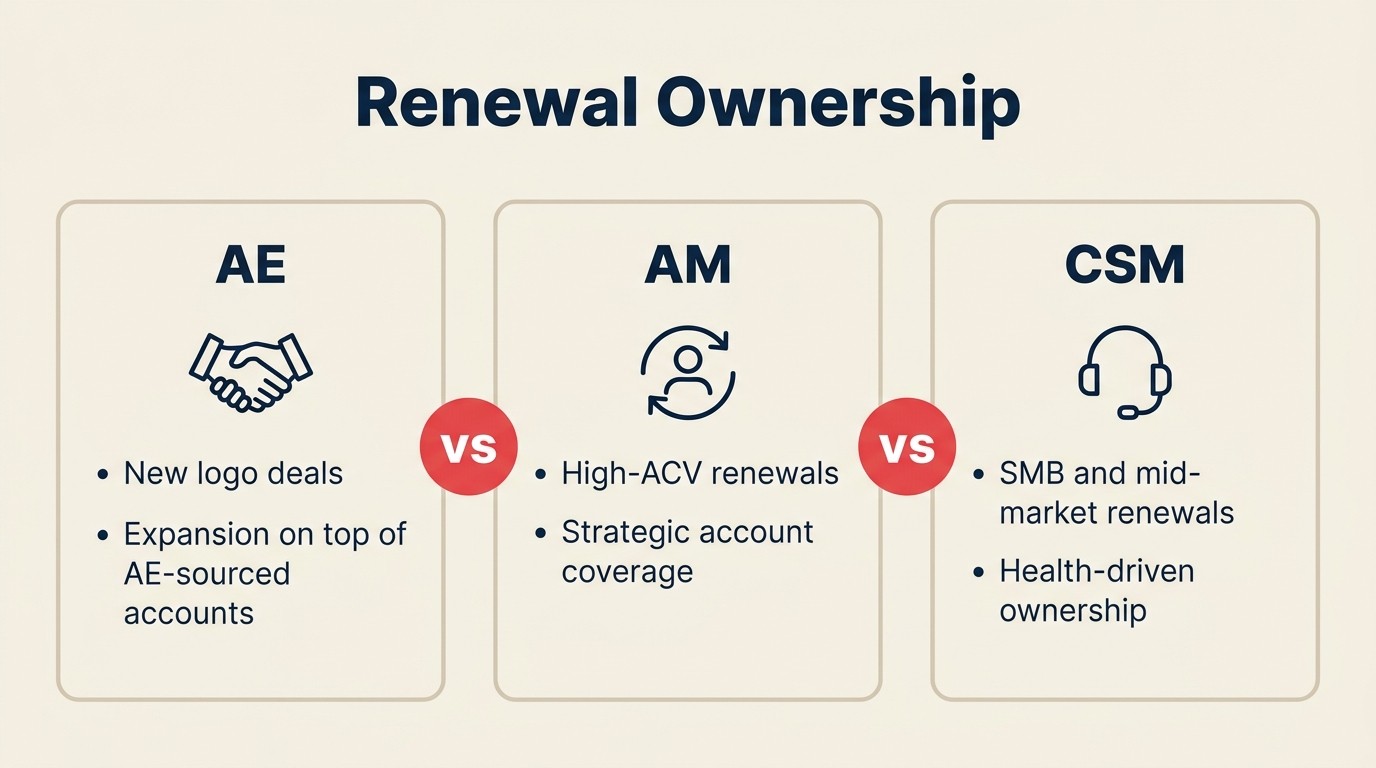
Renewal Ownership: AE vs AM vs CSM: Who Quarterbacks the Renewal and When
Turn this article into takeaways for your work.


Each assistant summarizes the article only for you and suggests best practices for your work.
It's 45 days before the renewal date. The CSM assumes the AE has started the commercial conversation: they closed the deal, they know the commercial relationships, this is their territory. The AE assumes the CSM has it: they've been managing the account for 11 months, they're the relationship, they know the account's health status. The customer hasn't heard from anyone with authority to move the paperwork.
The deal slips. Or worse, it churns. Not from a product failure. Not from poor CS execution. From an ownership vacuum that nobody created on purpose and nobody filled.
This scenario plays out across revenue teams every quarter. Not because AEs and CSMs are negligent. Because renewal ownership wasn't assigned. It was assumed. And assumptions about ownership are exactly how $X ARR exits the door without anyone feeling personally responsible.
Key Facts: The Cost of Renewal Ownership Gaps
- Deals lacking a defined renewal owner are 2x more likely to churn or significantly downsize than deals with an explicitly assigned quarterback, per Gainsight research on B2B renewal outcomes.
- The average B2B SaaS company loses 8-12% NRR annually to renewals that "slipped through the cracks" (deals where both AE and CSM believed the other team was responsible), per TSIA survey data.
- Only 31% of B2B SaaS companies document renewal ownership at the time of close, per ChurnZero's annual CS industry survey, meaning 69% are making the assignment reactively, 60-90 days before the renewal date.
- Companies that assign renewal ownership at close see 15% higher renewal rates and 23% higher expansion rates on the same accounts, per Gainsight data on proactive renewal management.
Why Renewal Ownership Is a Seam Problem, Not a Role Problem
AE, AM (Account Manager; see the Sales-CS Alignment Glossary), and CSM (Customer Success Manager; see glossary) are all legitimate renewal owners depending on context. There's no universal right answer. The error isn't picking the wrong role. The error is having no explicit assignment at all. McKinsey research on customer success notes that 50% of companies measure CS teams on renewal rates while 50% do not, a split that reflects genuine strategic disagreement, not just operational inconsistency.
Renewal ownership must be decided at the time of close, not 60 days before the renewal date. By the time you're 60 days out, the at-risk signals are already present, the customer has already formed an opinion about whether they're staying, and whoever gets assigned is immediately playing catch-up.
What does "renewal ownership" actually mean? For the purposes of this article, ownership means three things:
- Scheduling the renewal meeting and driving it to completion
- Owning the draft contract and commercial terms
- Managing escalation if the account goes at-risk before the renewal date
This article is about who owns those three things and how that assignment is made. It's not about how to run the renewal conversation, how to negotiate multi-year terms, or how to execute a retention play when an account is in crisis. Those are execution questions. This article is the upstream assignment question.
The Three Models: How Each Works and When to Use It
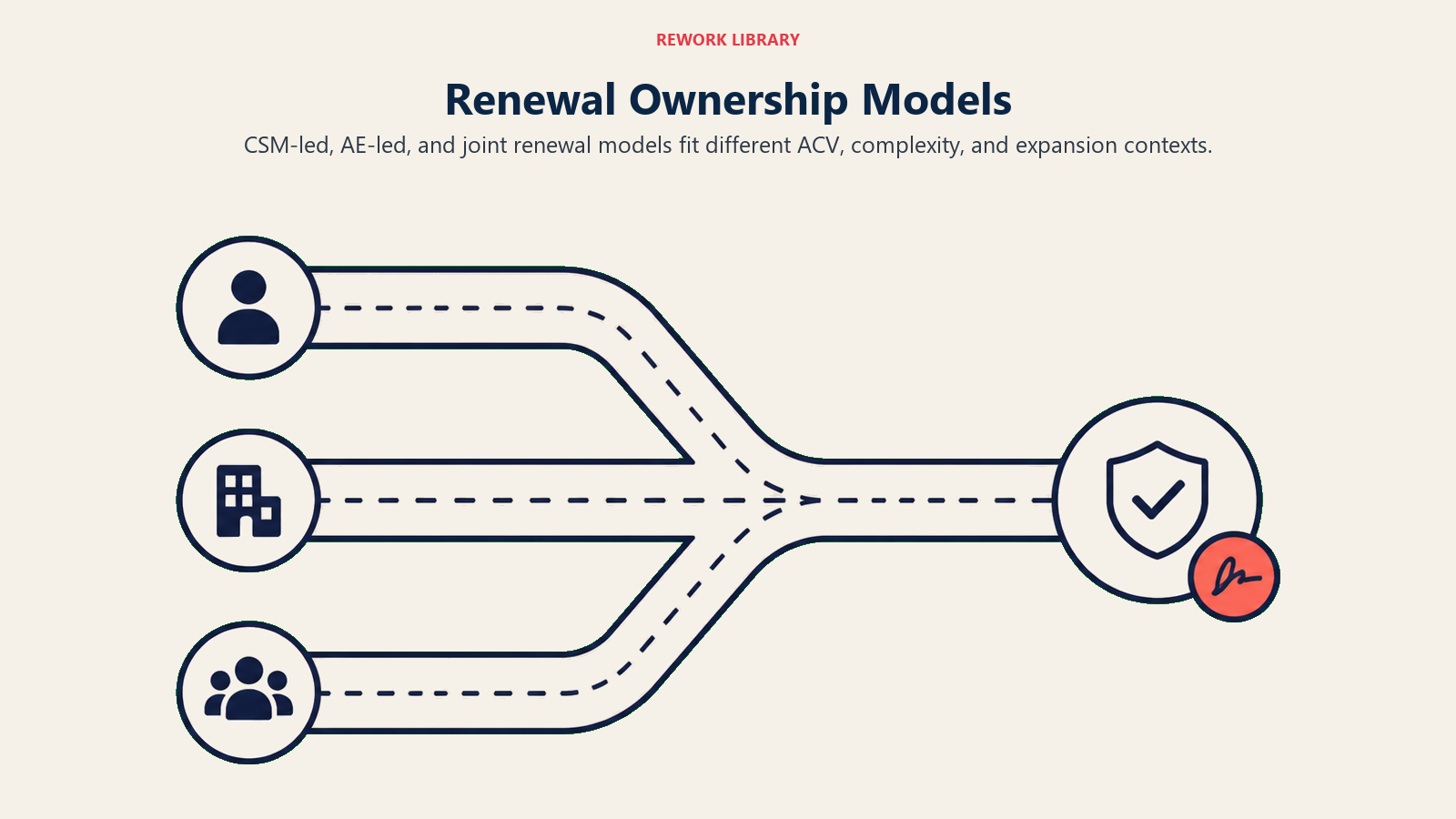
Model A: CSM-Led Renewal
The CSM owns the full renewal motion. They drive the commercial conversation, manage the contract process, and close the paperwork. The AE is informed but not in the driver's seat.
Best fit:
- High-volume SMB portfolios with low ACV (sub-$20K)
- Renewals that are largely administrative: not multi-year, not multi-product, no significant expansion opportunity
- CS teams with commercial authority (or a streamlined contract process the CSM can navigate without Sales involvement)
What the AE's role looks like: The AE gets notified 90 days before renewal. They review the account health signal, confirm there's no expansion opportunity that warrants their direct involvement, and stay available for escalation if the CSM hits a commercial blocker. They're on cc of the renewal notification, not in the driver's seat.
NRR (Net Revenue Retention; see glossary) risk: This model works well at volume until churn spikes. The structural limitation: CSMs in a pure Model A environment often lack commercial authority when a customer pushes back on pricing, demands contract modifications, or needs executive-level reassurance. The model breaks down at the exact moment it matters most: when the renewal is at risk.
Mitigate this by defining the escalation trigger clearly: any account that goes yellow on health in the 90 days before renewal automatically pulls the AE in. The CSM doesn't need to ask. The trigger does it.
Model B: AE/AM-Led Renewal
Sales owns the commercial process. The AE or AM schedules the renewal meeting, owns the draft contract, and manages the commercial close. The CSM provides the health signal and relationship context, attends the renewal meeting, and remains the ongoing relationship owner after the contract is signed.
Best fit:
- Mid-market accounts (ACV $20K-$150K)
- Multi-year or multi-product renewals with expansion potential
- Accounts where the original AE still has a strong executive relationship
- Deals where the renewal conversation is also a commercial expansion conversation
What the CSM's role looks like: Intel provider and relationship anchor. The CSM prepares a health summary for the AE before the renewal meeting: usage trends, champion status, open issues, and any expansion signals observed in the last quarter. The CSM attends the renewal meeting but lets the AE lead the commercial discussion. The CSM is the trusted advisor in the room; the AE is the closer.
Risk: AEs who close the deal and go dark for 11 months, then re-appear 30 days before renewal with a contract. The customer experience is jarring. The relationship context the AE once had is gone. The CSM has to backstop a commercial conversation with an AE who doesn't know the account's current state.
The fix: in Model B, the AE has defined touchpoints between close and renewal. Not weekly calls, but quarterly check-ins coordinated with the CSM. The AE should attend at least one QBR annually, specifically so they don't show up as a stranger at renewal.
Model C: Joint Ownership with a Quarterback
There's a defined primary owner (usually the AE or AM) and a defined support role (CSM), with a written handoff point that specifies when ownership shifts.
Best fit:
- Enterprise accounts (ACV $150K+)
- Strategic accounts with multi-stakeholder renewals
- Complex accounts where the renewal involves multiple product lines, multiple business units, or significant scope changes
The handoff trigger: Not a date. An event. "When the account reaches Stage 2 of the renewal process (commercial terms opened), ownership transfers to the AE" is a handoff trigger. "When it's 90 days before renewal" is a calendar reminder, not a handoff.
Define the event that signals the commercial process has started, and make the AE the quarterback from that point forward. Before the trigger, it's a CSM-led relationship. After the trigger, it's an AE-led commercial process with CSM in support.
AM as a distinct role: If your company has separated new-logo AEs from renewal/expansion AEs, the AM (Account Manager) owns the commercial renewal motion by definition. In this structure, the AM is the permanent commercial owner for existing accounts, and the CSM is the delivery and adoption owner. The renewal handoff protocol is simpler: AM is always the quarterback, CSM is always the intel provider. The challenge in this model is handoff from new-logo AE to AM at the time of close. If that handoff is rough, the AM starts behind. The post-sale team structures article covers how companies typically structure this AM-CSM split operationally at different stages of scale.
Decision Framework: Choosing the Right Model
Three variables determine which model fits an account:
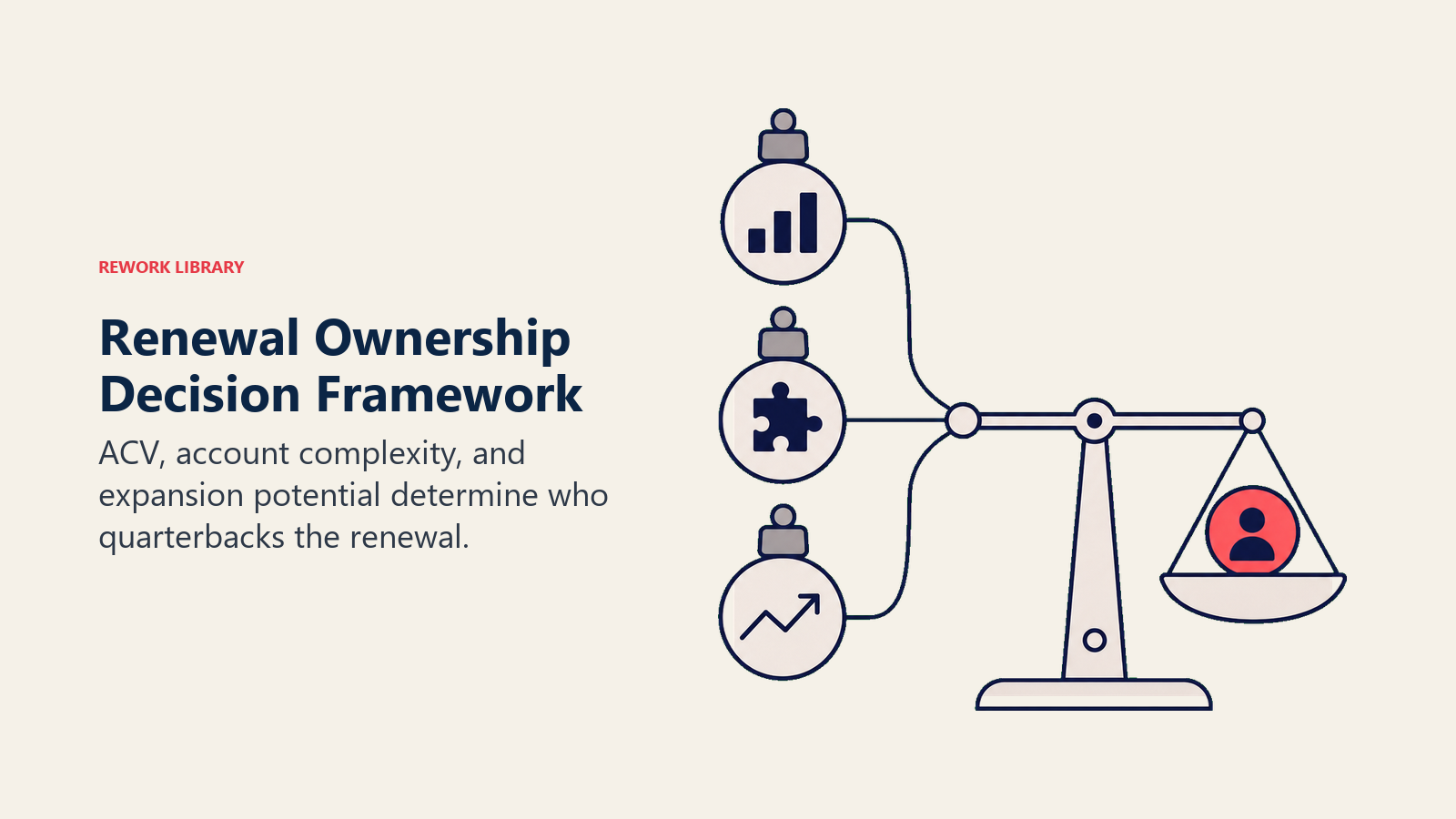
Variable 1: ACV
- Under $20K: Model A default
- $20K-$150K: Model B default
- $150K+: Model C default
Variable 2: Account complexity
- Single product, single business unit, single decision-maker: lower model letter
- Multi-product, multi-stakeholder, enterprise org: higher model letter
Variable 3: Expansion potential
- Low or no expansion signal: lower model letter (renewal is administrative)
- Active expansion opportunity identified: higher model letter (renewal is a commercial conversation)
Assignment matrix:
| ACV | Complexity | Expansion potential | Model |
|---|---|---|---|
| Under $20K | Low | Low | Model A |
| Under $20K | Low | Active | Model B |
| $20K-$150K | Any | Any | Model B |
| $150K+ | Any | Any | Model C |
| Any | Enterprise (multi-stakeholder) | Any | Model C |
RevOps assigns the model at close using this matrix. The assignment lives in the CRM account record, not in a spreadsheet, not in someone's head. Both AE and CSM can see their role without a meeting.
How to document the assignment: A single field in the CRM account record: "Renewal Model: A / B / C" and "Renewal Quarterback: [name]." Updated at close by RevOps or by the AE at close. Reviewed 90 days before the renewal date.
The "Quarterback" Definition: What It Actually Means
The quarterback doesn't do everything. They call the play and make sure everyone runs their route.
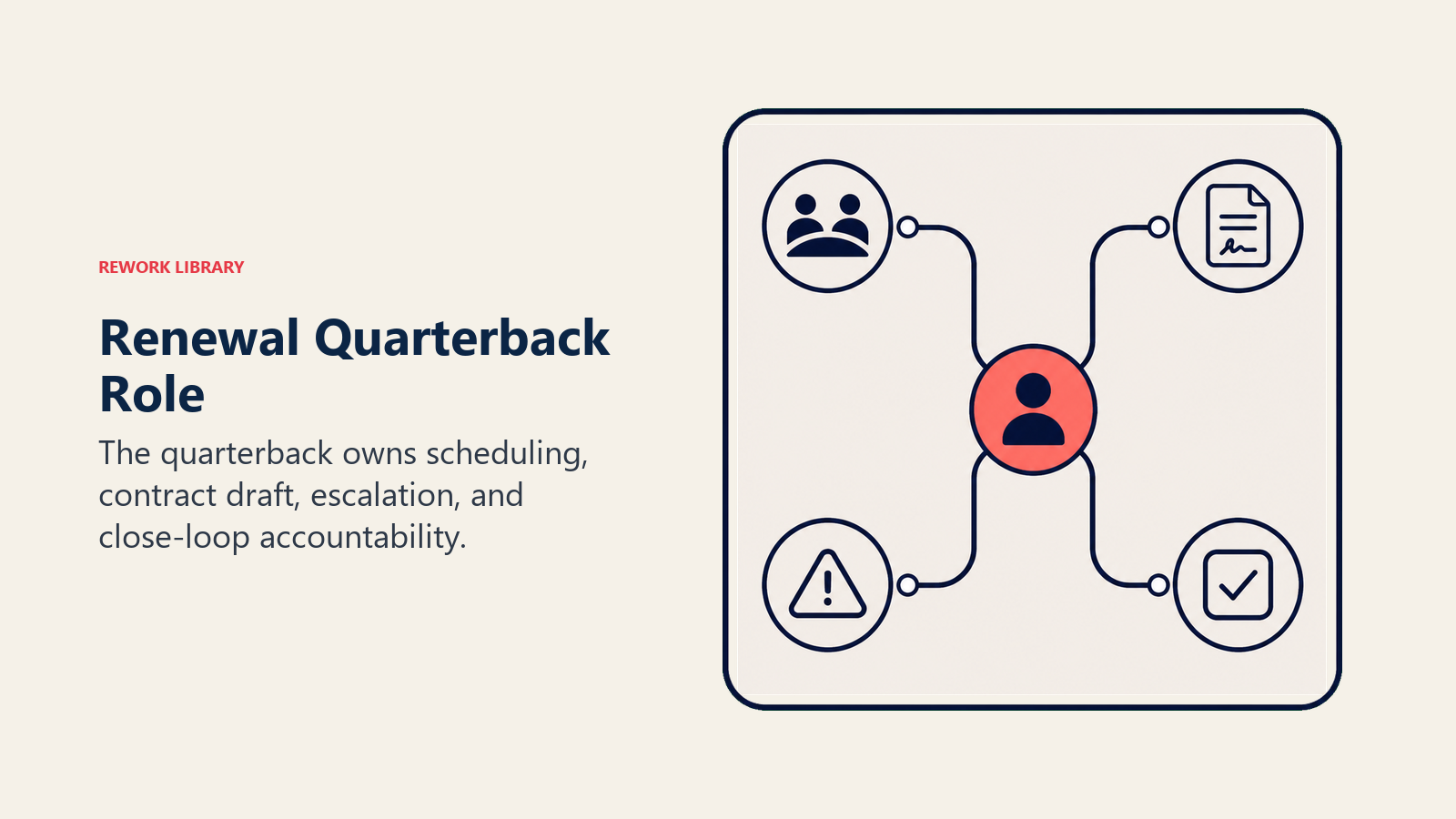
Concretely, the quarterback:
- Schedules the renewal meeting (or delegates to their EA, but owns the decision that it's scheduled)
- Owns the contract draft and sends it to the customer
- Manages the escalation chain if the account goes at-risk: their manager, then VP Sales, then CRO if needed
- Closes the loop after the renewal: to the CSM, to their manager, and in the CRM
The quarterback is NOT the only person talking to the customer. The CSM maintains their regular cadence regardless of who quarterbacks the renewal. The quarterback manages the commercial close; the CSM manages the relationship. Both run simultaneously, with communication between them.
What happens when the quarterback is wrong, when the account goes at-risk in a way that requires a different lead?
Define the escalation path explicitly:
- Health drops to red: VP CS notified same day; VP Sales notified within 24 hours; joint decision on whether to change the quarterback or add executive coverage
- Champion departs mid-renewal process: AE activates immediately regardless of model assignment; joint AE-CSM account plan required
- Customer requests a contract modification outside standard terms: escalates to VP Sales; CSM stays in relationship role
Compensation Alignment at the Renewal
Renewal ownership models only work when compensation doesn't create perverse incentives for one role to grab the renewal or avoid it.
The most common failure: CSM owns the renewal in Model A but gets no comp credit for renewal revenue. The CSM has every incentive to escalate to the AE to share the burden, and the AE has every incentive to get on the call once they realize there's commission involved. The result is role confusion at exactly the moment when clarity matters most.
Brief framing here. The detailed treatment is in Sales Commission on Retention and in the compensation architecture article. The key principle: whoever quarterbacks the renewal should receive at least partial credit for the renewal outcome, good or bad. Accountability requires stake. Stake requires comp.
When to Pull Sales Into a CS-Led Renewal
In Model A, the default is CSM-led. But there are five signals that should trigger automatic AE involvement regardless of model assignment:
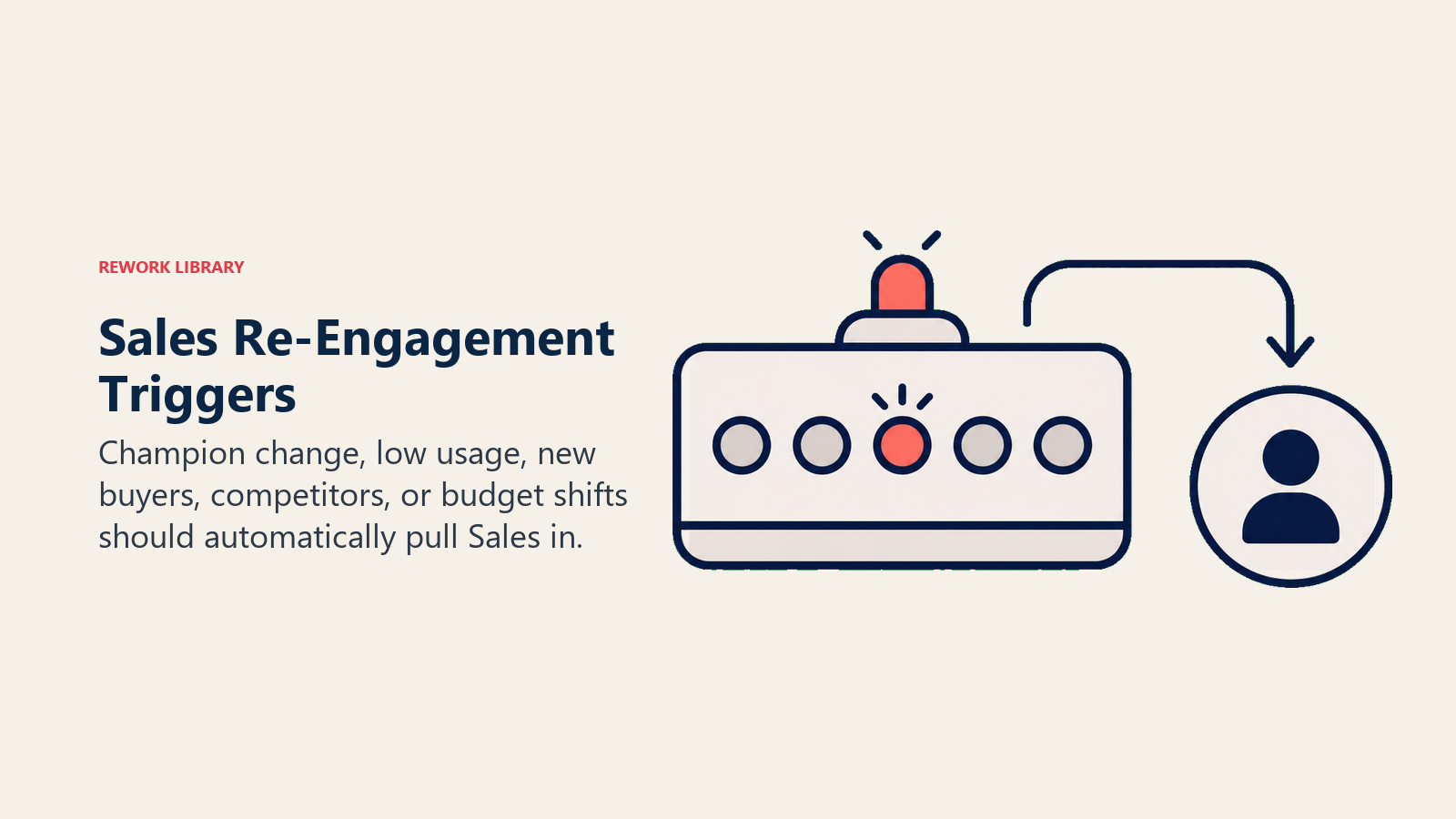
1. Champion has left or changed If the primary champion who originally bought the product is no longer in their role, the commercial relationship needs to be rebuilt. The CSM can maintain the day-to-day relationship, but the AE needs to re-establish the executive connection. This is especially true if the new champion wasn't involved in the original purchase decision and doesn't have buy-in.
2. Seat utilization below threshold at 90 days before renewal Define the threshold per account tier. But if utilization is below 50% of purchased seats at 90 days out, the renewal is at risk and the AE should be in the loop. The CSM and AE co-build a success plan.
3. New executive buyer involved If a new CFO or COO is asking questions about the renewal, that's an executive commercial conversation. CSMs generally don't have the positional authority to hold that conversation. Pull the AE in.
4. Competitor mentioned in the last QBR Not as a casual reference. As an active evaluation. If the customer mentioned they're looking at a competitor's product, the renewal is a competitive deal. That warrants Sales involvement even in a Model A account.
5. Budget conversation has changed If the account is going through a budget review, a reorganization, or any event that puts the renewal budget at risk, escalate immediately. Budget conversations require commercial relationships, not just product adoption data.
For a detailed playbook on AE re-engagement in at-risk accounts, see When Sales Gets Pulled Into an At-Risk Account.
Operationalizing the Decision
Where renewal ownership is documented: The CRM account record. Not a spreadsheet. Not a verbal agreement at the close meeting. The CRM record that both AE and CSM can access, that survives AE turnover, and that RevOps can audit without asking anyone. Forrester's SaaS customer success lifecycle report identifies renewal ownership documentation as one of the highest-leverage structural inputs to subscription revenue predictability. The companies that get it right assigned ownership at close, not 60 days out. The single source of truth for the customer record article defines the architecture that makes renewal ownership visible to both teams in a shared system.
Who assigns it and when: RevOps assigns the model at close using the decision matrix above. For multi-year deals with a distant first renewal, RevOps reviews the assignment at the 180-day mark to confirm it still fits the account's current profile.
How to audit quarterly: RevOps runs a query every quarter: "Show me every account with a renewal in the next 6 months. Filter by: renewal model assigned (yes/no), quarterback named (yes/no)." Any account without both fields populated is a gap. Fill it before the renewal window opens.
That quarterly audit takes 20 minutes and prevents the ownership vacuum entirely.
Transition Forward
Renewal ownership is one seam. The adjacent seam is expansion ownership: once the renewal is secured, who owns the upsell motion? McKinsey's NRR research is direct on this: companies with NRR above 120% sustain higher valuations through bull and bear markets alike, with shorter payback periods. That makes renewal assignment a balance-sheet issue, not just a process one. The CSM is closest to the account and usually spots the expansion signal first. The AE has the commercial authority to close it. The handoff protocol between those two functions is as important as the renewal assignment. Expansion Ownership and Upsell Motion covers that seam in detail. And for how customer health data feeds into renewal decisions, customer health scoring with sales context is the upstream model this article assumes is in place.
The Renewal Ownership Decision Matrix
The Renewal Ownership Decision Matrix is the three-variable framework this article defines for assigning the right renewal model at close. Variable 1 is ACV (under $20K defaults to Model A, $20K-$150K to Model B, $150K+ to Model C). Variable 2 is account complexity (single product, single decision-maker lowers the model; enterprise multi-stakeholder raises it). Variable 3 is expansion potential (low expansion signals lower the model; active expansion opportunity raises it to ensure commercial authority is in the room at renewal).
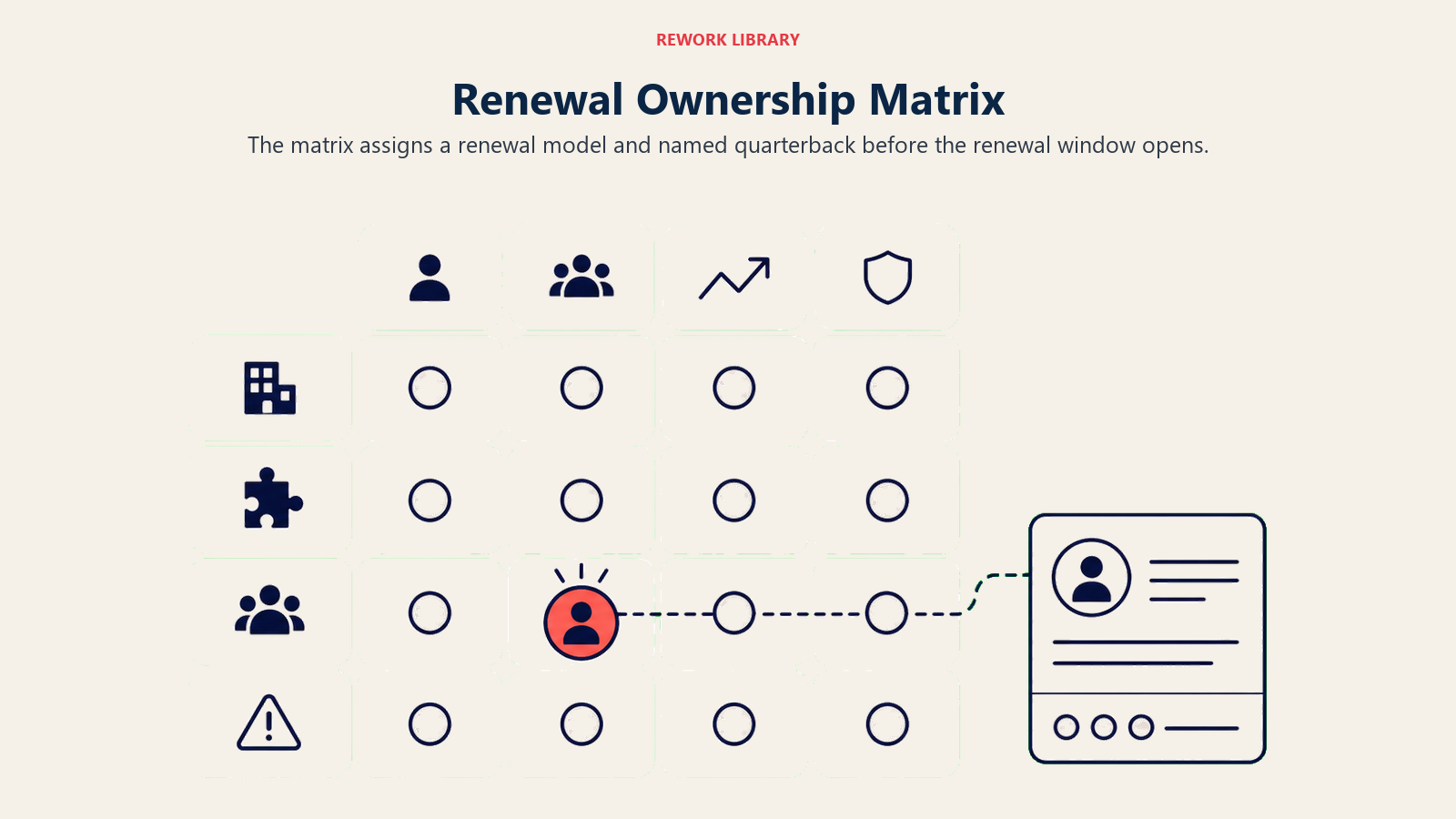
The matrix produces a model assignment (A, B, or C) and a named quarterback: the individual responsible for scheduling the meeting, owning the contract draft, and managing escalation if the account goes at-risk. The assignment lives in the CRM at close, not in a spreadsheet or in memory.
Rework Analysis: The quarterly audit that prevents ownership vacuums takes 20 minutes in RevOps: query every account renewing in the next 6 months, filter for "renewal model assigned" and "quarterback named," and fill any gaps before the renewal window opens. Companies that run this audit consistently report near-zero cases of "we each thought the other team had it," the most expensive form of renewal failure in mid-market SaaS.
Quotable Nuggets:
"Deals lacking a defined renewal owner are 2x more likely to churn or significantly downsize than deals with an explicitly assigned quarterback. The ownership vacuum is not a cultural failure, it's a documentation failure." (Gainsight research on B2B renewal outcomes)
"Only 31% of B2B SaaS companies document renewal ownership at the time of close, meaning 69% are making the assignment reactively, typically 60-90 days before the renewal date, when the customer has already formed their decision." (ChurnZero annual CS industry survey)
"Companies that assign renewal ownership at close see 15% higher renewal rates and 23% higher expansion rates on the same accounts. The difference between assignment at close and assignment at 60 days is the difference between a proactive commercial conversation and a rescue mission." (Gainsight data on proactive renewal management)
Frequently Asked Questions about Renewal Ownership
What is a renewal quarterback in B2B SaaS?
A renewal quarterback is the named individual (AE, AM, or CSM) responsible for three specific outputs: scheduling the renewal meeting, owning the contract draft, and managing escalation if the account goes at-risk before the renewal date. The quarterback doesn't do everything; they ensure everything gets done. They're assigned at the time of deal close using an ACV-and-complexity matrix, and their name lives in the CRM account record where both Sales and CS can see it.
Which renewal model should you use and when?
Three models cover most scenarios. Model A (CSM-led) fits SMB accounts under $20K ACV with low complexity and no active expansion signal. Model B (AE/AM-led) fits mid-market accounts from $20K-$150K, or any account with active expansion potential. Model C (joint ownership with a defined quarterback) fits enterprise accounts above $150K, or any account with multi-stakeholder complexity. The model is assigned by RevOps at close using these three variables: ACV, account complexity, and expansion potential.
When should a CSM own the renewal versus an AE?
The default allocation: CSM-led for SMB accounts under $20K ACV with low complexity and no active expansion signal. AE-led for mid-market and above, or any account with active expansion potential. The principle is that whoever leads the renewal should have the authority and incentive to handle the commercial conversation that renewal requires.
What happens to renewal ownership when the AE who closed the deal leaves the company?
The CRM record shows the assigned model and quarterback. RevOps reassigns the quarterback within 5 business days of the AE departure notification. If the replacement AE isn't yet assigned, the VP Sales temporarily owns the account or delegates to an AM. The CSM maintains their regular cadence uninterrupted. The key is that the quarterback is a named individual, not a role, so the gap is visible immediately.
Should the AE attend every renewal meeting or just the risky ones?
In Model B and C, the AE should attend the renewal meeting regardless of account health. The renewal meeting is a commercial conversation, and the AE is the commercial owner. In Model A, the AE attends if any of the five escalation triggers are present (champion departure, competitive threat, new executive buyer, low utilization, budget change). For green-health Model A accounts, the AE review is optional, but the CSM should brief the AE and get explicit sign-off before the meeting.
How do you handle renewal ownership in companies without an AM role?
Without a dedicated AM, the choice is between the original AE and the CSM. For mid-market accounts, use the AE. For SMB accounts, use the CSM. If the original AE has moved to a different segment, assign the renewal to the AE whose territory the account now falls in, and schedule a warm handoff call with the customer to introduce the new relationship.
Learn More

Principal Solution Architect
On this page
- Why Renewal Ownership Is a Seam Problem, Not a Role Problem
- The Three Models: How Each Works and When to Use It
- Model A: CSM-Led Renewal
- Model B: AE/AM-Led Renewal
- Model C: Joint Ownership with a Quarterback
- Decision Framework: Choosing the Right Model
- The "Quarterback" Definition: What It Actually Means
- Compensation Alignment at the Renewal
- When to Pull Sales Into a CS-Led Renewal
- Operationalizing the Decision
- Transition Forward
- The Renewal Ownership Decision Matrix
- Learn More