What is Scalability? Why Some Companies Grow 10x While Others Just Get 10x More Complex
Turn this article into takeaways for your work.


Each assistant summarizes the article only for you and suggests best practices for your work.
Two companies. Both doubled revenue last year.
Company A: Hired 2x people, spent 2x on systems, CEO worked 2x hours. Company B: Hired 20% more people, same systems, CEO worked less.
Same growth. Completely different futures. The difference? Scalability.
Scalability: Growth Without Proportional Pain
Scalability = The ability to increase revenue without proportionally increasing costs
It's the difference between:
- Linear growth: 2x revenue = 2x everything
- Scalable growth: 2x revenue = 1.2x costs
- Exponential growth: 2x revenue = 1.1x costs
Build scalability in, or growth will kill you.
The Three Types of Scalability
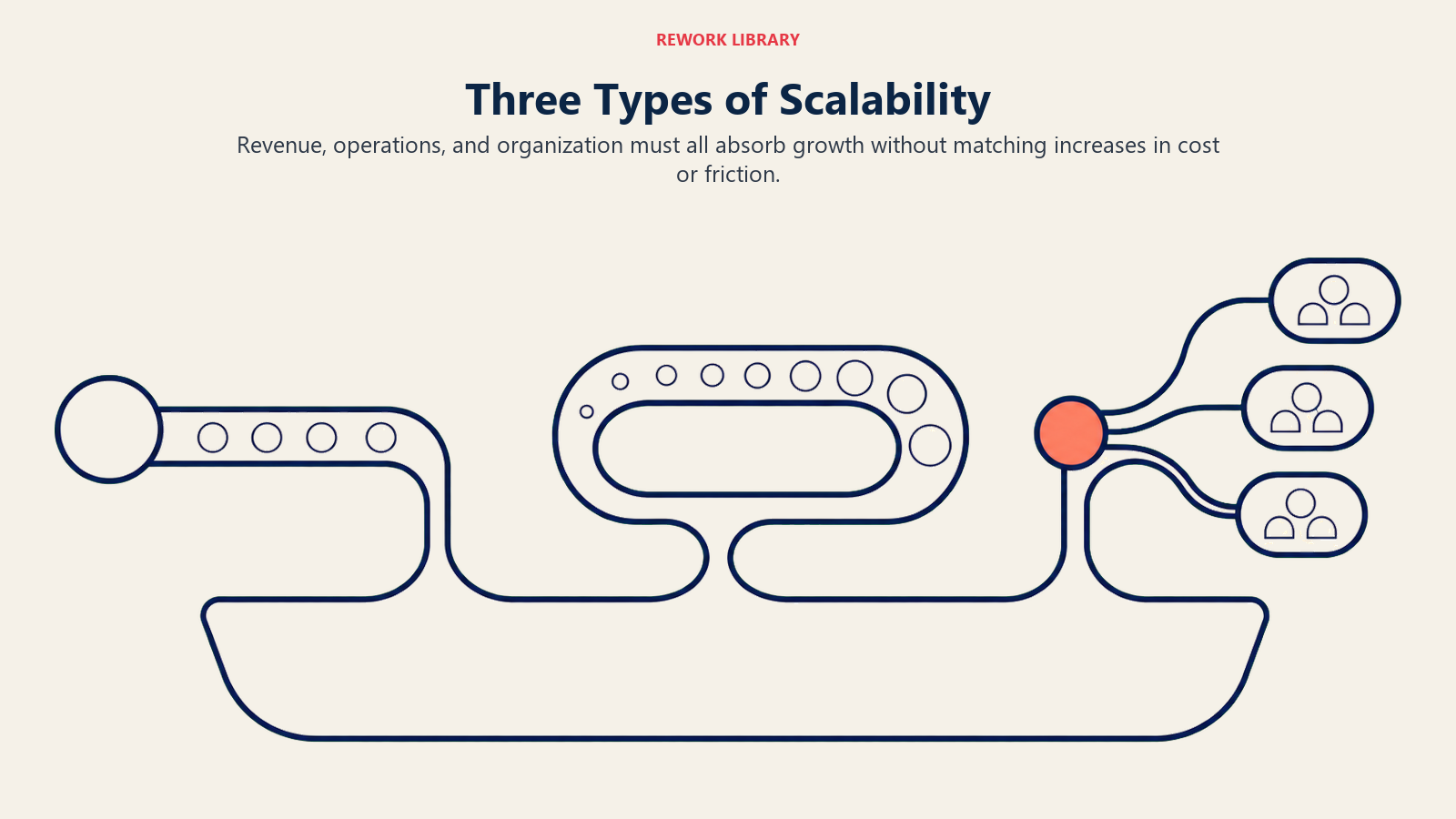
Scalability has three linked dimensions. Revenue, operations, and organization must all absorb growth without matching increases in cost or friction.
1. Revenue Scalability
Can you add customers without adding proportional costs?
High scalability:
- Software (near-zero marginal cost)
- Digital products
- Platforms/marketplaces
- Content businesses
Low scalability:
- Consulting (time-based)
- Restaurants (physical limits)
- Manufacturing (materials)
- Healthcare (provider time)
2. Operational Scalability
Can your operations handle 10x volume?
Scalable operations:
- Automated processes
- Self-service models
- Cloud infrastructure
- Distributed teams
Non-scalable operations:
- Manual processes
- High-touch service
- Fixed infrastructure
- Centralized decisions
3. Organizational Scalability
Can your team/culture handle growth?
Scalable organization:
- Clear roles/responsibilities
- Documented processes
- Strong middle management
- Autonomous teams
Non-scalable organization:
- Everything through founder
- Tribal knowledge
- Weak management layer
- Command-and-control
The Scalability Paradox
Here's what kills most companies:
Phase 1: Start lean, everything manual (works at small scale) Phase 2: Grow fast, complexity explodes (breaks at medium scale) Phase 3: Try to fix while growing (impossible) Phase 4: Growth stalls or company breaks
The secret: Build scalability BEFORE you need it.
Scalability Patterns That Work
The SaaS Model
Revenue: Subscription fees Marginal cost: Near zero Scalability secret: Same code serves infinite users
Example: Zoom
- 10 users: Same infrastructure
- 10 million users: Same infrastructure (scaled)
- Result: 90% gross margins
The Marketplace Model
Revenue: Transaction fees Marginal cost: Payment processing Scalability secret: Users create value for each other
Example: Airbnb
- Don't own properties
- Don't employ hosts
- Just connect and collect
- Result: $8B revenue, 5,000 employees
The Platform Model
Revenue: Multiple streams Marginal cost: Minimal Scalability secret: Others build on you
Example: Shopify
- Merchants do the selling
- Apps extend functionality
- Shopify provides infrastructure
- Result: Powers 10% of e-commerce
The Content Model
Revenue: Ads/subscriptions Marginal cost: Zero per view Scalability secret: Create once, monetize forever
Example: Netflix
- Same show costs whether 1 or 100M watch
- Algorithm scales curation
- Global distribution built-in
- Result: 230M subscribers
The Anti-Patterns (What Not to Do)
The Agency Trap
- Revenue tied to billable hours
- Growing means hiring linearly
- Quality depends on specific people
- Result: Owners can never exit
The Restaurant Trap
- Physical location limits
- Labor intensive
- Inventory spoilage
- Result: Work harder to grow
The Consulting Trap
- Expertise doesn't scale
- Custom work every time
- Senior time bottleneck
- Result: Growth ceiling
The Manufacturing Trap
- High capital requirements
- Physical goods logistics
- Inventory risks
- Result: Cash flow nightmares
Building Scalability Into Your Business
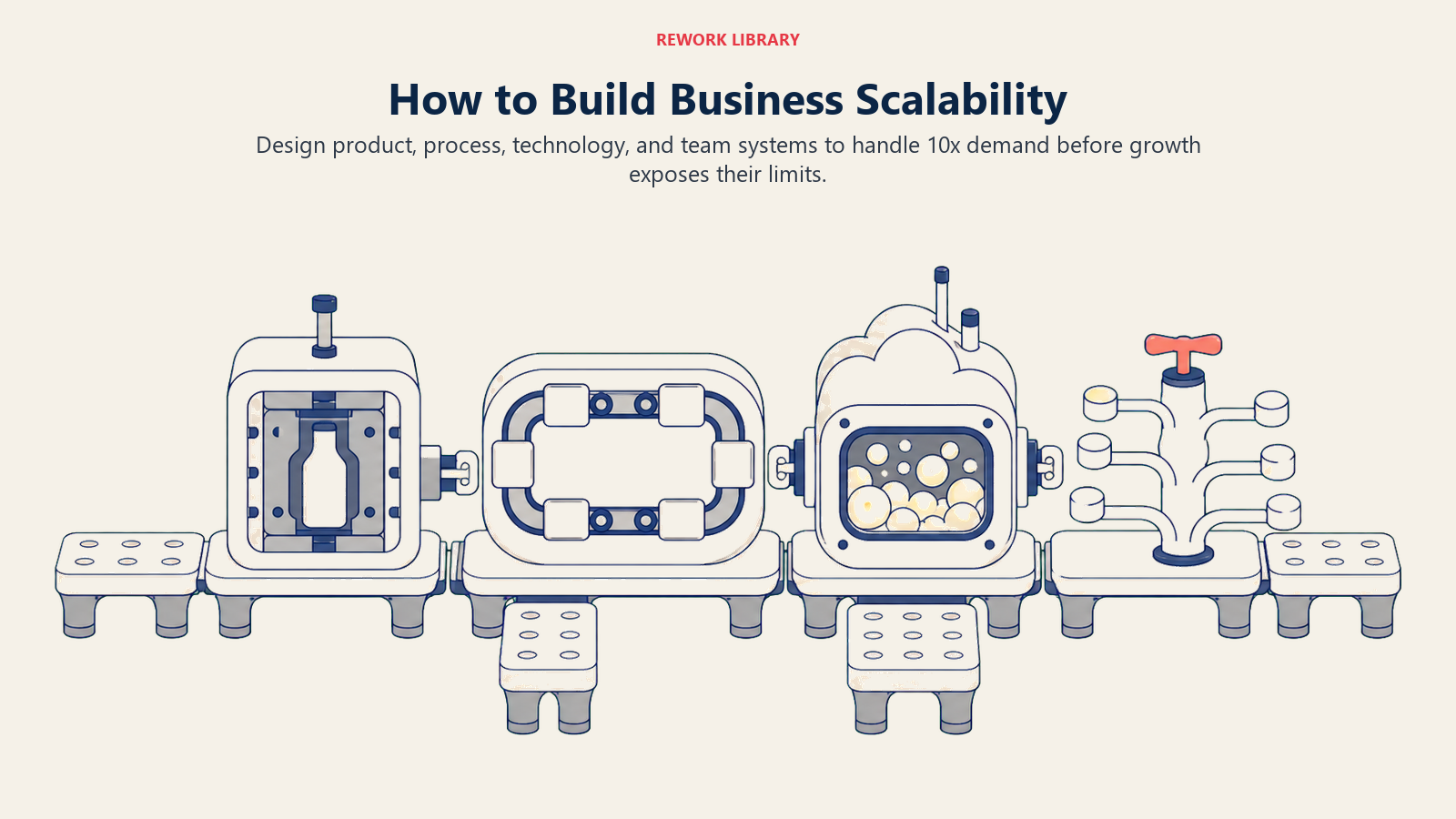
Scalable growth is designed into four connected systems before volume arrives: product, process, technology, and team.
1. Product Scalability
Ask: Can we serve 10x customers with this product?
Scalable features:
- Digital delivery
- Self-onboarding
- Automated support
- Standard offerings
Non-scalable features:
- Custom implementations
- High-touch onboarding
- Phone support only
- Bespoke everything
2. Process Scalability
Ask: Will this process work at 10x volume?
Scalable processes:
- Automated workflows
- Self-service options
- Async communication
- Clear documentation
Non-scalable processes:
- Manual approvals
- Meetings for everything
- Tribal knowledge
- Hero dependencies
3. Technology Scalability
Ask: Can our tech handle 10x load?
Scalable architecture:
- Cloud-native
- Microservices
- Auto-scaling
- API-first
Non-scalable architecture:
- Monolithic systems
- On-premise servers
- Manual deployments
- Tight coupling
4. Team Scalability
Ask: Can we 10x without 10x people?
Scalable teams:
- Clear playbooks
- Strong middle management
- Specialized roles
- Remote-first
Non-scalable teams:
- Founder does everything
- No documentation
- Generalists only
- Office-centric
Scalability Metrics That Matter
Unit Economics at Scale
Contribution Margin = (Revenue - Variable Costs) / Revenue

At 1x: 30% margin
At 10x: Should be 50%+ margin
If not, not truly scalable
The Rule of 3 and 10
Everything breaks at 3x and 10x growth:
- 3 employees → 10 (need managers)
- 10 → 30 (need directors)
- 30 → 100 (need VPs)
- 100 → 300 (need systems)
- 300 → 1000 (need culture)
Plan for breaks before they happen.
Revenue per Employee
Software: $200-500K/employee Services: $100-200K/employee Retail: $50-150K/employee
Growing revenue per employee = scalability Flat or declining = just getting bigger
The 80/20 Scalability Test
- 80% of revenue from 20% of effort = Scalable
- 50/50 split = Linear
- 20% of revenue from 80% effort = Broken
Audit your revenue sources now.
Case Studies in Scalability
WhatsApp: Ultimate Scalability
- 50 engineers
- 900 million users
- Sold for $19 billion
- Secret: Simple product, brilliant architecture
WeWork: Fake Scalability
- Claimed "tech company"
- Reality: Real estate with app
- Couldn't escape linear costs
- Result: $47B to near bankruptcy
AWS: Platform Scalability
- Started as Amazon's internal need
- Productized infrastructure
- Others build on top
- Result: $80B revenue, 70% margins
Your Scalability Transformation
Month 1: Audit Current State
Week 1: Revenue scalability
- Cost per customer
- Margin trends
- Pricing model
Week 2: Operational scalability
- Process bottlenecks
- Manual touchpoints
- System limitations
Week 3: Organizational scalability
- Decision bottlenecks
- Knowledge gaps
- Culture readiness
Week 4: Plan transformation
- Priority fixes
- Investment needs
- Timeline
Quarter 1: Foundation
- Automate one core process
- Document critical knowledge
- Hire key managers
- Upgrade core systems
Year 1: Transformation
- All processes scalable
- Technology upgraded
- Team structured for growth
- Metrics tracking scale
Common Scalability Mistakes
Mistake 1: Scaling Too Early
Premature optimization is evil. Find product-market fit first.
Mistake 2: Custom Everything
"Every customer is unique" = Death by complexity
Mistake 3: Heroic Culture
Depending on rockstars doesn't scale. Build systems.
Mistake 4: Ignoring Unit Economics
Growing while losing money per unit = Faster death
Mistake 5: Technical Debt
"We'll fix it later" becomes "We can't grow"
The Scalability Decision Framework
For every decision, ask:
- Will this work at 10x?
- Does it require linear resources?
- Can it be automated/systemized?
- Does it create or reduce complexity?
- What breaks if we grow 5x fast?
If the answers concern you, redesign before implementing.
Your Scalability Checklist
Product
- Digital delivery possible
- Self-service available
- Standard offerings
- Automated onboarding
Operations
- Documented processes
- Automated workflows
- Scalable systems
- Remote capabilities
Organization
- Clear org structure
- Strong managers
- Documented knowledge
- Scalable culture
Technology
- Cloud infrastructure
- API architecture
- Auto-scaling
- Modern stack
Finance
- Positive unit economics
- Improving margins
- Scalable pricing
- Efficient CAC
Score: 15+ checked = Highly scalable 10-14 = Moderately scalable <10 = Scalability crisis
The Bottom Line
Scalability isn't about getting bigger. It's about getting better as you grow.
The best businesses become more profitable, more efficient, and easier to run at scale. The worst become more complex, more expensive, and more fragile.
Which one are you building?
Here's the truth: Every business can be more scalable. But it requires choosing scalability over custom solutions, systems over heroes, and long-term thinking over short-term revenue.
Make those choices now, while you're small. Because once you're big and complex, it's almost impossible to retrofit scalability.
Growth without scalability isn't growth, it's just getting bigger before you fail.
Build to scale, or scale to fail. Your choice.
Ready to scale smartly? Master Operations Management for internal scaling or explore Platform Strategy for exponential growth models.
Part of the [Business Terms Collection]. Last updated: 2026-07-21
On this page
- Scalability: Growth Without Proportional Pain
- The Three Types of Scalability
- 1. Revenue Scalability
- 2. Operational Scalability
- 3. Organizational Scalability
- The Scalability Paradox
- Scalability Patterns That Work
- The SaaS Model
- The Marketplace Model
- The Platform Model
- The Content Model
- The Anti-Patterns (What Not to Do)
- The Agency Trap
- The Restaurant Trap
- The Consulting Trap
- The Manufacturing Trap
- Building Scalability Into Your Business
- 1. Product Scalability
- 2. Process Scalability
- 3. Technology Scalability
- 4. Team Scalability
- Scalability Metrics That Matter
- Unit Economics at Scale
- The Rule of 3 and 10
- Revenue per Employee
- The 80/20 Scalability Test
- Case Studies in Scalability
- WhatsApp: Ultimate Scalability
- WeWork: Fake Scalability
- AWS: Platform Scalability
- Your Scalability Transformation
- Month 1: Audit Current State
- Quarter 1: Foundation
- Year 1: Transformation
- Common Scalability Mistakes
- Mistake 1: Scaling Too Early
- Mistake 2: Custom Everything
- Mistake 3: Heroic Culture
- Mistake 4: Ignoring Unit Economics
- Mistake 5: Technical Debt
- The Scalability Decision Framework
- Your Scalability Checklist
- Product
- Operations
- Organization
- Technology
- Finance
- The Bottom Line