Feature Tier Upgrade: Converting Customers to Higher-Value Plans Through Strategic Packaging
Turn this article into takeaways for your work.


Each assistant summarizes the article only for you and suggests best practices for your work.
A basic tier upgrade moves a customer from your entry plan to a higher-value tier when they hit a feature limit, capability gap, or scale trigger. You drive it by packaging the right capabilities into each tier, building in-app prompts at the moment of need, and making the upgrade one click. Done well, this converts 15-25% of customers to higher tiers each year.
The tier upgrade paradox haunts most SaaS companies: offering too many features in base tiers kills expansion revenue, while offering too few kills acquisition.
Companies that load their Starter plans with premium capabilities acquire customers easily but have nowhere to expand them. Companies that artificially restrict base tiers drive customers to competitors who offer more value at entry levels. Finding the balance between acquisition-friendly entry tiers and expansion-enabling feature differentiation determines your expansion potential.
The best-performing SaaS companies have mastered tier architecture. They understand exactly which features belong in which tiers, how to create natural upgrade triggers, and how to execute upgrade conversations that convert 15-25% of customers annually. Their pricing pages aren't arbitrary feature lists. They're strategic expansion mechanisms designed to capture customers efficiently and expand them profitably.
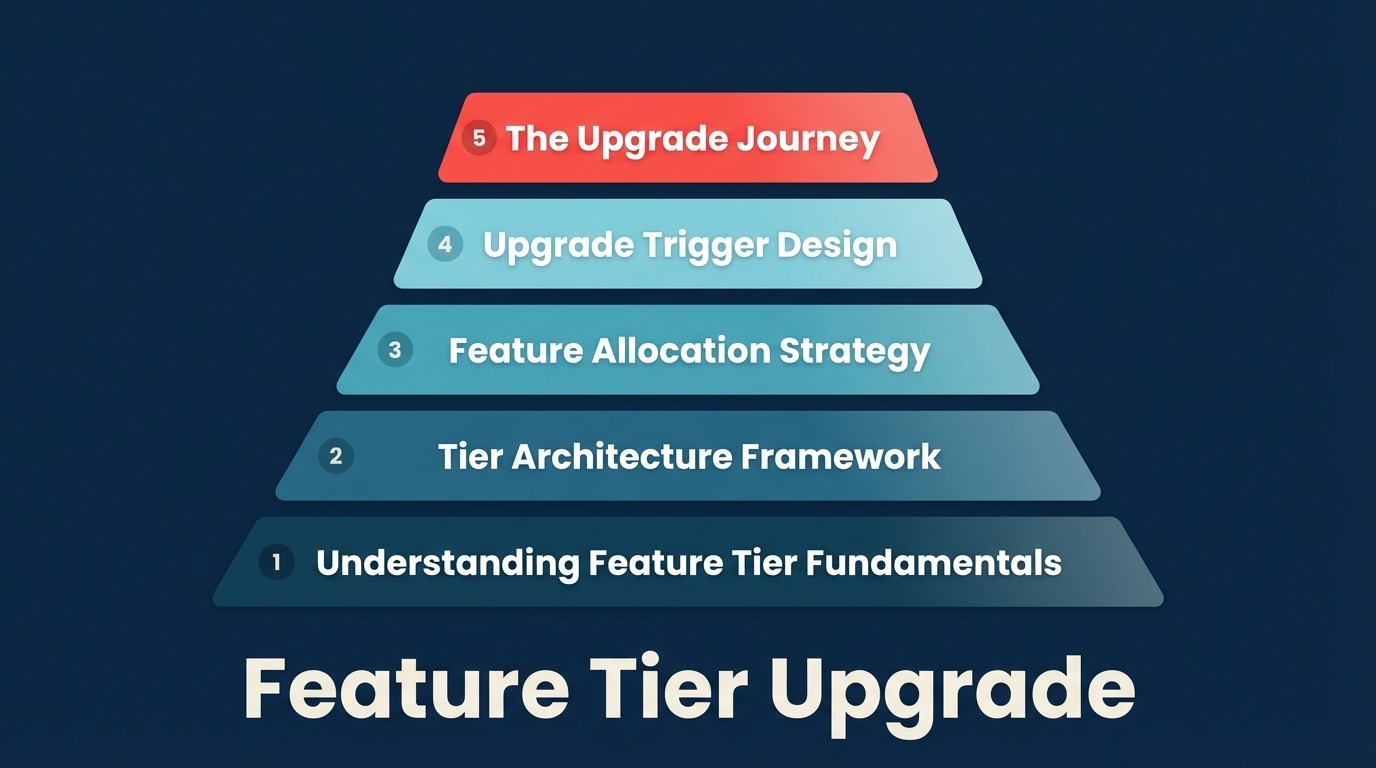
Understanding Feature Tier Fundamentals
Feature-based tiering packages different capabilities at different price points to serve different customer segments and usage patterns.
Good/Better/Best tier architecture represents the standard SaaS pricing model. Entry tiers (Starter, Basic, Essential) minimize barriers to customer acquisition. Middle tiers (Professional, Growth, Plus) serve mainstream customers with strong feature sets. Top tiers (Enterprise, Premium, Ultimate) target strategic accounts with advanced capabilities.
This structure creates natural migration paths. Customers start at entry levels to prove value cheaply. They upgrade to middle tiers as needs expand. Strategic accounts adopt top tiers for advanced capabilities and support.
Feature differentiation vs artificial limitation separates value-based tiering from arbitrary restriction. Value-based differentiation saves genuinely advanced capabilities for higher tiers. API access, advanced analytics, custom integrations, and enterprise security features cost more to build and deliver. Restricting them to higher tiers makes economic sense.
Artificial limitation restricts basic capabilities to force upgrades. Limiting projects to 3 in a project management tool or contacts to 100 in a CRM creates frustration rather than value. Customers feel manipulated rather than served. They start seeking alternatives instead of upgrading.
Understanding the different pricing model options helps you choose the right tier differentiation strategy for your product.
Value-based tier packaging aligns tier jumps with customer value expansion. Entry tiers deliver enough value to achieve initial outcomes. Middle tiers add capabilities that expand outcomes or serve growing teams. Top tiers provide capabilities that transform your product into mission-critical infrastructure.
Each tier should represent a meaningful capability jump worth the price increase. Customers should clearly understand what they gain from upgrading and why that additional value justifies additional cost.
Tier Architecture Framework
Most successful SaaS companies follow a 3-4 tier structure that balances acquisition and expansion.
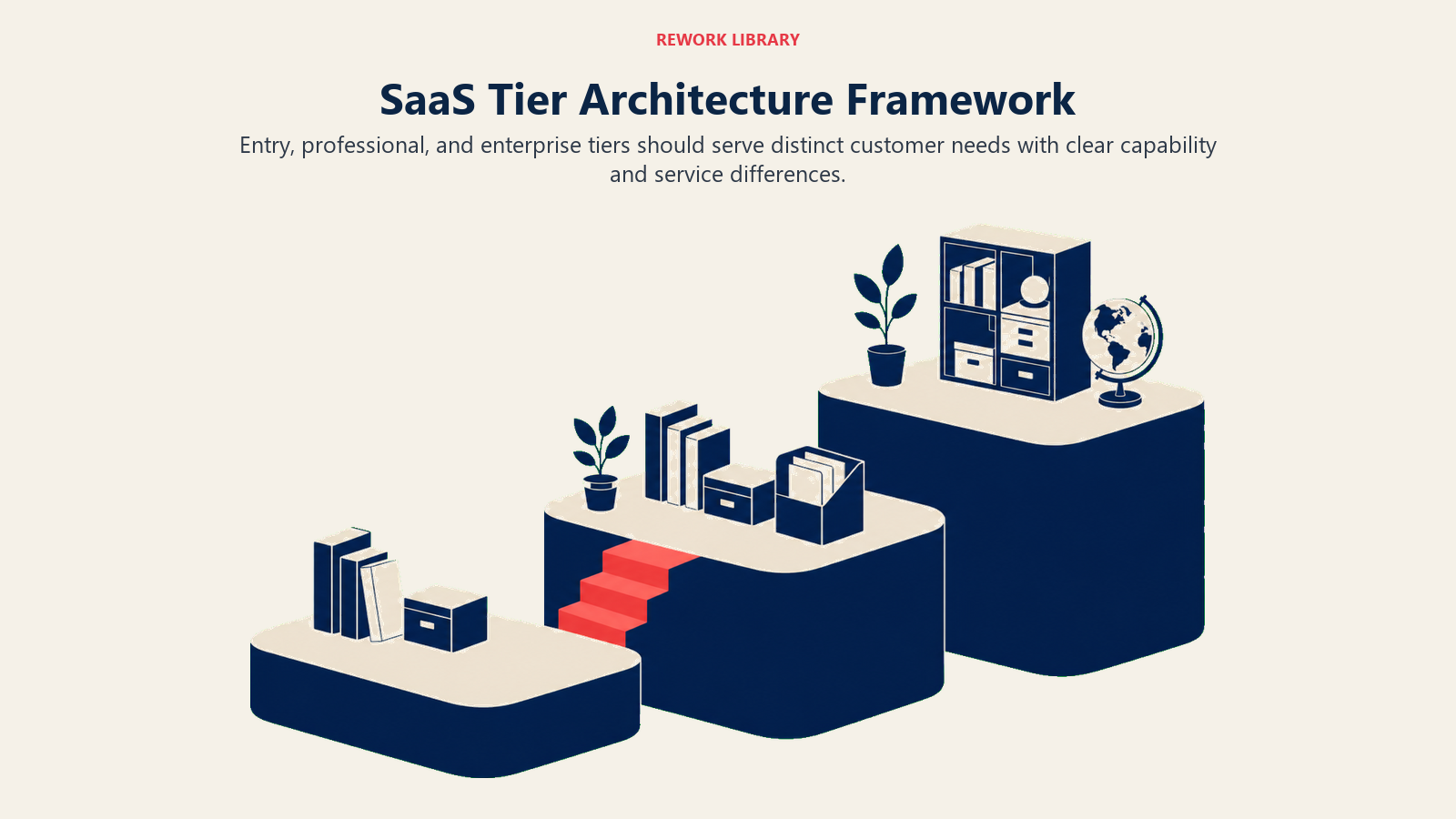
Starter/Entry tier optimizes for efficient customer acquisition. This tier should:
Remove financial barriers to trying your product. Pricing at $10-49 per month lets customers experiment without budget approval. Provide enough capability to achieve meaningful outcomes. Customers must prove your value proposition works for them. Create natural expansion vectors through thoughtful limitations. Customers should hit limitations that upgrading solves rather than abandoning the product.
Entry tiers work best when they capture individual users or small teams. A single marketer testing your tool. A 3-person startup needing basic functionality. These customers can't justify $100+ monthly commitments but will upgrade once they validate value.
Professional/Growth tier serves your mainstream customer base. This tier should:
Deliver the full core feature set most customers need. Professional tiers shouldn't feel like "almost enough." They should comprehensively serve target customers. Price at levels that reflect real business value. $49-199 per month positions the product as a serious business tool worth budgeting for. Include capabilities that small teams and growing companies actually use. Remove artificial limitations that frustrate rather than motivate upgrades.
Professional tiers generate the bulk of revenue for most SaaS companies. 40-60% of customers eventually land in middle tiers. These customers have validated value and committed budget but don't need enterprise-grade capabilities.
Enterprise/Premium tier targets strategic accounts with advanced needs. This tier should:
Provide capabilities that only larger organizations require. Advanced admin controls, SSO, audit logs, dedicated support, SLA commitments, and compliance certifications belong here. Price based on value delivered to enterprise customers. $500+ monthly or custom pricing reflects the real cost of enterprise features. Create clear differentiation from professional tiers. Enterprise capabilities should be obviously different, not marginally better.
Enterprise tiers serve 10-25% of customers but often generate 40-60% of revenue. These customers pay premium prices for premium capabilities and support.
Determining optimal tier count balances choice and simplicity. Three tiers (Entry/Pro/Enterprise) work for most companies. Simple products with clear use case progression fit three-tier models well.
Four tiers add a "Business" or "Team" tier between Professional and Enterprise. This works when there's meaningful differentiation between small team needs and mid-market company needs. More than four tiers creates analysis paralysis and weakens differentiation between adjacent tiers.
Feature Allocation Strategy
Which features go in which tiers determines your expansion potential and customer satisfaction.
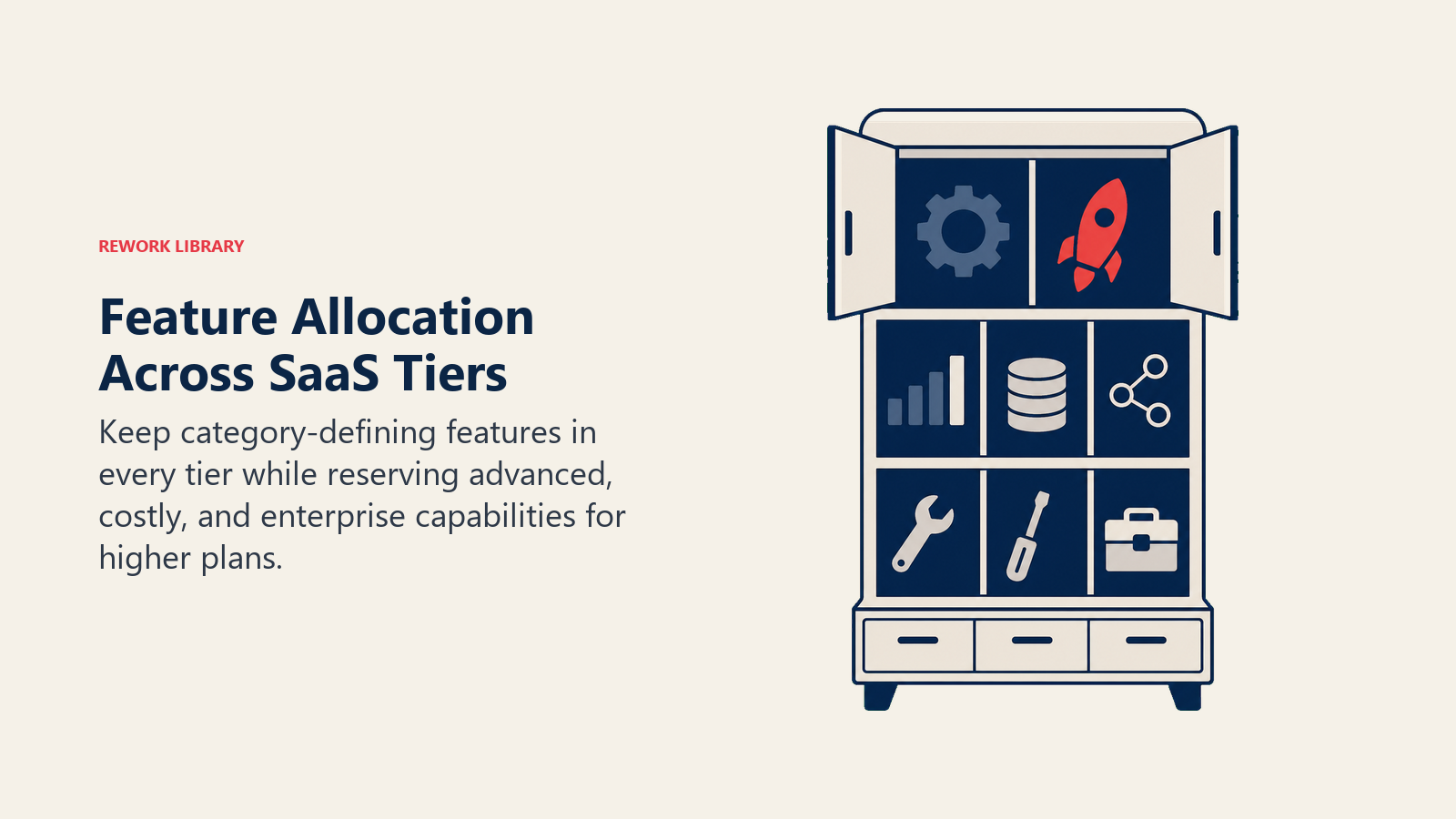
Core features appear in all tiers because they define your product category. Project management tools include task management, assignments, and deadlines across all tiers. CRMs include contact management and deal tracking. Removing core features from entry tiers prevents customers from validating your value proposition.
Differentiation features get reserved for higher tiers because they serve advanced use cases or require additional infrastructure. These include:
Advanced reporting and analytics that require sophisticated data processing. Custom integrations that demand engineering resources to maintain. Workflow automation that adds product complexity. Advanced permissions and controls needed by larger teams. Priority support that requires dedicated resources.
These features legitimately cost more to provide or serve needs that correlate with higher willingness to pay.
Enterprise features appear only in top tiers because they exclusively serve large organizations. SSO integration, SAML authentication, audit logs, compliance certifications, dedicated customer success, and SLA guarantees represent capabilities that only enterprises value enough to pay for.
Feature anchoring and comparison shapes how customers perceive tier value. Your Professional tier's feature list should make it obviously superior to Entry while Enterprise should be clearly more capable than Professional. Use feature comparison tables to highlight differences rather than hiding them.
The "goldilocks pricing" principle suggests most customers should choose your middle tier. If tier distribution clusters at entry or enterprise levels, your packaging likely misaligns with customer needs. Professional tier should be the obvious choice for mainstream customers, with entry and enterprise serving edge cases.
Upgrade Trigger Design
Build triggers into your product and tier design that naturally create upgrade conversations.
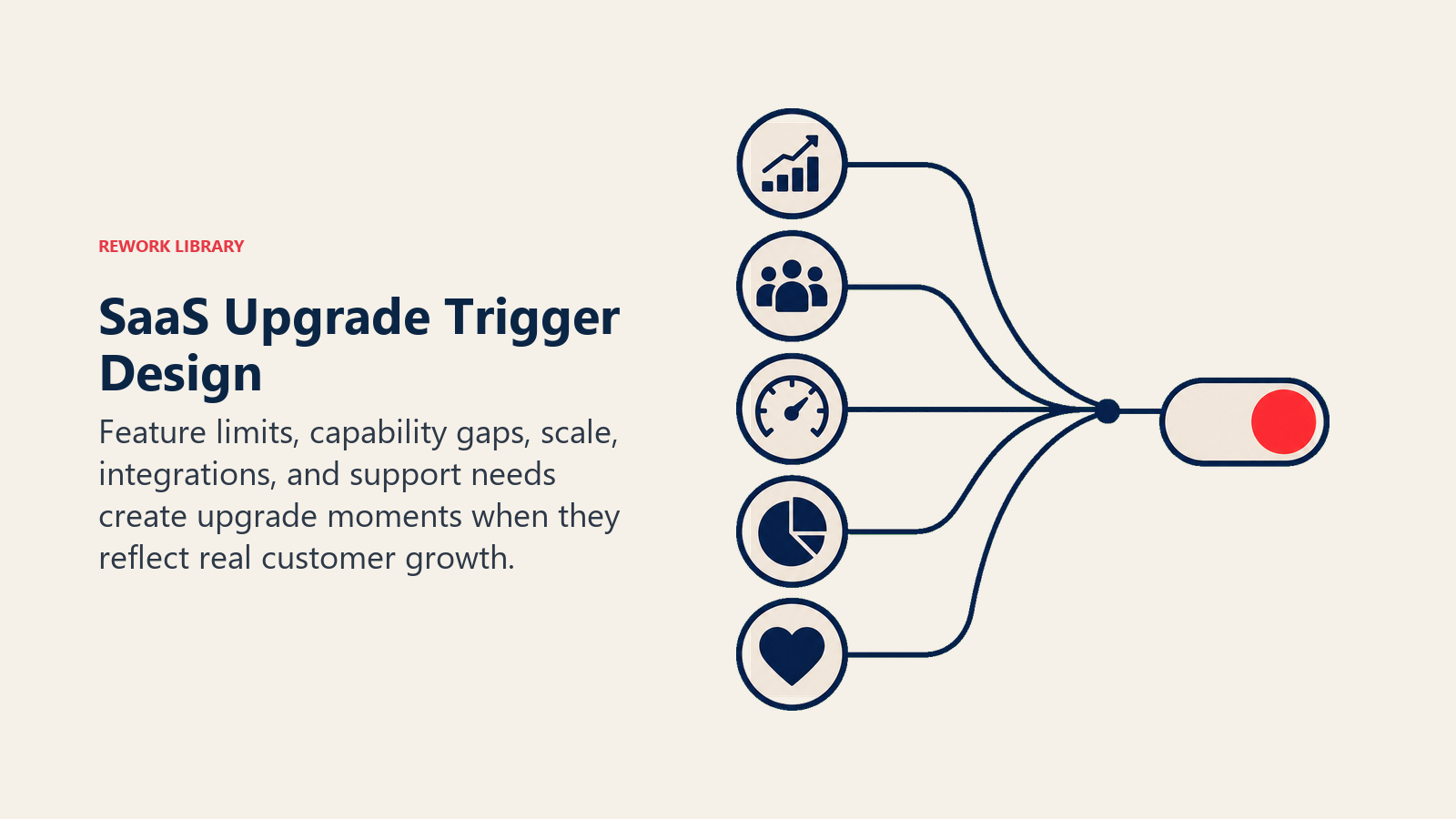
Feature limit triggers create upgrade pressure through capacity constraints. Entry tier supports 3 projects, Professional supports unlimited projects. When customers need a 4th project, they must upgrade. The limitation is clear, the solution is obvious, and the value is understood.
Feature limits work when they align with natural usage growth. Customers who succeed with 3 projects eventually need more. The upgrade represents success, not artificial constraint.
Capability triggers identify moments when customers need functionality unavailable in their current tier. A customer wants to build an automation workflow but automation is Professional-tier only. They've hit a capability ceiling that upgrading solves.
In-product feature gating lets customers discover these limitations organically. They attempt to use advanced features, learn they're on the wrong tier, and see upgrade options immediately. This converts curiosity into upgrade intent.
Scale triggers signal that customer success has outgrown current tier capacity. Teams that grow from 5 to 15 people need collaboration features only available in higher tiers. Data volumes that exceed entry tier limits require Professional storage capacity.
Scale triggers work because they associate upgrading with success. Customers outgrow entry tiers because your product works, not because it doesn't.
Integration triggers emerge when customers need connections to other tools. Entry tiers might include basic integrations (Google Calendar, Slack). Professional adds CRM, marketing automation, and data warehouse connections. Enterprise includes custom API access and webhooks.
Integration needs often drive upgrades because customers commit to workflows that require specific connections.
Support triggers convert customers who need faster response times or dedicated help. Entry tier gets email support. Professional adds chat support. Enterprise includes dedicated customer success managers and phone support.
Support needs increase as customer dependence on your product increases. Mission-critical use cases justify premium support pricing.
The Upgrade Journey
Converting customers from entry to premium tiers follows a predictable path.
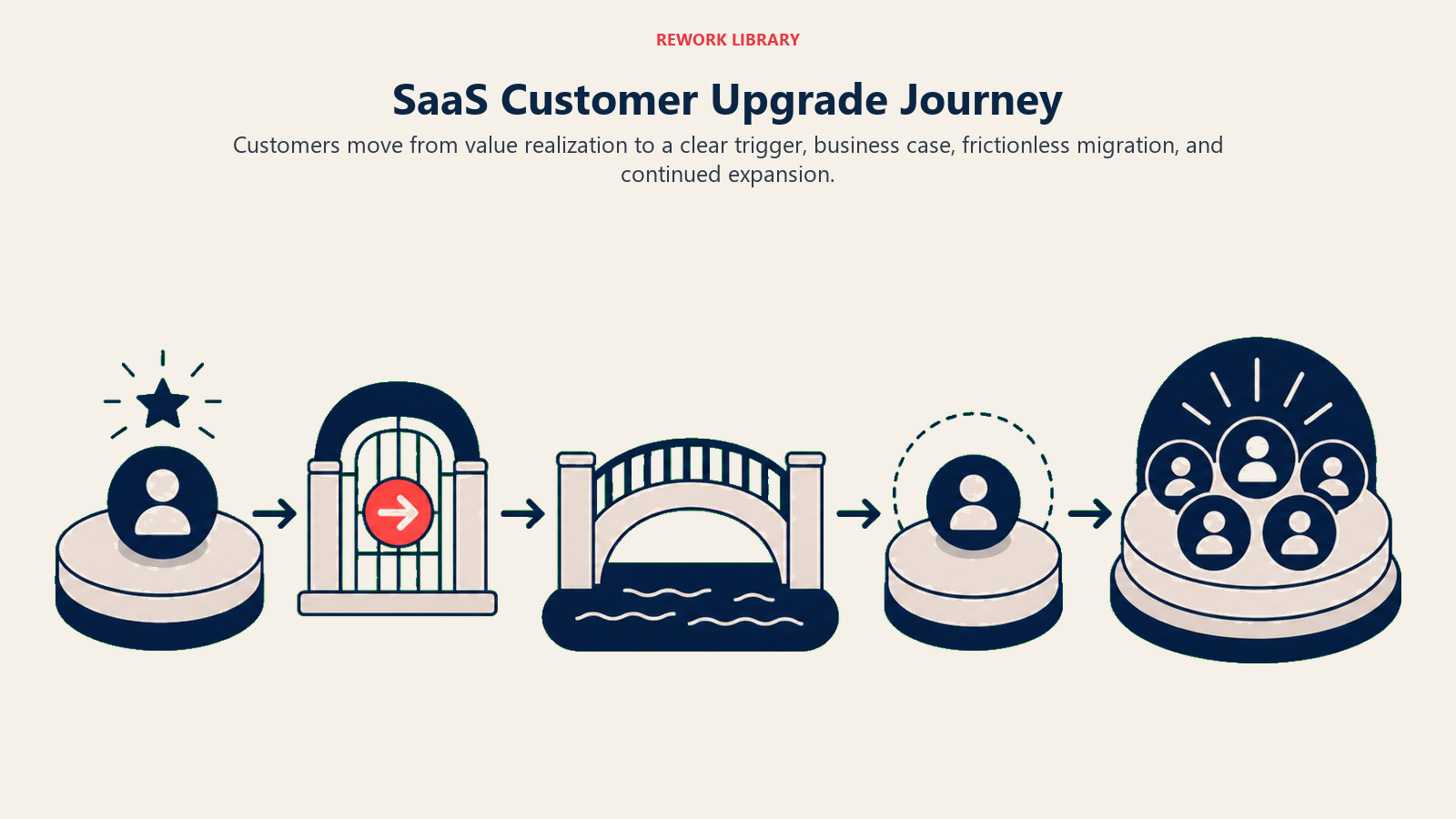
Tier 1: Value realization and adoption establishes the foundation for future expansion. Customers must achieve meaningful outcomes with their current tier. Without clear value, upgrade conversations fail because customers question whether more investment makes sense.
Focus early customer success efforts on ensuring entry-tier customers hit specific milestones: complete onboarding, achieve first outcome, establish regular usage patterns, and identify additional use cases. These milestones predict upgrade readiness.
Trigger: Feature limitation or capability gap creates the upgrade moment. Customer needs emerge that their current tier doesn't address. They hit project limits, need automation, require integrations, or want advanced analytics. The gap between what they can do and what they want to do creates upgrade motivation.
Product analytics should identify these trigger moments automatically. When customers attempt to create their 4th project on a 3-project tier, that's a trigger. When they explore automation features they can't access, that's a trigger. Each trigger represents upgrade opportunity.
Tier 2: Upgrade conversation and business case articulates why the customer should upgrade now. Effective upgrade messaging focuses on:
Specific capabilities the customer clearly needs based on their trigger. Don't list all Professional features. Highlight the ones solving their immediate need. Value quantification showing ROI from upgrading. Time saved through automation. Revenue enabled through better analytics. Collaboration improved through team features. Migration simplicity assuring customers that upgrading is frictionless. One-click upgrades, prorated billing, and immediate feature access remove hesitation.
Customer success teams should initiate upgrade conversations proactively when triggers fire rather than waiting for customers to request upgrades.
Execution: Migration and onboarding ensures customers successfully transition to their new tier. Poor upgrade experiences create buyer's remorse. Great upgrade experiences validate the decision.
Provide upgrade-specific onboarding that focuses on new capabilities. Don't make customers rediscover everything. Show them exactly what's new and how to use it.
Expansion: Continued value delivery maintains customer health post-upgrade and identifies next expansion opportunities. Professional tier customers who maximize their new capabilities become Enterprise upgrade candidates. Track feature adoption within each tier to identify when customers outgrow current levels.
Product-Led Upgrade Tactics
Build upgrade prompts and paths directly into your product experience.
In-app upgrade prompts appear contextually when customers need unavailable features. A customer tries to create their 4th project and sees: "You've reached your 3-project limit. Upgrade to Professional for unlimited projects." The prompt appears exactly when the need is clearest.
Contextual prompts convert 3-5x better than generic upgrade banners because they connect upgrading to immediate customer needs.
Feature gating lets customers discover premium capabilities and experience limited versions before purchasing. A customer sees an automation template but can't activate it on their entry tier. They understand what they're missing and what upgrading unlocks.
Try-before-you-buy gating works better than complete feature hiding. Customers who see what's possible get motivated to upgrade. Customers who don't know features exist never request them.
Usage-based notifications alert customers as they approach tier limits. At 80% of project limit, customers get warnings that they'll soon need to upgrade. This advance notice lets them plan upgrades rather than hitting sudden barriers.
Self-service upgrade flows remove friction from upgrade decisions. One-click tier changes, immediate feature access, and automatic prorated billing let customers upgrade the moment they decide. Every step added to upgrade flows reduces conversion rates.
Self-service conversion works particularly well for SMB and mid-market customers who want to move fast without sales conversations. Enterprise upgrades often require sales engagement for custom pricing and procurement navigation.
Trial-to-paid conversion optimization treats trial users as upgrade candidates from day one. Trial users on "Enterprise trials" should experience enterprise features to understand upgrade value. Generic trials that don't showcase tier differences miss conversion opportunities.
Sales-Led Upgrade Tactics
High-value accounts and complex upgrades benefit from human-led conversations.
Business case development quantifies upgrade ROI for customers who need financial justification. Calculate productivity gains from automation, revenue impact from better analytics, or cost savings from team collaboration improvements.
Provide ROI calculators and templates that account teams can customize for specific customers. Generic business cases convert poorly. Customer-specific calculations based on actual usage data and value-based pricing principles convert well.
ROI demonstration uses customer data to show upgrade value. "Your team spent 40 hours last month on manual processes that Professional-tier automation would eliminate. At $50/hour, that's $2,000 in wasted time. Professional tier costs $199/month." This math makes upgrade decisions obvious.
Stakeholder alignment ensures you engage decision-makers when upgrades require approval. Entry tier purchases often happen with individual credit cards. Professional upgrades may need manager approval. Enterprise upgrades require executive and procurement involvement.
Procurement navigation smooths the path through customer purchasing processes. Understanding approval requirements, budget timing, vendor management procedures, and contract amendment processes prevents upgrades from stalling after customers commit.
Migration planning addresses customer concerns about transition complexity. For customers with significant data or complex configurations, structured migration planning reduces upgrade hesitation. Phased rollouts, testing environments, and dedicated migration support de-risk large tier jumps.
Pricing Optimization
Tier pricing structure directly impacts both acquisition and upgrade conversion.
Tier price gaps should follow the 2-3x rule. If Entry tier costs $29, Professional should cost $79-99. If Professional costs $99, Enterprise should cost $299-499. Gaps smaller than 2x don't justify tier differences. Gaps larger than 3x create sticker shock.
Feature-to-price alignment ensures customers perceive fair value at each tier. Professional tier shouldn't be marginally better than Entry while costing 5x more. Feature improvements should feel proportional to price increases.
Testing different price points through pricing experiments helps you optimize tier gaps and maximize revenue without hurting conversion.
Grandfather policy design determines whether existing customers maintain old pricing during tier changes. Forcing all customers to new pricing maximizes revenue but damages relationships. Grandfathering existing customers maintains goodwill but limits pricing optimization.
Most companies grandfather pricing for current tiers but require new pricing for upgrades. A customer on old $49 Professional pricing maintains that rate but pays new $99 rate if they downgrade and re-upgrade.
Promotional upgrade incentives accelerate tier changes through limited-time offers. First 3 months at Professional tier for 50% off. Upgrade before quarter-end for annual discount. These promotions work for customers on the fence about upgrading but can cheapen pricing if overused.
Success Metrics
Track tier performance to optimize packaging and upgrade conversion.
Tier distribution shows percentage of customers at each tier. Healthy distribution typically shows 20-30% at Entry, 50-60% at Professional, 10-20% at Enterprise. Distributions heavily skewed to Entry suggest packaging problems or failed upgrades. Heavy Enterprise concentration might indicate entry tier isn't acquisition-friendly.
Upgrade conversion rate measures percentage of customers who upgrade annually. Benchmarks vary by product and market, but 15-25% annual upgrade rates indicate strong tier design and upgrade execution. Rates below 10% suggest weak triggers or poor upgrade paths. Rates above 30% might indicate entry tier is too restrictive.
Time-to-upgrade tracks how long customers stay at each tier before upgrading. Faster upgrades indicate strong value realization and clear upgrade triggers. Slow upgrades suggest customers find sufficient value at current tiers or don't recognize upgrade benefits.
Upgrade ARR contribution calculates expansion revenue generated specifically through tier changes. Track this separately from seat expansion and cross-sells to understand tier upgrade's contribution to your expansion revenue strategy.
Tier migration path analysis reveals which upgrade paths customers actually follow. Do customers jump from Entry to Enterprise, or do they progress Entry → Professional → Enterprise? Understanding actual migration patterns helps optimize tier design and pricing.
Common Pitfalls
Most tier design failures follow predictable patterns.
Overloading entry tiers with too many features eliminates upgrade motivation. If customers get everything they need at $29/month, they'll never pay $99/month. Entry tiers should prove value but leave clear headroom for expansion.
Artificial restrictions that frustrate rather than motivate create bad customer experiences. Limiting core features to absurdly low levels (3 contacts, 1 project, 5 emails) drives customers away rather than driving upgrades.
Unclear tier differentiation makes upgrade value hard to understand. When Professional and Enterprise tiers look similar on feature comparison tables, customers don't understand why they should pay more. Each tier jump should offer obviously superior capabilities.
Poor upgrade timing pitches tier changes before customers achieve value or after they've found workarounds. Upgrade conversations work best when customers actively experience tier limitations, not before (premature) or after they've solved problems other ways (too late).
Your tier architecture either enables or constrains expansion revenue potential. Companies with thoughtful feature packaging, clear upgrade triggers, and smooth upgrade paths convert 20%+ of customers to higher tiers annually. Companies with arbitrary tiers, artificial limits, and poor upgrade execution struggle to expand customers beyond entry-level plans.
Design your tiers to acquire customers efficiently at entry levels and expand them profitably to premium tiers. The feature allocation decisions you make today determine the expansion revenue you capture tomorrow.
Basic Tier Upgrade FAQs
What is a basic tier upgrade?
It's when a customer on your entry (basic, starter, or essential) plan moves to a higher-priced tier to unlock more capacity or capabilities. The upgrade is usually triggered by a feature limit, a capability gap, or team growth, not by a sales push alone.
What is a healthy tier upgrade conversion rate?
Most SaaS companies see 15-25% of customers upgrade to a higher tier annually when tier design and triggers are strong. Rates below 10% often signal weak upgrade triggers or an entry tier loaded with too many features. Rates above 30% can mean the basic tier is too restrictive.
How do I trigger basic tier upgrades without annoying customers?
Use contextual, in-app prompts that appear exactly when a customer hits a limit or tries to use a gated feature, then offer a one-click upgrade with prorated billing. Contextual prompts convert 3-5x better than generic upgrade banners because they tie the upgrade to an immediate need.
What features should I keep out of the basic tier?
Reserve genuinely advanced or infrastructure-heavy capabilities (advanced analytics, custom integrations, workflow automation, SSO, audit logs) for higher tiers. Keep core, category-defining features in the basic tier so customers can prove value, but leave clear headroom that upgrading fills.
Learn More
Explore these related resources to strengthen your tier upgrade strategy:
- SaaS Pricing Models - Understand the foundational pricing approaches that inform tier architecture decisions
- Product-Led Growth Strategy - Build product experiences that drive natural tier upgrades through usage
- Customer Health Scoring - Identify which customers are ready for upgrade conversations based on engagement patterns
- Usage-Based Expansion - Combine tier upgrades with usage-based pricing for maximum expansion potential