More in
AI Workforce Transformation
Does AI Make Distributed Teams Easier or Harder to Lead?
Oct 11, 2026
Where AI Productivity Monitoring Turns Into Surveillance
Oct 11, 2026
Why Your Most Experienced People Resist AI Hardest (and Why You Need Them Most)
Oct 11, 2026
Is AI Making Teams Less Collaborative?
Oct 11, 2026
Should CEOs Use AI Themselves? Why Executive Fluency Sets the Adoption Ceiling
Oct 11, 2026
Does AI Favor Generalists or Specialists? What It Means for Who You Hire
Oct 10, 2026
Is Experience Still Worth Paying For When AI Narrows the Skill Gap?
Oct 10, 2026
When Every Candidate Uses AI, What Is a Resume Still Worth?
Oct 10, 2026
Should AI Screen Your Job Candidates? Where Automated Hiring Helps and Where It Backfires
Oct 10, 2026
Should Candidates Be Allowed to Use AI in Interviews?
Oct 10, 2026
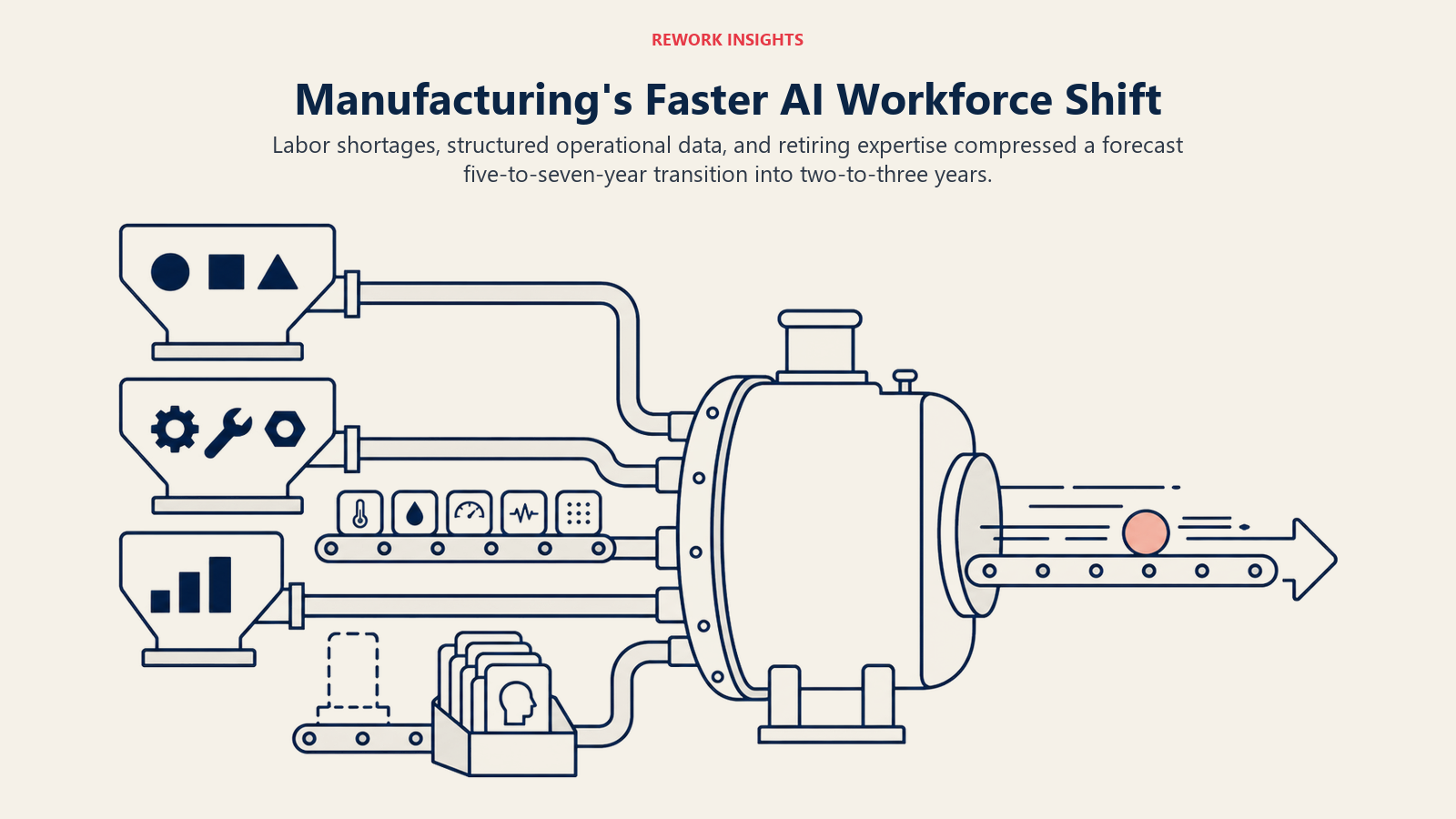
Why Manufacturing's AI Workforce Shift Is Faster Than Anyone Expected
Turn this article into takeaways for your work.


Each assistant summarizes the article only for you and suggests best practices for your work.
Here's a number that should stop you mid-scroll: in 2024, manufacturing companies posted more AI-related job openings than financial services firms. Not per capita. Total.
That's not a typo. The industry most executives picture when they think "slow to change" (factory floors, aging machinery, union contracts, long capital cycles) is now running one of the fastest AI workforce transformations on record. And the reasons it's happening so fast in manufacturing are the same reasons it's going to happen faster than you think in your industry too.
This isn't a story about robots replacing assembly workers. That narrative is at least a decade old and largely misses what's actually happening. The real shift is cognitive. It's organizational. And it's accelerating on a timeline that caught even the most bullish analysts off guard.
Three Forces That Made AI Adoption Non-Optional
Manufacturing didn't choose to move fast on AI workforce transformation. It was pushed there by three structural pressures that converged in a way that left leadership with no comfortable middle path. McKinsey's research on generative AI and the future of work projects that by 2030, up to 30% of current hours worked could be automated, and manufacturing is seeing that compression on a much shorter timeline than the broader forecast assumed. The same dynamic is now appearing in sectors that thought they had more time, as explored in which roles AI is actually eliminating and creating in mid-market companies.
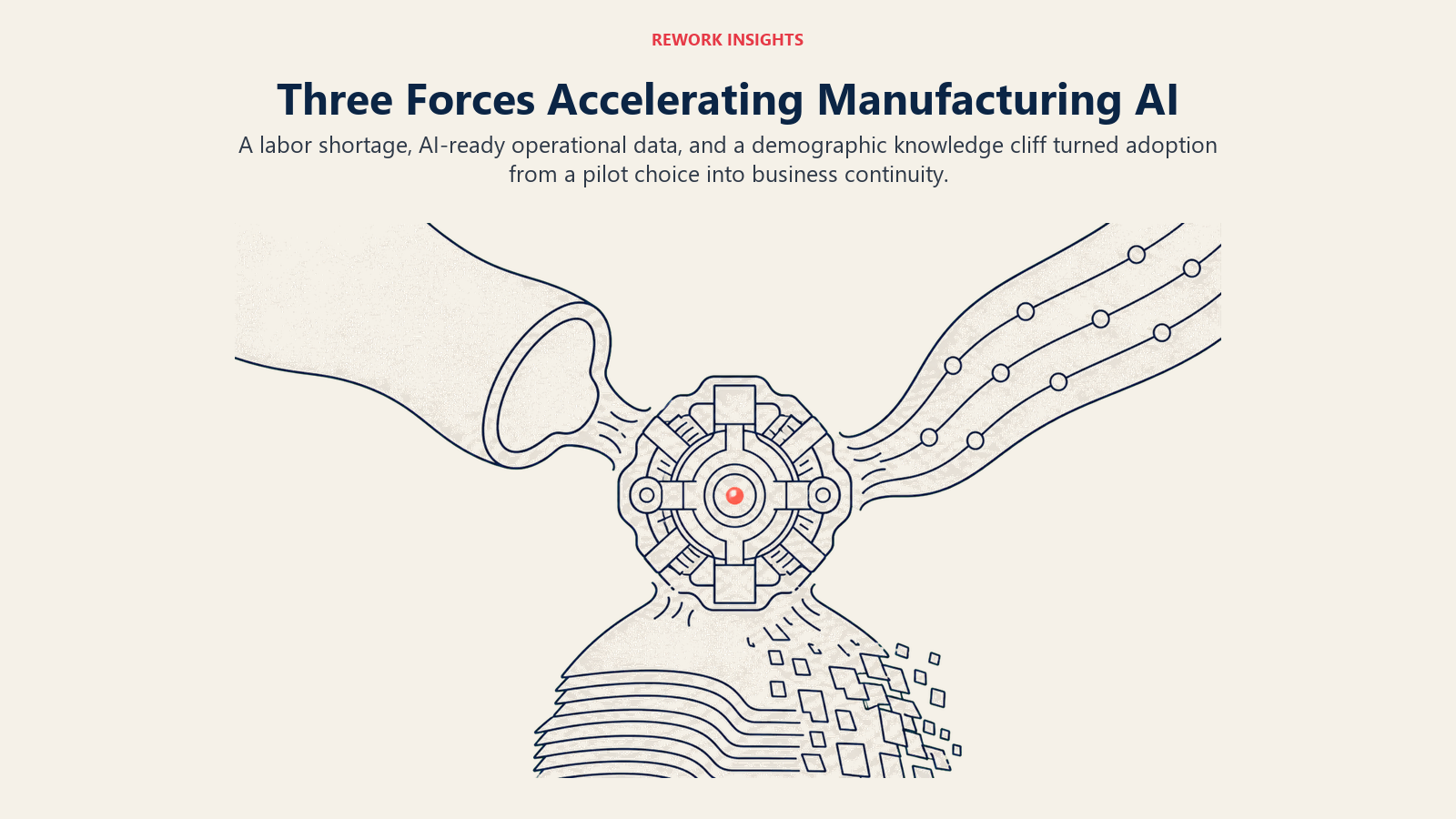
The labor shortage hit a wall. Manufacturing employment in the U.S. has been contracting for 40 years, but the pandemic exposed just how brittle that workforce had become. Plants that relied on experienced operators found those operators weren't coming back, either retired or permanently shifted to other industries. The National Association of Manufacturers estimates 2.1 million unfilled manufacturing jobs by 2030, with a separate analysis suggesting the U.S. could need up to 3.8 million manufacturing workers filled within the next decade. That's not a pipeline problem you solve with recruiting. It's a structural gap that forces you to change how work gets done.
When the alternative to AI augmentation is simply not operating at capacity, the ROI calculation changes completely. It's no longer "can we justify this investment?" It becomes "what does it cost us to not do this?" That's a different conversation at the board level, and it moves faster. The hidden cost of delaying AI upskilling, framed for CFOs, applies with even more force in manufacturing, where the labor shortage makes delay immediately visible on the production floor.
The data was actually ready. This is the part that surprises people. Manufacturing has been running structured data collection on physical processes for decades, through SCADA systems, PLC logs, quality control databases, and supply chain tracking. When AI tools arrived that could work with this data, there wasn't a two-year data cleanup project standing in the way. The data existed. It was structured. It was labeled. You could drop an AI system in and get ROI signals within weeks, not quarters.
Compare that to, say, professional services or healthcare administration, where the "data" is often locked in unstructured documents, email threads, and human memory. Manufacturing got faster AI ROI because its operational data was closer to training-ready than almost any other sector. That speed of early wins created organizational momentum that compressed the adoption timeline.
The demographic cliff created board-level urgency. The average age of a skilled manufacturing operator in the U.S. is north of 50. Deloitte's analysis of the shrinking US manufacturing workforce documents how a manufacturing skills gap currently sits at around 400,000 unfilled roles, a number that will grow to 1.9 million by 2033 if current trends continue. Within a decade, a significant portion of the institutional knowledge that keeps complex production lines running will walk out the door with retiring workers. That's not a future problem for HR to worry about. That's a board-level risk that's on every manufacturing CEO's radar right now.
The response wasn't just to hire younger workers. It was to capture that knowledge before it left, and embed it in systems that don't retire. AI-assisted process documentation, expert system development, and knowledge graph tools went from "interesting pilot" to "business continuity requirement" in about 18 months. When something becomes a business continuity question, it stops waiting for the annual budget cycle.
What the Workforce Shift Actually Looks Like
The popular version of manufacturing's AI story is about robots eliminating jobs. The actual story is more interesting, and more instructive for leaders in other sectors.
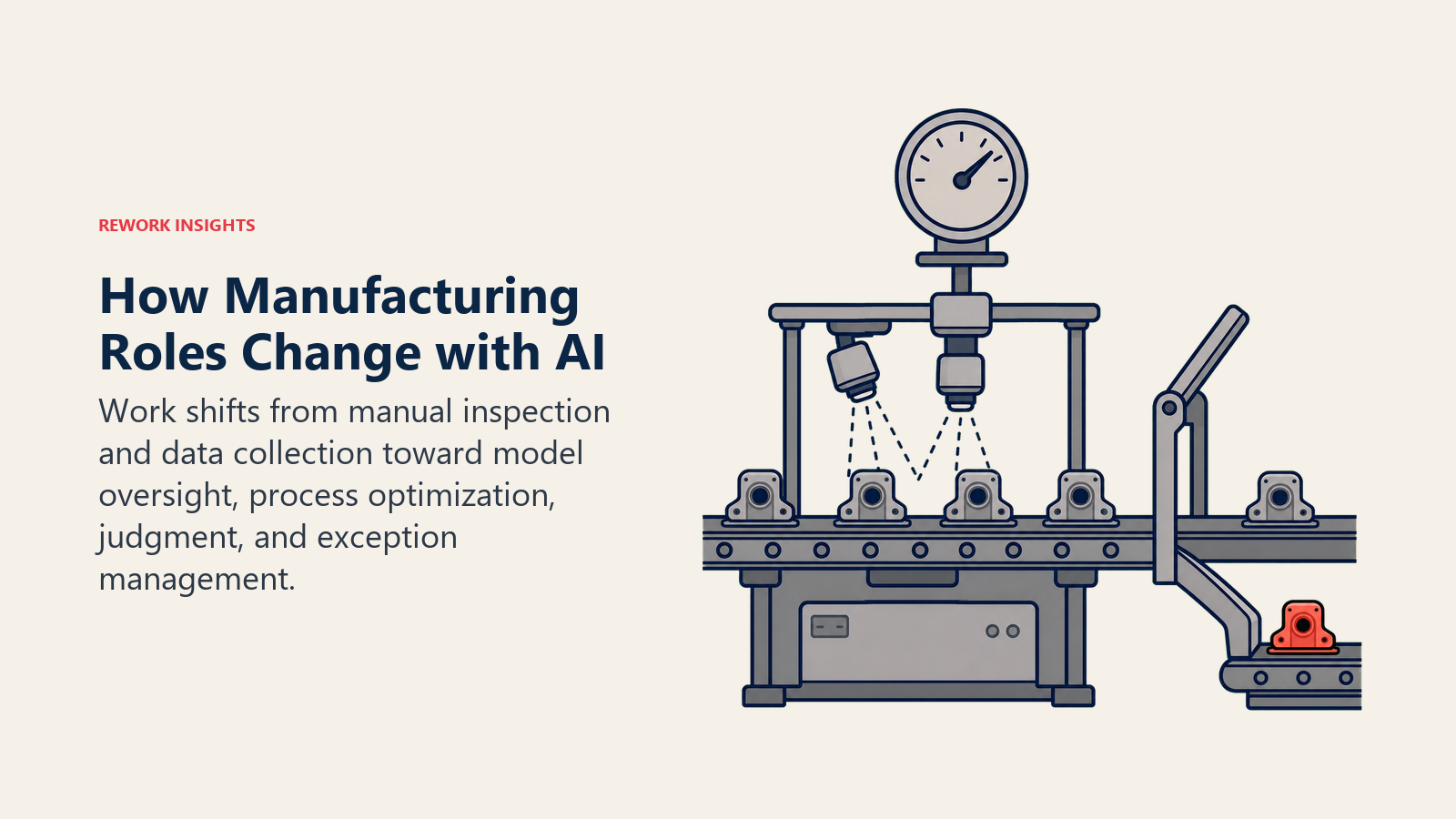
At a major automotive assembly plant in Tennessee, the job title "AI Maintenance Technician" didn't exist in 2022. By the end of 2024, there were fourteen of them on staff. Their job isn't to replace the maintenance workers who fix machines. It's to manage the predictive maintenance AI systems that tell those workers what to fix and when. They interpret model outputs, flag false positives, retrain models when production line configurations change, and serve as the translation layer between AI system behavior and operational decision-making.
That's a new role. Not a replacement. A new category of work that didn't exist before the AI system existed.
In discrete manufacturing (think electronics assembly and precision components), "Process Optimization Analyst" roles have become one of the fastest-growing job categories. These roles sit at the intersection of industrial engineering and data analysis. They're using AI tools to run continuous simulation of production parameters, identifying optimization opportunities that a human engineer reviewing weekly reports would never catch. The AI doesn't make the decision to change the process. The analyst does, informed by AI output that runs 24/7.
Food and beverage manufacturing tells a slightly different story. Here, AI-assisted quality engineers have become central to compliance and safety operations. Vision systems and sensor arrays generate massive volumes of inspection data that no human team could review at speed. The quality engineer's job has shifted from doing the inspection to designing the inspection criteria, auditing AI flagging behavior, and managing the escalation workflow when the system identifies anomalies. More judgment, less repetition. The role isn't smaller. It's different. This mirrors the AI tool to teammate mindset shift playing out in white-collar environments, but it's happening on the production floor first.
What's being eliminated? Roles that were primarily about data collection and first-pass review. Manual inspection roles where the core activity is watching and logging. Data entry positions that existed because systems didn't talk to each other. These aren't being replaced by robots. They're being replaced by connected systems that generate and route data automatically.
The Speed Factor: From 5-7 Years to 2-3 Years
Industry analysts were forecasting a 5-7 year transformation timeline for manufacturing AI adoption as recently as 2022. That estimate is already obsolete. The active transformation is happening on a 2-3 year cycle at leading manufacturers, and there are three specific reasons the clock compressed.
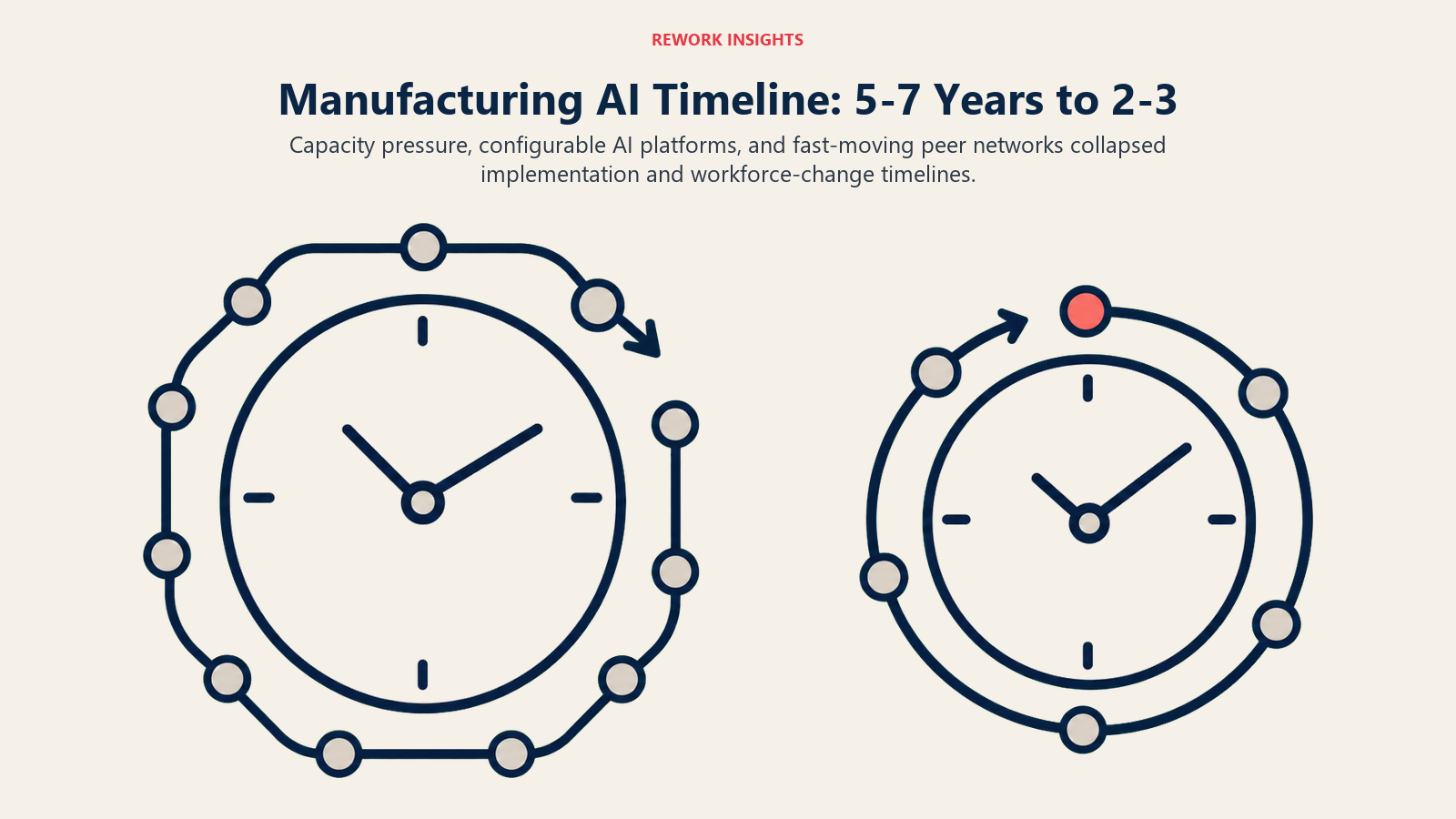
First, the labor pressure we described didn't give executives the luxury of a phased pilot approach. When you're operating at 70% capacity because you can't fill roles, you don't run a 12-month pilot. You deploy what works and iterate in production.
Second, the AI tools themselves improved faster than the technology forecasts projected. The combination of foundation models and purpose-built industrial AI platforms meant that manufacturers didn't need to build custom AI from scratch. They could configure and deploy. That collapsed implementation timelines from 18 months to 3-4 months for many applications.
Third, peer pressure within industry networks moved faster than analyst predictions anticipated. When a competitor runs a visible AI deployment and talks about it at an industry conference, the CEO of every competing plant is on a call with their operations team the following week. Manufacturing has tight industry networks. Success stories travel fast and create urgency at the executive level in ways that don't happen in more fragmented industries.
Here's a rough comparison of AI adoption speed by sector, measured from "significant executive attention" to "meaningful workforce role changes":
| Industry | Adoption Timeline | Primary Driver |
|---|---|---|
| Manufacturing | 2-3 years | Labor shortage + structured data |
| Financial Services | 3-4 years | Regulatory caution + legacy systems |
| Healthcare | 4-6 years | Compliance complexity + data silos |
| Professional Services | 3-5 years | Unstructured data + talent resistance |
Manufacturing isn't just fast. It's fast for structural reasons that are starting to appear in other sectors.
What Other Industries Can Learn
Manufacturing has forcing functions that don't exist everywhere. The physical labor shortage is acute in ways that white-collar sectors haven't experienced yet. The data readiness advantage is real and specific to industrial operations.
But some of the forcing functions do translate.
The "demographic cliff" problem isn't unique to manufacturing. Law firms, accounting practices, and consulting companies are watching senior partners age out of the workforce with institutional knowledge that's never been documented. The business continuity framing that drove urgency in manufacturing is available to any sector willing to name the risk honestly.
The "ROI in weeks, not quarters" dynamic is starting to show up in other sectors as AI tools mature. Early AI deployments in professional services were slow because the data wasn't ready. That's changing. Companies that have invested in data infrastructure are finding that AI deployments deliver measurable ROI on compressed timelines, and when executives see that, adoption decisions speed up. The pattern is documented in AI workforce transformation in professional services, where the data readiness gap is finally closing.
The peer network effect is universal. Once visible competitors in any sector make meaningful AI workforce changes, the urgency calculus at every competitor shifts. That inflection point hasn't hit most sectors the way it hit manufacturing in 2023 and 2024. But it will.
The lesson from manufacturing isn't "you need to move as fast as they did." It's "the conditions that made manufacturing move fast are building in your sector, and the timeline will compress faster than your current forecasts assume."
Applying Manufacturing's Urgency Model to Your Workforce Planning
If you're a CEO, COO, or CHRO outside of manufacturing looking at this and wondering what it means for your planning, here's the framework:
Identify your equivalent of the labor shortage pressure. Manufacturing had an obvious one. Where is your operational capacity constrained by headcount? Where are you running at less than full effectiveness because you can't find or retain people for specific roles? That's your urgency anchor. AI workforce investment framed around that constraint gets board attention and budget approval faster than a general "transformation" narrative.
Audit your data readiness honestly. Manufacturing got fast ROI because its data was cleaner than most sectors realize. Where is your operational data actually structured and accessible? Those are the areas where AI can deliver fast, measurable wins. Start there. Build momentum. Don't lead with the messiest data problems. Build organizational confidence first.
Name the knowledge retention risk. Every organization has experienced people carrying institutional knowledge that isn't documented anywhere. That's a business continuity risk, and it's one that boards respond to. Framing AI workforce investment as knowledge capture and retention infrastructure changes how it gets evaluated at the top of the house. A cross-functional AI collaboration framework is one practical mechanism for systematically capturing that knowledge before it walks out the door.
Set a 2-3 year horizon, not 5. Manufacturing's experience should recalibrate your planning window. The 5-7 year transformation forecast was wrong for manufacturing. It's probably wrong for your sector too. Plan for meaningful workforce role changes within 24-36 months, not as a distant horizon scenario.
The Executive Decision Framework for AI Workforce Strategy provides a structured approach for applying this kind of urgency to your own planning, including how to sequence investments and measure workforce readiness.
The Competitive Baseline Is Being Set Right Now
Manufacturing's AI workforce transformation is doing something that most executives in other sectors haven't fully processed yet: it's setting a new competitive baseline for operational efficiency.
When the best-performing manufacturers are running AI-augmented operations with 20-30% fewer headcount requirements for the same output, that becomes the cost structure everyone else competes against. It doesn't matter if you're in a different industry. If your supply chain partners, your customers, or your competitors have exposure to that cost structure, it affects your competitive position.
The industries that move at manufacturing speed in the next three years will set the baseline that everyone else has to match in the five years after that. And the industries that wait for the 5-7 year transformation clock are going to find themselves rebuilding the workforce planning they needed to start two years ago.
Manufacturing wasn't written off because it was backwards. It was underestimated because the AI story people were watching was the wrong story. The cognitive and organizational transformation happening inside those plants is the real story, and it's arriving in your sector faster than your current roadmap assumes.
Learn More
- AI Workforce Transformation in Professional Services: What's Different
- Which Roles AI Is Actually Eliminating in Mid-Market Companies (and Which It's Creating)
- The Executive Decision Framework for AI Workforce Strategy
- How SaaS Companies Are Restructuring Teams Around AI in 2026
- AI Readiness Assessment Templates for Operations Teams: The diagnostic framework for identifying your equivalent of manufacturing's labor shortage pressure

Co-Founder, Rework.com