More in
AI Workforce Transformation
Does AI Make Distributed Teams Easier or Harder to Lead?
Oct 11, 2026
Where AI Productivity Monitoring Turns Into Surveillance
Oct 11, 2026
Why Your Most Experienced People Resist AI Hardest (and Why You Need Them Most)
Oct 11, 2026
Is AI Making Teams Less Collaborative?
Oct 11, 2026
Should CEOs Use AI Themselves? Why Executive Fluency Sets the Adoption Ceiling
Oct 11, 2026
Does AI Favor Generalists or Specialists? What It Means for Who You Hire
Oct 10, 2026
Is Experience Still Worth Paying For When AI Narrows the Skill Gap?
Oct 10, 2026
When Every Candidate Uses AI, What Is a Resume Still Worth?
Oct 10, 2026
Should AI Screen Your Job Candidates? Where Automated Hiring Helps and Where It Backfires
Oct 10, 2026
Should Candidates Be Allowed to Use AI in Interviews?
Oct 10, 2026
What an AI-Native CRM Actually Looks Like for Mid-Market Companies
Turn this article into takeaways for your work.


Each assistant summarizes the article only for you and suggests best practices for your work.
There's a meaningful difference between a CRM with AI features and an AI-native CRM operation. Most mid-market companies in 2026 have the first. Very few have the second. And the gap between them is where revenue performance diverges.
A CRM with AI features means your existing CRM vendor has added AI-powered suggestions, some automated email drafting, and a dashboard that predicts deal close probability. These are useful. But they're incremental improvements to a system that was designed around human data entry, human pipeline reviews, and human follow-up. The underlying assumption is still that humans are doing most of the work and AI is assisting.
An AI-native CRM operation is built on a different assumption: AI handles the data maintenance, analysis, and routine execution, while humans focus on the decisions and relationships that genuinely require human judgment. That's a structural difference, not a feature difference.
What Changes When Your CRM Is AI-Native
Data integrity becomes a solved problem. In a traditional CRM operation, data quality is a constant struggle. Reps don't update records. Contact information goes stale. Deal stages don't reflect reality. Managers spend time in pipeline reviews fixing the data rather than discussing strategy.
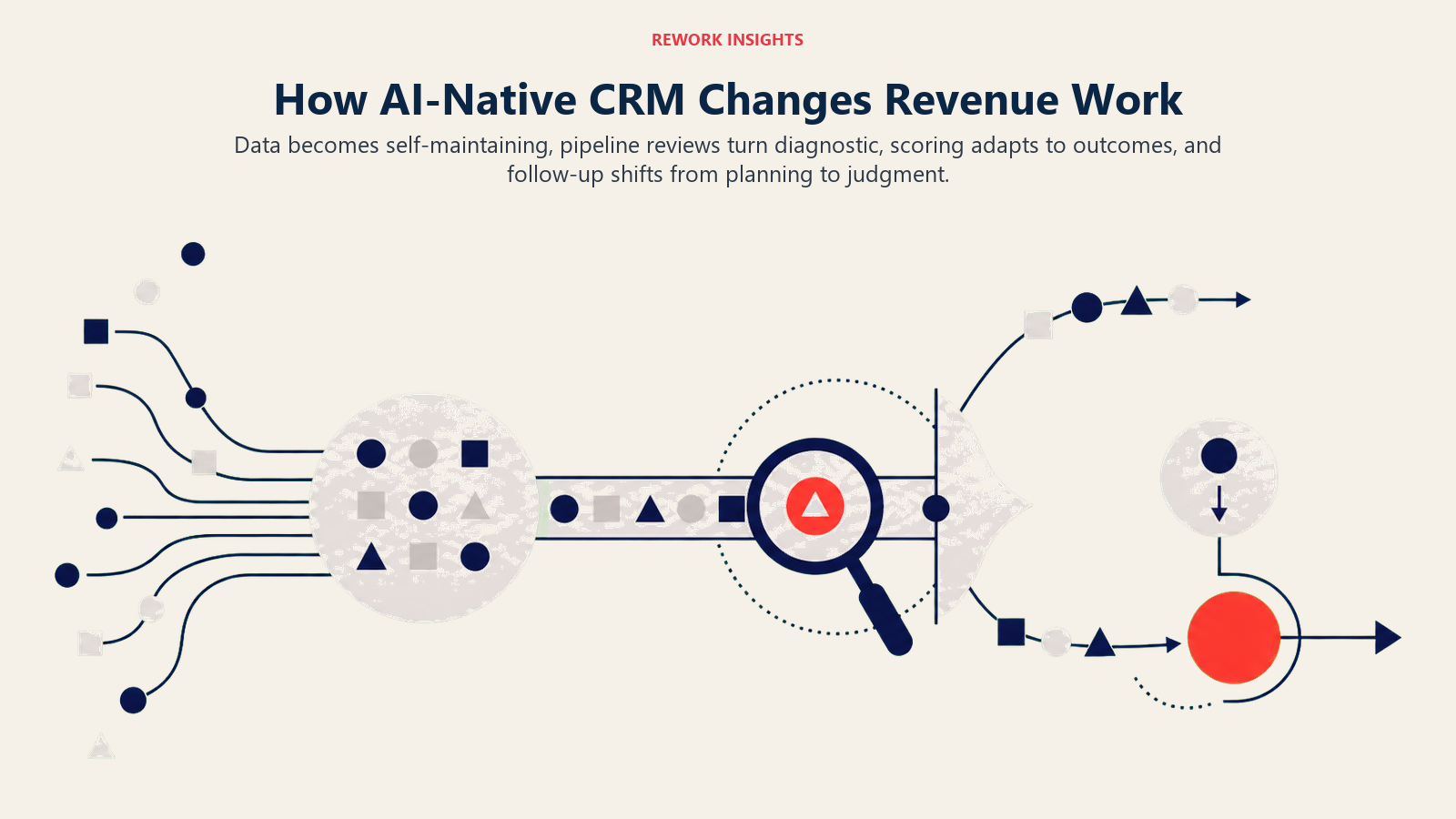
In an AI-native operation, data maintenance shifts from a human responsibility to an automated function. Call transcripts update contact records automatically. Email threads populate activity logs without rep intervention. Deal stages update based on actual buyer behavior rather than rep self-reporting. The CRM reflects reality, not what the rep last remembered to enter.
This sounds like a feature. It's actually a workflow redesign. The rep's job changes when they don't spend 30 to 45 minutes a day on CRM admin. The time either gets captured for higher-value work (more calls, better account research, deeper customer engagement) or it evaporates into unstructured activity. Getting the capture right requires intentional workflow design, not just turning on an AI feature.
Pipeline reviews become diagnostic rather than descriptive. Traditional pipeline reviews answer "what's in the pipeline?" An AI-native operation assumes that question is already answered by the system and focuses instead on "what's at risk, what's moving faster than expected, and where does the rep need coaching?"
The shift sounds subtle. The impact on manager time is significant. A VP of Sales who runs weekly pipeline reviews with 12 reps spends most of that time in a traditional setup asking for status updates and verifying data accuracy. In an AI-native setup, that time shifts to judgment calls: which deal needs executive intervention, which rep's pattern of stalled deals reflects a skill gap, which accounts show expansion signals worth a CSM conversation.
Lead scoring and routing move from rule-based to adaptive. Traditional lead scoring is a set of rules someone built two years ago: form fill plus company size plus job title equals a score. It's static. It reflects what someone believed about lead quality at the time they built it, not what's actually predicting conversion today.
AI-native lead scoring learns from actual outcomes. It identifies patterns in the leads that actually converted, not the ones someone thought would convert, and updates weighting accordingly. The result is scores that get more accurate over time rather than drifting from reality.
For mid-market companies, this shift in lead quality has a direct impact on pipeline efficiency. The lead scoring systems guide covers how modern scoring models work and what implementation looks like in practice. Routing automation, covered in lead routing automation, is the downstream function that adaptive scoring enables.
AI generates the first draft of follow-up communication. This is the feature most CRM vendors lead with in demos, and it's genuinely useful. But in an AI-native operation, it's not just that AI writes follow-up emails. It's that the cadence, content, and timing of follow-up is informed by buyer behavior signals: when they opened previous emails, what content they engaged with, what stage they're at in a buying process AI has modeled based on similar deals.
A rep in an AI-native operation doesn't decide on Monday morning what to do with each open deal. The system surfaces the recommended action for each deal based on current signals. The rep decides whether to follow the recommendation, modify it, or override it. Their job shifts from planning to judgment.
What Mid-Market Companies Get Wrong in the Transition
Buying AI-native software without changing workflows. The most common mistake. A company purchases a CRM with strong AI capabilities, turns on the features, and then runs the same meeting cadences, data entry expectations, and rep coaching processes as before. Six months in, AI adoption is low, reps aren't trusting the scores, and the investment looks like a failure.
The tool didn't fail. The workflow didn't change. AI-native CRM requires intentional redesign of how reps, managers, and ops teams interact with the system. It's not a lift-and-shift.
Underestimating data readiness. AI-native CRM features perform proportionally to data quality. If your contact records are incomplete, your historical deal data is sparse, or your activity logs have six-month gaps, the AI has nothing to learn from. Data readiness is the prerequisite, which is why RevOps data alignment has to come before tool deployment. The lead data management fundamentals and lead data enrichment guide cover the data infrastructure that AI-native operations require.
Not redefining success metrics. In a traditional CRM operation, rep performance is measured by activities: calls made, emails sent, meetings booked. In an AI-native operation, AI handles much of the activity execution. Measuring reps the same way penalizes them for using AI efficiently and rewards manual activity that the AI could do better.
The metrics shift toward outcomes (revenue per rep, pipeline accuracy, customer retention) and judgment quality (how well their AI overrides track compared to AI recommendations). Companies that make this metrics shift early see faster adoption. Those that don't create conflicting incentives that slow the transition.
The Revenue Ops Role in an AI-Native CRM
Revenue operations is the function that makes or breaks an AI-native CRM implementation. In a traditional setup, rev ops maintains the CRM configuration, manages integrations, runs reporting, and troubleshoots data problems. In an AI-native setup, that expands to include: managing AI tool configurations, monitoring AI model performance and accuracy, interpreting AI-generated insights for executive consumption, and continuously refining the system based on outcomes.
The Revenue AI Analyst role described in roles AI is eliminating and creating in mid-market is essentially the evolution of traditional sales ops in an AI-native operation. The analytical skills carry over. But the work shifts from building reports to maintaining AI systems, and from describing pipeline to modeling it predictively.
For companies that don't have a dedicated rev ops function, the AI-native CRM transition often creates the case for establishing one. The operational complexity of a well-configured AI-native CRM exceeds what a sales manager or individual rep can maintain alongside their primary responsibilities.
The ACE Framework Applied to CRM
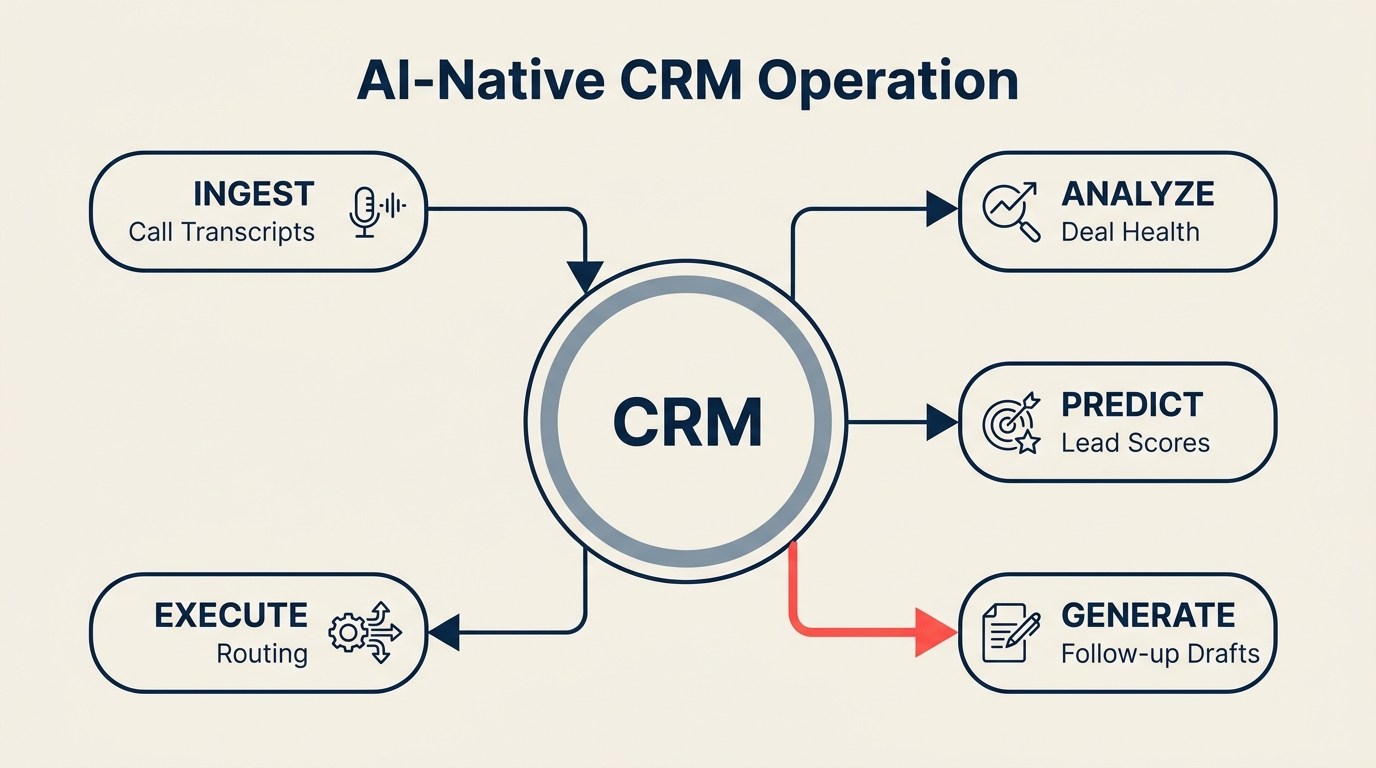
Using the ACE Framework vocabulary: a traditional CRM is primarily a Generate and Execute tool (drafting records, triggering sequences). An AI-native CRM adds Ingest (capturing activity signals from calls, emails, calendar), Analyze (classifying deal health, summarizing buyer behavior, identifying patterns), and Predict (scoring leads, forecasting close probability, flagging churn risk).
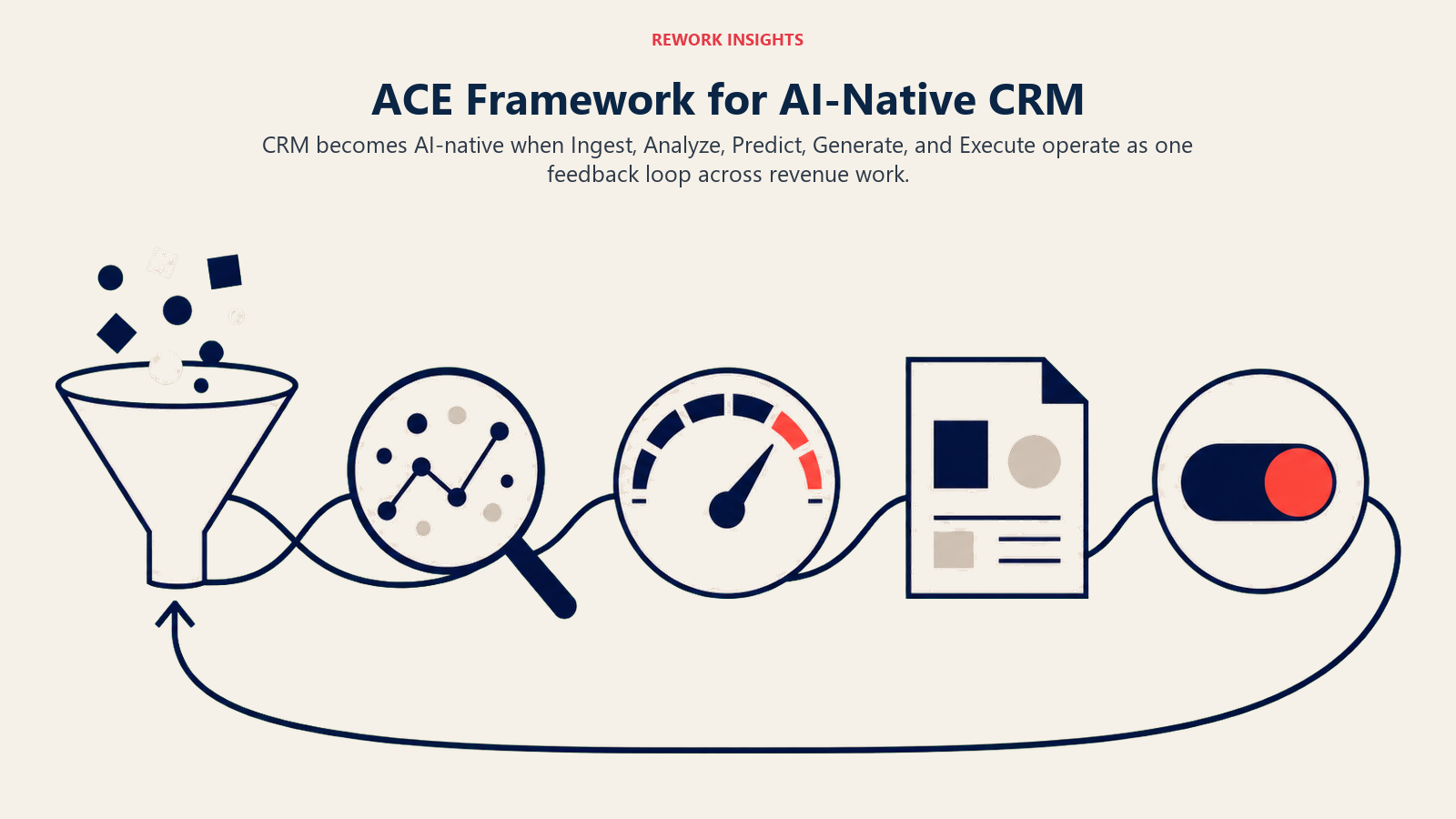
The result is a system that operates across all five capabilities, generating an autonomous feedback loop: data in, analysis and prediction out, generation of recommendations, execution of follow-up, and re-ingestion of new activity data. That's the architecture of an AI-native operation. It's different from a CRM that generates email drafts.
Is Your Company Ready to Run AI-Native CRM?
The readiness question isn't about software. It's about three organizational conditions:
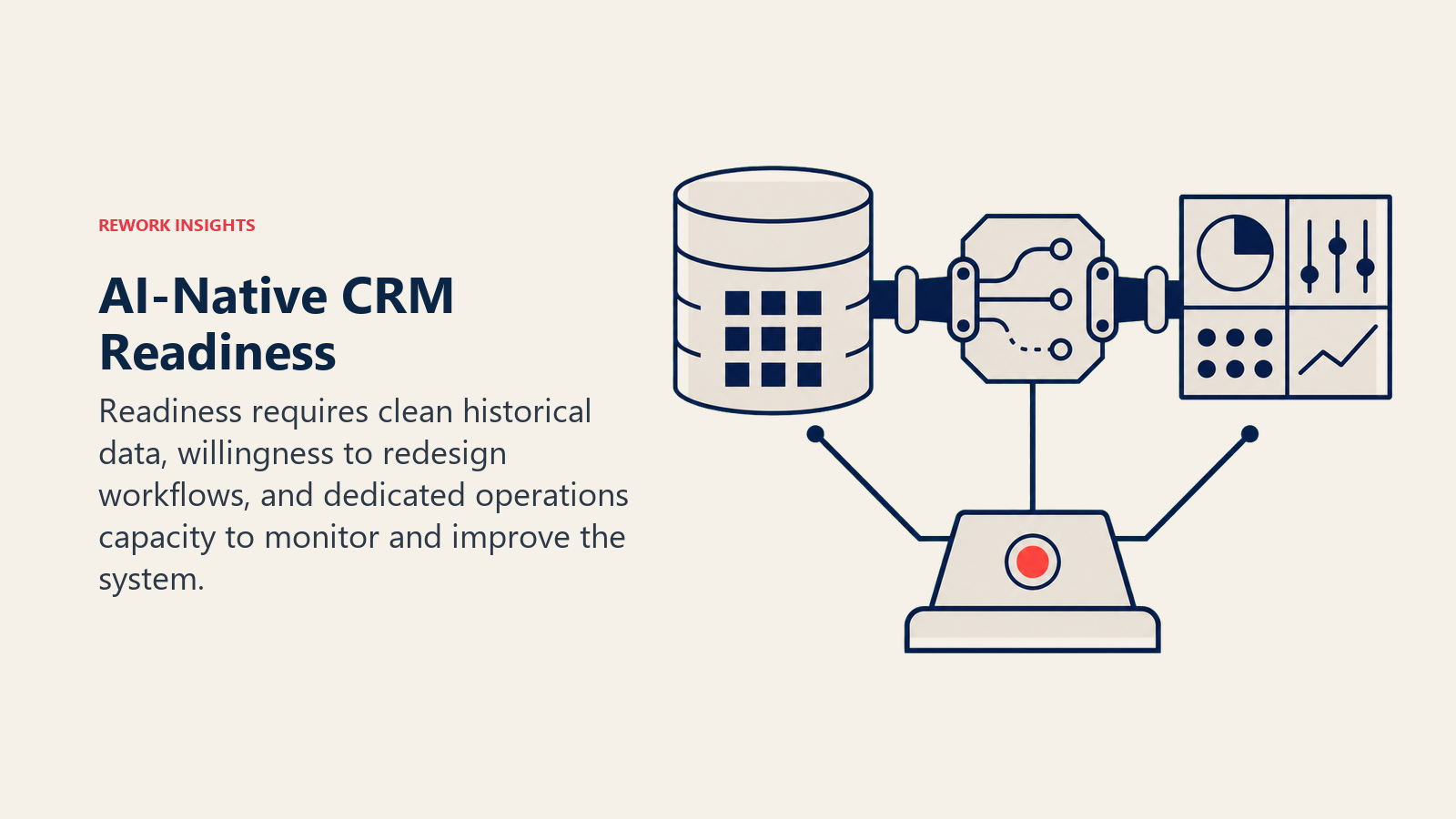
Data foundation. Do you have 12 to 24 months of reasonably clean deal, contact, and activity data? If yes, AI-native features can learn from it. If no, start with data cleanup and enrichment before expecting AI to perform.
Workflow willingness. Are your reps and managers open to having AI surface recommendations and expecting them to justify overrides rather than defaulting to gut feel? If yes, the culture can support an AI-native operation. If the dominant refrain is "I don't trust the AI," you have a change management challenge to address first.
Operations capacity. Do you have someone, whether full-time in rev ops or with meaningful dedicated time, who can own the AI configuration, monitor performance, and iterate on the system? Without this, AI-native CRM drifts toward underuse or misconfiguration.
The AI readiness assessment templates include CRM-specific readiness questions that help diagnose where a company stands before committing to an AI-native implementation path.
The gap between an AI-featured CRM and an AI-native revenue operation is real. Closing it isn't about the software purchase. It's about the workflow redesign, the data investment, and the organizational willingness to let AI handle execution while humans focus on judgment.
Learn More
