More in
AI Workforce Transformation
Does AI Make Distributed Teams Easier or Harder to Lead?
Oct 11, 2026
Where AI Productivity Monitoring Turns Into Surveillance
Oct 11, 2026
Why Your Most Experienced People Resist AI Hardest (and Why You Need Them Most)
Oct 11, 2026
Is AI Making Teams Less Collaborative?
Oct 11, 2026
Should CEOs Use AI Themselves? Why Executive Fluency Sets the Adoption Ceiling
Oct 11, 2026
Does AI Favor Generalists or Specialists? What It Means for Who You Hire
Oct 10, 2026
Is Experience Still Worth Paying For When AI Narrows the Skill Gap?
Oct 10, 2026
When Every Candidate Uses AI, What Is a Resume Still Worth?
Oct 10, 2026
Should AI Screen Your Job Candidates? Where Automated Hiring Helps and Where It Backfires
Oct 10, 2026
Should Candidates Be Allowed to Use AI in Interviews?
Oct 10, 2026
How to Get Finance to Approve Your AI PoC: A Practical Guide for Executives

Turn this article into takeaways for your work.


Each assistant summarizes the article only for you and suggests best practices for your work.
Most AI pilots that die don't die for technical reasons. They die in a Google Slides deck sitting in a CFO's inbox waiting for a budget sign-off that never comes.
The people pushing for AI pilots often come from operations, sales, or IT. They know what the technology can do. What they haven't figured out is how to translate that into the financial language that gets a yes from finance. And finance, for their part, often doesn't have the vocabulary to evaluate AI proposals on technical merit. So both sides talk past each other, and the pilot stalls.
This is the most common bottleneck for mid-market AI adoption that nobody talks about. It's not about the technology. It's about internal capital allocation, and AI proposals don't fit neatly into the frameworks finance uses for most other investments.
Why Finance Keeps Saying No
The default financial framework for capital requests is ROI with a defined payback period. You spend $X, you get $Y back, and that return happens in Z months. It works well for equipment purchases, headcount additions, and software contracts with predictable outcomes.
AI pilots don't fit this frame. Benefits often show up as time savings, error reduction, or decision quality improvements, none of which map cleanly to a revenue line or a cost center reduction on a quarterly P&L. And the proof often doesn't exist until after the pilot. Finance is being asked to fund a test, not an investment with known returns.
The natural response is to wait until there's more certainty. But waiting itself has a cost that's rarely quantified. The hidden cost of delaying AI upskilling applies directly here: each quarter a company delays a pilot is a quarter competitors are running real experiments, building institutional knowledge, and widening the execution gap.
The mistake is trying to meet the traditional ROI standard for a pilot. You won't win that argument because you can't satisfy it. The right reframe is positioning the pilot as a bounded experiment with defined success criteria, not a capital investment with projected returns.
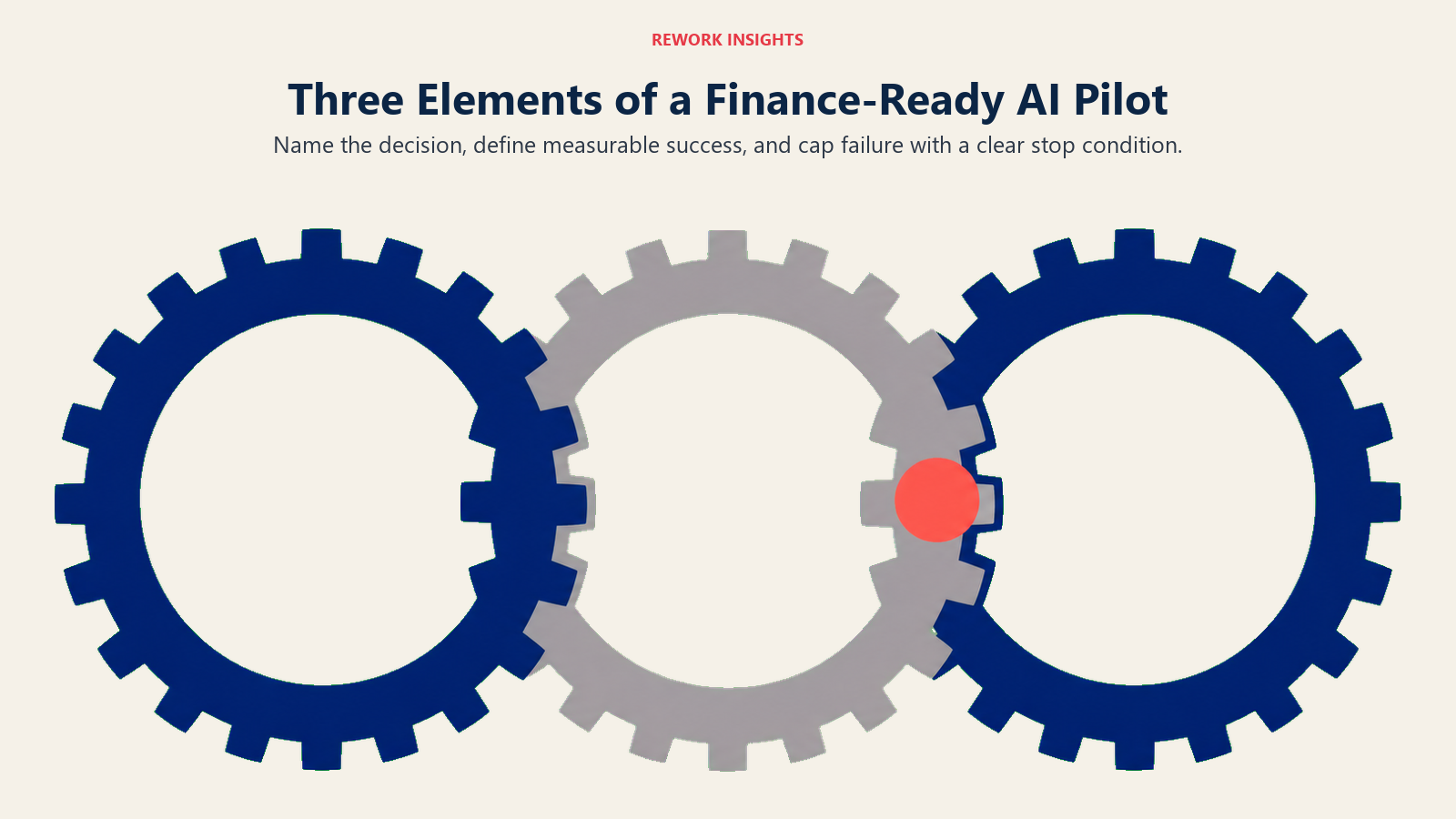
The Three Elements Finance Actually Needs
Finance approves pilots that answer three questions clearly. Most AI proposals answer one of them well, half-answer another, and skip the third entirely.
Question 1: What decision will this pilot inform?
Finance understands stage-gate funding. They fund R&D in tranches because each stage narrows uncertainty and provides better data for the next investment decision. That's the frame for an AI pilot. You're not asking for $80,000 to save time on invoices. You're asking for $30,000 to run an 8-week test that will tell you whether a $400,000 annual automation investment is worth making.
The pilot has to be positioned as the cheapest way to answer a specific high-stakes question. Not as a self-contained project with its own ROI.
Question 2: What does success look like, and how do you measure it?
Vague success criteria are a red flag for finance. "Better workflows" or "faster decision-making" sounds like the project will declare victory regardless of results. What finance wants to see is a small number of measurable outcomes with specific targets: processing time reduced by X%, error rate below Y%, volume handled without headcount addition.
This forces the proposal writer to do real work. You have to know your current baseline before you can write a credible success metric. Most AI pilot requests skip this step, which is why they fail scrutiny.
Question 3: What happens if it fails?
Finance is not allergic to risk. They're allergic to unbounded risk. A pilot proposal that doesn't address the failure scenario feels reckless. A proposal that says "if we don't hit the success metrics by week 8, we stop spending and we've learned that this use case is not the right starting point" sounds like something a rational adult designed.
Include a defined kill condition. It signals maturity and usually reduces the perceived risk enough to shift the decision from "not now" to "let's see the numbers."
Structuring the Actual Ask
The format matters as much as the content. A ten-page pitch deck is the wrong vehicle for a budget request. Finance reads budget requests the way they read financial models: they go straight to the assumptions and the numbers. Bury those in slide 7 and you've already lost.
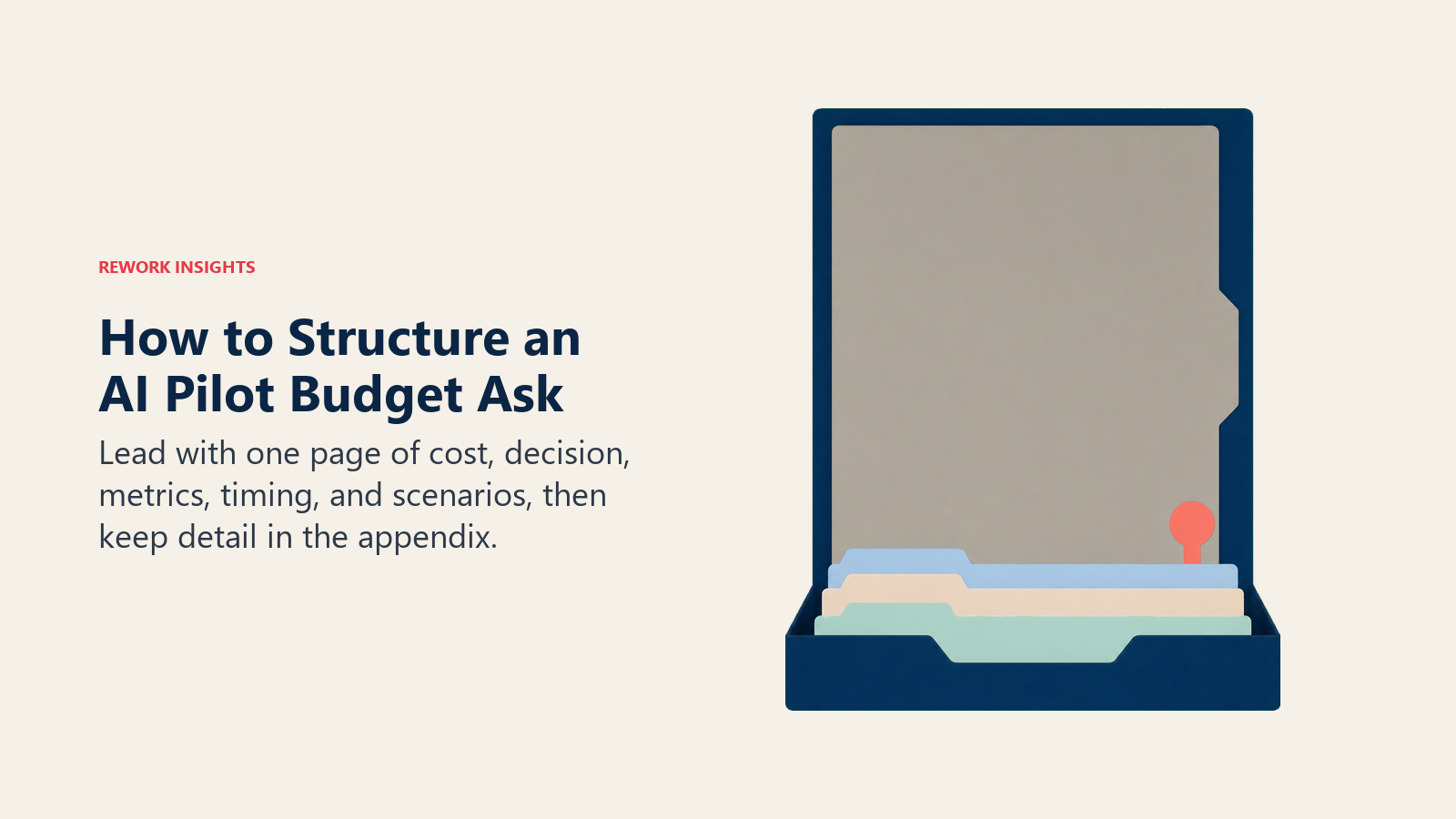
A one-page financial summary with a two-page appendix works better. The summary covers: total pilot cost, the question being answered, defined success metrics, timeline, and the financial implications of a positive result. The appendix has the details for anyone who wants to dig.
For the numbers themselves, build a simple scenario model. Best case, base case, and downside. Not because finance expects the projections to be precise, but because building the model forces you to make your assumptions explicit. Assumptions you can defend are the raw material of a credible business case. Assumptions you haven't examined are what finance will find and challenge in the first five minutes of the conversation.
One example of how this works: a 200-person professional services firm wanted to test AI-assisted contract review. The initial proposal was framed as "reduce contract turnaround time." Finance pushed back because there was no revenue impact they could trace. The revised proposal reframed it as: the pilot will test whether AI can reduce contract review time by 60%, which would eliminate the need to add a fifth contracts associate this fiscal year at $95,000 fully loaded. The pilot costs $25,000. If it works, the pilot pays back 3.8x before year-end. If it doesn't, we've spent $25,000 to confirm we need the hire. That proposal got approved in one meeting.
The change management framework for AI rollout covers what happens after the yes, but the financial framing is what gets you to the yes in the first place.
Common Mistakes That Kill Pilot Proposals
Proposing too much too fast. An $800,000 AI transformation program is not a pilot. Finance treats it as a capital project with a full investment review process, and those take months. Keep the initial ask under $50,000. The goal is to fund learning, not outcomes.
Using AI vendor materials as evidence. Every AI vendor has case studies showing 40% productivity gains and 6-week payback periods. Finance knows this. Citing vendor case studies as evidence for your business case damages credibility. Use internal data wherever possible. If you don't have internal data, be honest about that and explain how the pilot will generate it.
Not involving finance early. Bringing a finished proposal to finance is the wrong sequence. The people who need to approve a budget request should be involved in shaping it. A 30-minute conversation with your CFO or finance director before writing the proposal is worth ten hours of polish on the document. They'll tell you what they need to see, and you'll write it once.
Proposing an AI pilot when what you actually need is a process review. Not every workflow problem needs AI. Some need process redesign, better tooling, or clearer ownership. Finance is better at spotting this than most operations teams expect. If the root problem is process, an AI pilot won't fix it and the results will be disappointing. The AI readiness assessment templates can help you verify whether the problem is actually AI-appropriate before you build the case.
What Finance Wants to Know About Risk
The risk section of an AI pilot proposal is usually the shortest section. It shouldn't be.
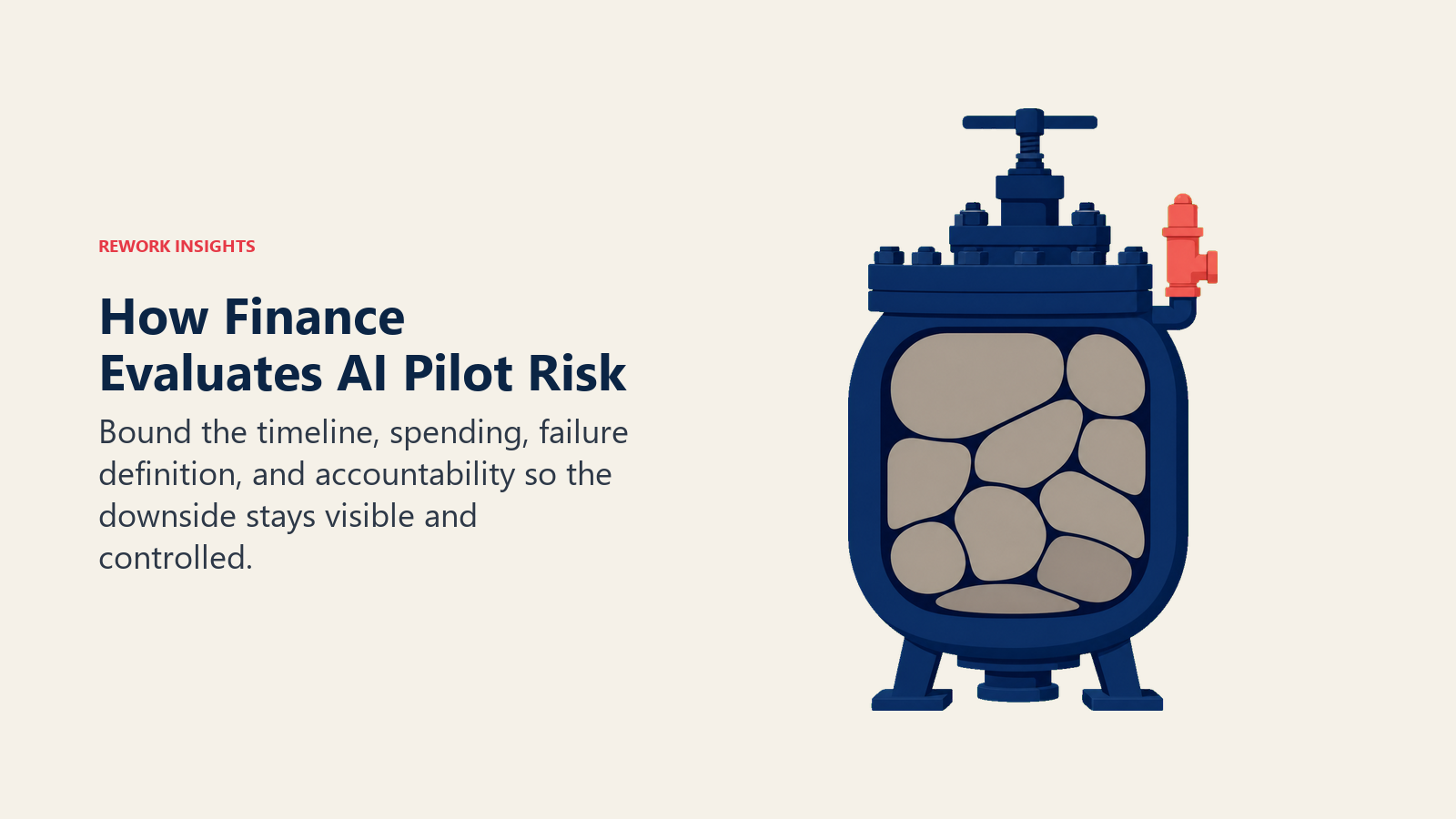
Finance thinks about risk in two ways: the probability that a project fails to deliver, and the cost of that failure. For most AI pilots, the probability of learning something useful is actually quite high even when the specific hypothesis doesn't pan out. What makes it feel risky is that the cost of failure is undefined.
Capping the cost of failure is how you reduce perceived risk. Set a time limit. Set a spending cap. Define what "failed" means clearly enough that there's no room to keep extending a project that isn't working. These aren't just risk management devices. They're signals to finance that someone has thought carefully about the worst case, which is usually more reassuring than the upside scenario.
The governance piece matters too. Finance wants to know who is accountable for this pilot. Not the vendor. An internal owner who will report back with results and defend the outcomes. Projects with named owners get approved more often than projects without them, because an accountable person is an early warning system for problems.
After the Pilot: Setting Up the Next Ask
The approval of a pilot is the start of a relationship, not a transaction. How you report results from the pilot determines whether the larger investment gets approved when the time comes.
Report back against the exact metrics you proposed. If the pilot worked, here's the data. If it didn't fully work, here's what you learned and here's what you'd change before the scale investment. Finance respects intellectual honesty about results far more than they respect optimistic post-hoc framing.
The path from PoC to scaled AI investment in a mid-market company runs directly through finance's trust in the people proposing it. Building that trust with a well-structured, honestly-reported pilot is faster than trying to win a single large approval on a case that can't fully satisfy the uncertainty requirements.
The executive decision framework for AI workforce strategy covers the broader build-vs-buy decisions that typically follow a successful pilot. But the PoC approval is the gate you have to move through first, and it's more often blocked by communication failures than budget constraints.
Learn More
