More in
AI Workforce Transformation
Does AI Make Distributed Teams Easier or Harder to Lead?
Oct 11, 2026
Where AI Productivity Monitoring Turns Into Surveillance
Oct 11, 2026
Why Your Most Experienced People Resist AI Hardest (and Why You Need Them Most)
Oct 11, 2026
Is AI Making Teams Less Collaborative?
Oct 11, 2026
Should CEOs Use AI Themselves? Why Executive Fluency Sets the Adoption Ceiling
Oct 11, 2026
Does AI Favor Generalists or Specialists? What It Means for Who You Hire
Oct 10, 2026
Is Experience Still Worth Paying For When AI Narrows the Skill Gap?
Oct 10, 2026
When Every Candidate Uses AI, What Is a Resume Still Worth?
Oct 10, 2026
Should AI Screen Your Job Candidates? Where Automated Hiring Helps and Where It Backfires
Oct 10, 2026
Should Candidates Be Allowed to Use AI in Interviews?
Oct 10, 2026
RevOps and AI: Why Data Alignment Comes Before Tool Deployment

Turn this article into takeaways for your work.


Each assistant summarizes the article only for you and suggests best practices for your work.
The promise of AI in revenue operations is specific: better forecasts, faster pipeline reviews, rep behavior visibility, automated handoffs between marketing and sales, and real-time signals that tell you which deals are at risk before they slip. Every major CRM and sales intelligence vendor is building toward this. The technology is real.
But there's a gap between the promise and what most RevOps leaders actually experience when they deploy AI on top of their existing revenue stack. The gap is not in the AI. It's in the data.
AI for revenue operations is essentially a pattern-recognition system working on top of your revenue data. If that data is clean, consistent, and complete, the AI finds patterns. If it's fragmented, inconsistently entered, siloed across systems, or missing key fields, the AI amplifies the noise rather than surfacing the signal. Most mid-market companies are deploying AI on top of data that wasn't designed to support it, and then wondering why the AI doesn't deliver on the vendor's promises.
What "Data Alignment" Actually Means in RevOps
RevOps teams use the term "data alignment" loosely. It can mean anything from syncing CRM records to marketing automation to making sure sales and finance agree on what counts as revenue. For AI specifically, data alignment has a more precise meaning.
AI models for revenue work need four things from your data. They need consistency (the same field means the same thing across every system, every rep, and every deal). They need completeness (the fields the model is trained on are actually populated, not left blank). They need recency (records reflect what's actually happening now, not what happened six months ago before someone stopped updating them). And they need coverage (the data represents the full range of your business, not just the deals that got closed or the accounts that didn't churn).
Most mid-market RevOps systems fail at least two of these. The most common failure is consistency. Deal stage definitions drift over time. What "qualified" means to one rep is different from what it means to another. "Decision maker contacted" gets checked off at different points in the process depending on who's doing the entry. Over a 200-rep sales team, these small inconsistencies accumulate into a dataset that looks like it has 50,000 data points but actually has 50,000 slightly-different-things-being-measured-with-the-same-label.
When you layer AI forecasting on top of inconsistently-defined data, the model learns to predict based on noise. It may hit acceptable accuracy in the short term because human intuition has been baked into the inconsistencies. But it won't generalize, won't improve, and will break when anything changes.
The Three Data Problems RevOps Needs to Solve First
There are common data alignment problems that block AI deployment. They're not the only problems, but they're the highest-leverage ones to fix.
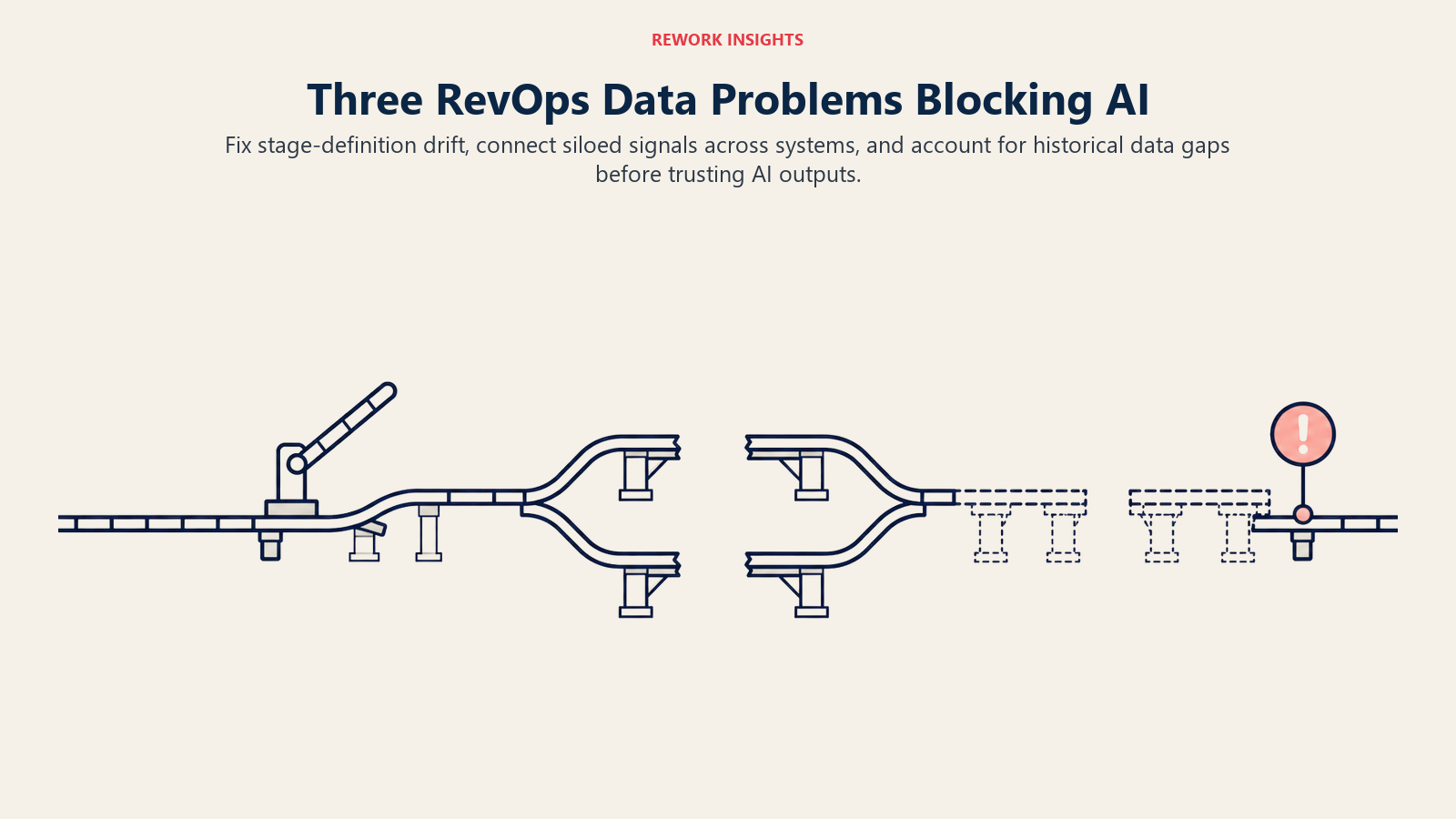
Problem 1: Stage definition drift. Every CRM has a pipeline stage structure. Most have it in documentation. Almost none have it consistently applied in practice. Run a simple audit: pull all deals that moved from "proposal sent" to "closed lost" and read the notes. You'll find deals where "proposal sent" was checked when the rep sent a preliminary email, deals where it was checked when a formal proposal was delivered, and deals where the rep checked it retroactively when the deal was already closing. That's three different things labeled the same way.
Fixing this requires both a definitional cleanup (clear entry and exit criteria for each stage) and a behavioral change program (reps need to understand why consistency matters for forecasting, not just be told to fill in the fields). The CRM hygiene routines guide covers the operational discipline side of this. The behavioral change is harder and usually requires manager involvement.
Problem 2: Siloed signal data. AI models for pipeline health and churn risk need signals from across your revenue stack, not just the CRM. Email engagement, product usage (if applicable), support ticket volume, contract renewal dates, invoice payment timing, marketing engagement. Most mid-market companies have this data in separate systems with no shared identifier that connects a contact in the CRM to the same contact's behavior in the support platform or the marketing tool.
Building these connections is the core of a RevOps data architecture. It's not glamorous work, and it often requires technical resources that RevOps teams don't control. But it's the prerequisite for AI that can give you genuine early warning on at-risk accounts rather than just pattern-matching on the CRM fields that reps update inconsistently.
Problem 3: Historical data gaps. AI models need historical data to learn from. A model predicting which deals will close needs to see enough closed deals to learn what patterns predict close. A churn model needs to see enough churned accounts. If your CRM was poorly maintained two years ago (many are), the historical dataset that an AI model would train on is too noisy to be reliable.
There are two approaches. You can clean the historical data, which is expensive and imperfect. Or you can accept that your first AI forecasting models will be weaker because they're training on noisy history, use human judgment to override model outputs during the initial period, and invest in clean data going forward with the understanding that the model gets better over time as cleaner data accumulates. The second approach is usually the more pragmatic one for mid-market companies.
Why RevOps Owns This, Not IT
Data alignment problems in revenue operations feel like infrastructure problems. They live in databases and systems. The instinct is to hand them to IT.
That instinct is wrong for a specific reason: the hardest part of data alignment in RevOps is behavioral, not technical. Getting reps to update deal stages consistently, getting marketers to apply lead status conventions that match how sales thinks about qualification, getting customer success to log engagement data in a way that integrates with the sales view of the account, these are workflow and culture changes. IT can build the integrations, but they can't change how 80 salespeople think about data entry.
RevOps owns this because RevOps is the function that sits at the intersection of the process, the systems, and the go-to-market teams. Data alignment is fundamentally a process and governance problem, not a technology problem. The technology is often the easy part.
This also means that the RevOps leader who wants to make AI work needs executive cover and cross-functional authority. Data alignment that requires sales leadership to enforce new CRM hygiene standards requires sales leadership to be bought in. Data alignment that requires marketing to change their lead scoring conventions requires marketing to see the value. That's a RevOps-led coordination problem, not a project that runs in a corner.
The AI-native CRM perspective for mid-market companies covers what the end-state looks like when data alignment is done well. But the path to that state runs through the messy alignment work described here.
What a Data Alignment Sprint Looks Like
The right approach for most mid-market RevOps teams is a focused sprint before AI deployment, not a multi-year data transformation program. The goal is not perfect data. The goal is data that's clean enough for AI to find real patterns.
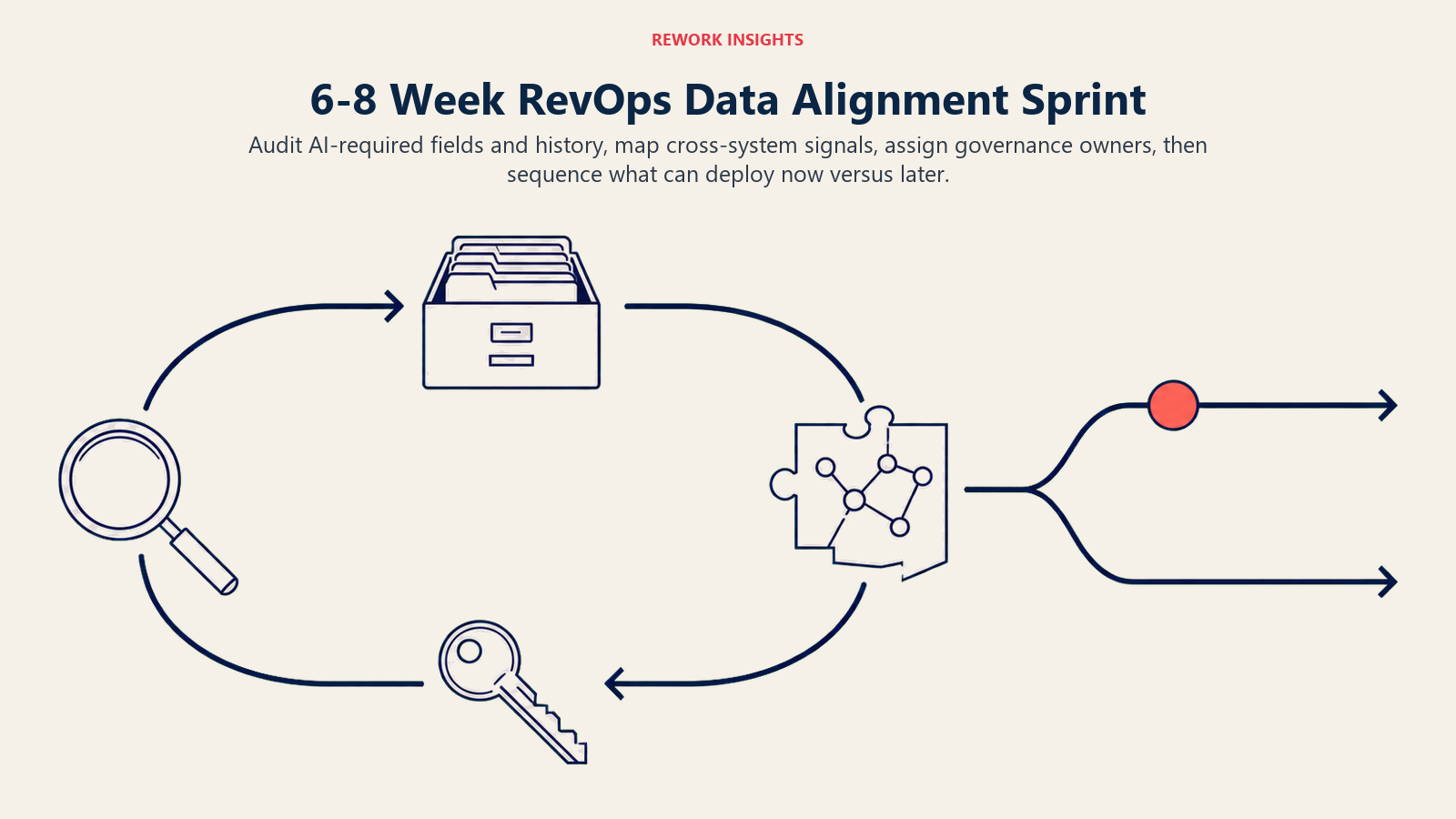
A typical sprint runs 6-8 weeks with a small RevOps-IT working group. The output is a data readiness assessment covering: field-by-field consistency check for your AI vendor's required inputs, historical record audit to identify the time periods that are clean enough to use for model training, integration map for the cross-system signals the AI model needs, and a governance framework defining ownership and enforcement for ongoing data quality.
The assessment tells you what you can deploy AI on now, what needs remediation before deployment, and what the ongoing maintenance requirements are. Most RevOps teams are surprised to find that 70-80% of the AI deployment they want can be supported by their existing data once a relatively small number of consistency issues are fixed.
The 20-30% that requires deeper infrastructure work can be sequenced into a later phase. Starting with what you can deploy now builds organizational confidence and produces the quick wins that fund the harder work.
The Sales Team Resistance You Will Encounter
Any data alignment initiative that touches how sales reps record activity will generate resistance. Reps will say the new requirements take too long, don't reflect how deals actually work, and create bureaucratic overhead that gets in the way of selling. Some of this is legitimate. Most of it is the normal friction of behavior change.
The framing that works is not "the CRM needs better data." It's "the AI that will help you close more deals faster needs this data to work for you." That's a different value proposition. The first is a company ask. The second is a personal benefit.
But it only works if the AI actually delivers visible value to reps fast enough that they connect the data discipline to the benefit. If there's a 12-month lag between improving data hygiene and seeing better AI outputs, the connection won't hold. The pilot design should be intentional about creating quick feedback loops where reps see the AI's improved accuracy in near-real-time as a result of their data discipline.
Manager behavior matters more than rep training here. If managers use pipeline reviews to reinforce data quality (referencing AI forecast accuracy explicitly, following up on fields that are blank or inconsistent), reps get the signal quickly. If managers ignore the data quality issues in pipeline reviews, reps will too.
The sales team AI readiness audit includes data hygiene as one of the readiness dimensions, which is the right framing. Data hygiene is an AI readiness issue, not just a CRM admin issue.
After Data Alignment: What AI Actually Changes in RevOps
When data alignment is in place, the AI capabilities that RevOps leaders care about actually work.
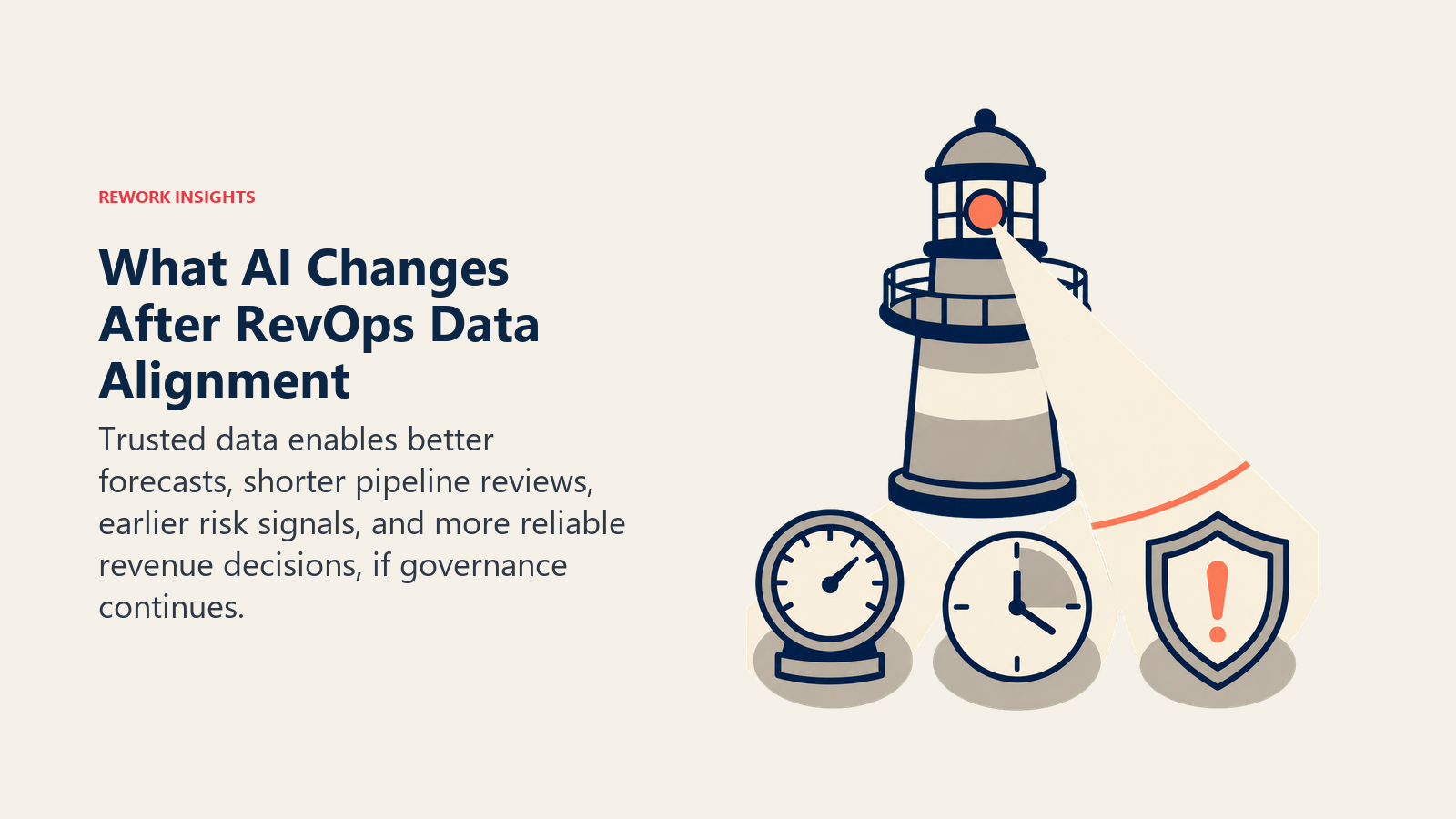
Forecasting accuracy improves because the model is pattern-matching on consistent, complete data rather than noisy approximations. Pipeline review meetings get shorter because reps and managers can trust the AI-generated deal health scores rather than spending 20 minutes debating whether a deal is really in stage 3. At-risk account alerts become actionable because the model has enough signal data to distinguish genuinely at-risk accounts from accounts that just have an open support ticket.
These are meaningful productivity and revenue outcomes. They're also fragile. Data quality degrades over time without active governance. The work of building the alignment infrastructure is matched by the work of maintaining it. RevOps organizations that treat data governance as a one-time project rather than an ongoing discipline see AI accuracy degrade within 6-12 months as data quality drifts back toward its prior state.
The measurement framework for RevOps AI investments connects directly to the returns measurement approach that CFOs need for any AI spend. The CFO framework for measuring AI returns and the RevOps data alignment work described here are two sides of the same problem: how to build an AI investment that generates defensible, measurable returns rather than just activity and noise.
Learn More

Co-Founder, Rework.com