More in
AI Workforce Transformation
Does AI Make Distributed Teams Easier or Harder to Lead?
Oct 11, 2026
Where AI Productivity Monitoring Turns Into Surveillance
Oct 11, 2026
Why Your Most Experienced People Resist AI Hardest (and Why You Need Them Most)
Oct 11, 2026
Is AI Making Teams Less Collaborative?
Oct 11, 2026
Should CEOs Use AI Themselves? Why Executive Fluency Sets the Adoption Ceiling
Oct 11, 2026
Does AI Favor Generalists or Specialists? What It Means for Who You Hire
Oct 10, 2026
Is Experience Still Worth Paying For When AI Narrows the Skill Gap?
Oct 10, 2026
When Every Candidate Uses AI, What Is a Resume Still Worth?
Oct 10, 2026
Should AI Screen Your Job Candidates? Where Automated Hiring Helps and Where It Backfires
Oct 10, 2026
Should Candidates Be Allowed to Use AI in Interviews?
Oct 10, 2026
Why Peer-Led AI Programs Outperform Top-Down Training Rollouts

Turn this article into takeaways for your work.


Each assistant summarizes the article only for you and suggests best practices for your work.
Most AI training programs have the same problem: they measure the wrong outcome. They track course completions, certification rates, and training hours. Then they report those numbers to leadership as evidence of AI adoption. But four months later, usage of AI tools in actual work hasn't changed, and nobody can explain why the investment didn't land.
The answer is usually that the training was designed for compliance, not behavior change. And compliance-driven training, even excellent compliance-driven training, is not what changes how people work.
What changes how people work is watching someone they trust and respect, someone who does the same job they do, use AI to solve a problem they recognize. That's peer influence, and it's been the primary mechanism of workflow change in organizations for decades. AI adoption is no different.
The Case Against Vendor-Led AI Training
Vendor-led and L&D-department-led AI training programs have a structural credibility problem. The trainer knows the tool. They don't know your workflows, your systems, your client relationships, or your team's specific resistance points. When a trainer demonstrates a capability, the audience is thinking about how it would actually work in their context, and the trainer can't answer those questions with authority.
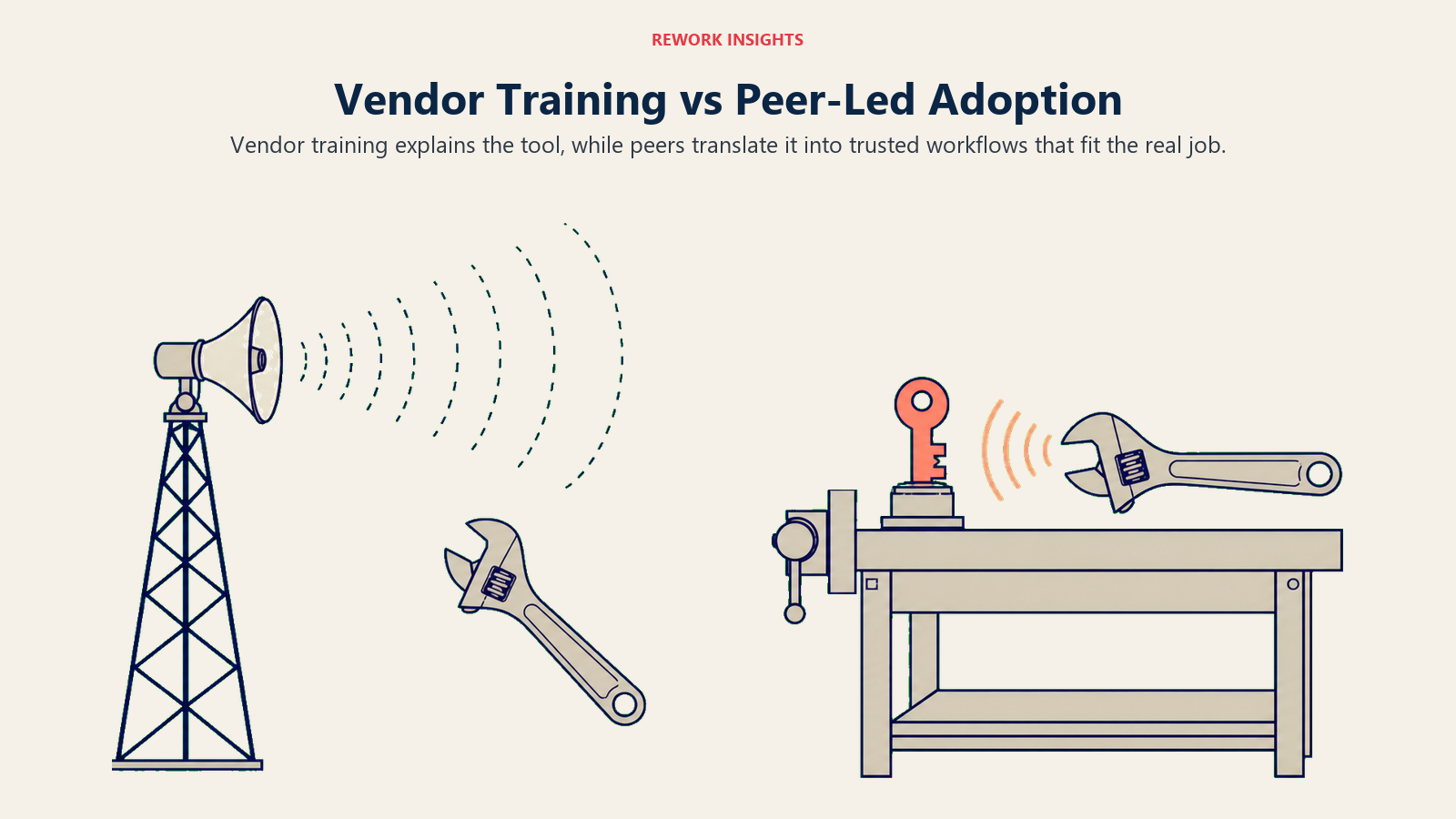
Peer champions can. They're solving the same problems with the same constraints. When a sales rep shows another sales rep how AI cut her proposal research time from three hours to forty minutes, the proof is immediate and contextually relevant. There's no translation required. The second rep doesn't need to imagine whether it would work. She can see that it works for someone doing exactly her job.
This is why the AI training investment that consistently delivers the highest adoption rates isn't a training platform license. It's a structured peer champion program. The champions aren't trainers. They're influencers with operational authority.
The gap between completion rates and actual adoption is the core finding from most serious analyses of enterprise AI programs. Completion rates measure attendance. Adoption rates measure whether the training changed anything. Those two numbers are weakly correlated at best.
What a Peer-Led AI Program Actually Looks Like
The structure of an effective peer champion program is straightforward, but the execution details matter. Getting them wrong produces a program that looks like a peer program but functions like a slightly more localized version of the top-down rollout it was meant to replace.
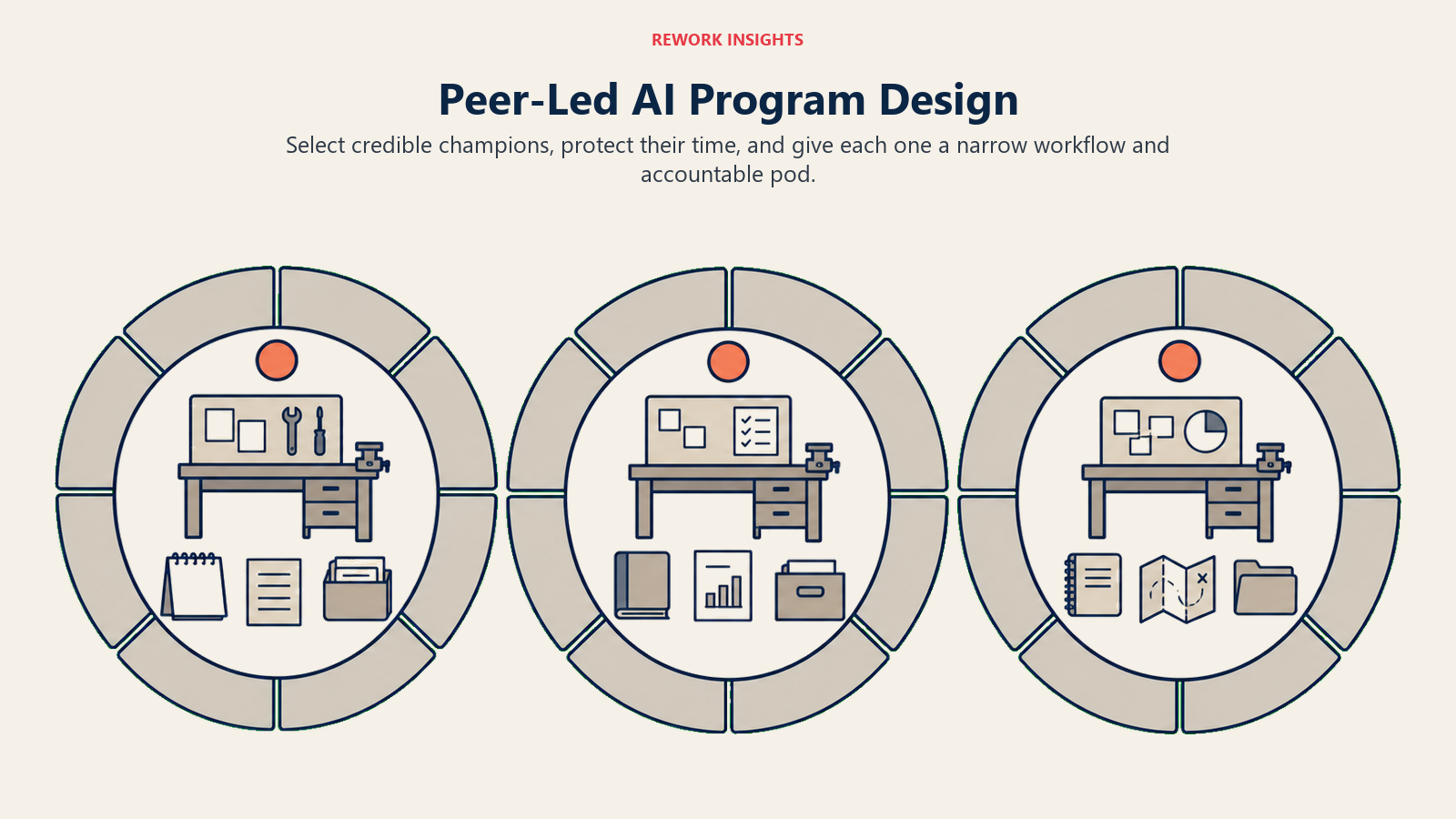
Champion selection is the most important decision. Champions need to meet two criteria: they are already experimenting with AI in some form, and they have genuine peer credibility with the people they'll be influencing. Formal authority is not a qualification. A team lead who people privately dismiss won't carry the program. An individual contributor who others go to for advice on how to handle difficult accounts will.
Look for the people who are already using AI tools on their own without being asked. They exist in most organizations. They're using ChatGPT to draft communications, running experiments with Notion AI or Copilot, finding workarounds that make their work easier. These people don't need to be trained. They need to be resourced, given legitimacy, and connected to others who can learn from them.
Champions need slack in their schedules. This is the part that most organizations underestimate. You can't make someone an internal AI champion and leave them with 100% of their previous workload. Something has to come out. Typically this means 10-15% of time redirected for 8-12 weeks during the active program phase. Organizations that try to run champion programs on top of existing workloads end up with champions who resent the program and stop participating by week three.
The program needs a defined scope, not an open-ended mandate. The most effective peer champion programs focus on a specific use case or a specific set of workflows rather than "AI adoption generally." Champions own one problem, get good at solving it with AI, and then teach that specific thing to their peers. Breadth comes later. Depth and specificity come first.
A 150-person B2B company in professional services ran a peer champion program focused exclusively on client report generation. Six champions, each owning a pod of eight colleagues, with a 10-week mandate to get their pods to adopt AI-assisted report drafting. After the program, 71% of the people in champion pods were using the tools regularly. The control group, which received standard vendor training on the same tools, was at 23%. The difference wasn't the tools. It was the accountability structure and the peer influence.
The Role of Psychological Safety
Peer programs work in part because they lower the social cost of being a beginner. In a vendor-led training, not knowing how to use a tool in front of colleagues can feel exposing. People who are skeptical or anxious about AI aren't going to ask the questions they actually have in a group setting with a stranger running the session.
With a trusted peer, the dynamic is different. The peer already admitted they needed to figure this out. They're sharing what they learned, including the mistakes. That makes it safe to be uncertain, to try things that don't work, to ask whether AI is actually the right tool for a specific task.
This matters especially for mid-career employees who feel more exposed by AI adoption than early-career employees do. The concern about AI changing existing roles is real for this group, and a peer who has navigated the same anxiety and found a productive way to engage with AI is far more persuasive than an executive mandate or a vendor talking point.
How to Handle the Skeptics
Every peer champion program runs into skeptics. Some are vocal. Most are quiet. Both types will undermine the program if champions aren't prepared for them.
The instinct is to ignore skeptics or to overwhelm them with data about AI benefits. Neither works particularly well. What works better is giving champions scripts for engaging productively with skepticism.
The most common forms: "This is just more work on top of my existing job," "AI will make mistakes and I'll get blamed for them," and "This is going to replace me eventually, so why help them implement it?" Each of these has a real answer, but the answer needs to come from someone the skeptic trusts, not from the CHRO's all-hands talking points.
Champions who have personally navigated these concerns are the right messengers. They can say honestly what they were worried about, what they tried, and what they found. That conversation is the most effective deradicalization for AI skepticism that most organizations can run.
The AI workforce transformation research on middle management covers this dynamic in detail. Middle managers are often both the biggest advocates and the biggest blockers of AI adoption, and peer programs that include middle managers as champions rather than managing around them tend to have significantly higher sustained adoption.
Measuring What Actually Matters
Peer champion programs succeed or fail based on behavioral outcomes, not training completion. That means defining measurement in terms of actual workflow change before the program starts.
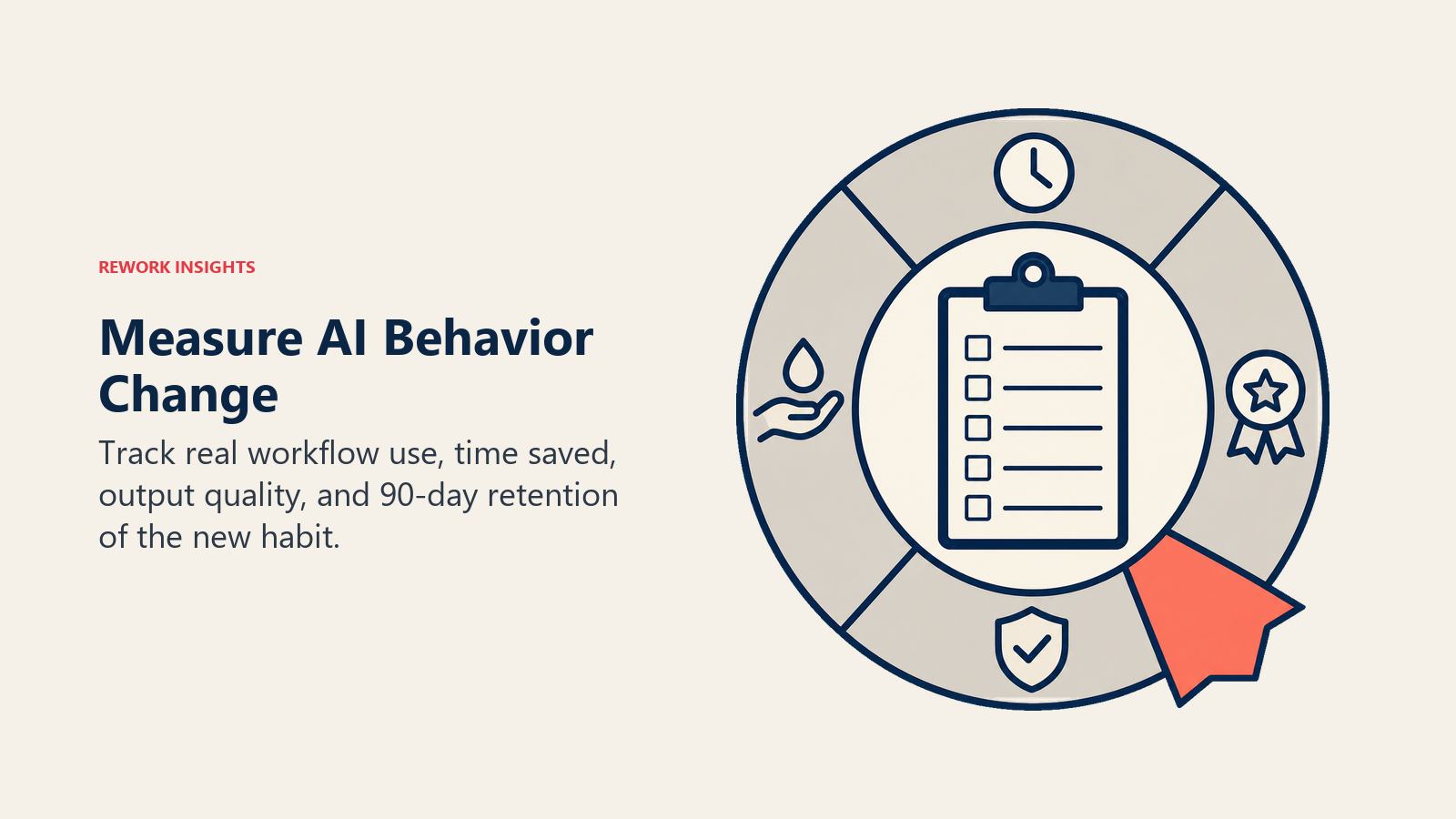
Good metrics for a peer-led AI program: percentage of target behavior (using AI for a specific task) observed after 8 weeks, self-reported time savings compared to baseline, quality of output as rated by downstream stakeholders, and retention of new behaviors at 90 days (the typical drop-off point for new workflow habits).
Bad metrics: training hours completed, champion-attendance rates, survey scores about whether the training was engaging.
One useful structure is a simple pre/post measurement for each champion's pod: before the program starts, survey participants on how they currently handle a specific workflow and how long it takes. After the program, survey them again. The delta is your adoption evidence. It's not controlled science, but it's honest data that tells you whether behavior changed.
The AI skills matrix provides a framework for assessing where skill gaps actually are before designing a program. That assessment step is worth running before selecting champions, because it tells you which workflows have the highest gap and the highest upside, which is where peer champion programs should focus first.
The Limits of Peer-Led Programs
Peer programs are not a complete AI training strategy. They're a behavior-change mechanism for specific use cases. They don't cover policy, governance, data security, or the cross-functional coordination that enterprise AI adoption eventually requires. A compliance and policy layer still needs to run in parallel.
Peer programs also depend on having champions who are genuinely ahead of the curve. In organizations where AI adoption has been very slow across the board, there may not be enough early adopters to seed the champion network. In that case, a structured exploratory phase, giving a small cohort protected time to experiment before the champion program launches, is worth the investment.
And peer programs need executive air cover even when they're designed to be bottom-up. Champions need to feel that their work has organizational endorsement, not just that they're doing a favor for L&D. Visible executive participation in the first champion showcase, a budget line for champion time, and a feedback loop that actually reaches senior leadership are the organizational signals that tell champions their work matters.
The decision about whether to build an internal champion capacity or hire AI-native talent to accelerate adoption is worth thinking through carefully. The upskill vs. hire AI-native ROI case covers the economics. Peer programs are typically the lower-cost path for organizations that have enough internal AI interest to seed them properly.
Learn More
