Customer Retention in Travel - Keeping Guests Coming Back 2026

Turn this article into takeaways for your work.


Each assistant summarizes the article only for you and suggests best practices for your work.
Acquiring a new traveler costs five to seven times more than retaining one you already have. Yet most travel businesses pour their budgets into top-of-funnel marketing and treat post-trip engagement as an afterthought.
That is a structural mistake. The math does not support it.
A guest who books twice spends 67% more per trip than a first-timer. A guest who books three or more times becomes your most cost-effective revenue source and your most credible referral channel. Retention is not a soft, feel-good metric. It is an economic lever that determines whether your business grows profitably or just stays busy.
This guide covers the frameworks and tactics that turn one-time travelers into loyal advocates through a systematic repeat booking strategy.
Why Retention Fails in Travel
Most travel businesses lose repeat customers not because the trip was bad, but because the relationship went cold afterward.
The booking is the peak of the customer relationship. Then the trip happens. Then silence. The traveler gets a generic "hope you had a great trip" email three days after returning, maybe a promotional newsletter two months later, and nothing else until a discount hits.
That is not relationship management. That is benign neglect.
Three root causes drive retention failure in travel:
Poor post-trip follow-up. Post-trip engagement is where retention either starts or dies. Businesses that wait more than 48 hours to follow up lose the emotional window when the experience is still vivid and guests are most likely to share, review, and plan their next trip.
No personalization at scale. Generic communications signal that you do not actually know the guest. A couple who just returned from a romantic safari in Kenya does not want an email promoting group tours to Thailand. Relevance requires travel customer segmentation and a CRM that tracks preference data.
No compelling reason to return. If your product line is narrow or your messaging does not actively surface new destinations and experiences, loyal customers have no reason to think of you first for their next trip.
The Retention Funnel
Retention is not a single action. It is a progression through four stages.
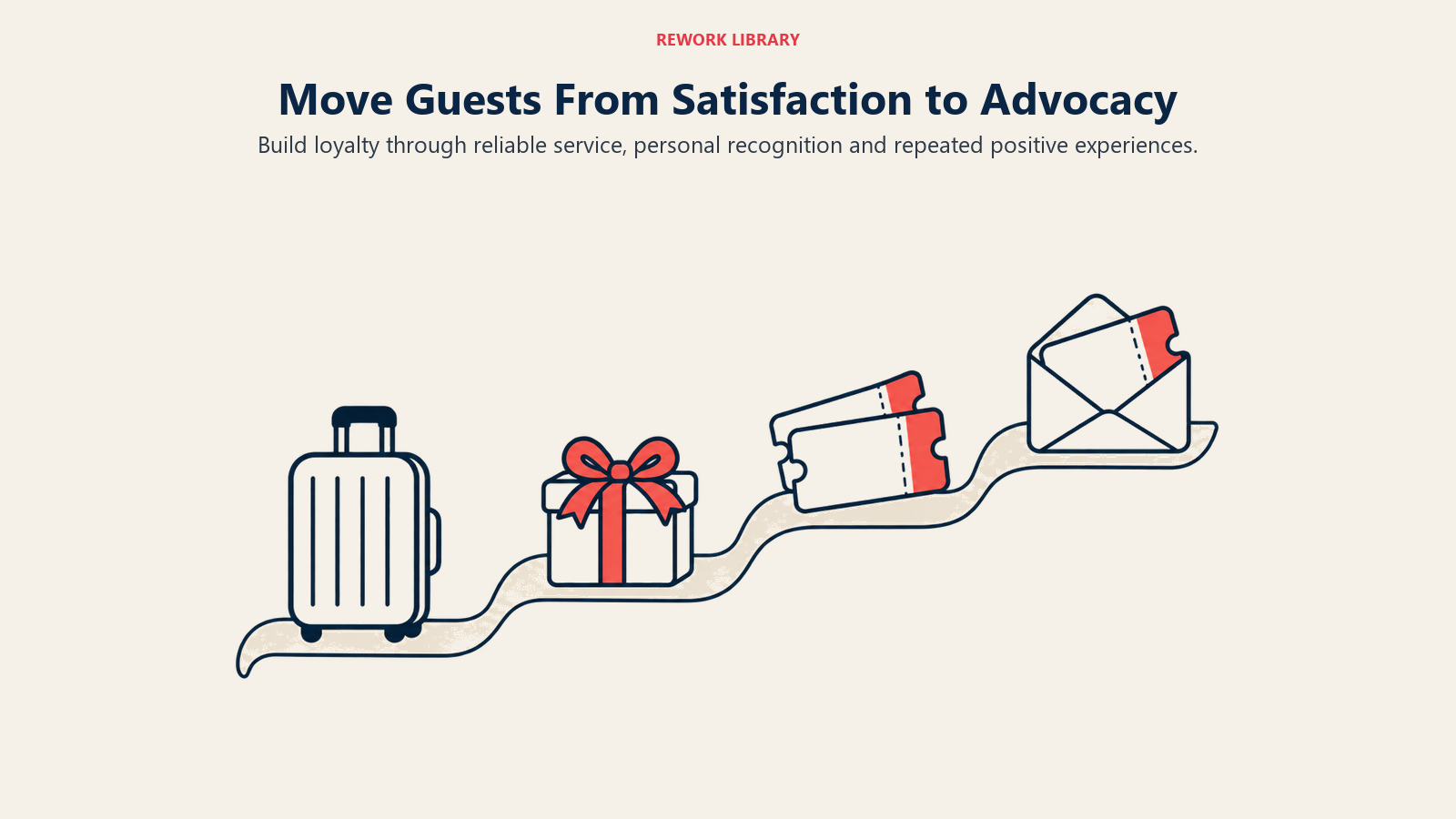
Satisfaction. The traveler must be satisfied before they can become loyal. This starts before the trip, continues through pre-trip communication and on-trip support, and culminates in how you handle problems when they arise. Satisfaction is the floor.
Delight. Delight happens when you exceed expectations in a specific, personal way. Not a generic upgrade. A note that references something the guest mentioned during the booking call. A local restaurant recommendation that matches their food preferences. Small gestures that prove you were paying attention.
Loyalty. A loyal customer actively chooses you over competitors, even when cheaper options exist. Loyalty is built through repeated positive experiences and reinforced through recognition programs that make guests feel seen and valued.
Advocacy. Advocates refer new customers. They leave reviews unprompted. They share content on social media. Converting loyal guests into advocates requires no additional marketing spend.
The goal is to move every guest up this funnel, not just capture the ones who naturally self-select into it.
Key Retention Tactics
Structured Post-Trip Sequence
The 48 hours after a trip ends are your highest-value window. The guest is emotionally warm, the experience is fresh, and they are receptive to engagement.
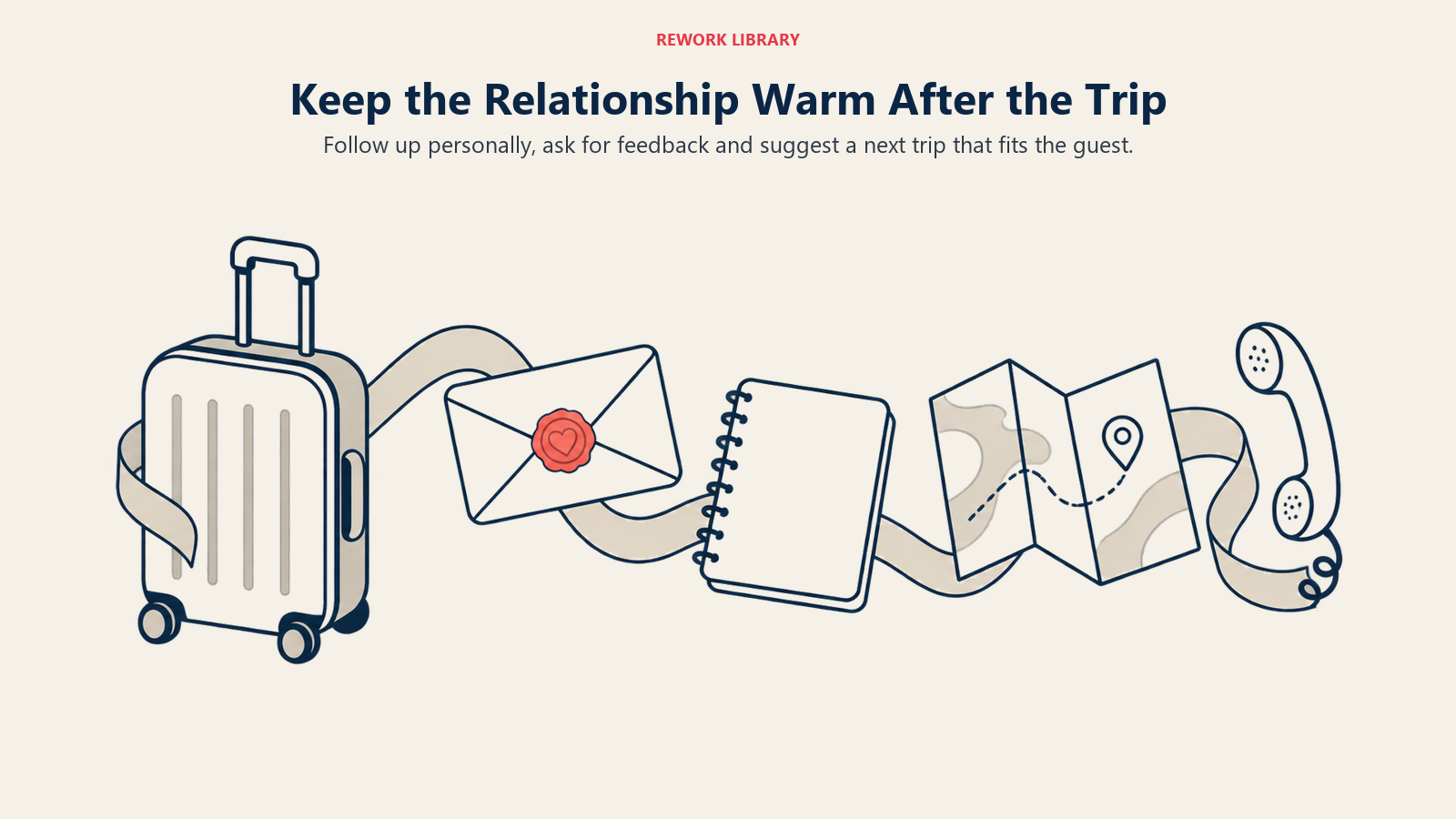
A proven post-trip sequence looks like this:
Within 24 hours: a personal thank-you from their consultant (not an automated template) acknowledging specific moments from their trip. Reference the destinations they visited, challenges they mentioned, or highlights they shared.
Day 3-5: a guest feedback request. Keep it short. Ask three questions: What exceeded expectations? What could be better? Would you recommend us? The response rate on this window is 3-4x higher than feedback requests sent a week later.
Day 10-14: a curated "what's next" email based on their travel profile. If they just did Southeast Asia, surface Central America or Eastern Europe. Show them something adjacent to what they loved, not a generic catalog.
Day 30: a "stay in touch" check-in. Not promotional. Just a note from their consultant asking how the post-trip glow is treating them, sharing a relevant piece of travel content, and planting the seed for their next adventure.
Loyalty Recognition Programs
Formal travel loyalty programs work best when they reward meaningful behavior rather than just spend.
Tier structures should reflect relationship depth, not just booking volume. A guest who books one high-value expedition annually is more valuable than one who books five budget trips. Your tiers should recognize that.
Recognition does not have to be discounts. Exclusive access, priority service, dedicated consultants, early availability for popular departures, and behind-the-scenes experiences carry high perceived value at low cost.
The simplest retention recognition you can implement: remember. Remember names. Remember anniversaries. Remember that they told you their daughter just graduated and they wanted to celebrate somewhere special. This kind of memory, systematized through your travel CRM, is worth more than any points program.
Win-Back Campaigns
Guests who have not booked in 18-24 months are at risk of being lost permanently. But they already know and have trusted you once. Reactivating them costs less than acquiring new customers.
Win-back campaigns work best when they are personal and specific. "We miss you" emails rarely convert. "We noticed you traveled to Japan with us two years ago and thought you should know about a new experience we're offering in the same region" is specific and relevant.
Include a genuine reason to act now, whether that is a limited-capacity departure, an exclusive early-access window, or a modest incentive. But lead with relevance, not discount.
Retention Metrics to Track
Retention performance is measurable. These are the numbers that matter:
Repeat booking rate. What percentage of guests book again within 24 months? Industry average for independent travel agencies is 15-20%. Strong operators hit 35-45%.
Time to second booking. How long does the average customer take to book again? Shortening this window is a direct indicator that your post-trip sequences are working.
Customer lifetime value. Total revenue generated over the full relationship. This is the number that justifies your retention investment. A guest with a 5-year LTV of $15,000 is worth far more than a one-time booking of $3,000.
Net Promoter Score. Travel NPS scores above 50 consistently correlate with strong organic referral rates. Track it by trip type, destination, and consultant to identify what is driving loyalty.
Churn rate. What percentage of past guests do not book again within 24 months? This is your retention failure rate, and understanding why they churned (through exit surveys and win-back campaign learnings) reveals where your service gaps are.
Building Retention Into Operations
Retention cannot be a campaign. It has to be embedded into how your business operates.
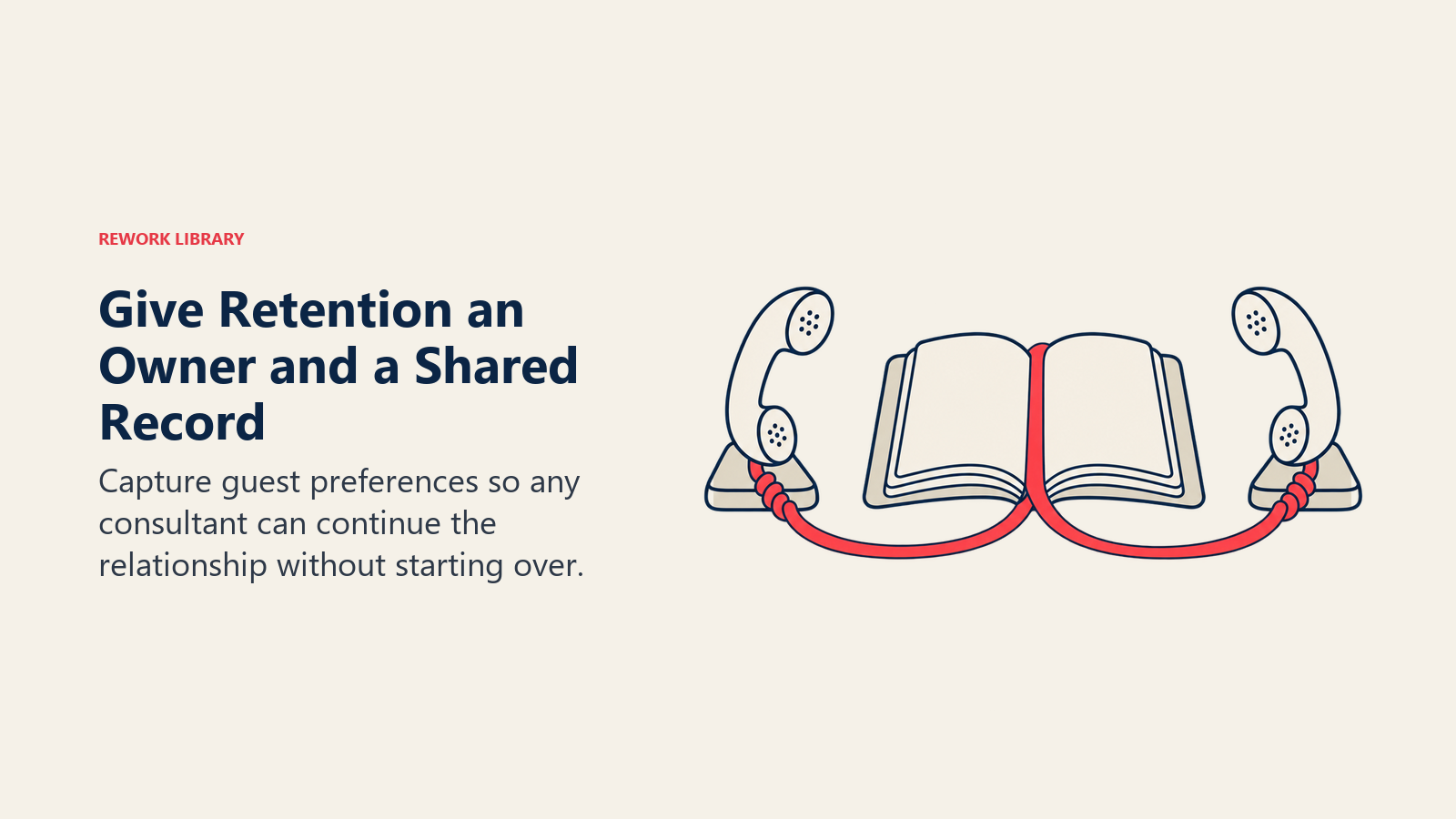
Assign ownership. Someone on your team should be responsible for retention metrics the same way someone is responsible for new bookings. Without an owner, retention work gets deprioritized whenever sales pressure spikes.
Use your CRM actively. Every guest interaction, preference, and conversation should be captured. Not so you can automate it away, but so any consultant can pick up a relationship where another left off without the guest having to repeat themselves.
Invest in your consultants. The single biggest driver of repeat bookings is the relationship with the consultant, not the price or the destination. Guests who feel genuinely understood and cared for return. Train your team to build relationships, not just close transactions.
Common Mistakes
Competing on price with loyal customers. Offering your most loyal guests the same promotional prices you advertise to new customers signals that loyalty has no value. Loyal guests should get early access, exclusive options, or white-glove service, not just discounts.
Over-automating. Automation is useful for consistency. But excessive automation strips relationships of the human element that makes travel purchases emotionally meaningful. If your post-trip sequence feels like a marketing workflow, it will not build loyalty.
Ignoring complaints. Guests who complain and get a fast, personal, genuine response retain at higher rates than guests who had no problems at all. Service recovery done well is a loyalty accelerator. Service recovery done poorly, or ignored, is permanent churn.
Key Facts
- Repeat travelers spend 67% more per booking than first-time customers, making retention the highest-ROI growth lever for travel businesses.
- Travel agencies with structured post-trip sequences within 48 hours see repeat booking rates 2-3x higher than those relying on organic reconnection.
- Guests who receive personal, consultant-authored follow-up are 4x more likely to leave a review and 2x more likely to refer a friend within 90 days.
- A repeat booking rate above 35% is a reliable indicator of a healthy, sustainable travel business with strong organic growth potential.
Frequently Asked Questions about Customer Retention in Travel - Keeping Guests Coming Back 2026
What is customer retention in travel?
Customer retention in travel refers to the strategies and practices travel agencies and tour operators use to bring past guests back for repeat bookings. It covers post-trip communication, loyalty programs, personalization, and win-back campaigns designed to build long-term guest relationships rather than relying solely on new customer acquisition.
What is a good repeat booking rate for a travel agency?
The industry average for repeat bookings within 24 months sits between 15% and 20% for most travel agencies. Operators with strong retention programs, active post-trip sequences, and dedicated consultant relationships regularly achieve 35-45%. Luxury and expedition travel operators with high personalization often exceed 50%.
How do you improve customer retention in a travel business?
The most effective retention improvements come from three areas: structured post-trip engagement within 48 hours of return, personalized follow-up based on travel preferences and history, and recognition of loyal guests through exclusive access or dedicated service rather than generic discounts. A CRM that captures every interaction is the foundation for all of these.
Why do travel customers stop booking with an agency?
The most common reasons are lack of follow-up after the trip, generic communications that feel irrelevant, and no compelling reason to think of the agency for the next trip. Poor service recovery (or no recovery at all) after a complaint is also a leading cause. Retention research consistently shows that most guests who leave were not actively unhappy, they simply felt forgotten.