Travel Team Training & Development - Building High-Performance Teams 2026

Turn this article into takeaways for your work.


Each assistant summarizes the article only for you and suggests best practices for your work.
The single most controllable variable in travel sales performance is consultant skill. Not marketing spend, not pricing, not destination popularity. The consultant who picks up the phone, responds to the inquiry, and builds the relationship is what determines whether a lead becomes a booking.
And yet most travel agencies treat training as a one-time onboarding event, not an ongoing operational priority.
That gap is expensive. A well-trained travel consultant typically closes at 2x the rate of an untrained one, handles more complex itineraries at higher margins, and generates 3-4x the repeat booking rate through stronger guest relationships. The return on training investment in travel is among the highest of any operational expense category.
This guide covers how to build a training and development program that actually changes performance, rather than just checking a compliance box.
What Travel Teams Actually Need to Learn
Training programs fail when they focus exclusively on product knowledge (destination facts, tour specs, supplier relationships) while neglecting the skills that drive conversion and retention.
A complete travel training curriculum covers four domains:
Product and destination knowledge. Consultants must know what they are selling. This includes destination profiles, tour structures, supplier quality differentials, visa and entry requirements, seasonal factors, and how to communicate value across different itinerary options. Product knowledge builds confidence, and confidence converts.
Sales and consultative skills. Consultative selling in travel is the technique that separates commodity travel sellers from trusted advisors. It requires active listening, needs discovery, handling objections, and presenting options in ways that frame value rather than price. These are learned skills, not personality traits. They can be taught, practiced, and measured.
Booking and operations process. Every consultant needs to execute the travel quote management workflow, the booking system, documentation processes, and supplier communication protocols accurately and efficiently. Errors here cost margin and damage trust.
Guest relationship management. How consultants handle pre-trip communication, respond to guest questions, manage problems during trips, and execute post-booking follow-up determines retention more than any other factor. This domain is often the least trained and the most impactful.
The Onboarding Framework
New consultant onboarding should be structured across 90 days, not compressed into a one-week induction.
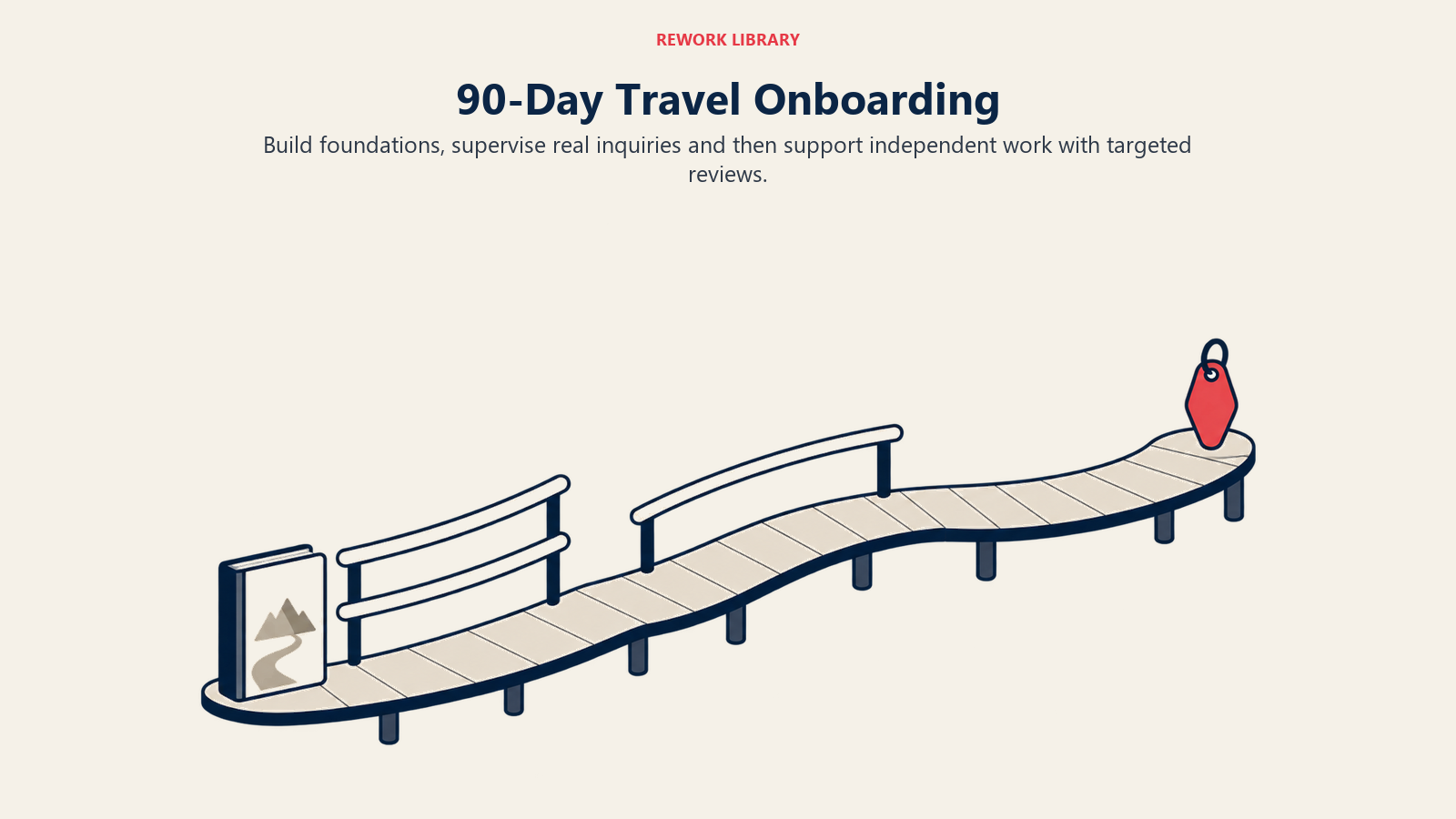
Days 1-15: Foundation. Cover company culture, processes, and systems. Train on the booking platform, CRM, and supplier portal. Introduce the product portfolio with destination overviews. Have the new consultant shadow high-performing colleagues on live calls and bookings.
Days 16-45: Supervised practice. The consultant begins handling inquiries and quotes with a senior consultant reviewing every interaction. Daily debriefs covering what went well and what to adjust. Focus on the sales conversation structure, not just the outcome.
Days 46-90: Supported independence. The consultant handles their own desk with weekly review sessions. Track conversion rate, average booking value, and response time against team benchmarks. Identify specific gaps and address them with targeted coaching rather than generic feedback.
The most common onboarding mistake is removing structure too early. Consultants left on their own before they have a solid sales process default to quoting prices and waiting for a response. That approach has a low conversion rate and trains the wrong habits.
Ongoing Training Cadence
One-time onboarding does not build high performers. Ongoing development does.
A practical ongoing training cadence for a travel team of 5-20 consultants:
Weekly: call or inquiry review. Spend 20-30 minutes reviewing real interactions from the previous week. Use specific examples of what worked and what did not. Keep it practical, not theoretical. This is the highest-ROI training activity in travel because it connects directly to active opportunities.
Monthly: product and destination updates. Suppliers change, destinations evolve, and new options come to market constantly. A monthly 60-minute session with a supplier partner or a senior consultant covering new products keeps the team current and builds the kind of specific knowledge that differentiates conversations.
Quarterly: skills development session. One skill area per quarter, covered in depth. Topics rotate through objection handling, presentation skills, luxury travel sales techniques, group and corporate travel approaches, and upselling. Use role-play, not lecture.
Annually: external training or conference. Sending consultants to industry events, destination familiarity trips, or external sales training programs signals that development is taken seriously. It also brings back fresh perspective and contacts.
Coaching vs. Training
Training delivers information and skills. Coaching changes behavior.
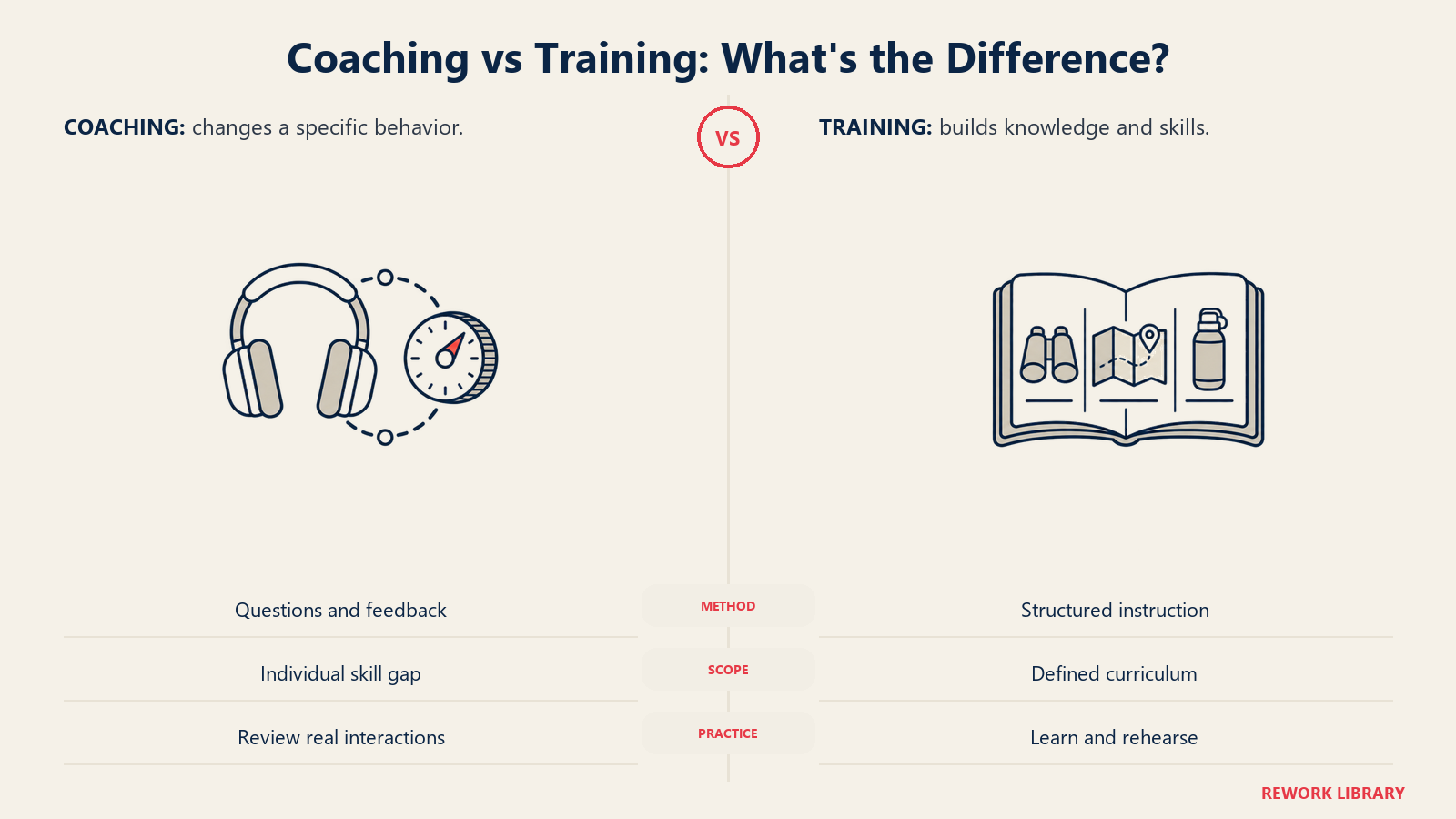
Most travel managers default to one-on-one meetings that cover pipeline updates, booking volumes, and administrative tasks. These are necessary but not developmental.
A coaching session looks different. It focuses on one specific behavior the consultant needs to change, one new skill they are building, or one performance challenge they are working through. It is a conversation, not a review. The manager asks questions more than gives answers.
Travel sales team performance improves most consistently when managers coach at least two hours per week per direct report. This is a significant time commitment, which is why most managers do not do it. But the compounding return in conversion rates and consultant tenure makes it worth protecting.
Measuring Training Effectiveness
If you do not measure outcomes, you cannot know whether your training is working.
Track these metrics before and after training interventions:
Conversion rate. What percentage of inquiries are converting to bookings? A well-trained consultant should be closing at 30-45% for qualified inbound leads, depending on the business model and booking complexity.
Average booking value. Training in upselling, premium products, and consultative presentation should increase this over time. If consultants are consistently closing at the lower end of available price points, it is a training issue.
Objection handling rate. Track how many inquiries go quiet after receiving a quote. A high drop-off after first quote usually signals weak follow-up or objection handling skills, both of which are addressable through coaching.
Repeat booking rate. This is the long-tail metric. Consultants who build strong relationships generate high repeat rates. Track this per consultant after 12 months to identify who is building loyalty and who is just transacting.
Time to competency for new hires. How long does it take a new consultant to reach full productivity? A structured 90-day onboarding should produce a measurably shorter ramp time than an unstructured one.
Building a Learning Culture
Individual training programs have a ceiling. A learning culture has compounding returns.
A learning culture in a travel team looks like this: consultants share what is working without being prompted. Senior consultants mentor junior ones as part of their role, not as an extra task. Managers model continuous improvement by openly discussing their own learning and development. Mistakes are treated as data, not failures.
This does not happen by accident. It requires explicit leadership, recognition of knowledge-sharing behavior, and time protected in the schedule for development that is not immediately production-focused.
The teams with the strongest travel sales performance numbers are almost always teams where the manager has made development a cultural norm, not just a box to check during annual review season.
Common Training Mistakes
Focusing only on product knowledge. Destination facts are table stakes. Consultants who know everything about a destination but cannot conduct a needs discovery conversation or handle price objections will lose to a less knowledgeable competitor who builds better relationships.
Training without coaching. A two-day skills workshop changes awareness. Consistent weekly coaching changes behavior. Both are needed, but coaching delivers the lasting return.
Measuring inputs, not outputs. Tracking hours of training completed is not the same as tracking whether performance improved. Measure conversion rates, booking values, and retention metrics. These are the outputs that matter.
Skipping the debrief. The most valuable learning in travel sales often comes from reviewing real calls and real proposals in real-time. Teams that debrief regularly compound their learning. Teams that only debrief after a loss miss most of the signal.
Key Facts
- Trained travel consultants typically convert at 2x the rate of untrained ones, making staff development one of the highest-ROI investments a travel agency can make.
- Repeat booking rates per consultant often exceed 35% for consultants with strong relationship and communication training, compared to 12-18% for purely transaction-focused approaches.
- Travel businesses with structured 90-day onboarding programs report new hire ramp times 40% shorter than those with informal onboarding processes.
- Weekly call review sessions of 20-30 minutes generate more measurable performance improvement than quarterly skill workshops for travel sales teams.
Frequently Asked Questions about Travel Team Training & Development - Building High-Performance Teams 2026
What should a travel agency training program include?
A complete travel agency training program covers four areas: destination and product knowledge, consultative sales skills (needs discovery, objection handling, value presentation), booking and operations processes, and guest relationship management including pre-trip communication and post-booking follow-up. New hire onboarding should be structured across 90 days with graduated independence, not compressed into a single induction week.
How do you measure the effectiveness of travel team training?
The most reliable training effectiveness metrics for travel teams are conversion rate (percentage of inquiries that become bookings), average booking value (whether consultants are presenting and closing premium options), repeat booking rate per consultant (a long-tail indicator of relationship quality), and time to competency for new hires. Track these before and after training interventions, not just during.
What is the difference between training and coaching in travel management?
Training delivers knowledge and skills. It can be done in groups, at scheduled intervals, and covers defined content. Coaching changes specific behaviors through one-on-one conversation, real-time feedback on actual interactions, and consistent follow-up over time. Both are necessary. Most travel managers over-index on training (which is easier to schedule) and under-invest in coaching (which drives lasting behavioral change).
How often should a travel team hold training sessions?
The most effective cadence is weekly inquiry or call reviews (20-30 minutes), monthly product and destination updates (60 minutes), quarterly skills development sessions with role-play, and annual external training or familiarity trips. This totals roughly 4-6 hours of structured development per consultant per month, which most high-performing travel agencies treat as non-negotiable production overhead.