Thomas Edison's Leadership Style and Legacy
Turn this article into takeaways for your work.


Each assistant summarizes the article only for you and suggests best practices for your work.
Thomas Edison's leadership style turned invention from a solitary act into an organizational discipline. He didn't wait for inspiration. He built a system to manufacture it.
By the time Edison died in 1931, he had changed how the world generated and consumed electricity, recorded and played back sound, and captured motion on film. But his deeper contribution to business and leadership was structural: he proved that research and development could be industrialized, staffed, and managed like any other production function.
Who was Thomas Edison?
Thomas Alva Edison (1847-1931) was an American inventor and industrialist who founded the world's first industrial research laboratory in Menlo Park, New Jersey, in 1876. Over a career spanning six decades, he held 1,093 US patents, a record that stood unchallenged for nearly a century.
Edison is credited with commercializing the incandescent light bulb, developing the phonograph, creating one of the first viable motion picture systems, and building the first electrical power distribution network in lower Manhattan. His laboratory complex at West Orange, New Jersey, which he opened in 1887, employed hundreds of researchers, engineers, machinists, and business staff working in parallel on multiple projects.
The companies Edison founded or co-founded eventually merged into what became General Electric, one of the largest corporations in American history.
Key Facts:
- 1,093 US patents filed across his career (Source: US Patent Office records)
- Menlo Park laboratory opened: 1876, often described as the world's first industrial R&D lab (Source: Smithsonian Institution)
- Edison's electrical companies merged into General Electric: 1892 (Source: General Electric corporate history)
Thomas Edison's leadership style
Edison led through a combination of relentless experimentation, systematic organization, and commercial obsession. He was less interested in pure science than in turning discoveries into products that markets would pay for. That distinction matters. Edison didn't just invent. He built businesses around what he invented, and he built teams to keep the invention pipeline full.
His approach at Menlo Park and later West Orange was genuinely novel. Before Edison, most invention happened in isolation: a lone craftsman, a university professor working alone, or a company's engineering department occasionally solving a narrow problem. Edison recognized that invention itself could become a team sport if you organized the right people, gave them the right tools, and structured their work around commercial goals.
He hired specialists: chemists, mathematicians, machinists, glassblowers, patent attorneys. He put them in the same building. He gave them access to the largest materials library of its kind in the world at the time. And he set explicit output targets. His famous boast that Menlo Park would produce "a minor invention every ten days and a big thing every six months or so" reads now like an OKR, a measurable commitment tied to a specific cadence.
Edison's personal style was hands-on and demanding. He worked long hours, expected the same from his team, and could be impatient with slow progress. He was also known for a quality that many strong leaders share: he was genuinely curious, willing to try things that looked foolish, and completely unbothered by the emotional cost of failure. His often-cited remark about finding 10,000 ways that didn't work before finding one that did wasn't false modesty. It described his actual process.
Key leadership principles
| Principle | What it meant for Edison | Modern takeaway |
|---|---|---|
| Fail fast and iterate | Edison's teams ran hundreds of experiments per project, logging failures as data, not defeats | Build short feedback loops; treat negative results as information |
| Build a system, not a solo act | The Menlo Park lab was designed so work continued whether Edison was in the building or not | Great leaders build processes and teams that outlast their personal involvement |
| Hire and organize specialists | Edison recruited the best machinists, chemists, and engineers he could find and organized them around projects | Cross-functional teams solve hard problems faster than departments of generalists |
| Obsess over real-world application | Edison consistently asked: will someone pay for this? | Research without a commercial pathway wastes both talent and capital |
| Market what you build | Edison staged public demonstrations of the light bulb and phonograph long before production scaled | Product launches are leadership acts; the inventor who can't sell is only half an innovator |
Edison vs Tesla: two models of innovation leadership
The rivalry between Edison and Nikola Tesla is one of the most instructive case studies in innovation leadership, specifically because the two men embodied opposite philosophies about how great work gets done.
| Dimension | Edison | Tesla |
|---|---|---|
| Work method | Empirical, trial-and-error across large teams | Theoretical, developed complete designs mentally before building |
| Organizational model | Industrial lab with many collaborators | Solo inventor supported by patrons and backers |
| Commercial focus | Relentless: every project had to reach a paying market | Secondary: Tesla's interest was in discovery, less in deployment |
| Key strength | Turning promising ideas into scalable products | Original theoretical leaps that opened entirely new domains |
| Key limitation | Sometimes resisted superior technologies (DC vs AC current) | Struggled to commercialize breakthroughs; died relatively poor |
| What leaders learn | Systems, teams, and commercial rigor produce reliable output | Genius without organizational support rarely reaches its potential |
The "War of Currents" in the late 1880s and 1890s is the sharpest illustration of the gap. Tesla's AC (alternating current) system was technically superior for transmitting electricity over long distances. Edison backed DC (direct current) and fought AC aggressively, staging public demonstrations of AC's dangers in what historians now view as a misinformation campaign.
Edison lost that argument on the merits. AC became the standard. But the episode reveals something important: even exceptional leaders can let institutional investment in a past decision override honest technical evaluation. Being a great systems builder doesn't make you immune to sunk-cost thinking.
Lessons for modern leaders
Lesson 1: Set an invention cadence
Edison didn't wait for inspiration. He scheduled it. The explicit targets he set for Menlo Park (minor invention every ten days, major every six months) forced his team to keep moving. Modern R&D teams that work without output commitments often drift toward research for its own sake. Setting a pipeline cadence, even an approximate one, changes how people prioritize their time.
Lesson 2: Build the infrastructure before you need the output
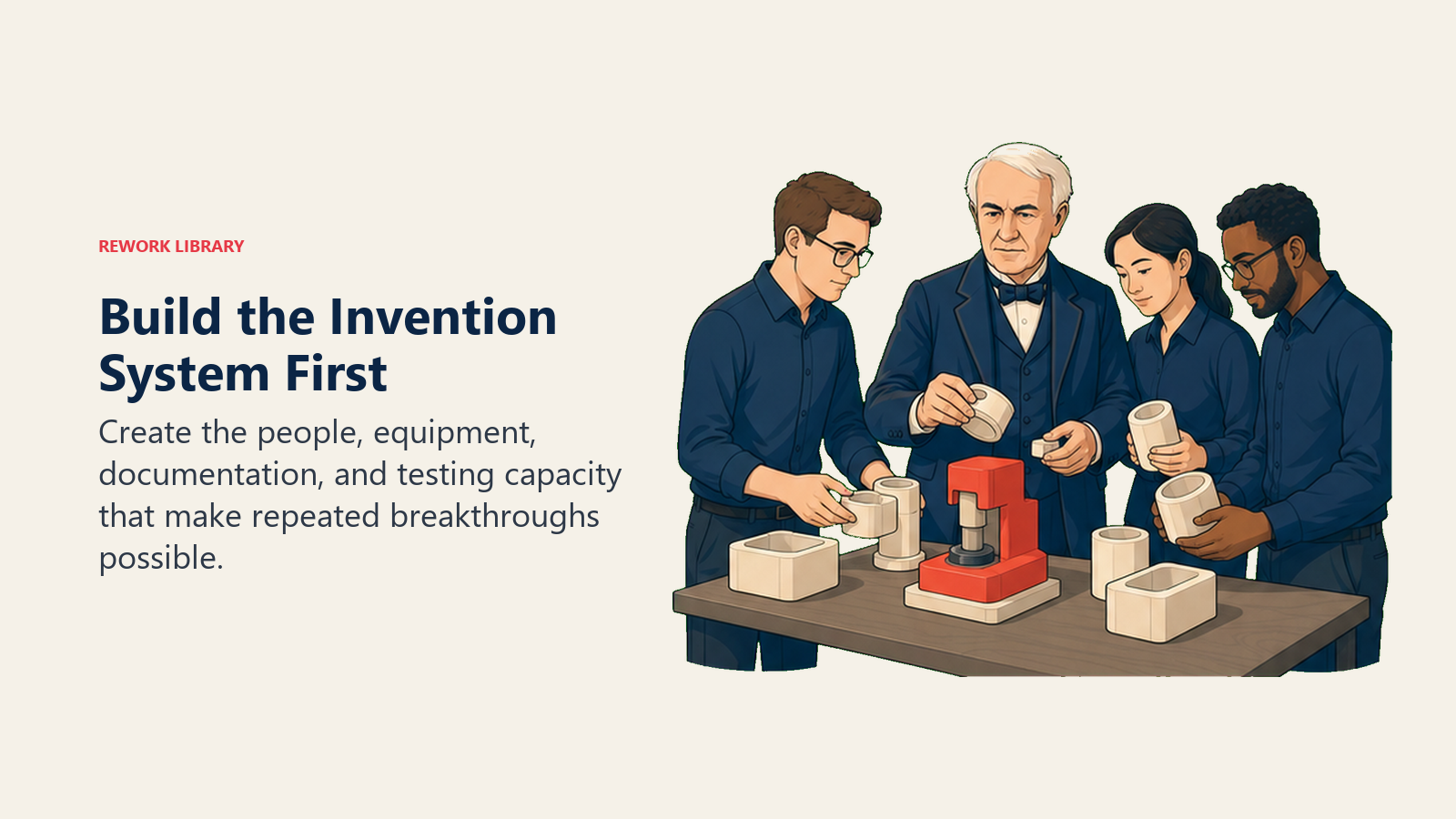
Edison assembled his materials library, hired his specialists, and built his machine shop before he had a specific project in mind. The capability came first. Most organizations do the opposite: they define the project and then scramble to find the people and tools. Edison's approach meant that when the right problem arrived, the team could move immediately.
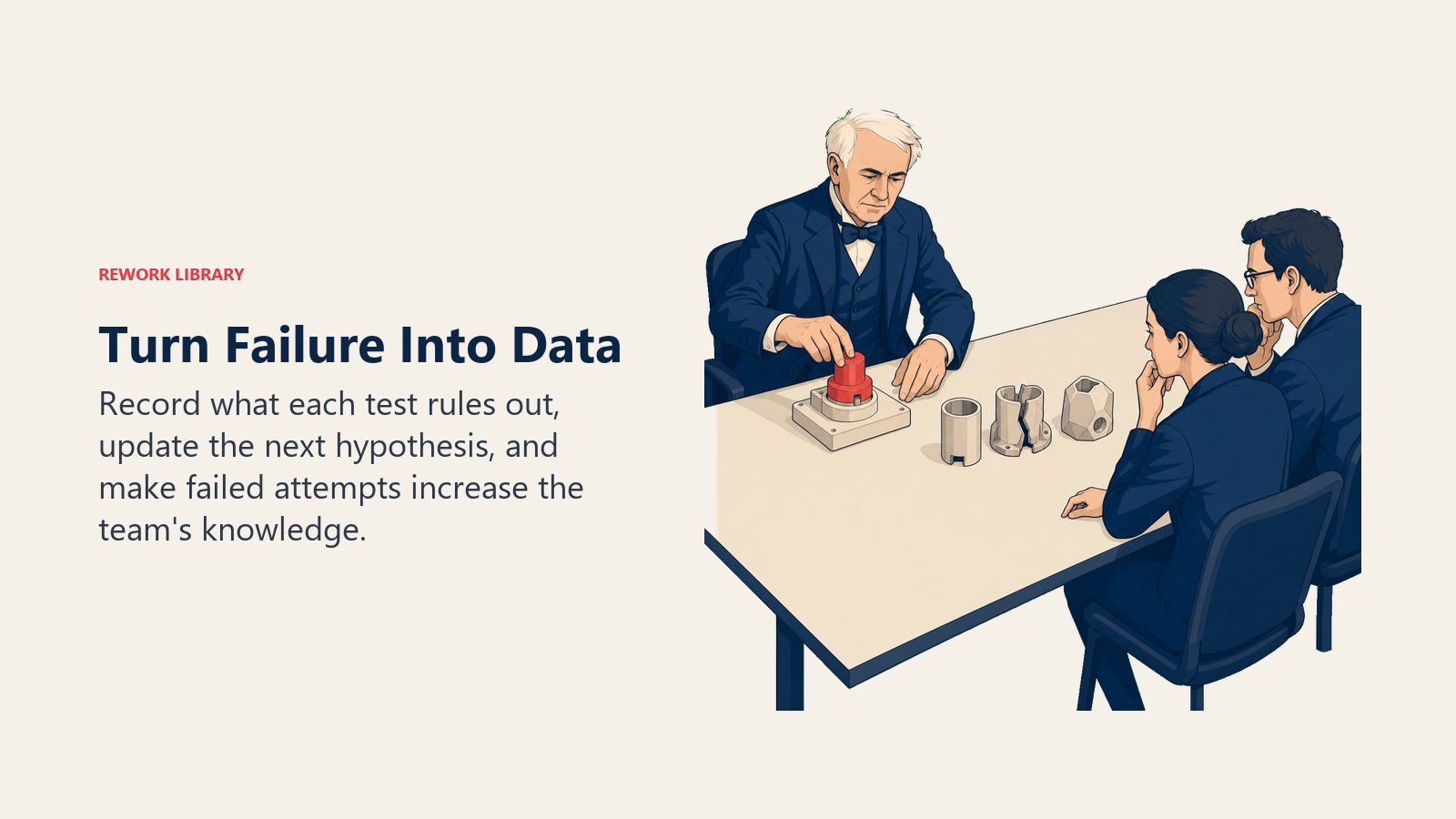
Lesson 3: Treat failure as a data-collection exercise
Edison's output rate required an industrial tolerance for failure. He didn't treat a failed experiment as a personal setback. He treated it as a confirmed data point. Teams led by people who catastrophize failure produce fewer experiments, share fewer negative results, and ultimately learn more slowly. The visionary leadership trait that mattered most in Edison's case wasn't his vision of what to build. It was his vision of how failure fits into progress.
Lesson 4: Commercial clarity is not a constraint on innovation
Edison's insistence that everything his lab produced had to reach a paying market is sometimes framed as a limitation on pure creativity. But the constraint had an organizing effect. When teams know that discovery without deployment is incomplete, they build differently. They think about scale, cost, user experience, and manufacturing from the start rather than retrofitting those considerations at the end.
Lesson 5: Protect your best ideas legally and financially
Edison filed patents aggressively and early. His legal team was an integral part of the Menlo Park operation. This isn't a detail about 19th-century business law. It's a principle: if you build something genuinely valuable, you need to understand how to protect and commercialize it, not just how to make it. Leaders who separate "the creative work" from "the business work" often lose the value they've created to people who don't.
Criticisms and limitations
Edison's legacy isn't clean, and taking it seriously means accounting for the parts that don't hold up.
The credit-sharing problem is real. Edison's lab operated on a collective output model: ideas, experiments, and improvements came from dozens of contributors, but patents and public credit flowed almost entirely to Edison. Charles Batchelor, John Kruesi, and other core Menlo Park staff made substantial technical contributions that history has largely attributed to Edison. The same dynamic played out at West Orange. This wasn't unique to Edison for the era, but it set a pattern in industrial innovation, including the practice of requiring employees to assign patent rights to employers, that has generated legitimate ethical debate ever since.
The treatment of Nikola Tesla is a specific case. Tesla worked directly for Edison in 1884 and 1885, and later claimed Edison had promised him a substantial bonus for solving a set of technical problems, then denied making that promise when the work was completed. Edison's version of events was different. The truth is contested, but the relationship ended badly, and Tesla left without the compensation he believed he'd earned.
The War of Currents, already mentioned, showed Edison at his most stubborn and his least honest. His public campaign against AC current, including the electrocution of animals to demonstrate danger, crossed from competitive advocacy into deliberate fear-mongering. He was wrong on the technical merits and he knew it by the mid-1890s. It took longer for him to say so publicly.
These criticisms don't cancel Edison's contributions. But leaders who study him as a model for innovation systems should also study this pattern: the same confidence and decisiveness that made Edison effective at building and moving also made him slow to admit when he was wrong and careless about whose contributions he acknowledged.
Edison's real legacy isn't the phonograph or the light bulb. It's the idea that an organization can be designed specifically to produce innovation at scale. That idea is everywhere now: in corporate R&D departments, in startup accelerators, in university research centers, in the way technology companies structure their engineering teams. The specific methods have evolved, but the core conviction, that discovery is a process you can manage and staff and optimize, came directly from the lab Edison built in a small New Jersey town in 1876. Leaders who understand that are already thinking about their own teams differently.

Co-Founder, Rework.com
On this page
- Who was Thomas Edison?
- Thomas Edison's leadership style
- Key leadership principles
- Edison vs Tesla: two models of innovation leadership
- Lessons for modern leaders
- Lesson 1: Set an invention cadence
- Lesson 2: Build the infrastructure before you need the output
- Lesson 3: Treat failure as a data-collection exercise
- Lesson 4: Commercial clarity is not a constraint on innovation
- Lesson 5: Protect your best ideas legally and financially
- Criticisms and limitations