Richard Branson's Leadership Style at Virgin
Turn this article into takeaways for your work.


Each assistant summarizes the article only for you and suggests best practices for your work.
Richard Branson's leadership style is one of the most studied in modern business because it produced an outcome that almost no other founder has matched: durable growth across wildly different industries, from airlines to music to mobile to space. He built the Virgin empire not by controlling everything, but by doing almost the opposite.
Most leaders treat delegation as something they do when they're too busy. Branson treats it as the strategy itself.
Who is Richard Branson?
Richard Branson founded Virgin Records in 1972, at age 22, after dropping out of school at 16. What followed over the next five decades is a portfolio that defies easy categorization: Virgin Atlantic (1984), Virgin Mobile, Virgin Galactic, Virgin Hotels, Virgin Active, and dozens more. The Virgin Group today spans more than 40 companies across 35 countries, with roughly 70,000 employees worldwide.
But the scale alone doesn't explain why Branson's approach gets so much attention. What makes him worth studying is the consistency of the method: he keeps backing new ventures, recruiting strong leaders to run them, and then getting out of the way. That pattern has held across a career longer than most companies last.
He's also unusually public about his thinking. Branson has written extensively about his principles in books like Losing My Virginity (1998) and Like a Virgin (2012), giving observers a rare window into how he actually reasons about leadership, rather than a polished retrospective built after the fact.
Key Facts
- Virgin Group spans 40+ companies across more than 35 countries (Virgin Group, 2024)
- Branson founded Virgin Records in 1972, launching the broader Virgin empire
- Virgin Atlantic, founded in 1984, grew into one of the UK's largest long-haul carriers
Richard Branson's leadership style
Branson's approach sits squarely in the charismatic leadership tradition, but it's unusually practical compared to how charismatic leadership is often described. He uses personal energy and visibility as recruiting and culture tools, not just as external PR.
His style also draws heavily from laissez-faire leadership. Branson has said directly that his job isn't to manage the day-to-day operations of his companies. It's to find excellent people, give them real authority, and create the conditions where they want to stay. That's a hands-off model, but it requires more upfront judgment than most laissez-faire leaders acknowledge: you have to hire the right people before you step back.
There's also a clear servant leadership thread running through how he talks about employees. His often-quoted principle, "clients do not come first. Employees come first. If you take care of your employees, they will take care of the clients," reads like servant leadership doctrine applied at scale. The logic is tight: customer experience is a downstream output of employee experience, so the leverage point is internal, not external.
Where Branson diverges from pure servant or laissez-faire models is in ambition and risk appetite. He isn't a quiet steward of existing businesses. He keeps launching things that might fail, and he frames failure publicly as a necessary cost of learning. That combination of high-risk ambition with people-first values is what makes his style genuinely distinctive.
Key leadership principles
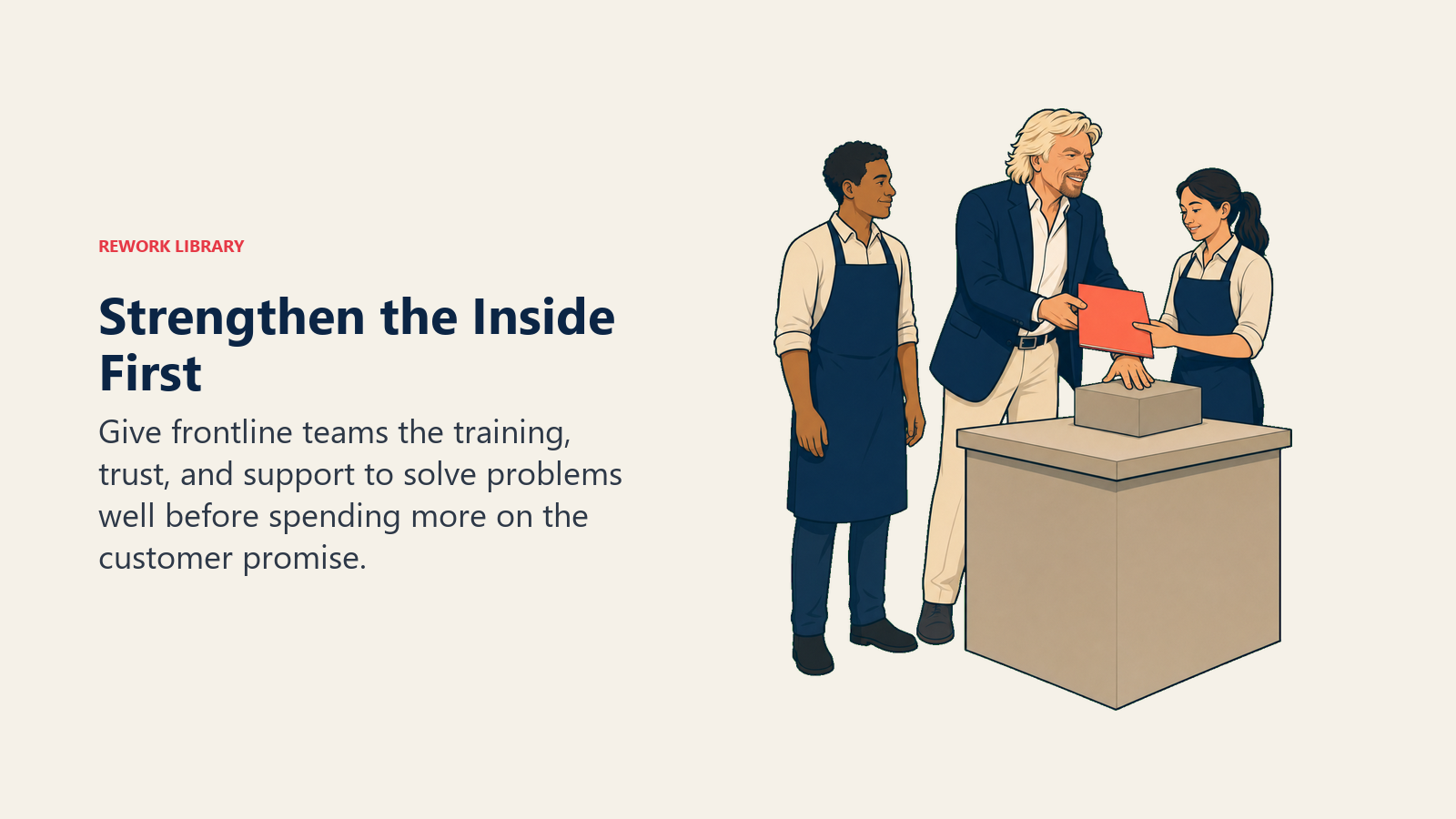
Employees first, customers second
This is the principle Branson returns to most consistently. At Virgin Atlantic, it meant investing in training and culture at a time when the airline was cash-poor and competing against British Airways with dramatically fewer resources. He bet that a happy crew would produce a customer experience that couldn't be copied by bigger carriers. It worked well enough that Virgin Atlantic built a loyal customer base despite never being the cheapest option on any route.
Delegate and trust
Branson has said he is not a good manager in the operational sense. He doesn't enjoy the detail work. So he found early that his best contribution was identifying talented operators, handing them real responsibility, and then staying connected through relationship rather than oversight. At Virgin Records, he gave artists and producers unusual creative latitude at a time when record labels were notoriously controlling. That freedom attracted talent that other labels couldn't keep.
Embrace risk and learn from failure publicly
Virgin Cola, Virgin Brides, and Virgin Cars all failed. Branson talks about them directly rather than burying them in footnotes. He frames these as tuition, not embarrassment. That public relationship with failure does something practical: it reduces the psychological cost of risk-taking inside Virgin companies. If the founder talks openly about his own losses, employees are less likely to hide problems or avoid big swings.
Make work enjoyable
Branson has written that if you don't enjoy what you do, you won't do it well. At Virgin, this shows up in how offices are designed, how company events are run, and in Branson's own behavior: he shows up in costume for product launches, camps out at company events, and publicly celebrates employee milestones. Critics call it performative. But there's a functional argument underneath it: cultures where people feel valued and have fun tend to retain better, and retention is a real cost lever in high-turnover industries like airlines and retail.
Lead by listening
Branson describes himself as a note-taker. He carries notebooks (later replaced by his phone) and records what employees and customers tell him, then follows up. Virgin's customer service reputation was built partly on this habit: Branson would receive direct complaints, respond personally, and then fix systemic issues surfaced by individual cases. It's an unusual practice for a billionaire, and it sends a clear signal about what he actually values.
Build your brand on personality
Virgin's marketing has always been inseparable from Branson himself. He crossed the Atlantic in a hot air balloon. He dressed as a bride to promote Virgin Brides. He posed as a flight attendant for a competing airline after losing a bet. These stunts generated press coverage that Virgin couldn't afford to buy at the same scale. But they also served an internal purpose: they showed employees that the person at the top wasn't hiding behind a corporate identity.
Branson's principles in practice
| Principle | What it looked like at Virgin | Lesson for leaders |
|---|---|---|
| Employees first | Virgin Atlantic cabin crew voted among the industry's most engaged, even during financial pressure periods | Customer experience is downstream of employee experience. Fix internal culture before investing in external CX programs. |
| Delegate and trust | Branson recruited strong operators for each Virgin venture and stepped back from day-to-day decisions | Delegation works when you hire well upfront. It fails when you use it to avoid hard personnel choices. |
| Learn from failure publicly | Virgin Cola and other failed ventures are documented openly in Branson's books and interviews | Leaders who discuss their failures build psychological safety. Leaders who hide them build cover-up cultures. |
| Fun as a culture tool | Office designs, events, and Branson's own public behavior signal that enjoyment is taken seriously | Fun isn't decoration. It affects retention, creativity, and risk tolerance. |
| Lead by listening | Direct complaint responses, personal note-taking, follow-up on individual cases | Listening is only valuable if it connects to action. Set up a channel for frontline input and close the loop. |
| Personality-driven brand | Branson's stunts generated press at a fraction of traditional advertising cost | Personal brand and company brand can reinforce each other when the values are consistent. |
Lessons for today's leaders
What Branson's career shows is that there's more than one path to building a large organization. The conventional path is operational mastery: process, control, metrics, accountability. Branson took a different path: vision, trust, culture, and personality. Both can work.
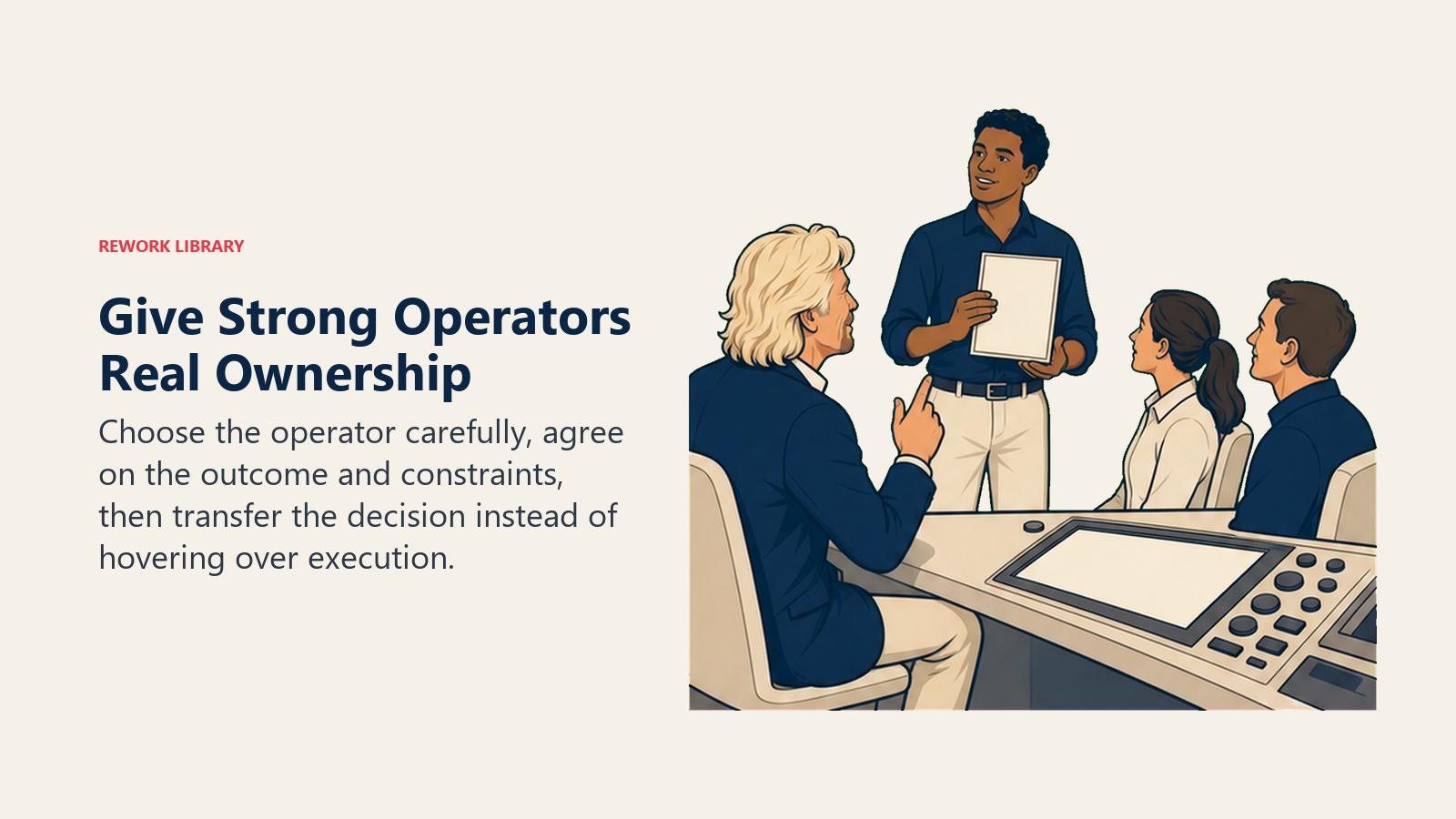
But his path has specific requirements. It requires excellent judgment in hiring, because you're outsourcing execution to the people you bring in. It requires the kind of public commitment to values that makes people want to work for you before they know much about the company. And it requires a high tolerance for losses, because some of what you try won't work.
The by-situation breakdown looks like this:
If you're scaling a service business, the employees-first principle is probably your highest-leverage move. Service quality is hard to systematize. It mostly comes from people who care. Create conditions where they can care.
If you're building a leadership team, study Branson's delegation model. He doesn't delegate tasks. He delegates whole businesses. That requires clarity about what you want, genuine authority for the people you pick, and a relationship model that lets you stay informed without micromanaging. For frameworks on how to structure that, transformational vs. transactional leadership is worth reading alongside the Branson model.
If you're trying to build culture at scale, the fun-and-personality approach isn't just Branson's quirk. It's a deliberate tool. Compare it to Oprah Winfrey's leadership approach, where authentic personal connection became the core of a media empire built on trust.
If you're a founder thinking about how you want to be seen, Branson's public relationship with failure is a model worth considering. The leaders who thrive long-term tend to be the ones who can say "that didn't work, here's what I learned" without losing the room. Elon Musk's leadership arc offers a useful contrast: similar risk appetite, very different public communication style, with different effects on organizational culture.
Frequently Asked Questions about Richard Branson's Leadership Style
What leadership style does Richard Branson use?
Branson combines charismatic, laissez-faire, and servant leadership. He uses personal energy and visibility to attract talent and build culture, delegates operational authority broadly to trusted leaders, and consistently prioritizes employee wellbeing over short-term cost efficiency. The combination is unusual but internally consistent: he bets that engaged people produce better outcomes, and then structures his companies around that bet.
Why does Branson put employees before customers?
His reasoning is causal rather than sentimental. If employees are engaged, supported, and enjoy their work, they produce better customer experiences without being told to. If they're disengaged, no customer service script fixes it. For service businesses where the product is largely a human interaction, employee experience is the upstream variable. Branson applied this at Virgin Atlantic, where crew engagement was a real competitive differentiator against larger, better-funded carriers.
How did Branson build so many companies across different industries?
By treating each new venture as a franchise of the Virgin brand and culture rather than a business he personally operated. He recruited operators with deep domain expertise, gave them authority, and focused his own role on brand building, recruiting, and morale. Virgin Records, Virgin Atlantic, and Virgin Galactic required completely different technical knowledge. What they shared was Branson's name, his people principles, and a willingness to challenge established players.
What can managers learn from Branson's leadership approach?
Three things stand out. First, delegation is a strategy, not a shortcut. If you hire well and give real authority, you get better results than if you stay involved in every decision. Second, your public relationship with failure shapes your team's risk tolerance. If you hide your mistakes, your team will hide theirs, and you'll make slower progress. Third, culture is a product decision. The experience people have working for you flows downstream into the experience customers have buying from you.
What were Richard Branson's biggest failures as a leader?
Virgin Cola, launched in 1994 to take on Coca-Cola and Pepsi, never achieved meaningful market share and eventually folded. Virgin Cars, Virgin Brides, and several other consumer ventures also closed. Branson's honest public accounting of these failures, rather than the failures themselves, is what makes him worth studying: he treats them as evidence of trying rather than as things to minimize.
The thread that runs through all of this is a simple bet: if you find great people and give them room to lead, you get better outcomes than if you try to control everything yourself. Branson made that bet 40+ times across wildly different industries. It didn't always work. But it worked often enough to build one of the most recognizable brands in the world.
For leaders building their own teams, that's the practical takeaway. Not that you should be more fun, or more public, or more willing to take risks (though those things may help). The core question is simpler: do the people working for you have enough trust and authority to actually do their best work? If not, Branson's career suggests that's the first thing worth fixing.
Related reading
