Peter Lynch Leadership Style: Invest in What You Know, and Know More Than the Market
Turn this article into takeaways for your work.


Each assistant summarizes the article only for you and suggests best practices for your work.
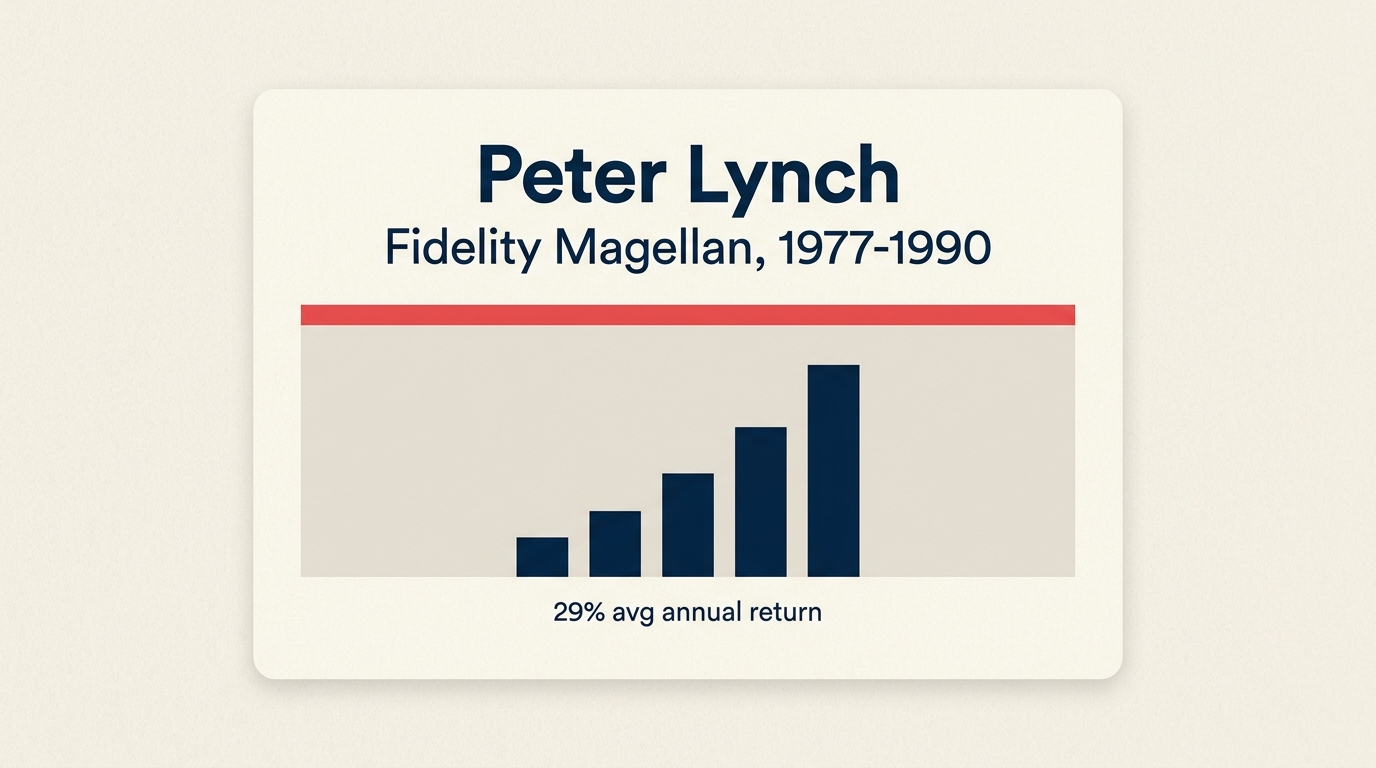
Peter Lynch ran the Fidelity Magellan Fund from 1977 to 1990, growing it from $18 million to $14 billion in assets under management. His average annual return over that period was approximately 29%, more than doubling the S&P 500's performance. When he retired at 46, he was the most successful mutual fund manager of his generation.
Lynch is studied not primarily for his investment picks but for the documented framework he used to find and evaluate them. His two books, "One Up On Wall Street" (1989) and "Beating the Street" (1993), laid out a research philosophy and decision-making discipline that has influenced investors and business leaders across multiple industries.
Leadership Style Breakdown
| Style | Weight | How it showed up |
|---|---|---|
| Ground-level research | Very High | Visited companies, talked to employees and customers, cross-checked financial data against observable reality |
| Pattern recognition | High | Developed specific frameworks for categorizing companies by growth type |
| Conviction without overconfidence | High | Concentrated bets when research was thorough; diversified when it wasn't |
| Discipline over narrative | High | Rejected investment stories that couldn't be connected to specific financial fundamentals |
"Invest in What You Know": The Actual Principle
Lynch's most-cited phrase is often misunderstood as "buy the brands you like." The actual principle is more operationally demanding: you have an information advantage when you understand an industry, company, or market from direct experience that institutional analysts don't have.

A shoe store buyer who sees a new product flying off the shelves has information that a Wall Street analyst covering the parent company doesn't have access to yet. A plant manager who notices a supplier is suddenly requiring large orders has information that the market hasn't priced. A customer service rep who observes a sudden increase in a competitor's product complaints knows something the market doesn't.
Lynch's framework turns this into an investment discipline: start with what you observe in your direct professional and consumer life. When something catches your attention, do the research to understand whether what you're observing is economically meaningful. The observation is the tip. The research is the work.
For business leaders, this translates directly: the people closest to customers, suppliers, and operational processes have information advantages that leadership further from the front lines doesn't. Building systems that surface this ground-level information, through structured feedback, regular field visits, and close reading of operational metrics, is Lynch's principle applied to organizational design.
The Six Categories of Companies
Lynch developed a classification system for evaluating companies that avoids the vague growth/value binary most analysts use. His six categories:

| Category | Description | What to look for |
|---|---|---|
| Slow growers | Large, mature companies growing at GDP rate | Dividend reliability; balance sheet health |
| Stalwarts | Large companies growing 10-12% annually | PE relative to growth rate; expansion into new markets |
| Fast growers | Small companies growing 20-25%+ | Sustainability of growth rate; balance sheet to support it |
| Cyclicals | Companies tied to economic cycles | Where in the cycle you're buying relative to earnings trough |
| Turnarounds | Companies with depressed earnings expected to recover | Specific catalysts; management credibility |
| Asset plays | Companies with undervalued assets on the balance sheet | Asset value relative to market price |
The operational implication for business leaders: the risk and return profile of a business opportunity depends heavily on which category it falls into. A "fast grower" opportunity requires a different investment thesis, different risk management, and different success metrics than a "turnaround" opportunity. Leaders who apply the same evaluation criteria to different types of opportunities make predictable errors.
Research Discipline Over Investment Narrative
Lynch's documented research process is notable for its emphasis on observable facts over narratives. He was deeply skeptical of investment stories that weren't grounded in specific financial data: revenue growth rates, earnings growth rates, debt-to-equity ratios, inventory changes, profit margins.
His documented practice: before buying a position, be able to tell the story in a paragraph or two, including the specific numbers that support it. If you can't explain the investment thesis with concrete numbers in two minutes, you don't understand it well enough to own it.
For directors: this is directly applicable to how proposals and business cases get evaluated in organizations. A business proposal that can be summarized in clear numbers (revenue opportunity, required investment, expected margin, payback period, key risks with quantified probability) is fundamentally different from a proposal built on narrative energy. Lynch's discipline is to require the former and be skeptical of the latter.
The "Cocktail Party" Market Timing Indicator
Lynch developed a behavioral heuristic he called the "cocktail party indicator" for market timing. He observed that at the bottom of bear markets, nobody talks about stocks at social events. As markets recover, a few people cautiously mention investments. At the top of bull markets, everyone is discussing their picks and giving advice.
He used this as a contrarian signal: when everyone is enthusiastic about an asset class, the obvious opportunity has already been captured by the market. When nobody wants to discuss it, the institutional pessimism may be creating an opportunity.
For operators, the behavioral pattern generalizes: the most obvious strategic bets tend to be the most crowded. When every competitor in your market is pursuing the same initiative (AI integration, platform expansion, market X entry), the competitive advantage of being early has eroded. Lynch's question: what's the equivalent of a deeply unfashionable stock in your competitive landscape?
Managing a Large Portfolio with Focused Principles
At peak, Lynch managed the Magellan Fund's portfolio of over 1,000 positions. The conventional wisdom in portfolio management is that diversification beyond a certain point dilutes returns without proportionally reducing risk. Lynch's documented response was pragmatic: he held large numbers of positions because the research process was generating more ideas than he could concentrate into a small portfolio without violating his own conviction standards.
The principle: the number of positions should follow from the quality and quantity of research, not from a target number. When research conviction is high, concentration is appropriate. When it's not, breadth is the honest response.
For leaders managing multiple initiatives: the same logic applies to resource allocation. The number of major initiatives should follow from the quality of each opportunity's thesis, not from a desire to appear comprehensive. Organizations that run 20 "strategic priorities" simultaneously are usually running none of them with the resource intensity to win.
Recognizing the "Tenbagger"
Lynch popularized the term "tenbagger" for investments that return 10x the original price. His documented observation: most of his largest returns came from positions he held for years, allowing the business to compound its value. The mistake most investors make is selling a winner too early (to "lock in gains") and holding a loser too long (to "wait for recovery").
The business leadership translation: the equivalent of a tenbagger is a product, market, or initiative that compounds value over time. The leadership mistake analogous to selling winners early is reallocating resources away from your highest-performing activities to fund marginal new initiatives. And the analogue of holding losers is continuing to invest in programs that aren't generating returns because of the sunk-cost effect.
Lynch's discipline: let your winners run as long as the underlying business thesis remains intact. Cut your losers when the thesis breaks, not when the short-term results improve marginally.
What Directors Can Take From Lynch
Build systems to surface ground-level intelligence. Lynch's edge came from information that the market didn't have. In your organization, the ground-level intelligence that the top floor doesn't have access to is in the front line: customer calls, field visits, supplier conversations, operations data. Build structured channels for this information to reach decision-makers.
Categorize opportunities before evaluating them. Lynch's six categories prevent apples-to-oranges comparisons. Apply the same principle to business opportunities: a new market entry has a fundamentally different risk profile than a product extension in an existing market. Evaluate them with category-specific criteria.
Require the two-minute explanation. Before approving any significant investment of time or money, require the proposer to explain the thesis in concrete numbers in under two minutes. If they can't, the thinking isn't complete.
Key Facts
- Peter Lynch ran the Fidelity Magellan Fund from 1977-1990, averaging approximately 29% annual returns
- The fund grew from $18 million to $14 billion under his management
- "One Up On Wall Street" (1989) remains one of the most-read books on investment research and decision-making
- Lynch retired at 46, having doubled the S&P 500's performance over his tenure
Learn More

Co-Founder, Rework.com
On this page
- Leadership Style Breakdown
- "Invest in What You Know": The Actual Principle
- The Six Categories of Companies
- Research Discipline Over Investment Narrative
- The "Cocktail Party" Market Timing Indicator
- Managing a Large Portfolio with Focused Principles
- Recognizing the "Tenbagger"
- What Directors Can Take From Lynch
- Key Facts
- Learn More