Growth Mindset in Business Teams: Applying Carol Dweck's Framework to Operational and Sales Teams
Carol Dweck's research on mindset started in academic settings, tracking how children responded to challenges and failure. But the implications for organizations are direct and have been validated in corporate contexts by researchers and practitioners over the past two decades.
The core finding is straightforward: people who believe their abilities are fixed (fixed mindset) avoid challenges that risk exposing limitations. People who believe abilities can be developed (growth mindset) pursue challenges as learning opportunities. Fixed-mindset teams optimize for looking competent. Growth-mindset teams optimize for getting better.
For a director managing a sales team or an operations function, the difference is not abstract. It shows up in how your team responds to quota misses, how they handle new processes, whether they share what's working or hoard it, and whether your best performers stay when they're no longer the fastest-learning person in the room.
What a Fixed-Mindset Team Looks Like in Practice
You've seen the symptoms even if you haven't named the underlying cause:
Post-mortems become attribution exercises. The question discussed is "why did this miss happen?" but the actual work in the room is positioning. People are protecting their reputation rather than understanding the system.
Training and coaching create defensiveness. When a manager offers skill-building feedback, the response is "I already know how to do that" or "that's not how it works in our segment." The feedback is decoded as a judgment on current ability rather than an investment in future ability.
Failure leads to avoidance. After a bad outcome, team members quietly route around the work that produced it. They stop proposing ambitious deals or taking on high-visibility projects because the downside risk to reputation is greater than the upside of success.
High performers stop developing. Once someone is the best on the team at a skill, they stop practicing it. Their identity is "the person who is best at X." Continuing to practice would imply they might not be as good as the label suggests.
These behaviors are rational within a fixed-mindset frame. They only look irrational from the outside.
The Manager's Role in Mindset
Dweck's research makes clear that mindset is not purely dispositional. It's heavily influenced by the environment, particularly by how leaders frame ability and performance. The same person can operate with a growth mindset on one team and a fixed mindset on another, depending on how feedback is given, how failure is handled, and what gets praised.

Turn this article into takeaways for your work.


Each assistant summarizes the article only for you and suggests best practices for your work.
This gives managers real leverage. You can't rewire someone's deep psychology, but you can design the team environment so that growth-mindset behavior is rational and fixed-mindset behavior is costly.
Three specific manager behaviors shift the environment:
1. Praise process, not results or talent.
When a rep closes a difficult deal, the fixed-mindset praise is "you're a natural closer" or "you crushed it." The growth-mindset praise is "you handled the procurement objection at stage 4 really well. The reframe you used around TCO has been something we've been working on. Tell us what you did and we'll build it into our playbook."
The first praise reinforces an identity. The second reinforces a process that can be learned and repeated. Dweck's research shows that talent-focused praise actually decreases challenge-seeking behavior because it raises the stakes of failure. "If I fail at the next hard deal, I'm no longer a natural."
2. Treat failure as information, not judgment.
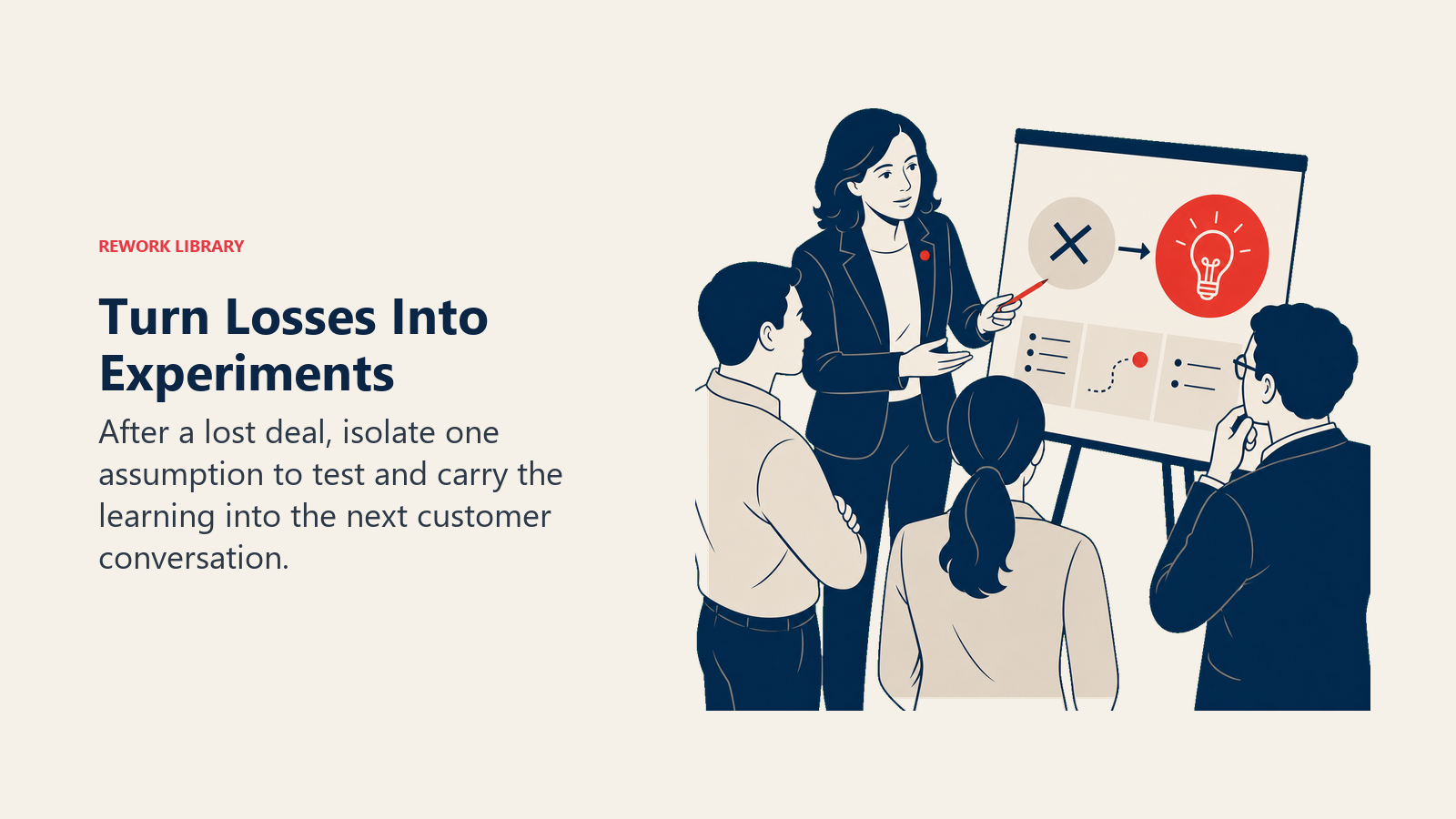
How you respond to failure in public settings sets the entire team norm. If a missed quarter triggers a performance conversation focused on "who is responsible," you've created a fixed-mindset environment. The team learns that failure is a verdict on who you are, not data about what to improve.
The alternative is to structure failure reviews as system diagnoses. "The deal slipped from stage 4. Let's look at what we knew and when. At what point was the risk visible? What would we need to see earlier in the pipeline to catch this before stage 4?" This is not about avoiding accountability. It's about locating accountability at the process level rather than the identity level.
3. Make learning visible and valued.
In most sales and operations environments, the work that's recognized is output: closed revenue, resolved tickets, shipped features. Learning work is invisible. It doesn't appear in dashboards or weekly reports.
Making learning visible means creating small ceremonies around it. A 10-minute segment in a weekly team meeting where someone shares what they tried this week and what they learned. A shared document of "plays we're testing" where anyone can add a hypothesis and outcomes. A monthly lunch where one team member presents a book, course, or framework they've been studying and its implications for the team's work.
None of these require budget. They require a decision that learning work is worth time.
Applying Growth Mindset to Sales Teams
Sales teams are particularly vulnerable to fixed-mindset dynamics because performance is so visible and the ego stakes are high. A rep who misses quota can't hide the fact. The cultural question is what that miss means.
Skills development vs. talent sorting. Fixed-mindset sales cultures sort for "natural salespeople" and attribute performance variance to talent. They invest in finding the right people rather than developing the current people. Growth-mindset sales cultures treat most of the performance variance as a skill gap that can be addressed. They invest in skill diagnosis and structured development.
Satya Nadella's transformation of Microsoft's enterprise sales culture is the canonical example. Microsoft had a "know-it-all" sales culture where admitting uncertainty in front of a customer was a weakness. Nadella reframed it as a "learn-it-all" culture where asking a customer "I'm not sure, let me find out" was a feature. The change in sales approach contributed meaningfully to Microsoft Cloud's growth trajectory.
Feedback norms in sales. In fixed-mindset sales cultures, call reviews are evaluative. Did the rep perform well or not? In growth-mindset sales cultures, call reviews are collaborative. What can we learn from this call? Where was the momentum? Where did the conversation shift? What would you try differently?
The practical difference: in the first format, reps submit their best calls for review. In the second format, reps submit calls where something interesting happened, including calls that went poorly. The information available to the team is categorically different.
Quota miss conversations. The most important test of a sales culture's mindset orientation is what happens in the 1:1 after a bad quarter. If the conversation is primarily about whether the rep has what it takes, you're operating in fixed-mindset territory. If the conversation starts with "let's look at the pipeline data and understand what happened," you're in growth-mindset territory.
Applying Growth Mindset to Operations Teams
Operations and process teams face different fixed-mindset failure modes:
Expertise defensiveness. Senior operations professionals often have deep domain expertise. This expertise is valuable but can become a liability when it develops into defensiveness about established processes. "We tried that in 2019 and it didn't work" is a fixed-mindset response. "What's different now that might change the outcome?" is a growth-mindset response.
Process ownership vs. process improvement. Fixed-mindset operations teams treat their processes as finished products to be defended. Growth-mindset operations teams treat their processes as hypotheses to be tested. The difference shows up in how teams respond to post-incident reviews, process change requests, and performance improvement initiatives.
Cross-functional learning. Operations teams frequently sit at intersections with sales, product, and customer success. Fixed-mindset teams treat these intersections as territory to be managed. Growth-mindset teams treat them as learning opportunities.
The Growth Mindset Hiring Filter
Teams with strong growth mindset norms can be eroded by a few fixed-mindset hires in visible positions. Building a growth-mindset hiring filter helps:
In interviews, ask about a significant professional failure or a project that didn't go as planned. You're not looking for the failure itself. You're looking for the response pattern: Does the candidate take ownership of the process without excessive self-blame? Do they describe what they learned specifically? Do they describe what they'd do differently? Candidates with growth mindset orientations find this question energizing. Candidates with fixed mindset orientations often get defensive or overly vague.
Also ask: "Tell me about a skill you've developed in the last 12 months that you were weak at before." The question surfaces whether the candidate sees skill development as an ongoing practice or as something that happened in school.
Key Facts
- Carol Dweck's original research showed that praise of talent decreases challenge-seeking behavior; process praise increases it
- Satya Nadella's reframing of Microsoft from "know-it-all" to "learn-it-all" is the most cited corporate application of growth mindset at scale
- Manager behavior is the primary driver of team mindset environment, not individual disposition
- Fixed-mindset teams in sales environments tend to sort for talent rather than develop it, which limits their ceiling
- Growth mindset is a learnable orientation, not a fixed personality trait
Learn More
