Henry Ford's Leadership Style and Legacy
Turn this article into takeaways for your work.


Each assistant summarizes the article only for you and suggests best practices for your work.
Henry Ford's leadership style shaped every factory, supply chain, and mass-market brand that followed him. He didn't just build cars. He rewrote how the world thought about production, wages, and the relationship between a business and its workers.
But Ford was also controlling, resistant to change, and held views that permanently stained his legacy. Understanding him fully means looking at both sides.
Who was Henry Ford?
Henry Ford founded the Ford Motor Company in 1903. He wasn't the first person to build a gas-powered automobile, but he was the first to make one affordable for ordinary working families. The Model T, introduced in 1908, became the defining product of the early 20th century. Not because it was luxurious, but because it was cheap, reliable, and simple enough for farmers to repair themselves.
Ford's most consequential invention wasn't the car. It was the moving assembly line, which he introduced at the Highland Park plant in 1913. By dividing the production process into repeatable, specialized tasks and routing the chassis continuously past stationary workers, Ford slashed the time to build a Model T from over 12 hours to under 2. That single operational change made industrial mass production the global standard.
Key Facts:
- Ford Motor Company founded: 1903 (source: Ford Motor Company corporate history)
- The moving assembly line introduced at Highland Park: 1913 (source: Henry Ford Museum)
- The $5 workday announced: January 5, 1914 (source: Ford Motor Company archives), doubling the then-prevailing wage and cutting turnover dramatically
Henry Ford's leadership style
Henry Ford led with a blend of autocratic leadership and visionary leadership that defined his era, and that mix was both his engine and his blind spot.
On the autocratic side, Ford kept decision-making centralized. He didn't build management layers. He didn't trust committees. He didn't delegate authority he thought he could handle himself. When Edsel Ford, his only son, served as president of Ford Motor Company, Henry regularly overruled him publicly, treating Edsel more as a figurehead than a decision-maker. Key executives who pushed back on Ford's methods either left or were pushed out.
On the visionary side, Ford's belief that the average American worker deserved to own what he built drove decisions that competitors found baffling. He cut the price of the Model T year after year as production efficiencies improved, passing savings directly to buyers. He announced the $5 workday when the industry wage was closer to $2.25 per day, not purely out of generosity, but because high turnover on the assembly line was costing him more than the raise would. Vision and calculation ran together in almost every Ford initiative.
His leadership was also deeply paternalistic. The Ford Sociological Department sent investigators to workers' homes to check living standards, diet, and English-language proficiency. Workers who met Ford's standards of "proper" domestic life received the full $5. Those who didn't got less. Ford believed he was helping. His workers largely felt surveilled.
Key leadership principles
1. Standardization at every level
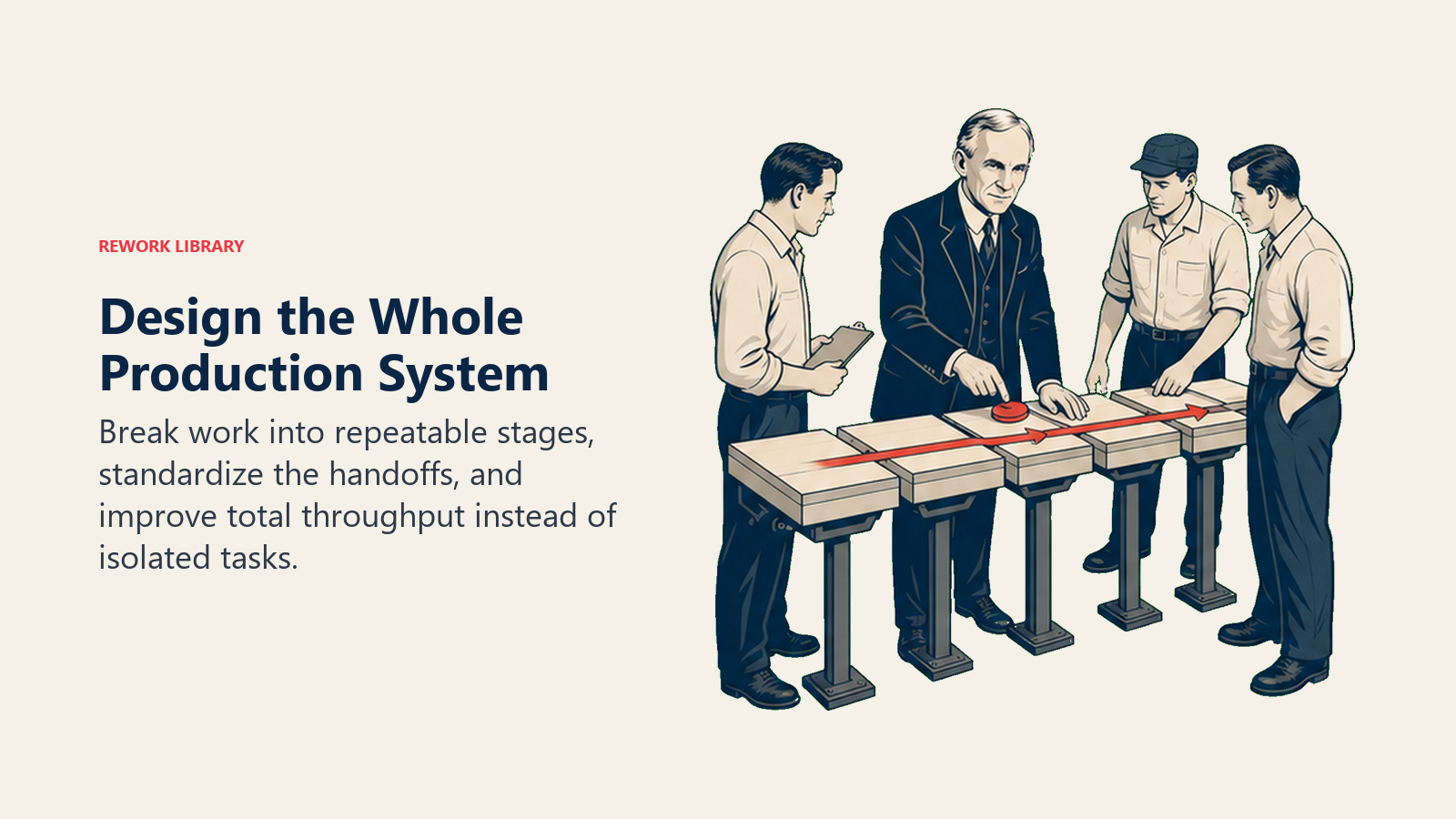
Ford believed variation was the enemy of quality and cost. The assembly line wasn't just a production method. It was a philosophy: if a task can be defined precisely, it can be repeated perfectly and cheaply. He applied this to parts, processes, supplier specifications, and eventually to the car itself, which was why the Model T came in one color for most of its production run.
2. Make the product affordable for the people who make it
Ford famously said that a worker who couldn't afford to buy the thing he produced represented a business failure, not just a social one. This wasn't altruism. It was market logic: a large workforce that earned enough to become consumers was a built-in customer base. This insight influenced the broader philosophy of cost leadership strategy that later theorists would formalize.
3. Own the supply chain
Ford wanted control over every input. At his peak, Ford's River Rouge Complex in Dearborn, Michigan, took in iron ore, coal, and rubber at one end and shipped finished cars out the other. He owned the mines, the timber tracts, the glass plants, and the rail lines. This vertical integration was Ford's attempt to eliminate dependency on suppliers he didn't trust. The scale he achieved also let him realize the economies of scale that kept the Model T's price falling year after year.
4. Volume over margin
Ford chose scale. Where competitors built higher-margin, lower-volume vehicles for wealthier buyers, Ford chased the largest possible market with the lowest possible price. He understood that a small margin on 1 million cars generated more absolute profit than a fat margin on 10,000 luxury vehicles.
5. Efficiency obsession
Every step in Ford's factories was timed, analyzed, and optimized. Frederick Winslow Taylor's scientific management ideas were baked into Ford's operations before most companies had heard of them. Waste in motion, material, or time was a personal affront to Ford.
6. Control over delegation
Ford rarely built strong second-tier leaders. He preferred loyal implementers over independent thinkers. This kept decision velocity high in the short term but created fragility. When Ford finally had to respond to General Motors' strategy of offering multiple models at different price points, the company lacked the organizational depth to pivot quickly.
Strengths and weaknesses of Ford's leadership
| Trait | Strength | Weakness |
|---|---|---|
| Autocratic control | Fast decisions, consistent standards, no internal political gridlock | Crushed dissent, drove out talented managers, left no succession depth |
| Visionary affordability | Created mass-market demand, grew the industry, benefited consumers | Vision was fixed on one product; Ford refused to update the Model T until sales collapsed |
| Vertical integration | Supply chain resilience, cost control, proprietary scale | Over-extended capital, inflexible when markets shifted, River Rouge was expensive to maintain |
| Standardization obsession | Drove radical efficiency, made the assembly line work | Created rigidity; the Model T's lack of variety became a fatal weakness against GM |
| Worker wage strategy | Cut turnover, created consumer base, improved community living standards | Paired with surveillance and paternalistic controls that undermined worker autonomy |
| Market intuition | Read mass-market demand correctly for 20 years | Missed the shift to aspirational purchasing and product variety in the late 1920s |
The Model T case is worth holding onto. Ford kept it essentially unchanged for nearly two decades while General Motors, under Alfred Sloan, began offering multiple models at multiple price points with annual styling updates. By the time Ford acknowledged the market had moved, Ford Motor Company had fallen from 60% U.S. market share to around 15%. Autocratic certainty that worked brilliantly during the Model T's rise became organizational paralysis when circumstances changed.
Lessons for today's leaders
Ford's story offers specific lessons depending on where you are in a business cycle:
| Situation | What Ford's playbook suggests | The warning |
|---|---|---|
| Early-stage scaling | Standardize processes ruthlessly before you grow. Inconsistency at scale is expensive. | Don't mistake early standards for permanent ones. Markets change. |
| Pricing strategy | Think about who can afford your product. A workforce that can buy from you is a market. | Low-price competition requires genuine operational advantage, not just ambition. |
| Supply chain design | Owning critical inputs reduces external risk and can build sustainable cost advantage. | Vertical integration requires capital and management bandwidth most companies underestimate. |
| Decision-making speed | Centralized authority is fast. In a crisis or a rapid build phase, speed wins. | Centralized authority fails when the organization outgrows one person's knowledge. Build leaders, not implementers. |
| Long-term relevance | Operational excellence must be paired with market listening. Ford's efficiency was real. His market blindness cost him anyway. | Winning by being better at the old game doesn't protect you from someone changing the game. |
Leaders who study Ford alongside Ray Kroc, Akio Toyoda, and Sam Walton will notice a shared pattern: all four built operational machines that dominated their eras, and all four created cultures where the system itself became the competitive advantage. The difference is that Toyoda built quality feedback loops into the system, Kroc franchised it rather than owning every outlet, and Walton shared financial upside with frontline workers. Ford's version was the most centralized, and the most brittle when it finally faced a competitor who understood what he didn't: that consumers want variety.
Henry Ford built something genuinely transformative. The assembly line, mass affordability, the concept that industrial workers deserve a living wage: those contributions belong to him. But he also built an organization shaped so tightly around his own judgment that it nearly broke when his judgment failed. The honest lesson isn't to copy Ford or to dismiss him. It's to take the operational rigor, build the team strength he didn't, and stay curious about the market in ways he couldn't.
