Larry Page's Leadership Style at Google
Turn this article into takeaways for your work.


Each assistant summarizes the article only for you and suggests best practices for your work.
Larry Page's leadership style is inseparable from a single conviction: that reasonable ambition is wasted ambition. From co-founding Google in 1998 to restructuring it into Alphabet in 2015, Page built organizations around the premise that 10x improvement is more achievable, not less, than 10% improvement. The reason: it forces you to rethink the problem entirely.
Key Facts
- Google co-founded: 1998 by Larry Page and Sergey Brin, both PhD students at Stanford
- Google IPO: August 2004 at $85/share; by 2019 Alphabet's market cap had crossed $900 billion (Source: Alphabet SEC filings, 2019)
- OKR adoption: Google adopted Objectives and Key Results in 1999, introduced by investor John Doerr, and scaled it to over 60,000 employees (Source: John Doerr, "Measure What Matters," 2018)
Who is Larry Page?
Larry Page is the co-founder of Google and former CEO of both Google and Alphabet, the holding company he created to house Google and its long-bet subsidiaries. Born in 1973 in East Lansing, Michigan, Page grew up in a household steeped in computing (his father was a computer science professor at Michigan State). He earned his undergraduate degree in computer engineering from the University of Michigan, then began a PhD at Stanford where he met Sergey Brin. Their collaboration on a research project called "BackRub" became the foundation of Google's PageRank algorithm and, ultimately, the company itself.
Page served as Google's first CEO until 2001, when he handed the role to Eric Schmidt and moved into a product-focused position. He returned as CEO in 2011, reorganizing Google's leadership structure around a small group of direct reports called the "L-team." In 2015, he stepped back from Google operations to run Alphabet, the new parent company, until his resignation in December 2019. He has been largely out of the public eye since.
Larry Page's leadership style
Page's style resists easy categorization. He's not a charismatic public communicator in the Steve Jobs mold, and he's not a relationship-builder like Sundar Pichai. What he is: a deeply technical, systems-oriented thinker who led by setting an almost unreasonably high bar and then giving people the space to either reach it or not.
| Trait | What it looked like | Impact |
|---|---|---|
| Moonshot thinking | Pushed teams toward 10x improvement over 10% gains; funded Google X, self-driving cars, Project Loon | Created the conditions for Android, Maps, and YouTube to become dominant platforms |
| Engineering-first culture | Promoted engineers to leadership; kept product and engineering decision-making close together | Attracted and retained top-tier technical talent; created a bias toward building over acquiring |
| Minimal communication overhead | Famously sparse in public statements; preferred internal memos and small leadership circles | Reduced noise for the people doing the work; created ambiguity at scale as the company grew |
| Structural clarity via reorganization | Created the L-team in 2011; designed Alphabet to give subsidiaries independence and clear accountability | Unlocked capital allocation discipline; allowed moonshot bets to be funded without cannibalizing core search revenue |
| Long-horizon capital patience | Funded multi-year R&D projects with no near-term revenue model (Waymo, Verily, Wing) | Positioned Alphabet as a portfolio of future bets; some paid off (YouTube, Android), many are still maturing |
Key leadership principles
10x thinking over 10% thinking
Page's most-cited concept is that 10x improvement in any domain is often easier to achieve than 10% improvement, because 10% thinking leads you to optimize what exists while 10x thinking forces you to start from the problem again. He applied this to search (the original PageRank insight), to maps (Street View was a 10x bet on data collection), and to transportation (Waymo). The principle isn't about recklessness. It's about which questions you're willing to ask.
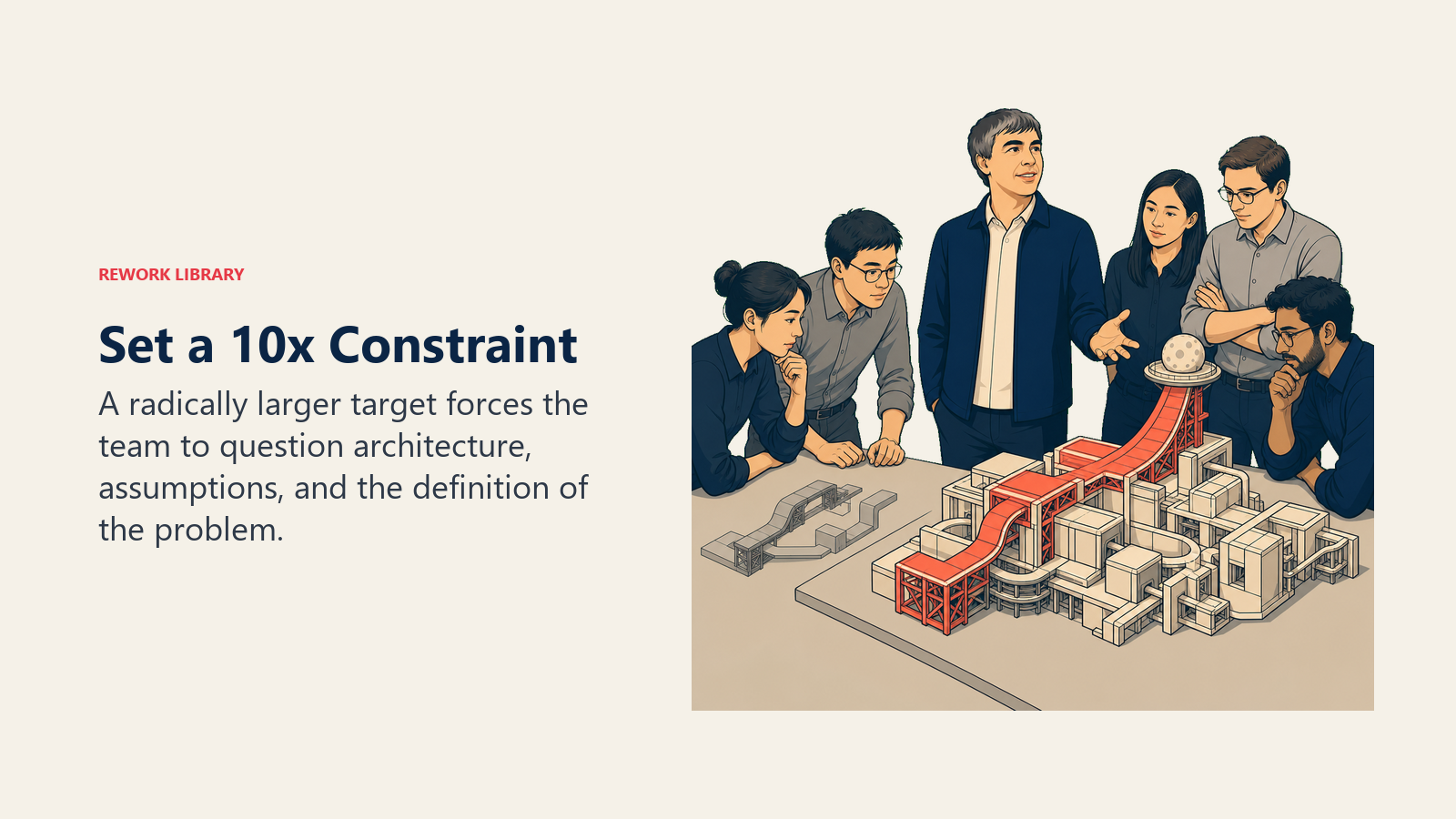
At its best, 10x thinking is a hiring filter and a culture anchor: if someone's job is to improve an existing metric by a small amount, you need a different kind of person than if their job is to make a product category obsolete.
The toothbrush test
Page reportedly used the "toothbrush test" for evaluating acquisitions: will people use this product at least twice a day, and does it make their life better? It's a product-first filter, not a financial one, and it reflects Page's preference for building products with inherent daily utility over financial engineering through M&A. It influenced acquisitions like YouTube (2006, $1.65B), Android (2005, $50M), and Waze (2013, $966M), all products with strong daily-use patterns.
OKRs as operating system
Google adopted OKRs (Objectives and Key Results) in 1999 at John Doerr's suggestion, and Page embedded the framework as the operating system for how Google set and measured goals at every level. OKRs gave the organization a way to handle rapid scaling without losing directional alignment. The framework was transparent: in Google's implementation, OKRs were shared publicly across the company, so any employee could see what any team was working toward. That transparency was a direct expression of Page's preference for engineering discipline over hierarchy.
Engineering leadership, not management hierarchy
Page consistently promoted engineers into leadership positions and kept product and engineering decision-making structurally close. He was skeptical of management layers that created distance between the people making decisions and the people building products. In 2001, he briefly tried to eliminate all manager roles at Google entirely, with every engineer reporting directly to him. The experiment lasted a few months before practical reality intervened, but it reflected a genuine belief that management overhead is a cost to be minimized, not a feature to be built.
The L-team reorganization
When Page returned as CEO in 2011, he restructured Google's senior leadership into a smaller, more focused group: the "L-team," consisting of roughly 15 direct reports covering Google's major product areas. The goal was to reduce the number of people who needed to be in a room before a decision could be made. It was a deliberate compression of decision-making authority, and it accelerated Google's product velocity in the years that followed.
Signature decisions
Acquiring Android for $50 million in 2005
Google's acquisition of Android Inc. in 2005 for approximately $50 million is one of the most asymmetrically profitable acquisitions in technology history. At the time, most people in the industry assumed Microsoft would dominate mobile operating systems. Page and Brin saw the mobile platform as a strategic necessity: if Google Search wasn't available on whatever device people used next, Google lost.
Android now runs on roughly 72% of smartphones globally (StatCounter, 2024). The acquisition cost less than Google spends on catering.
Creating Alphabet in 2015
The Alphabet restructure was Page's most significant organizational act as a leader. By separating Google (search, advertising, YouTube, Android) from "Other Bets" (Waymo, Verily, DeepMind, Wing), Page created a structure where each subsidiary had its own CEO, its own P&L, and direct accountability to Alphabet's capital allocation process. The goal was to prevent Google's advertising revenue from subsidizing unfocused moonshots without accountability.
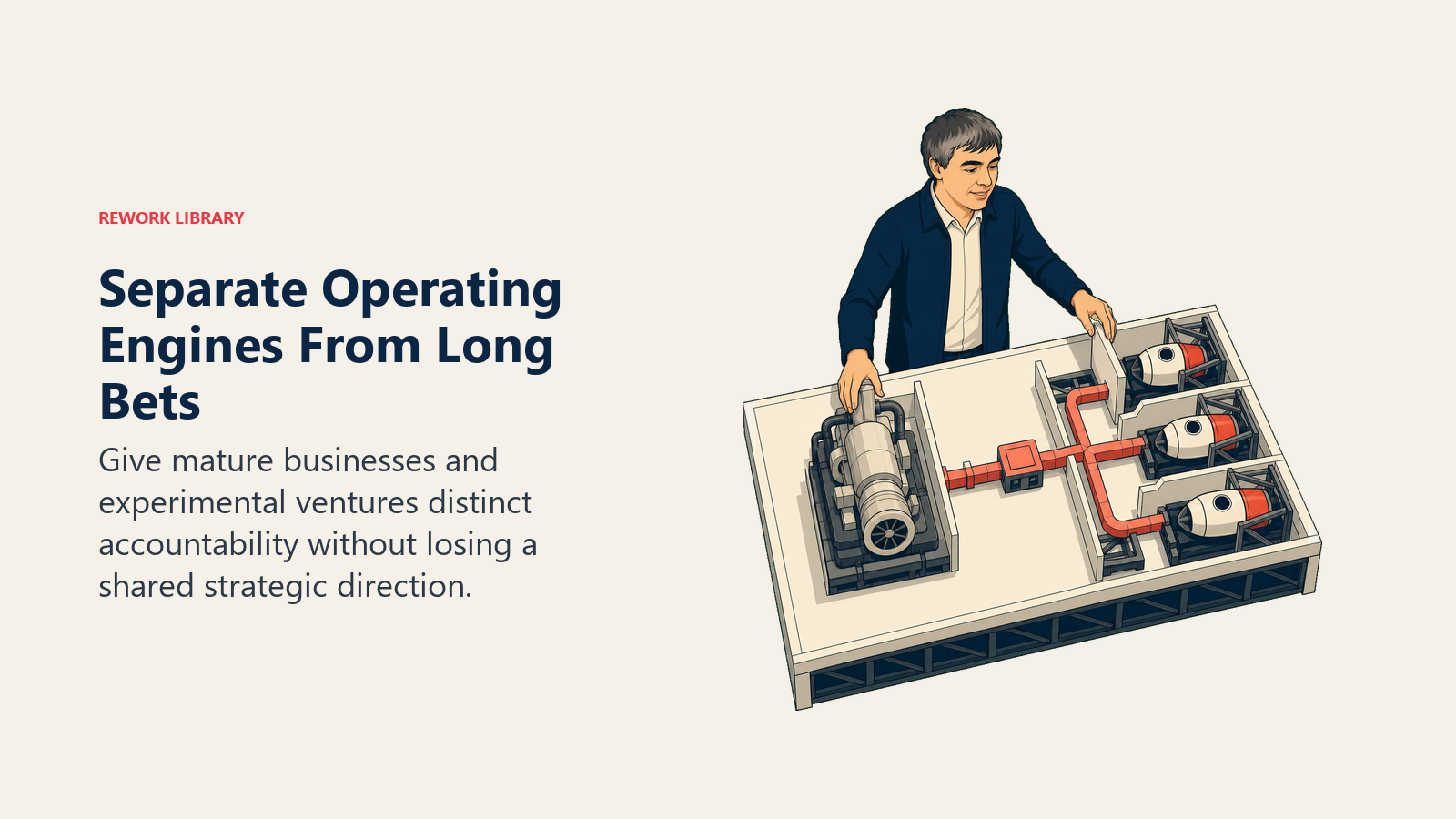
It also reflected Page's visionary leadership instinct: he wanted Alphabet to function more like Berkshire Hathaway for technology bets than like a traditional conglomerate with centralized operations.
Backing Google X and long-bet R&D
Google X (now X, the moonshot factory) was Page's institutional answer to the question: what happens if you fund a team specifically to work on problems that will take 10 years and might not work? Projects that came out of Google X include Waymo (self-driving vehicles), Wing (drone delivery), and Loon (internet access via stratospheric balloons). Loon was shut down in 2021, Wing is operating commercial deliveries, and Waymo has become the leading autonomous vehicle company by miles driven. The R&D model itself, regardless of individual outcomes, reflects Page's conviction that big bets require institutional protection from short-term financial pressure.
Criticisms and limitations
Communication distance at scale
Page's preference for small circles and minimal public communication worked well when Google was a few hundred engineers. As the company scaled to tens of thousands of employees, it created real problems. People at Google have described periods of genuine uncertainty about strategic direction because Page communicated so infrequently and so indirectly. When your culture is built around a founder's convictions and that founder rarely speaks publicly inside the organization, the culture becomes fragile at scale.
Sundar Pichai's leadership at Google, by contrast, is notably more communicative and coalition-building, which is partly why the board chose him as CEO in 2015 rather than retaining Page in that role.
"Wood behind fewer arrows" and the cuts that followed
When Page returned as CEO in 2011, he adopted the phrase "wood behind fewer arrows" as the rationale for cutting products and focusing Google's portfolio. Dozens of products were shut down, including Google Wave, Google Buzz, and various side projects. Some of those decisions were correct. Others cut products that had real user bases and potential (Google Reader, for instance, had millions of loyal users and was shut down in 2013 under the same logic). The "fewer arrows" framework is a useful heuristic, but Page's application of it was sometimes too mechanical, sacrificing community goodwill for operational tidiness.
Antitrust scrutiny and the scale problem
Alphabet's dominance in search, advertising, mobile operating systems, and video has made it a target for antitrust regulators across the US, EU, and elsewhere. Page's leadership philosophy prioritized winning at platform level, which is structurally different from winning at product level: you're trying to create a surface that everyone else builds on, which tends toward monopoly. The DOJ's 2020 antitrust lawsuit against Google, the EU's multi-billion euro fines for search and Android practices, and the ongoing investigations into advertising markets are in part a consequence of the platform-first strategy Page built. Whether those investigations represent regulatory overreach or legitimate accountability is debated. What's not debated is that platform thinking at scale creates regulatory risk that product thinking doesn't.
Stepping back without a transition plan
Page's departure from Alphabet in December 2019 was abrupt by executive succession standards. He and Sergey Brin stepped down simultaneously, handing authority to Sundar Pichai with no extended transition period and minimal public explanation. For a company of Alphabet's size, that handoff created uncertainty about strategic continuity for the Other Bets portfolio, which remains unresolved. Several of those bets have been quietly wound down since.
Lessons from Larry Page's leadership
1. Set the bar at 10x and let the team figure out how
Page's 10x principle is most useful not as a slogan but as a meeting intervention. When a team presents a plan to improve something by 15%, the question to ask is: what would it take to make this 10x better? That question either reveals that the team is solving the wrong problem (common) or surfaces assumptions about constraints that aren't actually constraints (also common). You don't have to fund the 10x answer. But asking the question changes what options end up on the table.
2. Structure creates accountability; don't wait until you're too big to reorganize
The Alphabet restructure was probably overdue by two or three years when it finally happened. The lesson for leaders: if you're running a portfolio of bets inside a single organizational structure, the time to separate accountability is before the portfolio gets large, not after. Mixing P&Ls creates the kind of cross-subsidy confusion that makes it impossible to know which bets are actually working.
3. OKRs work when they're transparent, not just when they're set
Google's OKR implementation worked partly because OKRs were visible across the company. Any engineer could look up the company's top objectives and see how their team's work connected to them. Most organizations that adopt OKRs keep them siloed by team, which defeats much of the value. Transparency is not just a nice principle here. It's the mechanism.
4. Engineering leadership is a culture choice, not just a hiring choice
Page didn't just hire good engineers. He structured the company so that technical judgment had more organizational authority than business development judgment. That's a deliberate culture choice with real consequences: it means your product decisions skew toward technical elegance, your sales culture is secondary to your product culture, and your acquisitions are filtered through product utility rather than financial synergy. Know which tradeoffs you're making before you copy the model.
5. Communication is not a soft skill at scale
Page's communication minimalism worked at Google's early stages and created real organizational problems at later stages. The lesson is not "communicate more" as a generic principle. It's that your communication style needs to evolve with organizational size. What works in a 50-person company creates ambiguity in a 50,000-person company. Building a layer of leaders who can translate your thinking, as Page eventually did with Pichai and Ruth Porat as CFO, is itself a leadership skill.
Page stepped back from Alphabet's day-to-day operations in 2019 and has given no indication of returning to an executive role. His influence on how technology companies are structured, how they think about long-horizon R&D, and how OKRs operate at scale is now largely built into the operating model of the industry he helped create. Whether the platform-first approach he pioneered holds up under the regulatory environment it generated is the open question that his successors are now managing.
For context on the operational discipline that complemented Page's vision inside Alphabet, Ruth Porat's leadership as CFO shows what it looks like to bring financial rigor to a company built on 10x ambition. On the culture side, Reid Hoffman's leadership at LinkedIn offers a parallel case study in scaling a founder-led culture through a structured transition.
Learn More

Co-Founder, Rework.com
On this page
- Who is Larry Page?
- Larry Page's leadership style
- Key leadership principles
- 10x thinking over 10% thinking
- The toothbrush test
- OKRs as operating system
- Engineering leadership, not management hierarchy
- The L-team reorganization
- Signature decisions
- Acquiring Android for $50 million in 2005
- Creating Alphabet in 2015
- Backing Google X and long-bet R&D
- Criticisms and limitations
- Communication distance at scale
- "Wood behind fewer arrows" and the cuts that followed
- Antitrust scrutiny and the scale problem
- Stepping back without a transition plan
- Lessons from Larry Page's leadership
- 1. Set the bar at 10x and let the team figure out how
- 2. Structure creates accountability; don't wait until you're too big to reorganize
- 3. OKRs work when they're transparent, not just when they're set
- 4. Engineering leadership is a culture choice, not just a hiring choice
- 5. Communication is not a soft skill at scale
- Learn More