Oprah Winfrey's Leadership Style and Principles
Turn this article into takeaways for your work.


Each assistant summarizes the article only for you and suggests best practices for your work.
Oprah Winfrey's leadership style is built on authentic connection and the belief that genuine curiosity about other people is itself a form of power. She didn't build a media empire by positioning herself as an authority. She built it by showing up, asking real questions, and refusing to pretend she had all the answers.
That approach produced results few media executives have matched. The Oprah Winfrey Show ran for 25 seasons (1986-2011) and at its peak reached 12 million daily viewers in the United States alone. She launched Harpo Productions in 1986, eventually expanding into film, publishing, satellite radio, and cable television with OWN (Oprah Winfrey Network). And she did it while consistently ranking as one of the most trusted public figures in America, a distinction that is far harder to maintain over decades than any single business metric.
For executives and managers, her approach raises a practical question: what does it actually look like to lead with authenticity, and how do you build an organization around it?
Who is Oprah Winfrey?
Oprah Winfrey is a media entrepreneur, television host, producer, actress, and philanthropist who built one of the most recognizable personal brands in entertainment history. She was born in rural Mississippi in 1954, grew up in poverty, and by 32 had launched the independent production company that would let her own and control her media output rather than work for hire.
Harpo Productions, founded in 1986, gave her control over The Oprah Winfrey Show at a time when on-screen talent rarely owned their own content. That ownership decision separated her from peers. She wasn't just a host; she was the executive making decisions about format, guests, direction, and revenue.
OWN (Oprah Winfrey Network) launched in January 2011, the same month The Oprah Winfrey Show aired its final season. Its early years were difficult and much-reported. But by 2013 the network had stabilized with original programming, and by 2015 OWN had its first full year of profitability. The network's ability to recover under her leadership is a less-told part of her business story, and a more useful one for operators facing a rough stretch.
Her philanthropic work, primarily through the Oprah Winfrey Foundation and her partnership with the Oprah Winfrey Leadership Academy for Girls in South Africa (founded 2007), reflects the same conviction that drives her on-screen approach: invest in people who haven't been given the same starting conditions you eventually received.
Key Facts
- The Oprah Winfrey Show: 25 seasons (1986-2011), syndicated in 149 countries at its peak (source: Harpo Productions)
- Harpo Productions: founded 1986; one of the first instances of a Black woman owning a major television production studio in the United States
- OWN: launched January 1, 2011; reached profitability by fiscal year 2015 (source: Discovery Communications investor reports, 2015)
Oprah Winfrey's leadership style
Oprah Winfrey's leadership style combines authentic leadership, transformational leadership, and a distinct brand of charismatic leadership that draws people in rather than commanding them forward.
Her authentic leadership shows up most clearly in how she handles her own story. She has spoken publicly, often uncomfortably so, about childhood trauma, weight, relationships, and professional setbacks. Most leaders manage perception. Oprah Winfrey has consistently chosen transparency instead, and it's built a level of audience trust that no marketing budget could manufacture.
The transformational dimension appears in how she treats the people around her. She doesn't just want employees or guests to perform better. She wants them to think differently about what they're capable of. Her show's consistent theme, across 25 seasons and thousands of episodes, was human potential. That same belief in growth runs through how she has described building her team at Harpo.
Emotional intelligence is probably the trait she's most studied for, and with good reason. She reads a room accurately and adjusts. She asks the follow-up question that a prepared interviewer would skip. She makes guests and audience members feel genuinely heard, not managed. That skill doesn't stay in the studio. It's what made business negotiations, partnership decisions, and leadership transitions work the way they did across her career.
The servant leadership thread in her approach is real but often understated. She has said in various forums that she sees her role as helping other people find their voice, not broadcasting her own. Her most commercially successful moves, endorsing books, launching careers, platforming causes, came from a place of wanting to share something valuable rather than simply selling something.
Compare her to Howard Schultz, who built Starbucks on the belief that brand experience and employee investment are the same asset. Oprah Winfrey's operating thesis is similar: trust is the product, and everything that undermines trust is a strategic problem, whether it's a misleading interview, a rushed business decision, or a brand partnership that doesn't align with her actual values.
Richard Branson offers an interesting contrast. Both Branson and Winfrey built personal brands that became business platforms, and both leaned heavily into authenticity as a differentiator. But Branson's style is outward-facing and adventurous; he leads by doing surprising things publicly. Winfrey's style is inward-facing and relational; she leads by listening deeply and then saying out loud what she heard.
Key leadership principles
Lead with authenticity, not authority. Oprah Winfrey has never led primarily by title or organizational hierarchy. She leads by being honest about what she believes, what she's experienced, and what she doesn't know. That approach creates a different kind of authority, one that people grant rather than one an organization chart assigns.

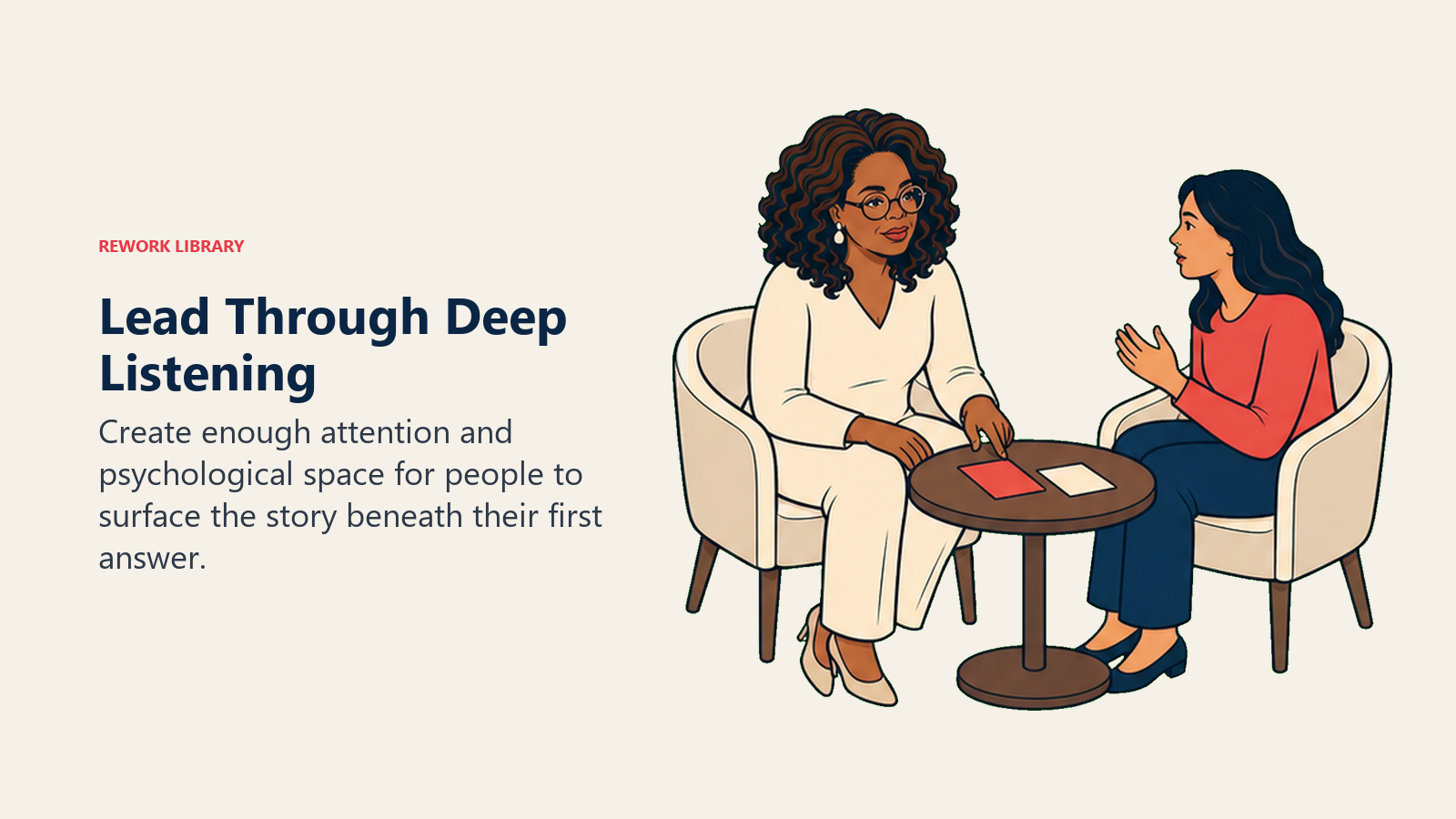
Listen as a leadership practice. Her interviewing style is famous, but the underlying skill is deliberate listening. She asks a question, waits for the answer, and then asks another question based on what she actually heard, not what she planned to ask next. In organizational terms, this is the difference between a leader who runs meetings and one who changes meetings by what they notice. Teams can tell the difference quickly.
Purpose over profit as a guiding constraint. Every business Winfrey has built has a thematic center: human development, storytelling, learning, wellness. She hasn't chased revenue into adjacent categories that contradict those themes. That restraint has cost her some deals and kept her out of some markets. It's also kept her brand coherent across four decades.
Lift others as a core operating principle. The "Oprah effect" (the name media analysts use for the measurable sales spike that follows her recommendation of a book, product, or person) is real. But the mechanism isn't endorsement. It's advocacy. She doesn't just mention things; she explains why she cares about them. That distinction matters for leaders who want to develop talent rather than simply assign tasks.
Treat vulnerability as a form of credibility. In business culture, most leaders learn early to project confidence and minimize visible uncertainty. Winfrey has done the opposite, not recklessly, but deliberately. She has said that sharing her own struggles, publicly and specifically, is part of how she earned the right to ask her guests to do the same. In organizational terms, this translates to leaders who say "I don't know" or "I got that wrong" before their teams do, and create the psychological safety that follows.
Build ownership into the model. Her decision to own Harpo Productions rather than license her name to a network was a structural choice that shaped everything else. It meant her decisions had long-term consequences she controlled. For executives: the governance question is as important as the strategy question. Owning the platform is different from using someone else's.
Oprah's principles in practice
| Principle | How she applied it | Lesson for leaders |
|---|---|---|
| Authentic storytelling | Shared personal setbacks (childhood poverty, public weight struggles, professional failures) as part of her public identity rather than liabilities to manage | When leaders share real context, teams make better decisions and trust increases faster than any management initiative can produce |
| Deep listening | Consistently asked follow-up questions based on what guests actually said, not what her notes said next; guests described feeling genuinely heard | Listening as a practice (not a performance) changes meeting culture, hiring quality, and customer understanding |
| Purpose as filter | Turned down brand partnerships and media formats that paid well but contradicted her editorial values | A clear purpose statement that actually functions as a decision filter is more valuable than one framed for internal documents |
| Lifting others | Used her platform to recommend books, causes, and careers with specific explanation of why she believed in them, creating what became a documented commercial phenomenon | Advocacy is more powerful than endorsement; explain your reasons, not just your conclusion |
| Ownership and independence | Structured Harpo Productions to give her creative and financial control rather than working under network contracts | Governance structure shapes culture; who owns the platform shapes what decisions get made and how fast |
| Vulnerability as credibility | Addressed personal struggles directly and specifically before asking guests to do the same | Leaders who name their own uncertainty earn the right to ask their teams to be honest about theirs |
Lessons for today's leaders
The most actionable thing about Oprah Winfrey's leadership style is that it doesn't require her specific industry, platform, or fame to apply. The underlying principles travel.
For CEOs and founders: The question Winfrey's career poses is whether your leadership has a consistent through-line that people can articulate without you in the room. She's been media mogul, producer, host, investor, and philanthropist simultaneously, but the through-line (human potential, authentic connection, purposeful storytelling) has never changed. If your team can't name your through-line clearly, it probably doesn't exist yet.
For directors managing teams: Her listening practice is one of the most underrated management tools you can borrow. In your next 1-on-1, try this: ask one question, hear the full answer before you respond, and then ask the question her practice suggests, the follow-up based on what you actually heard. Do it for one meeting cycle and observe what changes.
For managers running day-to-day operations: The ownership principle applies at every level, not just at the founder level. What does it mean to own your process rather than rent it? Winfrey didn't wait for permission to restructure how her show was produced. She bought the structure. At a manager level, owning looks like designing the team's workflow rather than inheriting it, building the feedback loop rather than waiting for HR to install one, and taking responsibility for the result rather than the activity.
For professionals building their personal brand: Her career demonstrates that authenticity compounds. A consistent, genuine point of view, held across time and expressed specifically, builds more durable trust than a polished, managed brand voice. The catch is that authenticity requires clarity about what you actually believe, which takes more work than positioning.
| Situation | What Winfrey's approach suggests |
|---|---|
| Building trust with a new team | Share real context about yourself before asking for it from others |
| Running a meeting where people aren't talking | Ask one genuine question and wait; don't fill silence with your own answer |
| Evaluating a new business opportunity | Run it through a purpose filter before a revenue filter |
| Developing a high-potential team member | Advocate for them specifically and publicly, with reasons, not just in a performance review |
| Navigating a public setback or failure | Name it directly and specifically; managed minimization costs more credibility than honest acknowledgment |
What her model shows us
Oprah Winfrey built a media empire on practices that most leadership frameworks treat as soft skills: listening, authenticity, vulnerability, advocacy. Her career is a 40-year demonstration that those practices produce hard results, measurable audience trust, sustainable brand equity, and business ownership that compounds.
The version of her leadership worth studying isn't the celebrity version. It's the operator who chose to own her production company instead of licensing her name, who turned down partnerships that paid well but didn't fit her values, and who built a network that struggled publicly in its first years and recovered. That's the Oprah Winfrey who has something specific to teach leaders at every level of an organization.
