Culture Change Playbook for Directors: Shifting Team Behavior Without a Reorg
Culture change is one of the most requested, least understood interventions in business. Every quarter, some leadership team announces a "culture initiative" that produces a new set of values posters, a company offsite, and then zero measurable change in how people actually work.
The reason these efforts fail isn't lack of intent. It's a flawed model of what culture actually is.
Culture isn't the values on the wall. It's the behaviors that get rewarded and the behaviors that get tolerated. It's what a new hire learns in their first 90 days about what actually matters. And it's shaped far more by what managers do in daily decisions than by anything said in an all-hands meeting.
This playbook gives directors, VPs, and functional leads a practical framework for changing culture at the team level without needing a company-wide initiative, without a reorg, and without waiting for executive buy-in.
Why "Top-Down" Culture Change Fails
Most culture change programs are designed as top-down initiatives: leadership defines the new values, HR creates training, and managers are tasked with "embedding" the culture in their teams.
The problem is that employees are not passive recipients of culture. They are active decoders. They watch what gets rewarded in promotion decisions. They notice which behaviors get called out in performance reviews and which get quietly tolerated. They observe what their direct manager does when no one senior is watching.
No amount of messaging can override what people observe in their direct environment. A company that calls itself "transparent" but where managers routinely withhold information to protect their own position will be experienced as opaque by every employee. The stated culture and the lived culture diverge, and employees trust the lived culture.
This means culture change that sticks starts at the team level, not at the messaging level. And it starts with leaders examining their own behavior first.
The Culture Gap Diagnostic
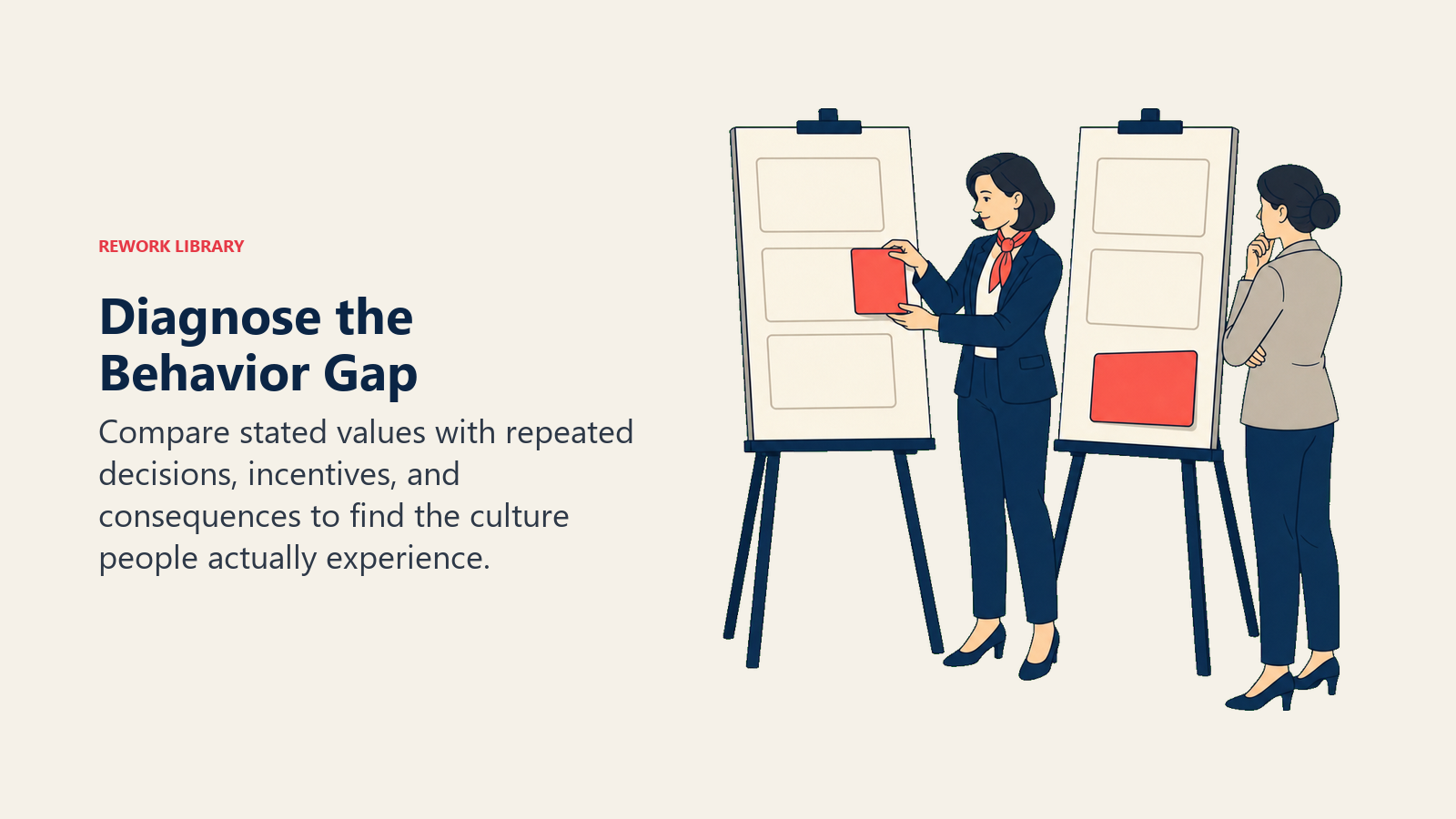
Before designing any intervention, you need to understand the gap between the culture you have and the culture you need. There are three questions that cut through to the truth:
Turn this article into takeaways for your work.


Each assistant summarizes the article only for you and suggests best practices for your work.
1. What behaviors are currently being rewarded, even unofficially?
This is not "what behaviors does our values framework reward." It's "who got promoted last year, and what specific behaviors led to that?" If the answer is "the person who worked the most hours" rather than "the person who made the most impact," you have a hours-over-outcomes culture, regardless of what your values say.
2. What behaviors are being tolerated that contradict the intended culture?
In any team, there are usually one or two people whose behavior contradicts the cultural norms. How leadership handles these situations sends a clearer signal about culture than anything else. Tolerating a high performer who violates norms tells the team that performance trumps culture. The team learns accordingly.
3. Where is there a gap between what leaders say and what they do?
Satya Nadella famously told Microsoft employees that the company needed to shift from a "know-it-all" culture to a "learn-it-all" culture. But he didn't just announce it. He publicly admitted mistakes, asked questions in meetings where he could have given answers, and cited learning from books and external sources in his own communications. The saying and the doing were aligned.
Document your answers honestly. The gap between current and target behavior is the work.
The Four Levers of Culture Change
Culture is shaped by four levers, in order of leverage:
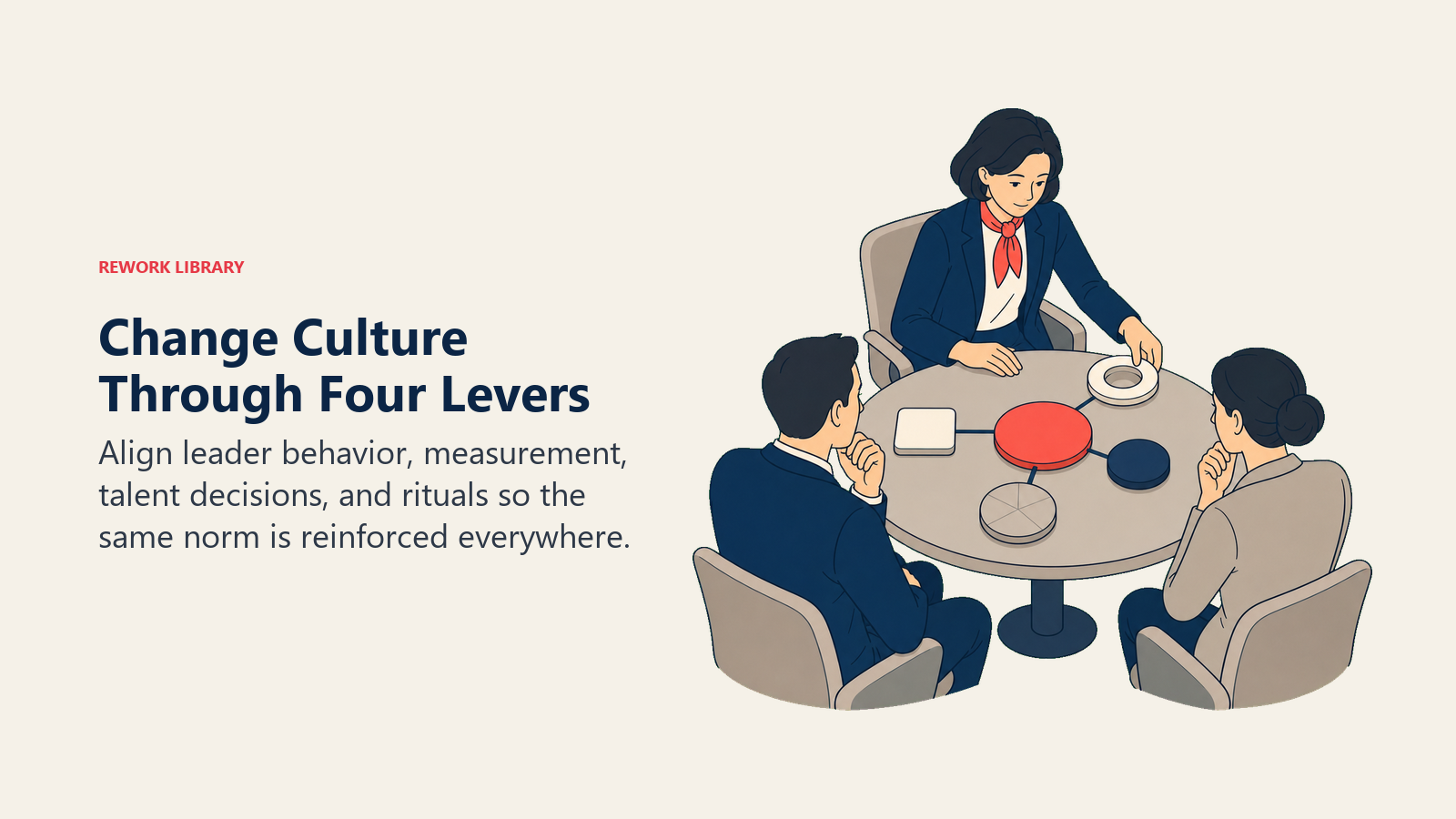
1. What Leaders Model
The highest-leverage lever is leader behavior. Research from organizational psychology consistently shows that teams model the behavior of their immediate manager more than any organizational-level messaging.
If you want a feedback-rich culture, give and receive feedback visibly. Not just in private 1:1s but in public forums where the team can observe it. When you receive critical feedback and respond with "that's really useful, let me think about how to act on it" instead of defensiveness, you demonstrate that the norm is real.
If you want a culture of accountability, hold yourself accountable publicly. When you miss a commitment, say so directly, explain what went wrong, and describe what you're changing. Don't rationalize it.
Practical action: For the next 60 days, pick one behavior that represents the culture you want and make it visible in every team interaction. Announce it explicitly to your team so they know what to watch for.
2. What Gets Measured
People optimize for what gets measured and reviewed. If your quarterly reviews focus exclusively on revenue targets and never address how those targets were hit, you're signaling that the how doesn't matter.
Culture change requires adding measurement for the behaviors you want to reinforce. If collaboration is important, track cross-functional projects initiated. If knowledge sharing is important, track documentation contributions or internal talks given. If customer empathy is important, add customer feedback scores to individual performance reviews.
This doesn't mean adding bureaucracy. It means being intentional about what gets reviewed in the conversations that matter for careers.
3. Who Gets Hired, Promoted, and Removed
Nothing signals culture as clearly as who gets promoted and who gets managed out. Promotions are public announcements of what the organization values. Every employee watches them and updates their model of what behavior actually leads to advancement.
This is why culture change that skips the promotion criteria almost always fails. If you're trying to build a collaborative culture but you're promoting individual contributors who hoard information to protect their position, the message received is that the collaborative values are window dressing.
Audit your last five promotion decisions against the culture you're trying to build. Where was there alignment? Where wasn't there? What does that signal about the culture you actually have?
4. Rituals and Artifacts
Rituals are repeated behaviors that reinforce norms. They don't need to be elaborate. Some of the most effective culture rituals are:
- "Failure of the week" in team meetings: A team member shares a failure and what they learned. When the leader goes first, it normalizes learning from mistakes.
- Public recognition tied to specific values: Not "great job this quarter" but "this week Alex demonstrated our learning-first value by documenting a process that the whole team can now use."
- Start-of-meeting context windows: Spending 5 minutes at the start of cross-functional meetings sharing context about what's happening in each team. Sounds small; reduces the silo behavior that kills collaboration.
Rituals work because they are regular, visible, and easy to participate in. A behavior that happens once in an offsite is an event. A behavior that happens every week in a team meeting becomes a norm.
A 90-Day Culture Change Framework
If you're a director or VP with authority over a team of 10-50 people, here's a practical sequence:
Days 1-30: Diagnose and declare
Run the Culture Gap Diagnostic with your leadership team. Identify two or three specific behaviors you want to change, framed as "we currently do X, we need to do Y." Write them down. Share them with your team and explain why the change matters and what you personally are going to do differently.
The act of naming the change publicly creates accountability. It also invites your team to be partners in the change rather than subjects of it.
Days 31-60: Implement visible levers
Start modeling the new behaviors in every meeting. Add one measurement that tracks the behavioral change you're driving. Review your next promotion decision against the new criteria and make the criteria explicit to your team.
Expect resistance. Change feels like criticism of the past. Some team members who were rewarded under the old norms will feel threatened by the new ones. Your job is to hold the line while being respectful of the legitimate concerns.
Days 61-90: Reinforce and assess
Look for early evidence of the change and call it out publicly. Correct visible backsliding directly and privately. Assess whether the measurement you added is capturing what you intended and adjust if needed.
At 90 days, run the Culture Gap Diagnostic again with your team. The goal isn't perfection. It's a measurable reduction in the gap.
What Doesn't Work
Culture committees. A cross-functional committee tasked with driving culture change almost always diffuses accountability. Culture is the responsibility of every manager. A committee implies it's someone else's job.
Values training without behavioral specificity. Training that explains the company values without specifying what those values look like in practice (what does "integrity" look like in a pricing negotiation? what does "customer obsession" look like when a customer asks for something unreasonable?) produces awareness without behavior change.
Messaging without modeling. Satya Nadella could not have changed Microsoft's culture by sending emails about growth mindset. He had to live it. Any gap between what you say and what you do will be seen, remembered, and used to calibrate what the culture actually rewards.
Key Facts
- Culture is defined by the behaviors that get rewarded and tolerated, not by values statements
- Leader behavior is the highest-leverage culture lever because teams model their immediate manager
- Promotion decisions are the clearest signals of what an organization actually values
- Culture change at the team level is feasible in 90 days; company-wide culture change takes 3-5 years
- Research shows that stated culture and lived culture diverge significantly in most organizations
Frequently Asked Questions
How long does real culture change take?
At the team level (10-50 people), meaningful behavioral shifts are visible within 90-120 days if the leader is consistent. Company-wide culture change is a multi-year effort. The mistake most organizations make is expecting company-wide change on a quarterly timeline and giving up when they don't see it.
Can a director drive culture change if the broader company culture is different?
Yes, within limits. A director can build a strong sub-culture within their team, and strong sub-cultures often spread. But there's a ceiling: if the broader organizational culture actively rewards the behaviors you're trying to eliminate, your team members will face career penalties for living your sub-culture. That ceiling is worth naming honestly.
How do you handle a high performer whose behavior contradicts the culture you want?
Directly and quickly. Tolerating behavior exceptions for high performers teaches the whole team that the culture is optional for people who are valuable enough. Have a direct conversation about the specific behavior, explain why it matters for the team, and set clear expectations. If the behavior doesn't change, the performance conversation needs to include the culture impact as a weighted factor.
Learn More

Co-Founder, Rework.com