Best Affiliate Marketing Software in 2026: 16 Platforms for Ecommerce and SaaS Programs
Turn this article into takeaways for your work.


Each assistant summarizes the article only for you and suggests best practices for your work.
The best affiliate marketing software in 2026 depends on which of three different jobs you're hiring it for. impact.com and PartnerStack lead the enterprise partnership platforms built for a dedicated partnerships team running affiliates, influencers and B2B partners under one program. Awin remains the strongest network for renting an established publisher roster instead of recruiting one from scratch. And Refersion, UpPromote, Rewardful and FirstPromoter lead the self-serve tracking tools one marketer can run alone, tiered by revenue, affiliate count or tracked users instead of by enterprise feature depth.
This guide evaluates 16 platforms on subscription price, the transaction or success fee most competing roundups leave out entirely, real feature depth, and who each tool is built for.
Key Facts
- US affiliate marketing spend hit $13.63 billion in 2024, up 49.8% from $9.1 billion in 2021, growing roughly twice as fast as the broader ecommerce market, per the Performance Marketing Association's 2025 Industry Study.
- Affiliate-driven sales accounted for 9.4% of all US ecommerce sales in 2024, generating $113 billion, per the same PMA study, conducted with independent firm London Research.
- 90% of senior marketers globally (99% in Germany) rate affiliate marketing as effective or highly effective, per Awin and Forrester's 2024 Global Survey.
- Customers acquired through affiliate channels carry 21% higher average order values and repurchase at a 21% higher rate than customers acquired through other channels, per the same Awin and Forrester analysis.
- 69% of B2B companies plan to increase their investment in partnerships in 2026, per PartnerStack and Wynter's State of Partnerships in GTM 2026 report.
The Three Segments You Are Actually Choosing Between
Most affiliate software roundups compare 15 tools on one feature grid as if they're all competing for the same budget. They aren't. The real first decision is which segment your program belongs in, since the three are priced and sold differently.
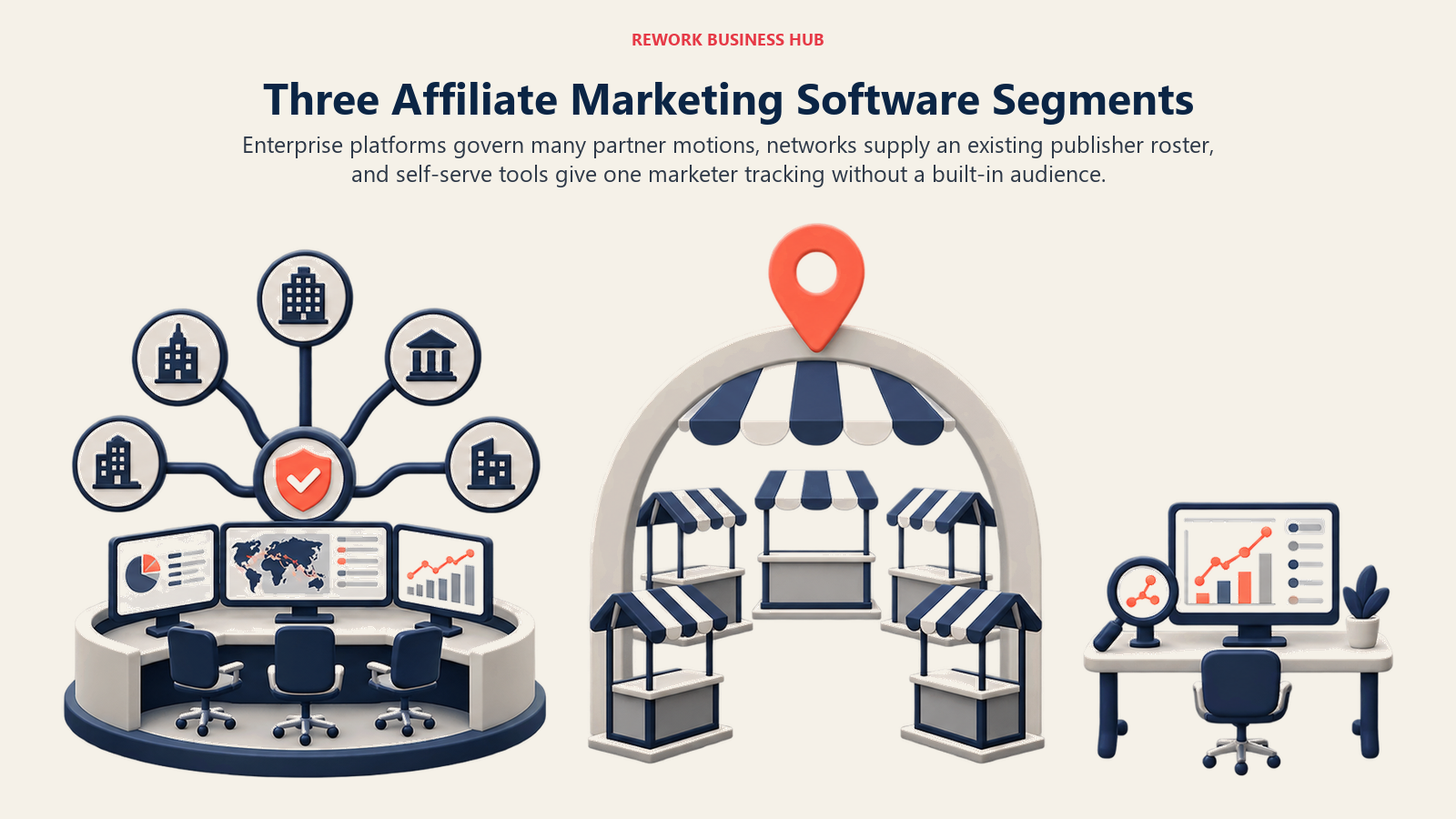
An enterprise partnership platform (impact.com, PartnerStack, Everflow) is what a dedicated partnerships team buys to run affiliates, influencers, referral partners and sometimes B2B resellers under one governed program, with automation and fraud detection built for someone whose full-time job is managing partner relationships. An affiliate network (Awin, CJ Affiliate, Rakuten Advertising) isn't just tracking software, it's a rented roster of publishers the network already recruited, which is why it takes a transaction cut on top of a base fee. And self-serve affiliate and referral tracking (Refersion, Tapfiliate, Post Affiliate Pro, UpPromote, Rewardful, FirstPromoter, LeadDyno, ReferralCandy, Trackdesk, Referral Factory, Reditus) is what one marketer runs directly, priced from free to a few hundred dollars a month and tiered by revenue, affiliate count, tracked users or tracking volume rather than by seat.
| Segment | Who buys it | Typical price band | What you're actually paying for |
|---|---|---|---|
| Enterprise partnership platform | A dedicated partnerships or affiliate marketing team | Low hundreds to low thousands per month, plus a 1% to 3.5% fee on partner-driven transactions | Cross-partner-type automation, fraud and duplicate-conversion protection, dedicated support, deep API access |
| Affiliate network | A brand or agency renting an existing publisher marketplace | $49 to $99+/mo base fee plus a 2.5% to 3.5% per-transaction network fee | Access to a roster of thousands of active publishers you did not have to recruit yourself |
| Self-serve tracking | One marketer running the program directly | $0 to roughly $400/mo, tiered by revenue, affiliates or users, sometimes plus a 1% to 10.5% success fee | Tracking, attribution, payouts and an affiliate portal, without an existing publisher network or a partnerships team |
The subscription price alone almost never tells the whole story here. Every price in this category has a second half, a transaction, success or tracking fee, and that second half is what surprises buyers at renewal because most listicles quote the subscription line and stop. Every price table below states both.
Quick Comparison Table
| Tool | Best For | Starting Price | Transaction or Success Fee | Key Strength | Key Limitation |
|---|---|---|---|---|---|
| impact.com | Enterprise partnerships: affiliate, influencer, B2B | $30/mo (Starter) | 2.5% on partner-driven sales | Now publishes real prices, ending its quote-only reputation | Fraud scoring, Data Lab, SAML need Pro ($2,500/mo)+ |
| PartnerStack | B2B SaaS affiliate, referral, reseller partnerships | Quote-only (Launch/Growth/Enterprise) | Not published, set at demo | Purpose-built for B2B SaaS partner-led growth | No self-serve price at any tier |
| Awin | Renting an established publisher network | $49/mo (Access), 3-month minimum | 3.5% per transaction (Access) | Absorbed ShareASale's ~9,500 advertisers, 250,000 publishers | Base fee plus transaction fee on every sale |
| Everflow | Affiliate, influencer, paid partnerships in one platform | Quote-only, 6-month commitment | Not published | Flexible across multiple partner types | 6-month lock before you see a price |
| Refersion | Ecommerce, especially Shopify, affiliate programs | $39/mo (Launch), $29/mo annual | 3% of affiliate-driven sales | Unlimited affiliates, clicks, conversions on every paid plan | Percentage fee erodes margin until Scale |
| Tapfiliate | Flat pricing, no revenue share | $89/mo (Launch), $74/mo annual | None; overage fees instead | Predictable bill, no sales-percentage fee | Hard caps on affiliates, clicks, conversions |
| Post Affiliate Pro | High tracking-request volume | $89/mo (Starter), $79/mo yearly | None published | Unlimited affiliates, generous request ceilings | Regular prices run higher than most self-serve rivals |
| UpPromote | Shopify merchants wanting a genuine free tier | Free (up to $3,000 referral review/mo) | 2% (Growth) to 1% (Enterprise) | Real free plan, not a trial | Free tier caps monthly referral volume at $3,000 |
| Rewardful | Stripe-billed SaaS, simple affiliate tracking | $49/mo (Starter) | None; flat, tiered by revenue | No percentage fee at any tier | Revenue tier caps force an upgrade as you grow |
| FirstPromoter | Lower entry revenue cap than Rewardful | $49/mo (Starter) | None; flat, tiered by revenue | Own workflow and reporting | $5,000/mo cap, tighter than Rewardful's $7,500 |
| LeadDyno | Priced by affiliate headcount, not revenue | $49/mo (Lite, 50 affiliates) | None | Simple, predictable headcount tiering | No annual discount on the entry Lite tier |
| ReferralCandy | Customer-referral programs | $39/mo (Basic) | 10.5% (Basic) to 0.25% (Enterprise) | Fee applies only to a customer's first three orders | Basic's 10.5% is the steepest fee in this list |
| Trackdesk | Enterprise tracking, no per-affiliate caps | $299/mo (Business) | None published | Unlimited clicks, conversions, affiliates on every plan | The free-forever plan is gone for new users |
| Referral Factory | Referral programs sized by tracked users | $200/mo (Basic), $160/mo annual | None | Scales with user base, not affiliate count | Steepest self-serve entry price on this list |
| Reditus | B2B SaaS affiliate program plus partner marketplace | $99/mo (Growth) or $1,188/yr | None on sales; 5% card or 2% invoice on automated payouts | Tiered by tracked ARR | Entry tier caps at $60K tracked ARR |
| CJ Affiliate | Large advertisers, one of the oldest networks | Not published, application + BD | Pay-for-performance, fee not published | Two decades of publisher relationships | No self-serve price or entry point |
1. impact.com
impact.com runs the widest partnership scope here, one platform for affiliate, influencer, B2B and employee-referral partnerships, with automation and fraud tooling built for a team managing hundreds of relationships at once. The single most important fact for 2026: impact.com now publishes real prices. Every stale roundup still calling it "quote-only enterprise software" describes a company that no longer exists.
Self-serve tiers: Starter from $30/mo, Essentials from $500/mo, Pro from $2,500/mo, billed monthly or annually, plus a 2.5% fee on partner-driven sales. Starter waives minimum fees for 30 days; after that, a program under $30 in partner-driven revenue gets billed that $30 minimum anyway. Essentials adds Partner Marketplace access to roughly 90,000 partners; Pro adds dedicated support, cross-device tracking, Data Lab and SAML; Enterprise (quote-only) adds fraud scoring and partner deduplication. A one-time onboarding fee applies, amount unpublished.
| Pros | Cons |
|---|---|
| Publishes real self-serve prices as of 2026 | Fraud detection and SAML are Pro-tier or above |
| Covers affiliate, influencer and B2B in one platform | 2.5% fee on top of every subscription tier |
| Essentials unlocks a 90,000-partner marketplace | Onboarding fee amount isn't disclosed |
Best for: Partnerships teams running affiliate, influencer and B2B partner programs together who want self-serve pricing without a sales call. See impact.com alternatives if the platform's scope is more than you need.
2. PartnerStack
PartnerStack was built specifically for B2B SaaS, treating affiliate, referral and reseller partnerships as one motion rather than three separate tools, organized around the partner types SaaS companies actually recruit rather than the publisher-marketplace model networks use. Building the broader channel partner program strategy first makes the evaluation sharper, since the platform executes a program rather than designing one.
PartnerStack doesn't publish pricing anywhere. Three tiers exist by name only, Launch, Growth and Enterprise, and the vendor states plainly that "pricing is based on your partner program size, feature needs, and level of support," confirmed only during a demo. Any dollar figure attached to PartnerStack elsewhere online is a third-party estimate.
| Pros | Cons |
|---|---|
| Purpose-built for B2B SaaS partner-led growth | Zero published pricing at any tier |
| Handles affiliate, referral and reseller partnerships in one program | Every deal requires a demo before a number |
| Strong partner portal and payout automation | Budgeting needs a sales call before evaluation starts |
Best for: B2B SaaS companies consolidating affiliate, referral and reseller partnerships into one platform. See PartnerStack alternatives if the quote-only pricing is a dealbreaker, and impact.com vs PartnerStack for the direct comparison against the other enterprise leader.
3. Awin
Awin is the affiliate network to know in 2026: it's now the largest home for advertisers and publishers who used to run on ShareASale. When ShareASale shut down in October 2025, its roughly 9,500 advertisers and 250,000 active publishers moved onto Awin, the practical default for any US brand wanting an established roster instead of building one from zero.
Awin's US pricing (use the US page; the UK page quotes GBP) runs Access at $49/month plus 3.5% per transaction, on a 3-month minimum contract with 14-day cancellation notice. Accelerate starts from $99/month plus 2.5%. Advanced is custom-priced with unlimited commission rules. That fee stacks on the subscription on every plan, so model the percentage, not just the monthly line, before committing.
| Pros | Cons |
|---|---|
| Inherited ShareASale's advertiser and publisher base after 2025's shutdown | Base subscription plus a 2.5% to 3.5% fee on every sale |
| Established relationships across nearly every ecommerce vertical | 3-month minimum contract on the entry Access tier |
| Tiered structure (Access, Accelerate, Advanced) fits a range of program sizes | Advanced tier pricing is fully custom |
Best for: Brands that want an established publisher network rather than recruiting affiliates from scratch, especially anyone migrating off the now-closed ShareASale.
4. Everflow
Everflow positions itself as partnership tracking broader than classic affiliate marketing, covering influencer deals, paid partnerships and affiliate links in one system, appealing to teams whose influencer marketing and affiliate programs live in separate tools with no shared attribution.
Everflow publishes no pricing. Every plan needs a "Request Personalized Pricing" conversation, and the vendor states a 6-month commitment is required, verbatim, "so we have enough time to help you scale and see results from your program," a real buyer-relevant fact, not boilerplate.
| Pros | Cons |
|---|---|
| Tracks affiliate, influencer and paid partnerships in one system | Zero published pricing, not even a starting range |
| Flexible partner-type modeling beyond the standard affiliate model | 6-month minimum commitment required before results are proven |
| Strong reputation among performance marketing teams for tracking depth | No self-serve way to estimate cost before a call |
Best for: Performance marketing teams that need one tracking system across affiliate, influencer and paid partnership types and can commit to a 6-month term.
5. Refersion
Refersion is one of the most Shopify-native names here, built for ecommerce brands wanting affiliate tracking wired into the storefront they already run, with unlimited affiliates, clicks and conversions on every paid plan rather than the hard caps competitors like Tapfiliate use.
Pricing: a free Marketplace Listing tier, Launch at $39/mo ($29 annual, 20% off) plus 3% on affiliate-driven sales, Growth at $199/mo ($159 annual) plus 2%. Scale is custom-priced for brands past $1 million GMV a year, dropping the percentage fee for a flat subscription (figure unpublished). Refersion has been owned by Pantastic since a 2023 acquisition.
| Pros | Cons |
|---|---|
| Unlimited affiliates, clicks and conversions on every paid plan | 2% to 3% sales fee on top of the subscription until Scale |
| Deep, native Shopify and ecommerce platform integrations | Scale's flat monthly figure for $1M+ GMV brands isn't published |
| Free Marketplace Listing tier for the lightest entry | Growth's $199/mo (or $159 annual) is a real jump from Launch |
Best for: Shopify and ecommerce brands wanting native storefront integration without a hard cap on affiliates or clicks. See Refersion alternatives for the field around it, and Refersion vs Tapfiliate for the volume at which its percentage fee stops paying off.
6. Tapfiliate
Tapfiliate's pitch is the opposite of a percentage-of-sales model: a flat monthly price with generous but hard caps, so a big sales month doesn't spike the bill, the draw for a team that wants to budget affiliate software like any other SaaS line item.
Launch runs $89/mo ($74 annual, $890/yr): 1 program, 50 affiliates, 5,000 clicks/mo, 500 conversions/mo, overage $1.50 per 1,000 clicks and $15 per 1,000 conversions, 7-day trial. Scale runs $179/mo ($149 annual, $1,790/yr): unlimited programs and affiliates, 100,000 clicks/mo, 10,000 conversions/mo, overage $1 per 1,000 clicks and $10 per 1,000 conversions, 14-day trial. Enterprise is custom, 30-day trial. Annual billing is "two months free" on every tier.
| Pros | Cons |
|---|---|
| No percentage-of-sales fee at any tier | Hard caps on affiliates, clicks and conversions on Launch |
| Predictable flat monthly cost, easy to budget | Overage fees apply past the tier's click or conversion cap |
| Unlimited programs and affiliates once you reach Scale | Scale's jump to unlimited affiliates costs double Launch |
Best for: Teams that want a flat, predictable bill with no revenue-share fee and are comfortable working within stated click and conversion caps. See Tapfiliate alternatives for the field around it, or Refersion vs Tapfiliate for the flat-rate-versus-percentage math.
7. Post Affiliate Pro
Post Affiliate Pro competes on tracking-request volume rather than affiliate count, mattering for a high-traffic program where every click, not just every conversion, needs logging. Every tier includes unlimited affiliates, unlike LeadDyno's headcount-based pricing.
Pricing: Starter $89/mo ($79 yearly), 10,000 requests/mo. Pro $139/mo ($129 yearly), 1,000,000 requests/mo. Ultimate $269/mo ($249 yearly), 6,000,000 requests/mo. Network $649/mo ($599 yearly), 20,000,000 requests/mo. Overage runs from $5 per 10,000 requests on Starter down to $0.20 per 10,000 on Network.
| Pros | Cons |
|---|---|
| Unlimited affiliates on every tier, no headcount pricing | Entry pricing runs higher than the revenue-banded self-serve rivals |
| Massive tracking-request ceilings, up to 20 million/month on Network | Four tiers make it easy to misquote which one applies |
| No percentage-of-sales or success fee at any tier | Tracking requests cover clicks, impressions and postbacks together, so the right tier is hard to size before a trial |
Best for: High-traffic programs that need to log millions of tracking requests a month without a per-affiliate fee. See Post Affiliate Pro alternatives if metering on tracking requests does not match how your program actually grows.
8. UpPromote
UpPromote is built Shopify-first and leads this list on accessibility: its Free plan is a genuine $0/month tier, not a trial, covering one program and up to $3,000 in referral review per month, the lowest-risk way to test whether a program works before spending anything.
Paid tiers add a performance fee: Growth $29.99/mo ($24.99 annual, $299.90/yr) plus 2% on referral sales, 300 referral reviews/mo. Professional $89.99/mo ($74.99 annual, $899.90/yr) plus 1.5%. Enterprise $199.99/mo ($166.66 annual, $1,999.90/yr) plus 1%, unlimited referral reviews. 14-day free trials on every paid plan.
| Pros | Cons |
|---|---|
| Genuine free tier, not a capped trial, up to $3,000/mo | Free tier's $3,000 cap is restrictive past a small store |
| Performance fee drops as you move up tiers (2% to 1%) | Fee still applies on every paid tier, on top of the subscription |
| Deep, purpose-built Shopify integration | Less suited to non-Shopify ecommerce stacks |
Best for: Shopify merchants who want to test an affiliate program with zero upfront cost before committing budget.
9. Rewardful
Rewardful was built for Stripe-billed SaaS companies specifically, reading revenue and subscription events directly from Stripe instead of requiring a separate ecommerce integration, which is why it shows up constantly in SaaS, not ecommerce, affiliate-program recommendations.
Pricing runs entirely on a flat-subscription model, no percentage fee anywhere: Starter $49/month for up to $7,500/month in affiliate-driven revenue, Growth $99/month for up to $15,000/month, Enterprise $149-plus/month above that. 14-day free trial; annual billing is "2 months free."
| Pros | Cons |
|---|---|
| No percentage-of-sales fee at any tier, ever | Tier caps are set by revenue, not by feature need |
| Deep, purpose-built Stripe integration | Poor fit outside the Stripe ecosystem |
| Simple three-tier structure, easy to budget | Enterprise's "$149+/mo" isn't a fixed number above the $15K cap |
Best for: Stripe-billed SaaS companies wanting simple affiliate tracking with no revenue-share fee. See how it stacks up in the SaaS partner-motion context of a PLG to SLG transition.
10. FirstPromoter
FirstPromoter sits nearly on top of Rewardful in both pricing and positioning, same $49/$99/$149-plus structure, same flat-subscription-no-fee model, same SaaS-first audience. The one real difference is the entry-tier revenue cap.
Starter is $49/month for up to $5,000/month in affiliate-driven revenue, tighter than Rewardful's $7,500. Business is $99/month for up to $15,000/month, Enterprise from $149/month above that. 14-day trial, no card; yearly plans exist but figures aren't public.
| Pros | Cons |
|---|---|
| No percentage-of-sales fee at any tier, matching Rewardful | Starter's $5,000/mo cap is tighter than Rewardful's $7,500 |
| No credit card required for the 14-day trial | Annual pricing isn't displayed publicly, unlike Rewardful |
| Own reporting and workflow tooling distinct from Rewardful | Fewer public case studies than Rewardful |
Best for: SaaS companies comparing directly against Rewardful who want to check the lower entry-tier revenue cap before deciding.
11. LeadDyno
LeadDyno prices by active affiliate count instead of revenue, the real differentiator against Rewardful and FirstPromoter's revenue-tiered model, mattering most for a program with many low-volume affiliates rather than a few high-revenue ones.
Lite is $49/month for 50 active affiliates, no annual discount shown. Essential is $129/mo ($110 annual, 15% off) for 150 affiliates. Advanced is $349/mo ($297 annual) for 500. Unlimited is $749/mo ($637 annual). Every plan includes unlimited clicks and conversions; the trial runs 30 days, the longest here.
| Pros | Cons |
|---|---|
| Unlimited clicks and conversions on every plan, no volume fee | Priced by affiliate count, expensive fast for a large roster |
| 30-day free trial, longest evaluation window in this category | No annual discount on the entry Lite tier |
| Predictable tiering by headcount rather than revenue | Essential to Advanced (150 to 500 affiliates) is a big price step |
Best for: Programs where affiliate headcount, not revenue volume, is the number that actually predicts platform cost.
12. ReferralCandy
ReferralCandy is a customer-referral tool wearing affiliate-software clothing: it's built for turning existing customers into referrers, not recruiting publisher-style affiliates, which is why it pairs naturally with a brand's existing customer lifetime value work rather than with publisher recruitment.
The subscription price is almost beside the point, the success fee is the real number to model. Basic runs $39/month plus 10.5%, the steepest fee in this article. Grow runs $79/month plus 3.5%. Scale runs $249/month plus 1.5%. Enterprise runs $799/month plus 0.25%. Every plan includes unlimited campaigns, custom coupon codes and full API access; the fee applies only to a new customer's first three orders. 7-day free trial; no annual pricing published.
| Pros | Cons |
|---|---|
| Success fee applies only to a new customer's first three orders | Basic tier's 10.5% success fee is the steepest in this article |
| Same feature set (unlimited campaigns, full API) at every tier | Higher-fee tiers are cheap in subscription but expensive in fee |
| Enterprise's 0.25% fee is the lowest percentage in this category | No annual billing discount published anywhere |
Best for: Ecommerce brands running a customer-to-customer referral program rather than a publisher-style affiliate program. See ReferralCandy alternatives for the wider field, or ReferralCandy vs Referral Factory for the head-to-head.
13. Trackdesk
Trackdesk built its reputation on a free-forever plan, now the single most out-of-date fact circulating about this category. As of 2026, that plan is gone for new users. Its own help center: "The Free plan has been discontinued and is no longer available for new users." Existing users are grandfathered at old limits ($1,000 revenue cap, 50 affiliate partners, 5,000 clicks/mo, 500 conversions/mo, 1 seat); new evaluators get only a 14-day trial.
Current plans, annual billing shown by default ("Save 2 months"): Business $299/month, Enterprise $359/month, Enterprise PLUS from $1,199/month. Unlimited clicks, conversions and affiliate partners on every plan. Separate Affiliate Network and iGaming plan families exist with their own unresolved pricing.
| Pros | Cons |
|---|---|
| Unlimited clicks, conversions and affiliate partners on every current plan | The free-forever plan that built its reputation is gone for new users |
| Enterprise PLUS scales to large programs without per-affiliate caps | Entry price ($299/mo) is among the steepest self-serve options here |
| No percentage-of-sales fee published on current plans | New evaluators only get a 14-day trial, not the old free tier |
Best for: Programs that outgrew a capped free tool and need unlimited affiliates without per-partner pricing, understanding the free plan itself is no longer an option.
14. Referral Factory
Referral Factory prices by tracked users rather than revenue, affiliate count or clicks, a structural difference from nearly everything else here, suiting a program measured in signups or app installs more than dollar volume.
Basic runs $200/month monthly or $160/month annual (20% off), covering 20,000 tracked users. Pro runs $400/month monthly or $320/month annual, 40,000 users. Enterprise starts from $1,000/month monthly or $800/month annual, 100,000-plus users. 15-day free trial; extra capacity is priced in batches of 100,000 users for $100.
| Pros | Cons |
|---|---|
| Priced by tracked users, a fit for signup or install-based programs | Steepest entry price of any self-serve tool in this article |
| Extra capacity is transparently priced ($100 per 100,000 users) | Doesn't map cleanly to revenue-based or affiliate-count-based programs |
| 20% annual discount consistent across every tier | No percentage fee, but the flat price climbs fast with scale |
Best for: Referral programs where the meaningful unit is tracked users or signups rather than affiliate-driven revenue. See ReferralCandy vs Referral Factory for the crossover between a flat user-capacity fee and a percentage success fee.
15. Reditus
Reditus combines affiliate tracking with a partner marketplace built for B2B SaaS, giving a program both tracking software and a way to get discovered by partners already browsing it, closer to PartnerStack's B2B focus than to an ecommerce-style affiliate tool.
Pricing is tiered by tracked ARR: Growth at $99/month or $1,188/year, up to $60,000 ARR, 14-day trial, no card. Scale Up at $399/month billed annually ($4,788/yr), up to $360,000 ARR. Enterprise from $799/month annually ($9,588-plus/yr), unlimited ARR. Every plan includes unlimited affiliates, and annual plans include free white-glove migration.
| Pros | Cons |
|---|---|
| Combines tracking software with a genuine partner marketplace | Entry tier caps at $60,000 tracked ARR, tight for fast growth |
| Unlimited affiliates on every plan, no headcount fee | Scale Up and Enterprise require annual billing for the quoted price |
| Tiered by ARR, a metric SaaS finance teams already track | Smaller brand recognition than PartnerStack or impact.com |
Best for: B2B SaaS companies that want an affiliate program plus a discovery marketplace, not just tracking software.
16. CJ Affiliate
CJ Affiliate (formerly Commission Junction) is one of the oldest names here, and its pricing reflects that legacy: no self-serve signup at all. Getting in requires an Advertiser Application, then a business-development conversation before terms get discussed.
CJ has no public pricing page. The model is pay-for-performance, advertisers pay affiliates through the network, but the network's own fee structure isn't published. Any dollar figure attached to CJ online is a third-party estimate.
| Pros | Cons |
|---|---|
| Two decades of publisher relationships and category incumbency | No self-serve pricing anywhere, not even a starting range |
| Deep advertiser and publisher base across most major retail verticals | Application and BD process required before you see a number |
| Pay-for-performance model aligns cost with results | Slower onboarding than any self-serve tool on this list |
Best for: Large advertisers with the sales-cycle patience for an application-and-BD onboarding process in exchange for an established publisher network.
Two More Names Worth Knowing
Two vendors come up constantly here without earning a numbered slot, because neither publishes enough for an honest comparison.
Rakuten Advertising is the third major network alongside Awin and CJ, real scale and a long history, but no pricing page at all, only a contact form. Expect the same application process as the other two.
Kiflo PRM sits just outside affiliate tracking proper, a partner relationship management (PRM) tool for reseller and channel partnerships rather than affiliate links and commissions. Core runs $399/month (25 partners, up to 50, unlimited users); Plus and Premier are quote-only, with a 10% annual-billing discount. Look here alongside PartnerStack if you need channel partner management, not affiliate tracking.
What Changed in This Category Since 2024
| Change | What happened | What it means for your shortlist |
|---|---|---|
| ShareASale shut down | Advertisers and publishers moved onto Awin on August 15, 2025; the platform closed October 6, 2025 | Not a 2026 option. A comparison still listing it is out of date; Awin is where its users now sit |
| Trackdesk deprecated its free plan | Its help center confirms the free-forever plan "has been discontinued and is no longer available for new users," old users grandfathered | Don't shortlist Trackdesk for a free tier. New evaluators get a 14-day trial, then Business at $299/month |
| impact.com started publishing prices | Self-serve tiers (Starter $30/mo, Essentials $500/mo, Pro $2,500/mo) now live at its plans page, replacing quote-only positioning | Re-run any pre-2026 impact.com evaluation. It's now comparable on price like any self-serve tool |
How to Choose: Decision Framework
Start with the program model before comparing vendors. Publisher access, B2B partner motions, governance, a free start, flat-fee tracking and customer referrals lead to different product segments.
| If you need... | Pick... | Why |
|---|---|---|
| An established publisher network instead of recruiting from scratch | Awin or CJ Affiliate | Both hand you an existing roster; Awin absorbed ShareASale's base in 2025 |
| One platform for B2B SaaS affiliate, referral and reseller partnerships | PartnerStack | Purpose-built for the B2B SaaS partner motion |
| Enterprise-scale automation and fraud protection across partner types | impact.com (Pro) or Everflow | Both cover affiliate, influencer and B2B with fraud tooling |
| To start with zero upfront cost | UpPromote | The only uncapped-duration free tier in this article |
| Zero revenue-share fee, on principle | Tapfiliate, Rewardful, FirstPromoter or LeadDyno | All four run flat subscription pricing, no percentage fee |
| The simplest setup on Stripe-billed SaaS | Rewardful or FirstPromoter | Both read Stripe events natively; compare revenue-cap tiers |
| A customer-to-customer referral program, not publisher affiliates | ReferralCandy or Referral Factory | Built for turning customers into referrers, not recruiting publishers |
| A partner marketplace alongside affiliate tracking for B2B SaaS | Reditus | Combines tracking with partner discovery, a hybrid the others don't offer |
Total Cost at Real Program Sizes
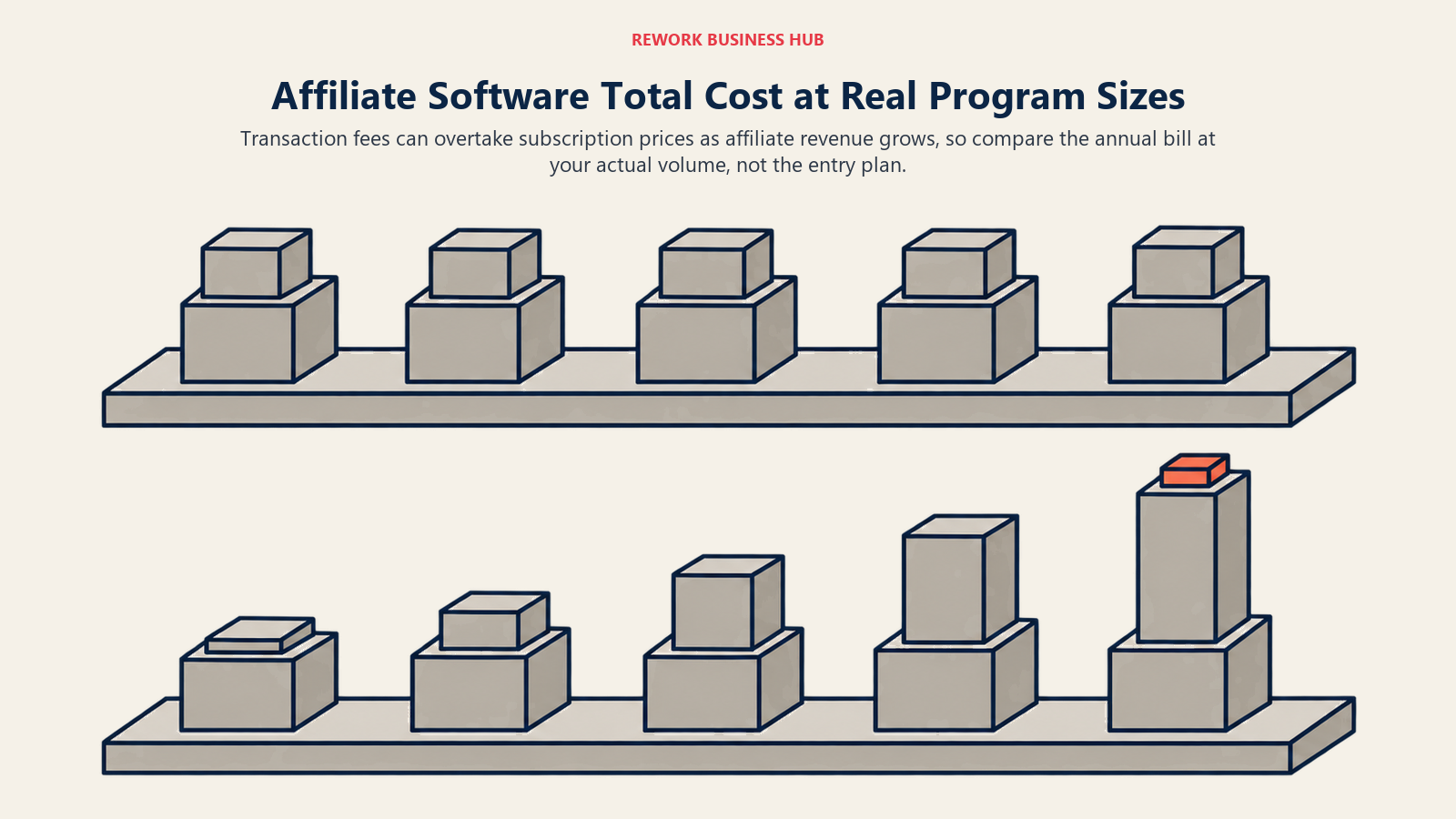
The subscription price rarely predicts the real bill here, the fee on top usually does. Below, five platforms modeled at two revenue levels, assuming the stated percentage applies to all affiliate-driven revenue passing through the platform. ReferralCandy is the exception worth naming: its success fee applies only to a net-new customer first three orders, so its two figures below are an upper bound rather than a like-for-like rate. Treat this as a planning estimate, not a quote, since real bills vary with chargebacks and negotiated rates.
| Tool | At $10K/mo revenue ($120K/yr) | At $100K/mo revenue ($1.2M/yr) |
|---|---|---|
| impact.com | Starter: $360/yr sub + $3,000 (2.5%) = $3,360 | Essentials: $6,000/yr sub + $30,000 (2.5%) = $36,000 |
| Awin | Access: $588/yr sub + $4,200 (3.5%) = $4,788 | Accelerate: $1,188/yr sub + $30,000 (2.5%) = $31,188 |
| Refersion | Launch (annual): $348/yr sub + $3,600 (3%) = $3,948 | Growth (annual): $1,908/yr sub + $24,000 (2%) = $25,908 |
| ReferralCandy | Grow: $948/yr sub + $4,200 (3.5%) = $5,148 | Enterprise: $9,588/yr sub + $3,000 (0.25%) = $12,588 |
| UpPromote | Growth (annual): $300/yr sub + $2,400 (2%) = $2,700 | Enterprise (annual): $2,000/yr sub + $12,000 (1%) = $14,000 |
For example, impact.com's Starter math at $10K/mo is $30/month times 12 for the subscription ($360), plus 2.5% of $120,000 in affiliate-driven revenue ($3,000), for a modeled total of $3,360 a year.
The pattern worth noticing: ReferralCandy looks most expensive at low volume (Basic's 10.5% fee, not shown above) and cheapest at high volume (Enterprise's 0.25%), because the fee percentage drops faster than the subscription rises. The cheapest-looking entry tier and the cheapest tier at your real volume are often different plans, the same lead-to-revenue attribution discipline worth applying to a software bill.
Frequently Asked Questions about Affiliate Marketing Software
What's the difference between an affiliate network and affiliate tracking software?
A network like Awin, CJ Affiliate or Rakuten Advertising rents you access to a roster of publishers it already recruited, charging a base fee plus a per-transaction cut. Self-serve software like Refersion or UpPromote gives you tracking, attribution and payout tools, but you recruit your own affiliates.
How much does affiliate marketing software cost in 2026, including fees?
Self-serve tools range from free (UpPromote's entry tier) to a few hundred dollars a month (Trackdesk's Business starts at $299/month), most adding a fee on top: 0.25% to 10.5% at ReferralCandy depending on plan, 2.5% to 3.5% per transaction at Awin, around 2.5% at impact.com. PartnerStack publishes no price at all. Tapfiliate, Rewardful, FirstPromoter and LeadDyno charge no percentage fee.
Is ShareASale still available in 2026?
No. Its advertisers and publishers moved onto Awin on August 15, 2025, and the platform itself closed on October 6, 2025, with account access and historical reporting ending that day. A comparison still listing ShareASale as active is out of date.
Does impact.com still require a sales call to see pricing?
Not anymore. It publishes self-serve pricing: Starter from $30/month, Essentials from $500/month, Pro from $2,500/month, all plus a 2.5% fee on partner-driven sales. Only Enterprise remains quote-only, a real change from its older "quote-only enterprise" reputation.
Is Trackdesk's free plan still available?
No, not for new users. Trackdesk's help center confirms the free plan "has been discontinued and is no longer available for new users." Old free-plan users are grandfathered; new evaluators get only a 14-day trial before paying $299/month or more.
Which affiliate software has no revenue-share fee?
Tapfiliate, Rewardful, FirstPromoter and LeadDyno run flat subscription pricing with no fee. Post Affiliate Pro, Referral Factory and Trackdesk also publish none. Reditus takes no cut of sales either, but charges 5% by card or 2% by invoice on automated affiliate payouts. Everything else here, including impact.com, Awin, Refersion, UpPromote and ReferralCandy, adds a fee on top of the subscription.
How do I decide between an enterprise platform like impact.com and a self-serve tool like Refersion?
It comes down to who runs the program day to day. A dedicated partnerships team managing hundreds of relationships needs impact.com or PartnerStack's automation and fraud tooling. One marketer running a program alongside other work is usually better served, and better priced, by Refersion, UpPromote or Rewardful.
What to Do Next
Pick the segment first, not the tool. Without a dedicated partnerships hire yet, start with a self-serve platform, UpPromote's free tier or Refersion's Launch plan are the lowest-risk ways to prove the channel works before a bigger commitment. Comparing impact.com against PartnerStack specifically, impact.com vs PartnerStack walks through that decision directly. Before signing anything, get the full annual cost in writing, subscription plus fee at your real volume, not just the headline price, and confirm it against the vendor's own page the way this guide did.

Principal Product Marketing Strategist
On this page
- Key Facts
- The Three Segments You Are Actually Choosing Between
- Quick Comparison Table
- 1. impact.com
- 2. PartnerStack
- 3. Awin
- 4. Everflow
- 5. Refersion
- 6. Tapfiliate
- 7. Post Affiliate Pro
- 8. UpPromote
- 9. Rewardful
- 10. FirstPromoter
- 11. LeadDyno
- 12. ReferralCandy
- 13. Trackdesk
- 14. Referral Factory
- 15. Reditus
- 16. CJ Affiliate
- Two More Names Worth Knowing
- What Changed in This Category Since 2024
- How to Choose: Decision Framework
- Total Cost at Real Program Sizes
- What to Do Next