ReferralCandy vs Referral Factory: Success Fee or Flat-Rate Pricing in 2026?
Turn this article into takeaways for your work.


Each assistant summarizes the article only for you and suggests best practices for your work.
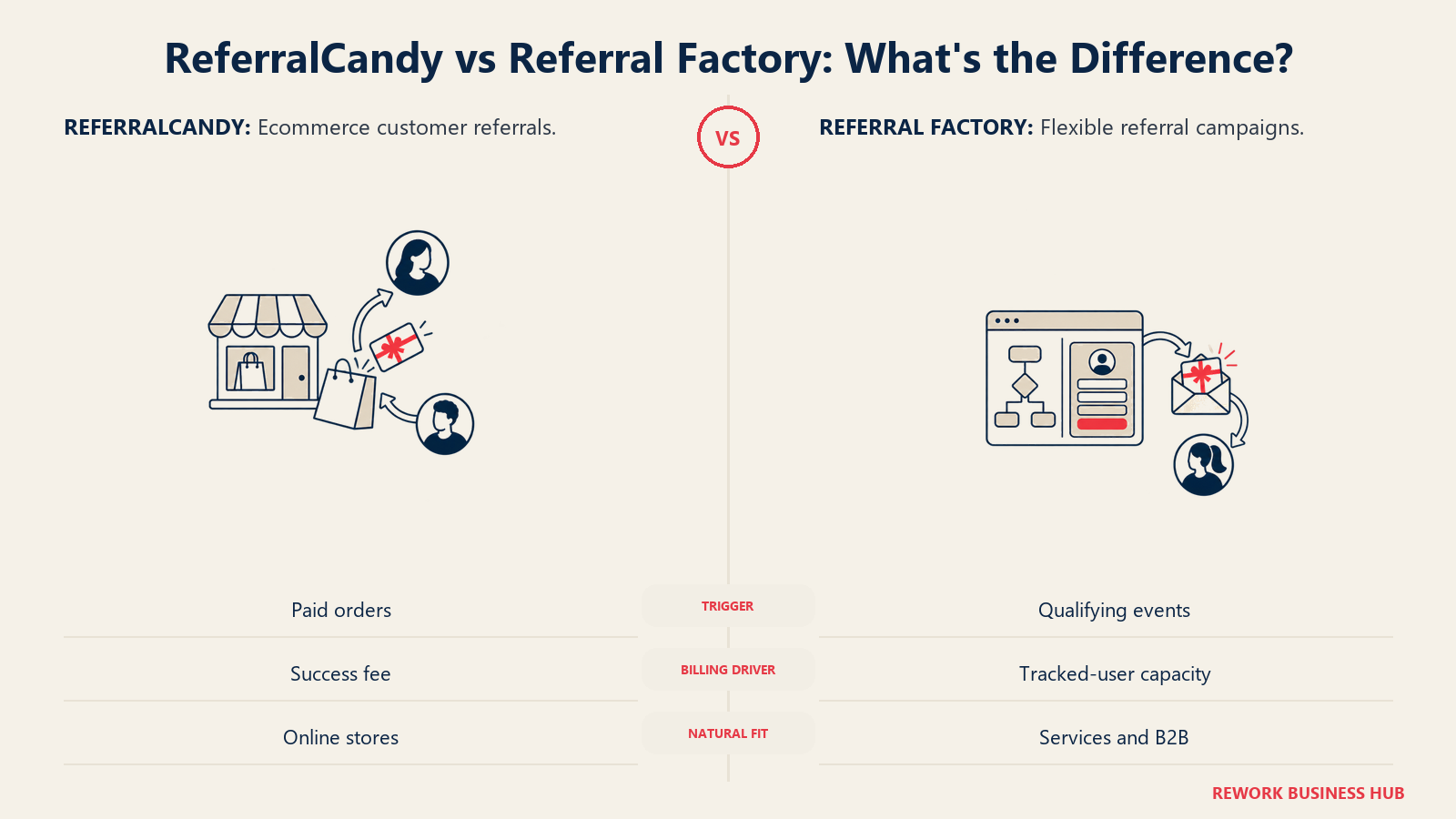
If you're a DTC or ecommerce marketer building a customer-referral program, or a growth lead at a B2B, finance or services company trying to turn happy customers into a lead source, ReferralCandy and Referral Factory keep landing on the same shortlist. That's a little misleading. ReferralCandy is a Shopify-rooted refer-a-friend app built for online stores. Referral Factory is a no-code campaign builder used by banks, accounting firms, solar installers, schools and SaaS companies about as often as by ecommerce brands. They compete for the same search traffic more than they compete for the same buyer.
Where they genuinely compete is on how they charge you. ReferralCandy prices four tiers from $39 to $799 a month, and every tier carries a success fee on top, from 10.5% down to 0.25%, month to month with no annual option published anywhere on its pricing page. Referral Factory prices three tiers from $200 to $1,000-plus a month, discounted about 20% on an annual plan, and charges no transaction fee at all, metering instead on how many users the platform tracks. One tool is cheap to start and takes a cut as your program works. The other costs five times more on day one and then stays flat no matter how well it performs. That's the whole decision, and this guide builds the actual crossover math so you can find your own number in it instead of guessing. For the wider field beyond these two, see our roundup of the best affiliate marketing software in 2026, and if ReferralCandy specifically is the tool you're trying to replace, our ReferralCandy alternatives guide covers a wider set of 12 options.
TL;DR
| ReferralCandy | Referral Factory | |
|---|---|---|
| What it is | Shopify-rooted customer-referral app for DTC and ecommerce brands | No-code campaign builder for referral programs across ecommerce, B2B, finance, education and services |
| Pricing model | 4 tiers, $39 to $799/mo, plus a success fee from 10.5% down to 0.25% | 3 tiers, $200 to $1,000+/mo, about 20% off billed annually, no transaction fee |
| What the fee is levied on | Only the first three orders per newly referred customer, not all referred revenue | Not applicable, no fee. Priced by tracked user capacity instead (20,000 to 100,000+) |
| Annual pricing | Not published, month to month only | Yes, roughly 20% off, for example Basic drops from $200/mo to $160/mo billed annually |
| Free trial | 7 days, no success fee charged on trial sales | 15 days, not offered on Enterprise |
| Best for | DTC and ecommerce brands wanting a fast, self-serve refer-a-friend program | B2B, finance, education and services teams wanting one platform for varied campaign types |
| Main limitation | The fee is capped per customer, but it still scales with success | The flat rate applies even if referral volume stays low, expensive to start |
Key Facts
- Referred customers are about 25% more profitable annually and 18% less likely to churn than non-referred customers, per a Journal of Marketing study of nearly 10,000 bank customers by Christophe Van den Bulte (Wharton), Bernd Skiera (Goethe University Frankfurt) and Philipp Schmitt. (Journal of Marketing, Vol. 75, 2011, via Wharton)
- 92% of consumers say they trust recommendations from people they know above every other form of advertising, per Nielsen's global trust study. (Nielsen)
- US advertisers will spend $13.81 billion on affiliate marketing in 2026, up 11.3% from $12.42 billion in 2025. (eMarketer)
- Purchases driven through affiliate and partner channels carry 21% higher average order values than purchases from other channels, per a 2024 Awin and Forrester analysis. (Awin)
- Well-run referral programs can drive up to 25% of a company's new customers, according to Extole. (Extole)
- Partner-sourced revenue sits at a median of 24% of new bookings across B2B SaaS companies, based on a 2026 panel of more than 2,100 vendors drawn from Crossbeam's ELG report. (Digital Applied)
Who Each Platform Is Built For
| Dimension | ReferralCandy | Referral Factory |
|---|---|---|
| Core business type | Shopify, BigCommerce, WooCommerce and Magento ecommerce stores | Education, banking and finance, accounting and consulting, solar and home services, wellness, and SaaS, alongside ecommerce |
| Program type | Customer refer-a-friend, one motion | Referral, lead-gen and campaign-builder templates, run through hosted pages, links, QR codes, widgets and popups |
| Team size to start | One marketer, self-serve signup, no demo required | One marketer or a small growth team, self-serve on Basic and Pro |
| Who signs the contract | The ecommerce marketer or founder running the storefront | A growth, marketing or partnerships lead, since campaigns often run outside a single storefront |
| Typical customer examples | Shopify-native DTC and ecommerce brands | Banks and lenders (EasyBank, BAWAG), PR software (Meltwater), home services (Checkatrade), education (Masterschool) |
ReferralCandy's roots are in ecommerce, and its feature set assumes a checkout exists to apply a discount or store credit against. Referral Factory's customer list reads like a B2B and services roster as much as an ecommerce one, which tracks with its "qualifying event" model working for signups, form fills and account openings, not just purchases. If your referral program is really a B2B SaaS partner motion with resellers and co-sell deals attached, rather than a customer-to-customer referral loop, our PartnerStack alternatives roundup covers platforms built specifically for that motion.
Feature Parity at a Glance
| Capability | ReferralCandy | Referral Factory |
|---|---|---|
| Hosted referral page | Yes, generated automatically per program | Yes, built through a no-code page builder with templates |
| Referral links, codes, QR codes | Referral links and codes | Referral links, codes, QR codes, plus referrer portals |
| Popups, sticky bars, website widgets | Not published as a named feature | Yes, popups, sticky bars and embeddable widgets |
| Double-sided rewards | Yes, customizable for each side | Yes, customizable for each side |
| Reward types | Percentage discount, flat dollar, store credit, cash or gift card | Cash, gift cards, account credit, coupons, discounts, custom rewards |
| Delayed and manually approved rewards | Not published as a named feature | Yes, delayed rewards and manual approval steps |
| CRM-native campaigns | Not a core feature, ReferralCandy is ecommerce-native | Yes, native HubSpot, Salesforce and Pipedrive connections |
| Multi-campaign management | Supported, unlimited campaigns on every tier | Supported, unlimited campaigns on every tier |
| API access | Included on every tier | Included, plus webhooks, Zapier, Make and n8n |
Referral Mechanics and Reward Types
| Mechanic | ReferralCandy | Referral Factory |
|---|---|---|
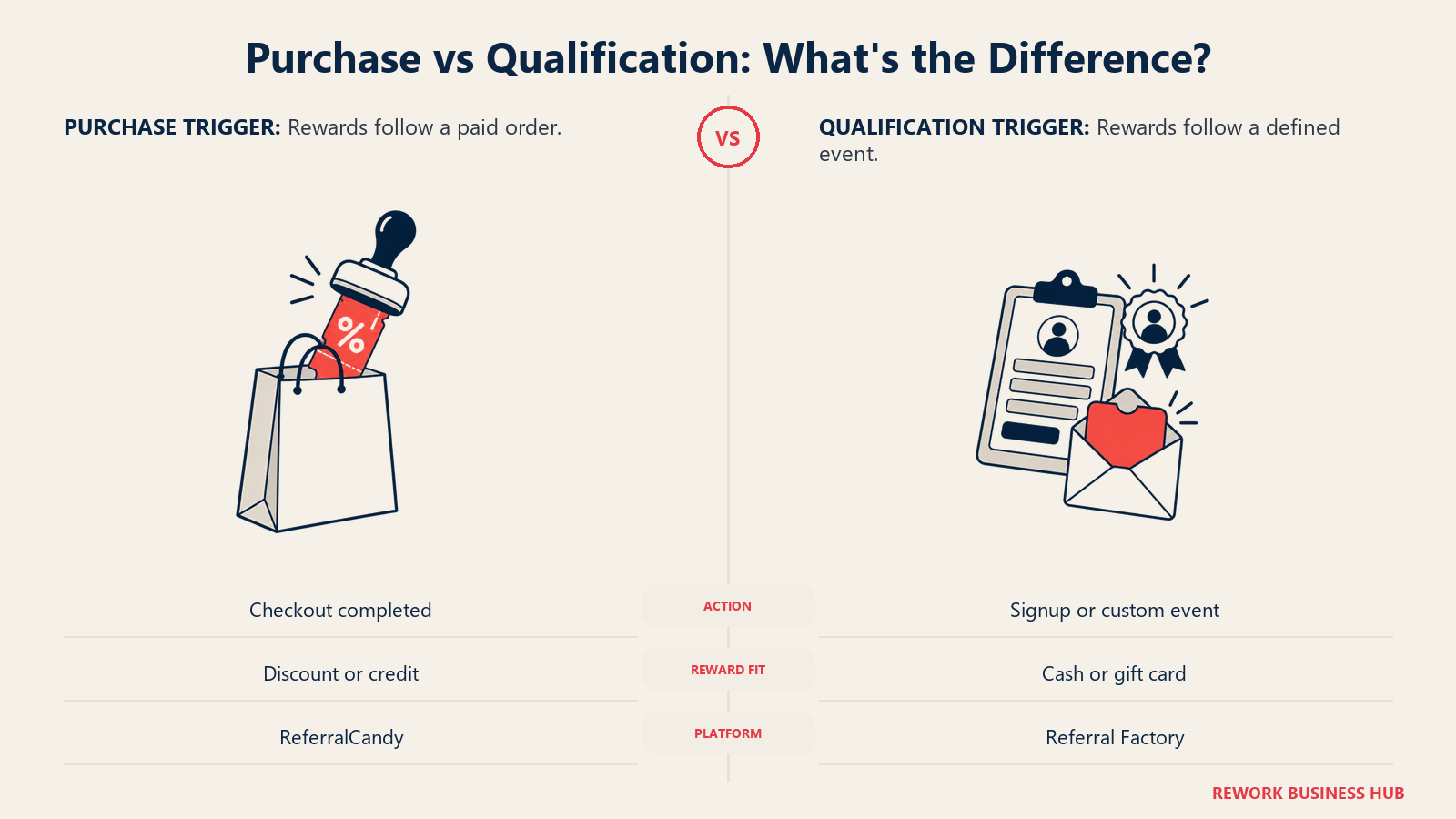
| Reward trigger | A referred friend's completed, paid order | Defined per campaign, can trigger on a form fill, signup, account opening or a custom qualifying event |
| Tiered rewards | Yes, rewards that climb with referral volume | Yes, configurable reward tiers per campaign |
| Reward payout | Automated store credit, discount code, cash or gift card issuance | Automated issuing through PayPal, Tremendous or Stripe, or manual approval before payout |
| Referral tracking method | A unique referral link tied to the referring customer's account | Referral links, codes and QR codes, tracked through the hosted page or embedded widget |
| Best fit for reward style | Ecommerce checkout rewards, discount and store-credit heavy | Cash and gift-card heavy rewards, useful where there's no checkout to apply a discount against |
The gap here comes down to what event the platform assumes happens. ReferralCandy's mechanics assume a checkout, which is exactly right for a store and exactly wrong for a bank opening an account or a school enrolling a student. Referral Factory's flexible "qualifying event" model is why its customer list skews toward banking, education and consulting, none of which have a cart to discount.
Fraud and Self-Referral Controls
| Control | ReferralCandy | Referral Factory |
|---|---|---|
| Stated mechanism | "Real-time analytics and fraud detection," per the vendor's feature page, exact detection logic not published | "Fraud checks and reward approvals," plus configurable qualification rules per campaign |
| Manual review option | Not published as a distinct workflow step | Yes, manual approval steps before a reward pays out |
| Qualifying minimums | Configurable per program, such as a minimum order value | Configurable per campaign, such as a minimum spend or a verified signup |
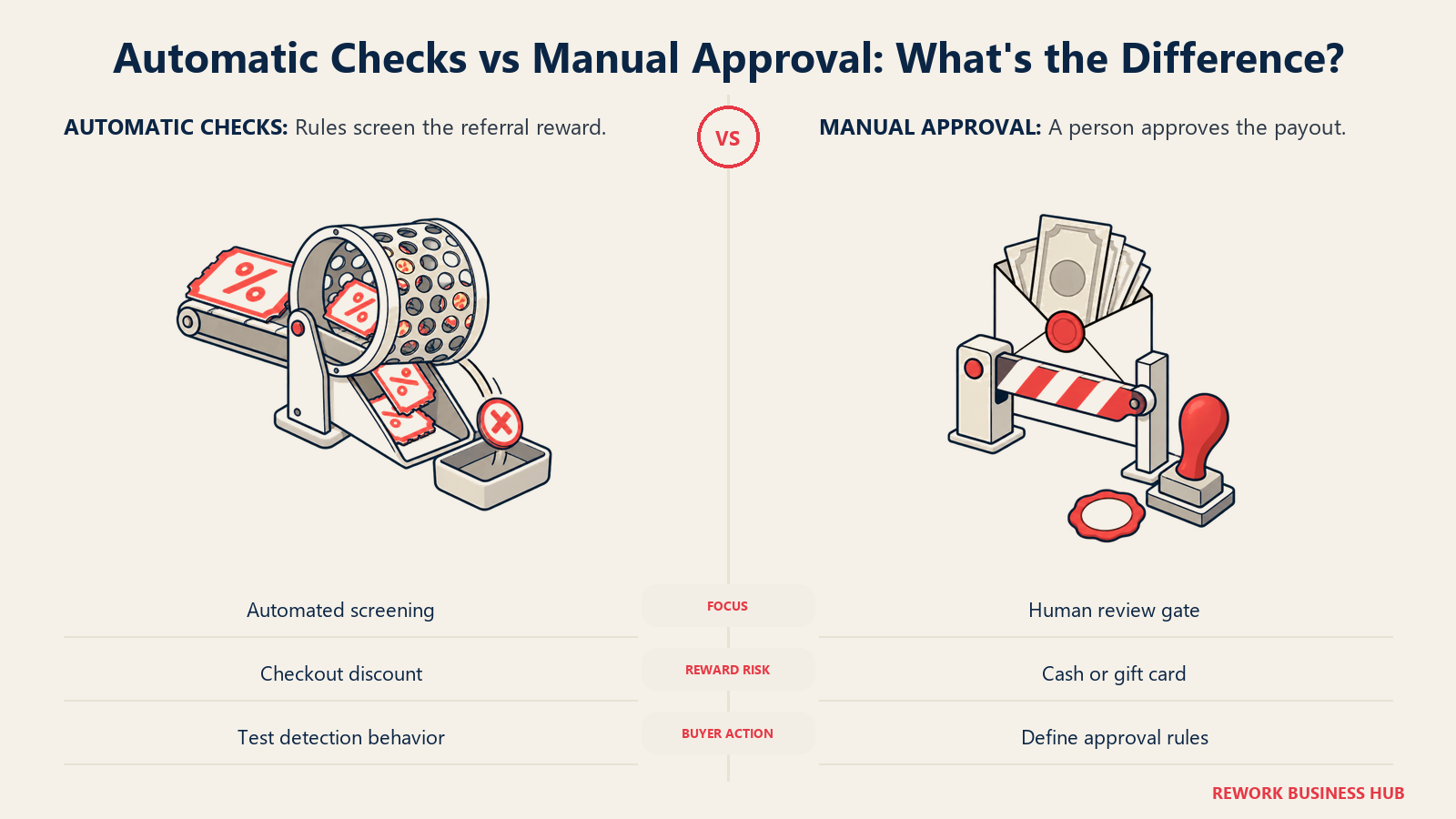
| Best fit | A store that wants fraud handled automatically inside checkout tracking | A team that wants a human approval gate before cash or gift-card money moves |
Neither vendor publishes the technical detail behind its fraud detection, so treat both as a starting point rather than a guarantee. The practical difference is stakes: a false negative on ReferralCandy costs a discount code or store credit, while a false negative on Referral Factory's cash and gift-card rewards is real money out the door, which is likely why manual approval is a named step there and isn't on ReferralCandy's published feature list.
Integrations
| Category | ReferralCandy | Referral Factory |
|---|---|---|
| Ecommerce platforms | One-click on Shopify, BigCommerce and WooCommerce, plugin or email-based install for Magento and headless setups | Not ecommerce-platform-native, connects through hosted pages, widgets and API instead |
| Email and marketing | Klaviyo, plus subscription apps Recharge, Skio and Loop, and retargeting through AdRoll | Not published as named integrations, connects through Zapier and Make for email tools |
| CRM | Not a core integration category | HubSpot, Salesforce, Intercom, Zoho, Pipedrive, Monday and ServiceTitan |
| Payments and payouts | Native to the ecommerce platform's checkout | Stripe, PayPal, Tremendous |
| Automation and workflows | Every ReferralCandy event can pipe into connected tools | Zapier, Make, n8n, plus webhooks and a documented API |
If your integrations list needs to include a CRM rather than a storefront, Referral Factory's HubSpot, Salesforce and Pipedrive connections do something ReferralCandy was never built to do. If it's the reverse and you actually need affiliate-style commission tracking bolted onto an ecommerce store, neither tool in this guide is the right fit; our Refersion alternatives and Tapfiliate alternatives roundups cover tools built specifically for paying independent affiliates a commission, and our head-to-head on Refersion vs Tapfiliate narrows that choice further.
What ReferralCandy Actually Charges
| Plan | Monthly price | Success fee | What changes between tiers |
|---|---|---|---|
| Basic | $39/mo | 10.5% | Same feature set as every other tier, only the fee percentage changes |
| Grow | $79/mo | 3.5% | Same feature set, lower fee |
| Scale | $249/mo | 1.5% | Same feature set, lower fee |
| Enterprise | $799/mo | 0.25% | Same feature set, lowest fee |
No annual pricing is published for any tier, so every figure above is a month-to-month number. A 7-day free trial applies, with no success fee charged on sales made during it.
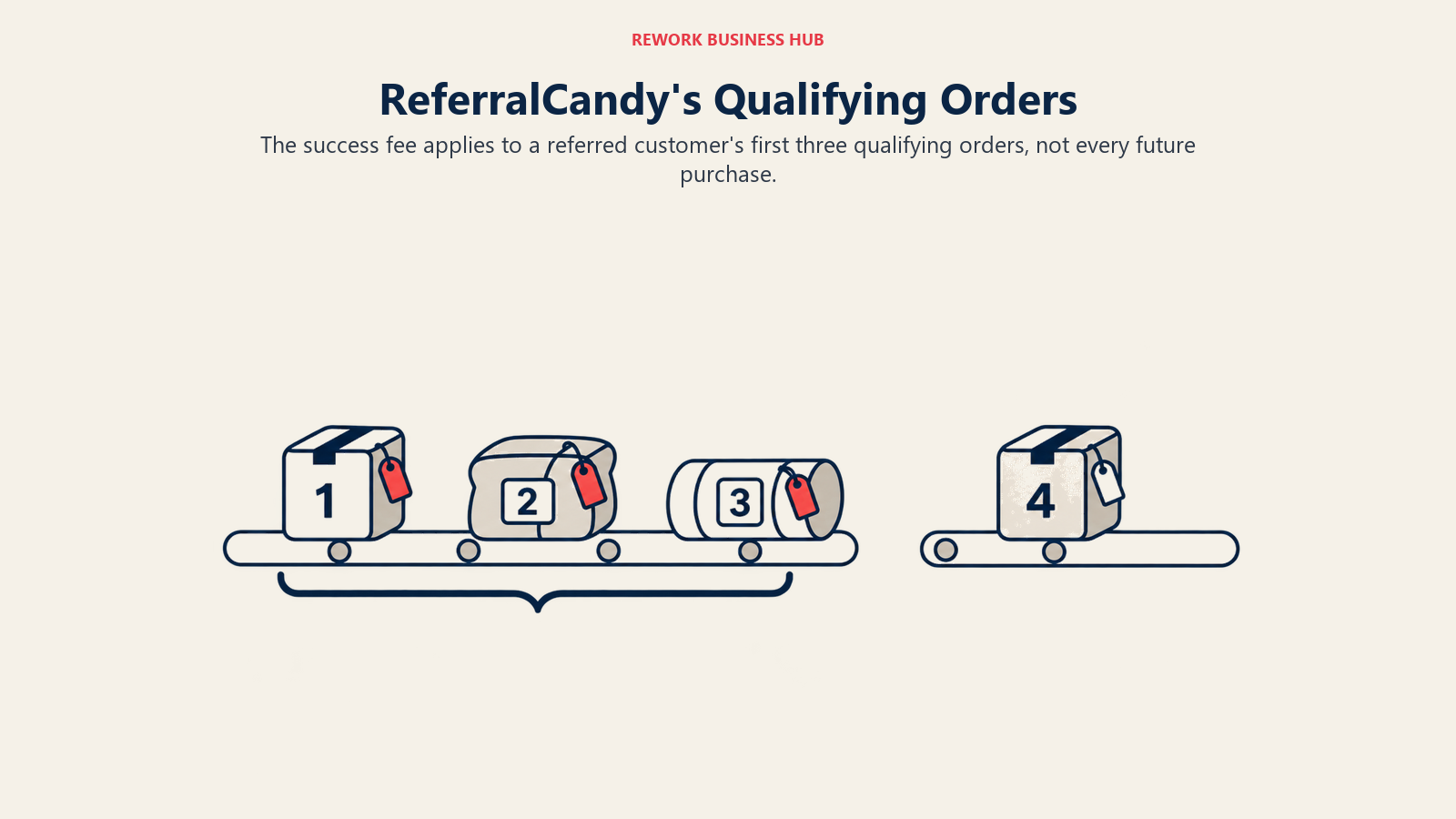
The detail that changes the whole comparison: the fee applies only to a referred customer's first three qualifying orders, not to everything that customer ever buys. Once someone converts through a referral and completes their third paid order, ReferralCandy stops taking a cut of anything else they spend, for as long as they stay a customer. A program with a strong repeat-purchase rate pays the fee on a shrinking slice of its total referred revenue as its referred customers mature past order three. A brand-new program, where most referred customers are still on order one or two, pays it on a much larger share of what it's actually generating.
What Referral Factory Actually Charges
| Plan | Monthly price | Billed annually | Tracked user capacity |
|---|---|---|---|
| Basic | $200/mo | $160/mo ($1,920/yr) | 20,000 users |
| Pro | $400/mo | $320/mo ($3,840/yr) | 40,000 users |
| Enterprise | From $1,000/mo | From $800/mo ($9,600/yr) | 100,000+ users |
Extra capacity is sold in blocks of 100,000 users for $100/mo, stacked on top of whichever base tier you're already on. There's no transaction fee, no success fee and no percentage of referred revenue anywhere in Referral Factory's pricing. A 15-day free trial is available on Basic and Pro but not on Enterprise, and a 50% startup discount exists on qualifying subscriptions, worth asking about directly if you're an early-stage company.
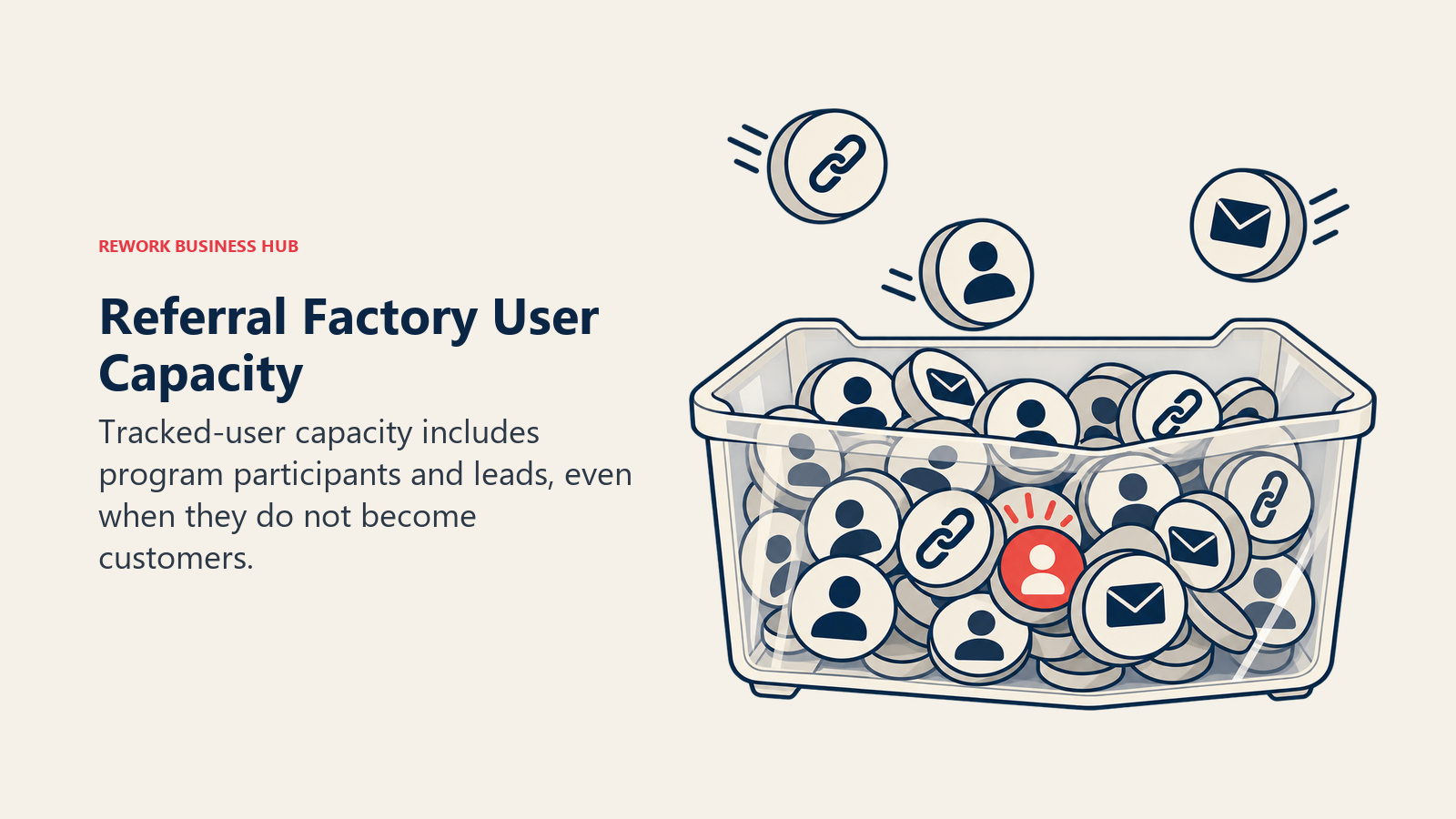
"Tracked users" is the number of people the platform tracks through a referral campaign during a billing period, and that's typically a much bigger number than your referred-customer count alone. Referrers who join the program, people who click a referral link without buying, and leads captured through a hosted page or form all count toward the cap, even when most of them never convert into a paying referred customer.
The Crossover: What Each Platform Costs at Real Referral Volume
To compare the two honestly you need two separate numbers. ReferralCandy's bill is driven by how many new referred customers convert each month and their average order value. Referral Factory's bill is driven by total tracked users, a figure that's usually several times larger than your converting customer count, since it counts everyone who touches the program, not just who buys.
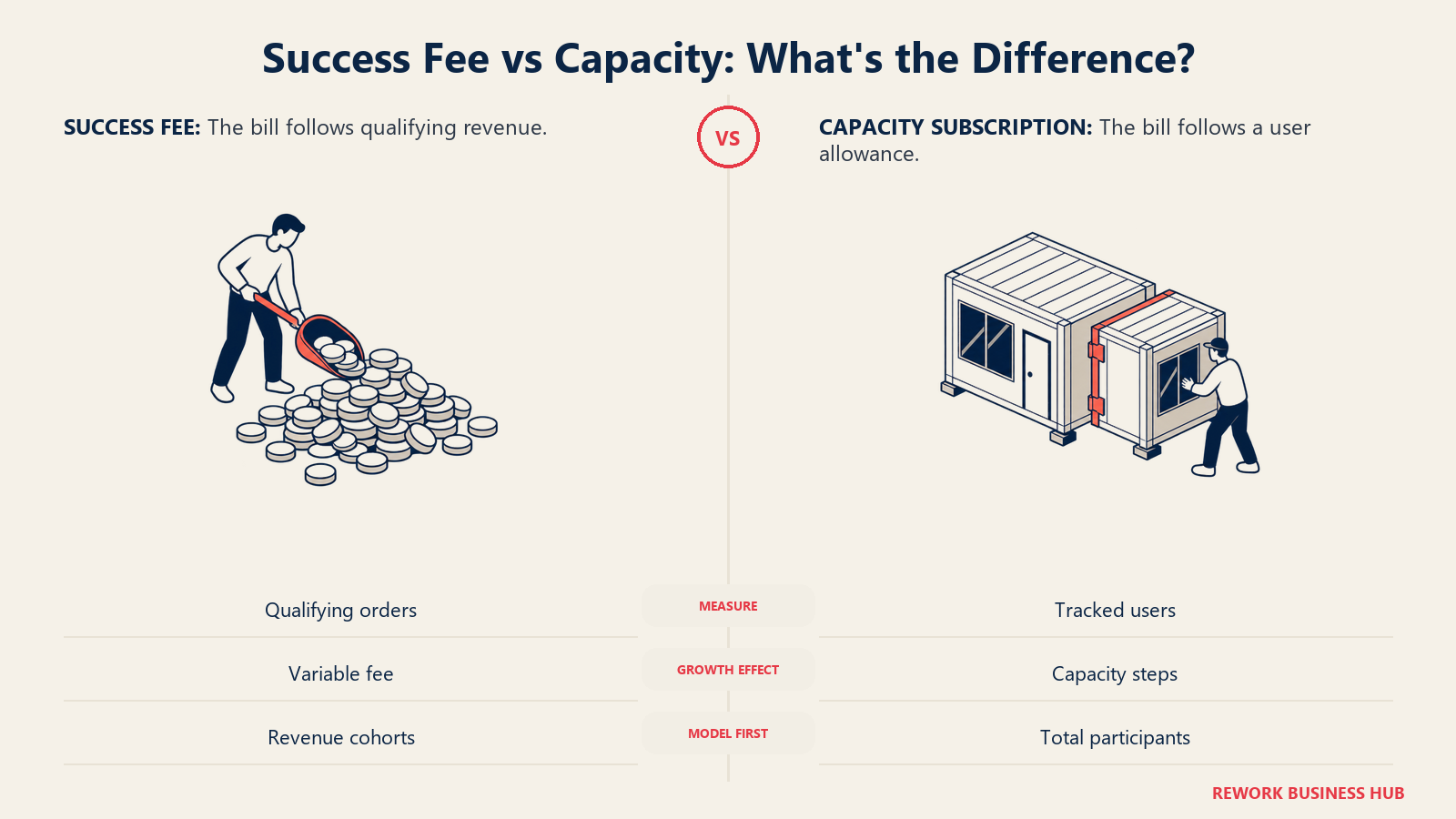
There's a modeling trick worth walking through before the table, because it's the part most price comparisons skip. ReferralCandy's fee applies to a referred customer's first three orders, and those three orders don't all land in the same month. A program running steady for a few months has three overlapping cohorts every month: this month's first-time referred buyers, last month's cohort placing their second qualifying order, and the cohort before that placing their third and final one. If referral volume holds roughly steady month over month, that means monthly qualifying revenue, the number the fee is actually levied on, runs at roughly three times (net-new referred customers that month multiplied by average order value), not the full ongoing revenue a mature referred-customer base keeps generating from order four onward.
The tracked-user figures below assume roughly 300 total tracked interactions, referrer signups, link clicks and leads, for every net-new referred customer who actually converts. That ratio will vary by industry and traffic source, so treat it as a way to structure the comparison and swap in your own funnel's numbers rather than a vendor-confirmed figure.
| Program size | Net-new referred customers/mo | Average order value | Qualifying revenue (RC fee base) | Cheapest ReferralCandy plan and bill | Tracked users/mo (est.) | Cheapest Referral Factory option and bill |
|---|---|---|---|---|---|---|
| Small, just launched | 15 | $40 | $1,800 | Grow: $79 + $63 = $142/mo | ~4,500 | Basic: $200/mo ($160/mo annual) |
| Growing | 60 | $60 | $10,800 | Scale: $249 + $162 = $411/mo | ~18,000 | Basic: $200/mo ($160/mo annual), near the 20,000-user cap |
| Established | 150 | $90 | $40,500 | Scale: $249 + $608 = $857/mo | ~45,000 | Pro + 1 capacity block (140,000 cap): $500/mo (~$420/mo annual) |
| Large, mature program | 400 | $120 | $144,000 | Enterprise: $799 + $360 = $1,159/mo | ~120,000 | Pro + 1 capacity block (140,000 cap): $500/mo (~$420/mo annual), or Enterprise from $1,000/mo |
Three crossover points sit inside ReferralCandy's own tier ladder, and they hold regardless of which tool you're comparing it to. Basic stops being the cheapest ReferralCandy plan once qualifying revenue passes roughly $571/mo, where Basic's 10.5% and Grow's $79 + 3.5% cost the same. Grow stops being cheapest above roughly $8,500/mo, where Scale's lower fee overtakes it. Scale stops being cheapest above roughly $44,000/mo, where Enterprise's near-flat 0.25% wins out. None of that math changes based on what you're comparing ReferralCandy against.
The more interesting crossover shows up in the last row. At real scale, a mature program pushing $144,000/mo in qualifying revenue lands on ReferralCandy Enterprise at $1,159/mo, which is more than double Referral Factory's $500/mo Pro-plus-capacity option covering the same rough tracked-user volume. That's the moment a flat rate stops looking expensive and starts looking cheap: ReferralCandy's fee never stops scaling with success, even at its lowest tier, while Referral Factory's cost only moves in discrete steps tied to capacity, not revenue. If your program is heading toward that kind of volume, run this math again against your own numbers well before you're locked into a renewal.
One more thing worth flagging on the Referral Factory side: if capacity is the only reason you're considering Enterprise, price out Pro plus an extra capacity block before assuming Enterprise is required. Pro at $400/mo plus one $100/mo block covers 140,000 tracked users for $500/mo total, less than half Enterprise's $1,000/mo starting price for a similar capacity range. The trade-off is whatever else Enterprise bundles beyond raw capacity, support level, onboarding, or feature access that Referral Factory's pricing page doesn't itemize, so it's worth asking directly rather than assuming the bigger tier is the only path.
Why the "10.5% of Everything" Number Is Wrong
Most quick comparisons of ReferralCandy's cost make the same mistake: they take the fee percentage and apply it to a program's total referred revenue, including every order a referred customer ever places, not just their first three. That overstates the bill for any program with a decent repeat-purchase rate, sometimes by a lot.
Take the Established scenario from the table above: $40,500/mo in qualifying revenue (the first three orders of newly referred customers), but suppose the same program's referred customers, once past their third order, keep buying, adding another $79,500/mo in revenue from orders four and beyond. Total referred revenue that month is $120,000. Here's what that looks like calculated the wrong way versus the right way, both on ReferralCandy's Basic plan:
| Calculation method | What it counts | Basic-tier bill in this example |
|---|---|---|
| Naive (wrong) | 10.5% of all referred revenue ever generated, including repeat orders past the third | $39 + 10.5% x $120,000 = $12,639/mo |
| Correct, per ReferralCandy's own published terms | 10.5% of qualifying revenue only, the first three orders of newly referred customers | $39 + 10.5% x $40,500 = $4,291.50/mo |
The naive method overstates this program's real bill by nearly three times. That gap only grows as a brand's referred customers stick around and keep buying, which is exactly the outcome a referral program is supposed to produce. A generic listicle that quotes "10.5%" next to a revenue figure without asking which revenue is quoting a number that doesn't map to what ReferralCandy will actually invoice.
Implementation and Time to Value
| Factor | ReferralCandy | Referral Factory |
|---|---|---|
| Fastest realistic go-live | Under a day for most Shopify merchants, per the vendor's own onboarding claim of installing, setting reward rules and publishing a signup page in under an afternoon | Days to a couple of weeks, depending on whether the program uses only the no-code builder and templates or needs custom CRM and API work |
| Who does the setup | The marketer or founder directly, no developer needed for the standard Shopify, BigCommerce or WooCommerce install | A marketer for the no-code path, a developer for custom API, webhook or CRM-triggered qualifying events |
| Migration complexity | Low, since most merchants install fresh rather than migrate from another referral app | Depends on how many CRM and payout integrations the program needs before launch |
| Ongoing maintenance | Minimal, since every tier ships the same feature set, upgrading is a pricing decision, not a re-implementation | Minimal for template-based campaigns, higher if the program relies on custom qualifying-event logic |
Support
Neither vendor's public pricing or feature pages itemize support response times or SLAs by tier. ReferralCandy's feature page doesn't break out support separately from its core product. Referral Factory markets "guided onboarding" as part of the no-code builder experience, without a separate published support tier. If support responsiveness is a deciding factor for your program, confirm it directly with either vendor before committing budget, since neither pricing page differentiates on it.
When ReferralCandy Is the Right Call
- The store runs on Shopify, BigCommerce, WooCommerce or Magento, and a same-day install with reward rules published within an afternoon matters more than a flat monthly rate.
- The program is still small, under roughly $571/mo in qualifying referred revenue, where Basic's low subscription and manageable fee genuinely beat every tier of Referral Factory.
- Rewards fit naturally into a checkout, discount codes, store credit or a percentage off the next order, rather than cash or gift cards that need a separate payout rail.
- You'd rather start cheap and let the fee scale with success than commit $200/mo or more before the program has proven it can convert.
When Referral Factory Is the Right Call
- There's no ecommerce checkout to apply a discount to, banking, education, home services, wellness and B2B SaaS all fit this model better than ReferralCandy's cart-based rewards.
- The program already has a predictable, growing user base, where a flat monthly rate is easier to budget against than a percentage fee that rises with success.
- Native CRM integrations matter, HubSpot, Salesforce, Pipedrive or ServiceTitan connections that ReferralCandy simply doesn't offer.
- The team is running more than one campaign type, referral, lead-gen forms and popups, from a single no-code platform rather than one refer-a-friend flow.
When Neither Tool Fits
- If you actually need affiliate commission tracking for independent publishers rather than a customer-referral program, neither tool is built for that. Rewardful, FirstPromoter and LeadDyno are priced and built specifically for flat-fee affiliate commission tracking.
- If your program has scaled past what either tool's ceiling comfortably handles, the budget conversation shifts toward full partnership platforms with dedicated fraud scoring, SAML and cross-device tracking, the kind compared in impact.com vs PartnerStack and our impact.com alternatives roundup.
- If you're a solo founder testing a first referral idea with no budget for either platform's entry tier, a free-tier tool sized for one person is a better starting point than either name in this guide.
Decision Framework
| If you are... | Pick |
|---|---|
| A Shopify or WooCommerce store launching a first referral program on a tight budget | ReferralCandy Basic |
| A growing DTC brand with real repeat-purchase revenue among referred customers | ReferralCandy Grow or Scale, since the fee shrinks faster than revenue grows once repeat orders pass the three-order cap |
| A bank, school, consultancy or home-services business with no ecommerce checkout | Referral Factory |
| Running referral, lead-gen and CRM-triggered campaigns from one platform | Referral Factory |
| At high enough volume that ReferralCandy's percentage fee has grown past what a flat rate would cost | Compare ReferralCandy Enterprise against Referral Factory Pro plus capacity blocks before your next renewal |
| Actually shopping for affiliate commission software, not customer referral software | Neither. See Rewardful vs FirstPromoter vs LeadDyno instead |
The short version. ReferralCandy's advantage is a low door price and a fee that only ever applies to a referred customer's first three orders, not their whole relationship with you. Referral Factory's advantage is a rate that never moves once you've picked a capacity tier, and a platform built to handle qualifying events that have nothing to do with a shopping cart. Pick based on which trade you'd rather make: a fee that starts small and scales with your program's success, or a flat number that costs more on day one and stays exactly where it is no matter what happens next.
What to Do Next
Before you sign up for either, write down two numbers: your expected net-new referred customers per month with an average order value, and a rough estimate of total tracked users the program would generate including clicks and non-converting leads. Run both through the tables above. If ReferralCandy's bill at your real qualifying revenue lands meaningfully under Referral Factory's cheapest matching tier, start there and revisit the math again once the program has a few months of real data instead of an estimate.

Principal Product Marketing Strategist
On this page
- TL;DR
- Key Facts
- Who Each Platform Is Built For
- Feature Parity at a Glance
- Referral Mechanics and Reward Types
- Fraud and Self-Referral Controls
- Integrations
- What ReferralCandy Actually Charges
- What Referral Factory Actually Charges
- The Crossover: What Each Platform Costs at Real Referral Volume
- Why the "10.5% of Everything" Number Is Wrong
- Implementation and Time to Value
- Support
- When ReferralCandy Is the Right Call
- When Referral Factory Is the Right Call
- When Neither Tool Fits
- Decision Framework
- What to Do Next