Impact.com vs PartnerStack: Which Partnership Platform Fits Your Program in 2026?
Turn this article into takeaways for your work.


Each assistant summarizes the article only for you and suggests best practices for your work.
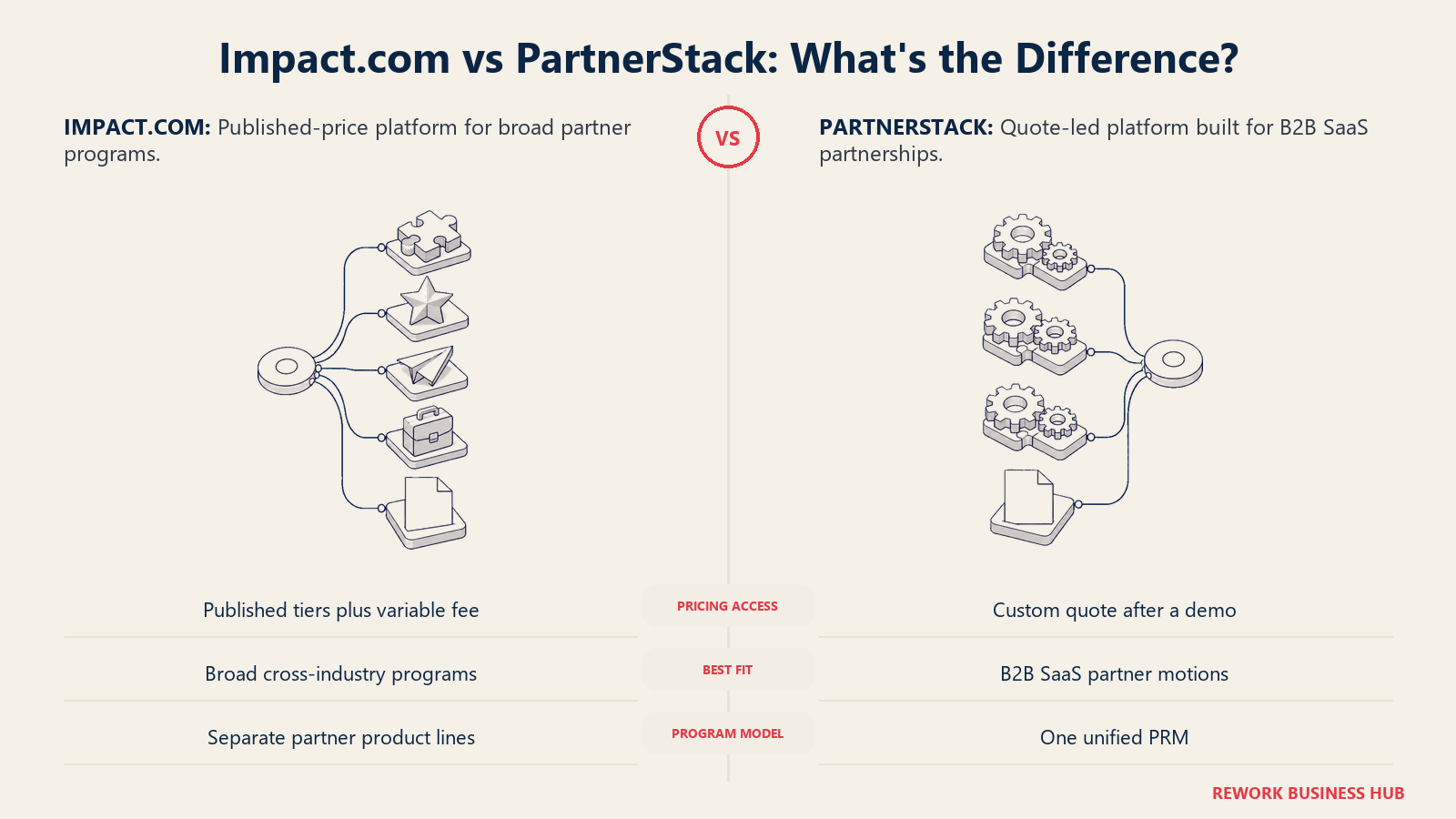
If you're a partnerships lead, growth lead or founder picking a platform to run an affiliate, referral or reseller program, these two names keep landing on the same shortlist. They answer different questions well, but before you compare a single feature, one structural fact should decide how you even run the evaluation.
impact.com now publishes exact prices for all four of its tiers: Starter from $30/mo, Essentials from $500/mo, Pro from $2,500/mo, and Enterprise by quote, plus a 2.5% transaction fee on partner-driven sales. PartnerStack publishes none of that. Its pricing page names three tiers, Launch, Growth and Enterprise, with no dollar figure attached to any of them, and states plainly that "pricing is based on your partner program size, feature needs, and level of support. Your final plan and pricing are confirmed during your demo." One of these two platforms you can price yourself in five minutes. The other you cannot, no matter how much research you do first. For a lean team, that isn't a footnote, it's the whole shape of the evaluation timeline. If you're weighing more than these two, our roundup of the best affiliate marketing software in 2026 covers the wider field.
TL;DR
| impact.com | PartnerStack | |
|---|---|---|
| What it is | Horizontal partnership management platform used across ecommerce, DTC, fintech and B2B programs | B2B SaaS-native partner platform for affiliate, referral and reseller programs |
| Partner types | Affiliate, influencer, referral, business development/reseller, agency and technology partners, run as named product lines | Affiliate, B2B influencer, referral and co-sell/reseller partners under one PRM |
| Marketplace | Partner Marketplace, stated at 90,000 partners, unlocks at Essentials | PartnerStack Marketplace, stated at 115,000+ active partners across 600+ B2B brands |
| Published pricing | Yes. Starter from $30/mo, Essentials from $500/mo, Pro from $2,500/mo, Enterprise by quote | No. Three tier names only, Launch, Growth, Enterprise, no dollar figures anywhere |
| Transaction fee | 2.5% on partner-driven transactions only, charged when a sale happens | Not published. Any fee structure surfaces during the demo |
| Self-serve entry point | Yes, on Starter. The call to action reads "Get started now" | No. Every tier routes through "Request a demo" |
| Best for | Ecommerce, DTC and fintech brands, plus B2B programs that also want affiliate or influencer reach | B2B SaaS companies running affiliate, referral and reseller partnerships in one program |
| Main limitation | Marketplace access needs Essentials at minimum, not the $30 Starter headline | Zero pricing transparency until a sales call, which is awkward for a team that needs a budget number first |
Key Facts
- UK affiliate and partner programs generated £20.7 billion in revenue in 2025, a reported average return of £15 for every £1 spent, per APMA's State of the Affiliate Nation 2026 report, cited on Awin's affiliate marketing statistics page.
- Purchases driven through affiliate and partner channels carry 21% higher average order values and a 21% higher repurchase rate than other channels, per a 2024 Awin and Forrester analysis cited on the same Awin statistics page.
- US ecommerce brands running affiliate and partner programs generated $113 billion in sales in 2024, according to the Performance Marketing Association's 2025 Industry Study, also cited on Awin's page.
- Partner-sourced revenue sits at a median of 24% of new bookings across horizontal B2B SaaS companies, based on a 2026 panel of more than 2,100 vendors drawn from Crossbeam's ELG report and Partnership Leaders, reported by Digital Applied.
- PartnerStack's own partner network processed $2.7 billion in all-time GMV in 2025, with transaction volume up 52% year over year and partner-sourced paid customer conversions up 112%, per PartnerStack's own February 2026 research report.
Who Each Platform Is Built For
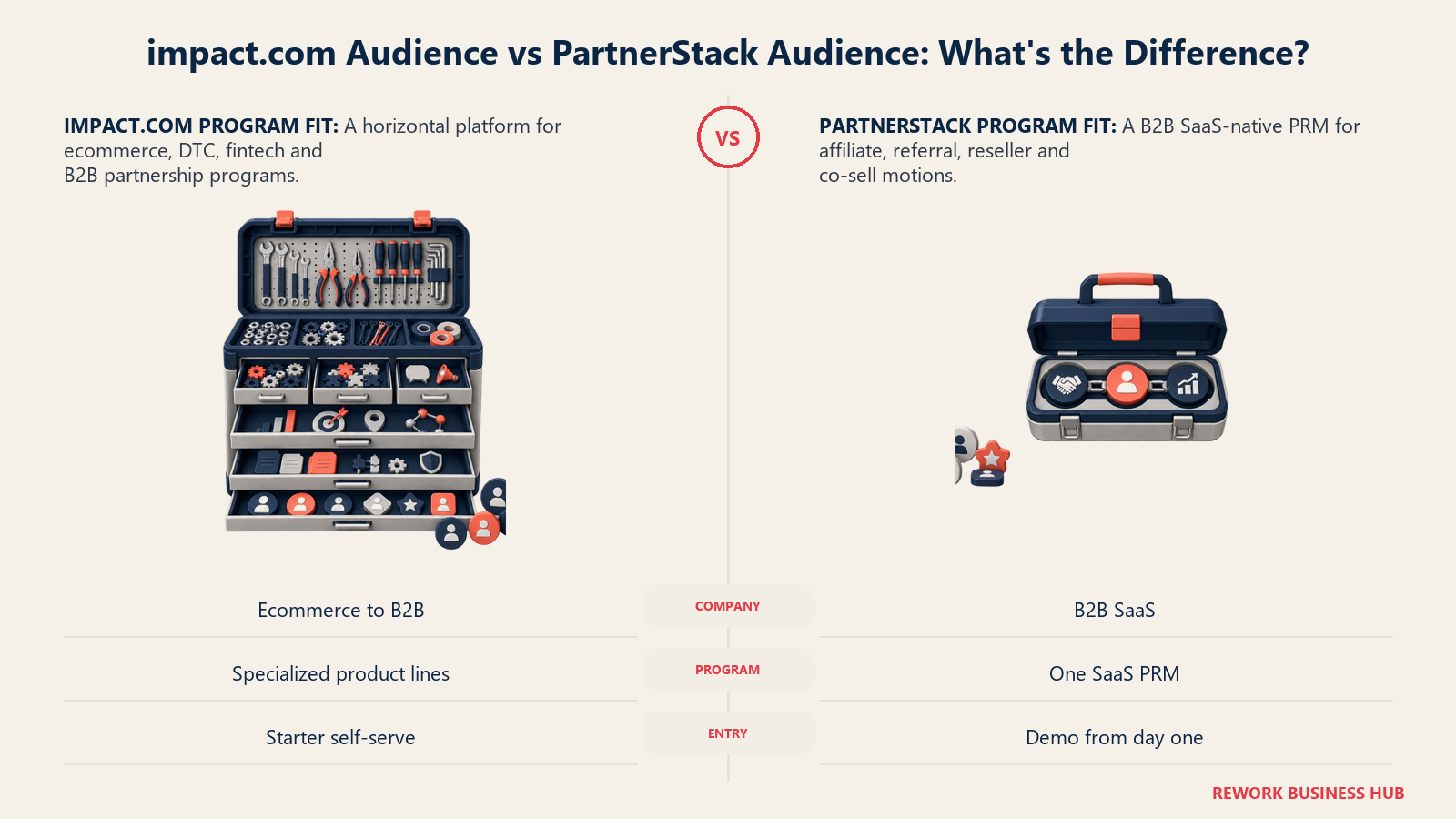
Program fit starts with the business model and partner motion. Broad commerce and mixed partnership portfolios point toward impact.com, while B2B SaaS affiliate, referral and co-sell motions point toward PartnerStack.
| Dimension | impact.com | PartnerStack |
|---|---|---|
| Company type | Ecommerce, DTC, retail and fintech brands, plus B2B companies, often running multiple channels at once | B2B SaaS companies specifically |
| Program type | Affiliate, influencer, referral (through its Advocate product), business development and technology partnerships, run on one platform | Affiliate, referral, reseller and co-sell partnerships, marketed as a single PRM that "scales multiple types and motions" |
| Team size to start | One marketer can run Starter alone. A partnerships or growth team typically owns the program once it's on Essentials or above | A dedicated partnerships or growth lead, since every tier is demo-gated from day one |
| Who signs the contract | On Starter, the individual marketer or founder signs up directly. On Essentials, Pro and Enterprise, a partnerships director or budget owner signs after a sales conversation | A partnerships lead, Head of Growth or RevOps leader, since no self-serve path exists at any tier |
impact.com's roots are in ecommerce and DTC affiliate marketing, and it still serves that base alongside fintech and B2B brands that want affiliate, influencer and referral partnerships on one platform. If that side of the program is what you're building, our guide to running an affiliate marketing program covers the operating basics regardless of which platform you end up on. PartnerStack, by contrast, was built specifically for B2B SaaS, and its own numbers back that focus up: partner-sourced paid customer conversions on its network grew 112% year over year in 2025. If reseller and co-sell motions are the bigger part of your program, our breakdown of channel partner programs is worth reading before you shortlist either tool.
Partner Types Each One Handles
| Partner type | impact.com | PartnerStack |
|---|---|---|
| Affiliate | Native, the platform's core product | Native, marketed as "the only affiliate platform built for B2B" |
| Influencer | Native, a dedicated influencer marketing product covering creator and brand-owned influencer partnerships | Native, described on the vendor's site as "B2B Influencers" |
| Referral | Native, run through impact.com's Advocate customer referral product | Native, referral programs run through the same PRM |
| Reseller / co-sell | Native, under impact.com's business development partnership type | Native, described as "Co-sell Partners" with pipeline-focused tooling |
| Agency | Native, a dedicated agency partner program and directory | Supported through the PartnerStack Marketplace, where the vendor states "publishers and agencies can discover and join" partnership opportunities |
| B2B tech / integration partner | Native, a dedicated technology partner directory | Covered under the same co-sell and PRM tooling. No separate technology partner directory is published on the vendor's site |
Both platforms cover the same five or six partner motions in name. The difference is packaging: impact.com ships them as separate, named products (affiliate marketing, influencer marketing, Advocate, business development, agency and technology directories), while PartnerStack runs them through one PRM dashboard built around a B2B sales motion.
The Marketplace Question
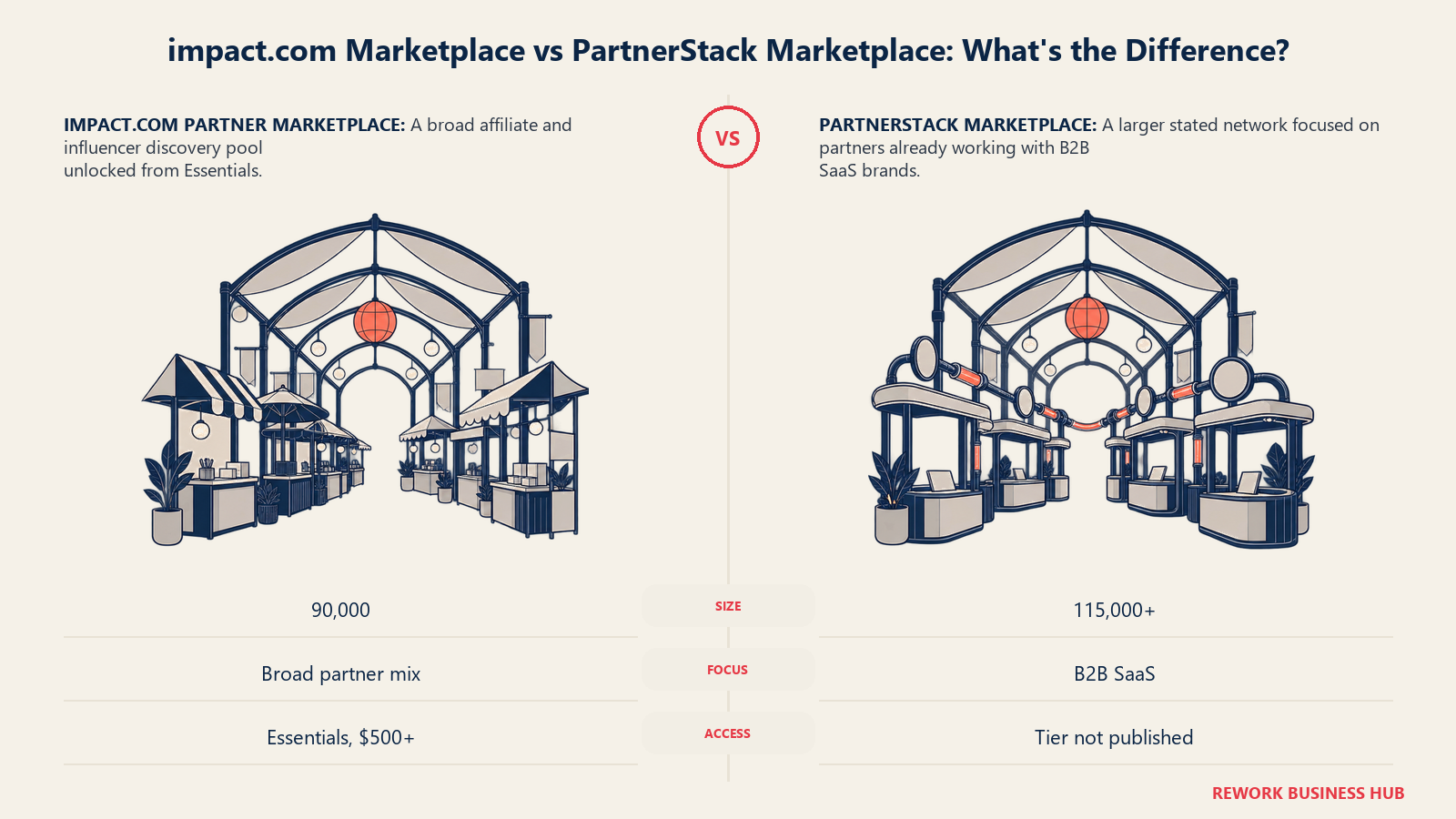
Both vendors sell access to a partner marketplace as a headline feature, and the two networks lean toward different kinds of programs.
| impact.com Partner Marketplace | PartnerStack Marketplace | |
|---|---|---|
| Stated partner count | 90,000 partners | 115,000+ active partners |
| Partner mix | Affiliates, influencers "and beyond," spanning ecommerce, DTC and B2B | B2B-focused affiliates, influencers and partners, alongside 600+ recognizable B2B brands already running programs on the network |
| Tier required | Essentials and above. Not included on Starter | Not published. PartnerStack does not disclose which tier includes marketplace access; that answer, like the price, surfaces during the demo |
| Best fit | A program that wants breadth: affiliate, influencer and DTC-style partners in one discovery pool | A program that wants partners who already understand B2B SaaS buying and referral motions |
This is the second precise fact worth being clear about: if your program's whole reason for evaluating impact.com is the Partner Marketplace, the real entry point is Essentials at $500/mo, not the $30/mo Starter headline that ranks in most search results. Starter gets you tracking and reporting, not marketplace-sourced partner discovery.
Pricing: One Publishes, One Does Not
Here is what each vendor actually publishes today.
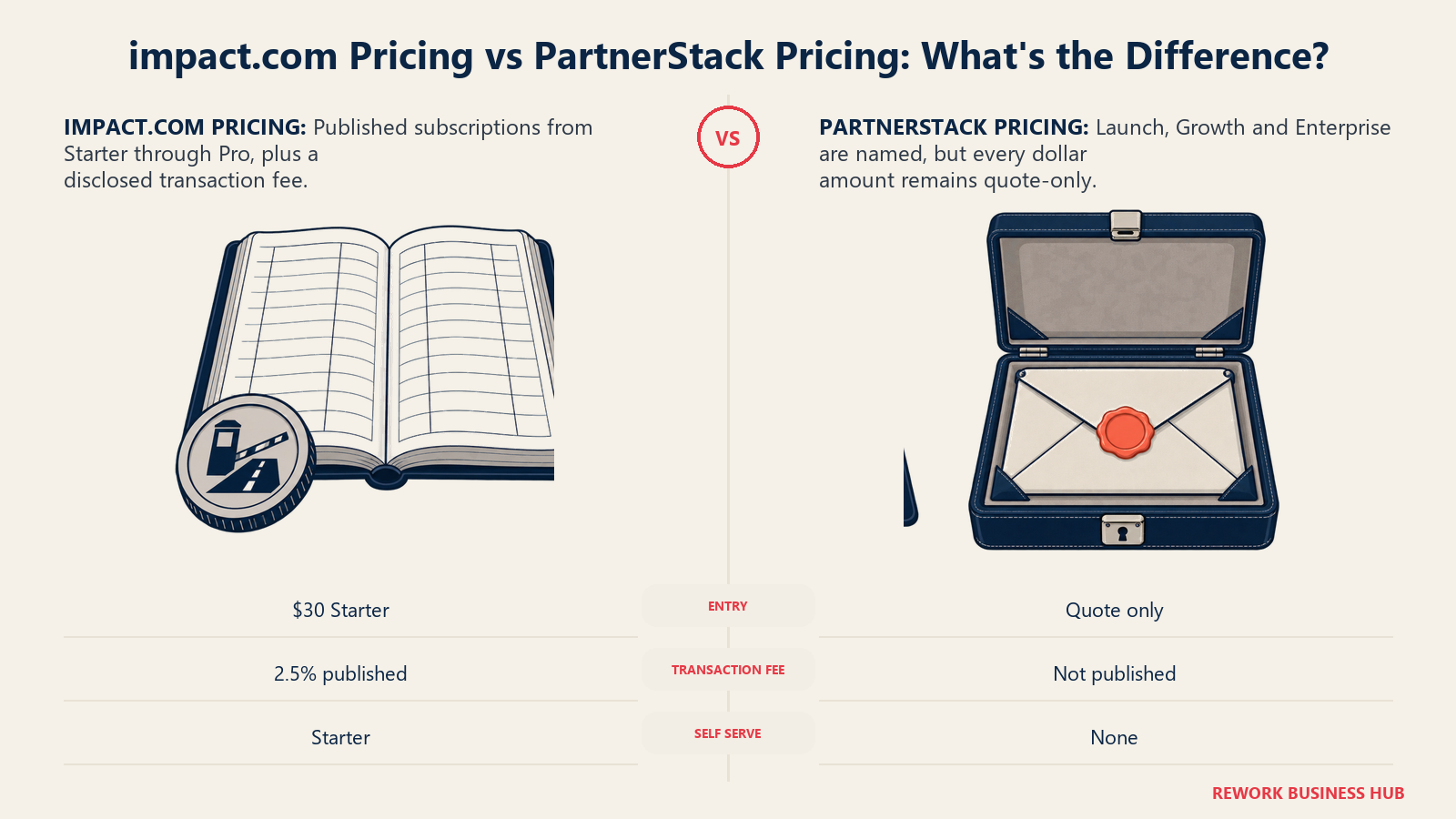
impact.com's four tiers:
| Tier | Price | Billing | What it adds | Transaction fee |
|---|---|---|---|---|
| Starter | From $30/mo | Monthly, annual available | Ecommerce plugin integrations, automated partner recommendations, promo code tracking, basic performance tracking, chat support | 2.5% on partner-driven transactions |
| Essentials | From $500/mo | Monthly, annual available | Everything in Starter, plus Partner Marketplace access (90,000 partners), unlimited contract templates, unlimited event tracking, multi-domain programs, automated campaign workflows | 2.5% on partner-driven transactions |
| Pro | From $2,500/mo | Monthly, annual available | Everything in Essentials, plus dedicated support, cross-device tracking, API-based tracking, Data Lab, SAML, keyword-based partner discovery | 2.5% on partner-driven transactions |
| Enterprise | Contact sales | Custom | Everything in Pro, plus benchmark recommendations, attribution risk protection, fraud scoring, forecasting and anomaly detection, additional payout incentives, partner deduplication | 2.5% on partner-driven transactions |
Two things belong next to that table, not buried below it. First, Starter carries a first-month wrinkle: for the first 30 days there's no minimum fee unless partners drive sales, but if the program doesn't generate at least $30 in partner-driven revenue in that window, impact.com charges that $30 anyway. Second, a one-time onboarding fee applies on top of every tier, and its size "is dependent on the number of technical resources your onboarding requires." impact.com does not publish an amount for it, so that line item stays unknown until you're in a sales conversation, even on a plan whose subscription price is fully public.
PartnerStack's three tiers:
| Tier | Price | What's published |
|---|---|---|
| Launch | Not published | Tier name only |
| Growth | Not published | Tier name only |
| Enterprise | Not published | Tier name only |
PartnerStack's own pricing page states this verbatim: "Pricing is based on your partner program size, feature needs, and level of support. Your final plan and pricing are confirmed during your demo." There is no dollar figure, range or starting price on the page at all. Any number you see attached to PartnerStack anywhere else online is a third party's estimate, not a vendor figure, and should be labeled as reported rather than taken as fact.
What impact.com's own rate structure looks like run against three illustrative program sizes. These are not vendor quotes. They combine impact.com's published subscription price with its published 2.5% transaction fee, applied to three illustrative levels of partner-driven monthly revenue, so you can see how the two costs interact.
| Program size (illustrative) | Tier | Subscription | 2.5% transaction fee | Modeled monthly total | Modeled annual total |
|---|---|---|---|---|---|
| New program, $10,000/mo in partner-driven revenue, no marketplace need | Starter | $30 | $250 | $280 | $3,360 |
| Growing program, $50,000/mo in partner-driven revenue, needs Marketplace access | Essentials | $500 | $1,250 | $1,750 | $21,000 |
| Established program, $250,000/mo in partner-driven revenue, needs API and cross-device tracking | Pro | $2,500 | $6,250 | $8,750 | $105,000 |
The pattern to notice: at $10,000/mo in partner-driven revenue, the transaction fee is already more than eight times the Starter subscription. By the time a program is generating $250,000/mo, the 2.5% fee is more than twice the Pro subscription on its own. The subscription price is the number every listicle quotes. The transaction fee is the number that actually scales with your program's success, and it's the one buyers get surprised by at renewal.
What you can and cannot know before a demo:
| Question | impact.com | PartnerStack |
|---|---|---|
| What does the subscription cost? | Known immediately, published for all four tiers | Unknown until the demo |
| What is the transaction or success fee? | Known immediately, 2.5% is published | Unknown until the demo |
| What does onboarding cost? | Unknown. A one-time fee applies but the amount isn't published, it depends on technical setup | Unknown until the demo |
| Can I sign up without talking to sales? | Yes, on Starter only | No, on any tier |
| Can I build a budget business case before the first call? | Yes, for Starter and as a working estimate for Essentials or Pro | No |
Tracking and Attribution
The tracking difference follows each platform's original market: commerce attribution on one side, SaaS lead identity and fraud controls on the other.
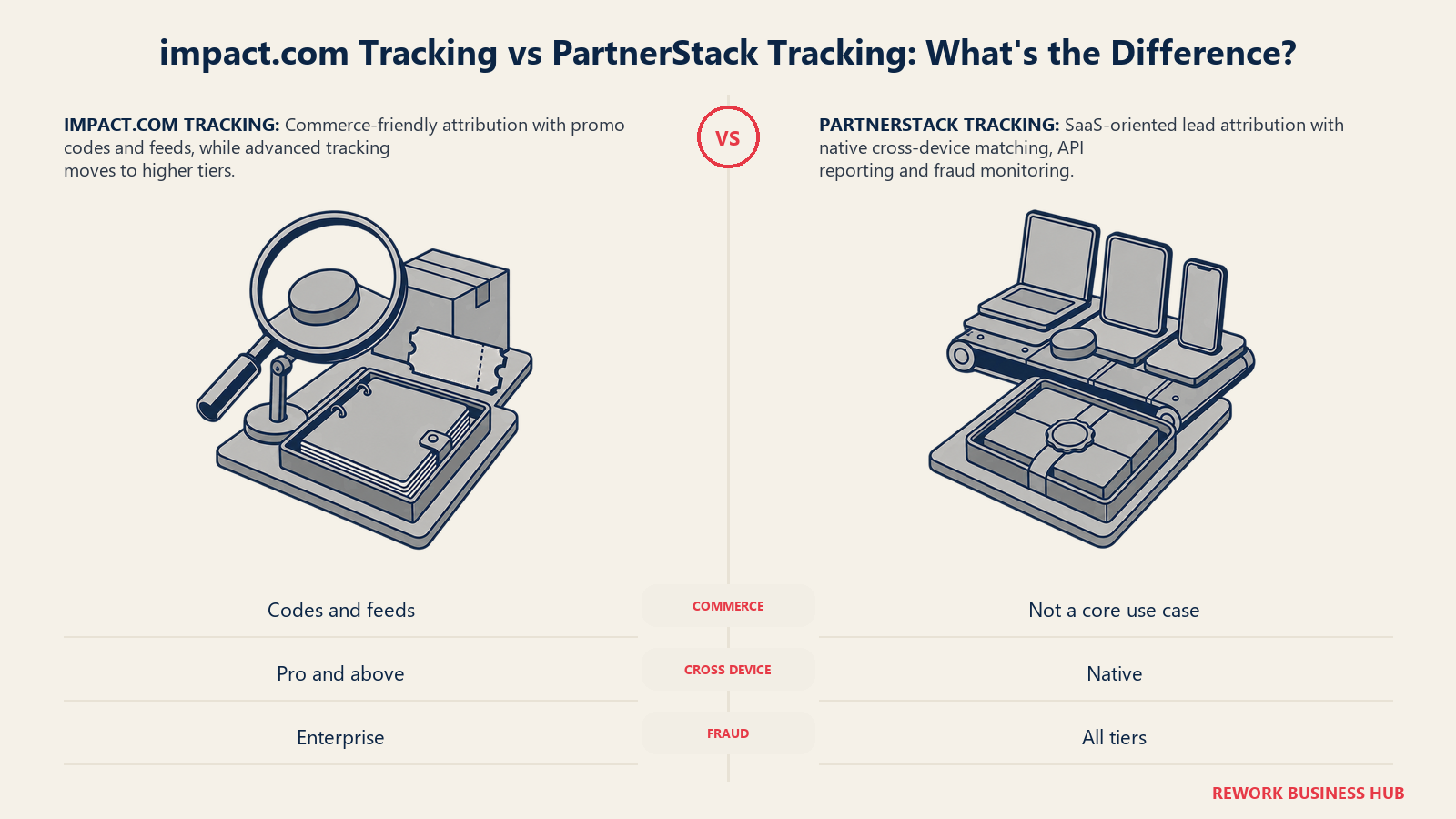
| Capability | impact.com | PartnerStack |
|---|---|---|
| Link tracking | Native, all tiers | Native, all tiers |
| Promo or coupon codes | Native from Starter | Not a core feature. PartnerStack's tracking model centers on referral links and API-reported leads, built for software sales rather than ecommerce checkout |
| Cross-device tracking | Pro tier and above | Native, using cross-device identity matching alongside cookie and non-cookie methods |
| API or server-side tracking | Pro tier and above | Native |
| Product feeds | Native, ecommerce plugin integrations from Starter | Not applicable. PartnerStack doesn't sell into ecommerce merchandising, so there's no product feed concept in a B2B SaaS partner program |
| Fraud detection | Enterprise tier only, fraud scoring and anomaly detection | Native on all tiers, runs partner activity through the Sift fraud network |
Attribution is where the two platforms' origins show up most clearly. impact.com's cross-device and API tracking are gated behind Pro at $2,500/mo, while fraud detection is Enterprise-only. PartnerStack ships cross-device matching and fraud monitoring as standard, but has no answer for promo codes or product feeds, because a B2B SaaS partner program rarely needs either. If where partner-sourced leads eventually land matters as much as how they're tracked, our piece on lead-to-revenue attribution covers the handoff from tracking data to pipeline reporting.
Payouts and Compliance
Both platforms automate core US tax documentation, so the decision turns on commission-currency breadth, payout rails and geographic reach.
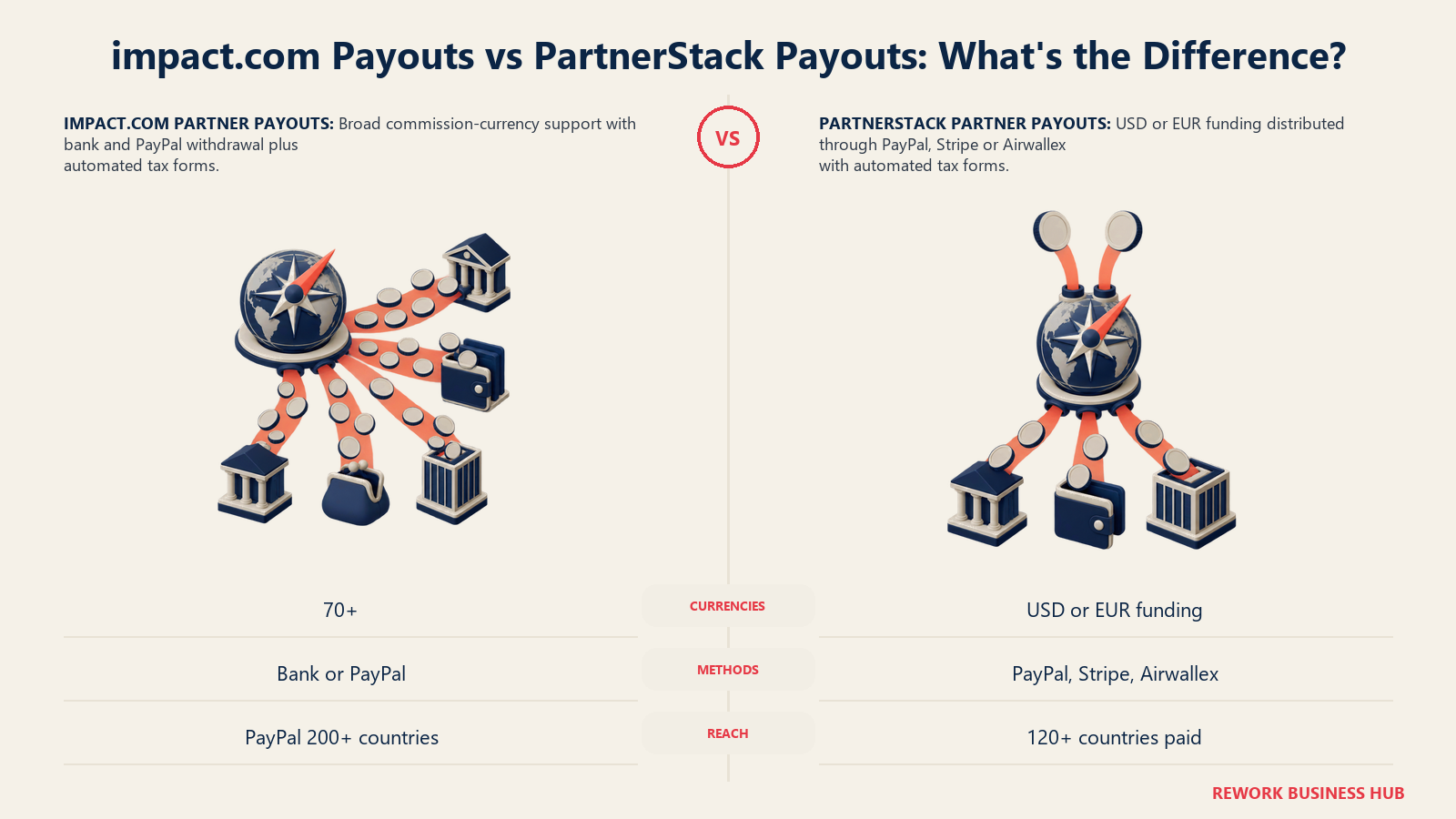
| Item | impact.com | PartnerStack |
|---|---|---|
| Payout methods | Bank account withdrawal or PayPal | PayPal, Stripe or direct deposit through Airwallex |
| Minimum payout threshold | $10 USD or currency equivalent | Confirm the minimum payout threshold with PartnerStack |
| Currencies | Commission structures supported in 70+ currencies | Vendors pay commissions in USD or EUR. The partner dashboard displays in USD, GBP, CAD, EUR, AUD or NZD |
| Global reach | PayPal's 200+ country reach, plus direct bank payout in supported regions | Direct deposit listed for 80+ countries through Airwallex, PayPal accepted separately. PartnerStack states it has paid partners in 120+ countries overall |
| Tax handling | Native. W-9 collected for US partners, W-8BEN or W-8BEN-E for international partners, 1099-NEC generated automatically once a US partner withdraws more than $600 in a calendar year | Native. W-9 for US partners, W-8 for non-US partners, 1099-NEC generated and downloadable once requirements are met |
Both platforms handle US and international tax paperwork the same way in substance, W-9 or W-8 collection feeding automatic 1099-NEC generation, so that's not a differentiator. The real gap is currency flexibility on the payer side: impact.com's 70+ supported commission currencies is a wider net than PartnerStack's USD-or-EUR vendor payout model, which matters if your partner base is genuinely global rather than concentrated in North America and Europe.
Implementation and Time to Value
| Factor | impact.com | PartnerStack |
|---|---|---|
| Fastest realistic go-live | Under 30 days for most brands, and as fast as 10 days for Shopify or BigCommerce merchants using prebuilt integrations, per impact.com's own onboarding materials | "Weeks," per PartnerStack's own onboarding guidance, with one cited customer launch completed in three weeks |
| Who's assigned to help | A dedicated Onboarding Success Manager plus an Implementation Engineer | Guided onboarding included on all plans, per PartnerStack's own pricing page |
| Migration from another platform | 6 to 8 weeks typical, with a 2 to 4 week overlap window recommended so partner links keep working during the switch | Not published in the vendor materials reviewed |
| Cost visibility before kickoff | High. Subscription and transaction fee are both published before implementation starts | Low. No figure is published until after the demo |
When Impact.com Is the Right Call
- The program spans ecommerce, DTC or fintech alongside B2B, and needs affiliate, influencer and referral partnerships running on one platform rather than three separate tools.
- The team wants a number before booking a call. Starter's $30/mo published price and self-serve "Get started now" signup let a single marketer start today with no sales conversation.
- The program needs Partner Marketplace-sourced discovery, and can budget for Essentials at $500/mo as the real entry point rather than assuming Starter covers it.
- The roadmap will eventually need cross-device tracking, API access or SAML, and it helps to know today that the next step up is Pro at $2,500/mo, rather than discovering it at renewal.
When PartnerStack Is the Right Call
- The program is B2B SaaS specifically, and the partners you want are already active inside PartnerStack's 115,000+ partner marketplace, which the vendor states spans 600+ recognizable B2B brands.
- Reseller and co-sell motions matter as much as affiliate and referral, and one PRM needs to run all of them under a single partner-facing dashboard built for that motion from the start.
- The team is comfortable trading pricing transparency for a SaaS-native network, and has the leverage or patience to get a written quote before committing.
- Fraud protection and cross-device attribution need to ship as standard, not gated behind an Enterprise tier, since PartnerStack includes both on every plan it sells.
When Neither Is the Right Call
Both platforms are priced and built for a program with real volume behind it, and neither one is the right first purchase for every partnerships motion. If you land in one of the rows below, the self-serve end of the market is a better place to start, and our roundups of Refersion alternatives and ReferralCandy alternatives cover the tools priced for it.
| If your situation is... | Better starting point |
|---|---|
| Small ecommerce brand, tight budget, one marketer running the whole program | Self-serve tracking software sized for that scale, not an enterprise partnership platform |
| Solo SaaS founder testing a first affiliate or referral program | A tool priced for one person, not a platform priced for a partnerships team |
| Advertiser mainly wants publisher reach rather than software to run | An affiliate network, where you rent a publisher marketplace instead of licensing a platform |
| Comparing more than these two platforms by name | Our best affiliate marketing software in 2026 roundup |
| Specifically evaluating impact.com against other enterprise platforms | Best impact.com alternatives |
| Specifically evaluating PartnerStack against other B2B SaaS PRM tools | Best PartnerStack alternatives |
If the whole reason you're comparing these two is that partner-sourced pipeline eventually has to land somewhere sales can work it, it's worth checking that the receiving end is ready too. Our roundups of CRM software and sales engagement platforms cover where that handoff usually breaks down, and our guide to lead distribution strategy is a reasonable read before partner-sourced leads start arriving in volume.
Decision Framework
Start with program type and the amount of pricing uncertainty the team can tolerate. Those two constraints usually settle the shortlist before feature depth does.
| If you are... | Pick |
|---|---|
| A solo marketer who needs a published price today | impact.com Starter |
| Running affiliate, influencer and referral partnerships across an ecommerce or DTC business | impact.com |
| A B2B SaaS partnerships team building reseller and co-sell motions alongside affiliate | PartnerStack |
| Budget-constrained and need to build a business case before any sales call | impact.com, since Starter through Pro all publish a number |
| Comfortable with a quote-only process in exchange for a SaaS-native partner network | PartnerStack |
| Needing marketplace-sourced partner discovery on day one | Either. Compare impact.com Essentials at $500/mo against a PartnerStack quote before committing |
| Running a small ecommerce program with a tight budget and no need for enterprise depth | Neither. Look at self-serve tracking tools sized for one marketer instead |
The short version. impact.com's advantage isn't that it's cheaper, Essentials at $500/mo and Pro at $2,500/mo are real enterprise money. Its advantage is that you know the number before you spend an hour on a sales call. PartnerStack's advantage isn't price either, it's that the whole platform is built around one motion, B2B SaaS partnerships, rather than stretched across ecommerce, DTC, fintech and B2B at once. Pick based on which trade you'd rather make: budget certainty up front, or a platform purpose-built for exactly your kind of program.
What to Do Next
Before you book a single demo, write down two numbers: your program's expected monthly partner-driven revenue, and whether you need marketplace-sourced partner discovery on day one. Those two answers tell you whether impact.com's published tiers already settle your budget question on their own, or whether you're walking into a PartnerStack call without a number and should ask for one in writing before the call ends.
Frequently Asked Questions about Impact.com vs PartnerStack
What's the main difference between impact.com and PartnerStack?
impact.com publishes exact prices for all four of its tiers (Starter from $30/mo, Essentials from $500/mo, Pro from $2,500/mo, Enterprise by quote) plus a 2.5% fee on partner-driven transactions, so you can price a program before ever talking to sales. PartnerStack publishes no dollar figures at all, only three tier names (Launch, Growth, Enterprise), and states that final pricing is confirmed during a demo. The two also target different buyers: impact.com serves ecommerce, DTC, fintech and B2B programs, while PartnerStack is built specifically for B2B SaaS.
How much does impact.com actually cost?
impact.com's Starter tier starts at $30/mo, Essentials at $500/mo and Pro at $2,500/mo, each billed monthly with an annual option. On top of the subscription, impact.com charges a 2.5% transaction fee on partner-driven sales only, charged when a sale happens, plus a one-time onboarding fee that depends on how much technical setup the program needs. Enterprise pricing is by quote.
Does PartnerStack publish any pricing at all?
No. PartnerStack's pricing page names three tiers, Launch, Growth and Enterprise, with no dollar figures attached to any of them. The page states verbatim that "pricing is based on your partner program size, feature needs, and level of support" and that your final plan and pricing are confirmed during a demo.
Which tier of impact.com unlocks the Partner Marketplace?
Essentials, priced from $500/mo, is impact.com's cheapest tier that includes Partner Marketplace access, which the vendor states connects programs to 90,000 partners. Starter, at $30/mo, doesn't include marketplace access, so a program that needs to discover new partners through impact.com's network has to budget for Essentials as its real entry point, not the $30 headline number.
What kinds of partners can each platform manage?
Both platforms natively support affiliate, influencer, referral and reseller or co-sell partnerships. impact.com organizes these as separate named products (affiliate marketing, influencer marketing, its Advocate referral product, business development, plus dedicated agency and technology partner directories). PartnerStack markets itself as a PRM that "scales multiple types and motions," grouping affiliates, B2B influencers, co-sell and referral partners under one dashboard.
Is impact.com or PartnerStack better for a B2B SaaS company?
PartnerStack was built specifically for B2B SaaS partnerships, and its own network reports partner-sourced paid customer conversions grew 112% year over year in 2025. impact.com is horizontal and works across ecommerce, DTC, fintech and B2B alike, so it can serve SaaS companies too, but a SaaS-only partnerships team should treat PartnerStack's B2B-native marketplace and PRM tooling as the more purpose-built option, and consider impact.com mainly if the program also touches affiliate or influencer partnerships tied to a broader ecommerce or DTC business line.
What happened to the free or self-serve options on either platform?
impact.com's Starter tier is the only genuinely self-serve entry point between the two. Its call to action reads "Get started now" rather than a demo request, and pricing starts at $30/mo. Every other tier on both platforms, impact.com's Essentials, Pro and Enterprise, and all three PartnerStack tiers, routes through a "Request a demo" conversation before signup.
Are there hidden fees to watch for on either platform?
On impact.com, the 2.5% transaction fee on partner-driven sales and the one-time onboarding fee are both real costs that don't show up in the headline subscription price, and the onboarding fee amount isn't published anywhere since it depends on technical setup. On PartnerStack, because no pricing is published at all, there's no way to know what fees exist until you're already in a demo, which is the bigger practical risk for a budget-conscious buyer.

Principal Product Marketing Strategist
On this page
- TL;DR
- Key Facts
- Who Each Platform Is Built For
- Partner Types Each One Handles
- The Marketplace Question
- Pricing: One Publishes, One Does Not
- Tracking and Attribution
- Payouts and Compliance
- Implementation and Time to Value
- When Impact.com Is the Right Call
- When PartnerStack Is the Right Call
- When Neither Is the Right Call
- Decision Framework
- What to Do Next