Refersion vs Tapfiliate: Flat Fee or Percentage of Sales, Which Costs Less in 2026?
Turn this article into takeaways for your work.


Each assistant summarizes the article only for you and suggests best practices for your work.
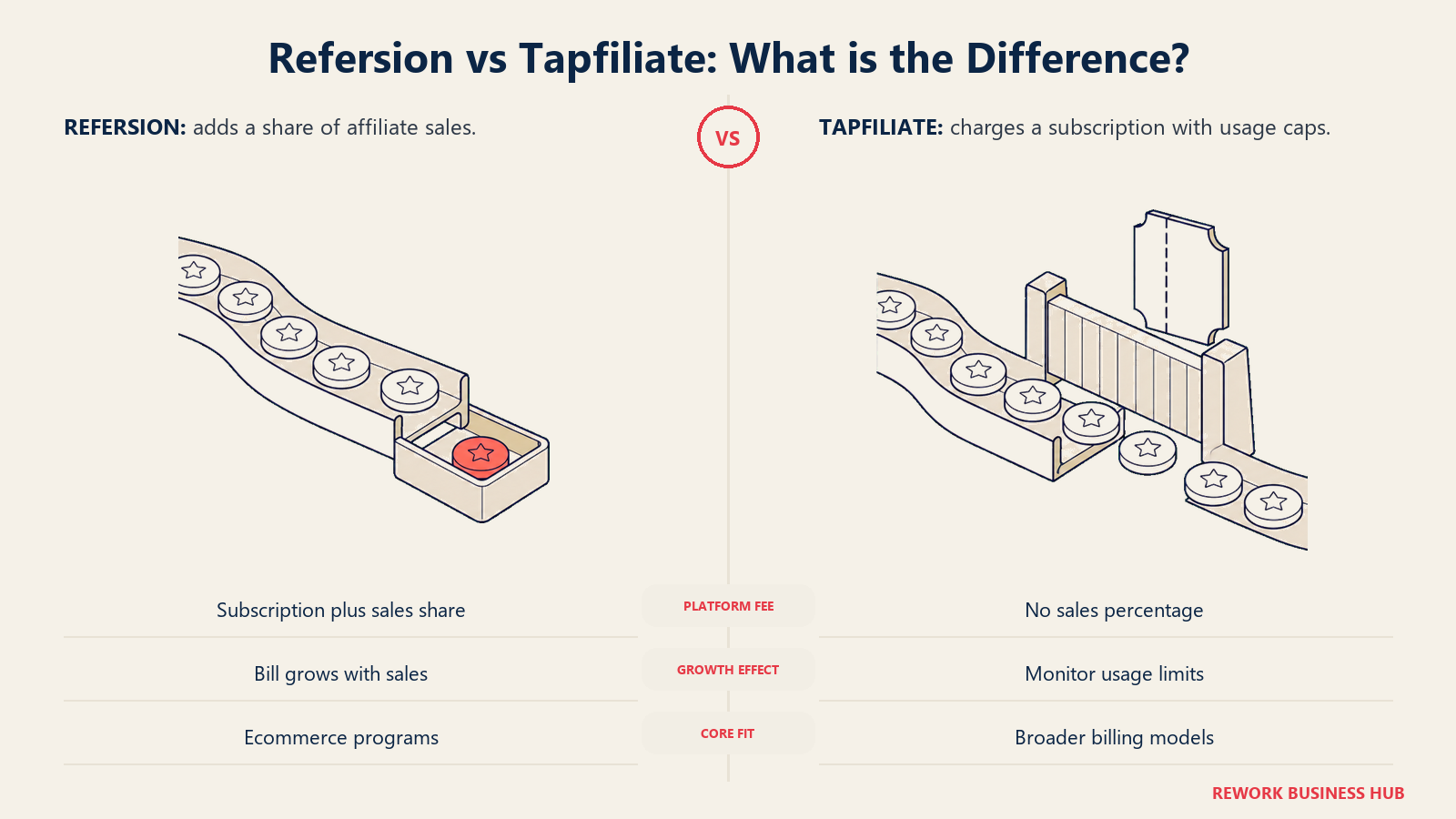
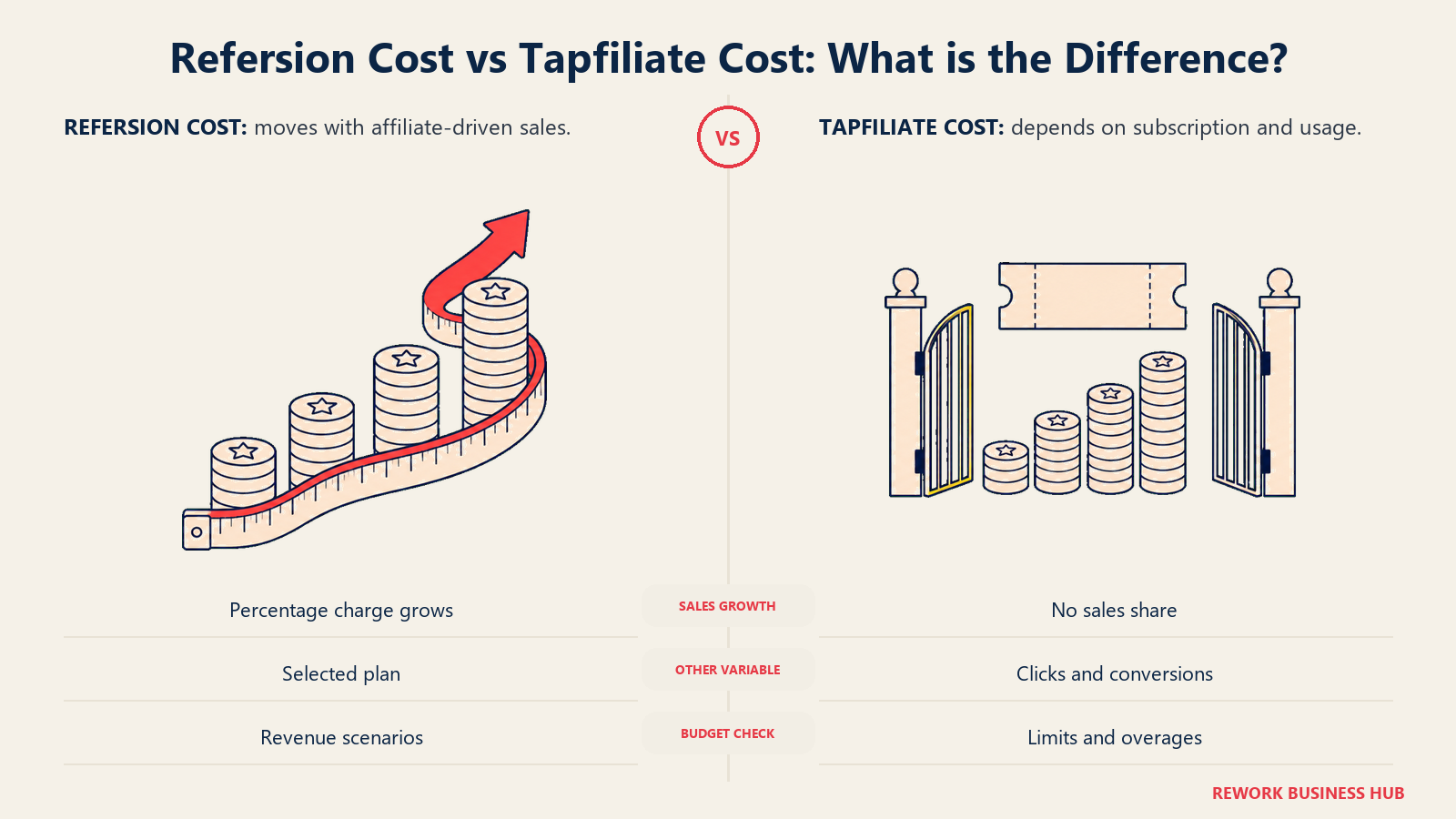
If you're pricing out affiliate tracking software, these two names keep landing on the same shortlist for a reason that has nothing to do with features. Refersion and Tapfiliate solve overlapping problems, tracking clicks, attributing sales to affiliates, and paying out commissions, but they charge for it in structurally different ways. One takes a smaller monthly fee and then a cut of every sale your affiliates drive. The other charges a flatter, higher subscription and keeps none of your affiliate-driven revenue.
Refersion's Launch tier runs $39/mo ($29/mo billed annually) plus 3% of affiliate-driven sales, and its Growth tier runs $199/mo ($159/mo annually) plus 2%. Tapfiliate's Launch tier runs $89/mo ($74/mo annually) with zero percentage fee, capped at 50 affiliates, 5,000 clicks a month and 500 conversions a month, and its Scale tier runs $179/mo ($149/mo annually), also with zero percentage fee, with those caps raised to unlimited affiliates, 100,000 clicks a month and 10,000 conversions a month. Whichever platform looks cheaper on the pricing page depends entirely on how much revenue your affiliates actually move, and that crossover point arrives earlier than most buyers expect. If you're comparing more names than these two, our roundup of the best affiliate marketing software in 2026 covers the wider field.
TL;DR
| Refersion | Tapfiliate | |
|---|---|---|
| What it is | Ecommerce-native affiliate tracking, built and marketed for DTC and Shopify brands | Broad affiliate and partner platform serving ecommerce, SaaS, subscription and other verticals |
| Pricing model | Subscription plus a percentage of affiliate-driven sales | Flat subscription, zero percentage fee at any tier |
| Entry tier | Launch: $39/mo ($29/mo annual) plus 3% of affiliate-driven sales, unlimited affiliates and clicks | Launch: $89/mo ($74/mo annual), capped at 50 affiliates, 5,000 clicks/mo, 500 conversions/mo |
| Mid tier | Growth: $199/mo ($159/mo annual) plus 2% of affiliate-driven sales | Scale: $179/mo ($149/mo annual), unlimited affiliates, 100,000 clicks/mo, 10,000 conversions/mo |
| Free option | Marketplace Listing: free, but no tracking, management or payouts included | None. Every tier is a metered, paid plan |
| Where the flat rate wins | Programs generating roughly $1,500 to $4,700 a month or more in affiliate-driven sales, once usage caps are accounted for | Nearly always, past a few thousand dollars a month, provided affiliate count and click/conversion volume stay under the tier's caps |
| Where the percentage wins | Small or brand-new programs, where 2-3% of a modest sales figure lands below Tapfiliate's flat fee | Not applicable at low volume, since Tapfiliate's price doesn't move with sales |
| Best for | Shopify and ecommerce brands that want pricing that starts cheap and scales with a young program | Programs of any size that want predictable, sales-independent pricing and don't need Refersion's Shopify-native depth |
Key Facts
- UK affiliate and partner programs generated £20.7 billion in revenue in 2025, a reported average return of £15 for every £1 spent, per APMA's State of the Affiliate Nation 2026 report, cited on Awin's affiliate marketing statistics page.
- Purchases driven through affiliate and partner channels carry 21% higher average order values and a 21% higher repurchase rate than other channels, per a 2024 Awin and Forrester analysis cited on the same Awin statistics page.
- US ecommerce brands running affiliate and partner programs generated $113 billion in sales in 2024, according to the Performance Marketing Association's 2025 Industry Study, also cited on Awin's page.
- US affiliate marketing spend grew 49.8% from $9.1 billion in 2021 to $13.62 billion in 2024, per the Performance Marketing Association's 2025 industry study.
- 74% of brands generate 11% to 30% of total revenue from affiliate marketing, and 14% generate more than 30%, per impact.com's 2025 Global State of Affiliate Marketing report, a vendor survey of 818 marketers across 8 countries.
- Partner-sourced revenue sits at a median of 24% of new bookings across horizontal B2B SaaS companies, based on a 2026 panel of more than 2,100 vendors drawn from Crossbeam's ELG report and Partnership Leaders, reported by Digital Applied.
Who Each Platform Is Built For
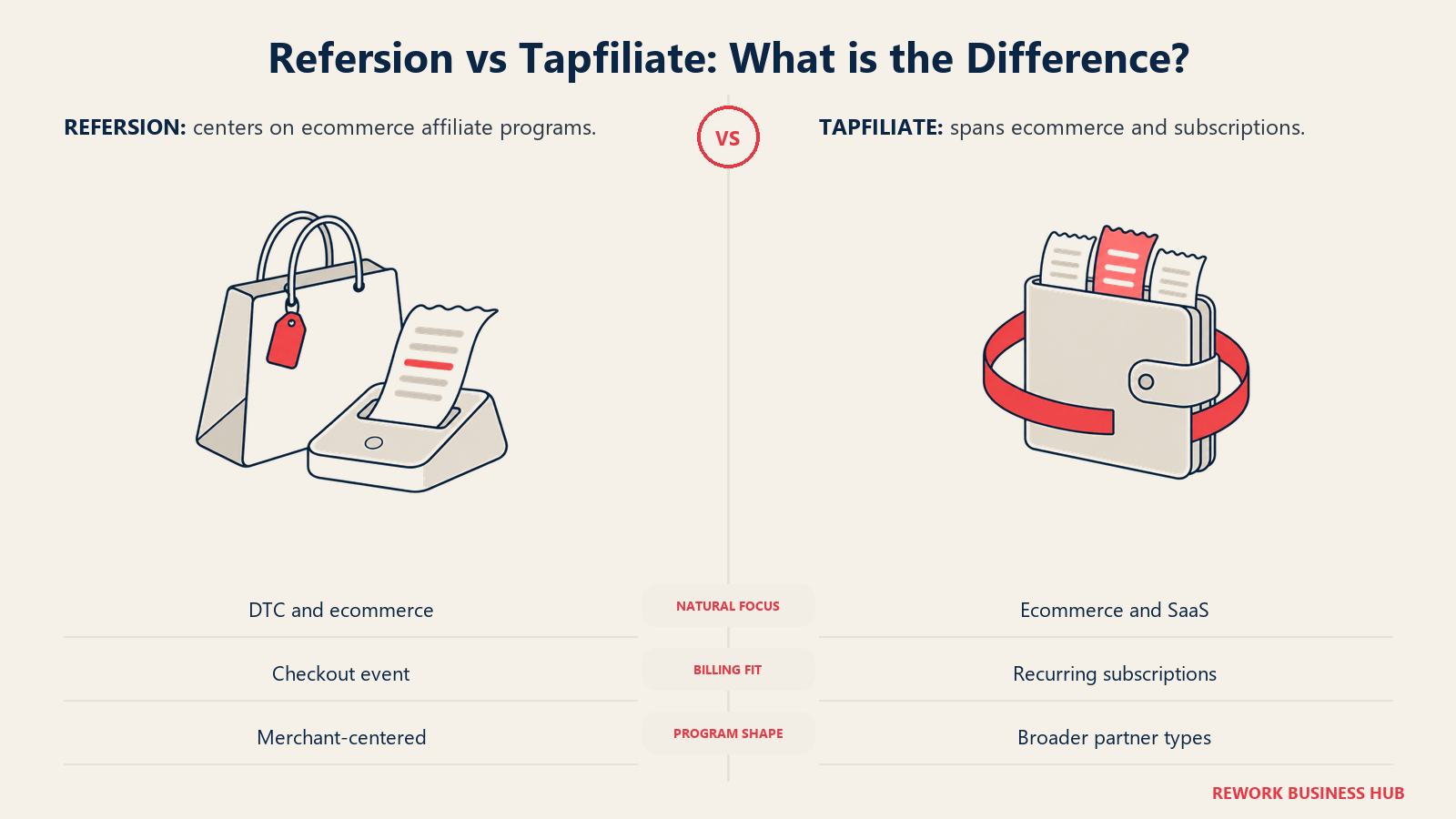
The two platforms didn't start from the same customer, and it still shows in how each one is marketed and priced today.
| Dimension | Refersion | Tapfiliate |
|---|---|---|
| Core business type | Ecommerce and DTC brands, described by the vendor as "designed and built for ecommerce brands and merchants" | E-commerce, SaaS, subscription, travel, wellness, finance, education, gaming and AI services, per the vendor's own site |
| Commerce platform fit | Shopify, Shopify Plus, WooCommerce and BigCommerce as native integrations | Shopify, WooCommerce, Stripe and Paddle among 30+ pre-built integrations |
| Team size to start | One marketer can run Launch alone | One marketer can run Launch alone; Scale supports up to 5 team members |
| Program stage this fits | A program still proving out its affiliate channel, where sales-linked pricing keeps early cost low | A program with steady or growing volume, where a flat price stops scaling as the program succeeds |
| Recurring/subscription billing | Not a core focus, the platform is built around a single ecommerce checkout event | Native recurring and lifetime commission support, built for SaaS and subscription billing |
Refersion's own positioning leans hard into ecommerce: it advertises "first-party tracking" that attributes sales correctly "even with browser privacy updates," which matters for a checkout-driven business more than a subscription one. Tapfiliate covers that same ecommerce ground but is built to also run recurring commissions for SaaS companies, tiered payouts for agencies, and lifetime commissions for subscription businesses, all from the same dashboard. If your program is closer to a B2B SaaS partner motion than a DTC affiliate one, our Rewardful vs FirstPromoter vs LeadDyno comparison covers three platforms built specifically around that billing model, none of which charge a percentage fee either.
Feature Parity at a Glance
| Capability | Refersion | Tapfiliate |
|---|---|---|
| Affiliate cap | Unlimited on Launch and Growth | 50 on Launch, unlimited from Scale up |
| Click and conversion volume | Unlimited on Launch and Growth | Metered: 5,000 clicks and 500 conversions/mo on Launch, 100,000 clicks and 10,000 conversions/mo on Scale |
| Coupon and promo code tracking | Native, and attributes sales even without a tracked click | Native, including attribution to affiliates when a shopper uses a code like "SARAH20" without clicking a link |
| SKU-level commission rules | Growth tier and above | Available through tiered and custom commission rules on Scale and Enterprise |
| Recurring and lifetime commissions | Not a core focus, geared toward a one-time ecommerce sale | Native, built for SaaS and subscription billing |
| Multi-store management | Growth tier and above | Not a feature the vendor names on its public plan pages |
| Free affiliate marketplace listing | Yes, the Marketplace Listing tier, though it excludes tracking, management and payouts | Not offered, every tier is a metered paid plan |
| White-label branding | Ask Refersion about white-label options | Full white label, Enterprise tier |
| Built-in AI data assistant | Ask Refersion about a built-in AI assistant | Native, with Model Context Protocol integration to Claude, ChatGPT and Google services |
Commission Types and Payouts
| Payout mechanic | Refersion | Tapfiliate |
|---|---|---|
| Commission types | Flexible, merchant-set payouts the vendor describes as built to "fit your program" | Percentage, fixed amount, tiered, recurring and lifetime commissions, with performance bonuses |
| Payout speed | Instant Payouts, per the vendor's own site | Ask Tapfiliate about payout timing |
| Who commissions apply to | Influencers, brand ambassadors, content creators, bloggers and a brand's own customers | Affiliates, referral partners, influencers, content creators, brand ambassadors and solution partners or resellers, all through one dashboard |
| Percentage fee on top of the subscription | Yes: 3% on Launch, 2% on Growth, undisclosed on Scale | None, at any tier |
The commission-type list looks similar on paper. The real difference is where the money goes after a sale closes. Refersion pays out the merchant-set commission and then keeps 2-3% of the affiliate-driven sale itself, on top of the subscription. Tapfiliate keeps the flat subscription and nothing else, which is the entire premise behind its "unlimited affiliates" positioning once you're on Scale or above. That premise doesn't hold on Launch, and the caps section below explains exactly where it breaks.
Integrations: Ecommerce-Native vs Broadly Cross-Platform
| Integration | Refersion | Tapfiliate |
|---|---|---|
| Shopify / Shopify Plus | Native | Native |
| WooCommerce | Native | Native |
| BigCommerce | Native | Not listed among the vendor's named integrations |
| Stripe | Native | Native |
| Paddle | Not listed among the vendor's named integrations | Native |
| Broader integration count | Not a headline number on the vendor's site | 30+ pre-built integrations, plus Zapier (5,000+ apps), a REST API and a JavaScript snippet for custom setups |
| API access | Growth tier and above | REST API included as a standard integration path |
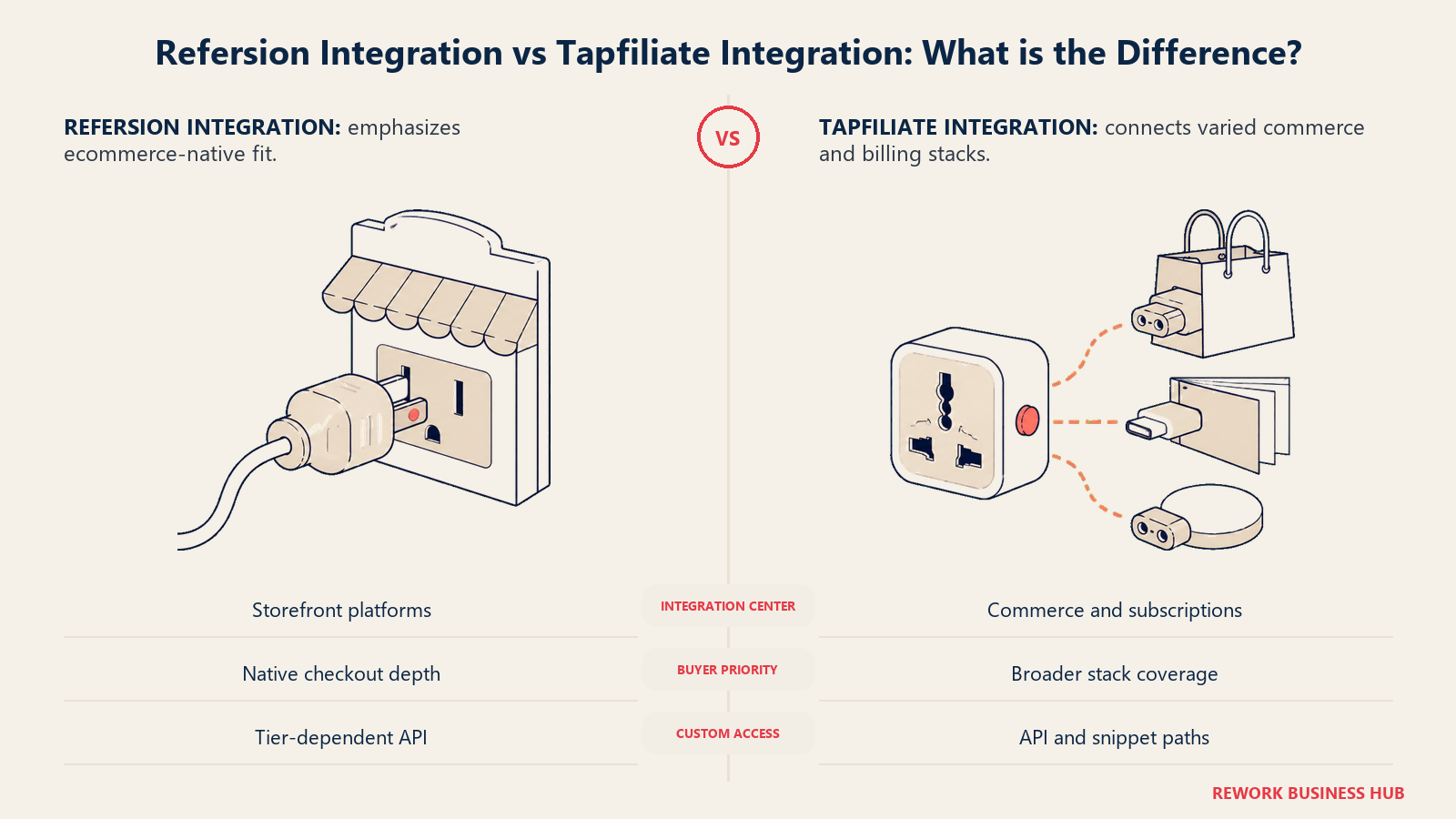
Refersion's integration list is short because its market is narrow on purpose: Shopify, Shopify Plus, WooCommerce, BigCommerce and Stripe cover the overwhelming majority of DTC checkout stacks. Tapfiliate's list is longer because its customer base spans ecommerce, SaaS, subscription, travel and several other verticals that each bring a different billing tool. If you're running the program on Shopify specifically and want the deepest native fit rather than the broadest integration count, that narrowness is a feature, not a gap.
Tapfiliate's Affiliate, Click and Conversion Caps
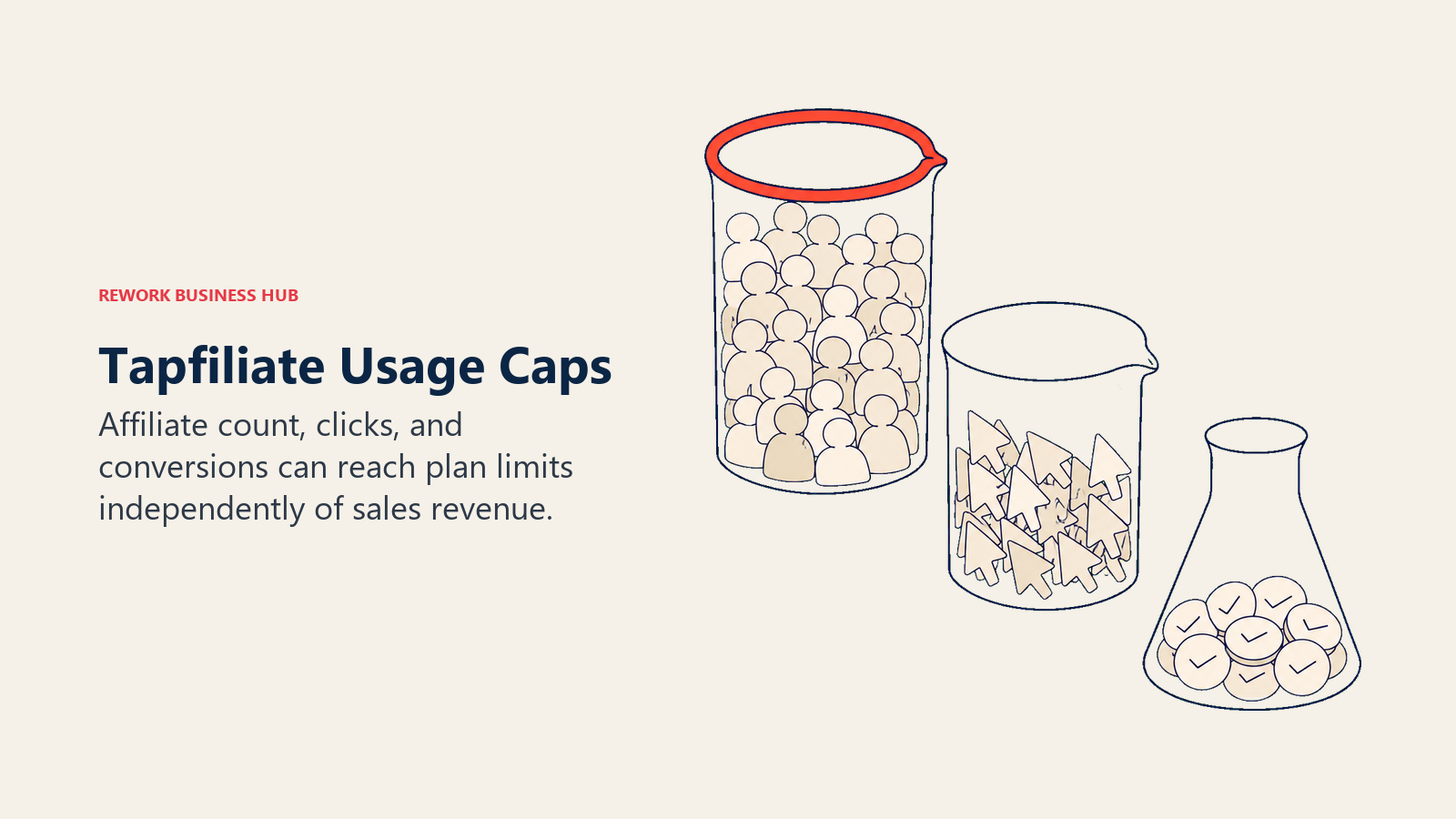
This is the section that decides whether Tapfiliate's flat-rate pricing actually applies to your program, and it's worth reading before the pricing math below.
| Cap | Tapfiliate Launch ($89/mo, $74/mo annual) | Tapfiliate Scale ($179/mo, $149/mo annual) |
|---|---|---|
| Affiliates | 50 | Unlimited |
| Monthly clicks | 5,000 | 100,000 |
| Monthly conversions | 500 | 10,000 |
| Team members | 1 | 5 |
| Click overage rate | $1.50 per extra 1,000 clicks | $1 per extra 1,000 clicks |
| Conversion overage rate | $15 per extra 1,000 conversions | $10 per extra 1,000 conversions |
| Free trial | 7 days | 14 days |
Tapfiliate's reputation as the "unlimited affiliates, no percentage fee" platform is only fully true on Scale and above. Launch caps out at 50 affiliates, 5,000 clicks a month and 500 conversions a month, and whether a growing program stays under those ceilings depends on numbers that have nothing to do with the price tag. A program doing $50,000 a month in affiliate-driven sales at a $500 average order value needs only 100 conversions, comfortably inside Launch's 500-conversion cap. The same $50,000 a month at a $100 average order value needs exactly 500 conversions, right at the ceiling. At a $50 average order value it needs 1,000 conversions, double the cap, which means either overage charges (an extra $7.50 for those 500 conversions at Launch's $15-per-1,000 rate) or a move to Scale. The 5,000-click cap can bind even earlier: any program running coupon-site or content affiliates at a typical low-single-digit-percent click-to-conversion rate can burn through 5,000 clicks a month well before it burns through 500 conversions. The 50-affiliate cap is the most predictable of the three: a small, curated affiliate roster fits easily, but a program recruiting broadly can pass 50 partners before it has meaningful revenue behind it. None of this makes Launch a bad plan, it makes it a plan sized for a small, low-traffic affiliate program, not a scaling one.
Pricing at Real Affiliate-Driven Sales Volumes
Here is what each plan actually costs, modeled at five levels of monthly affiliate-driven sales, using each vendor's own published rates and billed monthly.
| Affiliate-driven sales/mo | Refersion Launch ($39/mo + 3%) | Refersion Growth ($199/mo + 2%) | Tapfiliate Launch ($89/mo flat)* | Tapfiliate Scale ($179/mo flat) |
|---|---|---|---|---|
| $5,000 | $189 | $299 | $89* | $179 |
| $25,000 | $789 | $699 | $89* | $179 |
| $50,000 | $1,539 | $1,199 | $89* | $179 |
| $100,000 | $3,039 | $2,199 | $89* | $179 |
| $250,000 | $7,539 | $5,199 | $89* | $179 |
*Only valid while the program stays under Tapfiliate Launch's 50-affiliate, 5,000-click and 500-conversion monthly caps. Once a program in this revenue range breaches those caps, which is likely by the $50,000/mo row for most businesses, the real comparison is against Tapfiliate Scale, or against Launch plus overage charges.
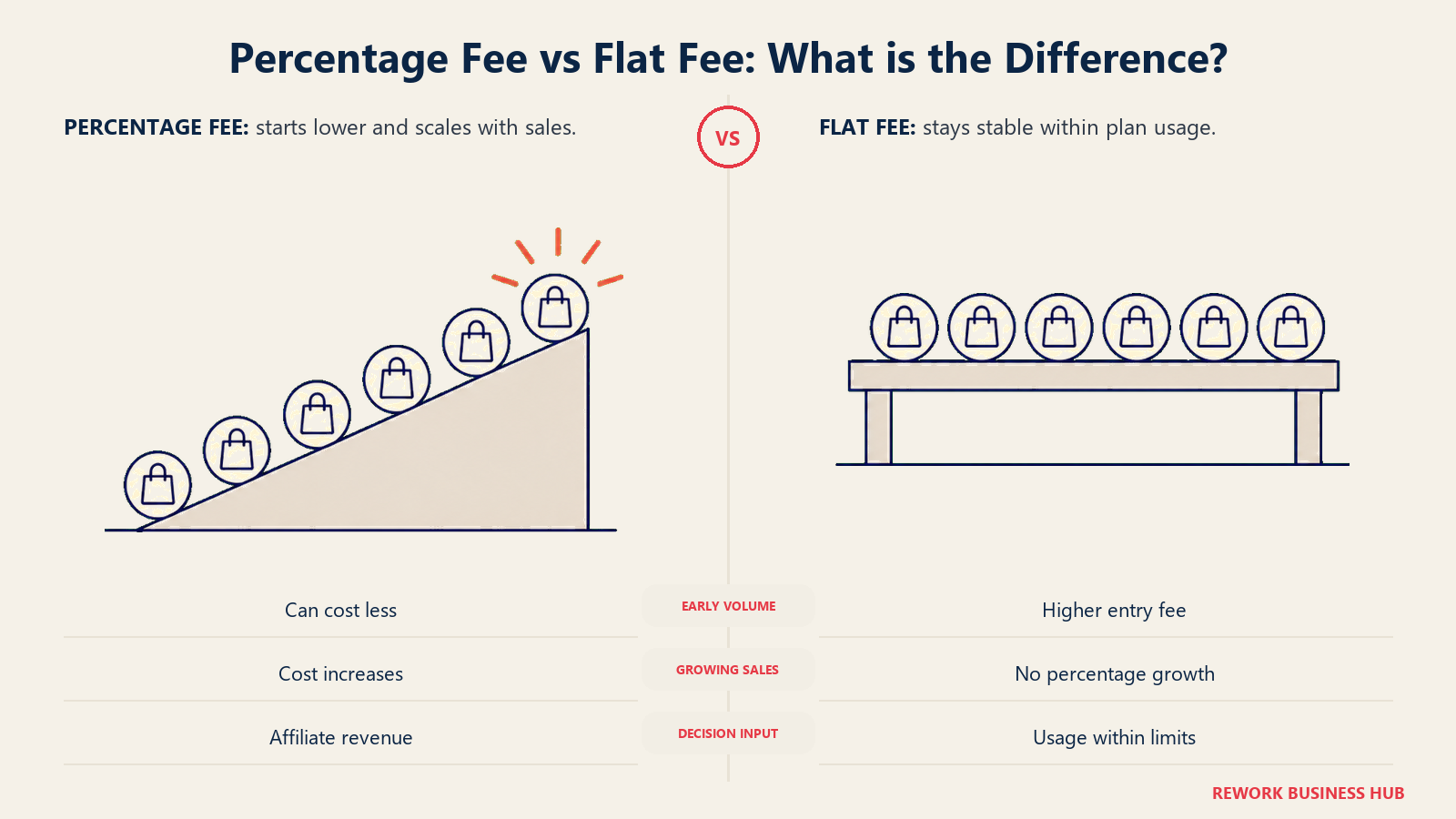
The pattern is stark once the percentage fee has something real to multiply against. At $5,000 a month in affiliate-driven sales, Refersion Launch's $189 total already costs more than double Tapfiliate Launch's flat $89. By $50,000 a month, Refersion Launch's total has climbed to $1,539 against Tapfiliate Scale's flat $179, a gap of more than $1,300 a month, or roughly $16,000 a year. Refersion Growth follows the same curve from a higher starting point: its $199/mo subscription alone already costs more than Tapfiliate's entire Launch tier before a single dollar of the 2% fee is added.
Where the Math Actually Crosses Over
| Comparison | Monthly-billed crossover point | Annual-billed crossover point |
|---|---|---|
| Refersion Launch vs Tapfiliate Launch | Refersion costs more above roughly $1,667/mo in affiliate-driven sales | Above roughly $1,500/mo |
| Refersion Launch vs Tapfiliate Scale | Refersion costs more above roughly $4,667/mo in affiliate-driven sales | Above roughly $4,000/mo |
| Refersion Growth vs Tapfiliate Launch | Refersion Growth's $199/mo subscription alone already exceeds Tapfiliate Launch's flat $89/mo, at any sales volume | $159/mo already exceeds $74/mo, at any sales volume |
| Refersion Growth vs Tapfiliate Scale | Refersion Growth's $199/mo subscription alone already exceeds Tapfiliate Scale's flat $179/mo, at any sales volume | $159/mo already exceeds $149/mo, at any sales volume |
Read plainly: once a program is generating more than about $1,500 to $1,700 a month in affiliate-driven sales, and can stay under Tapfiliate's affiliate and usage caps, Tapfiliate's flat price is very likely the cheaper option, often by a wide and growing margin as volume increases. Refersion's percentage-of-sales model is genuinely cheaper only in a narrow window: brand-new programs generating a few hundred to a couple thousand dollars a month, where 2-3% of a small number is smaller than $89 or $179 flat. That window closes fast for any program that's actually working. The trade a buyer is really making isn't "cheap platform vs expensive platform," it's "pay a little now and more later as the program succeeds" against "pay a fixed amount every month regardless of how well the program performs," provided the fixed-price plan's affiliate count and traffic actually fit inside its caps.
Implementation and Time to Value
| Factor | Refersion | Tapfiliate |
|---|---|---|
| Fastest realistic go-live | Fast on Shopify specifically, given native app-store integration and first-party tracking built around Shopify checkout events | Fast across a wider range of platforms, given 30+ pre-built integrations plus Zapier, REST API and a JS snippet for anything not natively supported |
| Setup complexity | Low for a single-storefront Shopify or WooCommerce brand | Low to moderate, scales with how many billing or commerce systems the program needs to connect |
| Best-fit technical profile | A DTC brand on Shopify, Shopify Plus, WooCommerce or BigCommerce that wants tracking to just work | A business on Stripe, Paddle or another supported billing platform that also wants recurring or lifetime commission logic |
| Ongoing admin | Percentage fee requires no extra admin, it's deducted automatically as sales are attributed | Flat fee requires periodic attention to affiliate count, click volume and conversion volume against the plan's caps |
Support and Onboarding
| Factor | Refersion | Tapfiliate |
|---|---|---|
| Support channel | Not itemized by tier on the vendor's public plan pages | Chat support named specifically on the vendor's plan comparison |
| Onboarding style | Self-serve, guided by Shopify app-store documentation and setup flows | Self-serve on Launch and Scale, with Enterprise adding a dedicated manager |
| Trial length | Not published as a standard free trial on the current pricing page | 7 days on Launch, 14 days on Scale, 30 days on Enterprise |
| Documentation depth | Ecommerce-specific setup guides tied to Shopify, WooCommerce and BigCommerce | Broader documentation covering 30+ integrations, the REST API, and Zapier setups |
Neither vendor publishes a detailed support SLA by tier the way some enterprise partnership platforms do, so if guaranteed response times matter to your team, get that in writing during the sales conversation rather than assuming parity between plans. Tapfiliate's longer trial windows are worth factoring into a real evaluation too: 14 days on Scale is enough time to run a small batch of actual affiliate traffic through the caps table above and see whether your real numbers fit before you commit to a year of billing.
When Refersion Is the Right Call
- The program is brand-new and small. At a few hundred to roughly $1,500 a month in affiliate-driven sales, 2-3% of that revenue costs less than Tapfiliate's flat $89 or $179 a month, and there's no reason to pre-pay for capacity the program isn't using yet.
- The business runs on Shopify, Shopify Plus, WooCommerce or BigCommerce, and native, first-party tracking that survives browser privacy changes matters more than breadth of integrations elsewhere.
- The team wants a free way to test affiliate discovery first. The Marketplace Listing tier is genuinely free, even though it skips tracking, management and payouts, so it's a reasonable way to gauge affiliate interest before committing to a paid tier.
- SKU-level commission rules and multi-store management are needed, and the program can justify Growth's $199/mo ($159/mo annual) plus 2% to get them.
When Tapfiliate Is the Right Call
- The program already does, or expects to soon do, more than roughly $1,500 to $4,700 a month in affiliate-driven sales. Past that range, Tapfiliate's flat price beats Refersion's percentage fee, often by a growing margin as the program succeeds.
- The business runs recurring or subscription billing. Tapfiliate's native recurring and lifetime commission support, plus its Stripe and Paddle integrations, fit a SaaS or subscription model that Refersion isn't built around.
- Predictable monthly cost matters more than a low starting price. A flat $89 or $179 a month is easier to put in a budget than a bill that moves every month with sales performance.
- The affiliate roster and traffic genuinely fit inside a tier's caps. A curated program of a few dozen affiliates generating well under 5,000 clicks and 500 conversions a month can run Launch comfortably; anything bigger should budget for Scale from the start rather than discovering the caps at overage-billing time.
When Neither Is the Right Call
Both platforms are built around a program that has some affiliate volume already, or a clear plan to get there. If your situation looks like one of the rows below, a different tool or a different comparison is the better next read.
| If your situation is... | Better starting point |
|---|---|
| Solo founder testing a first-ever affiliate program with near-zero volume | Refersion's free Marketplace Listing, or a tool priced for testing rather than scaling |
| Running a success-fee model instead of a flat or percentage-of-sales model | Our ReferralCandy alternatives roundup covers platforms that charge only on the first few orders per referred customer |
| A B2B SaaS partnerships team building reseller and co-sell motions, not just affiliate tracking | Our PartnerStack alternatives roundup covers PRM-style platforms built for that motion |
| Rejecting Refersion specifically and wanting other ecommerce-focused options | Our Refersion alternatives roundup |
| Rejecting Tapfiliate specifically and wanting other flat-rate or broader-vertical options | Our Tapfiliate alternatives roundup |
| Comparing enterprise-grade partnership platforms instead of self-serve tracking tools | Our Impact.com vs PartnerStack comparison covers that tier, and our Awin vs Tapfiliate vs Post Affiliate Pro comparison puts Tapfiliate up against two other unlimited-affiliate platforms |
Decision Framework
| If you are... | Pick |
|---|---|
| Running a brand-new program under roughly $1,500 to $1,700 a month in affiliate-driven sales | Refersion Launch |
| A Shopify, Shopify Plus, WooCommerce or BigCommerce brand that wants native, first-party tracking | Refersion |
| Already past roughly $1,500 to $4,700 a month in affiliate-driven sales, with an affiliate roster and traffic that fit the tier's caps | Tapfiliate |
| Running recurring or subscription billing through Stripe or Paddle | Tapfiliate |
| Wanting predictable monthly cost regardless of how well the program performs | Tapfiliate |
| Needing SKU-level commissions and multi-store management on an ecommerce budget | Refersion Growth |
| Uncertain which side of the crossover the program will land on | Model your own affiliate-driven sales against the pricing table above before committing to either |
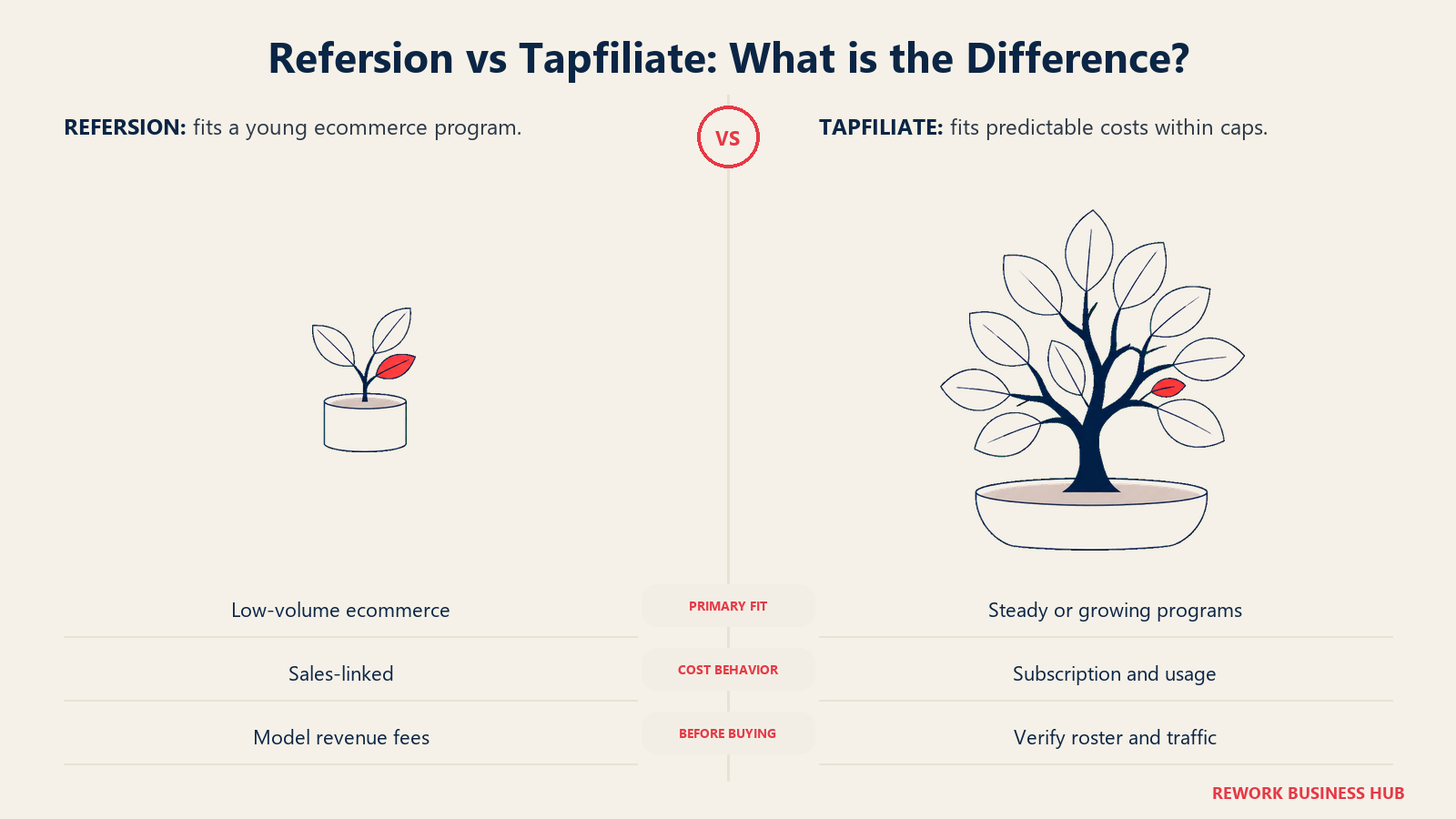
The short version. Refersion is cheaper when a program is small and untested, because 2-3% of a small number is a small number. Tapfiliate is cheaper almost everywhere past that early stage, because its price never moves regardless of how much revenue affiliates drive, as long as the affiliate count and traffic stay under the tier's caps. The real decision isn't which platform has more features, it's which side of roughly $1,500 to $4,700 a month your program sits on, and whether you're comfortable planning around Tapfiliate's caps instead of Refersion's percentage.
What to Do Next
Before choosing either platform, pull your current or projected monthly affiliate-driven sales, your active affiliate count, and your monthly click and conversion volume. Run those three numbers against the pricing table above. If you land clearly on one side of the crossover, the choice mostly makes itself. If you're close to the line, model both platforms at your actual numbers for a full year, not just one month, since the percentage fee compounds every month a program grows while the flat fee doesn't move at all.
Frequently Asked Questions about Refersion vs Tapfiliate
What's the main difference between Refersion and Tapfiliate?
Refersion charges a lower subscription, Launch at $39/mo ($29/mo annual) or Growth at $199/mo ($159/mo annual), plus a percentage of affiliate-driven sales, 3% on Launch and 2% on Growth. Tapfiliate charges a flat subscription with zero percentage fee, Launch at $89/mo ($74/mo annual) or Scale at $179/mo ($149/mo annual), but Launch caps out at 50 affiliates, 5,000 clicks a month and 500 conversions a month.
Is Tapfiliate really unlimited affiliates with no fee?
Only on Scale and above. Tapfiliate's Launch tier, at $89/mo or $74/mo annual, caps out at 50 affiliates, 5,000 clicks a month and 500 conversions a month, with overage charges of $1.50 per extra 1,000 clicks and $15 per extra 1,000 conversions. Unlimited affiliates, 100,000 clicks a month and 10,000 conversions a month start at Scale, $179/mo or $149/mo annual.
At what point does Refersion cost more than Tapfiliate?
Against Tapfiliate Launch, Refersion Launch costs more once affiliate-driven sales pass roughly $1,667 a month billed monthly, or $1,500 a month billed annually. Against Tapfiliate Scale, that crossover moves to roughly $4,667 a month billed monthly, or $4,000 a month billed annually. Refersion Growth's $199/mo (or $159/mo annual) subscription already exceeds both Tapfiliate tiers' flat price before any percentage fee is added.
Does Refersion have a free plan?
Refersion offers a Marketplace Listing tier at no cost, but it includes no tracking, management or payouts, so it functions as an affiliate-discovery listing rather than a usable free plan for running a program. Its first paid tier, Launch, starts at $39/mo ($29/mo annual) plus 3% of affiliate-driven sales.
Which platform is better for a Shopify store?
Refersion markets itself specifically as "designed and built for ecommerce brands and merchants," with native Shopify, Shopify Plus, WooCommerce and BigCommerce integrations and first-party tracking built around ecommerce checkout events. Tapfiliate also integrates natively with Shopify and WooCommerce among its 30+ pre-built integrations, so it's a fit too, but Refersion's positioning and feature set lean more specifically toward Shopify-first DTC brands.
Which platform is better for a SaaS or subscription business?
Tapfiliate, in most cases. It offers native recurring and lifetime commission support built for SaaS and subscription billing, plus native Stripe and Paddle integrations. Refersion is built primarily around a single ecommerce checkout event and isn't marketed toward recurring-revenue businesses the way Tapfiliate is.
What happens if a growing program exceeds Tapfiliate Launch's caps?
The program either pays overage charges, $1.50 per extra 1,000 clicks and $15 per extra 1,000 conversions on Launch, or upgrades to Scale at $179/mo ($149/mo annual), which raises the caps to unlimited affiliates, 100,000 clicks a month and 10,000 conversions a month. Whether a program breaches Launch's 500-conversion cap depends heavily on average order value: a $50,000/mo program needs only 100 conversions at a $500 average order value, but 1,000 conversions at a $50 average order value.
Are there other costs beyond the subscription and percentage fee on either platform?
Neither vendor's public pricing pages list a separate onboarding fee the way some enterprise partnership platforms do. Tapfiliate's only additional costs are its published click and conversion overage rates on Launch and Scale. Refersion's only additional cost beyond the subscription is its percentage fee on affiliate-driven sales, which is undisclosed on the custom Scale tier.

Principal Product Marketing Strategist
On this page
- TL;DR
- Key Facts
- Who Each Platform Is Built For
- Feature Parity at a Glance
- Commission Types and Payouts
- Integrations: Ecommerce-Native vs Broadly Cross-Platform
- Tapfiliate's Affiliate, Click and Conversion Caps
- Pricing at Real Affiliate-Driven Sales Volumes
- Where the Math Actually Crosses Over
- Implementation and Time to Value
- Support and Onboarding
- When Refersion Is the Right Call
- When Tapfiliate Is the Right Call
- When Neither Is the Right Call
- Decision Framework
- What to Do Next