Best PartnerStack Alternatives in 2026: 13 Platforms for B2B SaaS Partner Programs
Turn this article into takeaways for your work.


Each assistant summarizes the article only for you and suggests best practices for your work.
If you run partnerships at a B2B SaaS company and you're evaluating options past PartnerStack, the first three names worth a serious look are impact.com, Reditus, and Kiflo PRM, and which one fits depends on a question most roundups skip: is your program affiliates earning a commission on signups, resellers who need deal registration and margin protection, or both at once. PartnerStack built its name serving reseller, referral, and affiliate partners inside one program, plus a partner marketplace where partners discover you, and that breadth is why evaluating it takes longer than shopping for a single-purpose tool.
This guide sorts 13 alternatives into the three groups that matter to a partnerships lead or a founder doing this alone: other B2B SaaS partnership platforms built for the same job as PartnerStack, PRM software for teams managing resellers and channel partners rather than paying affiliate commissions, and self-serve SaaS affiliate tracking for a team that just needs tracking and payouts without a dedicated hire.
Key Facts
- 69% of companies plan to increase investment in partnerships this year. (PartnerStack and Wynter, "The State of Partnerships in GTM 2026")
- 51% of respondents say partners are involved in every sales and marketing decision at their company, while only 42% use multi-touch attribution across the partner funnel, meaning most programs still misattribute where partner-sourced revenue came from. (PartnerStack and Wynter, "The State of Partnerships in GTM 2026")
- US affiliate marketing spend grew 49.8% to roughly $13.6 billion in 2024, up from $9.1 billion in 2021, about twice the pace of ecommerce growth overall. (Performance Marketing Association, 2025 Industry Study)
- Nine in ten senior marketers across the UK, US, France, and Germany rated affiliate marketing effective or highly effective. (Awin, citing Awin and Forrester's 2024 Global Survey)
- Aligned go-to-market teams saw shortened sales cycles in 48% of cases and larger deal sizes in 23% of cases when partners were involved. (PartnerStack and Wynter, "The State of Partnerships in GTM 2026")
What PartnerStack Is and What It Costs
PartnerStack's pitch is breadth: one program that runs reseller, referral, and affiliate partners together, plus a partner marketplace where partners can find and apply to your program instead of you cold-recruiting every one of them. It's built specifically for B2B SaaS, not adapted from ecommerce affiliate software, so a reseller who needs a deal-registration flow or margin protection is a supported partner type from day one, not a workaround.
What it costs is where the evaluation gets slow. PartnerStack names three tiers, Launch, Growth, and Enterprise, and publishes no price for any of them. Its pricing page states this outright: "Pricing is based on your partner program size, feature needs, and level of support. Your final plan and pricing are confirmed during your demo." That's a real evaluation cost for a small team, not a footnote. You can't budget from PartnerStack's site the way you can from Rewardful's or Tapfiliate's, and getting a number means booking a call, describing your program, and waiting for a quote before you know whether it even fits your budget.
| Tier | What's published | What it's positioned for |
|---|---|---|
| Launch | No price published | Smaller programs getting a partner motion started |
| Growth | No price published | Scaling programs adding partner types or volume |
| Enterprise | No price published, custom quote | Large, complex partner ecosystems |
Source: partnerstack.com/pricing. No dollar figure appears anywhere on the page.
PartnerStack does publish scale numbers about its own network, worth naming even though they're vendor-reported rather than an independent benchmark: its 2026 research report states $2.7 billion in all-time gross merchandise value has moved through the PartnerStack Network, transaction volume grew 52% year over year in 2025, and 44% of active vendors adopted its AI tools that same year.
When PartnerStack is still the right call: if you're genuinely running all three partner types (affiliates, referral partners, and resellers) in one program, want a partner marketplace to recruit net-new partners from rather than only your own outbound list, and have the time and budget for a sales-led evaluation, PartnerStack's breadth is real. The alternatives below win on price transparency, category fit, or both, not because PartnerStack is a bad product.
Affiliate Platform, PRM, or Tracking Software: Three Different Products
The single biggest mistake a PartnerStack shopper makes is assuming every alternative on a "partner software" list does the same job. It doesn't; three genuinely different products get lumped into this category, and picking the wrong one wastes a quarter.
| Category | Partner type served | Who typically buys it | Price band (2026) | What it does NOT do |
|---|---|---|---|---|
| Affiliate / partnership platform | Affiliates, referral partners, and (on some) resellers | A partnerships lead or growth marketer running one program across partner types | Free-with-fees to $2,500+/mo, or quote-only; transaction fees are common | Deep reseller deal-registration, co-selling, or MDF workflows |
| PRM (partner relationship management) | Resellers, channel partners, system integrators | A channel or alliances lead managing partner relationships, not affiliate payouts | $399/mo and up, often quote-only above the entry tier | Calculating or paying a commission on a click-driven or affiliate-driven sale |
| Self-serve affiliate tracking | Individual SaaS affiliates sending signups or trials | One marketer, usually with no dedicated partnerships hire | $29 to roughly $750/mo, tiered by revenue, affiliate count, or volume | Reseller contracts, deal registration, co-selling, or a partner marketplace |
impact.com, Everflow, Partnerize, and Reditus sit in the first row alongside PartnerStack itself, software you run and recruit partners into yourself. Awin is a variant on that row: an affiliate network, where you rent access to an existing publisher base instead of building your own list, a model rooted in ecommerce more than B2B SaaS; our broader primer on running an affiliate marketing program covers that model in more depth. Kiflo PRM and Impartner sit entirely outside affiliate tracking. If your PartnerStack shortlist keeps drifting toward reseller agreements, deal registration, or co-selling, you may not need an affiliate tool at all. Our guide to building a channel partner program covers what that relationship actually requires before you buy software for it.
Why Teams Leave PartnerStack
| Reason | What to look for instead | Tool(s) on this list |
|---|---|---|
| No published pricing; sales-led evaluation takes weeks | A vendor with a self-serve published price you can test the same day | Reditus, Rewardful, FirstPromoter, Tapfiliate |
| The program is really reseller or channel management, not affiliate payouts | Dedicated PRM software, not an affiliate platform | Kiflo PRM, Impartner |
| Budget doesn't support an enterprise-shaped minimum | An entry tier priced in the tens, not hundreds, per month | Tapfiliate, LeadDyno, Rewardful, FirstPromoter |
| Need a bigger existing publisher network to recruit from, not just your own list | An affiliate network or a marketplace you rent access to | Awin, impact.com Essentials |
| Need attribution across paid, affiliate, and influencer in one view | A platform built around cross-channel attribution rather than partner tracking alone | Everflow, Partnerize |
| Outgrowing self-serve tracking, need fraud scoring, forecasting, or a dedicated CSM | An enterprise partnership platform with published entry pricing | impact.com Pro or Enterprise |
Quick Comparison Table
| Tool | Category | Best for | Starting price | Transaction fee | Key limitation |
|---|---|---|---|---|---|
| impact.com | Affiliate/partnership platform | Same breadth as PartnerStack, with a published entry price | $30/mo (Starter) | 2.5% on partner-driven transactions only | Unpublished onboarding fee |
| Everflow | Affiliate/partnership platform | Cross-channel attribution alongside affiliate tracking | No published price (reported) | Not published | 6-month minimum commitment |
| Partnerize | Affiliate/partnership platform | Large enterprise programs | No published price | Not published | Pricing page blocks automated verification (403) |
| Reditus | Affiliate/partnership platform (SaaS-native) | Early-to-mid stage B2B SaaS, priced on tracked ARR | $99/mo (Growth) | None on sales; 5% card or 2% invoice on automated payouts | Enterprise pricing climbs above $360K ARR tracked |
| Kiflo PRM | PRM | Reseller and channel relationship management | $399/mo (Core, 25 partners) | None; not affiliate-fee based | Doesn't calculate or pay affiliate commissions |
| Impartner | PRM | Large enterprise channel programs | No published price | Not published | Pricing page blocks automated verification (403) |
| Rewardful | Self-serve tracking | Small Stripe-billed SaaS teams | $49/mo (Starter) | None beyond subscription | Stripe-native; not built for other billing stacks |
| FirstPromoter | Self-serve tracking | Teams comparing head to head against Rewardful | $49/mo (Starter) | None beyond subscription | Lower entry revenue cap than Rewardful ($5K vs. $7.5K/mo) |
| Tapfiliate | Self-serve tracking | Volume-based budgeting instead of a revenue cap | $89/mo monthly, $74/mo annual (Launch) | None beyond subscription; click/conversion overages apply | 5,000 clicks/mo cap on the entry tier |
| Trackdesk | Self-serve tracking | Unlimited affiliates on every plan | $299/mo (Business) | None beyond subscription | Free-forever plan discontinued for new users |
| Post Affiliate Pro | Self-serve tracking (cloud or self-hosted) | Teams wanting a genuinely self-hostable option | $89/mo monthly, $79/mo yearly (Starter, regular price) | None beyond subscription | Tiered by tracking requests, easy to underestimate |
| LeadDyno | Self-serve tracking | Programs where affiliate headcount, not revenue, drives cost | $49/mo (Lite, 50 active affiliates) | None beyond subscription | Tiering by active affiliate count only |
| Awin | Affiliate network | Renting access to an existing publisher network | $49/mo + 3.5% (Access) | 3.5% (Access) or 2.5% (Accelerate) per transaction | Ecommerce-rooted network, not a channel/PRM tool |
1. impact.com: The Only Enterprise-Shaped Platform Here That Now Publishes a Price
Every stale listicle still calls impact.com quote-only enterprise software. That stopped being true when it published a rate card at impact.com/plans-b2b/, the biggest single correction worth making if you last looked more than a year ago. We go deeper on that shift, and on the rest of the field around it, in our guide to the best impact.com alternatives.
Starter runs from $30/mo for core tracking and payouts. Essentials starts at $500/mo and adds Partner Marketplace access, reach into 90,000 partners by impact.com's own count. Pro starts at $2,500/mo and adds dedicated support, cross-device tracking, API tracking, Data Lab, and SAML. Enterprise is quote-only and adds fraud scoring, forecasting, anomaly detection, and partner deduplication. A 2.5% transaction fee applies on every tier, but only to partner-driven transactions, charged when a sale happens rather than as a flat tax. A one-time onboarding fee also applies; its amount depends on the technical resources your integration needs, and impact.com doesn't publish a figure. One Starter wrinkle: no minimum fee in the first 30 days unless partners drive sales, but if your program hasn't generated at least $30 in partner-driven revenue by then, impact.com charges that $30 anyway.
| What you get | What you don't |
|---|---|
| A published entry price for the first time in this category's history | A published onboarding fee |
| The same reseller, referral, and affiliate breadth as PartnerStack | A transaction-fee-free plan |
| A 90,000-partner marketplace starting at Essentials | Enterprise pricing you can read without a call |
| Fraud scoring and forecasting at the top tier | A flat monthly number with nothing else added |
Best for: SaaS teams that want PartnerStack's one-program breadth across partner types but need a self-serve entry price to start the evaluation. Not ideal for: teams that want to avoid a transaction fee stacked on the subscription, or that need their full all-in cost, onboarding fee included, before talking to sales.
If impact.com and PartnerStack are your two finalists, our direct impact.com vs. PartnerStack comparison walks through the trade-off in more depth than a table can.
2. Everflow: Built for Teams That Want Attribution Across More Than Just Affiliates
Everflow's pitch isn't affiliate tracking alone, it's tracking affiliate, paid, referral, and influencer partnerships in one attribution layer, which matters if your partner-sourced revenue keeps getting double-counted against a paid channel in your reporting.
Everflow publishes no price. Its pricing page is a "Request Personalized Pricing" form only, and the one hard number it does state is a real buyer-relevant fact almost nobody mentions upfront: a 6-month minimum commitment. Everflow's own wording is direct about why: "We require a 6-month commitment for our Everflow plans, so we have enough time to help you scale and see results from your program." Budget the sales cycle and the lock-in period into your evaluation timeline before you get attached to it.
| What you get | What you don't |
|---|---|
| Attribution across paid, affiliate, referral, and influencer together | A published starting price |
| A platform built for performance-marketing-style granularity | Month-to-month flexibility |
| Strong fraud detection and click-fraud filtering | Anything you can budget from the website alone |
| A dedicated onboarding process | A trial you can start without a sales call |
Best for: teams running affiliate and paid or influencer partnerships together who want one attribution view and can commit to 6 months upfront. Not ideal for: teams that want month-to-month flexibility or a price before a sales conversation.
3. Partnerize: Enterprise Partnership Management With an Absorbed Affiliate Network Behind It
Partnerize acquired the affiliate network Pepperjam in 2020, consolidating two platforms into one enterprise partnership-management product serving, at the time, more than 1,750 enterprise and mid-market clients and roughly 750,000 partners worldwide. That history is why it shows up on enterprise shortlists next to impact.com rather than next to the self-serve tools further down this list.
Confirm current pricing with Partnerize in your own sales conversation, and don't trust a third-party figure that claims to know better.
| What you get | What you don't |
|---|---|
| An enterprise platform built from two consolidated affiliate businesses | Any verifiable published price |
| A partner base with real scale behind the brand | A self-serve trial or sign-up flow |
| Enterprise-grade reporting and partner management | A pricing page you can actually load |
| A track record serving large, complex programs | Anything to budget from before a call |
Best for: large enterprise programs that want a single partnership-management platform with the acquired reach of a legacy affiliate network behind it. Not ideal for: teams that want to compare pricing before booking an initial call, since nothing here is published.
4. Reditus: SaaS-Native Affiliate Software Priced on Tracked ARR, With a Partner Marketplace Built In
Reditus is the closest thing on this list to a purpose-built PartnerStack alternative for B2B SaaS specifically. It's priced on tracked ARR rather than clicks or affiliate headcount, which matches how a subscription business actually thinks about partner-sourced revenue, and it ships a partner marketplace so partners can find your program the way they can inside PartnerStack.
Growth runs $99/mo, or $1,188/yr, and covers up to $60K in tracked ARR, with a 14-day free trial and no card required. Scale Up is $399/mo billed annually ($4,788/yr) and covers up to $360K ARR. Enterprise starts from $799/mo billed annually ($9,588+/yr) with unlimited ARR. Every plan includes unlimited affiliates, and annual plans get free white-glove migration, worth asking about if you're moving off PartnerStack or another platform and don't want to re-onboard every partner by hand.
| What you get | What you don't |
|---|---|
| Pricing tied to tracked ARR, not clicks or headcount | A flat-rate plan with no revenue ceiling |
| Unlimited affiliates on every plan | Reseller or deal-registration workflows |
| A partner marketplace built for SaaS discovery | PartnerStack's enterprise-scale support tier |
| Free white-glove migration on annual plans | A published price below the $99 Growth tier |
Best for: early-to-mid stage B2B SaaS companies that want SaaS-specific tracking and a partner marketplace at a fraction of PartnerStack's evaluation cost. Companies transitioning from a pure product-led motion into partner-assisted sales should also read our guide to the PLG to SLG transition. Not ideal for: companies with affiliate-driven revenue well above $360K in tracked ARR, where Enterprise pricing starts climbing.
Reditus is also one of the tools covered in our broader affiliate marketing software roundup if you want it compared against tools outside this PartnerStack-specific list.
5. Kiflo PRM: Channel and Reseller Management, Not Affiliate Payouts
Kiflo is a genuinely different product from everything else here except Impartner, worth naming plainly: PRM software manages the relationship with resellers and channel partners, deal registration, co-selling, partner training and portals, MDF requests, not commission payouts to publishers who send clicks.
Core runs $399/mo for 25 partners, scaling to 50, with unlimited users at no extra cost. Plus and Premier are both "talk to sales" with no published rate, and a 10% discount applies on annual billing. If your actual pain with PartnerStack is that resellers need deal registration and margin protection while affiliates need commission tracking, and PartnerStack is forcing both into one shape, Kiflo for the reseller side paired with a dedicated affiliate tool is a more honest fit than one platform stretched across both jobs.
| What you get | What you don't |
|---|---|
| Deal registration, co-selling, and partner portal tools | Affiliate commission calculation or payouts |
| Unlimited users on every plan | A published rate above the Core tier |
| A 10% annual billing discount | A self-serve trial without a sales conversation |
| A product built specifically for channel relationships | Click, conversion, or affiliate-count-based tracking |
Best for: SaaS companies whose "partners" are resellers, system integrators, or referral partners who need a deal-registration workflow and co-selling tools, not affiliates earning a percentage of a sale. Not ideal for: anyone paying affiliates a commission on clicks or signups; Kiflo isn't built to calculate or pay that.
6. Impartner: The Enterprise PRM Name, With No Verifiable Price
Impartner is one of the longest-standing names in enterprise PRM, built around channel partner management, co-branded marketing, MDF management, and deal registration at a scale meant for large software companies with mature partner networks.
It's a real player worth a look if your program is enterprise-scale channel management. Confirm current pricing with Impartner in a direct conversation rather than relying on a third-party estimate. Either PRM choice lives alongside your CRM, not instead of it, since deal registration only works if it syncs back to the pipeline your sales team already runs in.
| What you get | What you don't |
|---|---|
| Deep enterprise PRM: co-branded marketing, MDF, deal registration | Any verifiable published price |
| A platform built for large, mature channel networks | A self-serve entry tier |
| Established market presence in enterprise PRM | A pricing page you can actually load |
| Sales-led onboarding built for complex deployments | Anything to budget from before a call |
Best for: enterprise software companies with a mature, large channel partner network needing deep PRM and the budget for a sales-led deployment. Not ideal for: smaller teams; there's no self-serve or published entry price at all.
7. Rewardful: The Stripe-Native Choice for a Small SaaS Team
Rewardful is the simplest self-serve option here for a team that wants affiliate tracking wired directly into Stripe checkout, run by one marketer with no partnerships hire and no dev project.
Pricing is tiered by monthly affiliate-driven revenue rather than clicks or headcount: Starter $49/mo up to $7,500/mo revenue, Growth $99/mo up to $15,000/mo, Enterprise $149+/mo above $15,000/mo. A 14-day free trial is available, and annual billing gets you 2 months free.
| What you get | What you don't |
|---|---|
| Native Stripe integration with no dev project | Support for non-Stripe billing stacks |
| Simple, revenue-based tiering | Reseller or deal-registration workflows |
| A 14-day trial and 2 months free annually | A partner marketplace |
| A UI built for a solo marketer to run alone | Enterprise support or SAML |
Best for: a small SaaS team on Stripe billing that wants affiliate tracking without a partnerships hire. Not ideal for: teams not on Stripe, or that need reseller and deal-registration workflows Rewardful doesn't offer. If pure ecommerce-style affiliate tracking is closer to what you need, our Refersion alternatives roundup covers that adjacent shortlist.
8. FirstPromoter: Rewardful's Closest Rival, With a Lower Entry Revenue Cap
FirstPromoter runs nearly the same pricing shape as Rewardful, worth comparing side by side rather than picking blind. The real difference is the entry-tier revenue cap: Starter is $49/mo for up to $5,000/mo in affiliate-driven revenue, a lower ceiling than Rewardful's $7,500/mo at the same price. Business is $99/mo up to $15,000/mo, and Enterprise starts from $149/mo above that. A 14-day free trial requires no credit card. Yearly plans exist, but FirstPromoter doesn't display the annual figures on its pricing page.
| What you get | What you don't |
|---|---|
| Pricing nearly identical to Rewardful's shape | A higher entry-tier revenue cap than Rewardful |
| A 14-day trial with no card required | Published annual pricing on the page |
| Solid Stripe and other billing-platform integrations | A partner marketplace or reseller tools |
| A dashboard some teams prefer over Rewardful's | Enterprise-scale support at the entry tiers |
Best for: teams comparing directly against Rewardful who want to weigh both before committing, especially if Rewardful's $7,500 cap doesn't matter but a specific integration or dashboard preference does. Not ideal for: teams that want annual pricing published upfront rather than asked for.
9. Tapfiliate: Volume-Based Overages Instead of a Revenue Cap
Tapfiliate prices around click and conversion volume rather than affiliate-driven revenue, which suits a team that would rather budget on traffic than forecast commission-eligible revenue months out.
Launch is $89/mo monthly or $74/mo annual ($890/yr): 1 program, 50 affiliates, 5,000 clicks/mo, 500 conversions/mo, overages at $1.50 per 1,000 clicks and $15 per 1,000 conversions, 7-day trial. Scale is $179/mo monthly or $149/mo annual ($1,790/yr): unlimited programs and affiliates, 100,000 clicks/mo, 10,000 conversions/mo, overages at $1 per 1,000 clicks and $10 per 1,000 conversions, 14-day trial. Enterprise is custom with a 30-day trial. Annual billing is two months free across tiers.
| What you get | What you don't |
|---|---|
| Volume-based pricing instead of a revenue cap | Unlimited programs below the Scale tier |
| Multiple affiliate programs on one account at Scale | A generous click allowance on Launch |
| Clear, published overage rates | Reseller or deal-registration tools |
| Trial length that grows with plan tier | A single flat monthly number with no metering |
Best for: teams that would rather budget on click and conversion volume than revenue share, or that run more than one affiliate program. Not ideal for: low-volume programs where the Launch tier's 5,000-click cap gets hit fast and overages stack up.
10. Trackdesk: The Free Plan Is Gone. Budget for a Trial Instead.
Trackdesk's entire reputation in this category was built on a free-forever plan, and that plan no longer exists for new users. It's worth stating this plainly because most competing lists still lead with "Trackdesk is free," and that's out of date.
Trackdesk's own help centre confirms it in an article titled "Limits of the Deprecated Free Plan": "The Free plan has been discontinued and is no longer available for new users." Existing users are grandfathered at the old plan's limits: a $1,000 revenue cap, 50 affiliate partners, 5,000 clicks/mo, 500 conversions/mo, 1 seat, 1 active offer, and 1 currency. For anyone signing up now, the vendor states plainly: "The only available free access to the platform is to apply for the 14-day free trial for any of the platform plans." Current Affiliate Program plans, shown with annual billing by default and labeled "Save 2 months," are Business at $299/mo, Enterprise at $359/mo, and Enterprise PLUS from $1,199/mo. Clicks, conversions, and affiliate partners are unlimited on every plan.
| What you get | What you don't |
|---|---|
| Unlimited clicks, conversions, and affiliates on every plan | Any free tier for new signups |
| A 14-day trial across all plan levels | A price near what Trackdesk is known for |
| Three tiers scaling to Enterprise PLUS | A budget-friendly entry point |
| Grandfathered access for legacy free-plan users | Anything comparable for a brand-new account |
Best for: mid-size to large programs that want unlimited affiliates, clicks, and conversions on every plan and can absorb a $299/mo minimum. Not ideal for: anyone shopping Trackdesk specifically because they read it's free; budget for the 14-day trial and a paid plan after it.
11. Post Affiliate Pro: Cloud or Self-Hosted, Metered on Tracking Requests
Post Affiliate Pro is one of the few tools here that genuinely offers a self-hosted option alongside its cloud product, which matters if data residency or platform ownership is part of why you're leaving a SaaS-only tool like PartnerStack.
Pricing runs by tracking requests rather than clicks or affiliates. Starter is $89/mo monthly or $79/mo yearly for 10,000 requests/mo. Pro is $139/mo or $129/mo yearly for 1,000,000 requests/mo. Ultimate is $269/mo or $249/mo yearly for 6,000,000 requests/mo. Network is $649/mo or $599/mo yearly for 20,000,000 requests/mo. Affiliates are unlimited on every plan, with a free trial available. Overage runs from $5 per 10,000 requests on Starter down to $0.20 per 10,000 on Network.
| What you get | What you don't |
|---|---|
| A genuine self-hosted option, rare in this category | Click or affiliate-count-based pricing you may find simpler |
| Unlimited affiliates on every tier | Revenue-banded pricing, which several rivals here do offer |
| Four tiers scaling to 20 million tracking requests/mo | A cheap entry point; $89/mo sits mid-pack for this category |
| A free trial on both cloud and self-hosted paths | Reseller or channel-management tooling |
Best for: teams that want either a cloud plan or a genuinely self-hostable option, and that are comfortable tracking usage in requests rather than clicks. Not ideal for: programs with light technical volume but high sales, where a revenue-banded tool lands cheaper.
12. LeadDyno: Tiered by Active Affiliates, Not Revenue
LeadDyno's pricing differentiator is headcount: it tiers on active affiliates rather than revenue or click volume, which fits a referral-heavy SaaS community where a large number of low-volume affiliates is normal.
Lite is $49/mo for 50 active affiliates, no annual discount shown. Essential is $129/mo monthly or $110/mo annual (15% savings) for 150 active affiliates. Advanced is $349/mo monthly or $297/mo annual for 500 active affiliates. Unlimited is $749/mo monthly or $637/mo annual for unlimited affiliates. A 30-day trial is available, and clicks and conversions are unlimited on every plan.
| What you get | What you don't |
|---|---|
| Pricing that scales with affiliate headcount, not revenue | A revenue-based tier for high-value, low-count programs |
| Unlimited clicks and conversions on every plan | Annual discount shown at the Lite tier |
| A 30-day trial, longer than most on this list | Reseller or deal-registration tools |
| Four tiers reaching unlimited affiliates | A low-cost path once you pass 500 active affiliates |
Best for: a program where affiliate headcount is the real driver of platform load and cost, not clicks or revenue, common in referral-heavy SaaS communities. If your program leans more toward customer referrals than paid affiliates, our ReferralCandy alternatives roundup is worth a look too. Not ideal for: programs with a small number of very high-volume affiliates, where per-affiliate tiering costs more than a click- or revenue-based competitor.
13. Awin: Rent a Publisher Network Instead of Running Your Own Program
Awin is a different product category from everything else on this list: an affiliate network, not software you populate with partners you recruited yourself. You get access to Awin's existing publisher base rather than building a list from zero, a model rooted in ecommerce and retail more than B2B SaaS.
Access, on Awin's US pricing page, runs $49/mo plus a 3.5% transaction fee, with a 3-month minimum contract and 14-day cancellation notice. Accelerate starts from $99/mo plus a 2.5% transaction fee. Advanced is custom-priced with unlimited commission rules. One fact worth stating for anyone still comparing ShareASale: all active ShareASale advertisers and publishers moved onto Awin on 15 August 2025, more than 9,500 advertisers and 250,000 active publishers by Awin's own count, and the ShareASale platform itself closed on 6 October 2025. If ShareASale is still on your list, it no longer exists; Awin is where its accounts went.
| What you get | What you don't |
|---|---|
| Immediate access to an established publisher network | A network built for B2B SaaS commission structures |
| A published US pricing page with three tiers | A transaction-fee-free plan |
| The absorbed ShareASale advertiser and publisher base | Reseller or deal-registration workflows |
| Unlimited commission rules at the top tier | MRR or ARR-based tracking |
Best for: teams that want immediate access to an established publisher network rather than building one from zero, and that are comfortable with a transaction fee stacked on the subscription. Not ideal for: B2B SaaS companies whose core need is reseller workflows or MRR-based commission tracking; Awin's roots and publisher base are ecommerce-first.
How to Choose: Decision Framework
First identify the partner motion you run, then use attribution, marketplace, and pricing needs to narrow the platform.
| If you need... | Pick |
|---|---|
| PartnerStack's breadth (affiliate, referral, and reseller in one program) but a published entry price | impact.com |
| Cross-channel attribution across paid, affiliate, and influencer together | Everflow |
| An enterprise partnership platform with a large acquired network behind it | Partnerize |
| SaaS-native tracking priced on tracked ARR, with a partner marketplace | Reditus |
| Reseller or channel partner management: deal registration, co-selling, not affiliate payouts | Kiflo PRM |
| The same PRM need at enterprise scale | Impartner |
| Simple Stripe-native tracking run by one marketer | Rewardful or FirstPromoter |
| Click and conversion volume pricing instead of a revenue cap | Tapfiliate |
| Unlimited affiliates on every plan and a budget that clears $299/mo | Trackdesk |
| A self-hosted option you control | Post Affiliate Pro |
| Pricing that scales with affiliate headcount, not revenue | LeadDyno |
| Access to an existing publisher network instead of building your own | Awin |
What Migration Costs You
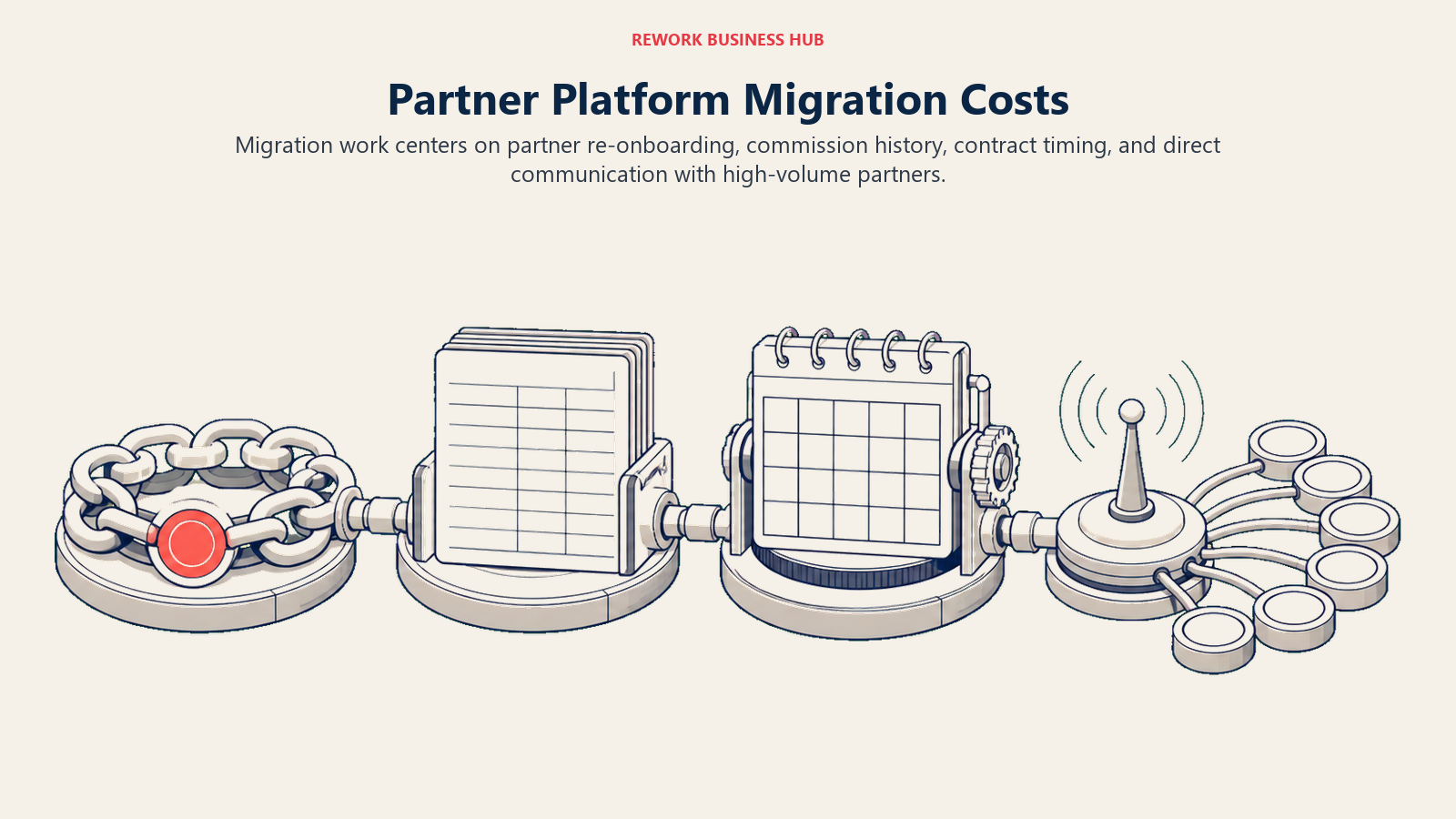
Moving off PartnerStack, or onto it, carries costs no pricing table shows. Budget for them before you sign.
| Migration cost | What it involves |
|---|---|
| Partner re-onboarding | Every affiliate or reseller gets a new tracking link or portal login; expect a dip in tracked activity for 2 to 4 weeks after cutover |
| Historical commission data | Decide upfront whether you need to import past payout history into the new platform or start clean |
| Contract timing | Watch minimum commitments before you lock in a start date, Awin's is 3 months and Everflow's is 6 |
| Partner communication | Your highest-volume partners need direct outreach, not a blanket email; they're the ones whose tracking breaks first if a link isn't updated |
Our lead-to-revenue attribution guide is a useful companion here if part of your migration reason is that PartnerStack's reporting doesn't tie back cleanly to your CRM's pipeline data.
Frequently Asked Questions about PartnerStack Alternatives
Why doesn't PartnerStack publish its pricing?
PartnerStack names three tiers, Launch, Growth, and Enterprise, by name only. Its pricing page states pricing depends on your partner program size, feature needs, and level of support, and your final plan and price are confirmed during a demo. There's no dollar figure published anywhere on the site.
What's the actual difference between a PRM and an affiliate platform?
A PRM like Kiflo or Impartner manages the relationship with resellers and channel partners: deal registration, co-selling, partner portals, MDF requests. An affiliate platform like PartnerStack, impact.com, Reditus, Everflow, or Partnerize calculates and pays commissions on partner-driven sales or signups. Buying the wrong one for your program wastes months.
Is ShareASale still a PartnerStack alternative worth considering?
No. ShareASale's advertisers and publishers moved to Awin on 15 August 2025, and the ShareASale platform itself closed on 6 October 2025. Any current listicle still recommending it is out of date; Awin is the direct successor.
What's the cheapest PartnerStack alternative for a small B2B SaaS team?
Rewardful and FirstPromoter both start at $49/mo, and LeadDyno's Lite tier is also $49/mo for up to 50 active affiliates. None of the three carry a transaction fee on top of the subscription, which matters more over a year than the sticker price alone.
Do impact.com, Everflow, and Partnerize charge extra fees beyond the listed subscription?
impact.com adds a 2.5% transaction fee on partner-driven transactions only, plus an unpublished onboarding fee. Everflow and Partnerize don't publish a fee structure, since neither publishes pricing in the first place; confirm both during your sales conversation.
Which alternative fits a company that just signed a reseller and needs deal registration?
Kiflo PRM or Impartner, not an affiliate platform. Deal registration, margin protection, and co-selling workflows are PRM functions; none of the affiliate or partnership platforms on this list are built to run that relationship.
How long should I budget to evaluate a quote-only platform like PartnerStack, Everflow, or Partnerize?
Plan for weeks, not days. A demo, a scoping conversation, and a negotiated quote typically take longer than signing up for a self-serve tool with published pricing, so factor that timeline into your rollout plan if you're replacing a platform under time pressure.
Is Awin a good fit for a B2B SaaS company, or is it ecommerce-only?
Awin's publisher base and pricing model are rooted in ecommerce and retail, and it's not built around MRR or ARR-based commission tracking the way Reditus or Rewardful are. It's still a viable option if what you want is access to an established network rather than SaaS-specific tracking, but it's not the SaaS-native pick on this list.
What to Do Next
Decide which of the three segments your program actually needs before you compare a single price: affiliate and partnership tracking, PRM for resellers and channel partners, or self-serve tracking for a one-person operation. Then take your two closest fits from that segment and run a real 30-day pilot with your 10 highest-volume partners before signing an annual contract, since that's where transaction fees, tracking-request caps, and revenue-cap overages actually show up, not in the sticker price you compared on day one.

Principal Product Marketing Strategist
On this page
- Key Facts
- What PartnerStack Is and What It Costs
- Affiliate Platform, PRM, or Tracking Software: Three Different Products
- Why Teams Leave PartnerStack
- Quick Comparison Table
- 1. impact.com: The Only Enterprise-Shaped Platform Here That Now Publishes a Price
- 2. Everflow: Built for Teams That Want Attribution Across More Than Just Affiliates
- 3. Partnerize: Enterprise Partnership Management With an Absorbed Affiliate Network Behind It
- 4. Reditus: SaaS-Native Affiliate Software Priced on Tracked ARR, With a Partner Marketplace Built In
- 5. Kiflo PRM: Channel and Reseller Management, Not Affiliate Payouts
- 6. Impartner: The Enterprise PRM Name, With No Verifiable Price
- 7. Rewardful: The Stripe-Native Choice for a Small SaaS Team
- 8. FirstPromoter: Rewardful's Closest Rival, With a Lower Entry Revenue Cap
- 9. Tapfiliate: Volume-Based Overages Instead of a Revenue Cap
- 10. Trackdesk: The Free Plan Is Gone. Budget for a Trial Instead.
- 11. Post Affiliate Pro: Cloud or Self-Hosted, Metered on Tracking Requests
- 12. LeadDyno: Tiered by Active Affiliates, Not Revenue
- 13. Awin: Rent a Publisher Network Instead of Running Your Own Program
- How to Choose: Decision Framework
- What Migration Costs You
- What to Do Next