Best Refersion Alternatives in 2026: 13 Affiliate Platforms for Ecommerce Brands
Turn this article into takeaways for your work.


Each assistant summarizes the article only for you and suggests best practices for your work.
Comparing Refersion against something else, the tools worth shortlisting first are Tapfiliate for a flat rate with no percentage fee, Post Affiliate Pro for unlimited affiliates at a fixed price, and impact.com if you've outgrown self-serve entirely. This guide covers those three plus ten more, evaluated on published vendor pricing, the fee structure behind the subscription price, and honest fit by program size.
This is for the ecommerce or DTC marketer who owns an affiliate program day to day: the person who set up Refersion two years ago, watched the monthly bill grow faster than the subscription price explains, and wants to know whether that's normal. Monthly and annual billing are stated separately wherever a vendor publishes both.
Key Facts
- US affiliate marketing spend grew 49.8% from $9.1 billion (2021) to $13.62 billion (2024), generating an estimated $113 billion in US ecommerce sales, per the Performance Marketing Association's 2025 industry study. (The PMA)
- Customers acquired through affiliate partners carried average order values 21% higher, and repurchased at a 21% higher rate, than customers from other channels, per a Forrester Consulting study commissioned by Awin. (Awin)
- 74% of brands generate 11% to 30% of total revenue from affiliate marketing, and 14% generate more than 30%, per impact.com's 2025 Global State of Affiliate Marketing report, a vendor survey of 818 marketers across 8 countries. (impact.com)
- Just 2.9% of Shopify stores show any detectable affiliate or referral activity, per a 2026 analysis of 193,717 stores by StoreInspect, meaning most DTC brands running a program are ahead of the market, not behind it. (StoreInspect)
- 69% of companies plan to increase investment in partnerships this year, per PartnerStack and Wynter's State of Partnerships in GTM 2026 report. (PartnerStack)
What Refersion Costs Once You Include the Percentage
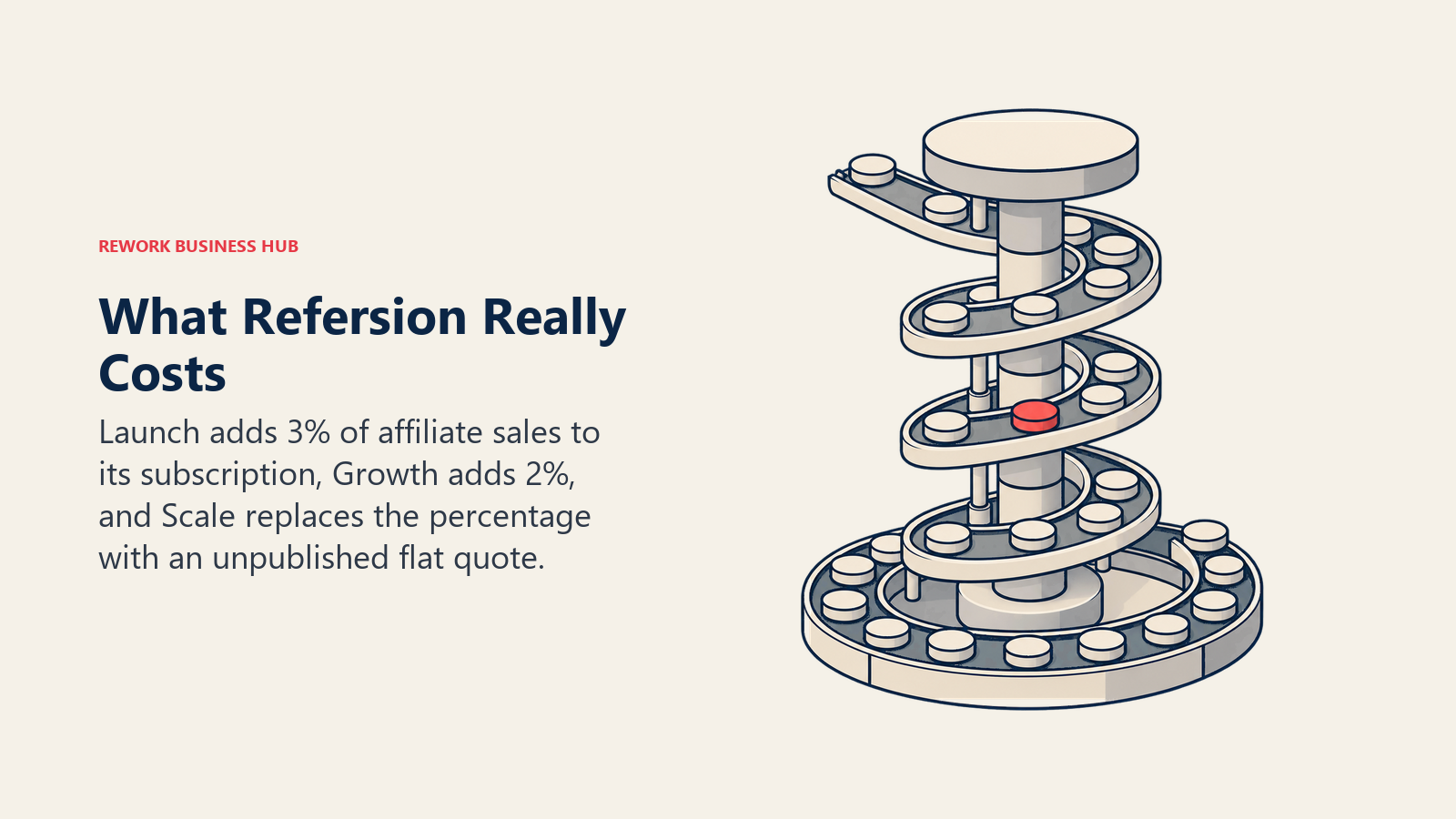
Refersion's pricing page reads simply: Launch at $39/mo, Growth at $199/mo. What it doesn't put in the headline is that both tiers also take a cut of the sales your affiliates drive, and that second number is what actually decides your bill once the program grows.
| Refersion plan | Subscription (monthly) | Subscription (annual) | Transaction fee | What it includes |
|---|---|---|---|---|
| Marketplace Listing | Free | Free | None | Listing in Refersion's affiliate marketplace, no tracking |
| Launch | $39/mo | $29/mo (20% off) | 3% of affiliate-driven sales | Unlimited affiliates, clicks and conversions |
| Growth | $199/mo | $159/mo | 2% of affiliate-driven sales | Everything in Launch, plus higher-touch program features |
| Scale | Custom | Custom | None (flat subscription instead) | For brands doing more than $1 million GMV per year; flat figure not published |
Source: refersion.com/pricing.
To be fair to Refersion: unlimited affiliates, clicks and conversions on every paid plan is a real advantage. Several flat-rate competitors below cap clicks or conversions and charge overage fees once you cross them; Refersion never does. Its Shopify integration is also genuinely strong.
But the percentage decides the bill at any real volume, so here's the arithmetic. At $50,000 a month in affiliate-driven sales, Refersion Growth costs $199 plus 2% of $50,000 ($1,000), for a total of $1,199 a month. A flat-rate tool priced at $299 a month costs $299 regardless of sales volume. Below some crossover point the percentage is cheaper; above it, it isn't. That crossover is different for every flat-rate competitor, so here's where it lands against five of them.
| Flat-rate alternative | Monthly price | Crossover vs. Refersion Growth ($199 + 2%) | What happens |
|---|---|---|---|
| Tapfiliate Scale | $179/mo | Never; Tapfiliate is always cheaper | $199 alone exceeds $179 before a dollar of commission is added |
| Post Affiliate Pro Ultimate | $269/mo | $3,500/mo in affiliate-driven sales | Below $3,500/mo, Growth is cheaper; above it, Post Affiliate Pro wins |
| Trackdesk Business | $299/mo | $5,000/mo in affiliate-driven sales | Below $5,000/mo, Growth is cheaper; above it, Trackdesk wins |
| LeadDyno Advanced | $349/mo | $7,500/mo in affiliate-driven sales | LeadDyno tiers by affiliate count too, so check headcount as well as this number |
| Referral Factory Pro | $400/mo | $10,050/mo in affiliate-driven sales | Referral Factory tiers by tracked users, not sales, so this comparison is approximate |
Do the math for your own program: multiply monthly affiliate-driven sales by 0.02, add $199, and compare the result to your flat-rate candidate. Nowhere near six figures a month, Growth is likely still cheaper. Well past it, you're probably overpaying for a percentage when a flat rate would do the job for less.
When Refersion is still the right call
- Your affiliate-driven sales sit below the crossover point for whichever alternative you're weighing.
- You expect to exceed the click or conversion caps that trigger overage fees on capped flat-rate plans like Tapfiliate's; Refersion meters neither.
- You run on Shopify and want the fastest path to a working program, which the native integration genuinely delivers.
- You're already past $1 million GMV a year, where Scale drops the percentage for a flat subscription. Get a quote before assuming that's cheaper; the figure isn't published.
Why Brands Leave Refersion
| Reason brands leave | Look for instead | Where on this list |
|---|---|---|
| Percentage fee gets expensive as the program scales | A flat monthly rate, no transaction fee | Tapfiliate, Post Affiliate Pro, Trackdesk |
| Need an existing publisher network, not just software | A network you rent into | Awin, CJ Affiliate |
| Outgrown self-serve, need fraud scoring and support | A partnership platform built for scale | impact.com, Everflow |
| Running a Stripe-billed SaaS product, not a cart | Revenue-banded pricing, not a percentage | Rewardful, FirstPromoter |
| Want a real $0 tier before committing budget | A genuine free plan, not just a trial | UpPromote |
| Program size tracks affiliate headcount better than GMV | Pricing tied to active affiliate count | LeadDyno |
| Want the success fee to taper sharply | A steep percentage taper across tiers | ReferralCandy |
| Need referral-link tracking beyond a classic program | User-tracked referral software | Referral Factory |
One more thing most competing pages get wrong: ShareASale is not an option anymore. Its advertisers and publishers moved onto Awin on 15 August 2025, and the platform itself closed on 6 October 2025, taking historical reporting with it.
Quick Comparison Table
| Tool | Best for | Starting price | Transaction or success fee | Key strength | Key limitation |
|---|---|---|---|---|---|
| UpPromote | Shopify brands wanting a genuine free tier | Free; paid from $29.99/mo ($24.99/mo annual) | 2% Growth, 1.5% Professional, 1% Enterprise | A real $0 plan plus Shopify-native setup | Percentage fee still stacks on every paid tier |
| Tapfiliate | Flat pricing with room to grow into unlimited affiliates | $89/mo ($74/mo annual) | None | No percentage fee, ever | Click and conversion caps trigger overage fees |
| Post Affiliate Pro | High-volume programs wanting a flat rate | $89/mo ($79/mo annual) | None | Unlimited affiliates on every tier | Tiered by tracking-request volume, not revenue |
| ReferralCandy | DTC brands running referral-style programs | $39/mo | 10.5% down to 0.25% by tier | Fee applies only to new customers' first 3 orders | Highest headline percentage of any tool here |
| LeadDyno | Programs sized by affiliate count, not revenue | $49/mo | None | Unlimited clicks and conversions on every plan | Cost scales with affiliate count, not performance |
| Trackdesk | Unlimited tracking without a percentage fee | $299/mo | None | Unlimited affiliates, clicks and conversions | The famous free-forever plan is gone for new signups |
| Awin | Renting an established publisher network | $49/mo | 3.5% Access, 2.5% Accelerate | Access to Awin's existing publisher marketplace | Percentage fee stacks on top of the subscription |
| impact.com | Brands that have outgrown self-serve tracking | From $30/mo | 2.5% on partner-driven transactions | Full partnership platform, now with published entry pricing | Jump from Starter to Essentials is more than 16x |
| Everflow | Enterprise teams needing custom tracking logic | Quote only | Not published | Deep customization for complex programs | No published price, 6-month minimum commitment |
| Rewardful | Stripe-billed SaaS companies | $49/mo | None (revenue-banded tiers) | No percentage fee, just revenue bands | Built for Stripe SaaS, not ecommerce carts |
| FirstPromoter | SaaS teams comparing directly against Rewardful | $49/mo | None (revenue-banded tiers) | Lower entry revenue cap than Rewardful | Same SaaS orientation, not ecommerce-first |
| Referral Factory | Referral programs tracked by user count | $200/mo ($160/mo annual) | None | Predictable cost tied to reach, not sales | Highest entry price of any self-serve tool here |
| CJ Affiliate | Access to one of the oldest affiliate networks | Not published | Not published | Deep, decades-old publisher relationships | No public pricing; application and approval required |
1. UpPromote: The One With an Actual Free Plan
UpPromote is Shopify-first the way Refersion is, but it answers the "can I start at zero dollars" question that Refersion can't. The Free plan supports one program and up to $3,000 in referral reviews a month, genuinely free rather than a time-limited trial.
Above free, the shape flips against Refersion's: UpPromote's percentage fee drops as you pay more, from 2% on Growth down to 1% on Enterprise, while Refersion's drops from 3% to 2% across just two tiers. Neither escapes the percentage entirely, but UpPromote's floor is lower, and the free tier is the real differentiator for a store not ready to commit budget yet.
| What you get | What you don't |
|---|---|
| A genuine $0 plan to test the waters | A percentage-free tier at any price point |
| A percentage fee that falls as you scale | Feature parity with Growth at Free |
| Native Shopify setup | A published flat-rate option for high-volume programs |
Pricing: Free: $0/mo, 1 program, up to $3,000 referral review/mo. Growth: $29.99/mo monthly, $24.99/mo annual, plus 2% of successful referral sales. Professional: $89.99/mo monthly, $74.99/mo annual, plus 1.5%. Enterprise: $199.99/mo monthly, $166.66/mo annual, plus 1%, unlimited. 14-day trial on paid plans. Best for: Shopify brands that want to launch an affiliate program without committing a subscription budget first.
2. Tapfiliate: Flat Pricing, No Percentage, Ever
Tapfiliate answers Refersion's transaction fee with the simplest possible counter: it doesn't charge one. Launch and Scale are flat monthly rates, and neither takes a cut of what your affiliates sell.
The trade-off is volume caps. Launch allows 5,000 clicks and 500 conversions a month before overage kicks in at $1.50 per 1,000 clicks and $15 per 1,000 conversions; Scale raises those ceilings to 100,000 clicks and 10,000 conversions at lower overage rates. Most mid-size DTC programs won't bind against those ceilings, but a high-traffic brand should model against them first.
| What you get | What you don't |
|---|---|
| Zero percentage fee at any tier | Unlimited clicks and conversions like Refersion offers |
| Unlimited affiliates and programs on Scale | A free tier |
| A 7 to 14-day trial depending on plan | Predictable cost above the volume ceiling |
Pricing: Launch: $89/mo monthly, $74/mo annual ($890/yr). 1 program, 50 affiliates, 5,000 clicks/mo, 500 conversions/mo; overage $1.50 per 1,000 clicks, $15 per 1,000 conversions. 7-day trial. Scale: $179/mo monthly, $149/mo annual ($1,790/yr). Unlimited programs and affiliates, 100,000 clicks/mo, 10,000 conversions/mo; overage $1 per 1,000 clicks, $10 per 1,000 conversions. 14-day trial. Enterprise: custom, 30-day trial. Best for: Mid-size programs that want a flat, predictable bill and can live within Tapfiliate's traffic ceilings. We run the full break-even in Refersion vs Tapfiliate, and Tapfiliate alternatives covers the rest of the flat-rate field.
3. Post Affiliate Pro: Unlimited Affiliates on Every Tier
Post Affiliate Pro's pitch is unusual: unlimited affiliates on every plan, including Starter, with the tier ladder built around tracking-request volume instead of affiliate headcount or sales, a friendlier metric for a small roster of high-performing affiliates than Refersion's percentage of sales.
Pricing runs from Starter at $89/mo ($79/mo yearly) for 10,000 tracking requests up to Network at $649/mo ($599/mo yearly) for 20 million. Quote the tier ceilings as carefully as the prices: a tracking request counts clicks, impressions and postbacks together, not clicks alone, so a program with heavy banner placements can outgrow Starter well before its sales volume suggests it should.
| What you get | What you don't |
|---|---|
| Unlimited affiliates at every tier, including Starter | Pricing tied to sales or affiliate count |
| A flat rate with zero percentage fee | A tier ceiling measured in sales rather than tracking requests |
| A free trial to test before committing | A cap-free tier; tracking requests still meter usage |
Pricing: Starter $89/mo monthly, $79/mo billed yearly, 10,000 tracking requests/mo. Pro $139/mo monthly, $129/mo yearly, 1,000,000 tracking requests/mo. Ultimate $269/mo monthly, $249/mo yearly, 6,000,000 tracking requests/mo. Network $649/mo monthly, $599/mo yearly, 20,000,000 tracking requests/mo. Overage runs from $5 per 10,000 requests on Starter down to $0.20 per 10,000 on Network. Unlimited affiliates on every plan. Free trial available. Best for: Programs that want unlimited affiliates and a flat rate, and can budget around tracking volume instead of GMV.
4. ReferralCandy: The Success Fee Is the Real Story
ReferralCandy leans referral program more than pure affiliate network, and its pricing is the steepest percentage taper here. Basic starts at a 10.5% success fee, the highest headline rate in this guide, dropping to 3.5% on Grow, 1.5% on Scale, and just 0.25% on Enterprise, with the subscription climbing the same ladder from $39/mo to $799/mo.
What makes the fee less alarming than it sounds: it applies only to a new customer's first three orders, not every repeat purchase after. For a brand already investing in retention through email and loyalty programs, that scoping matters, since it means ReferralCandy isn't taking a cut of your customer lifetime value the way an uncapped percentage would.
| What you get | What you don't |
|---|---|
| A fee scoped to new customers' first 3 orders only | A flat rate with no percentage at all |
| A percentage that falls sharply as you scale | Annual billing; none is published |
| Unlimited campaigns and full API access on every plan | A free tier; only a 7-day trial |
Pricing: Basic $39/mo + 10.5% success fee. Grow $79/mo + 3.5%. Scale $249/mo + 1.5%. Enterprise $799/mo + 0.25%. 7-day free trial. No annual pricing published. Success fees apply to net-new customers' first three orders only. All plans: unlimited campaigns, custom coupon codes, full API access. Best for: DTC brands running a referral-style program where the fee should only apply to genuinely new customers. If ReferralCandy itself is what you're replacing, see our ReferralCandy alternatives guide.
5. LeadDyno: Priced by Affiliate Count, Not Revenue
LeadDyno is the cleanest example here of a tool that ignores GMV entirely. Its four tiers are set by how many active affiliates you run, from 50 on Lite up to unlimited, with no percentage fee and unlimited clicks and conversions on every plan.
That structure suits a small, curated roster of affiliates that each drive meaningful volume, where cost stays flat no matter how much they sell. It's the wrong fit for a sprawling, low-performing affiliate base, since you'll pay the same $349/mo on Advanced whether those 500 affiliates generate $10,000 or $500,000 a month between them.
| What you get | What you don't |
|---|---|
| No percentage fee at any tier | A pricing model that rewards a smaller, elite roster |
| Unlimited clicks and conversions everywhere | A free tier; 30-day trial only |
| Predictable cost regardless of sales volume | Cost that falls if your affiliate count shrinks mid-cycle |
Pricing: Lite $49/mo, 50 active affiliates, no annual discount shown. Essential $129/mo monthly, $110/mo annual (15% off), 150 active affiliates. Advanced $349/mo monthly, $297/mo annual, 500 active affiliates. Unlimited $749/mo monthly, $637/mo annual, unlimited affiliates. 30-day free trial. Unlimited clicks and conversions on every plan. Best for: Programs with a defined, curated affiliate roster where cost per affiliate matters more than cost per sale.
6. Trackdesk: The Free Plan Is Gone, but the Flat Rate Remains
Trackdesk built its reputation on a free-forever plan, and that reputation is out of date. Its help center is explicit: "The Free plan has been discontinued and is no longer available for new users." Existing users are grandfathered on the old $1,000 revenue cap, 50 affiliates, and 5,000 clicks a month; new signups get a 14-day trial and nothing free beyond it. If a listicle calls Trackdesk free, it's describing 2025, not 2026.
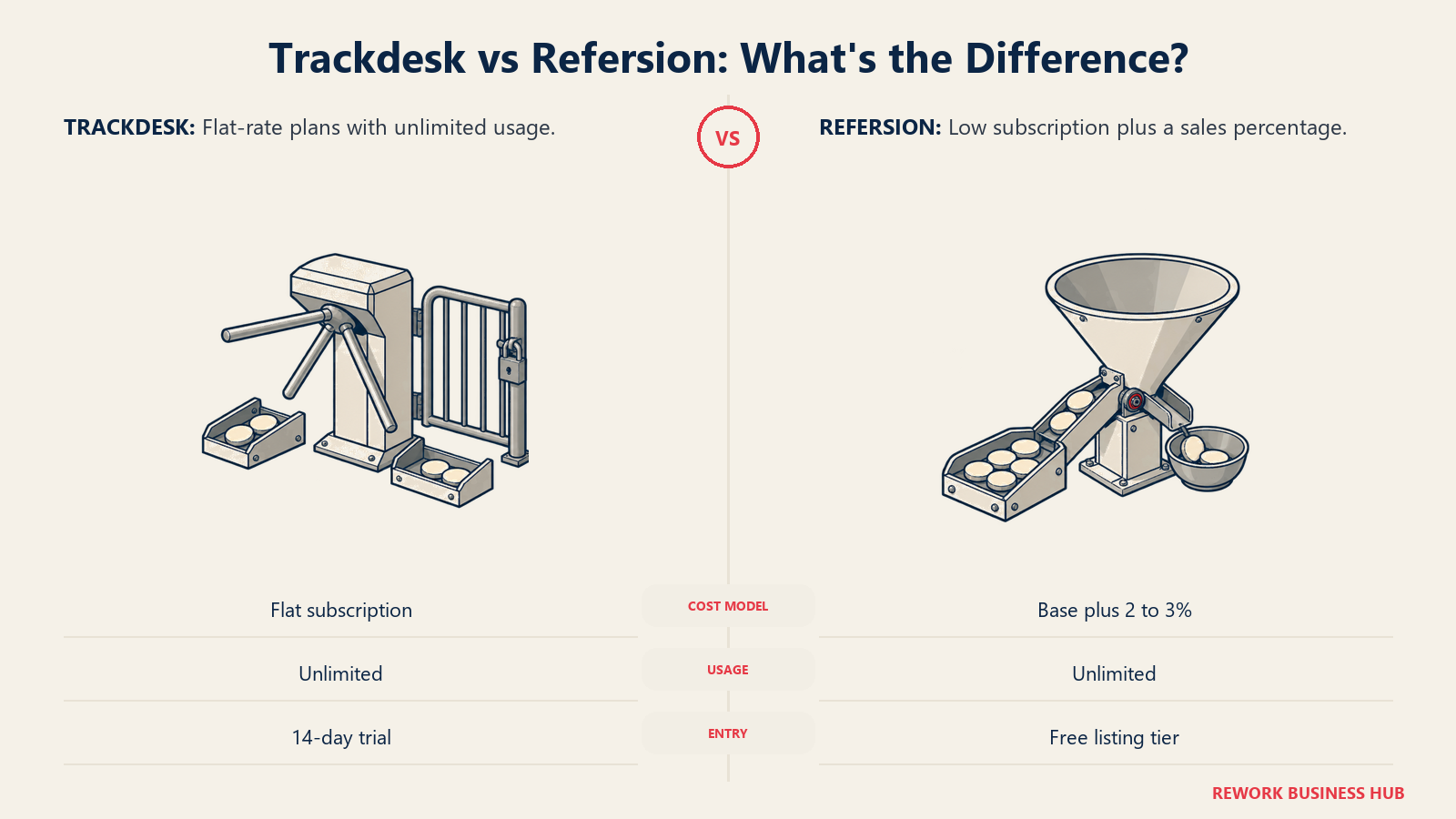
What's left is still flat-rate, no-percentage: Business at $299/mo, Enterprise at $359/mo, Enterprise PLUS from $1,199/mo, all with unlimited clicks, conversions and affiliate partners. That's the $299 this guide's crossover table already used: at $5,000/mo in affiliate-driven sales, Refersion Growth costs the same as Trackdesk Business, and Trackdesk wins above it.
| What you get | What you don't |
|---|---|
| Unlimited affiliates, clicks and conversions, flat rate | A free plan for new signups |
| No percentage fee at any published tier | The reputation the tool is still known for |
| A 14-day trial to test before committing | Entry pricing anywhere near Tapfiliate or LeadDyno's |
Pricing: Business $299/mo. Enterprise $359/mo. Enterprise PLUS from $1,199/mo. Pricing page shows annual billing by default, labeled "Save 2 months." Unlimited clicks, conversions and affiliate partners on all plans. 14-day trial. Separate Affiliate Network and iGaming plan families exist with unpublished figures. Best for: Established programs at real volume that want Refersion-style unlimited tracking without the percentage fee, and don't need the old free tier.
7. Awin: Where ShareASale's Advertisers Actually Went
Awin is the network to know about because ShareASale no longer exists. Every ShareASale advertiser and publisher moved onto Awin's platform on 15 August 2025, and ShareASale itself closed permanently on 6 October 2025. If your research turns up ShareASale as an option, Awin absorbed it.
Awin is a network, not just tracking software, a different category of purchase than Refersion. You're plugging into an existing marketplace of publishers, not configuring your own from scratch. Access starts at $49/mo plus a 3.5% per-transaction fee with a 3-month minimum contract; Accelerate moves to $99/mo plus 2.5%. This is US pricing; Awin's UK page quotes GBP.
| What you get | What you don't |
|---|---|
| Access to an existing publisher network, not a blank slate | A month-to-month contract on the entry tier |
| A landing spot for former ShareASale advertisers | A percentage-free plan |
| Two published self-serve tiers before custom pricing | Refersion's simpler self-configured setup |
Pricing: Access $49/mo + 3.5% per transaction, 3-month minimum contract, 14-day cancellation notice. Accelerate from $99/mo + 2.5% per transaction. Advanced custom pricing, unlimited commission rules. US pricing in USD; the UK Access page quotes GBP separately. Best for: Brands that want to rent into an established affiliate network rather than build a program from zero, especially former ShareASale advertisers.
8. impact.com: No Longer Quote-Only
The single most common mistake in older Refersion comparisons is calling impact.com "enterprise, quote-only software." That stopped being true. It now publishes starting prices: Starter from $30/mo, Essentials from $500/mo, Pro from $2,500/mo, Enterprise still custom. A 2.5% transaction fee applies to partner-driven transactions only, charged only when a sale happens.
The jump from Starter to Essentials is what to plan around: more than 16 times the price, and Essentials is what unlocks the Partner Marketplace's roughly 90,000 partners. That's the real decision point, not the headline $30. A one-time onboarding fee also applies, scaled to technical resources and not published; in the first 30 days there's no minimum fee unless partners drive at least $30 in revenue, in which case impact.com charges that $30.
| What you get | What you don't |
|---|---|
| A published entry price, unlike most enterprise platforms | A gentle step between Starter and Essentials |
| Access to a roughly 90,000-partner marketplace at Essentials+ | A published onboarding fee |
| Fraud scoring, forecasting and SAML at higher tiers | Refersion's Shopify-first simplicity |
Pricing: Starter priced from $30/mo. Essentials priced from $500/mo, adds Partner Marketplace access. Pro priced from $2,500/mo, adds dedicated support, cross-device and API tracking, Data Lab, SAML. Enterprise contact sales, adds fraud scoring, forecasting, anomaly detection, partner deduplication. 2.5% transaction fee on partner-driven transactions only. One-time onboarding fee, amount not published. Source: impact.com/plans-b2b/. Best for: Brands that have outgrown Refersion's self-serve model and need marketplace access, fraud tooling, or enterprise integrations. If you're weighing it against PartnerStack too, see our impact.com vs PartnerStack comparison; our impact.com alternatives roundup and PartnerStack alternatives guide cover the rest of the enterprise tier.
9. Everflow: Built for Custom Tracking Logic
Everflow doesn't publish pricing at all. The site offers a "Request Personalized Pricing" form and nothing else, and the vendor states its own minimum commitment plainly: "We require a 6-month commitment for our Everflow plans, so we have enough time to help you scale and see results from your program." That's a real constraint to weigh alongside whatever quote you get.
What it's actually built for is complex tracking logic: multi-touch attribution, custom conversion rules, and partnership programs that don't fit a simple affiliate-link model. That flexibility is why the platform doesn't sell itself off a price list the way Tapfiliate or LeadDyno do.
| What you get | What you don't |
|---|---|
| Deep customization for complex tracking scenarios | A published price at any tier |
| A platform built for programs Refersion can't model | A self-serve signup path |
| Vendor transparency about the 6-month commitment | Flexibility to cancel within a normal trial window |
Pricing: No published pricing; "Request Personalized Pricing" only. Vendor states a required 6-month commitment on all plans. Any dollar figure elsewhere is third-party and unverified. Best for: Enterprise programs needing custom tracking logic, and willing to commit 6 months.
10. Rewardful: Built for Stripe, Not Shopify
Rewardful is the clearest sign that this category splits into two different buyers. It's Stripe-native, built for subscription SaaS companies, and its tiers are set by monthly revenue generated from affiliates rather than a percentage of it. Starter covers up to $7,500/mo in affiliate revenue, Growth up to $15,000/mo, Enterprise anything above that, all flat with no percentage fee.
If your business runs on Shopify carts rather than Stripe subscriptions, this is the wrong tool regardless of price; it isn't built to track ecommerce checkout events. It's here because some Refersion shoppers are SaaS companies that landed on an ecommerce-first tool by mistake.
| What you get | What you don't |
|---|---|
| Zero percentage fee, ever | Ecommerce cart or Shopify tracking |
| Revenue-banded flat pricing | A tier below $49/mo |
| Native Stripe billing integration | Relevance if you're not billing through Stripe |
Pricing: Starter $49/mo, up to $7,500/mo revenue from affiliates. Growth $99/mo, up to $15,000/mo. Enterprise $149+/mo, over $15,000/mo. 14-day free trial. "2 months free" on annual billing. Best for: Stripe-billed SaaS companies, not ecommerce brands; if that's not you, skip to a Shopify-native option instead.
11. FirstPromoter: Rewardful's Closest Mirror
FirstPromoter runs nearly the same playbook as Rewardful: revenue-banded flat tiers, no percentage fee, built for SaaS rather than ecommerce. The one meaningful difference is the entry band: FirstPromoter's Starter caps at $5,000/mo in affiliate-driven revenue against Rewardful's $7,500/mo at the same $49/mo price, so a company right at that boundary hits FirstPromoter's upgrade prompt sooner.
Neither is built for ecommerce checkout tracking, so a DTC brand comparing Refersion against it is comparing against the wrong category of tool. Worth knowing mainly so you can rule it out quickly.
| What you get | What you don't |
|---|---|
| The same no-percentage, revenue-banded model as Rewardful | A higher revenue cap than Rewardful at the same price |
| A 14-day trial with no credit card required | Ecommerce cart tracking |
| Clear tier boundaries tied to affiliate revenue | Annual pricing published anywhere on the site |
Pricing: Starter $49/mo, up to $5,000/mo revenue from affiliates. Business $99/mo, up to $15,000/mo. Enterprise from $149/mo, above $15,000/mo. 14-day free trial, no credit card. Yearly plans exist but annual figures aren't displayed. Best for: SaaS teams already comparing Rewardful, who want the alternative with a lower entry-tier revenue cap.
12. Referral Factory: Tracked Users, Not Affiliate Sales
Referral Factory prices by tracked users rather than revenue, affiliate count, or transaction volume, a different kind of comparison against Refersion than almost anything else here. Basic covers 20,000 tracked users at $200/mo ($160/mo annual), scaling to Enterprise at 100,000-plus users from $1,000/mo.
That model suits a program where the thing you're counting is participants, not affiliate-driven sales. It's also the highest self-serve entry price here: if your program has a handful of high-volume affiliates rather than a large base of referring users, it works against you.
| What you get | What you don't |
|---|---|
| Predictable pricing tied to program reach | The lowest entry price in this category |
| A model built for participant-heavy referral programs | A fit for a small, high-volume affiliate roster |
| Extra capacity available in clear increments | Revenue- or sales-based pricing like Refersion's |
Pricing: Basic $200/mo monthly, $160/mo annual (20% off), 20,000 tracked users. Pro $400/mo monthly, $320/mo annual, 40,000 users. Enterprise from $1,000/mo monthly, $800/mo annual, 100,000+ users. 15-day free trial. Extra capacity: batches of 100,000 users for $100. Best for: Referral programs where the metric that matters is tracked participants, not affiliate sales volume.
13. CJ Affiliate: The Network With No Public Price at All
CJ Affiliate, formerly Commission Junction, is one of the oldest names in this category and the one with the least pricing transparency here. There's no published advertiser pricing anywhere; the path in is an Advertiser Application followed by a business development conversation, and the network fee isn't disclosed. There's no pricing page at the URL you'd expect, cj.com/pricing.
What you're buying, if you get through the application, is the same thing Awin sells: access to an established publisher network rather than software you configure from scratch. The tradeoff against Refersion is total: no self-serve signup, no published number, a sales process instead of a pricing page.
| What you get | What you don't |
|---|---|
| One of the oldest, largest affiliate networks in the category | Any published pricing to budget from |
| Deep, decades-old publisher relationships | A self-serve signup path |
| A pay-for-performance model on the affiliate side | A working pricing URL; cj.com/pricing 404s |
Pricing: No published advertiser pricing. Entry is an Advertiser Application, then a business development contact. Pay-for-performance model on commissions; network fee not disclosed. Best for: Established brands willing to apply for access to a legacy publisher network without a public price list.
Percentage Fee vs Flat Rate: Where the Crossover Falls
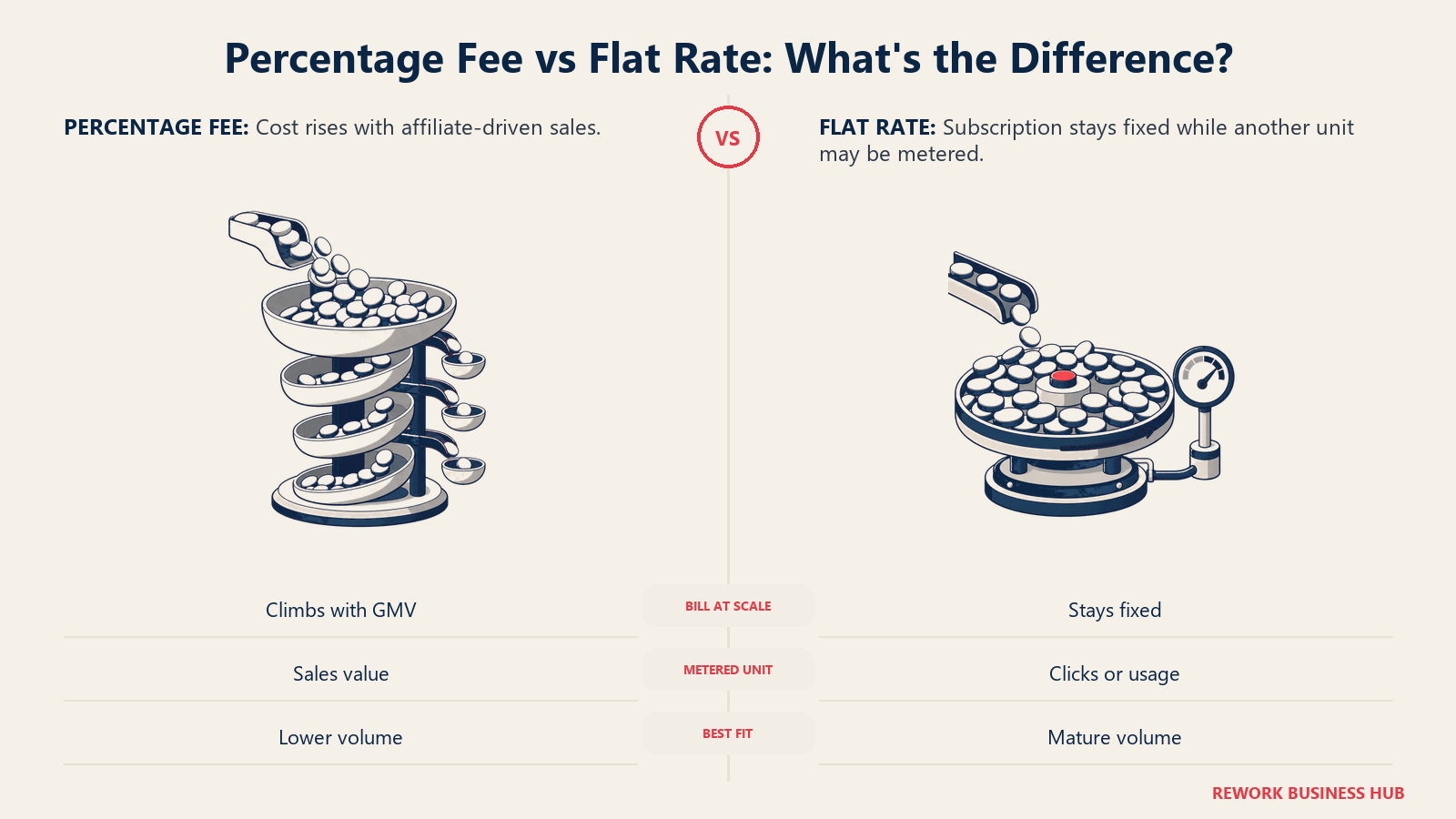
This is the table most listicles skip, and it's the one that actually decides which category of tool fits your program. It models total monthly cost at three affiliate-driven revenue levels for Refersion's two paid tiers plus three flat-rate alternatives, all using published monthly figures.
| Tool | $5,000/mo affiliate-driven sales | $25,000/mo | $100,000/mo |
|---|---|---|---|
| Refersion Launch ($39 + 3%) | $189/mo | $789/mo | $3,039/mo |
| Refersion Growth ($199 + 2%) | $299/mo | $699/mo | $2,199/mo |
| Tapfiliate Scale (flat $179/mo) | $179/mo | $179/mo | $179/mo (subject to click/conversion caps) |
| Post Affiliate Pro Ultimate (flat $269/mo) | $269/mo | $269/mo | $269/mo |
| Trackdesk Business (flat $299/mo) | $299/mo | $299/mo | $299/mo |
Read the $5,000 column first. Refersion Launch at $189/mo is already pricier than Tapfiliate Scale's flat $179/mo, and Growth at $299/mo sits level with or above every flat option in the table. Growth's $199 base fee is high enough that a small program gets no cost benefit from it over a flat-rate competitor.
Read the $100,000 column next, and the case for a flat rate at real scale is stark: Growth costs $2,199/mo, more than seven times Trackdesk's flat $299/mo for functionally similar unlimited tracking. That gap is the whole argument for switching once a program matures, and it's the arithmetic most competing roundups never show.
How to Choose: Decision Framework
The cleanest shortlist starts with the unit each platform meters, then checks whether that unit matches how your program grows.
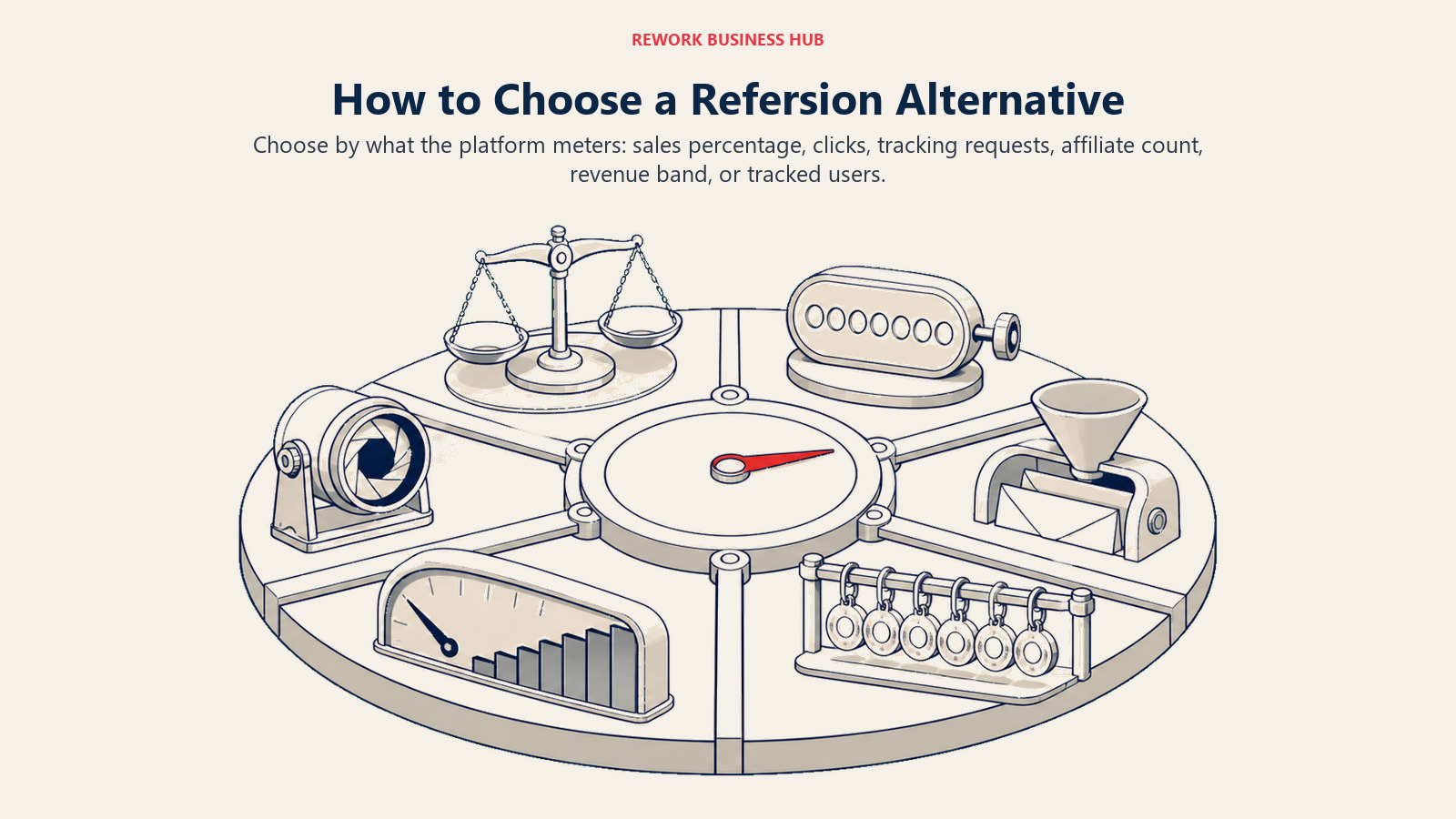
| If you need... | Pick |
|---|---|
| A genuine free tier before committing budget | UpPromote |
| Zero percentage fee, unlimited affiliates, flat rate | Post Affiliate Pro or Tapfiliate |
| An existing publisher network, not just software | Awin or CJ Affiliate |
| A fee scoped to new customers only | ReferralCandy |
| Pricing tied to affiliate count instead of sales | LeadDyno |
| A partnership platform for a program outgrowing self-serve | impact.com |
| Deep custom tracking logic and attribution | Everflow |
| Revenue-banded pricing for a Stripe-billed SaaS product | Rewardful or FirstPromoter |
| Pricing tied to tracked users, not affiliate sales | Referral Factory |
| To stay put because your program is still small | Refersion Launch, and revisit this table as you grow |
Frequently Asked Questions about Refersion Alternatives
What does Refersion actually cost once you include the transaction fee?
Launch is $39/mo ($29/mo annual) plus 3% of affiliate-driven sales. Growth is $199/mo ($159/mo annual) plus 2%. At $50,000/mo in affiliate-driven sales, Growth totals roughly $1,199/mo once the 2% is added, not the $199 headline alone.
Is there a completely free Refersion alternative?
UpPromote has a genuine $0 Free plan, covering one program and up to $3,000 in referral review a month, not a time-limited trial. Refersion itself also offers a free Marketplace Listing tier, though it doesn't include tracking.
What happened to ShareASale?
It's gone. All advertisers and publishers moved onto Awin's platform on 15 August 2025, and the platform closed permanently on 6 October 2025. Any comparison that still lists it as an option is out of date.
Which Refersion alternative has no percentage fee at all?
Tapfiliate, Post Affiliate Pro, LeadDyno, Trackdesk, Rewardful, FirstPromoter, and Referral Factory all charge a flat rate. Each meters something else instead: clicks, tracking requests, affiliate count, revenue bands, or tracked users. Check which metric fits your program before assuming flat means cheaper.
Does Trackdesk still have a free plan?
No, not for new users. Its help center states the free plan "has been discontinued and is no longer available for new users." Existing users are grandfathered on the old limits; new signups get a 14-day trial instead.
How is impact.com priced now?
It publishes starting prices as of 2026: Starter from $30/mo, Essentials from $500/mo, Pro from $2,500/mo, Enterprise custom, plus a 2.5% transaction fee on partner-driven sales only. That's a real change from its old quote-only reputation, which most competing articles still repeat.
When does a flat-rate tool actually beat Refersion Growth on cost?
It depends on the alternative's price and your monthly sales. Against Trackdesk Business at $299/mo, the crossover is $5,000/mo. Against Post Affiliate Pro Ultimate at $269/mo, it's $3,500/mo. Below those numbers, Growth is cheaper; above them, the flat-rate tool is.
What to Do Next
Pull your last three months of affiliate-driven sales from Refersion's dashboard, average them, and run that number through this guide's crossover formula: multiply by 0.02 (or 0.03 on Launch), add the subscription fee, and compare the total to the flat-rate alternatives that fit your size. If you're consistently above the crossover point for Tapfiliate or Post Affiliate Pro, trial one alongside your current account for two weeks before switching anything. Our affiliate marketing software roundup covers the rest of the category, and our guide to building an affiliate marketing program is worth reading before you rebuild yours around a new platform.

Principal Product Marketing Strategist
On this page
- Key Facts
- What Refersion Costs Once You Include the Percentage
- When Refersion is still the right call
- Why Brands Leave Refersion
- Quick Comparison Table
- 1. UpPromote: The One With an Actual Free Plan
- 2. Tapfiliate: Flat Pricing, No Percentage, Ever
- 3. Post Affiliate Pro: Unlimited Affiliates on Every Tier
- 4. ReferralCandy: The Success Fee Is the Real Story
- 5. LeadDyno: Priced by Affiliate Count, Not Revenue
- 6. Trackdesk: The Free Plan Is Gone, but the Flat Rate Remains
- 7. Awin: Where ShareASale's Advertisers Actually Went
- 8. impact.com: No Longer Quote-Only
- 9. Everflow: Built for Custom Tracking Logic
- 10. Rewardful: Built for Stripe, Not Shopify
- 11. FirstPromoter: Rewardful's Closest Mirror
- 12. Referral Factory: Tracked Users, Not Affiliate Sales
- 13. CJ Affiliate: The Network With No Public Price at All
- Percentage Fee vs Flat Rate: Where the Crossover Falls
- How to Choose: Decision Framework
- What to Do Next