Best ReferralCandy Alternatives in 2026: 12 Referral and Affiliate Tools Compared
Turn this article into takeaways for your work.


Each assistant summarizes the article only for you and suggests best practices for your work.
If you're an ecommerce or DTC marketer running a customer-referral program, or an affiliate manager tracking commissions for creators and publishers, ReferralCandy's pricing page hides the number that actually matters. The $39 Basic plan looks like the cheapest seat at the table, but it carries a 10.5% success fee on every qualifying order, and that fee makes Basic the single most expensive plan in ReferralCandy's own lineup for any program doing more than a few hundred dollars a month in referred revenue. This guide covers 12 alternatives split across three real segments: dedicated referral software, affiliate tracking software, and the enterprise partnership platforms that do both. This roundup is part of our broader affiliate marketing software comparison, narrowed here to the tools that most directly replace ReferralCandy.
Each price cell states monthly versus annual and names the transaction or success fee where one exists, because in this category the fee is usually the number that decides the real bill, not the subscription.
Key Facts
- US advertisers will spend $13.81 billion on affiliate marketing in 2026, up 11.3% from $12.42 billion in 2025, a growth rate that outpaces overall US ecommerce expansion of 6.7%. (eMarketer)
- That same affiliate channel is projected to generate roughly $241.03 billion in US ecommerce sales during 2026. (eMarketer)
- Nine out of ten senior marketers across the US, UK, France and Germany rated affiliate marketing effective or highly effective, and customers acquired through affiliate partners had average order values 21% higher than customers from other channels, per Awin and Forrester's 2024 Global Survey. (Awin)
- Nielsen's Global Trust in Advertising study found that 92% of consumers say they trust recommendations from people they know above every other form of advertising, the reason customer-referral programs exist as a category at all. (Nielsen)
- On Awin's network, creators' share of affiliate revenue grew from 15.9% to 19.5% year over year, the fastest-growing publisher category, while discount and coupon publishers still captured 42.4% of US affiliate revenue in the first half of 2025. (eMarketer, citing Awin data)
Referral Software vs Affiliate Software: Which One Do You Actually Need
Before comparing tools, it's worth checking which page you actually need. "Referral" and "affiliate" get used interchangeably in search results, but they're different programs with different mechanics, and a chunk of readers landing here searching "ReferralCandy alternatives" actually want the other one.
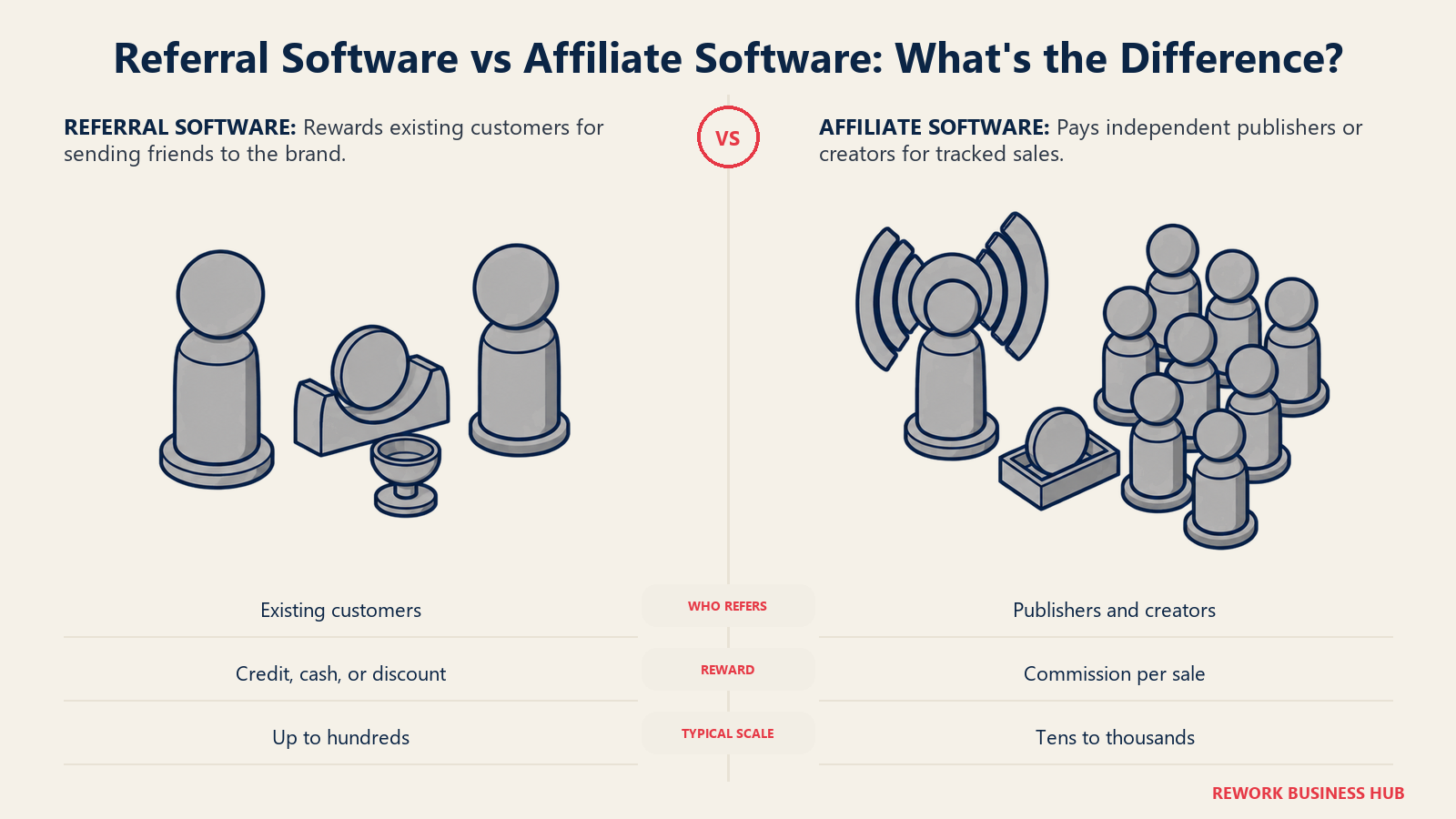
Customer referral software, ReferralCandy's own category, pays your existing customers to refer friends. Affiliate software pays independent publishers, bloggers, deal sites, and creators a commission for sales they drive. The distance between them matters because it changes who you're managing, how you pay them, and what volume looks like at scale.
| Program type | Who does the referring | How they're paid | Typical volume | Tools that serve it |
|---|---|---|---|---|
| Customer referral | Your own existing customers | Store credit, cash, or a discount for both sides | A handful of active referrers up to a few hundred, bounded by your customer base | Referral Factory, UpPromote, ReferralCandy |
| Affiliate marketing | Independent publishers, bloggers, deal and cashback sites | Commission per sale, tracked by cookie or link | Tens to thousands of publishers you recruit or approve | Refersion, Tapfiliate, Post Affiliate Pro, Trackdesk, Rewardful, FirstPromoter, LeadDyno, Reditus |
| Creator and influencer partnerships | Content creators with an audience | Flat fee, commission, or both, often negotiated per creator | Dozens to low hundreds, individually managed | UpPromote, impact.com |
| Enterprise partnerships and networks | A managed marketplace of publishers, or a dedicated partnerships team | Commission plus a platform or network fee | Hundreds to tens of thousands of partners across every type above | impact.com, Awin |
If you searched this term because you want your own buyers to refer friends, ReferralCandy, Referral Factory and UpPromote's referral features are true peers, and the arithmetic in the next section applies to you directly. If you actually want a network of publishers or creators earning commission, ReferralCandy is close to the wrong tool already, and the affiliate-only or enterprise rows below are where to look. For a deeper primer on structuring the program itself rather than picking software, see our guide to building an affiliate marketing program, and if creators are your primary channel, our guide to influencer marketing covers program design separately from tracking software.
What ReferralCandy Costs Once You Include the Success Fee
ReferralCandy's four plans look like a normal software ladder until you read the second column.
| Plan | Subscription | Success fee |
|---|---|---|
| Basic | $39/mo | 10.5% |
| Grow | $79/mo | 3.5% |
| Scale | $249/mo | 1.5% |
| Enterprise | $799/mo | 0.25% |
Every plan includes unlimited campaigns, custom coupon codes, all integrations, and full API access, so the fee isn't paying for missing features. It's a straight percentage cut, and it applies to net-new customers' first three orders only, not to a referred customer's entire lifetime spend and not to repeat orders from existing customers. That scoping matters more than it looks: a mature program with a lot of repeat referred-customer purchases pays the fee on a shrinking slice of total referred revenue over time, since only the first three orders from each newly referred customer count toward it. Most competing roundups quote the headline percentage and skip this detail entirely, which overstates ReferralCandy's real cost for an established program and understates it for a brand-new one still acquiring its first referred customers.
Here's what the four plans actually cost at three levels of qualifying referred revenue (the first three orders of newly referred customers in a given month), with a 7-day free trial and no published annual discount on any of them:
| Plan | $2,000/mo qualifying revenue | $10,000/mo | $50,000/mo |
|---|---|---|---|
| Basic ($39 + 10.5%) | $249/mo | $1,089/mo | $5,289/mo |
| Grow ($79 + 3.5%) | $149/mo | $429/mo | $1,829/mo |
| Scale ($249 + 1.5%) | $279/mo | $399/mo | $999/mo |
| Enterprise ($799 + 0.25%) | $804/mo | $824/mo | $924/mo |
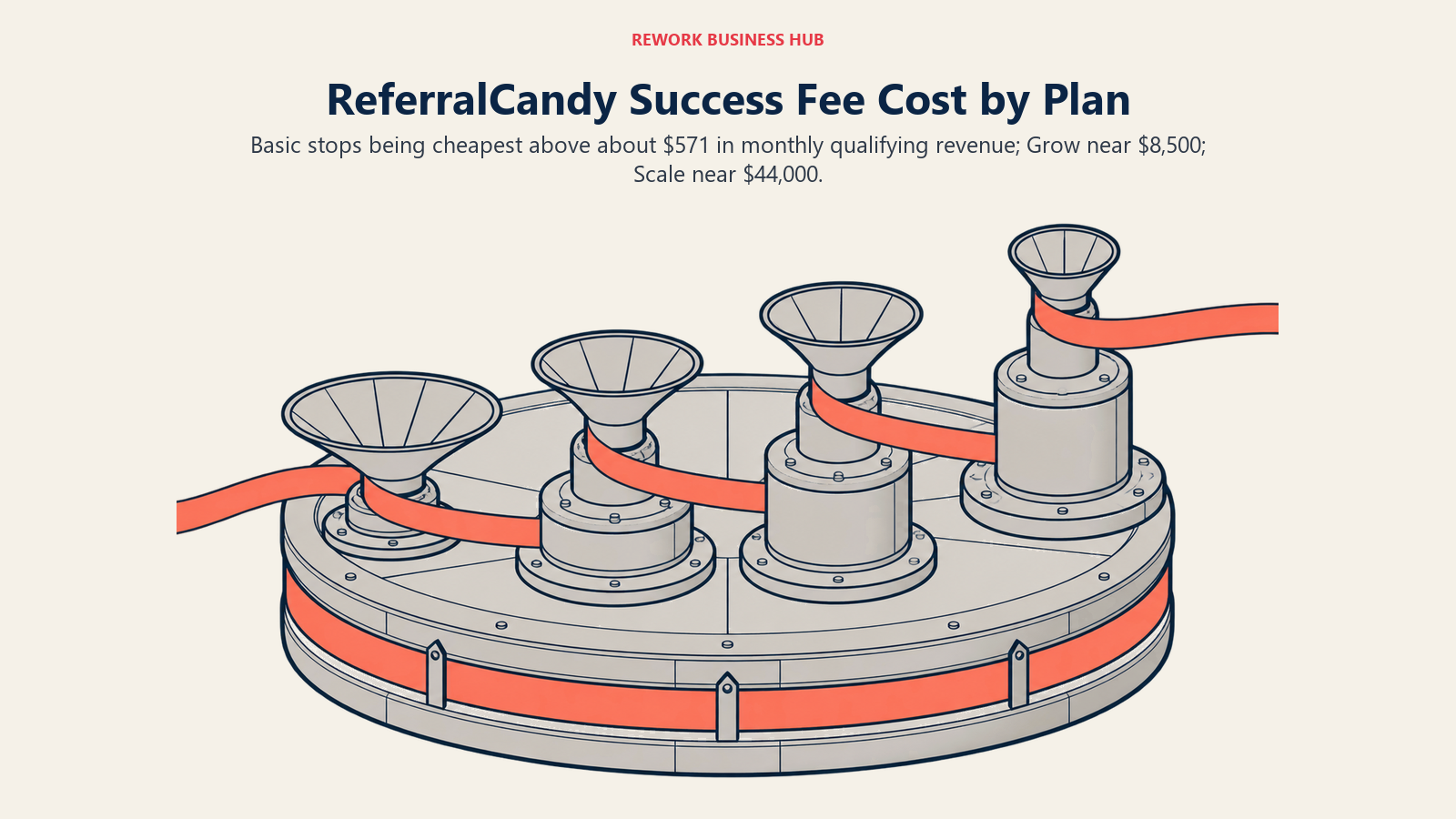
Run the arithmetic yourself and three crossover points appear. Basic stops being the cheapest plan once qualifying revenue passes roughly $571 a month (where $39 + 10.5% of $571 equals $79 + 3.5% of $571), a threshold most stores clear in their first real month of running the program. Grow stops being cheapest above roughly $8,500 a month, where Scale's higher subscription and lower percentage overtake it. Scale stops being cheapest above roughly $44,000 a month, where Enterprise's near-flat 0.25% wins out. Basic, the plan every price-comparison table lists first because it's the lowest number on the page, is the most expensive plan in ReferralCandy's own lineup for almost every program past its first few weeks.
When is Basic still the right call? Genuinely, for a brand-new program doing under roughly $500 to $600 a month in qualifying referred revenue, where $39 plus a small dollar amount in fees beats every alternative on this list, including the free tiers that come with their own limits. The problem isn't that Basic is a bad plan. It's that the plan you sign up for on day one stops being the right plan within a month or two of the program working.
Why Brands Leave ReferralCandy
| Reason | What to look for instead | Which tool on this list |
|---|---|---|
| The success fee eats the entry tier once volume grows | Flat-rate or revenue-banded pricing with no percentage skim | Rewardful, FirstPromoter, Tapfiliate, LeadDyno |
| No annual pricing published, so there's no reward for committing | A vendor that publishes and discounts an annual rate | Refersion, Tapfiliate, UpPromote, Referral Factory, Reditus |
| Referral-only, no affiliate or creator network attached | A tool that runs both referral and affiliate or influencer programs | UpPromote, impact.com |
| Program growth gets punished by a percentage of sales | Tiering by affiliates, tracked users, or ARR instead of revenue share | LeadDyno (affiliate count), Referral Factory (tracked users), Reditus (tracked ARR) |
| Need publishers to discover you, not just recruit them one by one | A network or marketplace of publishers already active | impact.com, Awin, Refersion (marketplace listing) |
| Outgrowing a single-marketer tool, need a full partnerships stack | An enterprise partnership platform with dedicated tiers | impact.com, Awin |
| Need deeper platform integrations beyond a Shopify-first app | Tools with broader ecommerce and CMS integration | Tapfiliate, Post Affiliate Pro, Trackdesk |
Quick Comparison Table
| Tool | Category | Best for | Starting price | Transaction or success fee | Key limitation |
|---|---|---|---|---|---|
| Referral Factory | Referral | Multi-brand or agency referral programs | $200/mo, $160/mo annual | None, flat by tracked users | Priced well above ReferralCandy at every tier |
| UpPromote | Affiliate + referral | Shopify stores wanting both in one app | Free, paid from $29.99/mo | 0% on Free; 1% to 2% performance fee on paid plans | Performance fee still applies above Free |
| Refersion | Affiliate | Brands wanting a built-in affiliate marketplace | $39/mo, $29/mo annual | 3% of affiliate sales, drops to 2% on Growth | The percentage never fully disappears below Scale |
| Tapfiliate | Affiliate | Teams wanting overage instead of a revenue cut | $89/mo, $74/mo annual | None, usage overage on clicks and conversions instead | The 50-affiliate cap on Launch requires an upgrade fast |
| Rewardful | Affiliate | Stripe-billed SaaS companies | $49/mo | None, flat regardless of revenue | Not built for ecommerce checkouts |
| FirstPromoter | Affiliate | SaaS companies at a lower entry revenue band | $49/mo | None, flat regardless of revenue | Entry tier caps at $5,000/mo affiliate revenue |
| LeadDyno | Affiliate | Programs paying by affiliate headcount, not revenue | $49/mo | None, flat by affiliate count | Gets expensive fast at higher affiliate counts |
| Post Affiliate Pro | Affiliate | Teams wanting a mature, configurable platform | $89/mo, $79/mo yearly | None, flat by tracking-request volume | Entry tier allows only 10,000 tracking requests a month |
| Trackdesk | Affiliate | Teams past needing a free plan | $299/mo, annual default | None, flat, unlimited affiliates and volume | The free plan that built its reputation is gone for new users |
| Reditus | Affiliate | B2B SaaS companies wanting a partner marketplace | $99/mo, or $1,188/yr | None on sales; 5% card or 2% invoice on automated payouts | Entry tier caps at $60K ARR tracked |
| impact.com | Both, enterprise | Building a full partnerships function | From $30/mo | 2.5% on partner-driven transactions only | Real cost starts at Essentials, $500/mo, plus onboarding |
| Awin | Affiliate network | Renting an established publisher network | $49/mo + 3.5% | 3.5% per transaction on Access, 2.5% on Accelerate | 3-month minimum contract; you're renting, not owning |
1. Referral Factory: Referral Software Priced for Volume, Not for One Small Program
Referral Factory is dedicated customer-referral software, not an affiliate tracker wearing a referral label. It's built to run many referral programs from one account across brands, regions, or product lines, which is why agencies and multi-brand retailers keep it shortlisted. Its core pitch is no-code program building with over a thousand templates, plus app-store, custom-domain, and localization support most single-program tools skip.
The trade-off for a reader coming straight from ReferralCandy is straightforward: Referral Factory tiers by tracked users, not revenue, and its entry price sits well above ReferralCandy's headline rate. Basic is $200 a month ($160 on annual, 20% off) for 20,000 tracked users, with no success fee attached at any tier. Once a program's qualifying referred revenue passes the crossover math above, that flat structure can beat ReferralCandy outright. For a brand-new, low-volume program still proving the mechanic works, $200 a month is a real commitment before you know it will pay off.
| What you get | What you don't |
|---|---|
| No percentage fee at any tier | A price under $200 a month |
| Multi-program, multi-brand support from one account | A per-program cost that stays low if you only run one small program |
| A 15-day free trial to test before committing | Any affiliate or publisher functionality |
| Capacity sold in clear 100,000-user, $100 batches | Cheap capacity headroom right at a tier boundary |
Pricing: Basic $200/mo monthly, $160/mo annual (20% off), 20,000 tracked users. Pro $400/mo monthly, $320/mo annual, 40,000 users. Enterprise from $1,000/mo monthly, $800/mo annual, 100,000+ users. Extra capacity in batches of 100,000 users for $100. 15-day free trial. No success fee on any plan. Best for: Agencies and multi-brand retailers running several referral programs from one account. For the direct head-to-head, including where a flat user-capacity fee beats a percentage success fee, see ReferralCandy vs Referral Factory. Not ideal for: A single small brand still validating whether referral is worth running at all.
2. UpPromote: Affiliate and Referral in One Shopify App, With a Real Free Plan
UpPromote runs affiliate, referral and influencer programs from a single Shopify app, making it the one tool on this list that can genuinely replace both a customer-referral tool and a separate affiliate tool at once. Shopify is the entire ICP here; it isn't built for a generic ecommerce stack outside that ecosystem.
The free plan is real rather than a crippled trial: one program and up to $3,000 in referral review a month at no cost. Paid tiers add a performance fee on top of the subscription, structurally the same shape as ReferralCandy's success fee but far smaller, 2% on Growth, dropping to 1% on Enterprise. Growth at $29.99 a month ($24.99 on annual) plus 2% undercuts ReferralCandy Grow's $79 plus 3.5% at every revenue level modeled earlier in this guide.
| What you get | What you don't |
|---|---|
| A genuinely usable free tier, not a time-limited trial | Zero performance fee, even on paid plans |
| Affiliate, referral and influencer in one app | A tool built for stores outside Shopify |
| A lower headline price and lower fee than ReferralCandy at every paid tier | Referral Factory's multi-brand account structure |
| A 14-day trial on paid plans | Enterprise-grade partnership tooling |
Pricing: Free $0/mo, 1 program, up to $3,000 referral review/mo. Growth $29.99/mo monthly, $24.99/mo annual ($299.90/yr), plus 2% of successful referral sales, 300 referral reviews/mo. Professional $89.99/mo monthly, $74.99/mo annual ($899.90/yr), plus 1.5% performance fee. Enterprise $199.99/mo monthly, $166.66/mo annual ($1,999.90/yr), plus 1% performance fee, unlimited. 14-day free trial on paid plans. Best for: Shopify brands that want referral and affiliate programs running from one app instead of two. Not ideal for: Stores outside the Shopify ecosystem.
3. Refersion: A Built-In Marketplace, With the Fee Baked into Every Paid Tier
Refersion is affiliate-first, not referral software, and treats that as a feature: it ships a Marketplace Listing plan that's free to join, giving a brand access to affiliates already browsing Refersion's network before spending a dollar on subscription. Ownership has changed since its early days too. Pantastic acquired Refersion in July 2023, worth knowing if vendor stability is part of your evaluation.
Every paid tier carries a percentage fee on top of the subscription, the same structural pattern as ReferralCandy, just smaller: 3% on Launch, dropping to 2% on Growth. Scale removes the percentage entirely for a custom flat monthly rate, but only for brands doing more than $1 million in GMV a year, and that flat figure itself isn't published.
| What you get | What you don't |
|---|---|
| A free marketplace listing that attracts affiliates at no cost | A published flat-rate top tier under $1M GMV |
| Unlimited affiliates, clicks and conversions on every paid plan | Zero percentage fee below Scale |
| A declining fee as you move up tiers | Referral program tooling, this is affiliate-only |
| 20% off on annual billing | A disclosed Scale price you can budget from today |
Pricing: Marketplace Listing Free. Launch $39/mo monthly, $29/mo annual (20% off), plus 3% of affiliate-driven sales. Growth $199/mo monthly, $159/mo annual, plus 2% of affiliate-driven sales. Scale custom, for brands over $1M GMV/yr, flat monthly rate not published. Best for: Ecommerce brands that want a ready-made affiliate marketplace alongside their tracking software. Not ideal for: Brands running a customer-referral program rather than a publisher affiliate program. If Refersion's marketplace model doesn't fit but you still want affiliate-only software, our Refersion alternatives roundup covers that segment in more depth.
4. Tapfiliate: A Flat Rate With Overage Instead of a Percentage of Sales
Tapfiliate is the first tool on this list to remove the percentage-of-sales fee entirely, replacing it with usage overage, a structurally different bet than ReferralCandy, Refersion, or UpPromote. You pay a flat monthly rate for a bundled allowance of clicks and conversions, then a small per-1,000 overage charge if you exceed it, instead of a cut of every qualifying sale.
Launch at $89 a month ($74 on annual, marketed as two months free) includes one program, 50 affiliates, 5,000 clicks and 500 conversions a month, with overage at $1.50 per 1,000 clicks and $15 per 1,000 conversions. Scale roughly doubles the price to $179 a month ($149 annual) for unlimited programs and affiliates plus a much larger 100,000-click, 10,000-conversion allowance and cheaper overage rates.
| What you get | What you don't |
|---|---|
| No percentage-of-sales fee at any tier | A single-affiliate-count cap that never changes on Launch |
| A predictable overage rate instead of a variable cut of revenue | Unlimited affiliates below Scale |
| Unlimited programs and affiliates on Scale | A free tier |
| Up to a 30-day trial on Enterprise | ReferralCandy's flat unlimited-campaign structure |
Pricing: Launch $89/mo monthly, $74/mo annual ($890/yr), 1 program, 50 affiliates, 5,000 clicks/mo, 500 conversions/mo, overage $1.50 per 1,000 clicks and $15 per 1,000 conversions, 7-day trial. Scale $179/mo monthly, $149/mo annual ($1,790/yr), unlimited programs and affiliates, 100,000 clicks/mo, 10,000 conversions/mo, overage $1 per 1,000 clicks and $10 per 1,000 conversions, 14-day trial. Enterprise custom, 30-day trial. Best for: Brands that would rather pay predictable overage than watch a percentage fee scale with revenue. Not ideal for: Small programs under 50 affiliates, where the flat $89 floor is expensive relative to volume.
5. Rewardful: Built for Stripe Billing, Priced Flat by Affiliate Revenue Band
Rewardful is affiliate software built specifically around Stripe billing, which makes it the natural fit for subscription SaaS companies rather than ecommerce storefronts. It charges no percentage of sales at all. Instead, each tier caps how much monthly revenue your affiliates can drive before you need the next plan, and the price stays flat within that band.
Starter is $49 a month for programs generating up to $7,500 a month in affiliate-driven revenue, Growth is $99 a month up to $15,000, and Enterprise starts at $149 a month above that. Because there's no percentage component, a program doing $10,000 a month in affiliate revenue costs a flat $99 on Growth, considerably less than ReferralCandy's blended cost at the same volume once its success fee is included.
| What you get | What you don't |
|---|---|
| Zero percentage fee, ever, at any tier | Ecommerce platform integrations beyond Stripe-billed products |
| Flat, predictable pricing within each revenue band | A tier that fits high-revenue affiliate programs cheaply |
| Native Stripe billing integration | A free plan |
| Two months free on annual billing | Suitability for a customer-referral program |
Pricing: Starter $49/mo, up to $7,500/mo affiliate-driven revenue. Growth $99/mo, up to $15,000/mo. Enterprise $149+/mo, over $15,000/mo. 14-day free trial, two months free on annual billing. Best for: Stripe-billed SaaS companies running an affiliate program, not an ecommerce store. Not ideal for: Ecommerce brands, or any team wanting customer-referral features.
6. FirstPromoter: The Same Shape as Rewardful, at a Tighter Entry Band
FirstPromoter is close enough to Rewardful in structure that the honest comparison fits in one sentence: nearly identical headline prices, a meaningfully tighter revenue cap at the entry tier. Starter is $49 a month for programs generating up to $5,000 a month in affiliate-driven revenue, versus Rewardful's $7,500 cap at the same $49 price. Business at $99 a month matches Rewardful Growth's $15,000 cap exactly.
Like Rewardful, there's no percentage-of-sales fee at any tier, which is the core reason both show up on almost every SaaS company's shortlist against ReferralCandy's success fee. FirstPromoter offers a 14-day free trial with no credit card required, and yearly plans exist even though the vendor doesn't display the annual figures on its pricing page.
| What you get | What you don't |
|---|---|
| No percentage fee, matching Rewardful's structure | A published annual price |
| A no-credit-card 14-day trial | As generous an entry-tier revenue cap as Rewardful |
| A flat rate through $15,000/mo affiliate revenue on Business | Ecommerce-native features |
| An Enterprise tier from $149/mo above that | Customer-referral program tooling |
Pricing: Starter $49/mo, up to $5,000/mo affiliate-driven revenue. Business $99/mo, up to $15,000/mo. Enterprise from $149/mo, above $15,000/mo. 14-day free trial, no credit card. Yearly plans exist; annual figures not published. Best for: SaaS companies comparing Rewardful and FirstPromoter directly, where the entry-tier revenue cap is the deciding factor. Not ideal for: Ecommerce brands or teams that need customer-referral program features.
7. LeadDyno: Priced by Affiliate Headcount, Not Revenue
LeadDyno breaks from every tool above it by tiering on active affiliate count rather than revenue, clicks, or tracked users. That's a meaningfully different bet: a program with a small number of high-performing affiliates stays cheap regardless of how much revenue those affiliates drive, while a program that recruits broadly climbs the tiers fast.
Lite is $49 a month for up to 50 active affiliates, with no annual discount shown on that entry tier. Essential jumps to $129 a month ($110 on annual, a 15% saving) for 150 affiliates, and the ladder keeps climbing to Advanced at $349 a month for 500 affiliates and Unlimited at $749 a month. Every tier includes unlimited clicks and conversions, so once you've picked your affiliate-count band, volume inside it is free.
| What you get | What you don't |
|---|---|
| Unlimited clicks and conversions at every tier | Cheap pricing at higher affiliate counts |
| A 30-day free trial, longer than most competitors here | Revenue-based pricing that rewards a small, high-performing roster |
| No percentage-of-sales fee | An annual discount on the entry tier |
| A simple headcount-based mental model to budget from | Ecommerce-specific features |
Pricing: Lite $49/mo, 50 active affiliates. Essential $129/mo monthly, $110/mo annual (saves 15%), 150 affiliates. Advanced $349/mo monthly, $297/mo annual, 500 affiliates. Unlimited $749/mo monthly, $637/mo annual, unlimited affiliates. 30-day free trial. Best for: Programs built around a small roster of high-performing affiliates rather than broad recruitment. Not ideal for: Programs that recruit affiliates broadly and will outgrow the headcount tiers quickly.
8. Post Affiliate Pro: A Mature, Configurable Platform Metered on Tracking Requests
Post Affiliate Pro is one of the older, more configurable platforms in this category, tiered by tracking-request volume rather than revenue or affiliate count. Starter handles 10,000 tracking requests a month, Pro jumps to 1,000,000, and the ladder tops out at Network's 20,000,000 requests for large multi-brand or network-style operations. Every plan includes unlimited affiliates.
Read the tracking-request ceilings carefully, because they are what actually decide your tier. Starter costs $89 a month ($79 on annual billing) but allows only 10,000 requests, and a request counts clicks, impressions and postbacks together rather than clicks alone. A modest program with heavy banner impressions can clear that ceiling faster than its sales volume suggests.
| What you get | What you don't |
|---|---|
| Unlimited affiliates at every tier | A percentage-of-sales fee, this tool doesn't charge one |
| Deep customization relative to newer entrants | A generous entry tier; Starter caps at 10,000 tracking requests |
| A tracking-request model that scales with technical volume, not revenue | Revenue-banded pricing for programs with light technical volume but high sales |
| A free trial to test before committing | Referral-specific program mechanics |
Pricing: Starter $89/mo monthly, $79/mo billed yearly, 10,000 tracking requests/mo. Pro $139/mo monthly, $129/mo yearly, 1,000,000 tracking requests/mo. Ultimate $269/mo monthly, $249/mo yearly, 6,000,000 tracking requests/mo. Network $649/mo monthly, $599/mo yearly, 20,000,000 tracking requests/mo. Overage runs from $5 per 10,000 requests on Starter down to $0.20 per 10,000 on Network. Free trial available. Best for: Teams wanting a mature, deeply configurable affiliate platform and comfortable budgeting from tracking-request volume rather than revenue. Not ideal for: Programs with light technical volume but high sales, where revenue-banded pricing costs less.
9. Trackdesk: The Free Plan That Built Its Reputation Is Gone
Trackdesk's reputation was built entirely on a free-forever plan, and that plan is gone for new users. If you've seen Trackdesk recommended somewhere as the free ReferralCandy alternative, that recommendation is out of date. Trackdesk's own help center article is titled "Limits of the Deprecated Free Plan" and states plainly that the free plan has been discontinued and is no longer available for new signups. Existing users on the old free plan are grandfathered at a $1,000 revenue cap, 50 affiliate partners, 5,000 clicks and 500 conversions a month, one seat, one active offer, and one currency, but a new account today gets a 14-day trial and nothing free beyond it.
What's left is a straightforward flat-rate ladder with unlimited clicks, conversions and affiliate partners on every plan: Business at $299 a month, Enterprise at $359, and Enterprise PLUS from $1,199, all shown at annual billing by default under a "save 2 months" framing.
| What you get | What you don't |
|---|---|
| Unlimited clicks, conversions and affiliates on every plan | A free plan for new accounts |
| A flat rate with no percentage-of-sales component | A price below $299 a month |
| A 14-day trial to test before paying | The reputation the free plan earned still applying today |
| Separate network and iGaming plan families for specialized use cases | Published entry-level pricing under $300/mo |
Pricing: Business $299/mo, Enterprise $359/mo, Enterprise PLUS from $1,199/mo, annual billing shown by default ("save 2 months"). Free plan discontinued for new users as of 2026; grandfathered legacy users retain a capped free tier. 14-day free trial for new accounts. Unlimited clicks, conversions and affiliate partners on all current plans. Best for: Teams that need a flat, unlimited-volume affiliate platform and have already budgeted past the $300-a-month mark. Not ideal for: Anyone choosing Trackdesk specifically because they read it was free. It no longer is, for new accounts.
10. Reditus: A B2B SaaS Affiliate Program Tied to Tracked ARR
Reditus is built specifically for B2B SaaS companies, tiering on tracked annual recurring revenue rather than monthly transaction volume, a metric that fits a subscription business far better than an ecommerce-shaped revenue band. It also runs a partner marketplace alongside the tracking software, so a program can attract SaaS-focused affiliates already active on Reditus instead of recruiting cold.
Growth is $99 a month (or $1,188 a year) for programs tracking up to $60,000 in ARR, Scale Up jumps to $399 a month billed annually for up to $360,000 in ARR, and Enterprise starts at $799 a month billed annually for unlimited ARR. Every tier includes unlimited affiliates, and annual plans get a free white-glove migration.
| What you get | What you don't |
|---|---|
| Pricing that maps to ARR instead of monthly transactions | A month-to-month rate on Scale Up or Enterprise |
| A built-in marketplace of SaaS-focused affiliates | Fit for an ecommerce or DTC storefront |
| Unlimited affiliates at every tier | A free plan |
| Free white-glove migration on annual billing | Monthly billing above the Growth tier |
Pricing: Growth $99/mo, or $1,188/yr, up to $60K ARR tracked. Scale Up $399/mo billed annually ($4,788/yr), up to $360K ARR. Enterprise from $799/mo billed annually ($9,588+/yr), unlimited ARR. 14-day free trial, no card. Free white-glove migration on annual plans. Best for: B2B SaaS companies running an affiliate program who want pricing that scales with ARR, not transaction count. For a broader B2B partnerships motion beyond affiliate tracking, see our guide to channel partner programs. Not ideal for: Ecommerce or DTC brands, whose revenue doesn't map to ARR.
11. impact.com: The Enterprise Partnership Platform That Finally Publishes Prices
impact.com has spent years as the platform every listicle described as quote-only enterprise software, and that description is now wrong. impact.com publishes starting prices for three of its four tiers: Starter from $30 a month, Essentials from $500 a month, and Pro from $2,500 a month, with Enterprise remaining a sales conversation. If you've read elsewhere that impact.com hides its pricing entirely, that page is out of date.
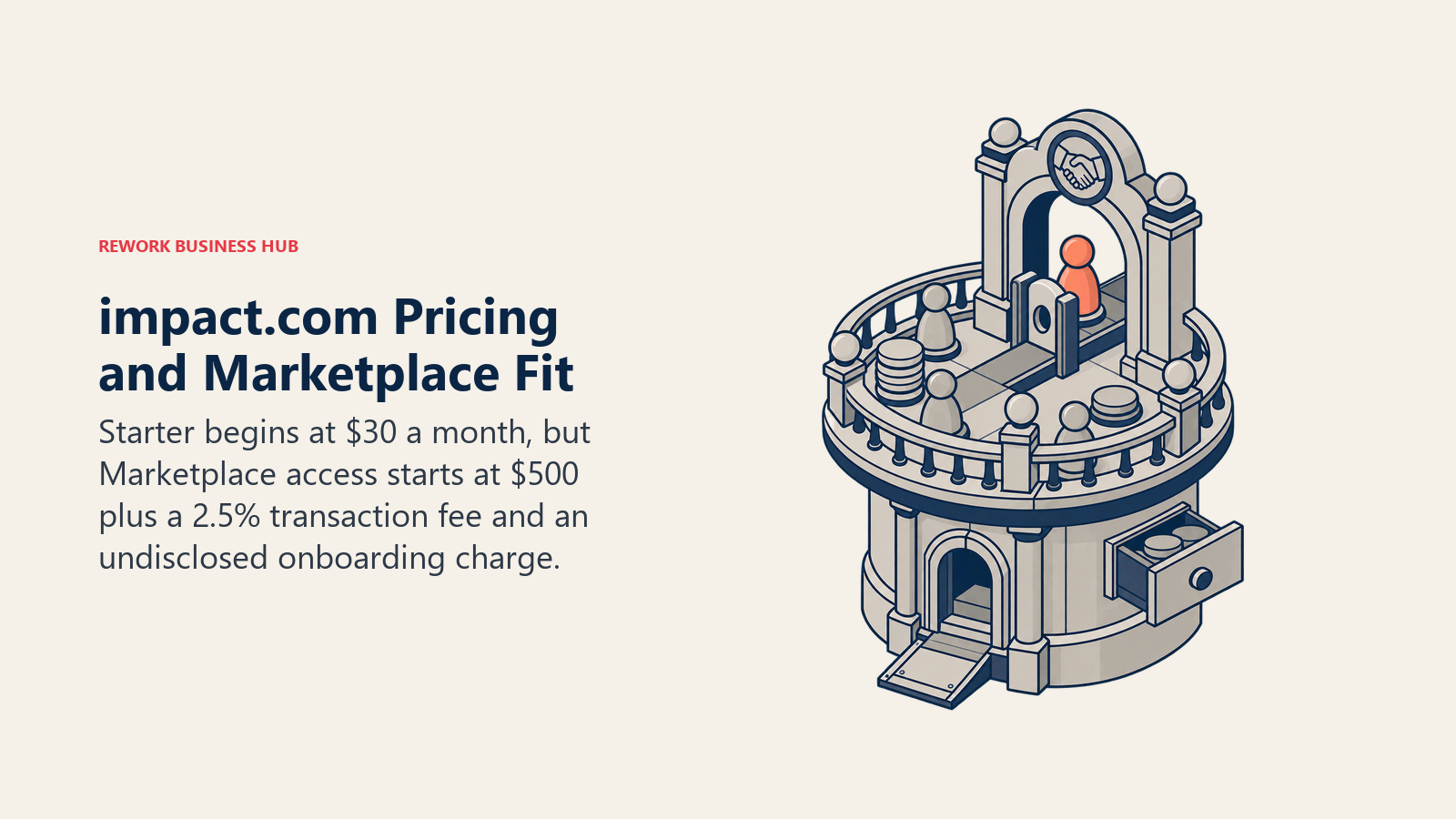
The number to actually plan around is a 2.5% transaction fee, charged only on partner-driven transactions, and only when a sale occurs, on top of whichever tier you're on. There's also an unpublished one-time onboarding fee scaled to how much technical setup the integration needs, and a 30-day grace period on Starter where no minimum fee applies unless the program generates at least $30 in partner-driven revenue, at which point that $30 becomes due. Essentials adds access to impact.com's Partner Marketplace, which the vendor describes as reaching 90,000 partners, and Pro layers on dedicated support, cross-device tracking, API tracking, a data lab, and SAML.
| What you get | What you don't |
|---|---|
| Published starting prices, no longer quote-only at every tier | A published onboarding fee |
| A 90,000-partner marketplace from Essentials up | Advanced fraud scoring below Enterprise |
| A capped, low-percentage transaction fee | A price that stays near $30/mo once Marketplace access is needed |
| Both affiliate and broader partnership tooling in one platform | ReferralCandy's simplicity for one small referral program |
Pricing: Starter from $30/mo. Essentials from $500/mo. Pro from $2,500/mo. Enterprise custom. Transaction fee: 2.5% on partner-driven transactions, charged only when a sale occurs. One-time onboarding fee, amount depends on technical setup, not published. Starter's first 30 days waive minimum fees unless partners drive at least $30 in revenue. Monthly or annual billing available. Best for: Companies building a real partnerships function that spans affiliate, referral and broader partner types, with budget to match. If impact.com's tier jump doesn't fit, our full impact.com alternatives roundup covers more options at that tier, and our PartnerStack alternatives roundup covers lighter enterprise options. If impact.com and PartnerStack are your final two, our impact.com vs PartnerStack comparison breaks down the difference directly. Not ideal for: A small brand whose entire need is one customer-referral program; the jump from Starter to Essentials is steep.
12. Awin: The Affiliate Network ReferralCandy Refugees End Up Renting Into
Awin is a network, not just software, and that's the structural difference every reader comparing it to ReferralCandy needs upfront. You aren't licensing a tracking platform and recruiting your own affiliates from zero; you're paying to plug into an existing marketplace of publishers already running offers for other advertisers. That's also why Awin absorbed ShareASale: every ShareASale advertiser and publisher moved onto the Awin platform on 15 August 2025, more than 9,500 advertisers and 250,000 active publishers by Awin's own count, and the ShareASale platform itself closed on 6 October 2025. If you're researching ShareASale today, Awin is where that history leads. It no longer exists as a current option.
On Awin's own network, creator-affiliate revenue share climbed from 15.9% to 19.5% year over year, the fastest-growing publisher category, while discount and coupon publishers still captured 42.4% of US affiliate revenue in the first half of 2025. Pricing on the US advertiser page runs Access at $49 a month plus a 3.5% transaction fee with a 3-month minimum contract, and Accelerate from $99 a month plus 2.5%. Advanced is custom with unlimited commission rules.
| What you get | What you don't |
|---|---|
| An established marketplace of publishers on day one | Software you fully own and configure independently |
| A documented migration path if you were on ShareASale | A contract shorter than 3 months on Access |
| Transparent US-page pricing with a stated transaction fee | Currency consistency, the UK page prices separately in GBP |
| A growing creator-affiliate share of network revenue | A flat rate with zero percentage component |
Pricing: Access $49/mo plus 3.5% per transaction, 3-month minimum contract, 14-day cancellation notice. Accelerate from $99/mo plus 2.5% per transaction. Advanced custom, unlimited commission rules. US page, USD; do not mix with Awin's separate GBP-denominated UK pricing. Best for: Brands that want to rent an established publisher network rather than build affiliate relationships from zero. Not ideal for: Teams that want full ownership of their affiliate software and a flat rate with no per-transaction fee.
How to Choose: Decision Framework
Start by deciding who does the referring and how the program should scale, then compare the fee model, integrations and marketplace needs.
| If you need... | Best pick |
|---|---|
| A customer-referral program without ReferralCandy's success fee, at scale | Referral Factory |
| Referral and affiliate or influencer programs in one Shopify app | UpPromote |
| The lowest flat entry price for straightforward affiliate tracking | Refersion or Tapfiliate |
| Revenue-banded pricing with zero percentage fee, for a SaaS product | Rewardful or FirstPromoter |
| Pricing that scales with affiliate headcount, not revenue | LeadDyno |
| A B2B SaaS affiliate program tied to ARR, plus a partner marketplace | Reditus |
| Enterprise-grade partnerships with a large publisher marketplace | impact.com |
| To rent an established affiliate network's publisher base | Awin |
Referred customers are also worth tracking past their first order, since repeat purchase behavior is where a referral program's real payback shows up; our guide to customer lifetime value covers the metric to model that against, and many brands run referral alongside a structured loyalty program rather than as a standalone tactic.
Frequently Asked Questions about ReferralCandy Alternatives
Is ReferralCandy affiliate software or referral software?
ReferralCandy is customer-referral software first. It's built for your own existing customers to refer friends in exchange for a reward, not for managing a network of independent publishers or creators earning commission. If you actually need affiliate tracking, look at Refersion, Tapfiliate, Rewardful, FirstPromoter, LeadDyno, Post Affiliate Pro, Trackdesk or Reditus instead.
How much does ReferralCandy actually cost?
Basic is $39 a month plus a 10.5% success fee, Grow is $79 plus 3.5%, Scale is $249 plus 1.5%, and Enterprise is $799 plus 0.25%. At $10,000 a month in qualifying referred revenue, Basic totals roughly $1,089 a month, more than any other tier, because its subscription is cheap but its percentage is the highest by a wide margin.
Does the ReferralCandy success fee apply to every order a referred customer places?
No. The fee applies only to a net-new referred customer's first three orders, not to their entire lifetime spend and not to repeat orders from existing customers. A mature program with strong repeat purchase behavior from past referred customers pays the fee on a shrinking share of its total referred revenue over time.
What replaced ShareASale?
Awin. Every ShareASale advertiser and publisher was moved onto the Awin platform on 15 August 2025, and the ShareASale platform itself closed on 6 October 2025. ShareASale is not a current option for a 2026 buyer; treat any listicle still recommending it as out of date.
Is Trackdesk still free?
Not for new users. Trackdesk's free-forever plan, the feature its reputation was built on, was discontinued for new signups. Existing free-plan users are grandfathered under the old limits, but a new account only gets a 14-day trial before paid pricing starting at $299 a month applies.
Which ReferralCandy alternative is cheapest for a small, early-stage program?
UpPromote's free plan, capped at one program and $3,000 in referral review a month, is the lowest-cost option here with a genuine free tier. For a program already generating steady referred revenue, ReferralCandy Basic itself is still competitive under roughly $500 to $600 a month in qualifying revenue, before its success fee overtakes the alternatives.
What's the difference between an affiliate network and affiliate software?
Affiliate software, like Refersion, Tapfiliate, or Rewardful, is a tracking platform you use to run a program with affiliates you recruit yourself. An affiliate network, like Awin, is a marketplace: you pay to access publishers who are already active on the network and running offers for other advertisers, which trades some independence for faster publisher discovery.
Does impact.com still require a sales call to see any pricing?
No, and this is worth correcting because many older articles still say it does. impact.com now publishes starting prices for Starter ($30/mo), Essentials ($500/mo) and Pro ($2,500/mo) directly on its site. Only Enterprise remains a custom quote.
What to Do Next
Run the arithmetic from the second table above against your own program's actual qualifying referred revenue, not ReferralCandy's headline $39 price, and pick the two tools whose crossover points bracket where your program sits today and where you expect it to be in six months. Then run a real trial with both, using your actual reward structure and a sample of real referral or affiliate traffic rather than demo data, before signing an annual contract on either one.

Principal Product Marketing Strategist
On this page
- Key Facts
- Referral Software vs Affiliate Software: Which One Do You Actually Need
- What ReferralCandy Costs Once You Include the Success Fee
- Why Brands Leave ReferralCandy
- Quick Comparison Table
- 1. Referral Factory: Referral Software Priced for Volume, Not for One Small Program
- 2. UpPromote: Affiliate and Referral in One Shopify App, With a Real Free Plan
- 3. Refersion: A Built-In Marketplace, With the Fee Baked into Every Paid Tier
- 4. Tapfiliate: A Flat Rate With Overage Instead of a Percentage of Sales
- 5. Rewardful: Built for Stripe Billing, Priced Flat by Affiliate Revenue Band
- 6. FirstPromoter: The Same Shape as Rewardful, at a Tighter Entry Band
- 7. LeadDyno: Priced by Affiliate Headcount, Not Revenue
- 8. Post Affiliate Pro: A Mature, Configurable Platform Metered on Tracking Requests
- 9. Trackdesk: The Free Plan That Built Its Reputation Is Gone
- 10. Reditus: A B2B SaaS Affiliate Program Tied to Tracked ARR
- 11. impact.com: The Enterprise Partnership Platform That Finally Publishes Prices
- 12. Awin: The Affiliate Network ReferralCandy Refugees End Up Renting Into
- How to Choose: Decision Framework
- What to Do Next