Hoshin Kanri: Desdobramento de Estratégia com a X-Matrix
Turn this article into takeaways for your work.


Each assistant summarizes the article only for you and suggests best practices for your work.
A maioria das organizações é boa em definir estratégia no topo. São péssimas em fazê-la funcionar abaixo do nível de VP. O hoshin kanri, também chamado de desdobramento de política (policy deployment), é um método de planejamento desenvolvido no Japão especificamente para resolver esse problema: pegar um pequeno número de objetivos de ruptura e conectá-los ao trabalho diário por meio de um desdobramento estruturado de objetivos, planos e revisões periódicas.
O Que É Hoshin Kanri?
Hoshin kanri é um sistema de planejamento e execução estratégica que alinha todos os níveis de uma organização, desde a equipe executiva até a linha de frente, em torno de um conjunto focado de objetivos de ruptura por meio de um desdobramento estruturado de planos, responsabilidade e ciclos de revisão periódica.
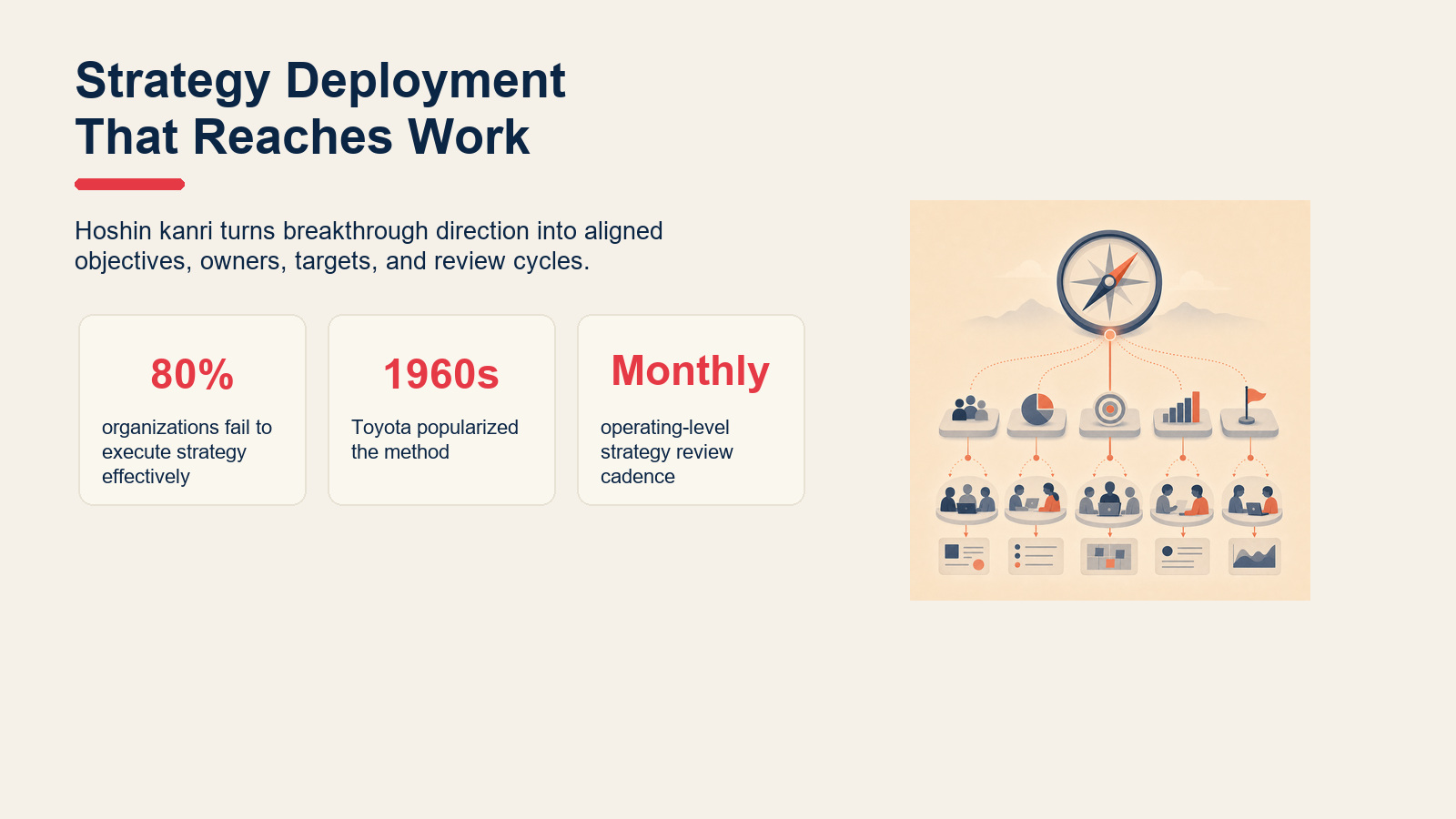
O nome vem do japonês: hoshin (direção ou agulha de bússola) e kanri (gestão ou controle). Juntos, significa conduzir a organização em direção a um rumo deliberado. Os praticantes ocidentais frequentemente o chamam de policy deployment, que captura a ideia de desdobrar uma política estratégica por todas as funções e níveis.
Fatos Principais
- A lacuna na execução da estratégia é grande: segundo a pesquisa da Bridges Business Consultancy citada em várias edições de seus estudos, aproximadamente 80% das organizações não executam suas estratégias de forma eficaz, sendo a principal culpada a falta de responsabilidade em cascata abaixo do nível de liderança.
- A Toyota popularizou o hoshin kanri nos anos 1960 como parte de seu Toyota Production System mais amplo, e o método foi introduzido aos fabricantes ocidentais nos anos 1980. Hoje é usado em saúde, tecnologia e serviços profissionais, não apenas na manufatura (Fonte: Lean Enterprise Institute, 2018).
- Pesquisa de Robert Kaplan e David Norton sobre execução de estratégia, publicada em seu trabalho de 2008 The Execution Premium, constatou que empresas com um mecanismo formal de desdobramento de estratégia revisavam a estratégia pelo menos mensalmente no nível operacional, em comparação com anualmente ou de forma ad hoc em empresas sem um.
O insight central do hoshin kanri é simples: objetivos de ruptura não acontecem porque você os anuncia. Eles acontecem porque cada equipe consegue traçar suas prioridades diárias de volta à direção da empresa para três a cinco anos, e porque as revisões acontecem com frequência suficiente para capturar desvios antes que se tornem fracassos.
A X-Matrix do Hoshin Kanri Explicada
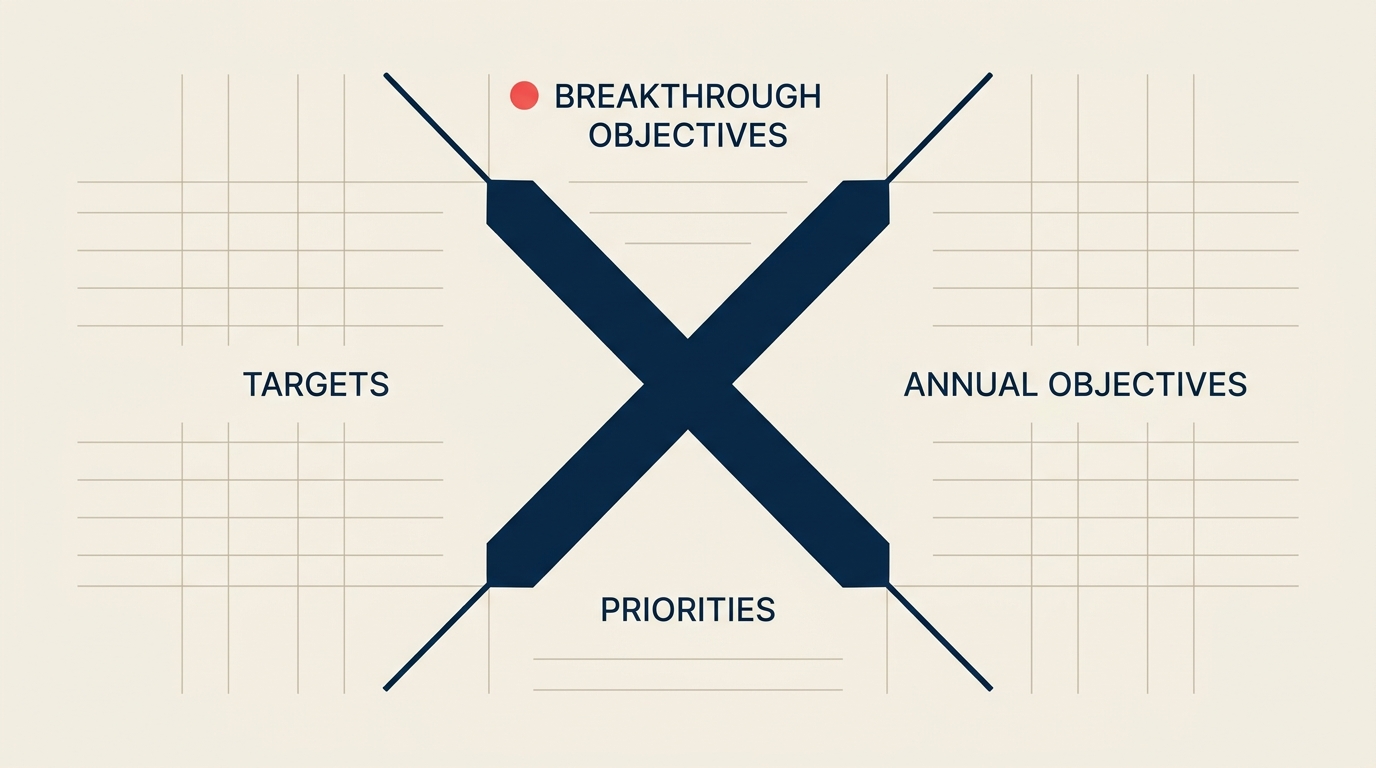
A X-matrix (às vezes chamada de A3-X) é a ferramenta visual de planejamento no centro do hoshin kanri. É uma única página que conecta quatro níveis de planejamento em uma visão, usando uma matriz de correlação ao longo de sua diagonal para mostrar quais iniciativas apoiam quais objetivos e quem é responsável pelo quê.
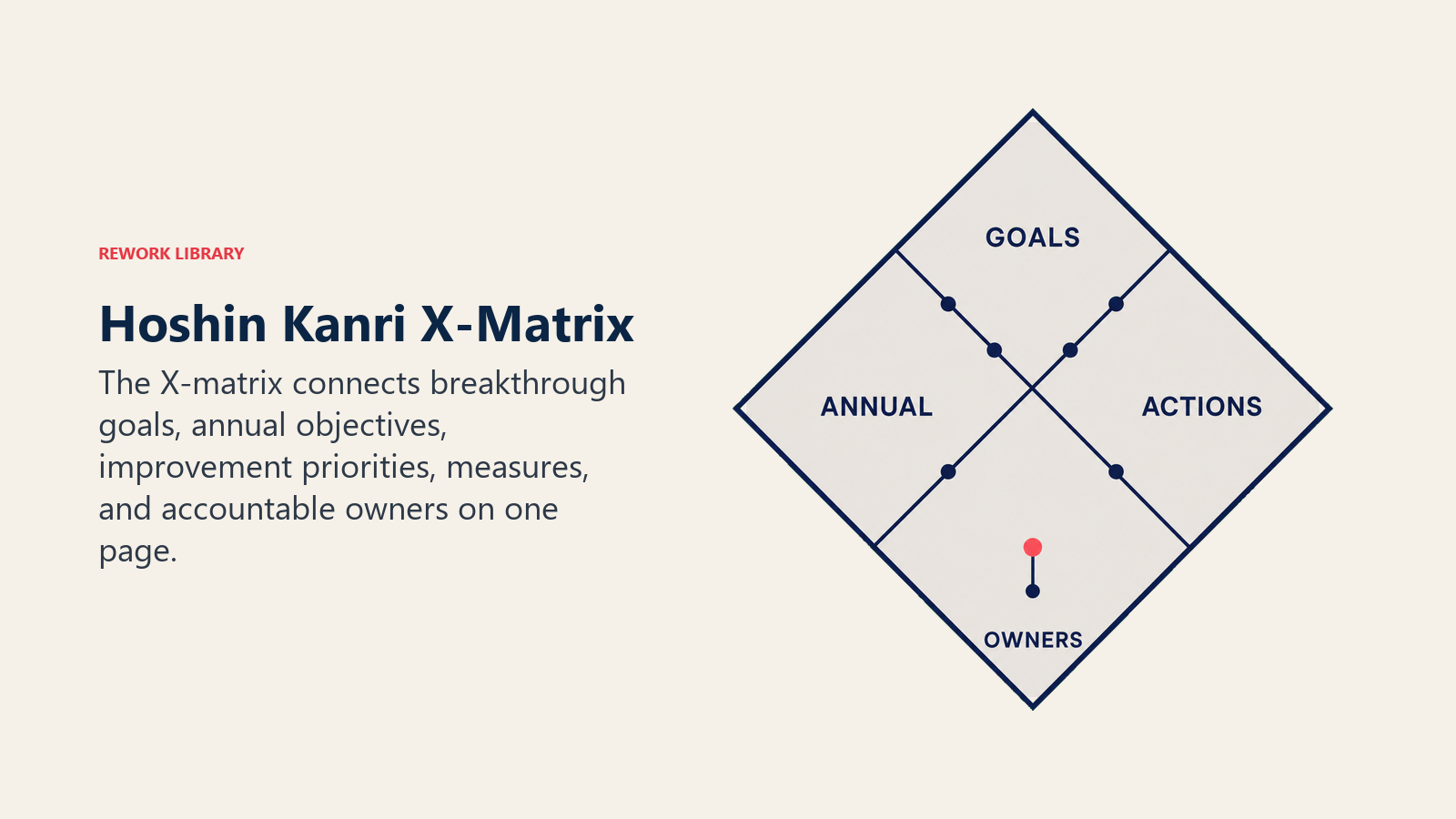
Os quatro quadrantes da X-matrix, lidos no sentido anti-horário a partir de baixo:
| Quadrante | Localização no X | Conteúdo |
|---|---|---|
| Objetivos de ruptura | Baixo | As metas transformacionais de 3 a 5 anos. São direcionais e ousadas (por exemplo, "Tornar-se o provedor de serviços número 1 no Sudeste Asiático até 2029"). |
| Objetivos anuais | Esquerda | O que precisa ser verdadeiro ao final deste ano fiscal para que a ruptura permaneça no caminho certo. São específicos e mensuráveis. |
| Prioridades de melhoria | Alto | As iniciativas ou projetos-chave que vão mover os objetivos anuais. Tipicamente 3 a 7 itens. |
| Metas a melhorar | Direita | As métricas de antecedência que mostram se as prioridades de melhoria estão funcionando. Frequentemente expressas como melhoria percentual ou metas absolutas. |
Ao longo das diagonais internas ficam mais dois elementos:
- Matriz de correlação: Círculos pequenos (cheio = ligação forte, aberto = ligação fraca) mostram quais objetivos anuais se conectam a quais objetivos de ruptura, e quais prioridades de melhoria se conectam a quais objetivos anuais. É aqui que você identifica se seu plano é internamente coerente.
- Recursos/responsáveis: O anel externo lista as equipes ou indivíduos responsáveis por cada prioridade de melhoria.
A X-matrix não é uma decoração de parede. As equipes a utilizam em revisões mensais e trimestrais para avaliar se a correlação se mantém, se as metas estão avançando e se as prioridades de melhoria precisam ser ajustadas.
Hoshin Kanri vs MBO vs OKRs
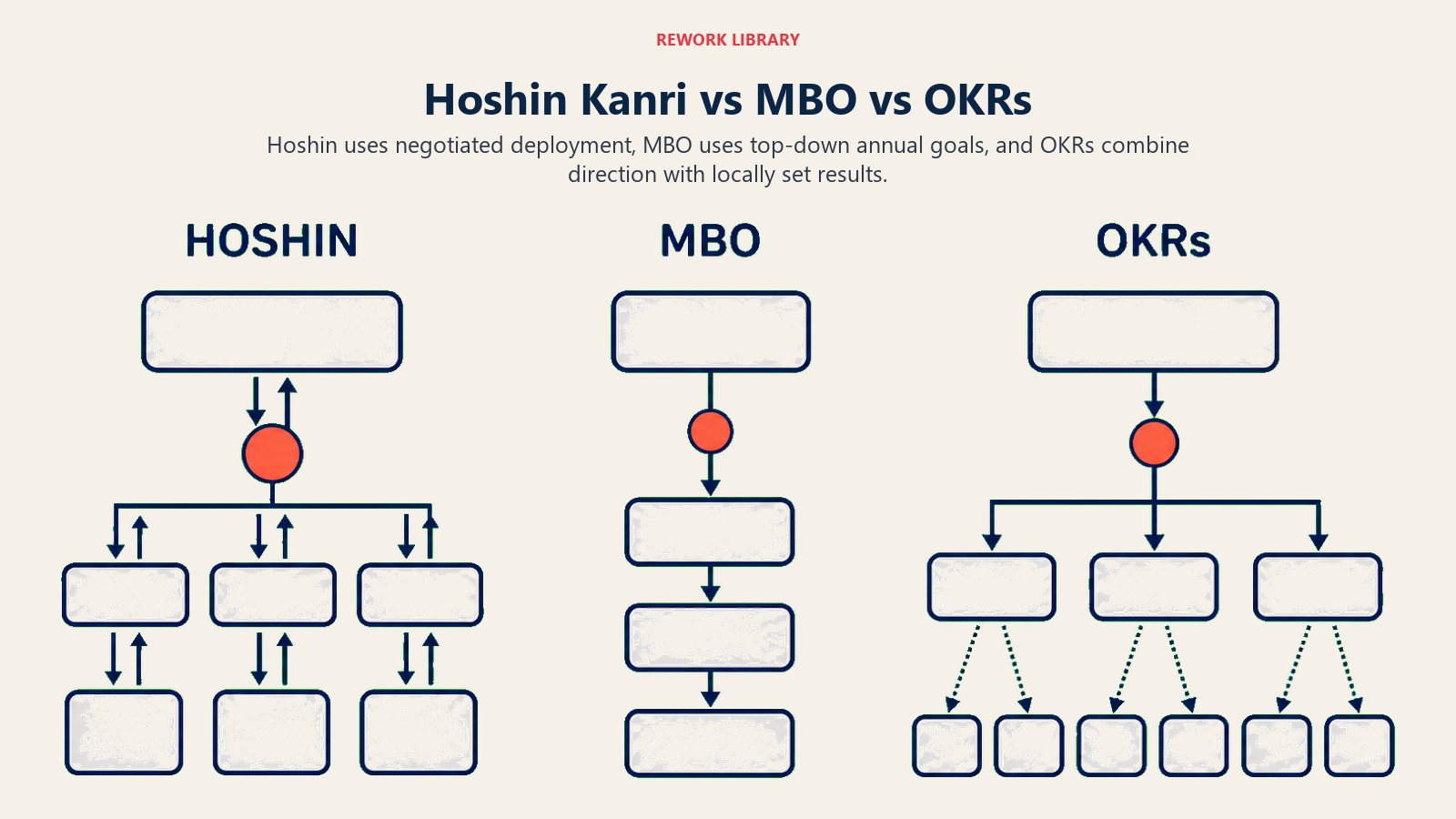
Os três frameworks tentam conectar metas à execução. Eles diferem significativamente em como chegam lá.
| Dimensão | Hoshin kanri | MBO (management by objectives) | OKRs (objectives and key results) |
|---|---|---|---|
| Mecanismo de alinhamento | Catchball (negociação bidirecional para cima e para baixo na hierarquia) | Definição de metas de cima para baixo com revisões anuais | Enquadramento de cima para baixo com OKRs de nível de equipe definidos localmente |
| Profundidade do desdobramento | Até o nível de contribuidor individual por meio de X-matrices aninhadas | Tipicamente para no nível de gerente | Variável; frequentemente para no nível de equipe |
| Cadência | Revisões mensais de progresso, revisões aprofundadas trimestrais, ciclo PDCA anual | Revisão anual, às vezes semestral | Ciclos trimestrais de OKR, check-ins semanais |
| Número de prioridades | Estrito: no máximo 3 a 5 objetivos de ruptura | Frequentemente permite muitas metas por pessoa | Tipicamente 3 a 5 objetivos por equipe, 3 a 4 resultados-chave cada |
| Origem principal | Toyota Production System, manufatura lean | Peter Drucker, 1954 | Andy Grove na Intel, popularizado pelo Google |
| Melhor aplicação | Excelência operacional, transformação lean, manufatura, grandes hierarquias | Planejamento corporativo geral | Startups de alto crescimento, equipes de produto, trabalho do conhecimento |
O diferencial fundamental é o catchball, o processo de negociação bidirecional do hoshin kanri. No MBO e na maioria das implementações de OKR, as metas descem. No hoshin kanri, cada nível recebe objetivos propostos, os questiona e devolve planos modificados para cima antes de qualquer comprometimento. Isso desacelera o ciclo de planejamento, mas produz um alinhamento que realmente se sustenta.
Benefícios do Hoshin Kanri
Foco em vez de amplitude. O limite rígido de 3 a 5 objetivos de ruptura força a liderança a dizer não. Essa restrição é um recurso: cada iniciativa que entra no plano se conecta diretamente a uma prioridade estratégica. Todo o resto espera.
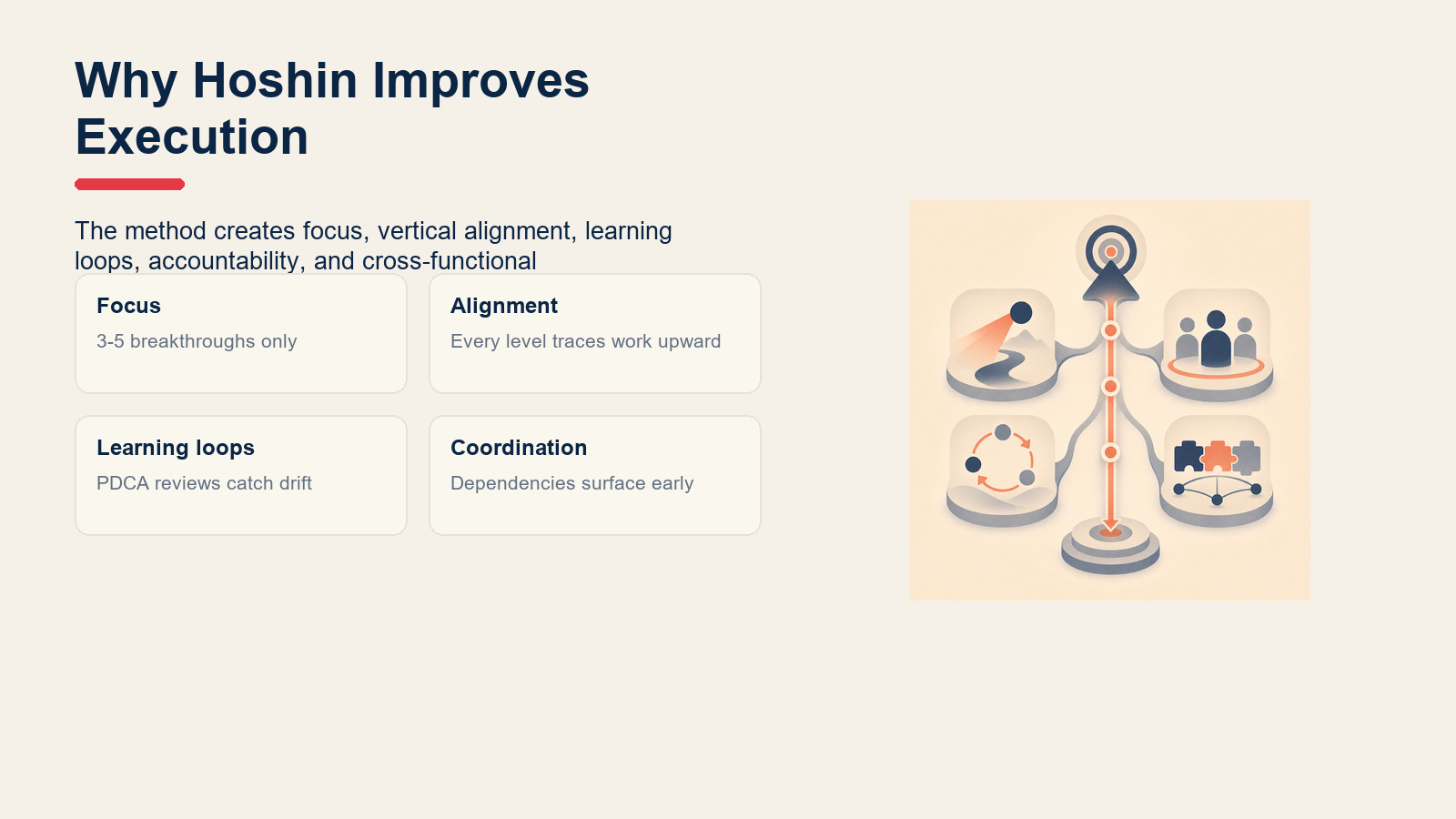
Alinhamento vertical real. Por meio do processo de catchball e de X-matrices aninhadas em cada nível organizacional, um supervisor de equipe de linha de frente consegue ver como sua prioridade semanal se conecta à meta de cinco anos da empresa. Essa visibilidade importa para a motivação e para a priorização.
Ciclos de aprendizado incorporados. O hoshin kanri usa o ciclo PDCA (Plan, Do, Check, Act) como seu ritmo de revisão. As revisões mensais verificam métricas de antecedência; as trimestrais avaliam as prioridades de melhoria; a revisão anual avalia o ano completo e alimenta o próximo ciclo de planejamento. Os problemas surgem cedo, em vez de no final do ano.
Responsabilidade sem microgestão. Os responsáveis são nomeados no nível de prioridade de melhoria, não no nível de tarefa. As equipes têm autonomia para escolher como mover suas metas; a liderança revisa se as metas avançaram, não se tarefas específicas foram concluídas.
Coordenação multifuncional. Como as prioridades de melhoria são responsabilidade no nível da matriz (não dentro de um único departamento), o hoshin kanri naturalmente evidencia dependências multifuncionais durante o planejamento, em vez de durante a execução.
Erros Comuns e Limitações
Objetivos de ruptura em excesso. No momento em que uma equipe se compromete com oito metas de "ruptura", o hoshin kanri se torna um exercício de planejamento anual comum. O framework só funciona quando a liderança genuinamente prioriza e corta.
Pular o catchball. Se a liderança escreve a X-matrix e a repassa para reconhecimento em vez de negociação, as equipes cumprem no papel e continuam trabalhando no que já estava em suas filas. O catchball leva tempo; a maioria das organizações investe pouco nele.
Confundir prioridades de melhoria com projetos. As prioridades de melhoria são capacidades a serem construídas (por exemplo, "reduzir o tempo do ciclo de pedido ao recebimento em 30%"), não nomes de projetos. Quando as equipes listam projetos em vez disso, a responsabilidade pelos resultados desaparece.
Apenas revisões anuais. O ritmo PDCA requer pontos de contato mensais e trimestrais. Organizações que tratam o hoshin kanri como um evento anual de planejamento produzem documentos bonitos que ninguém lê no quarto mês.
Complexidade para equipes pequenas. O hoshin kanri foi projetado para organizações grandes e hierárquicas com múltiplas camadas de gestão. Para equipes com menos de 50 pessoas, os OKRs ou um mapa de estratégia mais simples geralmente funcionam melhor com menos sobrecarga.
Como Implementar o Hoshin Kanri
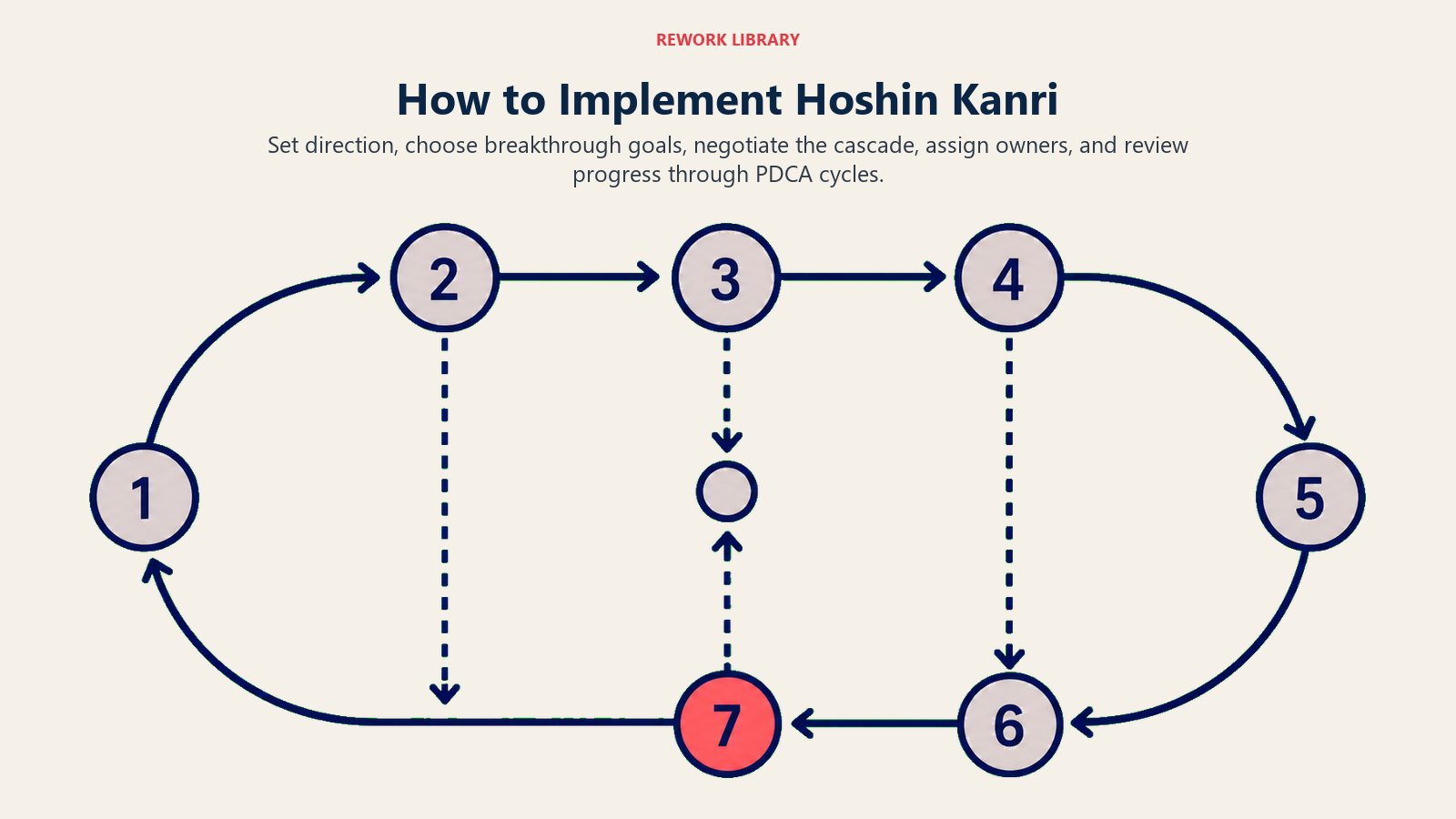
Etapa 1: Definir a visão e avaliar o estado atual
Antes de definir uma direção de ruptura, a equipe de liderança precisa de clareza compartilhada sobre onde a organização se encontra hoje. Realize uma avaliação estruturada usando ferramentas como o balanced scorecard, uma análise SWOT ou uma análise de lacunas para identificar a distância entre o desempenho atual e onde você precisa chegar. Essa análise alimenta diretamente a Etapa 2.
Etapa 2: Definir objetivos de ruptura de 3 a 5 anos
Os objetivos de ruptura são transformacionais. Não podem ser alcançados por meio de melhoria incremental; exigem fazer algo materialmente diferente. A equipe deve perguntar: "Como é o sucesso em três a cinco anos, e o que precisa mudar fundamentalmente para chegar lá?" Limite-os a 3 a 5 objetivos. Se você tem dez, não tem nenhum.
Esses objetivos ficam no quadrante inferior da X-matrix.
Etapa 3: Definir os objetivos anuais
Os objetivos anuais respondem: "O que deve ser verdadeiro até 31 de dezembro para que estejamos no caminho certo para a ruptura?" São específicos, mensuráveis e diretamente rastreáveis a pelo menos um objetivo de ruptura. Uma equipe de 200 pessoas não deve ter mais de 5 a 7 objetivos anuais no total, compartilhados em toda a organização, não por função.
Esses vão no quadrante esquerdo da X-matrix.
Etapa 4: Executar o processo de catchball e desdobrar
É aqui que a maioria das organizações investe pouco. A equipe de liderança apresenta o rascunho da X-matrix ao nível seguinte. Esse nível questiona: "Não conseguimos atingir aquele objetivo anual porque estamos atualmente limitados por X. Se quiserem nosso comprometimento, precisamos de Y." O plano revisado sobe. Esse vai e vem (catchball) continua até que cada nível tenha negociado algo que genuinamente se apropria.
Cada unidade de negócios ou função então constrói sua própria X-matrix, com seus objetivos anuais alimentados a partir das prioridades de melhoria do nível corporativo. Essa estrutura aninhada cria o alinhamento vertical pelo qual o hoshin kanri é reconhecido.
Etapa 5: Construir a X-matrix
Com objetivos de ruptura, objetivos anuais e prioridades de melhoria confirmados, construa a X-matrix completa. Preencha a matriz de correlação (quais prioridades apoiam quais objetivos anuais, e quais objetivos anuais se ligam a quais rupturas). Nomeie os responsáveis por cada prioridade de melhoria. Defina as metas a melhorar no quadrante direito. A X-matrix concluída se torna o documento de referência único para todas as revisões.
Etapa 6: Executar e conduzir revisões mensais
Os responsáveis reportam mensalmente sobre suas metas a melhorar. O formato de revisão é simples: a métrica está avançando conforme planejado? Se não, qual é a contramedida? As revisões focam nas métricas de antecedência no quadrante direito da X-matrix, não em relatórios de atividade. Quando uma métrica fica para trás, a equipe documenta o problema em uma planilha de solução de problemas A3 e apresenta uma ação corretiva.
É aqui que o ciclo PDCA (Plan, Do, Check, Act) opera no nível mensal.
Etapa 7: Conduzir a revisão anual do PDCA
No final do ano, a equipe de liderança conduz uma revisão PDCA completa. Eles avaliam cada objetivo anual: foi atingido? Se não, qual fator sistêmico causou a lacuna? Os resultados dessa revisão alimentam diretamente o ciclo de planejamento do próximo ano. As prioridades de melhoria que tiveram sucesso progridem ou são absorvidas no trabalho padrão. As prioridades que falharam são diagnosticadas: meta errada, responsável errado ou teoria de mudança errada.
A revisão anual fecha o ciclo e inicia o próximo ciclo de hoshin kanri.
Exemplos de Hoshin Kanri
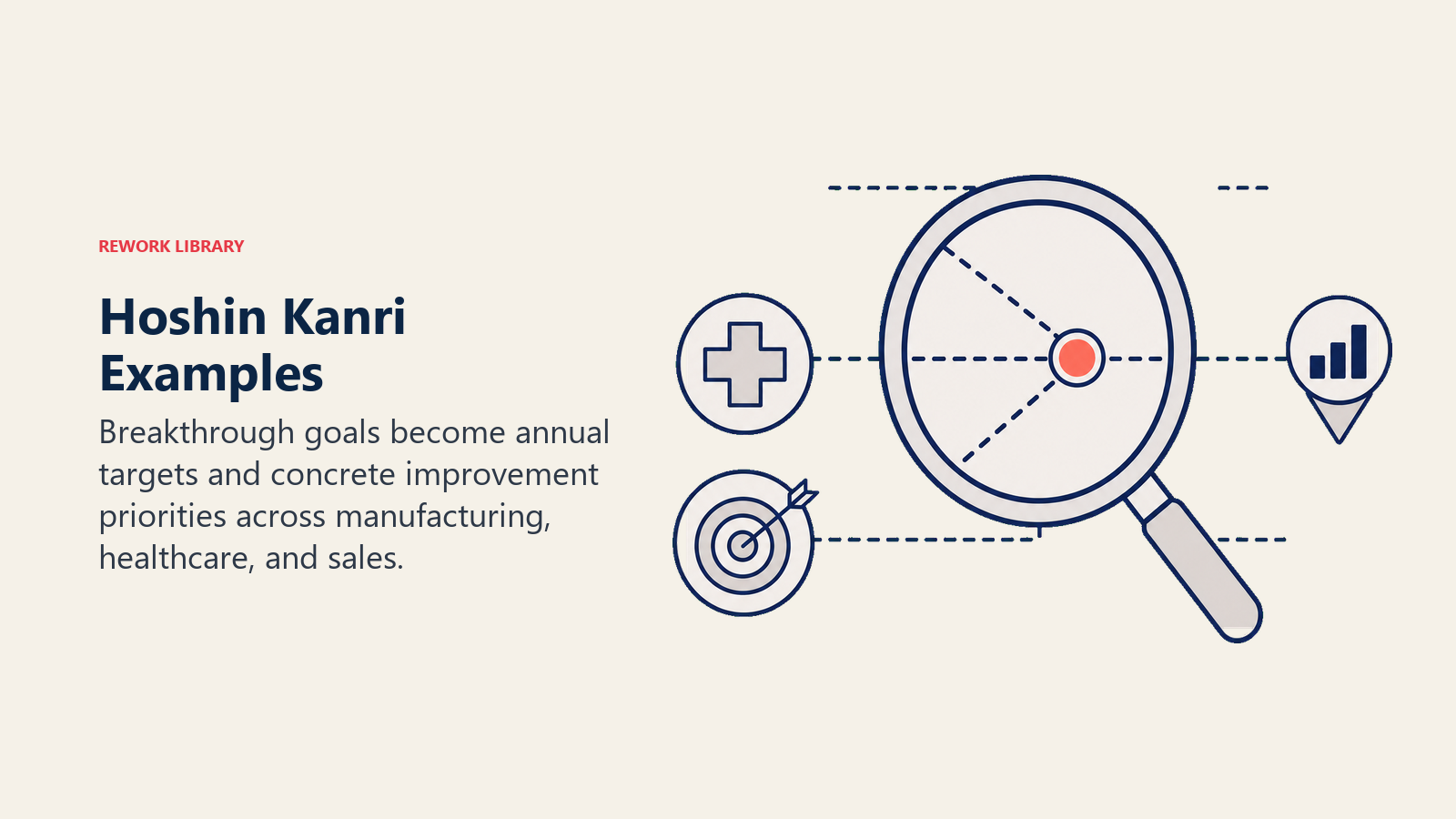
| Setor/Função | Objetivo de ruptura | Objetivo anual | Prioridade de melhoria |
|---|---|---|---|
| Manufatura | Tornar-se produtor zero defeito na linha de produto principal até 2028 | Reduzir a taxa de defeitos de campo em 40% no AF2026 | Implementar controle estatístico de processo nas três linhas de montagem |
| Saúde | Atingir satisfação do paciente no quartil superior da região até 2027 | Reduzir o tempo médio de espera para alta de 4,2 horas para 2,5 horas | Redesenhar o fluxo de coordenação de alta entre enfermagem e farmácia |
| SaaS/Tecnologia | Atingir 94% de retenção bruta de receita até o final do AF2028 | Melhorar a taxa de conclusão de onboarding em 90 dias de 61% para 80% | Construir pontuação de saúde de onboarding automatizada e gatilhos de intervenção no CRM |
Em cada caso, a prioridade de melhoria é uma capacidade a ser construída, não uma lista de tarefas. A conexão entre o trabalho diário e a meta de três a cinco anos é rastreável em um único documento.
Boas Práticas
Limite a X-matrix a uma página. Se o seu documento de hoshin kanri tem 40 slides, é um deck de orçamento, não um plano de desdobramento. A disciplina está em encaixar tudo em uma página.
Use a X-matrix em toda revisão, não apenas na temporada de planejamento. Imprima-a, coloque-a na sala e marque o progresso em relação às metas em tempo real. X-matrices desatualizadas são um sinal de que o hoshin kanri virou ritual em vez de sistema de gestão.
Combine o hoshin kanri com kaizen no nível operacional. O hoshin kanri define a direção; o kaizen (melhoria contínua) impulsiona a solução de problemas diária que realmente move as metas. Os dois métodos são projetados para trabalhar juntos.
Invista na fase de catchball. Reserve pelo menos duas a quatro semanas para o desdobramento. Equipes que apressam o catchball para cumprir um prazo de planejamento produzem X-matrices com metas nas quais ninguém acredita.
Conecte o hoshin kanri ao seu processo de planejamento estratégico. O hoshin kanri é mais forte como camada de desdobramento sobre uma estratégia bem definida, não como substituto para o desenvolvimento da estratégia.
Leitura Relacionada

Co-Founder & COO
On this page
- O Que É Hoshin Kanri?
- A X-Matrix do Hoshin Kanri Explicada
- Hoshin Kanri vs MBO vs OKRs
- Benefícios do Hoshin Kanri
- Erros Comuns e Limitações
- Como Implementar o Hoshin Kanri
- Etapa 1: Definir a visão e avaliar o estado atual
- Etapa 2: Definir objetivos de ruptura de 3 a 5 anos
- Etapa 3: Definir os objetivos anuais
- Etapa 4: Executar o processo de catchball e desdobrar
- Etapa 5: Construir a X-matrix
- Etapa 6: Executar e conduzir revisões mensais
- Etapa 7: Conduzir a revisão anual do PDCA
- Exemplos de Hoshin Kanri
- Boas Práticas
- Leitura Relacionada