Estratégia de Liderança em Custo: Como Funciona (Exemplos)
Turn this article into takeaways for your work.


Each assistant summarizes the article only for you and suggests best practices for your work.
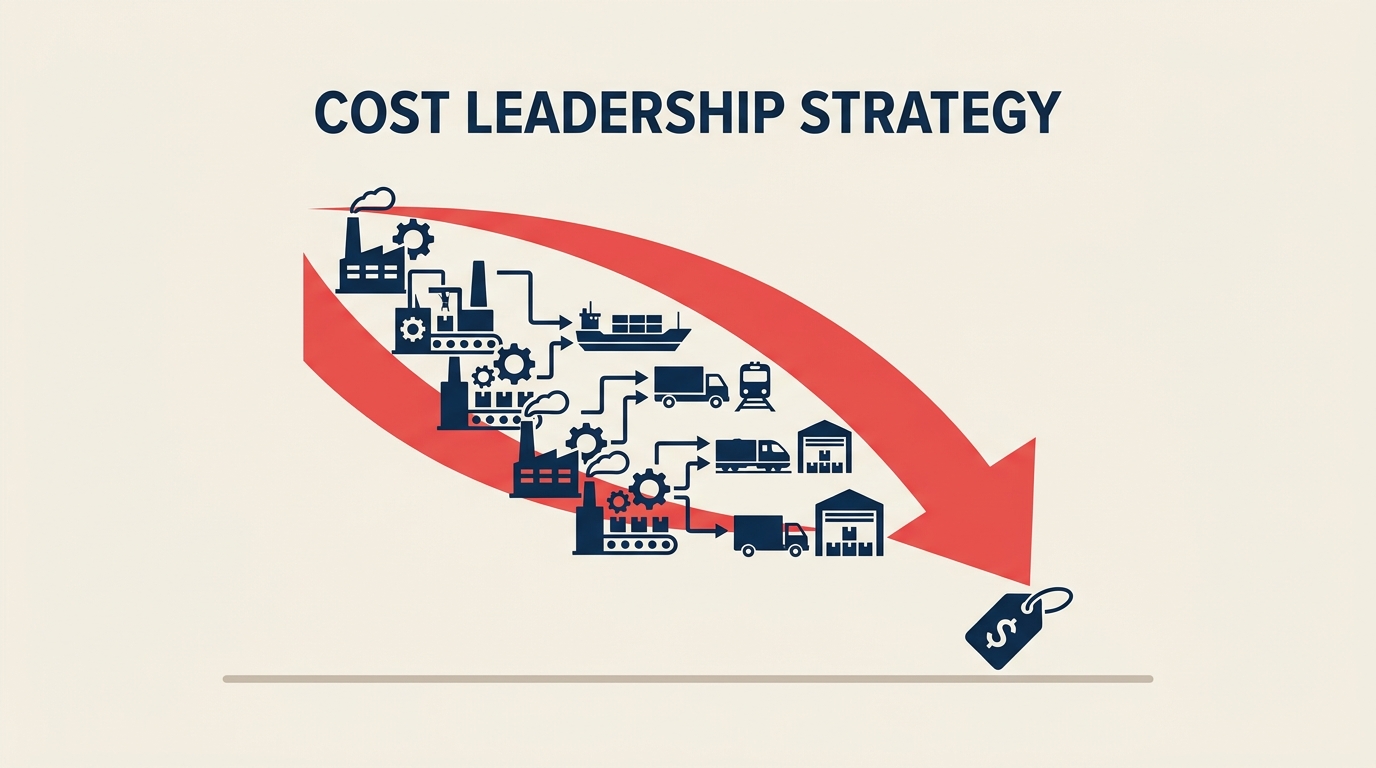
A estratégia de liderança em custo é um dos caminhos mais claros para uma posição competitiva duradoura: produzir bens ou serviços a um custo menor do que qualquer concorrente do setor, mantendo uma qualidade suficiente para manter os clientes comprando. Não significa vender o produto mais barato. Significa que sua estrutura de custos é tão eficiente que você pode precificar de forma agressiva, absorver guerras de preços melhor do que os rivais e ainda lucrar enquanto eles perdem dinheiro.
Michael Porter introduziu o conceito em Estratégia Competitiva (1980) como uma das três estratégias genéricas que uma empresa pode adotar para superar seus concorrentes. Desde então, a liderança em custo construiu alguns dos negócios mais duradouros do mundo, do Walmart à Ryanair à operação de logística da Amazon.
O que é uma estratégia de liderança em custo?
Uma estratégia de liderança em custo é uma abordagem competitiva em que a empresa se torna a produtora de menor custo em seu setor, mantendo qualidade de produto ou serviço aceitável. O objetivo não é ser barato pelo simples fato de ser barato. É construir uma estrutura de custos tão abaixo da norma do setor que os rivais não consigam igualar seus preços sem perder dinheiro.
Porter posicionou a liderança em custo ao lado da estratégia de diferenciação e do foco como as três estratégias genéricas viáveis para qualquer empresa. Empresas que não se comprometem com uma dessas posições, argumentou Porter, ficam "presas no meio-termo": não são baratas o suficiente para vencer no preço nem distintas o suficiente para cobrar um prêmio. A liderança em custo é a saída mais clara dessa armadilha para empresas que conseguem atingir escala.
Fatos principais: Estratégia de Liderança em Custo
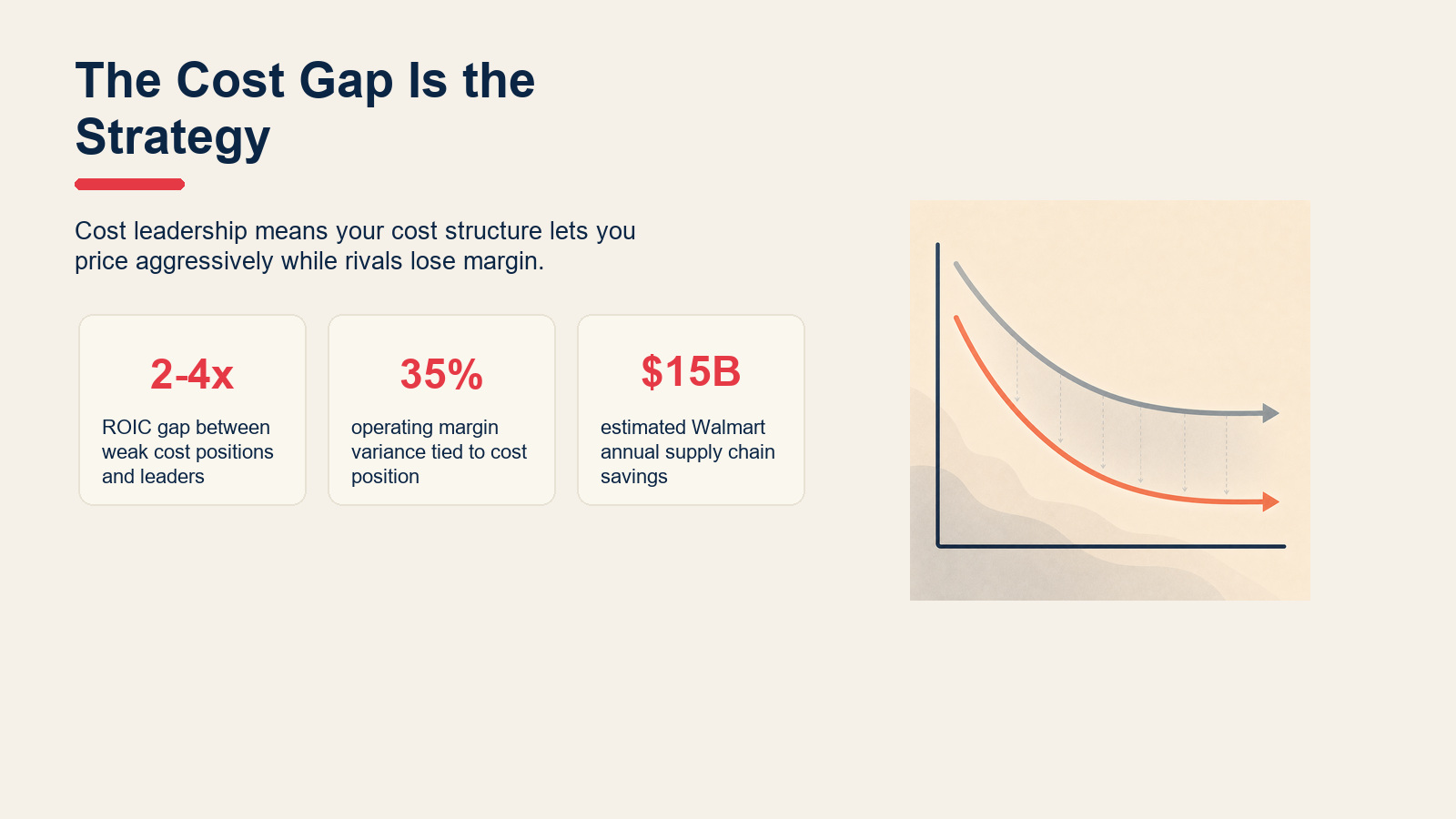
- Empresas no quartil inferior de estruturas de custo do setor obtêm retornos sobre o capital investido (ROIC) cerca de 2 a 4 vezes menores do que as líderes em custo no mesmo setor, mesmo quando o crescimento de receita é semelhante. (McKinsey Global Institute, 2023)
- Em setores maduros e comoditizados, a posição de custo é o preditor isolado mais forte de rentabilidade de longo prazo, explicando até 35% da variância nas margens operacionais. (Porter, Vantagem Competitiva, 1985, análise atualizada)
- As eficiências na cadeia de suprimentos do Walmart geram aproximadamente US$ 15 bilhões em economias de custo anuais em relação a concorrentes varejistas comparáveis, dando-lhe uma margem de precificação que nenhum concorrente exclusivamente digital consegue igualar. (Relatório Anual do Walmart, 2023)
A definição que importa operacionalmente: você é líder em custo quando consegue estabelecer preços que lhe rendem uma boa margem, mas colocariam um concorrente com estrutura de custo média no ponto de equilíbrio ou abaixo dele. Essa diferença é seu amortecedor estratégico.
Liderança em custo vs. diferenciação
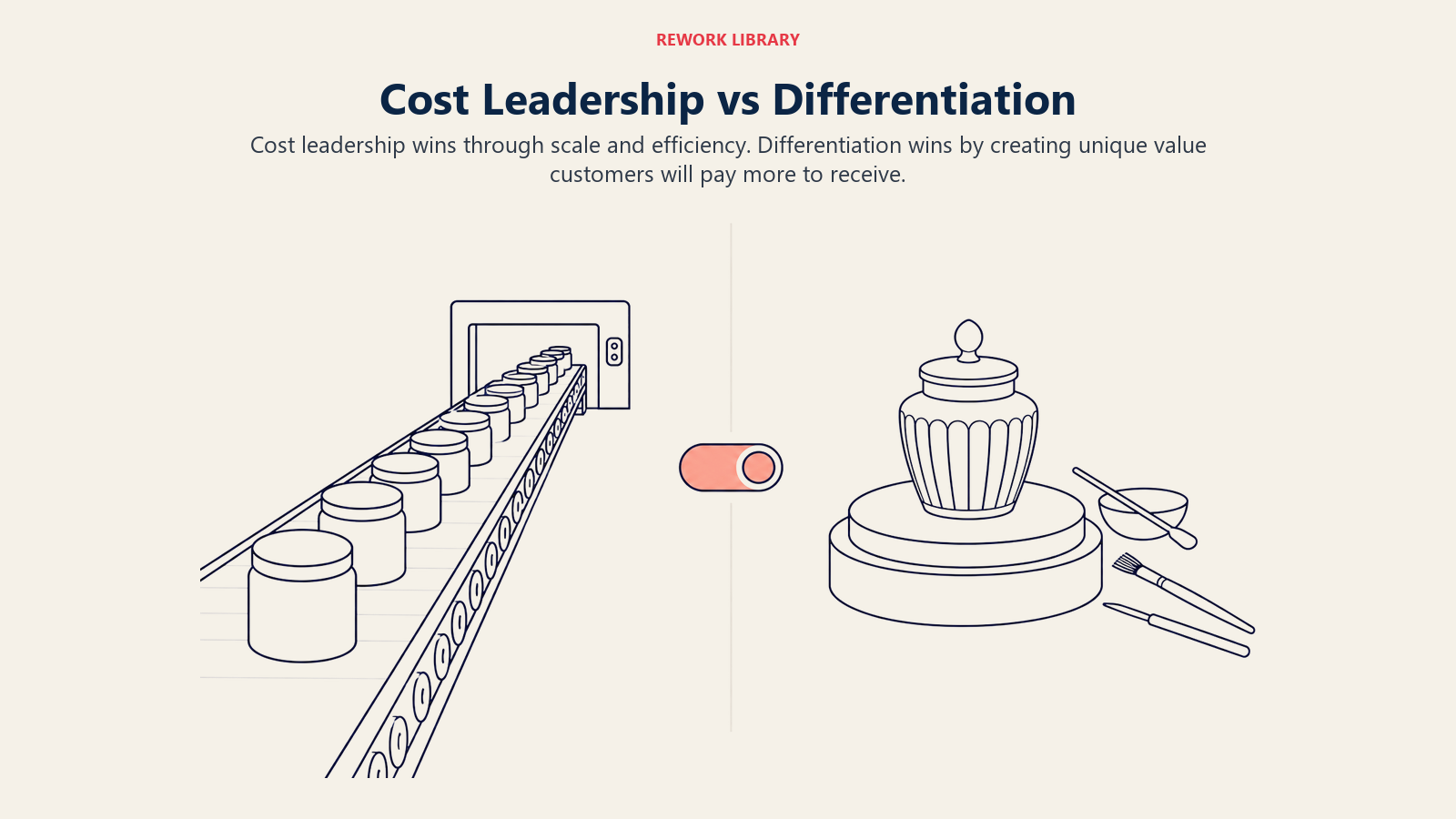
Essas duas estratégias puxam em direções opostas por design. A estratégia de diferenciação investe para tornar um produto ou serviço tão distinto que os clientes pagarão um prêmio. A liderança em custo otimiza incansavelmente para eliminar custo de cada etapa da cadeia de valor, permitindo preços mais baixos ou margens superiores ao preço de mercado.
| Dimensão | Liderança em Custo | Diferenciação |
|---|---|---|
| Objetivo principal | Menor estrutura de custo do setor | Valor único pelo qual os clientes pagarão mais |
| Poder de precificação | Competir no preço ou na margem com preços equivalentes | Cobrar prêmio pela distinção |
| Foco de investimento | Escala, eficiência de processos, compras | P&D, marca, experiência do cliente |
| Principal risco | Guerra de preços, imitação, comoditização | Cópia, mudanças de tendência, custos excessivos |
| Motor de margem | Volume e eficiência | Exclusividade e custos de mudança |
| Exemplos clássicos | Walmart, Ryanair, Costco, ALDI | Apple, Rolex, Salesforce, Dyson |
Escolher entre elas não é apenas uma preferência. É uma decisão estrutural sobre onde você vai construir vantagem, e as duas estratégias exigem capacidades, culturas e prioridades de investimento completamente diferentes. Porter foi explícito: tentar ser as duas geralmente significa não ser nenhuma. Uma empresa como a IKEA é uma exceção genuína, mas investiu décadas construindo o raro conjunto de capacidades que lhe permite vencer no custo e se destacar no design simultaneamente.
Como a liderança em custo cria vantagem
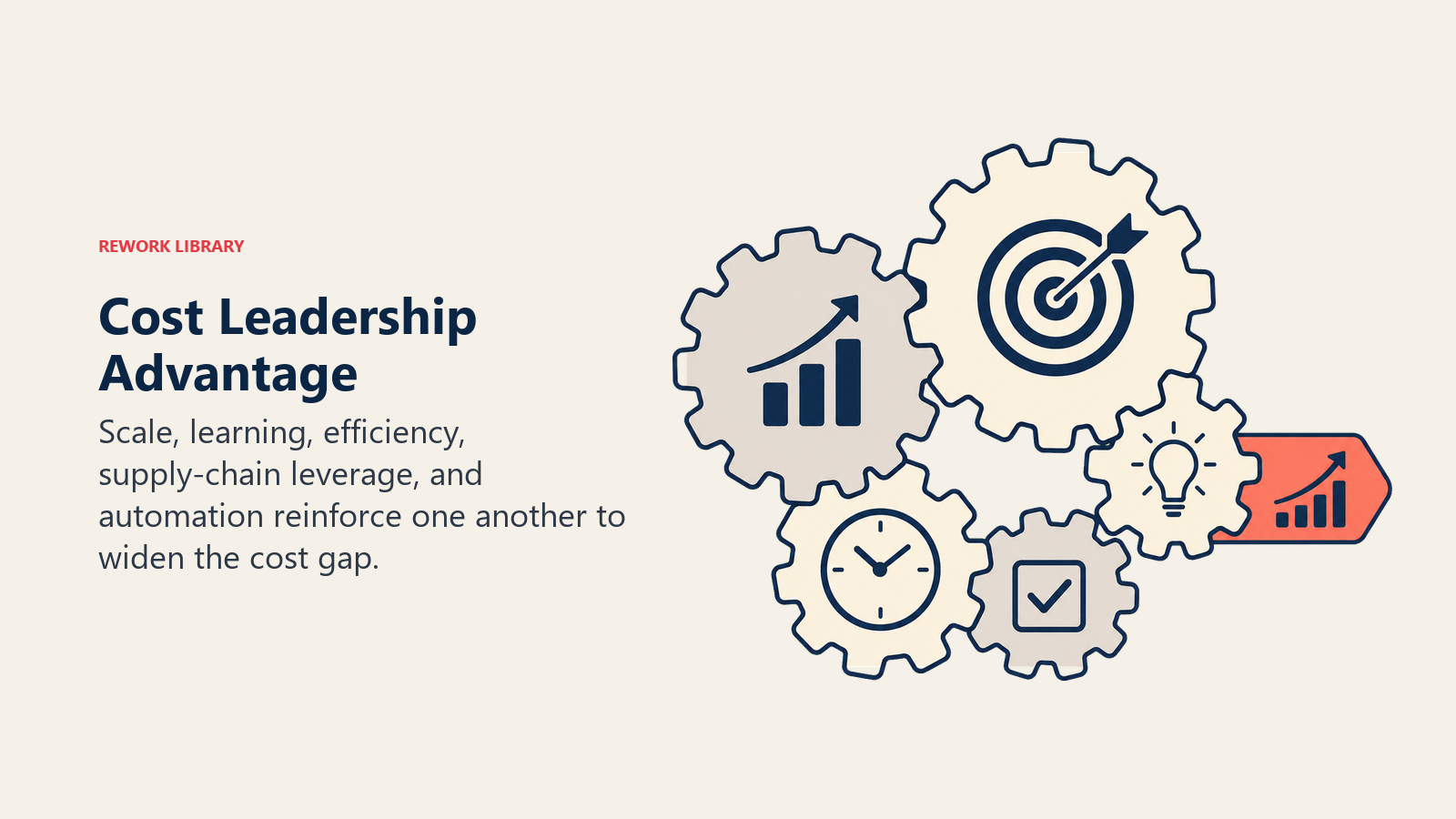
A vantagem de custo não vem de uma única fonte. Os líderes em custo mais duradouros combinam vários fatores que se reforçam mutuamente, tornando sua posição difícil de replicar mesmo quando os rivais podem ver exatamente o que estão fazendo. Veja análise de cadeia de valor para um detalhamento mais aprofundado de onde cada fator opera dentro do negócio.
As economias de escala geralmente são o primeiro fator discutido, e com razão. Quando os custos fixos (fábricas, infraestrutura de TI, investimento em marca) são distribuídos por um volume maior de unidades, o custo por unidade cai. Um fabricante que produz dez milhões de unidades pode normalmente comprar insumos a preços mais baixos, operar maquinário de forma mais contínua e negociar melhores tarifas logísticas do que um concorrente que fabrica um milhão de unidades. A escala não garante liderança em custo, mas sua ausência geralmente a impede.
A curva de experiência amplifica o efeito da escala. À medida que o volume de produção acumulado dobra, os tempos de trabalho caem, os processos se refinam e as taxas de defeito diminuem. O Boston Consulting Group quantificou esse padrão na década de 1960: em muitos setores, os custos unitários reais caem 15 a 25% cada vez que o volume acumulado dobra. Empresas que atingem escala primeiro acumulam vantagens de aprendizado que os rivais levam anos para fechar. Essa é a lógica por trás das estratégias de Cash Cow do BCG Matrix: extraia o negócio de alta participação de mercado e alto aprendizado para financiar novas entradas.
A eficiência operacional aparece em como a empresa configura seus processos internos. Lean manufacturing, Six Sigma, estoque just-in-time, automação e procedimentos de trabalho padronizados reduzem o custo por unidade sem exigir mais volume. O sistema de produção da Toyota é o exemplo canônico: a disciplina de processo, e não a escala bruta, criou sua posição de custo.
A alavancagem da cadeia de suprimentos vem do poder de compra, dos relacionamentos com fornecedores e do design logístico. O Walmart construiu centros de distribuição como hubs geográficos antes de abrir lojas ao redor deles, minimizando o custo de reabastecimento. A Costco compra em enormes quantidades diretamente dos fabricantes e vende uma linha estreita de SKUs (cerca de 3.700 itens versus mais de 40.000 em um supermercado típico), mantendo as compras simples e os relacionamentos com fornecedores profundos.
A tecnologia e a automação separam cada vez mais os líderes em custo do restante. A logística robotizada da Amazon, o modelo de rotas ponto a ponto da Ryanair com frotas padronizadas de Boeing 737 (um único tipo de aeronave significa menor custo de manutenção e treinamento) e o formato de varejo em armazém da Costco mostram como escolhas operacionais habilitadas por tecnologia se transformam em lacunas estruturais de custo que os concorrentes não conseguem fechar rapidamente.
Benefícios e riscos da liderança em custo
Benefícios
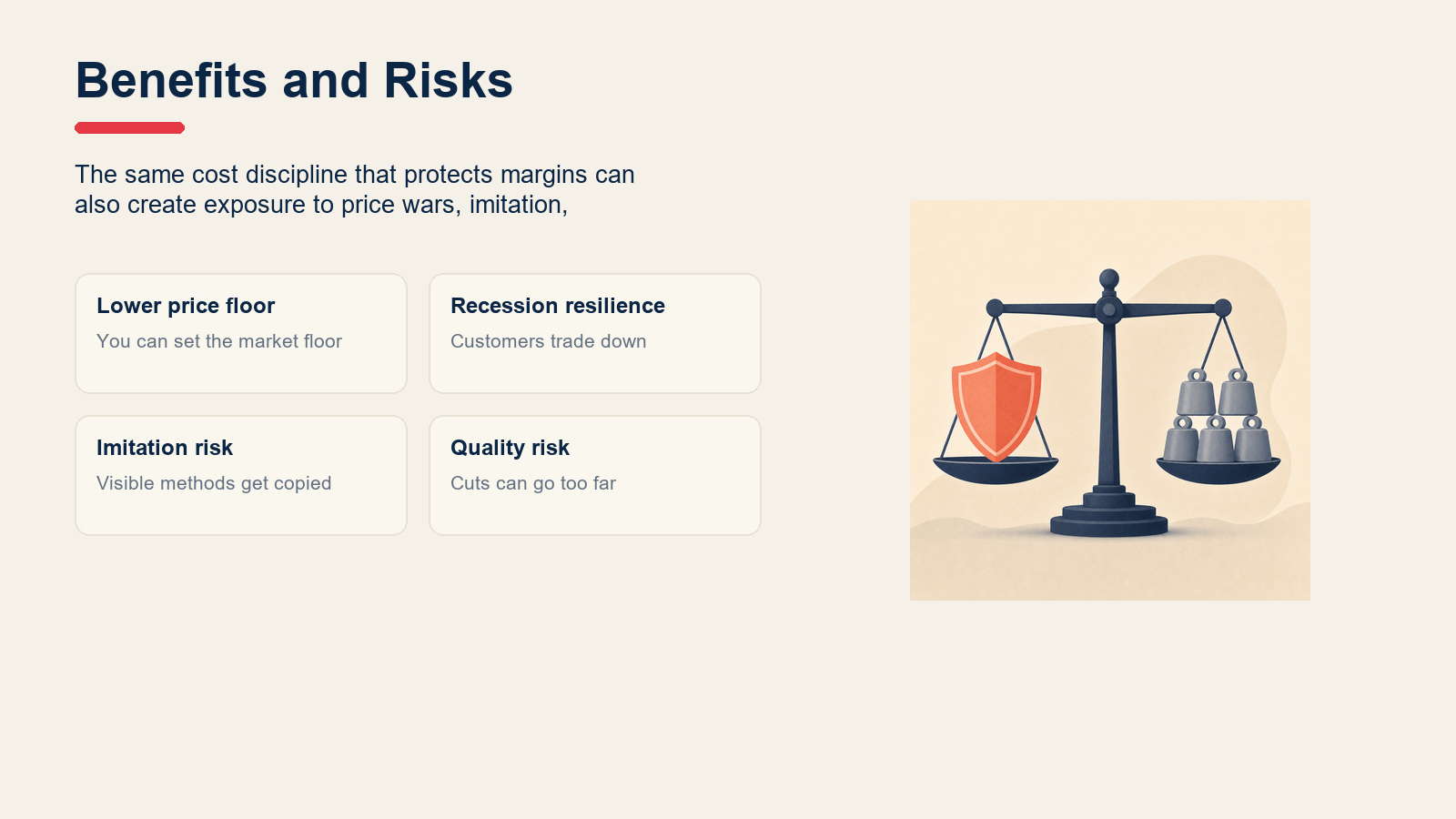
Ser o líder em custo do seu setor cria diversas vantagens duradouras. Você pode sustentar um preço mais baixo do que qualquer concorrente e ainda obter margem, o que tende a aumentar o volume e, consequentemente, a escala. Quando um setor passa por uma guerra de preços, você é quem define o piso, enquanto os rivais ou o igualam com prejuízo ou perdem participação de mercado. As recessões tendem a beneficiar os líderes em custo porque os clientes migram para baixo, e você é o destino natural. E se sua vantagem de eficiência for ampla o suficiente, você pode usar a margem excedente para investir em categorias adjacentes, adquirir concorrentes ou construir posições defensivas que os rivais não conseguem financiar.
Riscos
A liderança em custo também é um dos compromissos estratégicos mais arriscados quando não é mantida de forma implacável.
Guerras de preços com rivais bem capitalizados podem corroer as margens mais rápido do que as economias de escala conseguem compensar. Um concorrente com recursos financeiros robustos e razões estratégicas para ganhar participação de mercado (um novo entrante, uma startup bem financiada) pode sustentar perdas por mais tempo do que você.
A imitação é a ameaça mais comum. Assim que seus métodos de redução de custo se tornam visíveis (e em empresas de capital aberto frequentemente se tornam), os rivais investem para fechar a lacuna. A vantagem da curva de aprendizado se estreita à medida que o setor amadurece.
A disrupção tecnológica pode inverter a hierarquia de custos da noite para o dia. O modelo de marketplace da Uber eliminou o custo de capital de possuir frotas de táxi. O streaming digital eliminou a fabricação de discos e a distribuição no varejo. Empresas que construíram vantagem de custo em processos agora obsoletos descobriram que sua posição era inútil contra novos entrantes com arquiteturas de custo fundamentalmente diferentes.
Cortar qualidade em excesso é o risco mais sutil. Na busca pela redução de custo, as empresas às vezes cortam a qualidade do produto abaixo do nível que os clientes aceitarão. Isso não é liderança em custo. É falsa economia. A estratégia exige manter a qualidade no nível mínimo aceitável para o mercado-alvo, não abaixo dele.
Como construir uma estratégia de liderança em custo (passo a passo)
A liderança em custo não se alcança por meio de uma única iniciativa. Exige uma sequência de decisões que alinham toda a organização em torno da eficiência de custo como o objetivo estratégico primário.
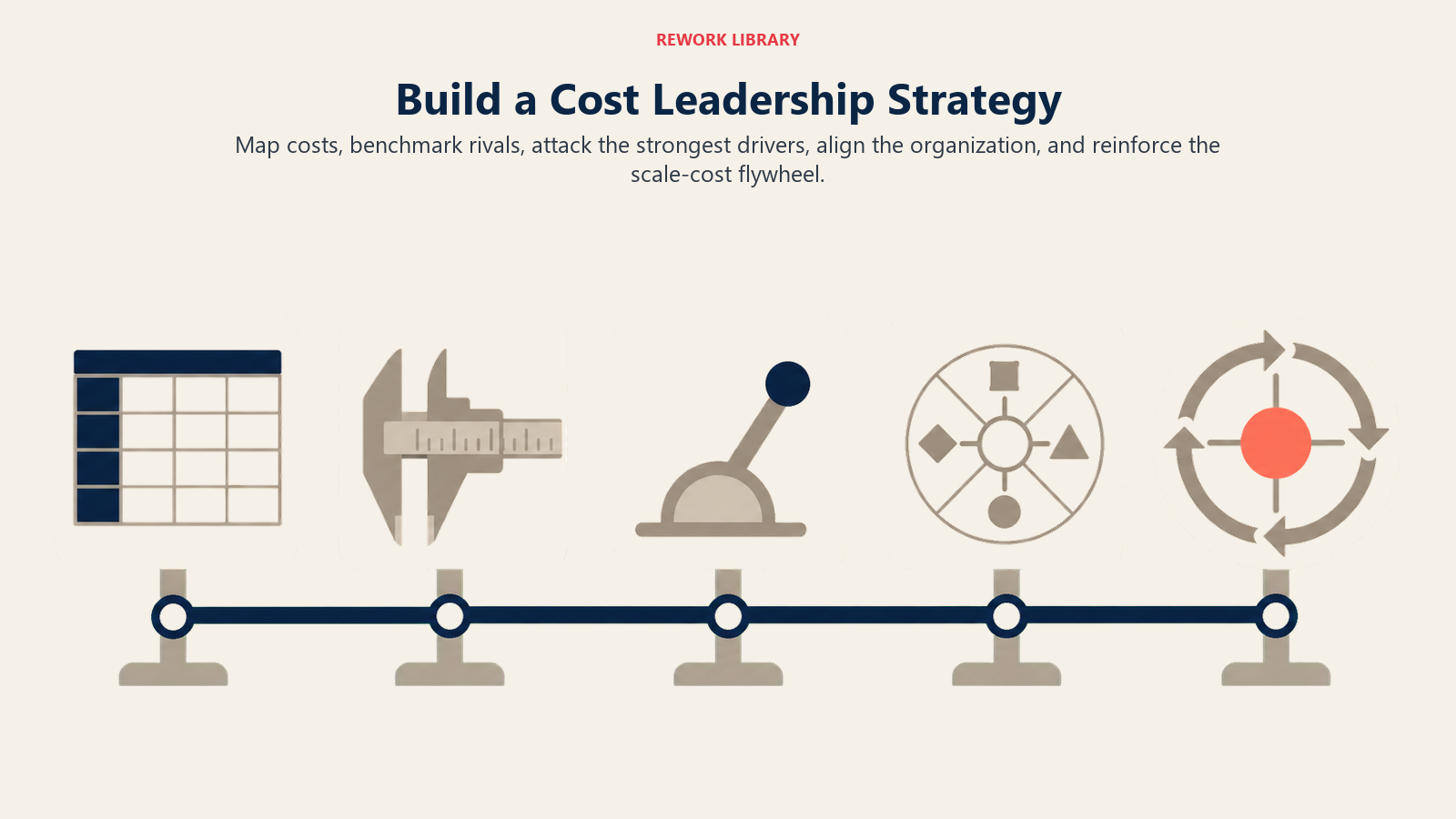
Passo 1: Mapeie sua estrutura de custos atual
Comece com uma análise de cadeia de valor para identificar onde os custos realmente se acumulam: logística de entrada, operações, logística de saída, marketing e vendas, serviços. Divida cada área em atividades primárias e de suporte. A maioria das empresas descobre que 60 a 80% do custo total se concentra em duas ou três atividades. Essas são as que precisam de maior atenção.
Passo 2: Compare-se com os melhores concorrentes da categoria
Você não pode saber se tem um problema de custo sem comparação. Analise dados públicos disponíveis: margens brutas nos relatórios anuais, custo dos produtos vendidos como percentual da receita, headcount por receita e logística como percentual das vendas. Depois compare não apenas com concorrentes diretos, mas também com empresas em setores análogos que resolveram desafios de custo semelhantes.
Passo 3: Identifique os fatores de custo e escolha dois ou três para atacar primeiro
Os fatores de custo de Porter incluem escala, aprendizado, utilização de capacidade, ligações entre atividades, integração vertical, localização e momento. Não tente melhorar todos ao mesmo tempo. Escolha os dois ou três onde sua lacuna é maior e sua alavancagem é maior. Uma empresa manufatureira com baixa utilização deve atacar a capacidade antes de otimizar as compras. Uma empresa de serviços com alto headcount por cliente deve automatizar antes de renegociar contratos com fornecedores.
Passo 4: Alinhe a organização em torno da disciplina de custo
A liderança em custo fracassa quando é tratada como uma iniciativa do departamento financeiro. Ela precisa atravessar operações, RH, compras e produto. Isso significa estabelecer KPIs de custo em todos os níveis, não apenas margens agregadas. Significa estruturas de incentivo que recompensem a melhoria de eficiência. E significa uma cultura que trata os gastos como uma decisão estratégica, não administrativa.
Passo 5: Integre a vantagem de custo ao ciclo virtuoso de vantagem competitiva
O objetivo é um ciclo auto-reforçante: custo menor permite preços menores, que impulsionam volume maior, que cria mais escala, que reduz ainda mais o custo. A operação de logística da Amazon executa esse ciclo de forma explícita. Identifique o mecanismo específico no seu negócio e invista em fortalecer o elo mais fraco da cadeia, em vez de distribuir o investimento de forma uniforme.
Exemplos de estratégia de liderança em custo
Os verdadeiros líderes em custo diferem em como alcançam sua posição, mas compartilham um padrão comum: escolhas estruturais deliberadas que reduzem o custo por unidade enquanto mantêm o nível de qualidade que o cliente-alvo precisa.
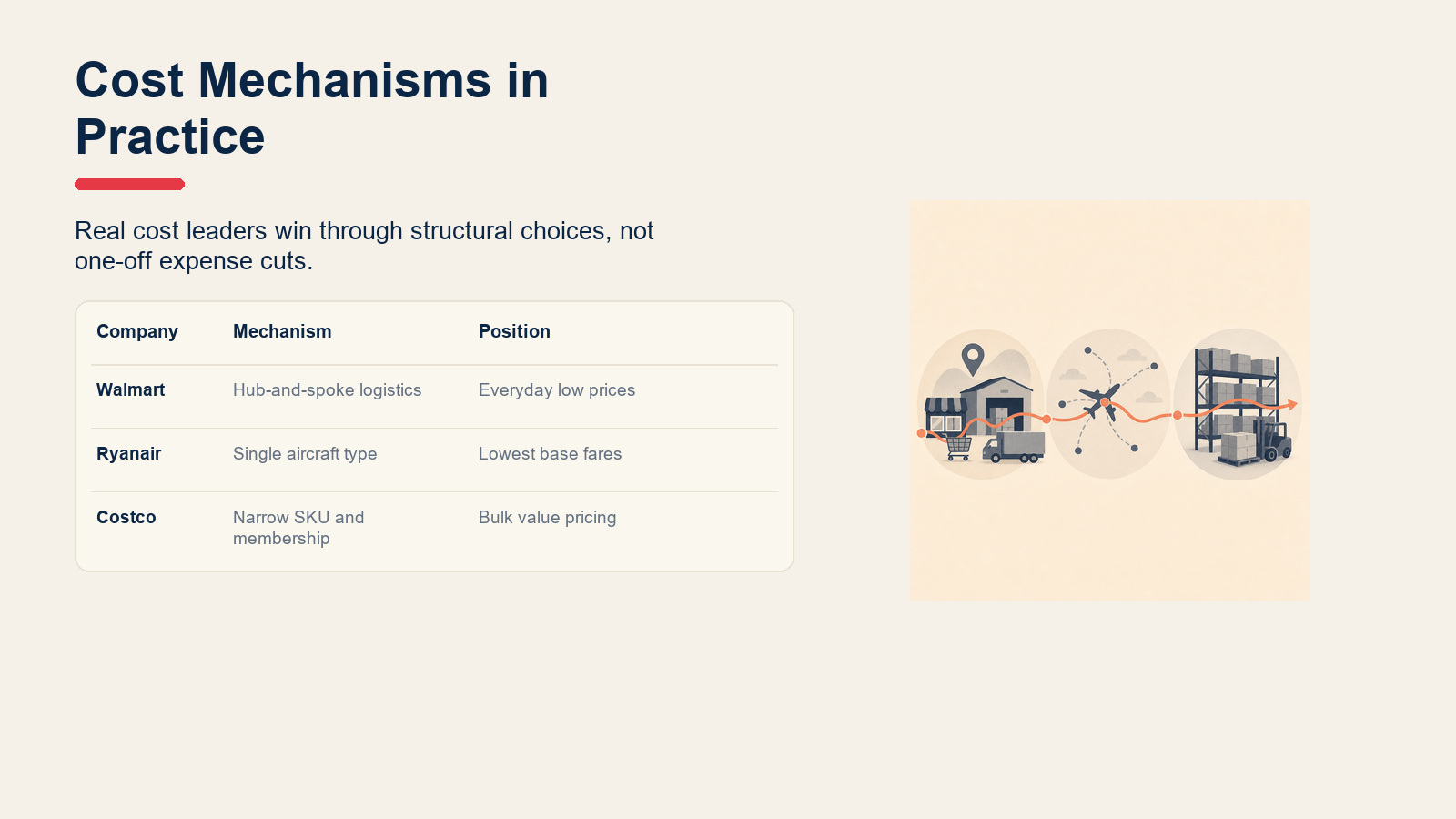
| Empresa | Setor | Mecanismo central de custo | Posição de preço |
|---|---|---|---|
| Walmart | Varejo | Logística hub-and-spoke, alavancagem com fornecedores, marca própria | Preços baixos todos os dias em alimentos e mercadorias em geral |
| Ryanair | Aviação | Frota de um único tipo de aeronave, rotas ponto a ponto, modelo sem extras | Tarifas base mais baixas nas rotas de curta distância europeias |
| Costco | Varejo atacadista | Linha estreita de SKUs, modelo de associação, compras em volume | Preços 20 a 40% abaixo dos supermercados convencionais em itens comparáveis |
| ALDI | Supermercados | 90% de marca própria, formato de loja compacto, equipe reduzida | Consistentemente os menores preços de supermercado nos mercados em que atua |
| Logística Amazon | E-commerce | Robótica, escala, densidade de rede, volume de terceiros | Custo de entrega por unidade abaixo de qualquer rede comparável |
| McDonald's | Restaurantes de serviço rápido | Modelo de franquia, cadeia de suprimentos padronizada, simplicidade do cardápio | Preços competitivos em todos os segmentos de refeição globalmente |
Observe que nenhuma dessas empresas é simplesmente "barata". Cada uma fez escolhas estruturais específicas que criam uma vantagem de custo e cada uma a defende com investimento contínuo. A Ryanair investe pesadamente na padronização da manutenção da frota. A Costco investe em especialistas em compras para negociar melhores condições. O Walmart destina centenas de milhões anualmente à tecnologia de cadeia de suprimentos.
Erros comuns na liderança em custo
Cortar em todo lugar em vez de otimizar estrategicamente. Empresas que respondem à pressão de margem cortando headcount de forma uniforme, reduzindo a qualidade em todos os produtos ou adiando todos os investimentos de capital estão gerenciando o caixa de curto prazo, não construindo vantagem de custo. Os verdadeiros líderes em custo investem fortemente nas atividades que criam eficiência e eliminam desperdícios implacavelmente no restante.
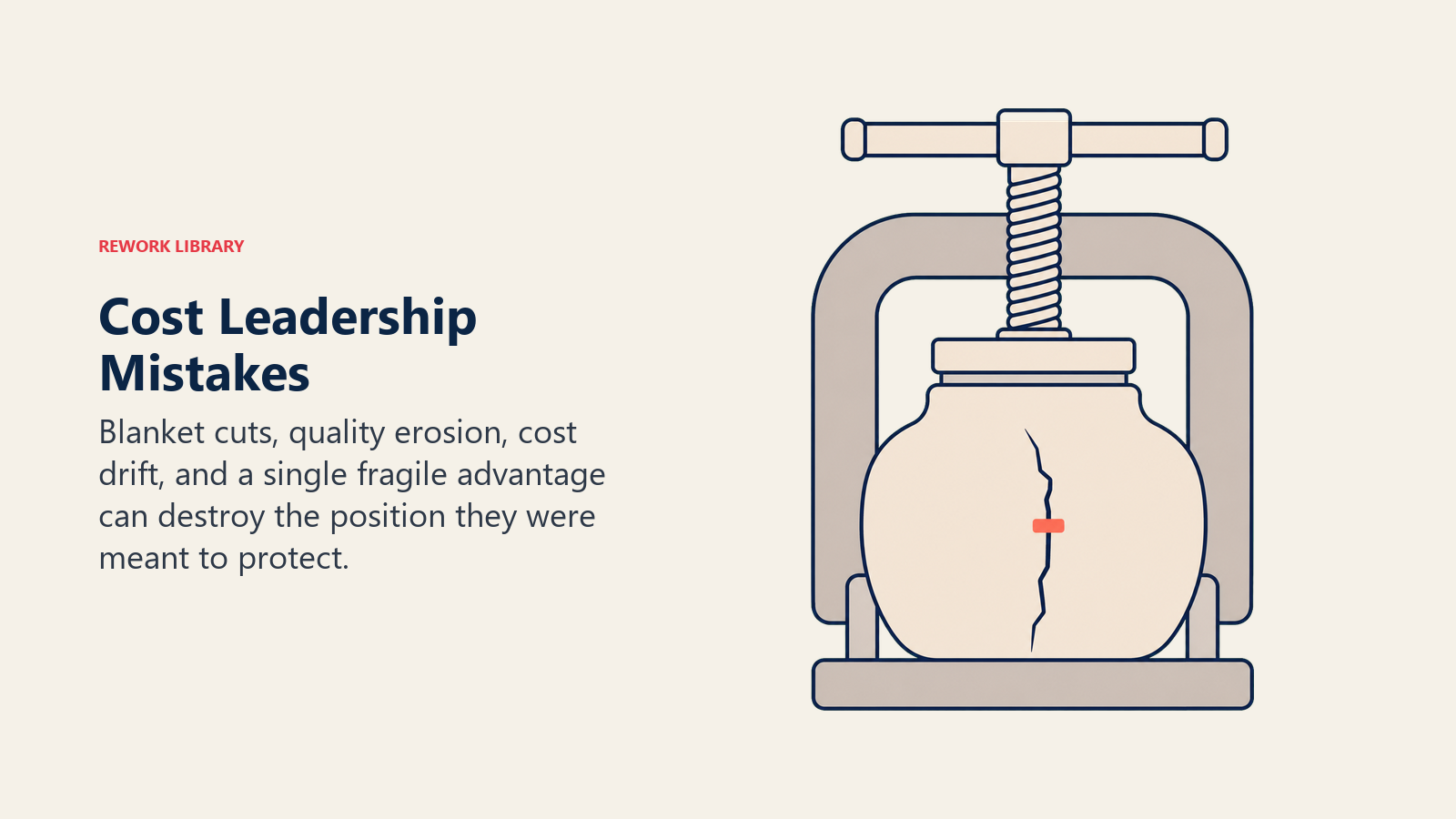
Ignorar os limites de qualidade aceitáveis pelos clientes. A vantagem de custo só funciona se o produto ou serviço permanece aceitável para o cliente-alvo. Quando a Southwest Airlines reduziu o conforto dos assentos abaixo do que os viajantes corporativos aceitariam, perdeu esse segmento. Mas manteve os viajantes de lazer sensíveis ao preço, que valorizavam tarifas baixas acima do espaço para as pernas. Saber exatamente onde está o piso de qualidade do seu cliente é essencial.
Permitir a deterioração do custo conforme a empresa cresce. Muitas empresas alcançam custos baixos no início por meio de operações enxutas, mas deixam os custos subir gradualmente à medida que contratam gestores, adicionam complexidade ao produto e constroem estruturas administrativas. Os líderes em custo desenvolvem processos e governança especificamente para evitar essa deterioração. ALDI e Ryanair são reconhecidamente vigilantes a esse respeito, mesmo quando estão crescendo rapidamente.
Confundir liderança em custo com estratégia de oceano azul. O pensamento de oceano azul identifica espaços de mercado não disputados redefinindo o valor. A liderança em custo é uma estratégia competitiva: você está no mesmo setor, disputando os mesmos clientes, apenas com uma vantagem estrutural de custo. As duas não são incompatíveis, mas abordam questões estratégicas diferentes.
Consideração final
A liderança em custo é uma das posições competitivas mais duradouras que uma empresa pode construir. Mas não é um estado passivo. Exige reinvestimento constante em eficiência, defesa implacável contra a deterioração do custo e uma visão clara de onde sua vantagem de custo real se situa em relação aos rivais. Empresas que a tratam como um destino, e não como uma disciplina, tendem a perdê-la. As que a incorporam ao modo de operar em todos os níveis tendem a mantê-la por muito tempo.
Leitura Recomendada
- Estratégias Genéricas de Porter: Custo, Diferenciação e Foco
- Estratégia de Diferenciação: Como Se Destacar e Cobrar Mais
- Vantagem Competitiva: Tipos e Como Construir
- As Cinco Forças de Porter: Analisando a Estrutura do Setor
- Análise da Cadeia de Valor: Encontrando Seus Fatores de Custo e Valor
- BCG Matrix: Gerenciando um Portfólio de Negócios
- Estratégia de Oceano Azul: Competindo Onde Não Há Concorrência

Senior Operations & Growth Strategist
On this page
- O que é uma estratégia de liderança em custo?
- Liderança em custo vs. diferenciação
- Como a liderança em custo cria vantagem
- Benefícios e riscos da liderança em custo
- Como construir uma estratégia de liderança em custo (passo a passo)
- Passo 1: Mapeie sua estrutura de custos atual
- Passo 2: Compare-se com os melhores concorrentes da categoria
- Passo 3: Identifique os fatores de custo e escolha dois ou três para atacar primeiro
- Passo 4: Alinhe a organização em torno da disciplina de custo
- Passo 5: Integre a vantagem de custo ao ciclo virtuoso de vantagem competitiva
- Exemplos de estratégia de liderança em custo
- Erros comuns na liderança em custo
- Consideração final
- Leitura Recomendada