Porter's Generic Strategies: Custo, Diferenciação, Foco
Turn this article into takeaways for your work.


Each assistant summarizes the article only for you and suggests best practices for your work.
As Porter's Generic Strategies oferecem aos executivos um framework claro para escolher como competir, não apenas onde competir. Michael Porter apresentou o modelo em seu livro de 1985 Competitive Advantage, e ele continua sendo o framework mais ensinado e aplicado na estratégia corporativa.
A ideia central é simples: para superar os concorrentes de forma sustentável, uma empresa precisa fazer uma escolha deliberada sobre o tipo de vantagem competitiva que deseja criar e o escopo de mercado que pretende atender. Empresas que evitam essa escolha não ficam no meio do caminho. Elas ficam presas lá, superadas por concorrentes mais focados.
O que são as Porter's Generic Strategies?
As Porter's Generic Strategies são três abordagens fundamentais que uma empresa pode usar para alcançar vantagem competitiva sustentável: liderança em custo, diferenciação e foco. Porter as apresentou em Competitive Advantage (1985, Harvard Business School Press) como resposta à confusão gerada pela tentativa de ser "tudo para todos".
O framework funciona em duas dimensões:
- Vantagem competitiva (eixo horizontal): Você vence oferecendo o menor custo ou oferecendo algo genuinamente diferente pelo qual os compradores pagarão mais?
- Escopo competitivo (eixo vertical): Você atende um mercado amplo ou um segmento de clientes específico?
O cruzamento dessas duas dimensões produz uma matriz 2x2 com quatro posições distintas. Porter agrupou as duas células de foco como uma única estratégia (Foco), dando ao framework o nome de "três estratégias", embora os profissionais frequentemente se refiram a todas as quatro células ao trabalhar decisões específicas.
A palavra-chave em cada definição é escolha. As estratégias são mutuamente exclusivas por design. Perseguir mais de uma ao mesmo tempo quase sempre corrói a coerência interna que faz cada uma funcionar.
Fatos-chave: Porter's Generic Strategies
- Porter publicou o framework pela primeira vez em Competitive Advantage (Free Press, 1985), com base em trabalho anterior em Competitive Strategy (1980), que introduziu o modelo das Five Forces.
- Pesquisa publicada no Strategic Management Journal (1988, Kim e Lim) constatou que empresas com uma posição estratégica clara superaram consistentemente aquelas sem uma posição definida em múltiplos setores.
- A Prática de Estratégia da McKinsey citou repetidamente a clareza estratégica como um dos três principais preditores de retornos totais acima da média para os acionistas ao longo de um horizonte de dez anos (McKinsey Quarterly, vários anos).
- Na visão de Porter: "A essência da estratégia é escolher o que NÃO fazer."
As três (ou quatro) estratégias genéricas
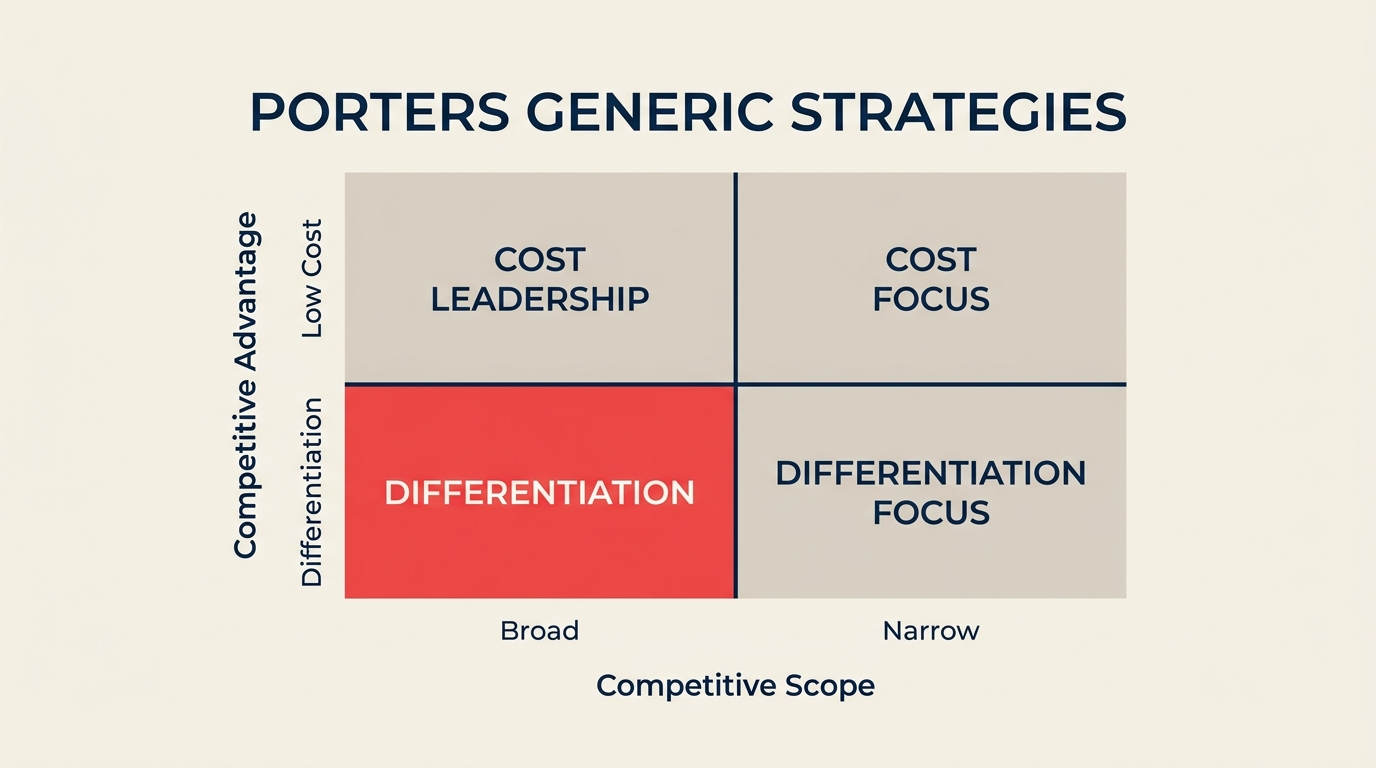
A visão completa da matriz 2x2 torna a lógica mais fácil de aplicar. Cada quadrante representa uma posição estratégica diferente.
| Escopo Competitivo | Vantagem de Baixo Custo | Vantagem por Diferenciação |
|---|---|---|
| Mercado amplo | Liderança em Custo | Diferenciação |
| Mercado restrito | Foco em Custo | Foco em Diferenciação |
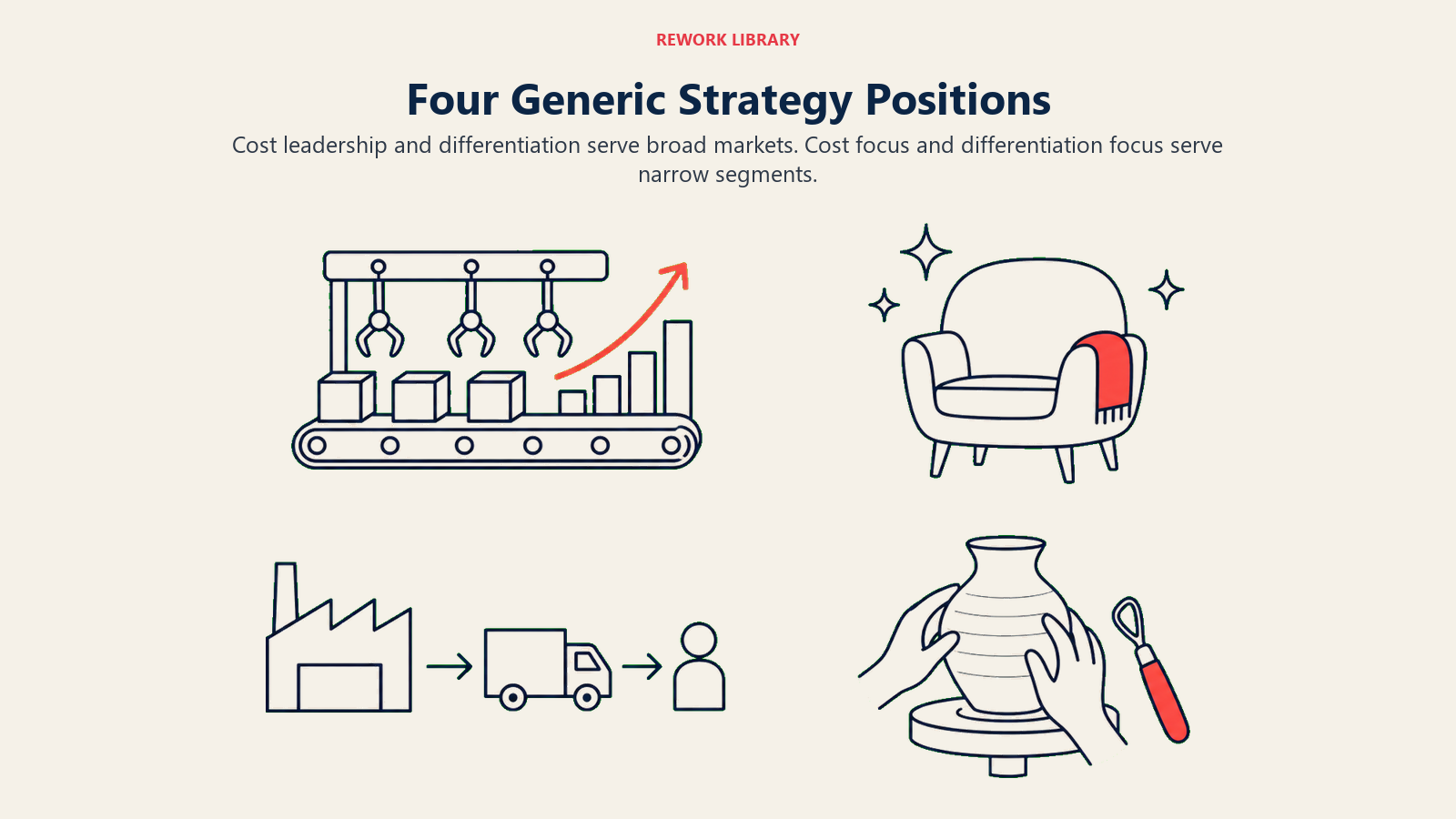
Liderança em Custo (amplo + baixo custo) A empresa atende todo o mercado e vence produzindo com o menor custo do setor. Não precisa ser o vendedor mais barato: pode cobrar preços médios e obter margens maiores, ou pode praticar preços abaixo dos concorrentes para ganhar participação de mercado. Economias de escala, processos proprietários, controle rigoroso da cadeia de suprimentos e operações enxutas são fontes típicas. Pense em Walmart, IKEA e Ryanair.
Diferenciação (amplo + único) A empresa atende todo o mercado e vence oferecendo algo que os compradores valorizam genuinamente e que os concorrentes não conseguem copiar facilmente: reputação de marca, design, tecnologia, qualidade de serviço ou efeitos de rede. Os compradores pagam um prêmio porque a oferta atende melhor às suas necessidades. Apple, Salesforce e Mercedes-Benz são exemplos canônicos. A estratégia de diferenciação é explorada em profundidade em seu próprio guia.
Foco em Custo (restrito + baixo custo) A empresa atende um segmento de clientes, uma região geográfica ou um grupo de clientes específico com custos menores do que os generalistas conseguem. O escopo restrito permite especialização operacional precisa. A Spirit Airlines (viajantes de baixo orçamento em rotas curtas) ou redes regionais de supermercados com desconto frequentemente ocupam essa célula.
Foco em Diferenciação (restrito + único) A empresa atende um segmento específico e o serve melhor do que qualquer outra, geralmente com preço premium. Marcas de moda de luxo (Hermès para compradores de altíssimo poder aquisitivo), fornecedores especializados de software (plataformas de negociação para hedge funds quantitativos) e fornecedores industriais de nicho frequentemente competem aqui.
Liderança em Custo e Foco em Diferenciação são o par mais frequentemente confundido. A questão é sempre o escopo: o "foco" atende uma necessidade fundamentalmente diferente do mercado de massa, ou apenas uma fatia menor do mesmo mercado? Se for a segunda opção, trata-se de uma forma restrita da estratégia ampla, não de uma verdadeira posição de foco.
Para uma análise mais detalhada do lado de custos da matriz, veja o guia de estratégia de liderança em custo.
Benefícios de escolher uma estratégia genérica
Comprometer-se com uma posição cria alinhamento interno que estratégias vagas não conseguem. Alguns benefícios concretos:
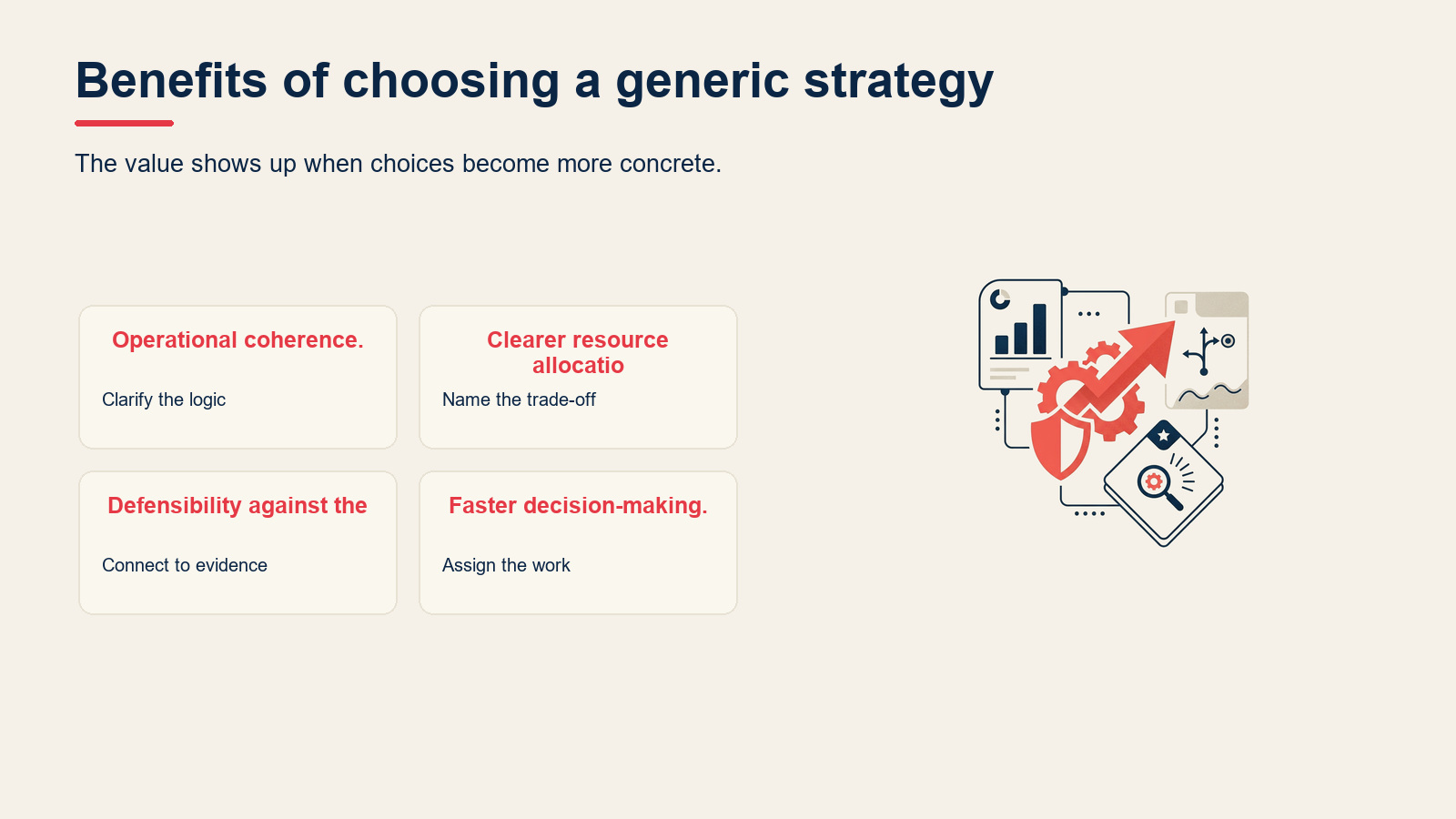
Coerência operacional. Quando toda a organização sabe que está competindo em custo, cada decisão de investimento, escolha de contratação e redesenho de processo passa pelo mesmo filtro. Não há ambiguidade sobre as compensações.
Alocação de recursos mais clara. A cadeia de valor é configurada para um único propósito. Um líder em custo investe de forma diferente em logística, tecnologia e RH do que um diferenciador que atende a mesma categoria. Clareza significa menos ciclos desperdiçados.
Defensabilidade contra as Five Forces. Cada posição cria um tipo diferente de proteção. Um líder em custo pode sobreviver a uma guerra de preços que destruiria os concorrentes. Um diferenciador consegue absorver aumentos de custos de fornecedores mais facilmente porque os compradores não compram primariamente por preço. Um focador pode construir relacionamentos profundos em seu nicho que os generalistas não conseguem replicar sem reestruturar todo o negócio.
Tomada de decisão mais rápida. Quando a posição estratégica é clara, os gestores de nível médio conseguem tomar decisões autônomas sem precisar escalar tudo. Essa agilidade se acumula ao longo do tempo e se transforma em velocidade organizacional.
Preso no meio-termo: o risco central
O alerta mais citado de Porter trata do que acontece quando uma empresa não faz uma escolha. Ele chamou isso de estar "stuck in the middle" (preso no meio-termo).
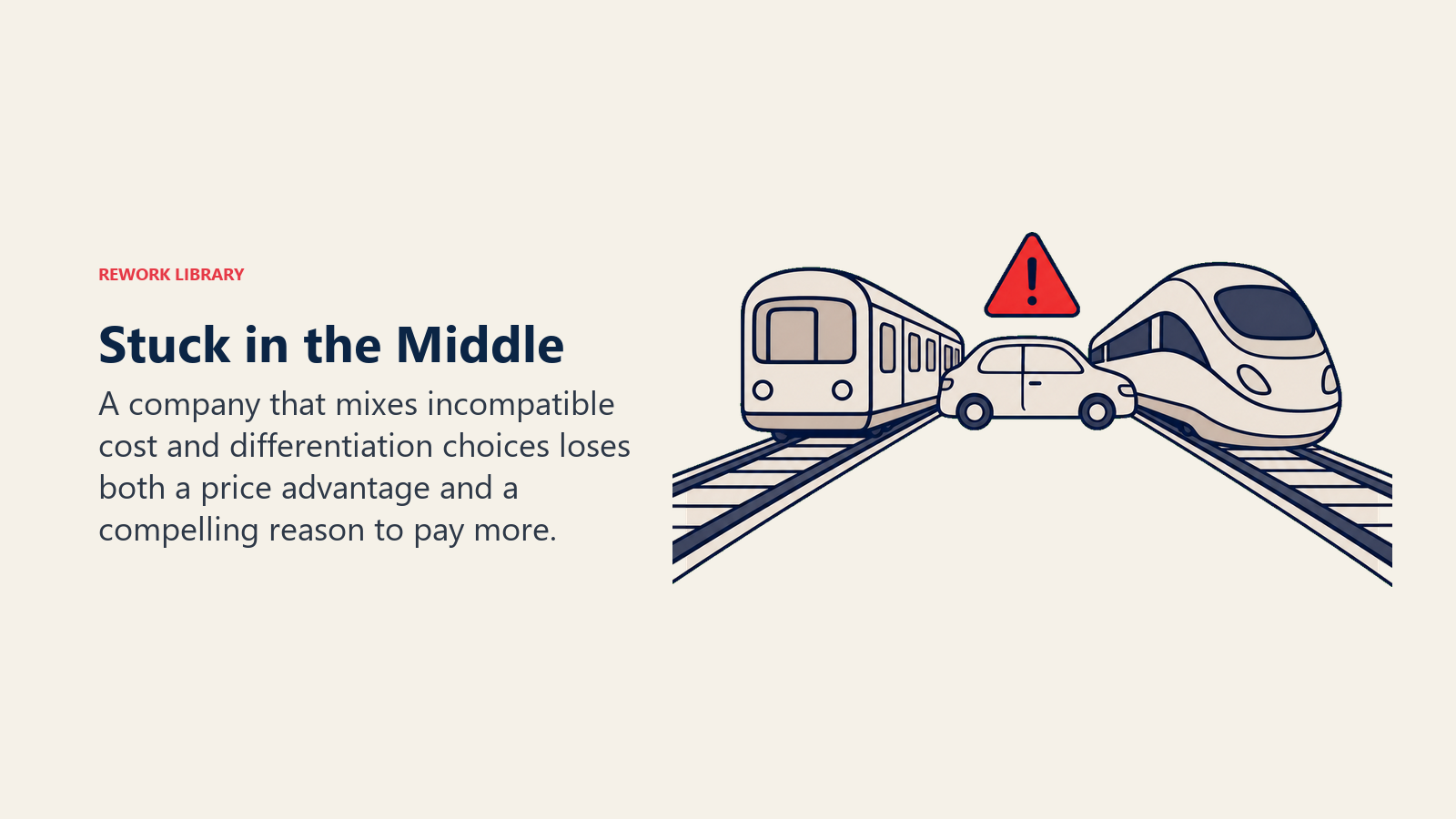
Uma empresa presa no meio-termo tenta agradar a todos e acaba não sendo distintivamente boa em nada. Cobra preços altos demais para vencer um líder em custo nas transações em que o preço é o fator decisivo, mas não investe o suficiente em diferenciação para justificar esses preços para os compradores dispostos a pagar mais. Fica espremida dos dois lados.
Como o "meio-termo" se manifesta na prática? Alguns padrões:
- Um banco regional que tenta competir com redes nacionais em taxa de juros enquanto promete consultoria premium, mas não consegue financiar totalmente nenhum dos dois.
- Uma empresa de software que continua dando descontos para fechar negócios enquanto também se posiciona como plataforma premium de nível enterprise. As equipes de vendas passam mais tempo se desculpando pelo preço do que explicando o valor.
- Um fabricante que usa iniciativas de redução de custos para financiar um reposicionamento de marca, mas não consegue sustentar nem a posição de custo nem a promessa de marca.
A armadilha geralmente não é uma decisão única. É uma série de pequenas concessões, cada uma parecendo razoável isoladamente, que coletivamente esvaziam uma posição estratégica clara. A análise SWOT pode revelar quando essa erosão está acontecendo, mas somente se a liderança for honesta sobre o que a organização realmente faz bem versus o que aspira fazer.
Como escolher uma estratégia genérica (passo a passo)
Escolher uma estratégia não é uma sessão de brainstorming. É um processo analítico que requer dados honestos sobre seu setor e sua própria organização.
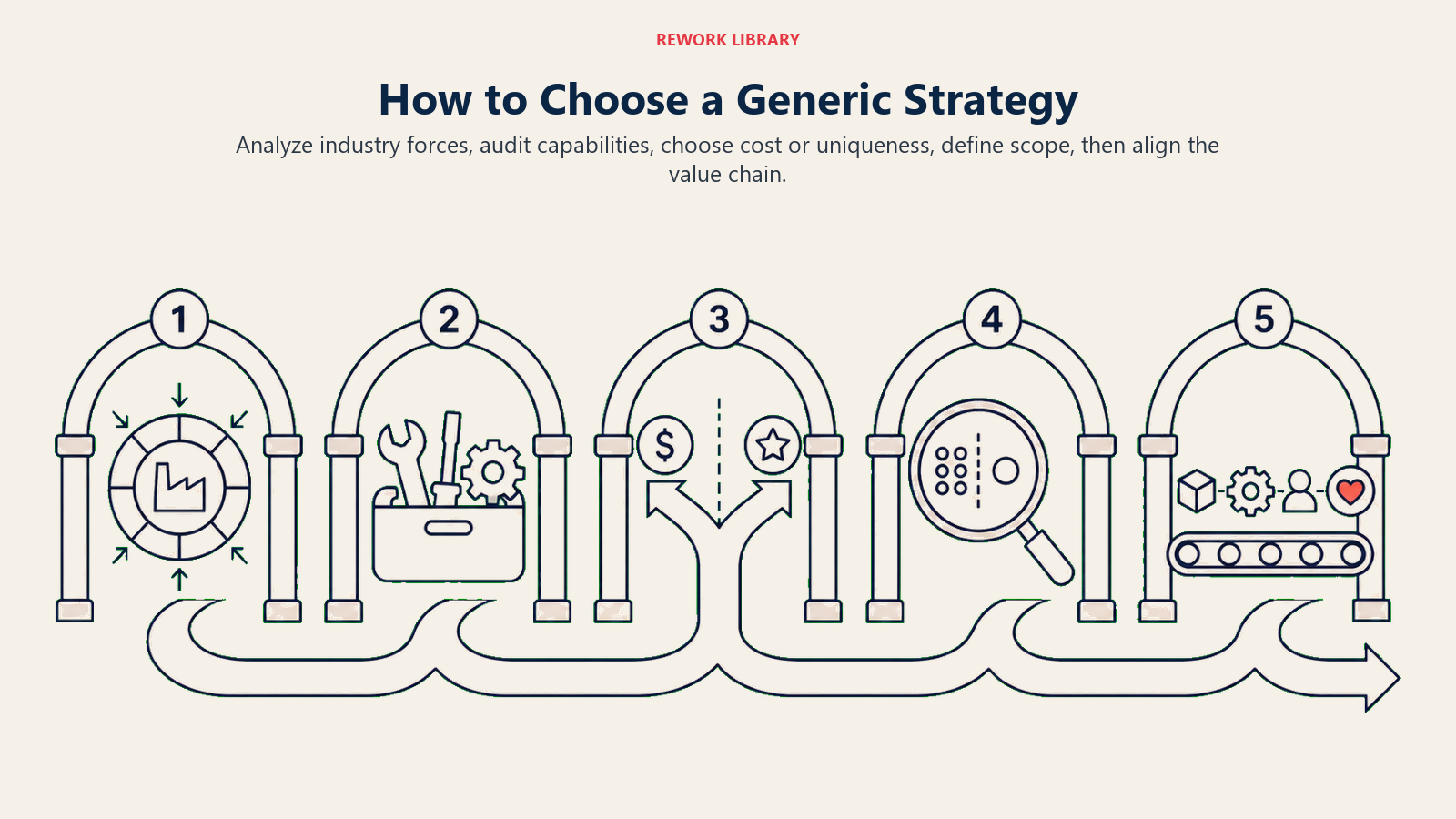
Passo 1: Mapeie as forças competitivas do seu setor
Comece com as Porter's Five Forces. Entenda de onde vem a pressão real sobre a rentabilidade: poder dos compradores, poder dos fornecedores, ameaça de novos entrantes, ameaça de substitutos e rivalidade competitiva. Setores com alto poder dos compradores (e, portanto, sensibilidade a preços) recompensam os líderes em custo. Setores com segmentos de compradores fragmentados e que buscam produtos premium recompensam os diferenciadores.
Passo 2: Faça um diagnóstico das suas capacidades atuais
Realize uma avaliação pelo framework VRIO e uma revisão de competências centrais. O que sua organização realmente faz melhor do que os concorrentes? Se você tem vantagens de escala, relacionamentos com fornecedores e eficiência de processos que os concorrentes não conseguem replicar, a liderança em custo é uma escolha natural. Se você tem propriedade intelectual, talentos de design, brand equity ou relacionamentos com clientes que geram fidelidade, a diferenciação é sua alavanca.
Passo 3: Defina seu tipo de vantagem
Com base nos Passos 1 e 2, escolha se você está competindo principalmente em custo ou em singularidade. Não hesite. Se a resposta honesta for "depende do negócio", isso é um sinal de que você já está derivando para o meio-termo.
Passo 4: Defina seu escopo competitivo
Seu mercado natural é todo o setor ou um segmento específico onde suas capacidades criam uma vantagem particularmente forte? Escopo restrito (Foco) é válido, mas requer uma razão estrutural genuína pela qual os generalistas não conseguem atender esse segmento tão bem quanto você.
Passo 5: Alinhe a cadeia de valor à posição escolhida
É aqui que a estratégia se torna operacional. Cada atividade na sua análise da cadeia de valor deve reforçar a posição escolhida. Um líder em custo precisa de compras, logística e operações otimizadas continuamente. Um diferenciador precisa de P&D, marketing, sucesso do cliente e contratações premium. Atividades desalinhadas criam arrasto de custos e confundem os clientes.
Use o pensamento da Ansoff Matrix para testar se os movimentos de crescimento planejados permanecem dentro da posição estratégica escolhida ou derivam para fora dela.
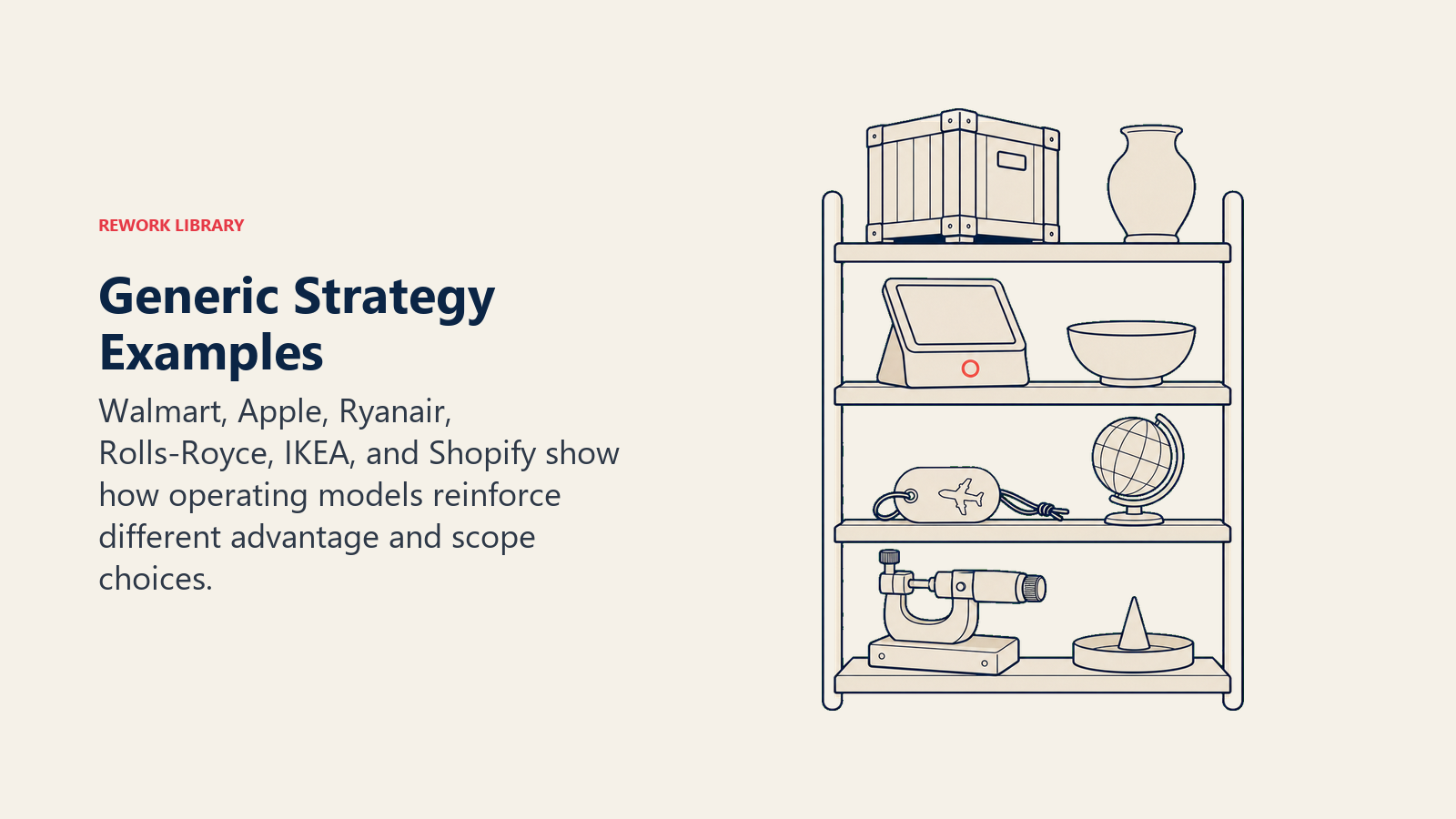
Exemplos das Porter's Generic Strategies
Empresas reais mostram como cada posição se manifesta em diferentes setores.
| Empresa | Estratégia | Como executam |
|---|---|---|
| Walmart | Liderança em Custo | Preços baixos todos os dias, escala da cadeia de suprimentos, logística hub-and-spoke, relacionamentos diretos com fornecedores |
| Apple | Diferenciação | Ecossistema premium (hardware + software + serviços), identidade de marca, integração de design |
| Ryanair | Foco em Custo | Rotas europeias de curta distância, serviço sem frescuras, operações ponto a ponto, frota altamente padronizada |
| Rolls-Royce (automóveis) | Foco em Diferenciação | Compradores ultraprêmium, fabricação sob medida, serviço de alto nível, baixo volume por design |
| IKEA | Liderança em Custo | Fabricação flat-pack, sourcing global, montagem pelo cliente, alto volume por SKU |
| Shopify | Foco em Diferenciação | PMEs e empresas de médio porte (não enterprise), ecossistema de desenvolvedores, facilidade de uso acima da profundidade bruta de funcionalidades |
Dois padrões se destacam nesta tabela. Primeiro, cada empresa tem uma resposta clara para as duas dimensões: tipo de vantagem e escopo. Segundo, as empresas que sustentaram sua posição por mais tempo são aquelas que construíram todo o modelo operacional em torno dela, não apenas seus preços ou branding.
Compare isso com empresas como Sears ou BlackBerry, que mantiveram posições sólidas por anos e depois as perderam. Em ambos os casos, a erosão começou com desvio estratégico: perseguindo novos segmentos sem abandonar as estruturas de custo antigas, ou adicionando funcionalidades para se defender de concorrentes diferenciados sem se comprometer com uma diferenciação genuína.
Boas práticas e erros comuns
Faça: torne as compensações explícitas. Cada "sim" em uma estratégia requer um "não" em algum lugar. Se sua equipe de liderança não consegue articular o que não vai fazer, a estratégia ainda não é real.
Faça: revisite sua posição quando a estrutura do setor mudar. Use uma revisão da BCG matrix ou uma análise PESTEL anualmente para verificar se as condições externas que justificaram sua posição ainda se mantêm. A disrupção digital tem alterado as estruturas de custo rápido o suficiente para deixar diferenciadores encalhados que não se adaptaram.
Não confunda preço com posição de custo. Liderança em custo diz respeito à sua estrutura de custos interna, não aos preços que você cobra. Uma empresa pode ter custos baixos e ainda cobrar preços de mercado para obter margens maiores. Reduzir preços sem uma vantagem de custo genuína apenas destrói margem.
Não deixe as equipes de produto adicionar funcionalidades que o afastem do seu escopo. A forma mais comum de diferenciadores derivarem para o meio-termo é tentar atender compradores enterprise quando sua posição foi construída para PMEs, ou vice-versa.
Não use a estratégia genérica como um rótulo estático. Os setores evoluem. A resposta certa é executar o processo de cinco etapas periodicamente de novo, não defender o rótulo atual.
Leitura relacionada
- Vantagem Competitiva -- o conceito mais amplo que as estratégias de Porter visam criar
- Porter's Five Forces -- a análise do setor que alimenta o Passo 1 da seleção de estratégia
- Análise da Cadeia de Valor -- como alinhar as atividades à estratégia escolhida
- Estratégia de Liderança em Custo -- análise aprofundada da coluna esquerda da matriz
- Estratégia de Diferenciação -- análise aprofundada da coluna direita
- Análise SWOT -- ferramenta de diagnóstico interno para os Passos 2 e 3
- Ansoff Matrix -- teste os movimentos de crescimento em relação ao escopo estratégico
Em resumo: as Porter's Generic Strategies funcionam porque forçam uma escolha real. A maioria das falhas estratégicas não são falhas de execução; são falhas de comprometimento. Escolha uma posição, alinhe sua cadeia de valor a ela e defenda-a escolhendo consistentemente o que não fazer.

Senior Operations & Growth Strategist
On this page
- O que são as Porter's Generic Strategies?
- As três (ou quatro) estratégias genéricas
- Benefícios de escolher uma estratégia genérica
- Preso no meio-termo: o risco central
- Como escolher uma estratégia genérica (passo a passo)
- Passo 1: Mapeie as forças competitivas do seu setor
- Passo 2: Faça um diagnóstico das suas capacidades atuais
- Passo 3: Defina seu tipo de vantagem
- Passo 4: Defina seu escopo competitivo
- Passo 5: Alinhe a cadeia de valor à posição escolhida
- Exemplos das Porter's Generic Strategies
- Boas práticas e erros comuns
- Leitura relacionada