The Pod Model: When Dedicated AE + CSM Pairs Work (And When They Don't)
Turn this article into takeaways for your work.


Each assistant summarizes the article only for you and suggests best practices for your work.
The pod model gets championed by Sales leaders for an obvious reason: account executives (AEs) love continuity. They built the relationship, they understand the account, and they don't want a stranger showing up at the QBR and fumbling the context they spent six months developing. So they push for a dedicated customer success manager (CSM) partner. The pitch to CS leadership is easy: "your CSM gets the full pre-sales picture, handoffs are smoother, and both of us are accountable to the same book."
What CS leadership sometimes discovers six months later is that "accountability to the same book" means the CSM is fielding renewal reminders for the AE, getting pulled into pre-sales calls on accounts that haven't even closed yet, and managing a customer base that the AE shaped without much regard for what makes a successful long-term account. The pod model solves a coordination problem. It doesn't always solve the underlying incentive problem. Deploy it without understanding the difference, and you'll wonder why churn didn't budge.
This article gives CROs and VP CS a clear-eyed framework for when pods are the right structure, when they're not, and how to pilot them before committing org-wide.
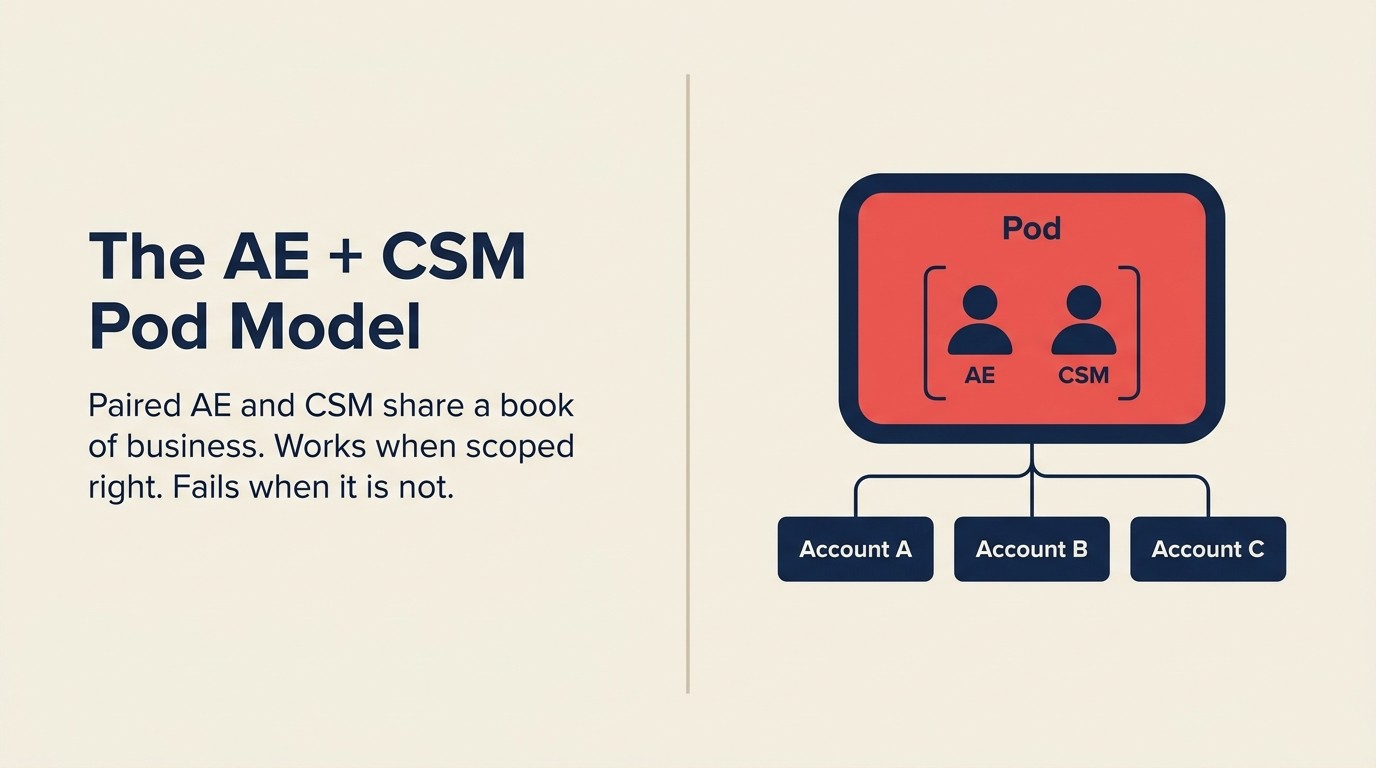
The AE+CSM Pod Model is a dedicated account pairing structure in which one Account Executive and one Customer Success Manager share a defined book of business, split ownership of the customer relationship across the sales and post-sale lifecycle, and are held jointly accountable (most often through a shared NRR target) for the revenue outcome of that book.
Quotable: "SaaS companies with poor Sales-to-CS handoffs experience first-year churn rates 2x higher than peers with structured handoff processes, according to Gainsight's State of Customer Success survey. That makes AE+CSM pod coordination one of the highest-ROI structural investments a mid-market CRO can make."
Quotable: "63% of CSMs report receiving insufficient information at handoff to successfully onboard a customer, per Totango research. The AE+CSM Pod Model is specifically designed to close that gap by keeping the CSM in the room before the contract is signed."
What a Pod Actually Is
A pod is a small, dedicated team assigned to a shared book of business. The classic pod is two people: one Account Executive responsible for new logo acquisition and expansion deals within the book, and one Customer Success Manager responsible for onboarding, adoption, and retention of existing customers in the same book.
The book can be structured two ways. Named accounts give each pod a specific list of companies. Both AE and CSM know exactly which logos they own. Territory-based books give pods a segment (a vertical, a region, or an ARR band) and they collectively own whatever accounts fall in that territory. Named account pods have cleaner accountability; territory pods are easier to rebalance as the book grows.
Three-person pod variants add a third role. The most common additions are a Solutions Engineer (SE) who covers technical pre-sales and early implementation support, or a Sales Development Rep (SDR) who sources new logos within the territory. SE-inclusive pods are most common in technically complex products where the CSM needs pre-sales coverage that neither the AE nor CSM can fully provide. SDR-inclusive pods make sense when the pod owns greenfield territory and has outbound capacity.
The unifying logic is shared context. Both people in the pod know the customer's history, their contractual terms, their stakeholder map, and the expansion opportunities in the account. In theory, the customer never has to re-explain themselves. For the broader taxonomy of how teams can be structured around accounts, see post-sale team structures.
Key Facts: The Coordination Cost of Handoff Failure
- Companies with poor Sales-to-CS handoffs report 2x higher first-year churn rates compared to peers with structured handoff processes, according to Gainsight's State of Customer Success survey.
- 63% of CSMs say they receive insufficient information at handoff to successfully onboard customers, per Totango research on CS team challenges.
- Aligned pod structures reduce time-to-first-value by an average of 23% in mid-market SaaS, but only where ACV justifies the 1:1 pairing ratio, per a Pacific Crest SaaS survey analysis.
Why Organizations Adopt the Pod Model
The business case for pods is built on three structural arguments.
Continuity of relationship. In a sequential model, the AE closes the deal, hands off to a CSM, and the customer starts over with a new face. Bain research on CS models finds that how a company positions its CSM team (retention-focused vs. growth-focused) determines how well this handoff actually serves the account. The CS rep has to rebuild trust, re-learn the account context, and often re-negotiate timelines the AE had informally promised. In a pod, the AE stays in the picture post-close, and the CSM was ideally introduced before the contract was signed. The customer feels less like they've been passed off. The closed-won to onboarded handoff process details what that transition should look like in practice.
Reduced information loss at handoff. The single most common failure point in the AE-to-CSM transition is incomplete context transfer. The AE forgets to mention the custom integration they promised, the CSM discovers three months in that the account was sold on a use case the product doesn't support, and the customer starts looking at competitors. Pods reduce this because the CSM was there for at least the late-stage calls. See what CS actually needs from Sales at handoff for the specific data points that prevent this failure.
Easier comp alignment. When both AE and CSM own the same book, you have a logical basis for shared metrics, NRR being the most common. McKinsey's Customer Success 2.0 research identifies shared revenue accountability between Sales and CS as the defining characteristic of growth-engine CS organizations. It's harder to tie AE pay to account retention when the AE doesn't know which CSM will be assigned post-close. Pod structure makes compensation aligned on NRR possible in a way that's difficult to implement with a pooled CS model.
When the Pod Model Works Well
Pods earn their place in four scenarios.
Mid-market and enterprise segments with high ACV. The economics only make sense when the value of the relationship justifies a dedicated pairing. If CSMs carry 50-80 accounts at $10K ARR each, you can't pair each CSM with a dedicated AE. The math doesn't work. But at $50K+ ACV with 20-30 accounts per CSM, the pairing makes economic sense and the coordination cost is worth it.
Complex products with long onboarding curves. When customers need 90+ days to realize value, early CSM involvement in the sales cycle is directly tied to retention. The CSM who attends the final two discovery calls will write a better success plan than the one who reads the CRM notes three weeks after contract signature. Pods enable this naturally.
Long sales cycles where CS can add pre-close credibility. Enterprise deals with 6-9 month sales cycles often stall because prospects want to know what "success" looks like 12 months in. A CSM on the call who can speak concretely to customer outcomes is more credible than an AE making forward-looking claims. Pods make that collaboration easy to operationalize.
Teams small enough for informal coordination. The practical reality is that pod coordination requires communication overhead. When teams are small (say, 4-6 AEs paired with 4-6 CSMs) that coordination happens naturally in shared Slack channels and brief weekly standups. The structure doesn't need to be formal because everyone knows everyone. This advantage disappears as the team grows. The alignment spectrum from SMB to enterprise covers how coordination needs shift as company scale changes.
The Scaling Challenges That Kill Pod Enthusiasm
Most CROs who love pods at 10 reps are ambivalent about them at 30. Here's why.
Ratio math breaks down. Pod models implicitly assume a 1:1 AE-to-CSM ratio. But AEs and CSMs have different capacity curves. AEs can run 20-30 active opportunities; CSMs often carry 30-60 accounts depending on complexity. As you hire more AEs to hit growth targets, you won't hire proportionally more CSMs. The economics push toward higher CSM ratios. Once you're at 1.5 or 2 AEs per CSM, the "dedicated pairing" concept is already fictional. You're running a hybrid model without calling it one.
Uneven book growth creates structural imbalance. Some pods' accounts expand aggressively. Others churn. After 12-18 months, Pod A is managing $4M ARR and overwhelmed, while Pod B is managing $800K ARR and has capacity. Rebalancing means reassigning accounts, and the AE who built those relationships will resist vigorously.
Scheduling dependency creates single points of failure. When the AE is on PTO and a customer escalates, who handles it? When the CSM is out for three weeks on leave and a renewal is due, what happens? Pod models that don't build coverage plans into their design create single points of failure at exactly the moments when customer retention is most at risk.
Promotion asymmetry breaks pods permanently. AEs get promoted to Senior AE or move to a different segment. CSMs get promoted to Lead CSM or move into management. Promotions almost never happen simultaneously for both members of a pod. When either person transitions, the pod either breaks or becomes a loose organizational fiction where two people who barely coordinate still share a book title.
Quotable: "The AE+CSM Pod Model degrades when the AE-to-CSM ratio exceeds 1.5:1, a threshold most fast-growing SaaS companies breach within 12-18 months of launching pods. At that point, the 'dedicated pairing' is a structural label applied to what is operationally a hybrid pooled model."
Rework Analysis: Based on industry benchmarks, AE+CSM pod structures deliver their strongest retention and time-to-value improvements when three conditions align: ACV above $30K, CSM account loads under 35, and a 12-month trailing AE-to-CSM ratio no worse than 1.2:1. Companies that launch pods without validating all three conditions typically see pod performance degrade within two quarters. Not because the model is wrong, but because the economics were never sound enough to support it. The pilot criteria in the section below are designed to surface that misalignment before it becomes a sunk org-design cost.
Anti-Patterns That Undermine Pod Models
Even well-designed pods drift into dysfunction. Watch for these patterns.
CS becomes AE's admin. The most corrosive pod failure mode: the CSM starts handling renewal reminders, scheduling follow-ups, and fielding customer inquiries that the AE used to handle personally. Not because it's in their role, but because it's easier to ask than to wait. The CSM's adoption and health score work gets crowded out by AE coordination tasks.
AE bypasses CSM on expansion. When an AE sees an upsell opportunity, they often move faster without looping in the CSM ("it's quicker"). The CSM finds out when the expansion contract is already signed. The customer, who trusts the CSM, is confused about why the person who knows their account wasn't part of the conversation. This pattern erodes the entire value of the shared book.
The pod becomes a blame unit. When an account churns or a renewal comes in below target, pod models create a convenient blame game. "The AE sold them on the wrong use case." "The CSM never built exec relationships." The pod structure, meant to create shared accountability, instead creates a structured adversarial relationship between two people who have the same bad outcome but different explanations for it. But blame patterns are a symptom, not the root cause. The next question is whether a different model would serve the same accounts better.
When to Use a Different Model
Pods aren't the only answer. The account team models article covers the full comparison, but briefly:
Pool model works when accounts are relatively uniform, CSM capacity is the constraint, and the relationship value doesn't justify dedicated pairing. CSMs are assigned to accounts based on availability, not partnership. Works well in SMB and lower mid-market.
Swarm model works when accounts need variable levels of support at different lifecycle stages. A dedicated CSM handles day-to-day, but can pull in technical specialists, AEs, or execs for specific moments (QBRs, expansion conversations, escalations). Works well in enterprise.
Hybrid is the default for multi-segment companies: pods for enterprise, pool for SMB, swarm elements for the most strategic accounts. Knowing which model fits which segment is the design work. Then comes the harder question: how do you run a pilot without betting the whole org on it?
How to Pilot Pods Before Committing Org-Wide
Don't launch pods across all segments simultaneously. Pick the right test conditions first.
Starting criteria:
- Segment: mid-market or enterprise only (minimum $30K ACV)
- AE-to-CSM ratio: 1:1 or no worse than 1.2:1 for the pilot group
- CSM account load: under 35 accounts per CSM in the pilot cohort
- Minimum pilot size: 3-4 pods (too small and you can't separate pod effects from individual rep effects)
Success metrics to track in the first 90 days:
- Handoff quality score (CSM-rated, post-close survey)
- Time-to-first-value vs. non-pod baseline
- AE attendance rate on CSM calls (are they actually collaborating or just nominally paired?)
- CSM time allocation: what percentage is going to pre-sales vs. post-sales work?
- Renewal forecast accuracy at 120 days out
If handoff quality improves but AE time-on-pre-sales is climbing above 15%, the pod is already drifting into a swarm model without the explicit support structure to back it up.
CRO + VP CS Decision Checklist
Before launching a pod model, answer these five questions:
- Is the ACV high enough? At what ARR floor does dedicated pairing make economic sense for your CSM capacity model? (Most companies land between $25K-$50K.)
- Can you sustain 1:1 ratios through hiring cycles? If your AE hiring plan outpaces CSM hiring by more than 20%, pods will degrade within 12 months.
- Do you have a coverage plan for out-of-office scenarios? If two people out of a pod of two equals zero coverage, you need a backup model documented before launch.
- Are your renewal ownership rules written down? Pods without explicit renewal ownership rules default to AE control, which defeats the alignment goal.
- Does your comp plan support the pod structure? If AEs and CSMs are measured on completely separate metrics with no shared accountability, the pod is a structural fiction. NRR-aligned compensation is what gives pods operational teeth.
What the Pod Model Solves (and What It Doesn't)
Here's the honest summary. The pod model solves a coordination problem: it reduces information loss at handoff, creates a natural basis for shared metrics, and keeps the AE relationship visible in the post-sale account. These are real benefits that compound over time when the pod is working.
But pods don't solve a comp problem. If AEs are incentivized purely on new ARR and CSMs are evaluated on NPS scores, pairing them on a shared book of business won't make them pull in the same direction. The coordination is there; the incentive to use it isn't.
And pods don't solve a culture problem. If Sales leaders view CS as a renewals team and CS leaders view Sales as a churn factory, putting two people in a pod will surface that tension faster, not resolve it. The structural alignment exposes cultural misalignment. It doesn't substitute for it.
Deploy pods where the economics work, the ratio math supports it, and the comp plan reinforces the shared book. Pilot in one segment for one quarter. Measure the right things. And accept that most pod models evolve into hybrid structures within 18 months. That's not failure. That's what good pod design looks like at scale.
Frequently Asked Questions about The Pod Model
What is the AE+CSM Pod Model?
The AE+CSM Pod Model is a revenue team structure in which one Account Executive and one Customer Success Manager share a defined book of business. Both roles know the same accounts, attend key customer calls together, and are held jointly accountable (typically through a shared NRR or expansion target) for the revenue outcome of their shared book. The model is designed to eliminate the information and incentive gaps that cause high first-year churn in sequential handoff models.
When does the pod model work best?
The pod model works best in mid-market and enterprise segments where ACV is above $25K-$30K, CSM account loads are under 35 accounts, and the product has a long onboarding curve (90+ days) that benefits from pre-close CSM involvement. It also works well in companies small enough (under 8-10 pods) for coordination to happen naturally without dedicated ops overhead. Below those ACV thresholds, the economics of 1:1 pairing don't hold.
What is the right AE-to-CSM ratio in a pod model?
The sustainable ratio is 1:1 for enterprise segments and no worse than 1.2:1 for mid-market. Once you exceed 1.5:1, the "dedicated pairing" becomes a label applied to what is operationally a pooled CSM model. The ratio should be set before the pod launches and validated against the AE hiring plan for the next 12 months. If the AE headcount plan outpaces CSM hiring by more than 20%, pods will degrade on their own without any structural change.
How do you scale pod models as the team grows?
Most pod models evolve into hybrid structures within 18 months of launch. Enterprise accounts stay in dedicated pods. Mid-market moves to named CSMs with higher account loads (1.5:1 ratios). SMB drops to a pooled coverage model. The practical approach is to design the pod for the enterprise segment from the start, build in ratio review gates at 6-month intervals, and accept that the pod label will cover a range of actual pairing intensities as the team scales.
What happens when the AE and CSM are a mismatch in a pod?
Mismatch in seniority, work style, or relationship approach is the most common reason individual pods underperform the average. The fix is not to break the pod structure; it's to establish explicit collaboration norms (weekly sync, shared account notes, CSM attendance criteria for sales calls) that reduce the dependence on personal chemistry. Where mismatch is severe, reassignment is faster than coaching. The pod model requires coordination overhead; don't let a bad pairing prove the model wrong when the pairing is the real problem.
Should the CSM attend pre-sales calls in a pod?
CSMs should attend the final 1-2 discovery calls and the demo for accounts that are likely to close, but shouldn't be pulled into early prospecting or pipeline qualification. The specific trigger is deal stage: when a prospect enters late-stage (final evaluation or shortlist), CSM involvement should be the norm. Earlier than that, CSM time is better spent on existing accounts. If CSMs are attending pre-sales calls on more than 25% of their capacity, the pod is drifting from a post-sale model into a swarm model, and the structure needs a name that matches what it's actually doing.
How do you handle renewal ownership in a pod model?
Renewal ownership should be written down before the pod launches, not resolved at the 90-day renewal window. The most functional rule: CSM owns the renewal process (relationship, health score, risk assessment, renewal meeting), AE owns the commercial close (pricing negotiation, contract execution). If the renewal requires meaningful expansion or restructuring, it becomes a joint process with explicit attribution rules for comp. The biggest pod failure mode is leaving renewal ownership ambiguous and having both people assume the other is handling it until 60 days before the date.
Learn More

Principal Solution Architect
On this page
- What a Pod Actually Is
- Why Organizations Adopt the Pod Model
- When the Pod Model Works Well
- The Scaling Challenges That Kill Pod Enthusiasm
- Anti-Patterns That Undermine Pod Models
- When to Use a Different Model
- How to Pilot Pods Before Committing Org-Wide
- CRO + VP CS Decision Checklist
- What the Pod Model Solves (and What It Doesn't)
- Learn More