What is Working Capital? The Hidden Cash That's Trapped in Your Business
Turn this article into takeaways for your work.


Each assistant summarizes the article only for you and suggests best practices for your work.
Two companies. Same revenue. Same profit. One thrives, one dies. The difference? Working capital.
I've seen profitable companies go bankrupt because they couldn't pay next week's bills. Here's how to make sure that never happens to you.
Working Capital: Your Business's Breathing Room
Working Capital = Current Assets - Current Liabilities
Or in human terms: Money you can access quickly minus bills you must pay soon.
Think of it as your financial flexibility:
- Positive working capital = You can pay your bills
- Negative working capital = You're borrowing to survive
- Zero working capital = Walking a tightrope
But here's the twist, too much working capital is also bad. It's lazy money that could be growing your business.
The Working Capital Cycle Explained
Money flows through your business in a predictable pattern:
- Cash → Buy inventory
- Inventory → Make sales
- Sales → Create receivables
- Receivables → Collect cash
- Repeat
The speed of this cycle determines everything:
- Fast cycle = Less working capital needed
- Slow cycle = Cash tied up for months
- Broken cycle = Business failure
Most CEOs focus on sales. Smart CEOs focus on cycle speed.
Calculate Your Cash Conversion Cycle
Here's the formula that matters:
Cash Conversion Cycle = DIO + DSO - DPO
Where:
- DIO (Days Inventory Outstanding) = How long inventory sits
- DSO (Days Sales Outstanding) = How long to collect payment
- DPO (Days Payables Outstanding) = How long you take to pay
Example:
- Inventory sits 30 days (DIO)
- Customers pay in 45 days (DSO)
- You pay suppliers in 40 days (DPO)
- Cash cycle = 30 + 45 - 40 = 35 days
You need 35 days of cash to run the business. Improve any component, need less cash.
Industry Benchmarks (2026)
Retail
- Working capital ratio: 1.2-1.5
- Cash conversion: 15-45 days
- Best practice: Under 30 days
Manufacturing
- Working capital ratio: 1.5-2.0
- Cash conversion: 60-90 days
- Best practice: Under 75 days
SaaS/Services
- Working capital ratio: 0.8-1.2
- Cash conversion: -30 to 30 days
- Best practice: Negative (collect before paying)
E-commerce
- Working capital ratio: 1.0-1.3
- Cash conversion: 20-50 days
- Best practice: Under 35 days
The Amazon Working Capital Magic
Amazon's working capital is negative. They've turned conventional wisdom upside down:
- Customer pays: Day 0
- Amazon pays supplier: Day 60-90
- Result: Suppliers finance growth
On $500 billion revenue with 60-day payment terms, that's $82 billion in free financing. No bank required.
Your opportunity: Even improving payment terms by 15 days can transform your cash position.
Working Capital Optimization Playbook
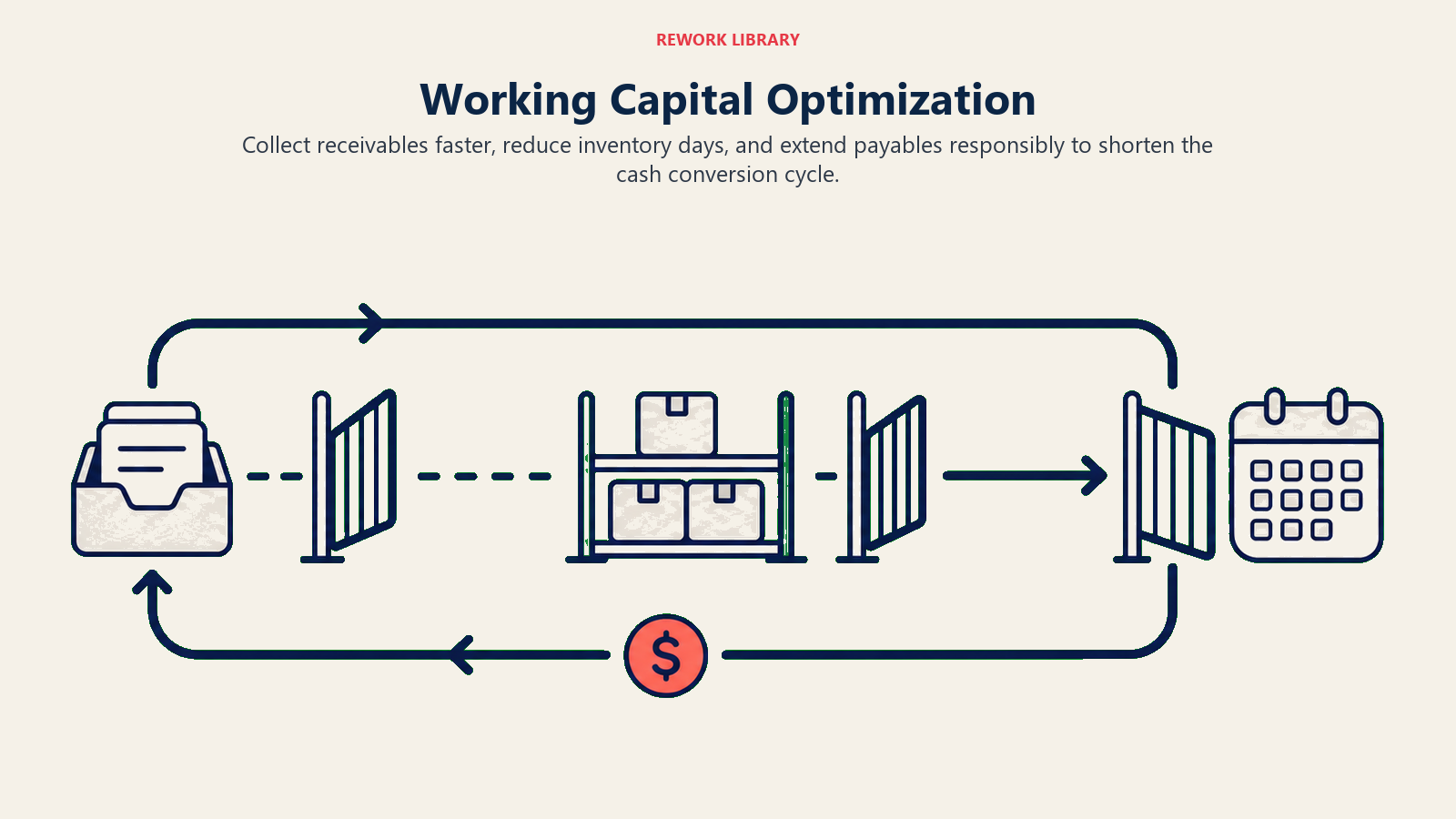
The playbook shortens the cash conversion cycle by coordinating collections, inventory, and supplier payment timing.
1. Accelerate Collections (Reduce DSO)
Immediate Actions:
- Invoice same day as delivery
- Offer 2/10 net 30 discounts
- Accept credit cards (yes, despite fees)
- Automated payment reminders
Results: 20-40% reduction in DSO typical
2. Optimize Inventory (Reduce DIO)
Quick Wins:
- Just-in-time ordering
- Drop-ship when possible
- Clear slow-moving stock
- Improve demand forecasting
Results: 30-50% reduction in inventory days
3. Extend Payables (Increase DPO)
Ethical Approaches:
- Negotiate longer terms
- Use trade credit fully
- Consolidate suppliers
- Strategic payment timing
Results: 15-30 day extension common
4. The Combo Move
Implement all three together:
- Before: 35-day cycle
- After: 10-day cycle
- Impact: 70% less working capital needed
Red Flags in Your Working Capital
Warning Sign 1: Growing Revenue, Shrinking Capital
Sales up 50%, working capital down 20%. You're about to hit a wall.
Warning Sign 2: Stretching Payables
Paying suppliers later and later? They'll cut you off eventually.
Warning Sign 3: Ballooning Receivables
DSO increasing monthly? You're becoming a bank, not a business.
Warning Sign 4: Inventory Buildup
Inventory growing faster than sales? Cash graveyard forming.
Working Capital Financing Options
When optimization isn't enough:
Traditional Options
Bank Line of Credit
- Cost: 5-10% annually
- Pros: Flexible, renewable
- Cons: Covenants, personal guarantees
Invoice Factoring
- Cost: 1-5% per invoice
- Pros: Fast cash
- Cons: Expensive, customer relationships
Modern Options
Revenue-Based Financing
- Cost: 6-12% of revenue
- Pros: No dilution
- Cons: Reduces margins
Supply Chain Financing
- Cost: 3-6% annually
- Pros: Suppliers happy
- Cons: Complex setup
Merchant Cash Advance
- Cost: 20-50% annually
- Pros: Fast, easy
- Cons: Extremely expensive
Rule: Optimize first, finance second.
Technology Stack for Working Capital
For Tracking
- QuickBooks/Xero: Basic metrics
- Cashflow.io: Specialized working capital
- Anaplan: Advanced modeling
For Collections
- Bill.com: Automated invoicing
- Chaser: Payment reminders
- Stripe: Instant payments
For Payables
- BILL: Payment scheduling
- Tipalti: Global payments
- Plastiq: Pay with credit cards
For Inventory
- Cin7: Inventory optimization
- NetSuite: Full ERP
- Fishbowl: Manufacturing focus
Your Working Capital Improvement Plan
Week 1: Measure Reality
Calculate:
- Current working capital
- Cash conversion cycle
- Component metrics (DIO, DSO, DPO)
- Industry comparison
Month 1: Quick Wins
- Implement same-day invoicing
- Negotiate one supplier extension
- Clear old inventory
- Set up payment reminders
Quarter 1: Systematic Improvement
- Automate collections
- Restructure payment terms
- Implement inventory system
- Create cash flow forecast
Year 1: Transformation
- Achieve negative working capital
- Build strategic supplier relationships
- Perfect demand forecasting
- Create competitive advantage
The Psychology of Cash Management
Why CEOs fail at working capital:
Ego: "We don't chase payments" Reality: Pride doesn't pay bills
Fear: "Suppliers will be upset" Reality: Professional negotiation strengthens relationships
Complexity: "Too many moving parts" Reality: Simple changes drive big results
Growth obsession: "Revenue solves everything" Reality: Growth without working capital kills companies
Your Action Plan
Working capital isn't sexy. But neither is bankruptcy.
Today:
- Calculate your working capital
- Find your cash conversion cycle
- Compare to benchmarks above
This Week:
- List top 10 customers by receivables age
- List top 10 suppliers by payment terms
- Identify quick improvement areas
This Month:
- Implement one collection improvement
- Negotiate with three suppliers
- Clear 20% of old inventory
This Quarter:
- Reduce cycle by 30%
- Free up 20% of trapped cash
- Build sustainable processes
Remember: Every day you reduce your cash cycle adds money to your bank account. Every day you ignore it costs you.
Working capital is the difference between growing your business and just talking about it.
Master the cycle, master your destiny.
Ready to dive deeper? Explore Cash Flow Management for daily tactics or Financial Planning for long-term strategy.
Part of the [Business Terms Collection]. Last updated: 2026-07-21
On this page
- Working Capital: Your Business's Breathing Room
- The Working Capital Cycle Explained
- Calculate Your Cash Conversion Cycle
- Industry Benchmarks (2026)
- The Amazon Working Capital Magic
- Working Capital Optimization Playbook
- 1. Accelerate Collections (Reduce DSO)
- 2. Optimize Inventory (Reduce DIO)
- 3. Extend Payables (Increase DPO)
- 4. The Combo Move
- Red Flags in Your Working Capital
- Warning Sign 1: Growing Revenue, Shrinking Capital
- Warning Sign 2: Stretching Payables
- Warning Sign 3: Ballooning Receivables
- Warning Sign 4: Inventory Buildup
- Working Capital Financing Options
- Traditional Options
- Modern Options
- Technology Stack for Working Capital
- For Tracking
- For Collections
- For Payables
- For Inventory
- Your Working Capital Improvement Plan
- Week 1: Measure Reality
- Month 1: Quick Wins
- Quarter 1: Systematic Improvement
- Year 1: Transformation
- The Psychology of Cash Management
- Your Action Plan